Power Quality Improvement using Active
Filter Based Z-source DVR
Geena Sharma
1, Bhupinder Singh
2Assistant Professor, Dept. of EE, BUEST, Baddi (Himachal Pradesh), India1 PG Student, Dept. of EE, BUEST, Baddi (Himachal Pradesh), India2
ABSTRACT: Now a day’s Active power filters are become emerging devices, which can mitigate harmonic pollution effectively. Normally, the shunt Active power filter is controlled such that it reduce the load current harmonics and supplies load reactive power to attain harmonic free source currents at unity power factor. Nevertheless, these control objectives cannot be achieved concurrently when the supply voltages and current are distorted and unbalanced (non-ideal). Hence, under such situation the shunt Active power filter should be controlled selectively to achieve a maximum possible PF without violating the current harmonics constraints recommended by the IEEEStd. 519. [1]
Most of the proposed control approaches for power quality improvements have been evaluate with regard to Performance and implementation. It has been seen that there has been a remarkable increase in interest of active Power filters and its control methods. Model of Active Power filter is implemented with Z-source inverter and fuzzy Logic controller. A battery is used as DC source and ultra-capacitor is used to increase the capacity of the battery.
Simulation is done in MATLAB further to verify the results. [4]
KEYWORDS: DVR, Active Filter, Z-Source Inverter, Fuzzy Logic controller, Ultra Capacitor.
I.INTRODUCTION
Power quality is defined as any disturbance occurred in voltage waveform, current waveform and frequency deviations that result in damage and failure of equipment which is connected in system. Power quality block diagram is shown in fig. 1. Power quality related problems in the power system are of most important a now days. Increased use of electronic devices, such as information technology devices, power electronics such as variable speed drives, Programmable logic controller, energy-efficient lightings, UPS, inverter, chopper, cyclo-converter, rectifier led to a complete change of electric loads nature.
These non-linear loads are simultaneously the major reason and the major effect of power quality distortions. Due to their non-linearity, all these non-linear loads cause disturbances in the current and voltage waveform. The increased sensitivity of the vast majority of processes industrial and residential led to increased Power Qualityproblems in every sector. [5]
II. HARMONICS DISTORTION
Harmonics is defined as current or voltage waveforms assume non-sinusoidal shape. The waveform corresponds to the sum of different sine-waves with different phaseandmagnitude, having frequencies that are multiples of power- system frequency.
Causes of Harmonics Distortion:
i. Electric machines working above the knee of the magnetization curve (magnetic saturation) ii. Welding machines ,Arc furnaces
iii. Rectifiers, Chopper, Inverter, iv. DC brushless motors.
v. All non-linear loads, such as power electronics devices including Adjustable speed derives,SMPS data processing equipment, high efficiency lighting.
Effects of Harmonic Distortion:
i. Increased the probability in occurrence of resonance.
ii. OverloadNeutral in 3-phase systems, overheating of equipmentandall cables. iii. Efficiency loss in electric machines.
iv. Electromagnetic interference with communication lines. v. Errors in measurement when using average reading meters.
Total Harmonic Distortion
Total Harmonics distortion (THD) is complex and often confusing concept to understand. However, when broken down into the basic definition of harmonics and waveform distortion, it becomes very easier to understand. Harmonics have frequency that is integral multiple of fundamental frequency. For example, given a 50Hz fundamental waveform, the 2nd, 3rd, 4th, and 5th, harmonics components will be at 100Hz, 150Hz, 200Hz and 250Hz respectively. This, harmonics distortion is the degree to which a waveform differ from its pure sinusoidal values as are sultofsummation of all these harmonic components. The ideal sine wave always has zero harmonic components. In that case, there is nothing to distort this perfect waveform.
Total harmonic distortion (THD), is addition of all harmonics components of the current or voltage waveform compare against the fundamental component of the voltage or current waveform:
The above formula shows the calculation fortotal harmonic distortion on a voltage signal. The final result is a %age comparing the harmonics components to the fundamental component of signal. The greater the percentage, the more distortion that is present on the main ssignals. [3]
PassiveFilters ActiveFilters
Passive filters comprise capacitance, inductance and resistance elements configured and tuned to control harmonics. Passive filters are designed either to shunt the harmonic currents off the line or block their flow by tuning the RLC elements to create resonance at a selected frequency. On the other hand,active filters are designed to inject harmonic currents to counterbalance existing harmonic components as they show up in the distribution system.
III. DYNAMIC VOLTAGE RESTORER (DVR)
Dynamic Voltage Restorer (DVR) is an important device which is used to reduce voltage sags, swells and harmonics in the distribution network. DVR is a solid-state device that continues regulates the voltage on the distribution side by injecting the voltage into the system. DVR is usually installed between the load and the source at the Point of Common Coupling (PCC). DVR can reduce both voltage sag and voltage swell. Dynamic voltage restorer can also limit fault current, mitigate transients in the voltage and also compensate voltage harmonics in the system.
Fig.-1 shows the basic block diagram of Dynamic voltage restorer (DVR).
Fig.-2.Block diagram of DVR.
Dynamic voltage restorer consists of a coupling transformer, energy storage device, harmonic filter, a Voltage Source Converter (VSC) and a control system for triggering the switches of VSC. The basic idea of a DVR is to inject voltage generated by the inverter to the bus through a coupling transformer. The injected voltage and injected current compensates for the reduction of voltage sags and swells. [2]
IV. ACTIVE FILTER
Fig.:3 Basic configuration of SAPF
Power filters could be connected either in parallel or in series to power systems; therefore, active filter can operate as either current sources or voltage sources. The shunt active filter is controlled such a way that to inject a compensating current into the power system so that it mitigate the harmonic currents generated by the non-linear load.
The main principal of active filtering for current compensation is shown in Fig.:4. The non-linear load current due to the non-linear load. In this figure, the active filter is controlled to inject or draw a current Iafsuch that the source
current I = IL + Iafissinusoidal. [4] BASIC COMPENSATIONPRINCIPLE
phase with the source voltage.
Advantages of active filter over passive filter:-
1) Active filter never resonate with the system where as passive filters resonate with system.
2) Active filter work independently of the system impedance characteristics and therefore they can be used in very Complicated circumstances where passive power filters cannot operate successfully because of parallel resonance problems.
3) They can address multiple harmonic at a time and fight with other power quality problems such as sag swell also. 4) Active power filter can be programmed to correct harmonics as well as power factor.
V. Z-SOURCE INVERTER
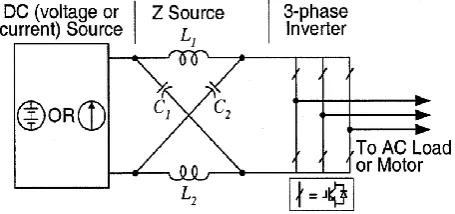
A Z-source inverter is a type of power inverter, a circuit that converts direct current (DC) to alternating current (AC). It functions as a buck-boost inverter without any use of DC-DC converter bridge due to its unprecedented
circuit topology.it proposes an impedance-source (or impedance-fed) power inverter (abbreviated as Z-source inverter) and its control method for implementing ac-to-dc, dc-to-ac, ac-to-ac, and dc-to-dc power conversion. The Z-source inverter employs a unique impedance circuit to couple the inverter main circuit to the power Z-source, thus providing unique applications that cannot be obtained in the traditional voltage-source inverter (or voltage-fed) and current-source (or current-fed) inverters, in which a inductor and a capacitor are used respectively. The Z-source inverter overcomes the conceptual and theoretical barriers and limitations of the traditional voltage-source inverter and current-source inverter and provides original power conversion concept. ZSI employs a Z network as L1=L2, C1=C2 shown in figure given below. The Z-Source inverter employs Impedance network between voltage source and inverter bridge. In Z-Source Inverter (ZSI), There is one more switching state as shoot through state, besides the 8 switching states ( 6 active states and 2 zero states) for traditional voltage source or current source inverter. The shoot through state intentionally added to boostthe output voltage with the Z- network. In the Z-Source inverter the output voltage is higher or lower than the DC-Link voltage.
Fig. 5 Three phase Z-Source inverter
VI. FUZZY LOGIC CONTROLLER
Fig.6 Basic Fuzzy logic controller
VII. PROPOSED MODEL
Fig.8 Z Source inverter with ultra-capacitor
Fig.9 Fuzzy Logic controller
VI. SIMULATION RESULTS
In figure 11 the profile of harmonic distortion without Active filter is shown when the fault is applied across the input. In fig. 12 the profile of reduction in the harmonic using Active filter based DVR is shown.The comparison of this proposed Active filter based Z-source DVR model results with existing [6] Passive filter based Z-source DVR.model results are shown in Tabular form in Table1
TABLE 1 COMPARISON TABLE
VII.CONCLUSION
The proposed model is simulated in MATLAB/SIMULINK. In this DVR model, Anactive filter is used with Z-source inverter and with fuzzy logic controller gives improved results in harmonic reduction as Z source inverter has two degree of freedom and controller is Fuzzy logic controller.Active power filter can address multiple harmonic at a time and fight with other power quality problems such as sag swell also but in case of passive filter it can address only a particular harmonics and eliminate only that harmonics on which based passive filter is designed.Active filter has various advantageous over the passive filter .It has been observed that in DVR, when active filter and fuzzy logic controller is used together they are very efficient for reduction in the harmonics and for improvement of power quality in power system.
REFERENCES
[1] IEEE Std. 519-1992, “IEEE Recommended Practices And Requirement For Harmonic Control In Electrical PowerSystems”
[2] M. Sharanya, BasavarajaBanakara and M. Sasikala” Dynamic Voltage Restorer And Hybrid Active Power Filter For Power Quality Improvement” ARPN Journal of Engineering and Applied Sciences VOL. 13, NO. 2, JANUARY 2018
[3] Savita N.Patil, Dr. P. H. Zope” Active Power Filter for Harmonics Compensation Single Phase Power Lines” International Journal of Engineering Research & Technology (IJERT)ISSN: 2278-0181Vol. 2 Issue 12, December – 2013
[4] Geena Sharma, KanchanJaswal” Harmonic Reduction using Shunt Active Power Filter” International Journal of Advanced Research in Electrical,Electronics and Instrumentation Engineering (An ISO 3297: 2007 Certified Organization) Vol. 5, Issue 6, June 2016
[5] S. U. Bhople, Asst. Prof. Santhosh Kumar Rayarao “Reduction of Harmonics using Shunt Active Power Filters”International Journal of Engineering Research & Technology(IJERT)ISSN: 2278-0181Vol. 4 Issue 07, July-2015
[6} Geena Sharma, Bhupinder Singh” Reduction of Harmonics using Passive Filter based Z-source DVR” ” International Journal of Advanced Research in Electrical, Electronics and Instrumentation Engineering Vol. 8, Issue 8, August 2019. ISSN (Print) : 2320 – 3765 ISSN
Type of filter Harmonic Distortion without Filter
Harmonic Distortion with filter Passive Filter 22.83% 6.91%