ISSN (Print) : 2320 – 3765 ISSN (Online): 2278 – 8875
I
nternational
J
ournal of
A
dvanced
R
esearch in
E
lectrical,
E
lectronics and
I
nstrumentation
E
ngineering
(An ISO 3297: 2007 Certified Organization)
Vol. 5, Issue 4, April 2016
A Study on Li-Fi -Advanced Wireless
Communication System
Pranali Bodke
Lecturer, Dept. of Electrical Power System, V.P.M’s Polytechnic Thane, West Maharashtra, India
ABSTRACT:This paper aims at demonstrating that Light Fidelity (Li-Fi) has now reached a state that is a viable and matured solution to wireless data transmission. Li-Fi technology will in future enable faster, more reliable internet connections, even when the demand for data usage has outgrown the available supply from existing technologies such as 4G, LTE and Wi-Fi. It will not replace these technologies, but will work seamlessly alongside them. Using light to deliver wireless internet will also allow connectivity in environments that do not currently readily support Wi-Fi, such as aircraft cabins, hospitals and hazardous environments. Light is already used for data transmission in fibre-optic cables and for point to point links, but Li-Fi is a special and novel combination of technologies that allow it to be universally adopted for mobile ultra high speed internet communication.
KEYWORDS: Principle of Li-Fi, Architecture of Li-Fi, Advantages of Li-Fi, Comparison of Li-Fi
I. INTRODUCTION
Now a day’s Wi-Fi is the most used technology by everyone. The recent survey of CISCO says by 2016 the internet traffic will reach 1.3 zettabytes (1300 exabytes) which is 4 times more than 2011. This network demand on mobile data saturates the RF spectrum soon. It is estimated that by 2017, more than 11 exabytes of data traffic will have to be transferred through mobile networks every month.
RF Spectrum Crisis will be the popular term in 2020. It drives the technology service providers & Researchers to look for an alternative. Prof. Harald Haas, Edinburgh UK, addresses and answers the problem by introducing Li-Fi which is bidirectional, high speed and fully networked wireless communications, like Wi-Fi, using visible light spectrum. It is a 5G VLC system that uses light from light-emitting diode (LED) bulbs by switching them on and off within nanoseconds to transmit data
Li-Fi could lead to the Internet of Things, which is everything electronic being connected to the internet, with the LED lights on the electronics being used as internet access points. The Li-Fi market is projected to have a compound annual growth rate of 82% from 2013 to 2018 and to be worth over $6 billion per year by 2018.
A. Principle of Li-Fi
Light modulation certainly isn’t a new concept, but Has is looking to move things forward and enable connectivity through simple LED bulbs. With Li-Fi, you can connect to the internet simply by being within range of an LED beam, or you could conceivably transmit data using your car headlights.
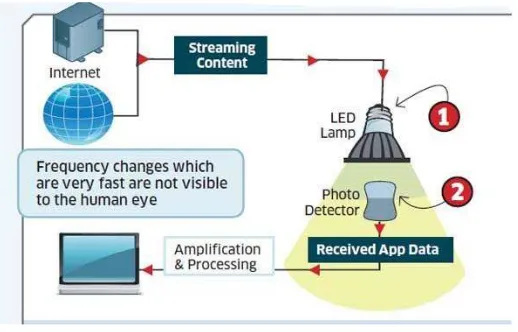
Li-Fi Architecture is based on the concept of Illumination and transmission. It consists of 3 major components i) LED Lamp
ISSN (Print) : 2320 – 3765 ISSN (Online): 2278 – 8875
I
nternational
J
ournal of
A
dvanced
R
esearch in
E
lectrical,
E
lectronics and
I
nstrumentation
E
ngineering
(An ISO 3297: 2007 Certified Organization)
Vol. 5, Issue 4, April 2016
notice. A light sensitive device (photo detector) receives the signal and converts it back into original data. This method of using rapid pulses of light to transmit information wirelessly is technically referred as Visible Light Communication (VLC) though its potential to compete with conventional Wi-Fi has inspired the popular characteristics Li-Fi. Refer Figure 2.1.
Figure i :- Li-Fi Principle
B. Li-Fi Suggested Architecture
The idea for novel architecture of Fi technology is based on the Main LED Unit (MLU), Agent LED (AL) and Li-Fi cloud. The MLU is extended to the ALs where every AL has their own Li-Li-Fi cloud to provide internet and other services connectivity through light. In this scenario the coverage area from a single node spread to the multiple nodes in the form of agent LEDs (AL). The main line is connected to the MLU and further it is extended to small nodes which are LED bulbs or lamps e.g. AL1, AL2, AL3 and AL4. The whole building is covered by these small nodes and provides wide coverage through light. The user can access the internet with little mobility inside the building as shown in figure 3.1 & 3.2. The number of ALs depends on the requirements and internal structure of the buildings
ISSN (Print) : 2320 – 3765 ISSN (Online): 2278 – 8875
I
nternational
J
ournal of
A
dvanced
R
esearch in
E
lectrical,
E
lectronics and
I
nstrumentation
E
ngineering
(An ISO 3297: 2007 Certified Organization)
Vol. 5, Issue 4, April 2016
Figure B-(i):- Li-Fi Cloud
C. Tuning Factors for Maximum throughput
i) Dimension of LED ii) Internal Structure Design iii) Data Rate vs Size of LED iv) Data Rate vs Number of LED v) Data Rate vs ON-OFF Switch Rate
a) Dimension of LED
Placement and positioning of LED plays a vital role
In Fixed Position, the LED lamp or bulb is fixed inside the room or building or any other place. The position is adjusted in such a way that it can cover the maximum area with high intensity of light. The LED lamp or bulb can be fixed on walls and ceiling of the room or building. The user can access the services and applications of Li-Fi technology in a fixed area where the LED lamp light can reach.
In Movable Position, the LED lamp is adjusted in such a position that it can move with some specific angle and
user can access the services of Li-Fi with low mobility. This type LED can be used widely because the lamp is moved around a fixed position. The LED lamp or bulb is mounted on the walls and ceiling of the room and the direction
b) Internal Structure Design (ISD)
ISSN (Print) : 2320 – 3765 ISSN (Online): 2278 – 8875
I
nternational
J
ournal of
A
dvanced
R
esearch in
E
lectrical,
E
lectronics and
I
nstrumentation
E
ngineering
(An ISO 3297: 2007 Certified Organization)
Vol. 5, Issue 4, April 2016
transmitting huge amount of data in terms of Gbps. The microchip LED bulb can generate data rates up to 150 Mbps with single bulb which provide fast internet connectivity and services. Here it can be concluded that data rate (R) is inversely proportional to the size of LED (Sled). The LEDs are of different sizes e.g. 5mm, 3mm, 1.8mm, 1mm, 1 m
and 1nm LED. The maximum data rate can be achieved with 1 m and 1nm LED which is considered to be a pixel in size.
R α 1/Sled
d) Data Rate vs Number of LED
The data rate can be increased with the increasing number of LEDs. The number of LEDs (Nled) can be according to
the available space inside the lamp. The number of LEDs can be adjusted so that it can achieve the maximum bit rate (bps).
R α Nled
e) Data Rate vs ON-OFF (Oled) Switching of LED
The ON-OFF switching of LED light bulb can create binary data of 1s and 0s e.g. 1 for ON and 0 for OFF. The micro-LED handles millions of alterations in light intensity per second and faster the ON-OFF switching, transmitting large amount of data at high speed. The ON-OFF switching of LED bulb is at a very high speed so that the human eye cannot detect the alterations. Micro-LED is capable to transmit data 1000 times faster than normal LED with faster ON-OFF switching, transmitting large amount of data at high speed
R α Oled
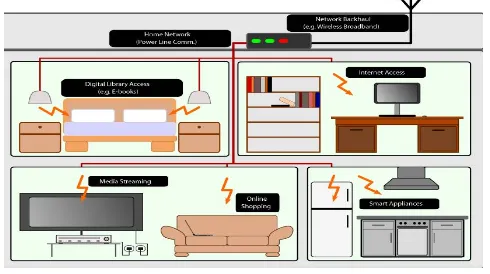
f) Li-Fi Home Wi-Fi LAN
In simple terms, Li-Fi can be thought of as a light-based Wi-Fi. That is, it uses light instead of radio waves to transmit information. And instead of Wi-Fi modems, Li-Fi would use transceiver-fitted LED lamps that can light a room as well as transmit and receive information. Since simple light bulbs are used, there can technically be any number of access points.
Figure ii :-Li-Fi Home Wi-Fi
II. ADVANTAGES OF LI-FI
Using of Li-Fi provides many advantages as below
Operates on Visible Light Spectrum having 10,000 times more spectrum bandwidth than current RF spectrum
ISSN (Print) : 2320 – 3765 ISSN (Online): 2278 – 8875
I
nternational
J
ournal of
A
dvanced
R
esearch in
E
lectrical,
E
lectronics and
I
nstrumentation
E
ngineering
(An ISO 3297: 2007 Certified Organization)
Vol. 5, Issue 4, April 2016
Visible Light Spectrum uses the Atto Cell, which not only improves the indoor coverage, but since it does not generate additional interference, it is able to enhance the capacity of RF wireless networks
Atto cell helps and being the bridge between RF and VLC Li-Fi Sub networks
High Installment cost but low maintenance cost
Uses the LED bulbs which is Cheaper than Wi-Fi
Theoretical speed of 1.3 Gbps by using the different color LEDs we can achieve the more speed of 10 Gbps
Less time & energy Consumption
Lower electricity Charges
Longevity of LED bulb saves money
More Expose of VLC spectrum won’t cause any health problems
Secured access because of light penetration restriction through wall
LiFi – can be used as remote signal under water Ocean where RF will not work
Can be used Petrochemical plants where the RF usage is not secured
Can be used in Hospitals where RF signals cannot be used
Can be used in Auto Driven Cars to avoid the traffic / accident collisions
Can be used in Streets to control the traffic signals also to form the Li-Fi Wi-Fi Network
Can be used in Air Cabins where RF signals are restricted
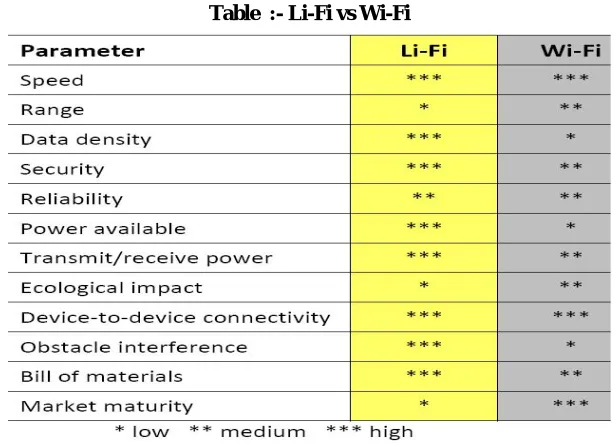
III. LI-FI COMPARISON OVER WI-FI
Table :- Li-Fi vs Wi-Fi
ISSN (Print) : 2320 – 3765 ISSN (Online): 2278 – 8875
I
nternational
J
ournal of
A
dvanced
R
esearch in
E
lectrical,
E
lectronics and
I
nstrumentation
E
ngineering
(An ISO 3297: 2007 Certified Organization)
Vol. 5, Issue 4, April 2016
IV. LIMITATIONS OF LI-FI
The main problem is that light can’t pass through objects, so if the receiver is inadvertently blocked in any way,
then the signal will immediately cut out. ―If the light signal is blocked, or when you need to use your device to
send information — you can seamlessly switch back over to radio waves, Harald says.
Reliability and network coverage are the major issues to be considered by the companies while providing VLC services. Filtering of Interference from external light sources like sun light, normal bulbs; and opaque materials in the path of transmission work in progress
High installation cost of the VLC systems can be complemented by large-scale implementation of VLC though Adopting VLC technology will reduce further operating costs like electricity charges, maintenance charges etc.
Li-Fi uses light-emitting diodes (LEDs) which are rapidly gaining in popularity for standard light bulbs and other domestic and commercial purposes. They are expected to be ubiquitous in 20 years. VLC is not in competition with Wi-Fi, Prof. Haas says, it is a complimentary technology that should eventually help free up much needed space within the radio wave spectrum.
V. CONCLUSION
In future, data for laptops, smart phones & tablets can be transmitted through light in room by using Li-Fi. Researchers are developing micron sized LED which are able to flicker on & off around 100 times quicker than larger LED. They offers faster data transfers and take up less space so we could save space or and more LED’s to further boost the channel of communication. Also 100 micron sized LED can fit into area required by 1sq. mm large single LED. A 1 sq.mm sized array of micron sized LED’s could therefore communicate 100×100 (i.e. a million) times as much information as a single 1mm LED. We can be sure that the future for Li-Fi is bright. Li-Fi consortium believes it is possible to achieve more than 10Gbps, theoretically allowing a high definition film to be downloaded in 30 seconds. The realization of a bidirectional connection also seems to have been addressed successfully to an extent that the first commercial bidirectional point-to-point Li-Fi systems are available.
REFERENCES
[1] http://www.lificenter.net/solutions/lifi-solution/
[2] http://www.lifi-led.com/
[3] http://en.wikipedia.org/wiki/Li-Fi
[4] www.lificonsortium.org/
[5] http://lighting.com/led-lights-lifi/
[6] Visible-light communication: Tripping the light fantastic: A fast and cheap optical version of Wi-Fi is coming’, The Economist, dated 28 Jan 2012.
[7] en.wikipedia.org/wiki/visible_light_communication Seminarprojects.com/s/seminar-report-on-lifi