Visual Categorization Using Negative Bootstrap
Manisha Bhimrao Waghmode
Department of Computer Science and Engineering N.B.Navale Sinhgad College of Engineering, Solapur, India. Solapur.
Abhijit V.Mophare
Department of Computer Science and Engineering N.B.Navale Sinhgad College of Engineering, Solapur, India. Solapur.
ABSTRACT:
Existing system uses query by image content with multiple visual properties such as color, texture and shape. Traditional system uses text based image retrieval with satisfactory retrieval performance. Some existing system uses canny and sobel edge detection algorithm for extracting the shape features for the images. Much research has been conducted towards inexpensive solutions to acquire positive examples, e.g., from web image search results or socially tagged data, or by online collaborative annotation.
In proposed system we consider positive examples obtained from web image search results or socially tagged data, or by online collaborative annotation. Obtaining negative examples seems to be trivial, as they are abundant in large photo repositories such as Flickr and Facebook. And it focuses on obtaining relevant negatives for better classifier performance. The system will reduce the searching time and will have low cost.
KEYWORDS: Image processing; Negative
bootstrapping; content based image retrieval; SVM.
I. INTRODUCTION:
There are two frameworks: text-based and content-based. The text based approach can be traced back to 1970s. In such systems, the images are manually annotated by text descriptors, which are then used by a database management system (DBMS) to
perform image retrieval. There are two
disadvantages with this approach. The first is that a
human labour at considerable level is required for manual annotation. The second is the inaccuracy in annotation due to the subjectivity of human perception. To overcome these disadvantages in text-based retrieval system, content based image retrieval (CBIR) was introduced in the early 1980s. In CBIR, images are indexed by their visual content, such as color, texture, shapes [1]. The fundamental difference between content-based and text-based retrieval systems is that the human interaction is an essential part of the latter system. Since last decades a large number of content-based image retrieval (CBIR) technologies (see the recent survey in [1]) have been developed to help users retrieve the desirable database photos using the query by example framework. In these systems, at first a user needs to provide example images as queries. Then, the database images are ranked based on the visual similarities between the query images and the database images.
II. RELATED WORK:
Query by Image Content It is the first
commercial content based retrieval system. This system allows users to graphically pose and refine queries based on multiple visual properties such as color, texture and shape. It supports queries based on input images, user-constructed sketches, and selected color and texture patterns.
Content based image retrieval is not a
Only the integration of the two can result in satisfactory retrieval performance. In this paper they reviewed the main components of a content based image retrieval system, including image feature representation,
indexing, and system design, while
highlighting the past and current technical achievement.
Ivan Lee, et.al. (1996) [11] have present the
analysis of the CBIR system with the
human controlled and the machine
controlled relevance feedback, over
different network topologies including centralized, clustered, and distributed content search. In their experiment for the interactive relevance feedback using RBF, they observe a higher retrieval precision by introducing the semi-supervision to the non-linear Gaussian-shaped RBF relevance feedback.
Verma, Mahajan, (2012) [14] have used
canny and sobel edge detection algorithm for extracting the shape features for the images. After extracting the shape feature, the classified images are indexed and labeled for making easy for applying retrieval algorithm in order to retrieve the relevant images from the database. In their work, retrieval of the images from the huge image database as required by the user can get perfectly by using canny edge detection technique according to results.
Ryszard S. Chora´s (2007) [15] contributes
their work for the identification of the problems existing in CBIR and Biometrics systems describing image content and image feature extraction. They have described a possible approach to mapping image content onto low-level features. Their paper investigated the use of a number of different color, texture and shape features for image retrieval in CBIR and Biometrics systems.
Pattanaik, Bhalke (2012) [16] has worked
to prove that Content Based Image Retrieval has overcome all the limitation of
Text Based Image Retrieval by considering the contents or features of image. A query image can be retrieved efficiently from a large database. A Database consists of different types of images has implemented on the system. Different Features such as histogram, color mean, Color structure
descriptor texture is taken into
consideration for extracting similar images from the database. From the experimental result it is seen that combined features can give better performance than the single feature. So selection of feature is one of the important issues in the image retrieval. The system is said to be efficient if semantic gap is minimum .The result can be improved in future by introducing feedback and user‟s choice in the system.
Zhao,Grosky (2002) [17] view that
bridging the semantic gap between the low-level features and the high-low-level semantics is within the interface between the user and the system, other research direction is towards improving aspects of CBIR systems by finding the latent correlation between low-level visual features and high-level semantics and integrating them into a unified vector space model.
III.
EXISTING SYSTEM
:The term Content-based image retrieval was originated in 1992, when it was used by T. Kato to describe experiments into automatic retrieval of images from a database, based on the colors and shapes present. Since then, this term has been used to describe the process of retrieving desired images from a large collection on the basis of syntactical image features. The techniques, tools and algorithms that are used originate from fields such as statistics, pattern recognition, signal processing, and computer vision [4].
similar to a specified target image. In most cases the aim of CBIR systems is to replicate human perception of image similarity as well as possible [5].
CBIR works in different stages such as image
acquisition, Image preprocessing, Feature
Extraction, Similarity Matching, Resultant
Retrieved images.
There could be many challenges faced by a CBIR system such as:
The issue related to the Semantic gap
where it means the lack of coincidence between the information that one can extract from the visual data and the interpretation that the same data have for a user in a given situation. The user wants to seek semantic similarity, but the database can only provide similarity by data processing.
The expectation of users for huge amount
of objects to search among.
Sometimes incompleteness of query
specification seems to be a challenge.
Incomplete image description is also a
source of challenge to an efficient CBIR system.
IV. PROPOSED SYSTEM:
In this paper, there is given a set of unlabeled images, we search for images which contain a specific concept by employing a visual classifier of
the concept. Let x be an image. Its content-based
representation is a d -dimensional feature vector.
We will refer to an image and its corresponding
feature vector interchangeably, using x(i) to
indicate the i-th dimension of the vector. We use
g(x) to denote a classifier, which produces a
real-valued score of an image being a positive instance
of the target concept. In particular(x)>0 means the
image is classified as positive, and negative otherwise.
We choose SVM classifier which simultaneously minimize the classification error and maximize the functional margin. The maximum margin property
makes SVMs a solid choice for building visual classifiers [1].
For our system we need both positive and negative training data. We obtain positive data are for instance by different approaches discussed in I. Negative training data is harvested from
user-tagged images on the web. Let B+ be a positive set,
S a set of user-tagged images independent of , and
B_ a negative set from S .We derive g(x) from B+
and B_ :
(1)
Negative bootstrapping algorithm works in following stages:
We have a set of unlabeled images; we search for images which contain a specific concept by employing a visual classifier of the concept [1].
Let „x‟ be an image. Its content-based
representation is a d-dimensional feature vector. We will refer to an image and its corresponding feature vector interchangeably, using to indicate the i-th dimension of the vector. We use to denote a classifier, which produces a real-valued score of an image being a positive instance of the target concept. In particular, means the image is classified as positive, and negative otherwise Our proposed algorithm works in following stages:
A. Iterative Negative Ensemble Learning
In our approach we use T to denote the number of
iterations, and t=1,….,T. to index the iterations. Let Gt(x) be the final classifier obtained after t iterations. In the -th iteration, we conduct a two-stage adaptive sampling to acquire the most relevant negative examples according to Gt-1(x), the latest classifier obtained in previous iterations.
In the first stage, we randomly sample m examples
from S to form a candidate set ut as expressed by
To reduce the chance of incorrectly having
genuine positives in ut , we let m<<|S|.
In the second stage, we use Gt-1(x) to classify each
example in ut, and obtain in which each
Example is associated with a classification score.
We express by
(3)
To derive a new classifier given the new negative
data B_(t), if we simply add B_(t) to the existing
training data we will come face to face with the imbalanced data problem as the negatives accumulate.
To make the positive and negative classes perfectly balanced, we set the number of selected negatives
equal To |B+|, i.e.
(4)
B. Model Compression
We introduce model compression by generalizing the fast intersection kernel algorithm [2] from a single classifier to an ensemble of classifiers. Our compact model classifies an image at a constant time complexity, while simultaneously maintaining the effectiveness of negative bootstrap.
let λt be a nonnegative weight for a meta classifier gt(x) . Accordingly, we express the ensemble
classifier GT(x) as
(5)
Negative Bootstrap Algorithm
V. RESULTS AND DISCUSSION:
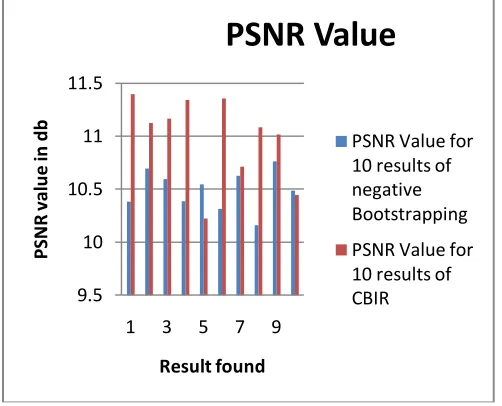
To analyze CBIR and negative bootstrapping methods scientifically we are applying two formulas on this that are Mean Squared Error (MSE) and Peak Signal to Noise Ratio (PSNR). The PSNR is most commonly used as a measure of quality of reconstruction in image processing. It is defined via the Mean Squared Error.
MSE= [U i, j − V(i, j)]m 2
n /m*n (6)
Where the U is source image, V is the processed image and m. n are the height and width of the image respectively.
The PSNR is defined as,
Fig. 1Execution of CBIR and Negative Bootstrapping
Fig. 2. Comparison od PSNR values of CBIR and Negative Bootstrapping
Fig 1 shows the effectiveness of negative bootstrapping method over existing content based image retrieval method. Graph shows that the proposed approach take very less time for execution as compared to the existing method. Fig 2 shows the PNSR values comparison which directly shows the quality of image reconstruction. Here both parameters are very important and our proposed method shows the improvement over CBIR.
VI. CONCLUSION:
In our work we proposed a negative bootstrapping algorithm, which works in stages like classifier
learning, random sampling and model
compression. Proposed algorithm combines
random sampling and adaptive selection to
iteratively find relevant negatives. We propose model Compression to compress an ensemble of histogram intersection kernel SVMs.
In our evaluation we used two parameters execution time and PSNR values. In Both parameters our approach proved to be more efficient than the existing system.
ACKNOWLEDGEMENT:
Authors are thankful to the all who have been part of this work and supported us to complete the work.
REFERENCES:
[1] Ying Liua , Dengsheng Zhanga, Guojun Lua, Wei-Ying Mab, “A survey of contentbased image retrieval with high-level semantics”, The journal of
the Pattern Recognition society, Pattern
Recognition 40(2007) 262–282.
[2] Gonzalez, R.C., Woods, R.E., Digital Image Processing, 2nd Ed, Prentice-Hall of India Pvt. Ltd.
[3] Source : www.mathworks.com
[4]Source:http://en.wikipedia.org/wiki/Content-based_image_retrieval
[5] Ville Viitaniemi, “Image Segmentation in
Content-Based Image Retrieval”, Helsini
University OF Technology, Department of Electrical and Communications Engineering, Master Thesis, Finland 24th May 2002.
0 1000 2000 3000 4000 5000 6000 7000
Algorithm Name
Ti
m
e
in
m
s
Execution Time
Negative Bootstrapping CBIR
9.5 10 10.5 11 11.5
1 3 5 7 9
P
SN
R
v
al
u
e
in
d
b
Result found
PSNR Value
[6] H.B. Kekre , “Survey of CBIR Techniques and Semantics”, International Journal of Engineering Science and Technology (IJEST), ISSN : 0975-5462 Vol. 3 No. 5 May 2011.
[7] Kanchan Saxena, Vineet Richaria, Vijay Trivedi,“A Survey on Content Based Image Retrieval using BDIP, BVLC AND DCD”, Journal of Global Research in Computer Science , Vol.3, No. 9, September 2012 ,ISSN-2229-371X
[8] R.Senthil Kumar, Dr.M.Senthilmurugan,
“Content-Based Image Retrieval System in Medical”,International Journal of Engineering Research & Technology (IJERT),Vol. 2 Issue 3, March – 2013,ISSN: 2278-0181.
[9] Gaurav Jaswal Amit Kaul , “ Content Based Image Retrieval ”, National Conference on Computing, Communication and Control , A
Literature Review , National Institute of
Technology, Hamirpur-177001, Himachal
Pradesh(India).
[10] Paolo Parisen Toldin, “A survey on content-based image retrieval/browsing systems exploiting semantic”, 2010-09-13.
[11] Ivan Lee, Paisarn Muneesawang, Ling Guan, “Automatic Relevance Feedback for Distributed Content-Based Image Retrieval”,ICGST, ieee.org
FLEXChip Signal Processor (MC68175/D),
Motorola, 1996.
[12] M. Sifuzzaman, M.R. Islam and M.Z. Ali ,“Application of Wavelet Transform and its Advantages Compared to Fourier Transform ”, Journal of Physical Sciences, Vol. 13, 2009, 121-134 ISSN: 0972-8791 .
[13] Jean-Francois Omhover, Marcin
Detyniecki,University P. et M. Curie – CNRS, rue du Capitaine Scott, “Combining text and image retrieval”.