EFFECTS OF PRACTICAL WORK ON STUDENTS’ ACHIEVEMENTS IN PHYSICS AT SECONDARY SCHOOL LEVEL IN MURANG’A
EAST SUB-COUNTY, KENYA
MUCHAI AUGUSTINE NG’ETHE E83/20087/2012
A THESIS SUBMITTED IN FULFILLMENT OF THE REQUIREMENTS FOR THE AWARD OF THE DEGREE OF DOCTOR OF PHILOSOPHY
(SCIENCE EDUCATION) IN THE SCHOOL OF EDUCATION, KENYATTA UNIVERSITY
DEDICATION
ACKNOWLEDGEMENT
I am greatly indebted to all the people and institutions who played one role or another in the production of this thesis. First, I am greatly indebted to my supervisors Prof. Nicholas W. Twoli, and Dr. David W. Khatete for the role they played in shaping this thesis from a concept paper to this level. Their tireless guidance, untold patience and encouragement during this research work was of great help. I also thank Prof. M.M. Amadalo for his invaluable advice.
I would also like to thank The Murang’a County Education Office for their co-operation and guidance in providing relevant data required for the study. I also thank the Principals, teachers and students of the schools which were involved in this study. I say thank you for your time. The analysis of the data could not be complete without the assistance of Dr. Njoroge Wanjiru, Thank you so much.
TABLE OF CONTENTS
TITLE PAGE .……….………..…………...i
DECLARATION ... Error! Bookmark not defined. DEDICATION ... ii
ACKNOWLEDGEMENT ... iv
TABLE OF CONTENTS ... v
LIST OF TABLES ... ix
LIST OF FIGURES ... x
ABBREVIATIONS AND ACRONYMS ... xi
ABSTRACT ... xii
CHAPTER ONE: INTRODUCTION ... 1
1.1 Background to the Study ... 1
1.2 Statement of the Problem ... 8
1.2.1 Purpose of the Study ... 9
1.3 Objectives of the Study ... 9
1.4 Hypotheses ... 9
1.5 Significance of the Study ... 10
1.6 Delimitation and Limitations ... 10
1.6.1 Delimitations of the Study ... 10
1.6.2 Limitation of the Study ... 11
1.7 Assumptions of the Study ... 11
1.8 Theoretical Framework ... 12
1.9 Conceptual Framework ... 16
1.10 Operational Definitions Terms ... 17
CHAPTER TWO: LITERATURE REVIEW ... 19
2.1 Introduction ... 19
2.2 Importance of Science to Society ... 19
2.2.1 Students’ Attitude towards Science Subjects ... 20
2.3 Importance of Physics to the Society ... 21
2.4 Challenges faced in the Teaching and Learning of Physics as a Science Subject22 2.5 Methods of Teaching Physics ... 25
2.6 Practical Approach in the Teaching of Physics ... 29
2.7Research Gap ... 35
2.8 Chapter Summary ... 36
CHAPTER THREE: RESEARCH METHODOLOGY ... 37
3.1 Introduction ... 37
3.2 Research Design ... 37
3.3 Location of the Study ... 40
3.4 Target Population ... 40
3.5 Sampling and Sampling Procedures ... 40
3.6 Research Instruments ... 42
3.6.1 Pre-Test Achievements Test ... 42
3.6.2 Post-test ... ………43
3.6.3 Form Two Students Attitude Scale (FTSAS) ... 43
3.6.4 Observation Checklists for Skills Acquisition (OCFSA) ... 43
3.7 Piloting…… ... 43
3.7.1 Validity of the Instruments ... 44
3.7.2 Reliability of the Instrument ... 44
3.9 Methods of Data Analysis ... 46
3.10 Ethical Consideration ... 47
CHAPTER FOUR: DATA ANALYSIS, PRESENTATION AND DISCUSSION49 4.0 Introduction ... 49
4.1 Effects of Practical Work in Physics on Students’ Performance in Physics ... 49
4.1.1 Students’ Achievements on the Physics Performance Pre-Test ... 49
4.1.2 Students’ Performance in the Post-Test ... 51
4.2 Effect of Practical Work in Physics on Students’ Attitude towards the subject . 55 4.2.1 Pre-Test Students’ Attitude towards Physics scale ... 55
4.2.2 Post-Test Students’ Attitude towards Physics ... 56
4.2.3 Comparison between the Pre-Test and Post-Test Students’ Attitude towards Physics ... 58
4.3 Effect of Practical Work on Acquisition of Science Process Skills in Physics ... 61
4.4 Effect of Practical Work on Enrollment in Physics ... 64
4.5 Development of a Prototype Scheme for Evaluating Practical Work in Secondary School Physics... 70
CHAPTER FIVE: SUMMARY OF FINDINGS, CONCLUSIONS AND RECOMMENDATIONS ... 76
5.1 Introduction ... 76
5.2. Summary of the Findings ... 76
5.3 Conclusions of the Study ... 81
5.4. Recommendations ... 82
5.4.1 Recommendations for Action ... 82
REFERENCES ... 84
APPENDICES ... 98
Appendix I: Candidature in the Science Subject Nationally between 2006 - 2009 .. 98
Appendix II: Candidates Overall Achievements in Physics Nationally between 2008 – 2009……… ………99
Appendix III : Candidature for science subjects in Murang’a East Sub-county 2012100 Appendix IV : Students’ Enrolment in Physics in KCSE for the Participating Schools between 2011-2013... 101
Appendix V: An Example of a Prototype Marking Scheme for Practical Work in Physics ... 102
Appendix VI: Pre-Test ... 104
Appendix VII: Post Test ... 109
Appendix VIII: Marking Scheme for Pre-Test ... 117
Appendix IX: Marking Scheme Post Test ... 122
Appendix X: Students Physics Attitudes Scale (SPAS) ... 128
Appendix XI: Observation Checklists for Skills Acquisition (OCFSA) for Form Two130 Appendix XII: Research Authorization Letter ... 132
Appendix XIII: Approval of Research Proposal ... 133
Appendix XIV: Research Permit ... 134
LIST OF TABLES
Table 1: Sampling Grid ... 42
Table 2: Mean Scores of the Pre-Test per Group ... 50
Table 3: Comparison of Mean Scores of Experimental and Control A Groups ... 50
Table 4: Comparison of Mean Scores of Experimental and Control for set B Groups51 Table 5: Students’ Achievements in the Post-Test Achievement Test ... 51
Table 6: Independent t-test for the Post-Test ... 52
Table 7: Comparison of Mean Scores of Post-Test among the Four Schools ... 53
Table 8: Pre-Test Students’ Attitude towards Physics ... 56
Table 9: Post-Test Students’ Attitude towards Physics ... 57
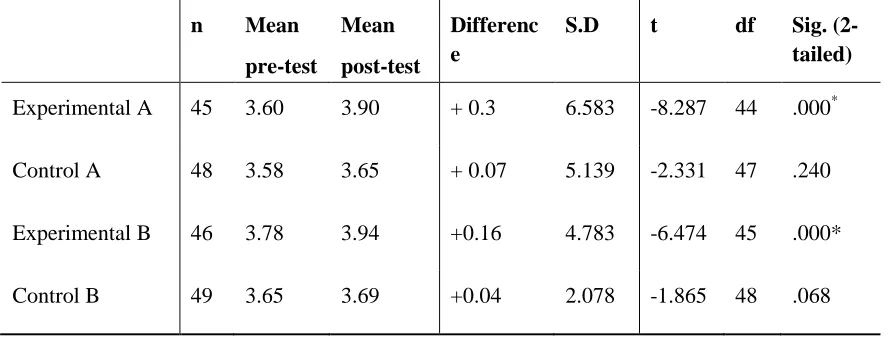
Table 10: Comparison between the Pre-Test and Post-Test Students’ Attitude towards Physics ... 58
Table 11: Acquisition of Science Process Skills ... 61
LIST OF FIGURES
Figure 1: Conceptual Frame Work ... 16 Figure 2: Design for the Study ... 37 Figure 3 : Study Design and Process ... 39 Figure 4: Model showing Relationship between instructional approaches in Physics
ABBREVIATIONS AND ACRONYMS CDF : Constituency Development Fund
FMCE : Force and Motion Conceptual Evaluation
FSE : Free Secondary Education
FTSAS : Form Two Students Attitude Scale
HIV/AIDS : Human Immunodeficiency Virus, Acquired Immunodeficiency Syndrome
ISLE : Investigative Science Learning Environment KCSE : Kenya Certificate of Secondary Education KESSP : Kenya Education Sector Support Program KICD : Kenya Institute of Curriculum Development KNEC : Kenya National Examinations Council
MBT : Mechanics Baseline Test MOEST : Ministry of Education Science and Technology
MSS : Mean Standard Score
NACOSTI : National Commission for Science Technology & Innovation
OFCSA : Observation Checklists for Skills Acquisition PHET : Physics Education Technology
SAT : Student Achievements Test
SEPU : Science Equipment Production Unit
SMASSE : Strengthening of Mathematics and Sciences in Secondary Education
ABSTRACT
CHAPTER ONE INTRODUCTION 1.1 Background to the Study
Scientific principles are an important tool required by all nations to assist them in developing technological innovation in the present competitive world. For any nation to develop socially, economically and technologically it requires a strong scientific background. There are several challenges facing the world today which include emergence of new drug resistance, effects of genetic experimentation and engineering, ecological impact of modern technology, dangers of nuclear war and explosions and global warming among others (Alsop & Hicks, 2001). These challenges have triggered rapid innovation and technological advancement in fields such as communication and agriculture. Among the sciences, Physics is one of the instrumental subjects that spearhead innovation and technological advancement.
Science education is instrumental to the development of any nation (Kola, 2013). It is reason behind the success in science and technology in the developed world. The launching of sputnik in 1957 by the Russians was only possible because of the position they placed physics education (Olyede, 2013). Physics is one of the subjects in science education. It involves the study of matter, energy and their interactions (Chu & Lin, 2002). It plays a key role in the future progress of mankind. The interest and concerns of physics education form the basis of technology.
technological infrastructure needed to make scientific advances and discoveries (Kola, 2013).
Physics plays a major role in health education, economic development, energy and environment. The x-rays, radioisotope nuclear resource imaging, laser electron, microscope, synchrotron radiator among other advances in medicine depend on physics (Kola, 2013). The knowledge of electronics and quantum physics has enabled development of computers technology (Viladya, 2003). Our world is more connected through them and the conduction of business around the world is done almost effortlessly (Olufunke, 2012).
Advances in physics have benefited the transportation industry from building of efficient automobiles, sea vessels, aeroplanes to navigation using the global positioning system (Juan, 2009).
cancer, Ebola, and HIV/AIDS will require the development of high precisions equipment employing Physics principles.
Despite the importance of Physics in the scientific and technological development, it appears Physics education has been facing various challenges. First, the enrolment in Physics course at all levels is low in many African countries (Amunga et al., 2011a). Many reasons are advanced for this discrepancy which include inadequate lower level preparations, weak mathematics background, and lack of job opportunities outside the teaching profession, inadequate teacher qualification as well as possession of below standard pedagogical content knowledge (Semela, 2010). Many students consider Physics as difficult, abstract and theoretical (House of Lords, 2006). Many students find the subject boring, unemployable (Hirschfield, 2012) and as a result interest in high school Physics is decreasing. Secondly, the students’ enrolment is low compared to other sciences (Garwin & Ramsier, 2003). In many school curricula little time is allocated for the discipline compared to language and mathematics. In secondary school curriculum in Kenya, Physics is allocated five lessons per week in Form Three and Four whereas English Language and Mathematics are allowed eight and seven lessons per week respectively.
crucial point that major decisions that affect the feature of the students and the country at large are made.
There has been low enrolment in Physics in Kenya Certificate of Secondary Education (KCSE). This is presented in appendix I. Appendix I shows that the number of candidates enrolled for Physics is low compared to the other science subjects (KNEC, 2009). However, the numbers have been increasing since 2006. This trend is good but still low compared to other science subjects (KNEC, 2010). The student’s achievements in Physics in KCSE between 2006-2009 are presented in appendix II. The results shows that the highest mean score was in 2007 (M = 27.54, S.D = 37.00) and the lowest mean score was recorded in 2009 (M = 20.87, S.D = 19.87). It implies that students have never managed to get a mean score of 30 percent. This shows that the achievement is low. It also shows that there are underlying issues behind these results. This calls for the need for the current study. Low enrolment and achievements have also been recorded in Murang’a East Sub-County. The results are presented in appendix III. The number of candidates enrolled for Physics as compared to the other science subject is very low (Murang’a East Sub-County, QASO, 2012). In the year 2009, the Physics candidature was only 30.99% compared to that of Chemistry and Biology which was 97.77% and 88.67% respectively of the total candidature who sat for the KCSE in that year.
instructional method on students’ attitude toward Physics. It further investigated the effects of the approach on student’s enrolment in Physics at KCSE. Appendix III shows that only 651 candidates registered for Physics in 2012 in Murang’a East Sub-County which comprised only 39.07% of the total candidature. In the same Sub-County, 1611 (96.6%) candidates had registered for Chemistry while 1200 (72.02%) candidates had registered for biology. This shows that the enrolment of Physics at KCSE in the sub-County is low. This trend is more severe in the day schools where in some schools there are no candidates for Physics (Appendix III). The problem of low enrollment and poor achievements is particularly noticeable amongst the girls in Kenyan secondary schools (Wasanga, 2009).
According to Twoli (1986), major factors which attributes to differences in achievements in science between boys and girls in National examinations include unequal distribution of resources among schools of different types and motivational differences brought about by different cultural backgrounds. Thus, provided the similar environments, girls may perform just as well as boys. The trend of opting out of Physics which influences technology is worrying given Kenya’s emphasis on the achievements of visions 2030 (Amunga & Musera, 2011b) it should be expected that the demand for Physics should be growing due to its strong influence on technology programs at university and other tertiary institutions of learning.
showed that lack of appropriate apparatus and inability of teachers to improvise hinder effective teaching of science. This has meant that teacher resort to theoretical teaching neglecting the practical approach. This has led the students to have negative attitude towards the subject hence disliking it and therefore low enrolment. The science teachers are mainly trained in theoretical content aspects. Teachers training in handling Physics practical lessons have been ineffective in many developing countries including Kenya (Masingila & Gathumbi, 2012).
Training in conducting school type science experiments is completely ignored in many university teachers training curricula (Masingila & Gathumbi, 2012). Many if not all the Kenyan university trained Bachelor of Education (science) graduates lack the skills of handling high school type practical work. There are no teaching laboratories set aside for this exercise in the various Kenyan universities that train teachers (Masingila & Gathumbi, 2012). The situation has improved though with many school establishing science rooms or laboratories through KESSP programs and through CDF. Being a science subject, effectiveness of teaching Physics depends on the practical activities that teachers and students undertake in the process of learning the subject (Oyoo, 2004).
(Tamir, 1991). Practical work in Physics helps to develop familiarity with apparatus, instruments and equipment. Manipulative skills are acquired by the learners. Expertise is developed for reading all manner of scales. The observations made and results obtained are used to gain understanding of Physics concepts.
majority, 508 students (78%) of the students who sat for Physics scored below D (County Director of Education Office-Murang’a). These twin issues of low enrolment and low students’ achievements in Physics in the Sub-County informed the design of the study.
1.2 Statement of the Problem
1.2.1 Purpose of the Study
The study was set to investigate the effects of practical work in Physics on students’ achievements in Physics in Secondary schools of Murang’a East sub-County.
1.3 Objectives of the Study
The study was guided by the following objectives:
1. To investigate the effect of practical work in Physics on students’ achievements in Physics
2. To develop a scheme for evaluating practical work in secondary school Physics.
1.4 Hypotheses
This study was guided by the following null hypotheses:
HO1: There is no significant difference in student performance in Physics for Form Two students taught Physics through practical work and those not taught through practical work
HO2: There is no significant difference in attitudinal change towards Physics for Form Two students taught Physics through practical work and those not taught through practical work.
HO4: There is no significant difference in enrolment in Physics for Form Two students taught Physics through Physics practical work and those not taught through practical work at Form Three.
1.5 Significance of the Study
The study found out students’ involvement in meaningful practical work contributes to improved achievements in Physics. This information may be helpful to Physics teachers who embrace the practical approach in their teaching. Teachers training institutions may be in a position to change their training approaches and emphasize practical work. Curriculum developers will have to change their approach in designing the curriculum and incorporate more practical aspects in the curriculum. The result may be useful to Kenya National Examination Council when setting Physics examination so that the examination can emphasize evaluation of science process skills rather than the product. The inspectors of schools may find the findings useful. They may need to change their approach to inspection so that they can inspect the practical and skill acquisition processes.
1.6 Delimitation and Limitations 1.6.1 Delimitations of the Study
streams of Form Two students in the selected four secondary schools in their third term of the study. This is because it is at form Two that students in secondary schools make subjects choices. The study was also limited to one term of fourteen (14) weeks. The study was limited to four (4) topics as stipulated in the syllabus. The study had no right of choosing which topics to teach except those stipulated in the syllabus and schemes of work.
Thus the findings are likely to reflect the situation in the day schools but cannot be generalized to other schools in the county or other counties in the country.
1.6.2 Limitation of the Study
The study involved only the Form Two classes. It was limited to syllabus as stipulated by KICD. The researcher did not have the freedom to choose what to be taught but had to adhere to the schemes of work provided by the school. The number of lessons per week had to be limited to what is provided for.
1.7 Assumptions of the Study
In undertaking this study, several assumptions are taken into consideration.
a) The schools selected had the necessary equipment to perform the practical work.
b) The teachers administering the treatment are all qualified in Physics Education.
1.8 Theoretical Framework
The theoretical framework for this study was based on Jean Piaget theory of cognitive development and Jerome Bruner theory of Cognitive Development. Jean Piaget (1896-1980) studied the development of children’s understanding and particularly the role of maturation in children’s increasing capacity to understand their world. According to him, children cannot undertake certain tasks until they are psychologically mature enough to do so. His theory is called cognitive theory and is central to the school of cognitive theory called cognitive constructivism.
There are several key principles of Piaget theory. First is adaptation. According to him, a child adapts to the world through assimilation and accommodation. He referred to the process by which a person takes material into their mind from the environment as assimilation. This is also accompanied by accommodation; the difference made into one’s mind by the process of assimilation. The other key idea of the theory is classification-ability to group objects together on the basis of common features. A fourth tenet of the theory is class inclusion-the understanding that some classes or sets of objects are also sub-sets of a larger class. His fifth key idea was the realization that objects stay the same even when they are changed about or made to look different, which he called conservation. His other key tenet was operation- the process of working something out in one’s head. According to him, young children have to try out things in the real world like count on fingers while older one can use their heads.
are 4 stages of cognitive development. These include the sensori-motor (birth-2 years), pre-operational (2-7 years), concrete operational (7-11 years) and formal operational (11 years and above). The sensori-motor stage is characterized by the child differentiates self from objects and achieves object permanency. In the pre-operational stage, the child learns language and to represent objects by images and words. The concrete operational stage is characterized by the child been able to think logically about objects and events. Finally, in the formal operational stage, the child can think logically about abstract propositions and test hypothesis systematically.
In this theory, Piaget argue, that there is a continuous reorganization of the child’s mental processes as he grows and interacts with the environment. Children learn by manipulating the environment they build information in their minds which he called schemas. These schemas kept improving and growing as the child grows from one stage to the next stage. The importance of Piaget’s theory to this study is that a child learning by doing things on his own. It is not easy to learn from the teacher just giving the child information. According to him, a child’s meaningful learning is through manipulation of the environment. Children are able to construct their own knowledge by manipulating the objects in the environment.
The second theory on which the study is anchored on is the Cognitive development theory by Jerome Bruner (1962). According to him, the goal of education should be intellectual development and not memorization of facts. He insisted that learning should entail the acquisition of the process of knowledge but not mere memorization of facts. Instruction should therefore teach the learner how to participate in the process that makes possible the establishment of knowledge. It should not be a matter of getting the learner to commit the results to mind. The aim of teaching a discipline is to get learners to take part in the process of knowledge. According to him, acquiring knowledge is a process rather than product.
Bruner advocated organizing concepts and learning by discovery. He believed that learners can be able to construct knowledge by interacting with the world around them. He identified three stages of cognitive development, the enactive, iconic and symbolic representations. Enactive, which is the representation of knowledge through actions while iconic, which is the visual summarization of images. The last one is the symbolic representation, which is the use of words and other symbols to describe experiences.
representation of the rattle and, therefore, does not understand that it needs the rattle in order to produce the sound.
The iconic stage appears from one to six years old. This stage involves an internal representation of external objects visually in the form of a mental image or icon. For example, a child drawing an image of a tree or thinking of an image of a tree would be representative of this stage.
The symbolic stage, from seven years and up, is when information is stored in the form of a code or symbol such as language. Each symbol has a fixed relation to something it represents. For example, the word 'dog' is a symbolic representation for a single class of animal. Symbols, unlike mental images or memorized actions, can be classified and organized. In this stage, most information is stored as words, mathematical symbols, or in other symbol systems.
1.9 Conceptual Framework
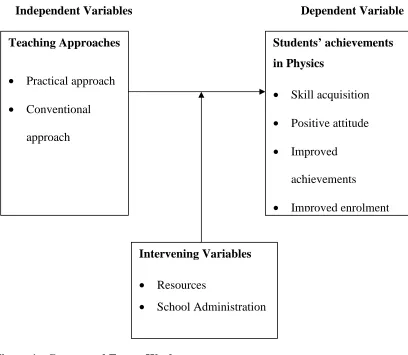
The study conceptualized the teaching approaches in Physics as the independent variables. The students’ achievements in Physics were considered as the main dependent variable. There variables are interrelated as depicted in Figure 1.
Figure 1: Conceptual Frame Work
Figure 1 shows that the independent variables of the study were the two teaching approaches; practical approaches and the conventional approach. The students’ achievement in Physics was conceptualized to be the dependent variable. The students achievements in Physics was measured using four indicators; science skills acquisition (observation, recording, measurement, communication, classification,
Independent Variables
Students’ achievements in Physics
• Skill acquisition
• Positive attitude
• Improved achievements
• Improved enrolment Dependent Variable
Intervening Variables
• Resources
• School Administration Teaching Approaches
• Practical approach
hypothesizing) positive attitude towards Physics, improved achievements in examination and improved enrolment in Physics in KCSE.
The independent variable however can be intervened by availability of resources; both human and capital and schools administration. Well equipped laboratories for carrying the practicals in Physics, schools enrolment policy may also moderate the dependent variable.
1.10 Operational Definitions Terms
Some of the operational terms used in the research study are:-
Attitude Change: - Change in perception towards the subject as a result of using practical work approach in teaching Physics.
Conventional Method:-Method of teaching Physics by using lecture method with only a few teacher demonstrations.
Practical Work: - It is work in which students interact with materials or with secondary sources of data to observe and understand the material world.
1.11 Chapter Summary
CHAPTER TWO LITERATURE REVIEW 2.1 Introduction
A literature review is an account of work which has been published on a topic by accredited scholars and researchers (Kombe & Tromp, 2006). It critically looks at the existing research that is significant to the work that the researcher will be carrying out. This chapter reviews the importance of science in societal development, importance of Physics to the society and students’ attitude towards Physics. The chapter will also review the different approaches of teaching Physics and the importance of practical work in the teaching of Physics.
2.2 Importance of Science to Society
It is important for any scientist to understand the principles of natural schema and be able to give an explanation to these phenomena. In the present world, it is important to note that to achieve any goals in socio-economics, one need to interpret all things scientifically. Therefore, the essence of the modern world depends on scientific technology (Juan, 2009). For example, physical sciences have been, are and will continue to be a major conceptual pillars and application for certain professions such as engineers and technologists, as it helps in the development of their thinking and in the structure of their minds (Harley, 2010).
2.2.1 Students’ Attitude towards Science Subjects
explanation for this could be related to how they are introduced and what techniques teachers utilize for them.
2.3 Importance of Physics to the Society
The broad aim of Physics is to understand and explain various physical phenomena occurring in nature/laboratory through observation, experimentation and theoretical formulation. Well known examples of physical processes are the motion of planets around the sun, evaporation of water, sound emission from a tuning fork, refraction of light, attraction of iron by magnets, discharge of an electrical capacitor, and decay of the pi meson (Agrawal & Menon, 2010). Thus, meaningful learning of Physics is acquired through proper planning of Physics syllabuses and their relationship to environmental issues. It is important that at secondary school, the aim of Physics should be acquisition of process skills. These skills help the students apply Physics knowledge to solve every-day problems. In addition, these skills aid in the acquisition of the Physics concepts and apply them in their daily life (Zdenek & Hana, 2008).
2.4 Challenges faced in the Teaching and Learning of Physics as a Science Subject
The challenges faced by Physics as a subject include teachers’ training and conceptualization of the subject, students’ understanding of the subject, physical resources such as laboratories, teaching aids and text books. Research findings suggest that traditional lecture instruction is ineffective in dealing with students’ misconceptions. Traditional lecture instruction does not consider the view of students. This technique is limited in helping a learner develop skills (Tarekegn, 2009). The practical approach on the other hand engages the student productively and leads to relational understanding. The proposed study contends that if practical work instructional approach is used perhaps improved students’ achievements in the subject may occur. In addition, the enrolment is likely to increase. It is on this basis that the proposed study is designed to investigate the effects of Physics practical work on students’ achievements in Physics.
A study conducted by Juan (2009) on totalizing of didactic teaching-learning process in physics. The study found out that the teaching and learning physics faces some challenges since its teaching has been largely confined in the classroom. He also found out that the teaching appealed more to the cognitive domain and little on the affective-emotional domain. Teaching and learning physics was individualized. Another finding was that learning was not focused on changing the individual to change the environment but learning was focused on making the individual to fit in the environment. Thus, due to the fore going it is important to change the approaches of teaching so as to improve it and be meaningful. Also, it is worth noting that there is a break down between the practicals and theory taught. The practicals are taught as a different entity from the theory and this does not reinforce concept acquisition. Practicals should be integral part of teaching and theory should be derived from the practical (Juan, 2009). This informed the designing of the current study.
Another challenge facing the Physics as a subject is inadequate content knowledge by the teachers of Physics. Fadaei (2012b) carried a research to find out the teachers level of knowledge acquisition. It was based on Force and Motion Conceptual Evaluation (FMCE) for teachers understanding of mechanics concepts. It was administered to a large group of teachers in teacher training courses. The study found out most of the Physics teachers did not completely understand kinematics and dynamics concepts.
Therefore, 1) Self-evaluating for teachers to know their abilities and motivating them to be more active in teaching. 2) Recognizing the necessity and planning for teacher training projects have to be emphasized. María et al., (2012) proposed a new approach to teaching Physics having considered a problem within the teaching of Physics, in two aspects: The first, the didactic part, which concerns the professor, since Physics courses, generally, are imparted without giving the student an active role and with knowledge and concepts unlinked of his/her environment, making the teaching and learning of this subject lose its essence and significance. The second, the discipline part, has to do with the student; since it is observed recurrently that even with the education, the student does not use precisely the concepts of a studied theme when explaining or arguing a Physic problem or situation. Particularly within the Heat topic, although there is a daily generalized interaction of people with thermal phenomena.
Evaluation is a key stage in all teaching-learning processes, but it usually demands significant efforts of preparation from students and teachers, not to mention that it is very time-consuming. The traditional model of evaluation prescribes that students must sit periodically to demonstrate that they can recite blocks of knowledge, and solve exercises and problems which usually resemble or refers to the same set of study cases presented in lectures, in the laboratory, or the textbooks. Thus conceived, evaluation is indeed lacking, particularly in Physics teaching.
knowledge, or learning new analytical techniques. It also means seeing examinations as an opportunity for the application of standard powerful tools which students learned in their previous mathematics and Physics courses (Celso, 2009).
2.5 Methods of Teaching Physics
There are various ways in which sciences and Physics in particular can be taught and these methods have continuously evolved over time. New development in cognitive science especially the works of Piaget, Bruner, Gagne, Bloom and others have spearheaded the attack on rote learning which dominated the traditional science. They have called for active participation of the learner in the acquisition of knowledge. This calls for process-based science learning (Bybee, 1981; Wellington, 1989).
The goal of science education is to produce students who can be able to deal with daily environmental, social economic issues which they come across in their daily lives. Zdenek & Hana (2008) argue that it is important to note that any changes in physics curriculums should be taken into account that students will be more interested in solving issues which are within their environment.
students construct their own understanding of the subject. The quality of the construction depends crucially on the conceptual tools available to the students and facilitation by the teacher. Effective teaching requires complex skills which take years to develop. Technical knowledge about teaching and learning is as essential as subject content knowledge (Fadaei, 2012).
Tesfaye & Getinet (2012 carried out an experimental study in Nigeria to investigate on the effects of instructional interventions on students learning gains. The study aimed at investigating the effect of question-answer approach on gain in students’ understanding of the basic concepts in Mechanics. The result of the research indicated that students exposed to the question–answer approach with group discussion as a teaching intervention performed better than students taught by teacher lecture on Mechanics Baseline Test (MBT). The current study was designed to investigate the effects of practical work in Physics on students’ achievements in Physics.
On the basis of their findings, Gamze et al., (2008) recommended that teachers of physics need to use problem solving method so as to help the students develop the same. This is because from the research they conducted it was evidential that problem solving method and practicals involves the students in the learning process and therefore be good problem solvers. The practical approach is one approach which equips students with skills to enable them solve the everyday problems (Huffman, 1997). The practical approach to teaching physics can be put into two groups: (1) Classroom experiments where students are allowed to perform experiments on their own in the laboratory with the teacher acting as a guide and (2) Demonstration- this involves the teacher demonstrating when the students observed and asked questions Gamze et al., 2008).
grade students in Turkey. During the study, problem solving strategies were applied to the experimental group by the cooperative learning method and to the control group by conventional teaching. The averages of the experimental group’s achievements, motivation and attitude were found to be higher than that of the control group. It was concluded that problem solving strategies were more effective in cooperative learning than conventional teaching. The study concluded that the reasons for the increase in the experimental group’s attitude score were: systematic application of the problem solving strategies, information exchange during the teamwork, paying attention to applied methods, excitement, and supporting and helping each other. Therefore, it can be concluded that the teaching of problem solving strategies affects the attitudes of the students toward problem solving. Thus, evidentially the ability of the students to solve problems should be the main goal of testing and hence, students should try to solve as many problems as possible (Gamze et al., 2008).
ways and means of improving the teaching and learning of physics and it has been established that science process skills help the student to understand concepts and other global issues (Juan, 2009.)
2.6 Practical Approach in the Teaching of Physics
Physics is a science based on experiences and whose facts are found empirically (Michael & Möllmann, 2012). The most suitable in relation to teaching and education is concerned is the successful deployment of the tools you have, because the tools themselves cannot accomplish the work of education, i.e., the laboratory more accurate, more perfect simulation, the more consistent mathematical development or historical and epistemological development can foster more accurate or direct the student to learn lines, and even more, knowing a student's level of technology, which is the product of a process which culminated in the development of his professional practice (Harley, 2010).
For more than a century, laboratory experiences have been purported to promote central science education goals including the enhancement of students' understanding of concepts in science and its applications; scientific practical skills and problem solving abilities; scientific ‘habits of mind’; understanding of how science and scientists work; interest and motivation (Hofstein & Mamlok-Naaman, 2007). Thus, the laboratory has been given a central and distinctive role in science education, and science educators have suggested that rich benefits in learning accrue from using Laboratory activities (Hofstein & Lunetta, 2004). Inquiry-type laboratories have the potential to develop students' abilities and skills such as posing scientifically oriented questions, forming hypotheses, designing and conducting scientific investigations, formulating and revising scientific explanations, and communicating and defending scientific arguments (Hofstein & Mamlok-Naaman, 2007).
Science teaching and learning cannot be called science without practicals. Practicals help the students understand scientific concepts and acquire science process skills. Practicals can be of two types of class practicals with students free to use the instruments available. These are open-ended and help the students develop scientific mind. The other is demonstration by the teacher (Millar, (2004).
experiments which make them purposeful for learning and can give a starting point for students’ own construction of knowledge, that it, the generative view makes it possible to retain those aspects of experiments, which make them purposeful for learning by giving a starting point for students’ own construction of knowledge during the learning process. The reconstruction also helps to conceive the experiments with their correct historical role and helps to bring back the generative use of experiments in teaching, which, after all, has never vanished from the practice of Physics.
significant enhancement in the conceptual understanding of the students after exposure to the treatment (Umapati et al., 2012).
Based on the foregoing, it can be concluded that practical work enhances relational understanding of Physics concepts. The proposed study contends that perhaps this enhanced understanding can lead to students’ improvement in Physics achievements and have positive effects on retention. However, the reality on the ground is that most experiments are sterile which are also accompanied with un-illuminating exercises whose purpose is often lost on the learners. In many countries, practical work is ill conceived, confused and unproductive (Hodson, 1991). Whatever is undertaken in the laboratory in the name of practicals is not related to science at all. There is usually limited planning and formulation of hypotheses, mostly done by the teachers. In many cases the experiments are derived from mostly irrelevant cultural settings with the attendant equipment disasters. The students follow a fixed program of experimental manipulations and observations set by the teacher, cookbook style. This research acknowledges the great role that well planned and delivered practical work in Physics can play in influencing students learning Physics in the Kenyan secondary school. For this to happen, practical work has to form a central part of classroom learning of Physics. Deliberate effort have to be made to attract and retain students in the Physics class by appealing to the curiosity raising element and discovery component of practical work in the subject.
pedagogical content knowledge of the teacher, the ways in which the teacher delivers instruction, and the teacher's attitudes toward science have been shown to have an impact on student learning and achievements (Ware, 1992). This is especially so in the laboratory where the essence of the practical instruction is not immediately abundantly clear to the learners. Drawing meaning out of practical and experimental work requires guided higher level abstraction. Learners can benefit from an inspirational and knowledgeable teacher. All of these factors are related to the teacher's own education, both as a teacher and as a former school pupil. Practical work in secondary school Physics takes the form of laboratory experiments, demonstrations, fieldwork and excursions. Teacher innovativeness and creativity could also introduce novel modes of practical investigations.
2.7 Research Gap
The preceding sections of this chapter reviewed empirical studies carried on the methods of teaching and learning of physics. This section will highlight some of these key studies and identify gaps upon which the current study was based on a study by Juan (2009) on totalizing didactic teaching learning process in physics.
Juan found out classroom teaching was largely appealing to cognitive domain and little on the affective and psychomotor domains. The current study was designed to bridge such gap by investigating the effects of teaching physics using the practical approach on student’s achievement in physics. Garuma and Tesfaye (2012) carried out a study to investigate the effect of guided discovery, demonstration and traditional teaching methods on students’ achievement in physics in Aba Bora Zone Ethiopia. They found that, the discovery method was the most effective method among the three. The current study was designed to investigate the effect of practical strategy as a guided discovery approach on students’ achievement in physics. The current one differs from the former in that the settings are different; former was conducted in Ethiopia and the later in Kenya. In addition, the main focus of the current was on practical work. Another critical study was that carried by Tesfaye and Getinet (2012) in Nigeria on the effect of question-answer instructional approach on students learning gains. The study was an experimental design just the current one but the later focused on the practical approach.
achievement in physics and attitudinal change. The reviewed studies show that instructional interventions are likely to influence students’ achievements in physics and students’ attitude change towards the subject. However there are no documented studies in Kenya more so in Murang’a East sub-county on the effects of practical work on students’ achievement in physics. The current study was designed to address this gap.
2.8 Chapter Summary
CHAPTER THREE RESEARCH METHODOLOGY
3.1 Introduction
This chapter focused on the methodology that was used in this study. The following issues were addressed; research design, location of the study, target population, sample size and sampling procedures, research instruments, pilot study, data collection methods and procedures, methods of data analysis and ethical considerations.
3.2 Research Design
The study adapted a quasi-experimental pretest-posttest design. It involved four schools in two categories: A and B. There were two schools from category A and two from category B. Each category had one experimental and one control group making a total of four groups. The four groups set for the pre-test achievements test at the start of the study. The experimental groups were then taught using the practical approach while the control groups were taught using the conventional method. This was done for one full-term of three months. Then the post-test achievements tests were administered and the results analysed. The rubrics for the design are presented in Figure 2.
Experimental group R O1 X O3
Control group R O2 O4
Figure 2: Design for the Study
Where X = Treatment
= No treatment
O1 pre-test result for the experimental group O2 pre-test result for the control group
Q3 post-test result for the experimental group O4 post-test result for the control group
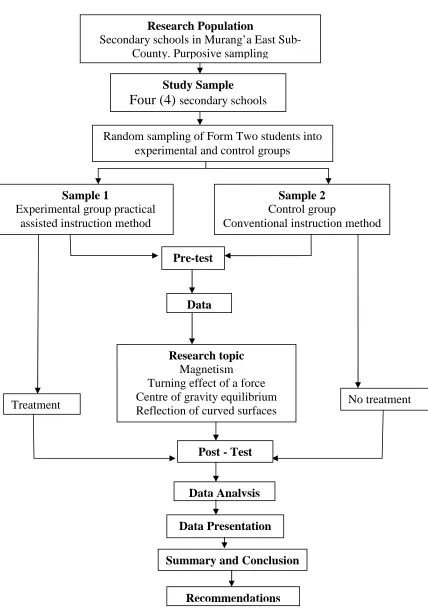
A summary of the entire research design and process is displayed in Figure 3.
Figure 3: Study Design and Process
Research Population
Secondary schools in Murang’a East Sub-County. Purposive sampling
Study Sample
Four (4)
secondary schoolsRandom sampling of Form Two students into experimental and control groups
Sample 1
Experimental group practical assisted instruction method
Sample 2 Control group
Conventional instruction method
Pre-test
Data
Research topic Magnetism Turning effect of a force Centre of gravity equilibrium Reflection of curved surfaces
Treatment No treatment
Post - Test
Data Presentation
Summary and Conclusion
Figure 3 shows how the study was undertaken. Two groups were sampled to form the experimental and control group. The experimental group was given the treatment while the control group was not. The two groups were exposed to the post-test achievements test, the mean for each group was computed and the difference analyzed using the t-test.
3.3 Location of the Study
The study was located in secondary schools of Murang’a East Sub-County. The Sub-county has 31 secondary schools. The Sub-county was chosen due to the low enrolments in Physics and also the low students’ achievements in the subject in KCSE (Appendix 1).
3.4 Target Population
The target populations were the 9820 form two students of 31 secondary schools in Murang’a East Sub-County (County Education Office, 2013). The unit of analysis was the Form Two students in the 31 secondary schools. The sampling frame is shown in Table 2. The 31 schools were categorized into; two (2) private’s schools and one (1) national school, one (1) extra county school, three (3) District school and twenty four (24) Days school.
3.5 Sampling and Sampling Procedures
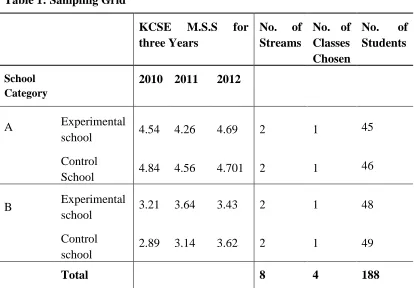
prerequisite skills and the knowledge level of the students in Physics is almost the same. Schools with almost the same MSS in the past five at KCSE. Also one of the key resource that were required for practical work as a method of instruction is availability of a relatively functional laboratory with basic laboratory fittings. The sample was drawn from the Day schools’ category. This was because the schools’ in the category had low enrolments and low achievements in Physics in KCSE. Stratified sampling technique was used to select the sample. The Day schools were classified into two; those with a define MSS of between 4 -5 and those with a MSS between 3- 4 the 2012 KCSE results. From each stratum, two schools were purposively chosen totaling to a sample size of four schools. Sampled schools were far from each other to minimize interaction.
Table 1: Sampling Grid
KCSE M.S.S for three Years
No. of Streams
No. of Classes Chosen
No. of Students
School Category
2010 2011 2012
A Experimental
school 4.54 4.26 4.69 2 1 45
Control
School 4.84 4.56 4.701 2 1
46
B Experimental
school 3.21 3.64 3.43 2 1 48
Control school
2.89 3.14 3.62 2 1 49
Total 8 4 188
3.6 Research Instruments
There were four (4) instruments used in this study. Their development and roles are explained in the following section.
3.6.1 Pre-Test Achievements Test
3.6.2 Post-test
The Students Achievements Test (SAT) was administered to both experimental and control groups in a staggered manner throughout the term (Appendix VII). Specific tests evaluating the work done in each topic was given at the end of the topic. These was graded and eventually complied at the end of the term.
3.6.3 Form Two Students Attitude Scale (FTSAS)
This was administered at the beginning of the study and at the end of the study (Appendix X). The scale was based on a five point Likert type attitude scale. Strongly disagree (1) disagree (2) don’t know (3) agree (4) and strongly agree (5).
3.6.4 Observation Checklists for Skills Acquisition (OCFSA)
This was administered to each study group to determine proficiency aspects of science process skills and experimental achievements attitude (XI).
3.7 Piloting
3.7.1 Validity of the Instruments
Content and construct validity of the research tools were initiated at the design stage. Some of the items used in the achievements tests were adapted from KNEC (2008, 2009 & 2010). The test items were constructed using the Form Two syllabus.
These strengthened both content and construct validity. This stage was followed by the pilot study whose main purposes were to check the appropriateness of the language used in the tools and to conceptualise them for predictability and reliability. The pre-test and post-tests were developed with the assistance of three experts in Science Education in Department of Educational Communication and Technology at Kenyatta University and two KNEC Physics Examiners in 231/1-paper one. The Form Two Students Attitude Scale (FTSAS) was adapted from Tapia & Marsh (2004).
3.7.2 Reliability of the Instrument
The reliability of the assessment test was determined using the split-half method. This is where the total number of items were divided into halves by assigning the odd numbered items to one half and even numbered items to the other half. Correlation between the two halves was determined. Spearman-brown prophecy formula was used to estimate the reliability of the whole test. The Spearman–Brown prophecy formula adopted from Elzinga, et al., (2001) was used.
2
1
reliability coefficient of 0.83 and 0.87 were obtained for the Pre-test and posttest tests respectively. The Form Two Students Attitude Scale (FTSAS) was adapted from Tapia & Marsh (2004). The scale has a reliability coefficient of 0.96.
3.8 Data Collection Methods and Procedures
At the beginning of the term the four groups were given a standard achievements test which served as a pre-test. This pre-test was based on work covered previously. The results from this test were analysed to ascertain the relative achievements levels of both the experimental and the control groups. At the beginning of the study, the teachers who were involved in the study underwent training exercise to familiarize themselves with the practical approach. The students were taught using the practical approach for the experimental group and the conventional method for the control group for a period of one term. The topic taught were: Moment and Force, center of gravity and equilibrium, magnetism and reflection of curved surfaces. These topics were selected from the syllabuses as stipulated by Kenya Institute of Curriculum Development (KICD) and Kenya National Examination Council (KNEC).
the class before the respondents were required to complete writing the final laboratory report. In the control group the conventional method of teaching was used. The students achievements tests (SAT) was administered to the respondents in a staggered manner throughout the term. Specific tests evaluating the work done in each topic was given out at the end of each topic. This formed the post-test scores. All the students in the two groups were given a Form Two Students Attitude Scale, (FTSAS). The scale was based on a five point Likert type attitude towards Physics learnt up to form two. The respondents proficiency in practical skills garnered from each of the topics learnt in class was determined using the Observation Checklists for Skills Acquired (OCFSA) administered to each study group. The OCFSA determined proficiency in aspects of science process skills. Finally during term one the next year; the same respondents were tracked to find out how many of them had chosen to study Physics in form three.
3.9 Methods of Data Analysis
The data collected underwent various stages of preparation before the analysis using the Statistical Package for Social Sciences (SPSS) computer software. First, the data were edited and coded. A code book was then used to prepare computer code sheet, which was later used to synthesize the data. Upon completion of data entry, the data was cleaned to detect and remove any errors committed during data entry. Simple frequency analyses on the variables were run and random cross-tabulation done to clean the data.
Quantitative analysis involved presentation of statistical data in form of frequency distribution tables whose explanation was mainly descriptive and inferential statistics. The statistical significance of the results was then examined at α = 0.05 statistical confidence level. Quantitative data was analyzed using independent t-test. For objective one, the student’s t-test was used to compare if there was significant difference in the means between the control and experimental groups in the pre-tests and post-tests. The student t-test was used to establish the significant difference in means in Physics achievements between those students taught Physics using the practical approach and those taught using the conventional method. In the respect to the students’ attitude towards Physics, the student t-test was also used to establish the significant difference in MSS in the attitude scale between pre-test and post-tests for both the control and the experimental groups.
For the science process skills, the Observation Checklists for Skills Acquisition (OCFSA) was used to collect quantitative data. Student t-test was also used to establish the significant difference in the mean of students’ achievements in the science process skills between the experimental and control groups. For objective two, a prototype marking scheme for the evaluation of Science Process Skill was developed based on the evaluation scheme for the experimental groups in Practical work.
3.10 Ethical Consideration
CHAPTER FOUR
DATA ANALYSIS, PRESENTATION AND DISCUSSION
4.0 Introduction
This chapter presents, interprets and discusses the findings generated from this study and reported using mainly tabular mode. The chapter specifically considers and explains effects of practical work in Physics on students, in particular achievements in Physics, acquisition of science process skills, attitude change towards Physics, scheme for evaluating practical work in secondary schools Physics and enrolment in Physics at KCSE.
4.1 Effects of Practical Work in Physics on Students’ performance in Physics In order to establish the effects of practical work in Physics on student’s performance in Physics, the respondents were first subjected to a pre-test to determine their equivalence about ability in physics. A Physics Achievements pre-test was used for this purpose.
4.1.1 Students’ Performance the Physics Achievement Pre-Test
Table 2
Mean Scores of the Pre-Test per Group
Table 2 results show that the experimental and control groups are fairly equivalent in ability in Physics. This underscores the fact that both the experimental and control groups were starting on a fairy even ground. The equivalence of the groups was confirmed by the t-test using their means. The differences in means were not significant.
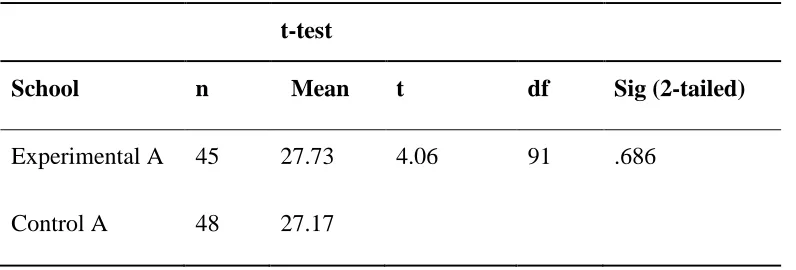
Table 3
Comparison of Mean Scores of Experimental and Control A Groups t-test
School n Mean t df Sig (2-tailed)
Experimental A 45 27.73 4.06 91 .686
Control A 48 27.17
Table 3 shows that there was no significant mean difference in the performance of pre-tests between experimental and control schools in set A school, t (91) = 4.06, ρ = 0.686, α = 0.05). An independent t-test was also conducted for the schools set B. The results are presented in Table 4.
Group (School) n Mean Std Deviation (SD)
Experimental A 45 27.73 7.817
Control A 48 27.17 5.513
Experimental B 46 25.24 8.239
Control B 49 25.31 7.177
Table 4
Comparison of Mean Scores of Experimental and Control for set B Groups t-test for Equality of Mean
School n Mean t df Sig (2-tailed)
Experimental B 46 25.24 .042 93 .966
Control B 49 25.31
Table 4 shows that an independent t-test conducted absolute t (93) = 0.042, ρ = 0.966, α = 0.05 revealed that there was no significant difference between the experimental and control schools in set B in the performance of pre-test as shown in Table 5 and 6.
4.1.2 Students’ performance in the Post-Test
The experimental group was taught for a full school term using a practical approach while the control group went on with the conventional approach which does not use many practical sessions. At the end, a post test was administered (see Appendix VII). The results are as in Table 5.
Table 5
Students’ performance in the Post-Test Achievement Test
School n Mean SD
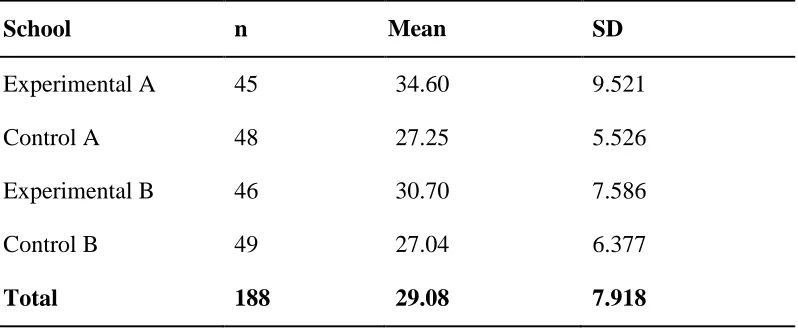
Experimental A 45 34.60 9.521
Control A 48 27.25 5.526
Experimental B 46 30.70 7.586
Control B 49 27.04 6.377
Table 5 shows that the experimental groups in both cases performed higher than the control groups. For group A the experimental group had a mean = 34.6 while the control group had mean = 27.25. On the other hand, in group B, the experimental group had (mean = 30.7) while the control group had (mean = 27.04. This clearly shows that the intervention was effective and that practical approach is more effective.
Table 6
Independent t-test for the Post-Test
t-test for Equality of Mean
Set School n Mean T df Sig. (2-tailed)
A Experimental A 45 34.60 4.588 91 .000*
Control A 48 27.25
B Experimental B 46 30.70 2.548 93 .012*
Control B 49 27.04 * Significant at .05 level
Table 6 shows that there was a significant difference for the two sets A and B. It was more significant for A (M = 34.60) and control school A (M = 27.25), t (91) = 4.588,
Table 7
Comparison of Mean Scores of Post-Test among the Four Schools
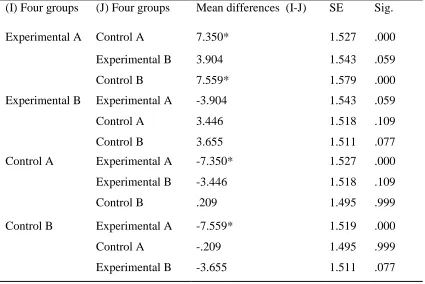
(I) Four groups (J) Four groups Mean differences (I-J) SE Sig.
Experimental A Control A 7.350* 1.527 .000
Experimental B 3.904 1.543 .059
Control B 7.559* 1.579 .000
Experimental B Experimental A -3.904 1.543 .059
Control A 3.446 1.518 .109
Control B 3.655 1.511 .077
Control A Experimental A -7.350* 1.527 .000
Experimental B -3.446 1.518 .109
Control B .209 1.495 .999
Control B Experimental A -7.559* 1.519 .000
Control A -.209 1.495 .999
Experimental B -3.655 1.511 .077
* Significant at .05 level
Table 7 shows that there is a significant mean difference between experimental A and control school A (7.350), ρ = .001 and between experimental B and control B (7.559), ρ = .001. The study may attribute the significant mean difference to practical work which enhanced acquisition of skills resulting in better achievements.
students exposed to practical work in Physics performed better than those taught through conventional method. Wasanga (2009) also found a similar correlation between practical work and understanding of science subjects which leads to improved achievements in achievements tests. Amunga et al., (2011a) demonstrated that practical work makes the students take learning science seriously. The determination to unravel the requirements of the objectives of the practical task leads the learners to take charge of the learning situation and to develop an insight in the requirements of the tasks involved in the practical work.
concluded that practical work in Physics as an instructional strategy significantly contributes to students’ achievement in Physics.
4.2 Effect of Practical Work in Physics on Students’ Attitude towards the subject
The study was also designed to establish the effects of practical work in Physics on students’ attitude change towards Physics. For systematic presentation of the findings in this area, the study presented the result of the students’ pre-test attitude towards Physics between the experimental and control groups and then followed by post-test attitude towards Physics and finally compared the two.
4.2.1 Pre-Test Students’ Attitude towards Physics scale
Table 8
Pre-Test Students’ Attitude towards Physics
t- test
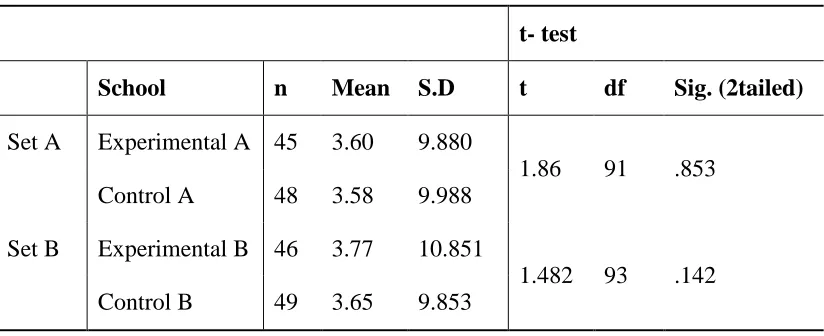
School n Mean S.D t df Sig. (2tailed) Set A Experimental A 45 3.60 9.880
1.86 91 .853 Control A 48 3.58 9.988
Set B Experimental B 46 3.77 10.851
1.482 93 .142 Control B 49 3.65 9.853
*Significant at α = .05
Table 8 shows that the experimental group A (M = 3.60, SD = 9.880) had a higher mean attitude towards Physics than control A (M = 3.58, SD = 9.988). However, these results show that there was not statistically significant difference in the means of the two groups. The experimental school B had also a higher mean attitude towards Physics (M = 3.77, SD = 10.85) than the control school B (M = 3.65, SD = 9.853). These results show that there was no statistically significant mean difference between the experimental and control groups. This is important as it shows that the experimental and control group started off at the same level in terms of attitude towards Physics.
4.2.2 Post-Test Students’ Attitude towards Physics
Table 9
Post-Test Students’ Attitude towards Physics
t- test
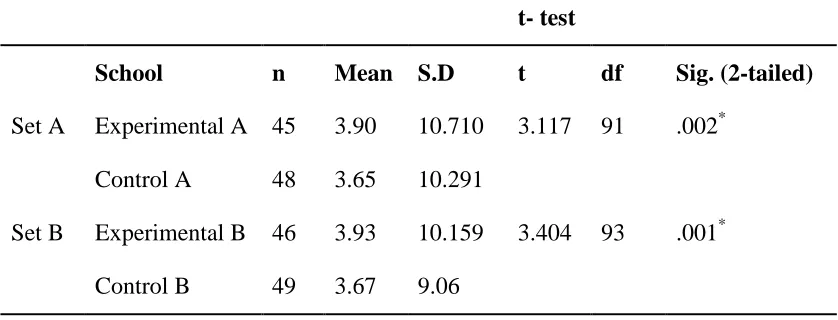
School n Mean S.D t df Sig. (2-tailed) Set A Experimental A 45 3.90 10.710 3.117 91 .002*
Control A 48 3.65 10.291
Set B Experimental B 46 3.93 10.159 3.404 93 .001* Control B 49 3.67 9.06
* Significant at .05
Table 9 shows that experimental school A had a higher mean attitude towards Physics (M = 3.90, SD = 10.710) than control school A (M = 3.65, SD = 10.291). The difference between the two groups, t (91) = 3.117, ρ =.002, α =.05. This implies that the experimental group taught Physics through practical work had a better attitude towards the subject than those taught through the conventional method. Table 9 also shows that the experimental school B had a higher mean attitude towards Physics (M = 3.93, SD =10.159) than the control school B (M = 3.67, SD = 9.06). The t-test performed shows that there was a significant mean difference between the two schools in sample set B in attitude towards Physics t (93) = 3.404,