International Journal of Research (IJR)
e-ISSN: 2348-6848, p- ISSN: 2348-795X Volume 2, Issue 07, July 2015Available at http://internationaljournalofresearch.org
Intelligent Recommendation E-menu using android
application in restaurant
G. Yaswanth Babu
1; P.Praveen
2& D. Vijay Kumar
3M.Tech, Dept of ECE Vijaya Engineering College, Telangana, India. Email: [email protected]
Assistant Professor, Dept of ECE,Vijaya Engineering college, Telangana,India, Email: [email protected]
Associate Professor, HOD ,Dept of ECE,Vijaya Engineering college, Telangana,India, Email: [email protected]
Abstract
The growing number of restaurants and population of restaurant-goers have emphasized the need to enhance the working of hospitality industry. This research work aims at improving the quality of services and business of the hospitality industry by incorporating technology. A detailed research on the integration and utilization of technology in hospitality industries showcased that various applications based on wireless technologies are already in use enabling partial automation of the food ordering process. In this paper, we discuss about the integration of touch technology in restaurants using android. This system is a basic dynamic database utility system which fetches all information from a centralized database. The tablet at the customer table contains the android application with all the restaurant and menu details. The customer tablet, kitchen display and the cashier counter connects directly with each other through WiFi. This wireless application is user-friendly, improves efficiency and accuracy for restaurants by saving time, reduces human errors and provides customer feedback. This system successfully overcomes the drawbacks in earlier automated food ordering systems and is less expensive as it requires a one-time investment for gadgets.
Keywords: recommendation; tablet; E-menu; android application; intelligent; restaurant
1.
Introduction
Over the years, technology has tremendously revolutionized the restaurant industry. But much of the innovation has been with point-of-sale (POS) operations. Yet other areas of a restaurant are ripe for innovation, such as the menu. Traditional restaurant service requires waiters to interact with customers directly before processing their orders. However, a high-quality recommendation service system would actively identify customers and their favorite meals and expenditure records. The restaurant menu has evolved from its humble beginnings on carte chalkboards and imageless print to today’s detailed, colorful displays. With the emergence of digital tablets and user-friendly touch screen technology menus can move to a Whole new
International Journal of Research (IJR)
e-ISSN: 2348-6848, p- ISSN: 2348-795X Volume 2, Issue 07, July 2015Available at http://internationaljournalofresearch.org
paper menus with the digitized tablet menu. But none of the apps let the patronplace an order directly to the kitchen. The tablet’s use is restricted to simple viewing of the menu.
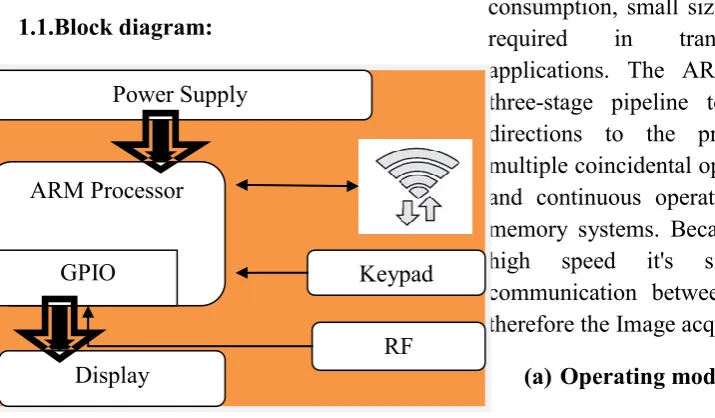
1.1.Block diagram:
Fig 1: Restaurant Table Section.
Fig 2: Feedback Section.
Fig 3: Billing Section
2.
Related Work
2.1. System Hardware
2.1.1. ARM Processor
The ARM7 family includes the ARM7TDMI, ARM7TDMI-S, ARM720T, and ARM7EJ-S processors. The ARM7TDMI core is that the
industry’s most generally used 32-bit embedded RISC micro chip resolution. Optimized for value and power-sensitive applications, the ARM7TDMI resolution provides the low power consumption, small size, and high performance
required in transportable, embedded
applications. The ARM7TDMI core uses a three-stage pipeline to extend the flow of directions to the processor. This enables multiple coincidental operations to require place and continuous operation of the process and memory systems. Because the processor has a high speed it's simple to form the communication between the RF module and therefore the Image acquisition module
(a) Operating modes:
The ARM7TDMI core has seven modes of operation:
User mode is that the usual program execution state Interrupt (IRQ) mode is employed for general purpose interrupt handling Supervisor mode may be a protected mode for the
Package Abort mode is entered once an
information or
Instruction pre fetch abort the interrupt
setting of ARM supports the DHLS to
Response to the interrupt returning from
the server section.
(b)Interrupt controller:
The Vectored Interrupt Controller (VIC) accepts all of the interrupt request inputs from the house server section and categorizes them as quick Interrupt Request (FIQ), vectored Interrupt Request (IRQ), and non-vectored IRQ as outlined by programmable settings. These interrupt settings can offer a quick response to the RF decoder. so address verification are going to be terribly quicker and signal for image process are going to be given to the image acquisition module.
Power
Supply Encoder
RF Trans mitter Power Supply
ARM Processor
GPIO
Display
Keypad
International Journal of Research (IJR)
e-ISSN: 2348-6848, p- ISSN: 2348-795X Volume 2, Issue 07, July 2015Available at http://internationaljournalofresearch.org
(c) Wireless RF communication:
Frequency, any frequency at intervals the spectrum related to radio emission propagation. once AN RF current is equipped to AN antenna, AN magnetism field is made that then is ready to propagate through house. Several wireless technologies area unit supported RF field propagation.
(d)Wireless Transmitter:
The TWS-434 extraordinarily tiny, and area unit wonderful for applications requiring short-range RF remote controls. The TWS-434 modules don't incorporate internal encryption. If straightforward management or standing signals like button presses or switch closures need to send, think about employing AN encoder and decoder IC set that takes care of all encryption, error checking, and secret writing functions.
The transmitter output is up to 8mW at 433.92MHz with a range of approximately 400 foot (open area) outdoors. Indoors, the range is approximately 200 foot, and will go through most walls. The TWS-434 transmitter accepts both linear and digital inputs can operate from 1.5 to 12 Volts-DC, and makes building a miniature hand-held RF transmitter very easy.
(e) Wireless RF-Receiver:
RWS-434: The receiver conjointly operates at 433.92MHz, and encompasses a sensitivity of 3uV. The WS-434 receiver operates from four.5 to 5.5 volts-DC, and has each linear and digital output. A zero potential unit to Vcc information output is accessible on pins. This output is often accustomed drive a digital decoder IC or a microchip that is acting the info decryption. The receiver’s output can solely transition once valid information is gift. In instances, once no carrier is gift the output can stay low. The RWS-434 modules don't incorporate internal decryption. If
you wish to receive easy management or standing signals like button presses or switch closes, you'll be able to use the encoder and decoder IC set delineated higher than. Decoders with fugitive and bolted outputs are obtainable.
3.
Implementation
To overcome the limitations of existing systems, we propose this integration of touch technology in restaurants based on android technology. It is a wireless food ordering system using android devices. Android devices, in the past few years, have reached the pinnacle of popularity and have revolutionized the use of mobile technology in the automation of routine task in wireless environment.
Our system aims at providing the following features:
Combining of Wireless technology and
Android OS to automate food ordering process.
Allow the restaurant to operate faster
(faster seating, faster order preparation, faster turnaround on food).
Reduce employee error, thereby
increasing customer happiness. This also reduces waste as when the wrong item is ordered, the food must be discarded.
To minimize the flaws in conventional
system by atomizing the working of a restaurant.
To provide a mechanism for obtaining
feed-back from the customers and provide the restaurant a means of review of their service.
3.1 System Architecture
International Journal of Research (IJR)
e-ISSN: 2348-6848, p- ISSN: 2348-795X Volume 2, Issue 07, July 2015Available at http://internationaljournalofresearch.org
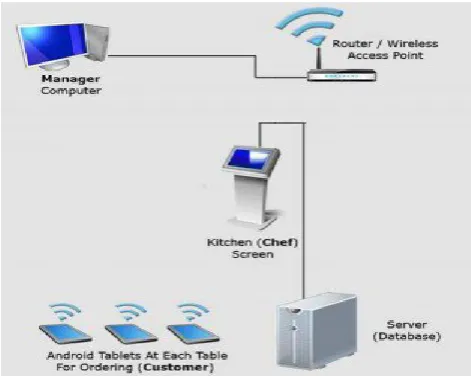
areas of restaurant: the Serving area, the Kitchen, and the
Cashier counter. The main components of this system are:
1. The android application on tablets at the tables. The tablets will be provided to customers, at their tables, allowing them to directly view the menu card and order immediately from their respective tablets. The tablets are the property of the establishment and are kept at each table.
2. The server application on the restaurant-owner’s laptop/tablet to customize menu and keep track of customer records.
3. The central database for restaurant-owner to store updated menu information, order details and broadcast various offers and promotions.
4. Wireless connectivity between the three main areas of restaurant. This system, however, is confined within the restaurant vicinity only.
Fig 4: System Architecture Diagram.
3.2 System Overview:
The most important components of this system are the database and the patron frontends or the tablet applications. Providing value to both the
business and its patron is an important objective, but we believe that one follows the other. Following that belief, the customer is given a whole lot of importance. The following figure demonstrates the flow of our tablet application The patron will be presented with a tablet, running the Android OS.
This tablet will be synchronized with the database running on our centralized cloud powered servers the menu data, upon synchronization, is stored on locally on the tablets so that the user, i.e. patron, need not wait forthe menu to be downloaded from the servers. This will allow faster access to the menu. The user can then browse the menu however they want to, sorting the items on various dimensions like price, popularity, ratings, etc. The user can also click through to view more information about any item like nutritional information, ingredients, trivia and any other content that the restaurant administration may feel like including. The user can also view personalized recommendations for items that they may like. This is one of the most important aspects of our system that not only enhances the customer experience but can also help increase revenue for the business. While browsing through the menu, the customer may add items to his/her order. This process is commonly known as “building the order”. After the order is built and read, the user may go ahead and place the order. The staff will automatically and almost instantly be notified about the new order so that they can act on it. If the establishment allows, the user may even track the status of their order so that the customer may know when to expect their food and drinks to land up on their table.
4.
Experimental Results
4.1 Features:
International Journal of Research (IJR)
e-ISSN: 2348-6848, p- ISSN: 2348-795X Volume 2, Issue 07, July 2015Available at http://internationaljournalofresearch.org
Almost all components - frame, key switches and membrane sheet - other than connecters and cord are manufactured inhouse, giving Minebea an un-matched advantage in terms of quality, supply capabilities, cost-competitiveness and speed of delivery. Especially, these products
capitalize on Minebea's ultra-precision
machining technology of components.
4.2 Efficient Production System:
Plant in China which supply’s the global market employs the Minebea's vertically integrated manufacturing system, whereby all process, from machining components to final assembly are conducted in-house.
5.
Conclusion
E restaurant can be developed in order to provide easy interaction between customers through wireless technology. Customers will get a reply message of available menu items when he sends an enquiry message. With the keypad (at every table) the customers can order their items, these messages are sent to the cashier section wirelessly where he acknowledges with the total amount for the order. This amount (acknowledgment) will be displayed on the LCD at the respective Table section
6. References
[1]Ashutosh Bhargave, Niranjan Jadhav, Apurva Joshi, Prachi Oke, Prof. Mr. S. R Lahane, “Digital Ordering System for Restaurant using Android”, in International Journal of Scientific and Research Publications, Volume 3, Issue 4, April 2013.
[2] Tan-Hsu Tan, Ching-Su Chang, Yung-Fu Chen, Yung-Fa Huang, Tsung-Yu Liu, “Developing an Intelligent e-Restaurant with a Menu Recommender for Customer-Centric
Service”, Systems, Man, and Cybernetics, Part
C: Applications and Reviews, IEEE
Transactions
[3]Shweta Shashikant Tanpure, Priyanka R. Shidankar, Madhura M. Joshi, “Automated Food Ordering System with Real-Time Customer Feedback”, in International Journal of Advanced Research in Computer Science and Software Engineering, Vol. 3, Issue 2, February 2013.
[4]V. Swapna, M. Firdouse Ali Khan, “Design and Implementation of Ordering System for Restaurants”, in International Journal of Engineering Research & Technology (IJERT), Vol. 1, Issue 10, December- 2012.
[5] Tomoko Kashima, Shimpei Matsumoto, and Hiroaki Ishii, “Recommendation Method with Rough Sets in Restaurant Point of Sales System”, PIMECS 2010 Vol III [6] Ali Akhtarzada, Cristian S. Calude and John Hosking, “A Multi-Criteria Metric Algorithm for Recommender Systems”, CDMTCS-400 [7]Android_Developer_Service_http://developer .andr
oid.com/reference/android/app/Service.htht,201 2 [8] Daniel Gallego Vico, Wolfgang Woerndl, Roland Bader “A Study on Proactive Delivery of Restaurant Recommendation for Android Smart phones”
[9] K. Kamarudin, “The Application of Wireless Food Ordering System”, MASAUM Journal of Computing, vol. 1,pp 178-184,2009
[10] http://en.wikipedia.org: Wikipedia is a
multilingual, web-based, free-content
encyclopedia project operated by the Wikimedia Foundation and based on an openly editable model.
[11] Mark L. Murphy. Android Programming Tutorials, The Restaurant Store, pp93-102
[12] http://www.waitersrace.com: The
International Journal of Research (IJR)
e-ISSN: 2348-6848, p- ISSN: 2348-795X Volume 2, Issue 07, July 2015Available at http://internationaljournalofresearch.org
Authors Profiles
G. YASWANTH BABU pursuing his M.Tech, from Vijaya Engineering College, Telangana, India. Email: [email protected]
P.Praveen completed his M.Tech and working as a Assistant Professor, from Vijaya Engineering college, Telangana,India, Email: [email protected] 9966687097
D. Vijay Kumar completed his M.Tech and working as a Associate Professor, HOD , HOD,14-years Experiencefrom