Proficient Resource Allocation for Wireless
Multicast
Mounika.D,Suresh babu.CH
Computer Science&EngineeringGudlavalleruEngineering College, Gudlavalleru,(A.P)
India.
Abstract—In this paper, we propose a bandwidth-efficient multicast mechanism for heterogeneous wireless networks. We reduce the bandwidth cost of an l (IP) multicast tree by adaptively selecting the cell and the wireless technology for each mobile host to join the multicast group. Our mechanism enables more mobile hosts to cluster together and leads to the use of fewer cells to save the scarce wireless bandwidth. Besides, the paths in the multicast tree connecting to the selected cells share more common links to save the wireline bandwidth. Our mechanism supports the dynamic group membership and offers mobility of group members.Moreover,. We use Integer Linear Programming to model the problem and show that the problem is NP-hard. To solve the problem, we propose a distributed algorithm based on Lagrangean relaxation and a network protocol based on the algorithm. The simulation results show that our mechanism can effectively save the wireless and wireline bandwidth as compared to the traditional IP multicast.
Index Terms—Heterogeneous wireless networks, multicast.
I INTRODUCTION
THE success of wireless and mobile communications in the 21st century has resulted in a large variety of wireless technologies such as second and third generation cellulars, satellite, Wi-Fi, and Bluetooth. The heterogeneous wireless networks combine various wireless networks and provide universal wireless access. The leading wirelesscompanies in some countries have operated networks with multiple wireless technologies, such as T-Mobile in the United States, British Telecom in the United Kingdom, Orange Telecom in France, NTT DoCoMo in Japan, and Chunghwa Telecom in Taiwan. The number of such companies would increase because the standards for operators to provide seamless services in networks with multiple wireless technologies have been proposed by the Third-Generation Partnership Project (3GPP) [1] and Unlicensed Mobile Access (UMA) [2]. In addition, users in the heterogeneous wireless networks are usually covered by more than one cell to avoid connection drop and service disruption. More mobile terminals in the wireless networks are likely to own multiple wireless technologies. Therefore, the heterogeneous wireless networks provide the mobile hosts with many choices for the cells and wireless technologies to access the Internet.
Multicast is an efficient way for one-to-many and many to-many communications. Each multicast group owns a set of members, and each member can be a sender or a receiver of the group. The sender in a multicast group delivers data in a multicast tree to all receivers of the group. Current Internet Protocol (IP) multicast routing protocols adopt the
shortest path trees for data delivery [3], [4], [5], [6], [7]. The path from the root of the shortest path tree to each member must be the shortest path in the network. In other words,the routing of the shortest path tree is fixed once the root and all group members have been determined. As a consequence, the bandwidth consumption in an IP multicast tree will not be able to be reduced in wired networks.
cells. However, resource allocation among heterogeneous wireless networks has not been addressed in the previous works. We believe that it is an important issue because current ISPs tend to operate multiple wireless networks and multiradio handsets and PDAs are appearing in the markets. Consequently, in thispaper, we propose a mechanism for reducing the bandwidth consumption in the shortest path tree by adaptively selecting the cell and the wireless technology for each mobile host in the heterogeneous wireless networks. Thefeature distinguishes our work from others. Explicitly, we formulate in this paper the selection of the cell and the wireless technology for each mobile host as an optimization problem, which is denoted as the Cell and Technology Selection Problem (CTSP) in the heterogeneous wireless networks for multicast communications. The problem is to select the cell and the wireless technology for each group member to minimize the total bandwidth cost of the shortest path tree. We design a mechanism, which includes an Integer Linear Programming (ILP) formulation, a distributed algorithm, and a network protocol, to solve the CTSP. We use ILP to formulate the CTSP, and the network operator can use our ILP formulation to find the optimal solution for network planning. We show that CTSP is NP-hard, which, in turn, justifies the necessity of designing efficient algorithms for suboptimal solutions. We devise an algorithm LAGRANGE, which is based on Lagrangean relaxation [21] on our ILP formulation. We adopt the Lagrangean relaxation in our algorithm, instead of other optimization techniques, due to the following reasons: First, our algorithm decomposes the original problem into multiple subproblems such that each subproblem can be solved by each member and base stationindividually. In other words, the algorithm can be implemented in a distributed manner, and the important merit of the LAGRANGE algorithm enables us to design a network protocol accordingly. Second, the algorithm adapts to the change of the group membership and the mobility of group members. The algorithm iteratively reduces the bandwidth consumption according to the current group membership and the location of group members. Third, the algorithm provides the lower bound on the total bandwidth cost of the optimal shortest path tree, where the optimal shortest path tree is the shortest path tree with the optimal selection of the cell and the wireless technology for each member. For the multicast group with a large number of members, the lower bound obtained by our algorithm provides the benchmark for comparing with any algorithm for the problem since using the ILP formulation to find the total bandwidth cost of a large optimal shortest path tree is computationally infeasible. This network protocol can be regarded as a rerouting mechanism. Note that rerouting mechanisms have been designed for unicast communication in backbone IP networks [22], circuit-switched networks [23], optical networks[24], and satellite networks [25] to reduce the bandwidth consumption. Our approach differs from the existing ones in the methods for finding a new routing according to the current one. Our approach is based on Lagrangean relaxation, which is a global optimization technique that iteratively improves the solution toward the
globally optimal solution. However, most of the previous rerouting methods improve each part of the solution locally. Fortz and Thorup [22] adjust the cost of each link in shortest path routing according to the load of the link. Wong et al. [23] substitute a direct circuit-switched path with an alternate longer path. Lee and Li [24] move some links in a congested wavelength path to the fibers with more available wavelengths. Donner et al. [25] choose nearby satellites and links of a congested or failure satellite to reroute a multiprotocol label switching (MPLS) path.
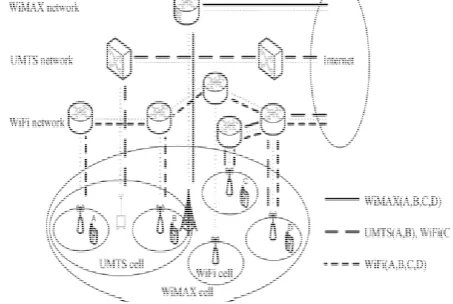
Fig. 1. An example that provides three different multicast trees by selecting different cells and wireless technologies for mobile hosts
Each mobile host in our mechanism may need to switch to another cell or technology to reduce the total bandwidth cost of the shortest path tree. Therefore, our mechanism requires sophisticated handover protocols such as in the related works [26], [27], [28]. Note that our mechanism enables each mobile host to choose, either automatically or manually, the cell and the wireless technology. When some mobile hosts manually choose the cells and the wireless technologies, a partial shortest path tree spanning these mobile hosts is given, and our mechanism reduces the total bandwidth used in the tree by adaptively connecting other mobile hosts to the existing partial tree.
Overall, the contributions of this paper and the featuresof our mechanism are manifold:
. For each wireless technology, our mechanism reduces the number of cells used in the shortest path tree. Our algorithm clusters the mobile hosts such that nearby mobile hosts tend to use the same cell. Therefore, we can reduce the wireless bandwidth consumption even when the operator owns only one wireless technology. Our mechanism also optimizes the resource allocations for the operators with multiple wireless technologies. For a set of nearby mobile hosts, our mechanism uses a single larger cell or multiple smaller cells to serve these hosts depending on the number of mobile hosts, the location of each mobile host, and the bandwidth cost of each wireless technology.
bandwidth such as the optical network. Also, the flexible cost model enables the network operators to balance the load of both wireless cells and wired links. The network operators can increase the cost of a link or cell when the link or cell is congested [22].
. Our mechanism is transparent to the IP multicast routing protocols. The shortest path tree is created by joining the multicast group with the IP multicast routing protocols after each member has selected the cell and the wireless technology according to our mechanism. We thereby require no modification on the current IP multicast routing protocols. . Our protocol supports the dynamic group membership. Our protocol reduces the total bandwidth cost according to the current group membership. When some mobile hosts join or leave a multicast group, each mobile host of the multicast group can adaptively initiate a horizontal or vertical handover to reduce the bandwidth consumption in the current shortest path tree.
The rest of the paper is organized as follows: Section 2 describes our assumption, presents our ILP formulation and shows that CTSP is NP-hard. We propose the LAGRANGE algorithm, which is based on Lagrangean relaxation, in Section 3 and our protocol based on the algorithm in Section 4. Section 5 presents our experimental results. Finally, we conclude our paper in Section 6.
II. PROBLEM DESCRIPTION
In this paper, we consider CTSP in the heterogeneouswireless networks for multicast communications. The problem is to select the cell and the wireless technologyfor each group member to minimize the total bandwidthcost of the shortest path tree. The total bandwidth cost of the shortest path tree consists of the total wireless bandwidth cost of the selected cells and the total wirelinebandwidth cost of the shortest path tree spanning the root and each selected cell. In the following, we first describe our assumption and notation in Section 2.1. We then propose our ILP formulation and show that the CTSP is NP-hard in Section 2.2.
A.Assumption and Notation
In this paper, we assume that every wireless cell has the multicast capability. That is, the base station of the cell can send a single multicast packet to all mobile hosts in the cell instead of sending an individual packet to each mobile host. In addition, some members in a multicast group can be located in the wired network, but we focus on only the shortest path tree in the heterogeneous wireless networks, which could be a subtree of the whole multicast tree spanning all members. The reason is that the routing of the subtree spanning the members in the wired network is fixed. Therefore, the shortest path tree in the rest of the paper means the subtree in the heterogeneous wireless networks and the root of the subtree is the common gateway in the heterogeneous wireless networks. If each wireless network owns an individual gateway, our mechanism can still solve the CTSP by using a virtual common gateway to connect with the gateway in each wireless network and assigning a zero cost to each wireline link between the gateways. Note that we assume that the path between the root of a tree and a mobile
host via eachwireless network is determined mobile by the multicast protocol in the network and is given in our problem. The mobile hosts considered in this paper are the members of a multicast group. A cell covers a mobile host if the mobile host is within the transmission range of the base station of the cell. Let a cell be a candidate cell if the cell covers at least one mobile host. A node or link x is downstream to another node or link y in the shortest path tree if y is on the path from the root of the tree to x. A subtree that is downstream to a link e contains link e and every node and link that is downstream to e in the shortest path tree. For simplicity, the selection of the cell for each mobile host means the selection of both the cell and the wireless technology in the rest of the paper. The notation in this paper is summarized as follows:
. C: the set of cells in the heterogeneous wireless networks. . E: the set of links in the shortest path from each
candidate cell to the root of the tree. . M: the set of mobile hosts in the network.
. Mc: the set of mobile hosts covered by cell c,c ∈ C.
. Cm: the set of cells covering mobile host m,m ∈ M, Cm ∁ C. . Cu: the set of cells that are downstream to node u in the shortest path tree Cu ∁ C.
. Ec: the set of links in the shortest path from cell c to the root of the tree Ec ∁ E.
. Eu: the set of links that are downstream to node u in the shortest path tree Eu ∁ E.
. eu;v: the link from node u to v, eu;v E. . bc: the bandwidth cost of cell c, c ∈ C. . bu;v: the bandwidth cost of link eu;v, eu;v ∈ E. . cu;v: the cell with the base station v connected to link eu;v, cu;v ∈C, eu;v ∈ E.
. r: the root of the shortest path tree.
B. ILP
We use ILP to model CTSP. The ILP formulation can find the optimal shortest path tree in the heterogeneous wireless networks with any existing commercial software. Our ILP formulation has the following variables:
. m;c: a binary variable. _ m;c is 1 if mobile host mselects cell c, m ∈M, c ∈ Cm.
. _c: a binary variable. _c is 1 if cell c is used in the shortest path tree c ∈ C.
The objective function of our ILP formulation is given as follows:
bc bu, v
, ∈ ∈
The constraints of our ILP formulation are given as follows:
. 1
∈
covered by at least one selected set. Therefore, Minimum Set Cover is the same as the CTSP if we connect each cell in the CTSP directly to the root with a zero-cost wireline link, where each cell and mobile host in the CTSP are just the set and element in Minimum Set Cover, respectively.
III. DESIGN OF LAGRANGE ALGORITHM
In this section, we propose an algorithm for CTSP. The LAGRANGE algorithm is based on Lagrangean relaxation on our ILP formulation proposed in Section 2. The LAGRANGE algorithm has the following advantages:
. The algorithm can be implemented in a distributed manner. Each mobile host owns a cost for each covering cell and selects the cell with the smallest cost. The wireless networks compute and update the cost in a distributed manner to reduce the total bandwidth cost of the shortest path tree. No centralized server is required to maintain the group membership, the network topology, and the location of each mobile host. Therefore, the algorithm is easier to be integrated with the current IP multicast service model and protocols.
. The algorithm iteratively reduces the total bandwidth cost of the shortest path tree according to the current group membership and the set of cells covering the mobile hosts. In other words, the algorithm adapts to the dynamic join and leave of mobile hosts in a multicast group and the mobility of members.
. The algorithm provides a lower bound on the total bandwidth cost of the optimal solution to the CTSP. The lower bound can be used for comparing with the solution obtained by any algorithm for the problem. The algorithm relaxes a constraint of our ILP formulation and transfers CTSP into the Lagrangean Relaxation Problem (LRP). The LRP owns a new objective function with the Lagrange multipliers and fewer constraints such that we can decompose the LRP into multiple subproblems, where each subproblem can be solved in a distributed manner.
The members in our algorithm collaboratively construct the shortest path tree according to the solutions to the subproblems. Besides, the cost of each cell for each member is updated iteratively to reduce the total bandwidth cost of the shortest path tree according to the current group membership and the locations of members. Therefore, the algorithm is suitable for protocol design. In the rest of this section, we describe how we can solve CTSP:
. Transfer CTSP into the LRP.
. Decompose the LRP into multiple subproblems andsolve each subproblem respectively
. Select the cell and the wireless technology for each member according to the solutions to the subproblems.
. Reduce the total bandwidth cost of the shortest path tree by iteratively updating the cost of each cell for each mobile host. A. Decomposing and Solving the LRP
The algorithm relaxes the second constraint in the ILP formulation to transfer CTSP into the LRP, and the objective function of the LRP is given as follows:
,
, ∈
, ,
∈
min , ,
∈ ∈
, ,
, ∈ ∈
∈
We solve the LRP by decomposing the LRP into two subproblems. We divide the objective function and the constraints of the LRP into two parts, where each subproblem owns one part of the objective function and constraints. The variables in the two subproblems are mutually independent such that we can solve each subproblem individually, and the solution to the LRP is just the combination of the solutions to the two subproblems. The objective function of the first subproblem is given as follows:
, ,
∈ ∈ ∈
The first subproblem has the following constraint:
, 1, ∀ ∈
∈
In the subproblem, each cell c is associated with a
cost m;c for each mobile host m. The optimal solution to the first subproblem is to find the cell with the minimum cost for each mobile host m. The runtime of the algorithm for the first subproblem is thereby O(jMjjCj). In the LAGRANGE algorithm, the cost m;c for cell c is stored in each mobile host m, and each mobile host can thereby find the cell with the minimum cost individually.
The objective function of the second subproblem is given as follows:
, ,
, ∈ ∈
∈
B. Finding and Improving the Solution to the CTSP
Each member m in the LAGRANGE algorithm selects the cell c according to the cost _ m;c, the Lagrange multiplier, of the cell in the first subproblem. We adjust the cost iteratively with the subgradient algorithm [21] and the solutions to the two subproblems of the LRP. Let W( ) denote the objective function of the LRP in Section3.1 where
, , ∀ ∈ , ∀ ∈ . The subgradient
corresponding to the optimal solution of the LRP is denoted as
, , ∀ ∈ , ∀ ∈ ,
where
IV. PROTOCOL DESIGN
In this section, we propose a distributed protocol based on the LAGRANGE algorithm in Section 3. Our protocol is transparent to the current IP multicast routing protocols. Each mobile host individually selects the cell with the lowest cost to join the multicast group with the multicast routing protocols, and we regard the shortest path tree for data delivery as the data tree of the multicast group. To iteratively reduce the cost of the data tree, our protocol needs to solve the second subproblem of the LRP. Our protocol builds a control tree to solve the second subproblem in a distributed manner, where each router and base station in the control tree maintains a node agent and cell agent. Initially, the control tree spans every candidate cell. Afterward, our protocol incrementally prunes the control tree to reduce the protocol overhead. In the following, we explain the information stored in each agent in Section 4.1, the control messages in Section 4.2, and the operations of our protocol in Section 4.3.
A. State
The information stored in each agent is a soft state to guarantee the robustness of the protocol. A soft state stored in an agent needs to be refreshed periodically by neighbor agents or covering mobile hosts. Therefore, when any incident link or adjacent agent fails, the node agent removes the state to ensure that no idle state remains in the agent. Each node in a multicast tree stores the required information for its parent node and child nodes to build the tree in a distributed manner, which is identical to the standard multicast routing protocols. Each node agent stores the following states: 1) multicast group address, 2) the address of the parent node agent in the control tree, and 3) the bandwidth cost of the link that connects the node agent and the parent node agent. For each child agent in the control tree, the node agent stores the address of the child agent and a Join Timer. We use the Join Timer to maintain the soft state for the child agent. When the timer times out, the node agent removes the state corresponding to the child agent.
B. Control Messages
Our protocol has the following control messages: Join,Join_Ack, Leave, Request, Reply, and Inform. We introduce each control message as follows:
. Join. Each mobile host or node agent sends a Join message to a cell agent or the parent node agent to join the control tree. Each mobile host or node agent also periodically sends a Join message to refresh the soft state.
. Join_Ack. Each cell agent or node agent returns a Join_Ack message to confirm the Join message after it receives a Join message. The Join_Ack message sent by a cell agent also contains the Data Flag and the cost of the cell for the mobile host. Each mobile host may select another cell after it acquires the cost for the cell from the cell agent.
. Leave. Each mobile host sends a Leave message to
each covering cell agent when it decides to leave the multicast group or when it is no longer covered by the cell. Each cell agent sends a Leave message to the parent node agent if it has
no covered mobile host or if it is pruned in the control tree. Each node agent sends a Leave message to the parent node agent if it has no child agent or if it is pruned in the control tree.
. Request, Reply, and Inform. Our protocol uses the three messages to update the cost of each cell in a distributed manner. The root of the control tree periodically initiates an update procedure by sending a Request message along the tree to each cell agent. The Reply message finds the net cost of the control tree. Each node agent sends an Inform message to the downstream cells if it obtains a zero net cost. The Inform message determines the Control Flag of each cell agent.
C. Operations
We describe the protocol operations as follows:
1. Join a multicast group. When a mobile host decides to join a multicast group, it sends a Join message to the cell agent of each cell that covers the mobile host. If the mobile host receives a Join_Ack message from any cell agent, with Data Flag being TRUE, it selects the cell to join the multicast group. Otherwise, it can select any cell to join the group. When a cell agent receives a Join message from a new mobile host, it creates a new state for the mobile host. If the cell agent has not joined the control tree, it sends a Join message toward the root. The Join message propagates upstream until it reaches the root or any node agent that is in the control tree. 2. Hand over to a new cell. When a mobile host hands over to a new cell, it sends a Join message to the new cell and a Leave message to the original cell. The Leave message may propagate via the new cell if the mobile host is no longer covered by the original cell. A cell agent removes the state for the mobile host after it receives the Leave message from the mobile host. If the Leave message fails to reach the original cell agent, the cell agent can still remove the state for the mobile host after the Join timer for the mobile host times out. 3. Update the cost of each cell. The root of the control tree periodically sends a Request message along the control tree to each cell agent. After the message arrives at a cell agent, the cell agent first calculates the net cost according to the LAGRANGE algorithm in Section 3. If the net cost is negative, the cell agent then sets the Control Flag as true and sends a Reply message with the net cost to its parent node agent; otherwise, it sets the Control Flag as FALSE and sends a Reply message with a zero net cost to its parent node agent. The cell agent then updates the cost for each covered mobile host. Each node agent first finds the net cost according to the net cost included in the Reply message from every child node agent.
5. Leave the multicast group. Each mobile host sends a Leave message to a cell agent when it decides to leave the multicast group. Each cell agent leaves the control tree if it covers no mobile host. Each node agent leaves the control tree if it has no child agent.
V. EXPERIMENTAL STUDIES
In this section, we present our simulation results. To the best of our knowledge, there is no related algorithm for CTSP in the previous works. Therefore, we compare the LAGRANGE algorithm with two other algorithms that can represent the reasonable user behaviors. In the first algorithm RAND, each mobile host randomly selects a cell. In the second algorithm LOCAL, each mobile host locally selects the wireless technology with the minimum bandwidth cost because the mobile host tends to spend the least monetary cost in this case To test the performance of our algorithm in different scenarios, we change the following parameters:
1. Group size. The group size is the number of members, namely, mobile hosts, in a multicast group. We change the group size to test the scalability of our algorithm and protocol.
2. Transmission range of a base station. For each wireless technology, the size of the overlapping area of adjacent cells is different when the transmission range of a based station changes.
3. Bandwidth cost of each link and cell. The network operators can assign a larger bandwidth cost to a wireless cell rather than a wireline link. The network operators can also give a larger bandwidth cost to a congested link or cell to balance the traffic load in the networks. Besides, we also consider that every wireline link is assigned a zero cost to represent the case that the network operators concern only the wireless bandwidth consumption. We measure 100 samples in each scenario. The performance metrics in our simulation are listed as follows:
1. Total bandwidth cost of the data tree and the control tree. The data tree is the shortest path tree for data delivery, and control tree is the shortest path tree in our protocol to solve the second subproblem of the LRP in a distributed manner. 2. Number of links and cells in the data tree and the control
tree. The number of control messages and the number of nodes storing the agent of our protocol are proportional to the number of links and cells in the control tree.
A. Results for Small Wireless Networks
We first compare the solutions obtained by the LAGRANGE algorithm with the optimal solutions obtained by our ILP formulation with CPLEX [31]. We simulate only small wireless networks because solving large ILP problems is computationally infeasible. The network is in a 25 km _ 25 km service area and has 36 hexagon cells. The base stations of every adjacent nine cells are connected to a router, and each router is connected to the gateway. The bandwidth cost of each cell and link is 1 and 3.
presents the total bandwidth cost and the number of cells used in the data tree and the control tree. The number of links used in the data tree and control tree is similar to Fig. 4b. Fig. 4 shows that our algorithm outperforms both RAND and LOCAL. Our algorithm saves about 40 percentof bandwidth cost.
B. Transient Behavior of the LAGRANGE Algorithm
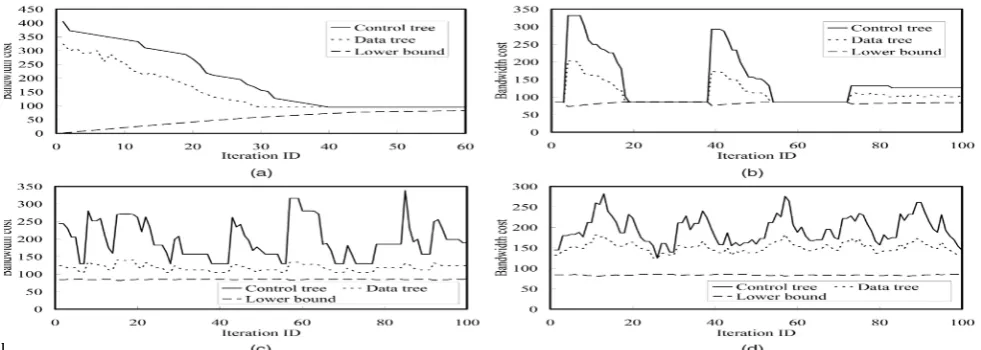
Fig. 2 presents the transient behavior of the LAGRANGE algorithm with 65 members in the multicast group. We change the probability that each mobile host decides to move at each iteration. Fig. 6a first shows the total bandwidth cost after each iteration of the algorithm when no mobile host moves. Fig. 6a indicates that the total bandwidth cost of the LAGRANGE algorithm approaches the lower bound on the total bandwidth cost of the optimal
shortest path tree, and the control tree is pruned iteratively.Our algorithm, at some iterations, generates the shortest path trees with slightly larger bandwidth costs than the trees in the previous iterations. The reason is that our algorithm, which is based on Lagrangean relaxation, searches the slightly worse solutions to avoid trapping in locally optimal solutions [21]. Figs. 2b, 2c, and 2d change the frequency of each mobile host to move to a new location. The average bandwidth cost of a data tree slightly increases when a mobile host moves more frequently.
Fig. 2. Transien
VI.CONCLUSION
In this paper, we have proposed a new mechanism for
reducing the total bandwidth cost of the IP multicast tree by adaptively selecting the cell and the wireless technology for each mobile host. We model the selection of the cell and the wireless technology for each mobile host as an optimization problem. We use ILP to formulate the optimization problem and show that the problem is NP-hard. The network operator can use the ILP formulation to find the optimal solution for network planning in small wireless networks. We design an algorithm based on Lagrangean relaxation and devise a distributed protocol based on the algorithm. Our algorithm iteratively reduces the total bandwidth cost of the shortest path tree. Our protocol supports the dynamic
group membership and mobility of members. Moreover, our protocol requires no modification on the current IP multicast routing protocols. Our simulation results show that our mechanism can effectively save the network bandwidth compared with the traditional IP multicast
ACKNOWLEDGMENTS
This work was supported in part by the National Science Council of Taiwan under Contract NSC93-2752-E-002-006- PAE. The authors would like to thank the anonymous referees for their helpful comments to improve this paper.
REFERENCES
[1] 3GPP System to Wireless Local Area Network (WLAN) Interworking, 3GPP TS 23.234, 2007.
[2] Unlicensed Mobile Access (UMA), http://www.umat echnology. org/index.htm, 2007.
[3] D. Waitzman, C. Partridge, and S. Deering, Distance Vector Multicast Routing Protocol, IETF RFC 1075, 1988.
[4] J. Moy, Multicast Extensions to OSPF, IETF RFC 1584, 1994.
[5] D. Estrin et al., Protocol-Independent Multicast-Sparse Mode (PIMSM): Protocol Specification, IETF RFC 2117, 1997.
[6] A. Ballardie, Core-Based Trees (CBT Version 2) Multicast Routing Protocol Specification, IETF RFC 2189, 1997.
[7] S. Bhattacharyya, An Overview of Source-Specific Multicast (SSM), IETF RFC 3569, 2003.
[8] T.G. Harrison, C.L. Williamson, W.L. Mackrell, and R.B. Bunt, “Mobile Multicast (MoM) Protocol: Multicast Support for Mobile Hosts,” Proc. ACM MobiCom, pp. 151-160, 1997.
[9] C.R. Lin and K.-M. Wang, “Mobile Multicast Support in IP Networks,” Proc. IEEE INFOCOM, vol. 3, pp. 1664-1672, 2000.
[10] Y. Wang and W. Chen, “Supporting IP Multicast for Mobile Hosts,” ACM Mobile Networks and Applications, vol. 6, no. 1, pp. 57- 66, Jan. 2001. [11] J.-R. Lai, W. Liao, M.-Y. Jiang, and C.-A. Ke, “Mobile Multicast with Routing Optimization for Recipient Mobility,” Proc. IEEE Int’l Conf. Comm. (ICC ’01), vol. 5, pp. 1340-1344, 2001. [12] M. Hossain, A.K. Elhakeem, and W. Hamouda, “Handoff Latency
Improvement Using Multicasting Schemes in Heterogeneous Networks,” Proc. 16th IEEE Int’l Symp. Personal Indoor and Mobile Radio Comm. (PIMRC ’05), vol. 4, pp. 2766-2770, 2005.
[13] Y. Sun, W. Trappe, and K. Liu, “A Scalable Multicast Key Management Scheme for Heterogeneous Wireless Networks,” IEEE/ACM Trans. Networking, vol. 12, no. 4, pp. 653-666, Aug. 2004.
[14] L. Huang, K.A. Chew, and R. Tafazolli, “Network Selection for One-to-Many Services in 3G-Broadcasting Cooperative Networks,” Proc. 61st IEEE Vehicular Technology Conf. (VTC ’05– Spring), vol. 5, pp. 2999-3003, 2005.
[15] M. Hauge and Ø. Kure, “Multicast in 3G Networks: Employment of Existing IP Multicast Protocols in UMTS,” Proc. Fifth ACM Int’l Workshop Wireless Mobile Multimedia (WoWMoM ’02), 2002. [16] R. Rummler and H. Aghvami, “End-to-End IP Multicast for Software
Upgrades of Reconfigurable User Terminals within IMT- 2000/UMTS Networks,” Proc. IEEE Int’l Conf. Comm. (ICC ’02), vol. 1, pp. 502-506, 2002.
[17] S.K. Palat, I.N. Weerasekera, and A. Casati, “Multicasting in UMTS,” Proc. Third IEEE Int’l Conf. 3G Mobile Comm. Technologies, pp. 96-101, 2002.
[18] U. Mudugamuwa, M. Karaliopoulos, R. Tafazolli, and B. Evans, “Reliable Multicast Transport and Power Scheduling for MBMS Delivery over 3G Mobile Satellite Systems,” Proc. 59th IEEE Vehicular
Technology Conf. (VTC ’04–Spring), vol. 5, pp. 2836-2841, 2004. [19] R. Rummler, Y.W. Chung, and A.H. Aghvami, “Modeling and Analysis
of an Efficient Multicast Mechanism for UMTS,” IEEE Trans. Vehicular Technology, vol. 54, no. 1, pp. 350-365, Jan. 2005.
[20] T. Alrabiah and A. Aljadhai, “Low-Cost Multicast Routing in Wireless Mobile Networks,” Proc. IEEE Wireless Comm. And Networking Conf. (WCNC ’00), vol. 3, pp. 1467-1471, 2000.
[21] G.L. Nemhauser and L.A. Wosley, “Integer and Combinatorial Optimization,” Wiley-Interscience Series in Discrete Math. And Optimization, 1999.