Implementation Of Fuzzy Controller For Image Edge
Detection
Anjali Datyal1and Satnam Singh2
1M.Tech Scholar, ECE Department, SSCET, Badhani, Punjab, India 2AP, ECE Department, SSCET, Badhani, Punjab, India
Abstract
— Edges in images are pixels at whichthe intensity of an image function changes suddenly and edges are sets of connected edge pixels. Edge detectors have been an essential part of many computer vision systems and in this modern era these are of great importance. This paper proposed a fuzzy based image edge detection algorithm. The developed algorithm uses 3 by 3 mask windows with eight inputs pixels and the center pixel as the output. The pixel values of window are subjected to various fuzzy rules designed. Based on these set of rules the output of fuzzy is decided whether that particular pixel is an edge or not. The developed algorithm is compared with conventional edge detection algorithm like sobel, prewitt etc.
Keywords
─
FIS
, Fuzzy logic, Edge detection.1. INTRODUCTION
The objects discrimination from their
background is the crucial task in image processing. The extraction of an object from their background requires the detection of the edges forming that object. Edge detection in image processing has wide range of applications like image enhancement, recognition, morphing, restoration, registration, compression, retrieval and watermarking etc. Edge detection is a method or technique that detects the location of edges constituted by sudden changes in colour intensity or brightness of an image [7].
Edge pixels are defined as locations in an image where there is a significant variation in gray level
(or intensity level of color) pixels. The process of edge detection reduces an image to its edge details that appear as the outlines of image objects that are often used in subsequent image analysis operations for feature detection and object recognition [3]. Earlier edge detection methods, such as Sobel, Prewitt and Robert were used that are based on the calculation of the intensity gradient magnitude at each image pixel. In these algorithms, the gradient value is compared to the threshold value and a pixel location is classified as an edge if the value of the gradient is higher than a threshold. Gradient based edge detectors have a major drawback of being very sensitive to noise [2].In order to counter noise problems Canny proposed an approach to edge detection in which the image is convolved with the first order derivatives of Gaussian filter for smoothing in the local gradient direction followed by edge detection and thresholding [7].
Edge detection represents an extremely important step facilitating higher-level image analysis and therefore remains an area of active research, with new approaches continually being developed. Comparison of edge detection approaches and an assessment of their performance may be found in [8].The goal of the edge detection is to locate the pixels in the image that corresponds to edges of the objects seen in the image. An idea to solve the problem of edge detection by using fuzzy image processing and as well as the comparisons of the results with traditional methods of edge detection is the main consideration of this work. [5,6].
ISSN 2348 – 7968 partial degree of membership .Membership
Functions (MF) is a curve that defines how each point in the input space is mapped to a membership value (or degree of membership) between 0 and 255 i.e. black and white for input and edge and non-edge for output [9,10,11]. A fuzzy relative pixel value algorithm for edge detection has been presented by Shashank Mathur and Anil Ahlawat,in which the relative pixel values in 3 by 3 pixel mask are checked for scanning of image using the windowing technique, which is subjected to a set of fuzzy conditions for the comparison of pixel values with adjacent pixels to check the pixel magnitude gradient in the window[1]. Edge detection represents an extremely important step facilitating higher-level image analysis and therefore remains an area of active research, with new approaches continually being developed. Comparison of edge detection approaches and an assessment of their performance may be found in [12, 13].
In this paper, the 3*3 window mask is used alongwith the fuzzy logic rules based algorithm for the detection of image edges. Fuzzy Inference based system in MATLAB environment has been developed, which is capable of detecting edges of an image. The result has been compared with the standard algorithms.
2. PROPOSED METHOD
In this proposed method, eight inputs and one output are given to the fuzzy inference system. The eight inputs are the eight pixels of the 3 by 3 masking window. For inputs and output, the triangular membership function is used. Two fuzzy sets are used for the input -Black & White and three fuzzy sets are used for the output- Black, Edge & White.
The fuzzy sets are created to represent each variable’s intensities; these sets are associated to the linguistic variables ‘black’ and ‘white’ for input and ‘black’, ‘edge’ and ‘white’ for output. The adopted membership functions for the fuzzy
sets associated to the input and output are triangular.
The functions adopted to implement the “and” and “or” operations are the minimum and maximum functions, respectively.
Table 1. FUZZY SETS FOR INPUT & OUTPUT
Two fuzzy sets used for input
Name Range MF Type
Black [0 0 255] Triangular
White [0 255 255] Triangular
Three fuzzy sets used for output
Name Range MF Type
Black [0 3 5 ] Triangular
Edge [130 133 135] Triangular
White [249 252 255] Triangular
The Mamdani method is chosen as the defuzzification procedure, which means that the fuzzy sets obtained by applying each inference rule to the input data are joined through the add function; the output of the system is then computed using weighted average method of the resulting membership function. The values of the three membership functions of the output are designed to separate the values of the edges regions and non edges regions of the image.
The mask is slid over an area of the input
and the value of the pixels P1, P2, P3, P4, P6, P7 P8, and P9.
3. METHODOLGY USED
To accomplish the task of edge detection using fuzzy logic, step by step methodology is:
The first step is determining the degree of membership of each input using membership functions.
Table 2: Fuzzy Rule Matrix
Fuzzy Inputs Fuzzy
Output
P1 P2 P3 P4 P6 P7 P8 P9 P5
W W W W W B B B E
B B B W W W W W E
B W W B W B W W E
W W B W B W W B E
B B W B W B W W E
W W B W B W B B E
B W W B W B B W E
W B B W B W W B E
B B B B W W W W E
W W W B W B B B E
B B B W B W W W E
W W W W B B B B E
B B B B B W W W E B B W B W B B W E
W W W B B B B B E
W B B W B W B B E
B W W B W W W W E
W W W B W B W W E
W W W W W B B W E
B B W W W W W W E
W W W W W W B B E
W W W W B W W B E
W W B W B W W W E
W B B W W W W W E W B B W B W W W E
W W W W B W B B E
B B W B W W W W E
W W W B W B B W E
After inputs have been fuzzified, if the antecedent of a rule has more than one part, the fuzzy t-norms operator is applied to obtain the result.
Applying Implication Method.
Aggregate resultant output FS for all fired rules are achieved by using MAX operator. Defuzzifying using the centroid method.
The inference rules depend on the weights of the neighbor gray level pixels, if the neighbor’s weights are degree of blacks or degree of whites. The powerful of these rules is the ability to extract all edges in the processed image directly. This study is assaying all the pixels of the processed image by studying the situation of each neighbor of each pixel. The condition of each pixel is decided by using the floating 3x3 mask which can be scanning the all grays. In this location, some of the desired rules are explained. We have defined two fuzzy sets Black (B) and White(W) for eight fuzzy input variables P1,P2,P3 P4, P6, P7,P8 and P9 and three fuzzy sets Black (B) ,Edge (E) and White(W) for output variable P5 representing the image after the edges have been detected over the universe of discourse U = [0 ,..., G - I] (G = 256). The fuzzy rules for this fuzzy edge detection algorithm are shown in table 2.
4. SIMULATION RESULTS
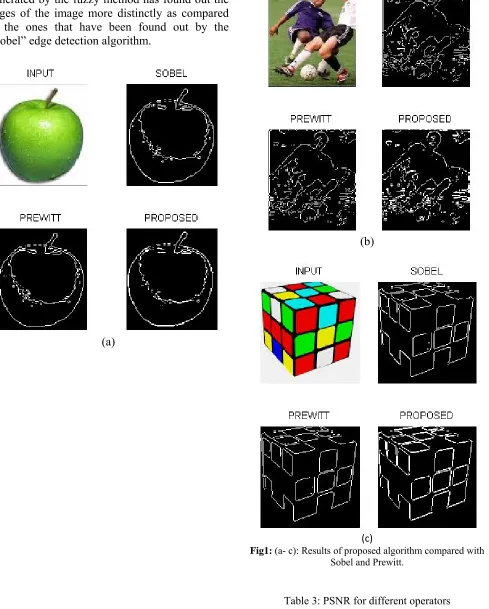
ISSN 2348 – 7968 compared with Sobel and Prewitt approaches. It
can be observed that the output that has been generated by the fuzzy method has found out the edges of the image more distinctly as compared to the ones that have been found out by the “Sobel” edge detection algorithm.
(a)
(b)
(c)
Fig1: (a- c): Results of proposed algorithm compared with Sobel and Prewitt.
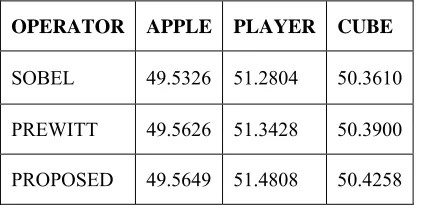
OPERATOR APPLE PLAYER CUBE
SOBEL 49.5326 51.2804 50.3610
PREWITT 49.5626 51.3428 50.3900
PROPOSED 49.5649 51.4808 50.4258
Table 4: MSE for different operators
OPERATOR APPLE PLAYER CUBE
SOBEL 0.7241 0.4842 0.5984
PREWITT 0.7192 0.4773 0.5944
PROPOSED 0.7188 0.4624 0.5895
6. CONCLUSION
In this paper, we develop, implement and test simple & small but a very efficient, fuzzy rule based edge detection algorithm. The performance of the proposed system is evaluated and compared with the various other existing edge detection algorithms. The results shows that the accuracy of the edge detection using proposed fuzzy algorithm outperform over the other algorithms
REFERENCES
[1] Shashank Mathur, Anil Ahlawat, “Application Of Fuzzy Logic In Image Detection”, International Conference "Intelligent Information and Engineering Systems" INFOS 2008, Varna, Bulgaria, June-July 2008.
[2] O. R.Vincent and O. Folorunso [2009] “A descriptive algorithm for sobel image edge detection” Proceedings
of Informing Science & IT Education Conference (InSITE) 2009.
[3] L. Liang and C. Looney, “Competitive Fuzzy Edge Detection,” Applied Soft Computing, (3), 2003, pp. 123-137.
[4] E. Argyle. “Techniques for edge detection,” Proc.
IEEE, vol. 59, pp. 285-286, 1971.
[5] Ayman A. Alyand and Abdallah A. Alshnnaway [2009], “An edge detection and filtering mechanism of two dimensional digital objects based on fuzzy
inference” World Academy of Science and
Engineering and Technology 53 2009.
[6] Tizhoosh [1997], “Fuzzy Image Processing.” Springer
and 1997.
[7] John Canny. [Nov. 1986], “A computational approach to edge detection”. Pattern Analysis and Machine
Intelligence and IEEE Transactions on and PAMI-8(6):679–698.
[8] Yasar Becerikli and Tayfun M. Karan, “A New Fuzzy Approach for Edge Detection”, Computational Intelligence and Bio inspired Systems” , June 2005. [9] Singh Gill [2010], “Fuzzy logic based image edge
detection algorithm in matlab” ©2010 International
Journal of Computer Applications (0975 - 8887) Volume 1 – No. 22.
[10]Devesh D. Nawgaje, Dr. Rajendra and D.Kanphade [Feb 2011], “Implementation of fuzzy inference system
for white blood cell cancer detection using dsp tms320c6711.”International Journal of Engineering
Science and Technology (IJEST) ISSN: 0975-5462 NCICT Special Issue Feb 2011.
[11]Isha Jain and Babita Rani [Dec. 2010], “Vehicle detection using image processing and fuzzy logic.”
International Journal of Computer Science & Communication. 1, No. 2, July-December 2010, pp. 255-257.
[12]Mamta Juneja and Parvinder Singh Sandhu [2009],
“Performance evaluation of edge detection techniques for images in spatial domain” International Journal of
Computer Theory and Engineeringand Vol. 1 and No. 5 and December and 2009 1793-820
[13]I.Nedeljkovic “IMAGE CLASSIFICATION BASED ON FUZZY LOGIC” and MapSoft Ltd and Zahumska 26