A Framework to Facilitate Selection of Multi Cloud Service
Providers
Dr.B.Mahesh
Associate Professor, Department of CSE, Dr.K.V.Subba Reddy College of Engineering for Women, Kurnool,AP
Abstract: Cloud computing is the popular expression where server, storage, CPU and so forth are given as administration to associations and individual clients over the web. Since cloud processing is of non-straightforward nature, there could be a few issues that are to be managed. Administration level understandings (SLAs), which archive ensured nature of administration levels, have not been observed to be reliable among suppliers, despite the fact that they offer services with comparative usefulness. In administration outsourcing cloud situations, the nature of administration levels are of prime significance to clients, as they utilize outsider cloud services to store and process their customers' information. In the event that loss of information happens because of a blackout, the client's business gets influenced. Thusly, the real test for a client is to choose a suitable administration supplier to guarantee ensured administration quality. To support clients in dependably recognizing perfect administration supplier, this work proposes a structure, SelCSP, which joins dependability and skill to gauge danger of association. Reliability is figured from individual encounters increased through direct communications or from inputs identified with notorieties of merchants. Skill is surveyed taking into account straightforwardness in supplier's SLA ensures.
I. INTRODUCTION
Different cloud hypotheses and advancements are the hot bearings in the cloud computing industry, which a great deal of organizations and government are putting much worry to ensure that they have profited from this new
development [1], [2]. In any case, contrasted and customary systems, numerous cloud computing situations has numerous one of a kind elements, for example, assets having a place with every cloud supplier, and such assets being totally dispersed, heterogeneous, and absolutely virtualized; these components show that unmodified conventional trust instruments can never again be utilized as a part of different cloud processing situations. An absence of trust between cloud clients and suppliers has impeded the all-inclusive acknowledgment of clouds as outsourced processing services [3], [4].
Further, expectationsfrom clients are high as far as a secured framework, requiring right provisioning at opportune time, with pay as you go model. Henceforth constructing a dependable framework in cloud registering conveys the certainty to the clients which turns out to be exceptionally vital for cloud supplier. Blast et al. (2010) separated the terms trust and security. Trust is identified with security, unwavering quality, and accessibility and not restricted to different attributes of hub. A trust or node assesses the dependability of a trustee node. For the most part there are two strategies for trust assessment. They are 1) Direct Trust Assessment 2) Aberrant Trust Assessment. Direct trust assessment suggests the trust level of a man who has the past experience for a specific administration. In roundabout Trust assessment, one individual won't not have related knowledge of associating with the supplier or any services, however he knows a cloud client who has immediate trust esteem for an administration.
Cloud administration supplier gives services to client. A portion of the purposes behind selecting reliable administration supplier are: 1) In a cloud commercial center, rise of new administration supplier gives the cloud services comparative advertising. 2) A client does not have control over its information, sent in cloud. 3) Cloud administration suppliers are narrowing minded towards expanding their own particular incomes. 4) In light of pay – as - you - use model, client desire is high as far as quality administration from the reliable supplier.
Nirnay Ghosh et al. (2013) [5] proposed SelCSP, a system which empowers the clients to assess the reliability and to know the skilled SPs. The dependability can be assessed regarding connection particular, dynamic trust and notoriety inputs. The ability of an administration supplier can be assessed by this technique. This model, including these two substances, gives the measure of danger level included in an association.
This empowers a client for picking an administration supplier. There are two sorts of danger estimation. They are:
1)Relational danger, 2) Execution hazard. Where there is absence of trust among cooperating elements there emerges the social danger and when the conveying gatherings' don't accomplish fulfillment, there emerges the execution hazard. Advantage: This technique considers the issue of selecting reliable administration supplier in cloud commercial center.
Hindrance: The proposed strategy does not check the validity of the input.
Obed Jules et al. (2014)[6] proposed a system called Bayesian system and probalistic cosmology driven trust model. In this model, Bayesian system is utilized to choose a trusted
Bayesian system is overhauled with the infringement by means of cloud index. The creator has acquainted a SLA administration plan with identify infringement of SLAs parameters with the assistance of probabilistic metaphysics. Aside from this, cautions are utilized to comprehend about the activated SLA infringement. There are three modules: 1).Reputation - based trust module, 2). Insight Module and 3) Control Module. In the main module, Bayesian model is utilized to survey the supplier's trust level and the trust qualities are put away in a cloud registry. Well before the SLA arrangements, the client knows about the supplier's believability. In the second module, the learning about accessible assets is assessed and decides the danger included. In the third module, the assets are observed for appropriate administration. Cautions are utilized to illuminate the suppliers. Advantage: 1) Client will have a thought regarding the suppliers before beginning SLA arrangement. 2) Probalistic cosmology is utilized to distinguish SLA infringement and alarms the administration supplier. 3) Precise forecast of trust estimation of the supplier, utilizing Bayesian system. Impediment: The proposed plan is not executed in a genuine situation to demonstrate the precision of the plan.
practical and non-utilitarian prerequisites by danger evaluation module. At long last, client can pick the best administration supplier as per the client prerequisites from the ordered rundown. Advantage: 1) This model builds the client fulfillment level. 2) It helps the client to pick legitimate supplier.
Inconvenience: Absence of procedure in execution examination and Assessment.
Sarbjeet Singh et al. (2014) proposed a trust assessment structure to compute trust on administration supplier. In this structure, purchaser sends the administration solicitation to administration supplier and thusly, the administration supplier reaction back to the administration requestor. Free outsider observing the associating services and the checking data helps the customer to pick the reliable administration supplier. Trust figuring, named last trust, is computed for administration supplier in light of client's self-trust, companion's proposals and outsider's suggestions. Advantage: 1) Exact and more dependable. 2) It is adaptable, extensible and powerful.
Disservice: This proposed structure is not executed in a constant situation to demonstrate the viability in cloud.
Chunsheng Zhu et al. (2014) [8] proposed a novel trust and notoriety administration framework for cloud and sensor systems mix. The proposed plan helps the client to pick the best cloud administration supplier and help the cloud administration supplier to choose sensor system supplier by considering the traits prerequisite, Cost, Trust and Notoriety. An approved trusted focus substance is utilized to store the direct and notoriety trust estimation of every administration from the both cloud administration supplier and sensor system supplier. Direct trust quality and notoriety trust
worth is considered for building a trust of the administration supplier. Advantage: It gives a joining of cloud and sensor system: 1). The proposed framework ought to consider the base properties of two diverse area for proficient administration. 2). Framework Overhead.
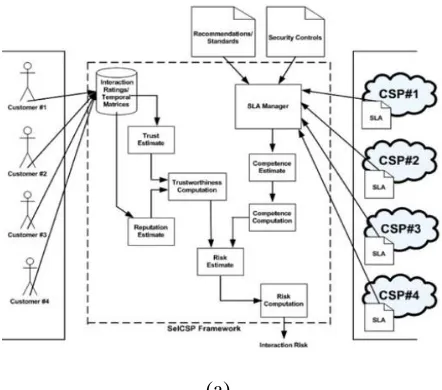
The primary reason for builds up a structure, called SelCSP, to figure general saw collaboration hazard. It builds up a relationship among saw communication danger, reliability and ability of administration supplier. It proposes a component by which reliability of an administration supplier might be assessed. It likewise proposes a component by which straightforwardness of any supplier's SLA might be registered.
• Risk estimate. It estimates perceived interaction risk relevant to a customer-CSP interaction by combining trustworthiness and competence.
• Trust estimate. It computes trust between a customer CSP pair provided direct interaction has occurred between them.
• Reputation estimate. It evaluates reputation of a CSP based on referrals/feedbacks from various sources and computes the belief a customer has on former’s reputation.
• Trustworthiness computation. Function to evaluate a customer’s trust on a given CSP.
• SLA manager. This module manages SLAs from different CSPs. It takes into account different recommendations/standards and controls which are supposed to be satisfied by the SLAs.
• Competence computation. It computes transparency with respect to a given SLA and hence evaluates the competence of the CSP.
• Risk computation. It computes perceived interaction risk relevant to a customer-CSP interaction.
• Interaction ratings. It is a data repository where customer provides feedback/ratings for CSP.
III. PROPOSED SYSTEM
• In Proposed the framework estimates trust-worthiness in terms of context-specific, dynamic trust and reputation feedbacks even from new coming cloud service providers. It also computes competence of a service provider in terms of transparency of SLAs. Both these entities are combined to model interaction risk, which gives an estimate of risk level involved in an interaction.
(a)
The broad objective of SelCSP framework is to evaluate risk involved in interacting with different cloud service providers.
Risk evaluation is done by computing trust which a customer has on a particular provider
and transparency obtained from latter’s service level agreement guarantees.
For clear Fig. 1. SelCSP framework and module interactions. Understanding, a high-level functional overview of the framework has been presented in Fig. 1b.
(b)
Fig. 1. SelCSP framework and module interactions.
The risk estimate block receives customer request regarding estimation of interaction risk for a provider. This block delegates the request to relation risk and performance risk blocks to compute trustworthiness and competence of the provider, respectively. The relational risk block checks if the requester has previous interaction ratings with the provider. If such ratings are available, trust is calculated, otherwise feedback-based reputation is computed, both eventually leading to estimation of trustworthiness. In contrast, performance risk is computed by evaluating the transparency of provider’s SLA guarantees. Finally, trustworthiness and competence gives a measure of interaction risk through compute: interaction risk block.
Cloud computing is an advancing worldview, where new administration suppliers are every now and again appearing, offering services of comparable usefulness. In this proposal work issue for a cloud client is to choose a fitting administration supplier from the cloud commercial center to bolster its business needs. Be that as it may, benefit ensures gave by merchants through SLAs contain uncertain provisions which make the employment of selecting a perfect supplier significantly more troublesome. As clients use cloud services to process and store their individual customer's information, ensures identified with administration quality level is of most extreme significance.
REFERENCES
[1] M. Singhal et al., “Collaboration in multicloud computing environments:Framework and security issues,” Computer, vol. 46, no. 2, pp. 76–84,Feb. 2013.
[2] H. M. Fard, R. Prodan, and T. Fahringer, “A truthful dynamic workflowscheduling mechanism for commercial multicloud environments,” IEEETrans. Parallel Distrib. Syst., vol. 24, no. 6, pp. 1203–1212, Jun. 2013.
[3] P. Jain, D. Rane, and S. Patidar, “A novel cloud bursting brokerageand aggregation
(CBBA) algorithm for multi cloud
environment,” inProc.2nd Int. Conf. Adv.
Comput.Commun. Technol. (ACCT), Jan.
2012,pp. 383–387.
[4] K. M. Khan and Q. Malluhi, “Establishing trust in cloud computing,”IT Prof., vol. 12, no.
5, pp. 20–27, Sep./Oct. 2010.
[5] K. Hwang and D. Li, “Trusted cloud computing with secure resourcesand data coloring,” IEEE Internet Comput., vol. 14, no. 5,
pp. 14–22,Sep./Oct. 2010.
[6] H.Kim,H.Lee, W.Kim,andY.Kim, “Atrust evaluation modelforQoS guarantee in cloud
systems,”Int. J. Grid Distrib. Comput.,vol.3,no.
1, pp. 1–10, Mar. 2010.
[7] P. D. Manuel, S. ThamaraiSelvi, and M. I. A.-E. Barr, “Trustmanagement system for grid
and cloud resources,” inProc.1st Int.
Conf.Adv.Comput. (ICAC), Dec. 2009, pp. 176– 181.
[8] L.-Q. Tian, C. Lin, and Y. Ni, “Evaluation of user behaviortrust in cloud computing,” in Proc. Int. Conf. Comput. Appl. Syst.Modeling (ICCASM), Oct. 2010, pp. V7-576–V7-572. [9] X. Li and Y. Yang, “Trusted data acquisition mechanism for cloudresource scheduling based on distributed agents,”Chin. Commun.,vol.8,no.
6, pp. 108–116, 2011.
[10] X. Li, H. Ma, F. Zhou, and X. Gui, “Service operator-aware trust schemefor resource matchmaking across multiple clouds,”IEEE Trans. ParallelDistrib. Syst., to be published,
doi: 10.1109/TPDS.2014.2321750.
[11] (2014). OPTIMIS.[Online]. Available:
http://www.optimisproject. eu/
[12] W. Fan and H. Perros, “A novel trust
management frameworkfor multi-cloud
environments based on trust service
providers,”Knowl.-Based Syst., vol. 70, pp.
392–406, Nov. 2014.
[13] N. Ghosh, S. K. Ghosh, and S. K. Das, “SelCSP: A framework tofacilitate selection of cloud service providers,” IEEE Trans. CloudComput., vol. 3, no. 1, pp. 66–79,
Jan./Mar. 2015.
[14] A. Nagarajan and V. Varadharajan, “Dynamic trust enhanced securitymodel for
trusted platform based