Available online: http://edupediapublications.org/journals/index.php/IJR/ P a g e | 2502
A Comparative Study on Forecasting and Analysis of 4140 Material
Composition of Connecting Rod for Various Applications
Pawan Sarate
1, G. R. Kesheorey
2, Manish Shah
31
PG Research Scholar Department of Mechanical Engineering VITS Indore
2
Asst. Prof. & Head Department of Mechanical Engineering VITS Indore
3
Director MSA Indore.
Abstract:
This paper presents a perfect forecasting proposal for
composition of material for connecting rod. The material
of connecting rod is as important as it will break the work
or production. The material of connecting rod is highly
inevitable due to its role in work mechanism of various
machineries. Diesel generator set and steam engines are
few places where connecting rods perform pivot role. Here
an attempt is made to forecast the appropriate material
composition including alloy percentage for specific
operation for material 4041. Fuzzy logic is used to
forecast the material composition with percentage in Mat
lab environment.
Keywords
Connecting Rod, Ductability, Fuzzy Logic, 4140
1.
Introduction
Connecting Rods are used practically in all varieties of
automobile engines. These behave as an intermediate link
between the piston and the crankshaft of an engine of an
automobile. It is responsible for transmission the up and
down motion of the piston to the crankshaft of the engine,
by converting the reciprocating motion of the piston to the
rotary motion of crankshaft. Now a day’s Aluminum
connecting rods are used in Automobile Internal
combustion engine but aluminum connecting rod having a
more ductile & low stiffness. [2]. Connecting rod is one of
the important driving parts of Light vehicle engine it forms
a simple mechanism that converts linear motion into rotary
motion that means the connecting rod is used to transfer
linear, reciprocating motion of the piston into rotary
motion of the crankshaft.[5]
T
he one end, small end the connecting rod connected tothe piston of the engine by the mean of piston pin and the
mechanism, the other end, the bigger end being connected
to the crankshaft with lower end big end bearing by
generally two bolts. Connecting rod is most important
components of the complete engine assembly as it acts as
a mediator between piston assembly and crankshaft. To
provide the maximum rigidity with minimum weight, the
cross section of the connecting rod is made as and I –
section end of the rod is a solid eye of connecting rod or a
split eye that is used to holding the piston pin. The big end
works on the crank pin and is always split. In some
connecting rods, a hole is drilled between two ends for
carrying lubricating oil from the big end to the small end
for lubrication of piston and the piston pin. The
connecting rod fabricated from an AISI/SAE 4140 low
alloy steel; chemical composition, mechanical properties
and microstructure were appropriate for the application.
[1]. The only problem with using steel rods is that the
material is extremely heavy, which consumes more power
and adds stress to the rotating assembly. Performance steel
rods can be made from 4340 and even 300M grade steel.
The tensile strength, yield strength, and hardness of 4340
steel depends on the temperature at which the steel is
forged, and how the steel is heat treated.[7] The 4340 is
also a type of 4140. It is the modification of 4140 that
changes the composition of material. The most common
types of Connecting rods material are steel and aluminum
Available online: http://edupediapublications.org/journals/index.php/IJR/ P a g e | 2503 forging and powdered metallurgy. Connecting rods are
widely used in variety of engines such as, in-line engines,
V-engine, opposed cylinder engines, radial engines and
opposed-piston engines [8]. The connecting rod faces a
complex state of loading. It undergoes high cyclic loads of
the order of 108 to 109 cycles, which range from high
compressive loads due to combustion, to high tensile loads
due to inertia [3]. The major stresses induced in the
connecting rod are a combination of axial and bending
stresses in operation [10]. The protection of connecting
rod from corrosion has very important issue but in case of
material 4140 resistivity of material will increase
according to the requirement.[4]
The materials used for connecting rods are mild carbon
steels (having 0.35 to 0.45 percent carbon), alloy steels
(chromium-nickel or chromium-molybdenum steels) and
different alloys like aluminum alloys, magnesium alloys,
titanium alloys and polymeric materials. These alloys are
used for different applications depending upon the
ultimate tensile strength required for the particular
application [9]. The material of connecting rod is as
important as it may break the work or production. The
material of connecting rod is highly inevitable due to its
role in work mechanism of various machineries such as
Diesel generator set or IC engines. Here an attempt is
made to forecast the appropriate material composition
including alloy percentage for specific operation for
material 4041 material using Fuzzy logic technique
through tool box used in Mat lab environment.
Sadaphale The research work describes the design &
modeling analysis of IC engine connecting rod using two
different Materials. 1st one aluminum material & second
one aluminum fly ash silicon based composite material &
compare to the farmer material to the new Material found
to have less weight & better stiffness. Carrying out that
modification to engine element will result ineffective
reduction of weight increase of durability or machinability
of particular part will lead to decrease of overall engine
weight improvement in its traction parameter & increasing
performance of engine [1].
Apasi et.al. The study deals with the performance of metal
matrix composite connecting rod and the regular carbon
steel connecting rod. The study work commenced with
casting of the Metal Matrix Composite sample connecting
rod by stir-casting method and purchasing the Regular
(carbon steel) connecting rod to serve as control. A
performance test of the two sample connecting rods was
carried out using a Toyota starlet Engine of 12 valve
model E series. The tentative result obtained showed that
the duration and rate of fuel consumption for the regular
connecting rod varied from 0.3 to 0.636kw/h, while that of
the composite connecting rod, varied from 0.33 to
0.58kw/h. But for both connecting rods as the speed
increases the brake horse power also increased. [2]
Jeeva Bharathi et.al. The conventional connecting rod used
in the engines was replaced with a composite connecting
rod. The predictable connecting rod and the Composite
connecting rod were analyzed by finite element methods.
From the results, it is clear that the stress induced in the
composite connecting rod is found to be lower than that of
the conventional connecting rod. Composite connecting
rod material is replaced for good fatigue strength,
minimizing weight and without violating the limiting
constraint formed by induced stress. A reduction of 31.5%
weight is achieved when a conventional connecting rod is
replaced with composite connecting rod under identical
conditions of design parameters [3].
Pathan and Wasekar This research paper gives idea about
the result weight of the connecting rod can be reduced by
replacing the old material AB60 by Aluminum Fly ash
silicon compound which has higher strength and is
manufactured using industrial waste such as fly ash [4].
Bedse and Ahire The main objective of this research work
is design evaluation through finite element analysis for
fatigue life of Hero Honda Motor Cycle connecting rod.
By using FEA and Experimentation method find the
Available online: http://edupediapublications.org/journals/index.php/IJR/ P a g e | 2504 basis FEA and Experimentation result recommend the best
alternative design for connecting rod. 3D model of
connecting rod is created in CATIA software and it will be
analyze in HYPERMESH software. The structural strength
of connecting rod will be verified on [5].
Patil and Chhapkhan The work used for connecting rod is
analyzed by using three different materials such as
AISI4340 steel alloy, AISI7068 and Titanium alloy.
Results of axial load carrying capacity and weight
reduction of connecting rod of material AISI4340 and
Titanium alloy is compared. By checking and comparing
the results of materials in finalizing the results are shown
in below [6].
2.
Soft Computing Technique with Special
Reference to Fuzzy Logic
In present research work, application of soft computing
techniques is made to solve the research problem.
Following are the details of techniques. Soft computing
could be a branch, in which, a shot is created to make
intelligent wiser and quick machines & systems.
Intelligence provides the ability to derive the solution and
not merely arrive to the solution. Purity of thinking,
machine intelligence, freedom to figure, dimensions,
quality and indistinctness handling capability will increase
we tend to go higher within the hierarchy. the ultimate
slogan is to develop hardware and package which {can|
which is able to} add an identical approach as citizenry
can do. Intuitive consciousness knowledge is additionally
one in all the vital space within the soft computing, that is
usually cultivated by meditation. this is often so, a
unprecedented challenge and nearly a replacement
development, to incorporate consciousness into the
computers. Soft computing is associate rising assortment
of methodologies that aim to take advantage of tolerance
for inexactitude, uncertainty, and partial truth to attain
strength, traceableness and total low price. Soft computing
methodologies are advantageous in several applications. In
distinction to analytical strategies, soft computing
methodologies mimic consciousness and knowledge in
many.
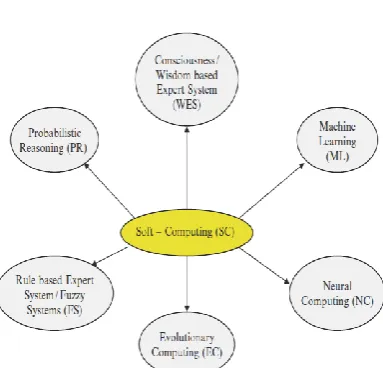
Figure 1: Soft Computing Techniques with branches
Soft computing may be a partnership within which every of the partner’s contributes a definite methodology for
addressing issues in its domain. During this perspective
the principal constituent methodologies in SC area unit
complementary instead of competitive. What is more, soft
computing is also viewed as a foundation part for the
rising field of abstract intelligence.
3.
Simulation & Result
This section presents the simulation of proposed work and
results. Fuzzy logic is used for deciding the priority among
different alloy composition for better requirement of
material. The proposed work is focused on composition,
application, and analysis and forecasting of specific
mixing of alloys for specific applications of material 4140.
The 4140 material has some very specific physical
properties like high tensile strength, hardness, ductility,
machinability etc. The material is extremely useful where
Available online: http://edupediapublications.org/journals/index.php/IJR/ P a g e | 2505 & high temperature working atmosphere is present so the
material should match the required standard. It is used in
internal part of internal combustion engine as connecting
rod or cam shaft. The composition of 4140 material
already discussed in chapter no 2. Here the proposed work
is simulated on MATLAB environment through fuzzy
logic tool box. The fuzzy logic method gives fast and
accurate result of material composition. Composition of
4140 varies with different properties of material. These
variations of properties of material check by fuzzy logic
tool in MATLAB software. The composition of 4140
material continuously changes accordingly your
requirement that depends upon variation of composition
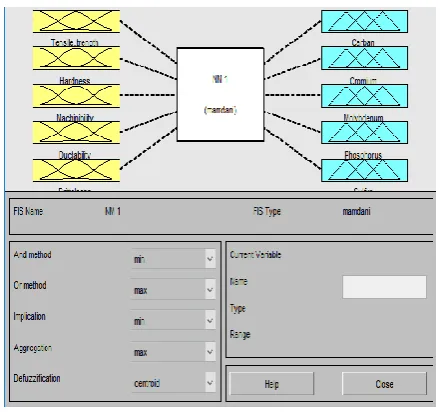
under given limit. Five input parameter is used as a group
of properties. According to the number of properties input
parameter are selected and these input parameter are
direction of alloy of these properties. By considering all
these input parameter total five input variable are
designed. Then priority of each alloy counted as a output
parameter. So there are five output variable are designed.
Figure 2: Input output variables
There are five input variable named as a tensile strength,
hardness machinability etc. For variable tensile strength
five membership functions are selected. First low,
medium, high and other is very high.0 to 1 is the range for
this input variable in which 0 to 0.2 is taken as very low,
0.2 to 0.4 is taken as low, 0.4 to 0.6 is taken as medium,
0.6 to 0.8 is taken as high, and 0.8 to 1 is taken as very
high.
The next variable is hardness. There are also five
membership functions is this variable four shape and range
are same as tensile strength.
Figure 3: Membership function of tensile strength
Then there are five output variable named as given in fig.
For every output variable there are four memberships
Available online: http://edupediapublications.org/journals/index.php/IJR/ P a g e | 2506 Figure 4: Membership function of output variable
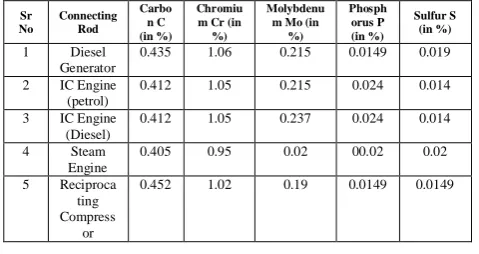
On applying boundary conditions following results were
obtained.
Table No 1:
Connecting Rods Material Composition for
different Application using 4140
Sr No
Connecting Rod
Carbo n C (in %)
Chromiu m Cr (in %)
Molybdenu m Mo (in
%)
Phosph orus P (in %)
Sulfur S (in %)
1 Diesel Generator
0.435 1.06 0.215 0.0149 0.019
2 IC Engine (petrol)
0.412 1.05 0.215 0.024 0.014
3 IC Engine (Diesel)
0.412 1.05 0.237 0.024 0.014
4 Steam Engine
0.405 0.95 0.02 00.02 0.02
5 Reciproca ting Compress
or
0.452 1.02 0.19 0.0149 0.0149
4.
Conclusion
The 4010 material is specially designed for heavy work
and robust performance. The connecting rod technology
requires extra care during design and drawing even in
selection of proper materials for manufacturing. Here
fuzzy logic is used to forecast the general requirement of
specific application based composition of alloy. Every
different application requires a specific composition of
metals and alloys. Fuzzy logic tool box using mat lab
shows excellent result and ease of use even for beginners.
The work shows here is a different kind of work itself and
extremely useful in selection of material for connecting
rod in seconds without any mathematical calculations.
4140 material is used extensively for such applications but
within this material to a possibility of partial changes of
metal compositions due to different applications based on
different physical properties required.
The proposed work is good enough to select the proper
material composition but at every place there is a
possibility to improve. The use of other Artificial
Intelligence techniques such as Machine learning and
ANN may also use for selection of composition and a
comparative study may present for manufacturer those
who are interested in CAM and automation.
References
1. C. Juarez, F. Rumiche , A. Rozas , J. Cuisano , P. Lean;
Failure analysis of a diesel generator connecting rod,
ELSEVIER (2016),pp 25-31
2.Kailas more, Mr. D.B Sadaphale; Review: IC Engine
ALFASIC Composite Connecting Rod (ICGTETM-2016),
PP 176-178
3. Mr. Rohit S. Phatale, Prof. B. S. Allurkar; Review on
Weight Optimization of Connecting Rod using Composite
Materials, (IJSETR)2016,PP563-564
4. C. Escobar , J. C. Caiced , W. Aperador , A. Delgado, P.
Prieto ; Improve on Corrosion Resistant Surface for AISI
4140 Steel Coated with VN and HfN Single Layer Films,
(2013) 7591 - 7607
5. Dipalee S. Bedse1, Mangesh. A. Ahire2; DESIGN
EVALUATION THROUGH FINITE ELEMENT
ANALYSIS FOR FATIGUE LIFE OF CONNECTING
ROD USED IN TWO WHEELERS, International journal
of advance technology in engineering and science 2015 pp
126-133
6. Rohit B. Bhandwale,Prof. Dr. Niloy K. Nath,Prof.
Shailesh S. Pimpale; Design and Analysis of Connecting
Rod with Abaqus, International Journal on Recent and
Innovation Trends in Computing and
Communication,(2016) PP 906-912
7. Puran Singh, Debashis Pramanik, Ran Vijay Singh; Fatigue and Structural Analysis of Connecting Rod’s
Material Due to (C.I) Using FEA, International Journal of
Automotive
Engineering and Technologies (2015) PP 245-253
8. Prof. N.P.Doshi, Prof .N.K.Ingole; Analysis of
Connecting Rod Using Analytical and Finite Element
Method, International Journal of Modern Engineering
Research (2013) PP 65-68
9. Amit Kumar, Bhingole P.P. and Dinesh Kumar;
Dynamic Analysis of Bajaj Pulsar 150cc Connecting Rod
Using ANSYS 14.0, Asian Journal of Engineering and
Available online: http://edupediapublications.org/journals/index.php/IJR/ P a g e | 2507 10. Mr. Vikram A. Shedge, Prof. K. H. Munde;
Optimization of Connecting Rod on the basis of
Static & Fatigue Analysis, International Journal of
Mechanical Engineering (2015) PP 7-13
11
. Sourabh Mehto, Rahul Agarwal, Manish Shah, “AComparative Study Based on PI and Fuzzy Control of Inverter fed Induction Motor Drive”, International Journal
of Research (IJR) Vol-2, Issue-2 February 2015 ISSN
2348-6848, pp.75-79.
12. Juhi Nagpal, Rahul Agarwal & Manish Shah, “A
Comparative Study on Different Speed Control Methods of D.C. Drives for Electric Vehicle”, International Journal
of Research (IJR) e-ISSN: 6848, p- ISSN:
2348-795X Volume 2, Issue 07, July 2015, pp. 1-6.
13. Khushboo Hardia, Neha Maithil & Manish Shah, “Particle Swarm Optimization Applied To Economic Load Dispatch Problem”, International Journal of Research
(IJR) e-ISSN: 2348-6848, p- ISSN: 2348-795X Volume 2,
Issue 09, September 2015, pp. 834-843.
14. Jyoti verma, Manish Shah, “Simulation and Analysis
of H-bridge Cascade Multi level Inverter Fed Induction Motor Drive for Industrial Applications”, International
Journal of Innovative Research In Electrical, Electronics,
Instrumentation And Control Engineering Vol. 4, Issue 3,
March 2016, pp. 17-19.
15. Manish Shah, Rahul Agrawal, “A Review On Classical
And Modern Techniques with Decision Making Tools For Load Forecasting”, International Journal of Emerging
Trends in Engineering and Development Issue 3, Vol.6
(November 2013), pp. 174-184.
16.Ritu Bhateja, Manish Shah, “A Proposed Method for
Smooth Speed Control of Indirect Vector Control
Inverter-Fed Induction Motor Drive using Boost Converter Topology”, International Journal of Emerging Trends in
Engineering and Development Issue 6, Vol. 5 (September
2016), pp. 1-10.
17. Sudeep Mohaney, Sourabh Mehto, Manish Shah,
“Modeling and Optimization of Elevator Group Control
System for High Rise Commercial Building”, IEEE
International Conference on Computer, Communication
and Control (IC4-2015).
18. Sudeep Mohaney, Manish Shah, “Emerging Trends in Vertical Elevating System”, International Journal of
Engineering and Management Research Vol.-5, Issue-1,
February-2015, pp. 51-56
19. Ranvijay Parmar , Manish Shah, Mona gupta shah, “ A
Comparative study on Different ANN Techniques in Wind Speed Forecasting for Generation of Electricity”, IOSR
Journal of Electrical and Electronics Engineering
(IOSR-JEEE,
Volume 12, Issue 1 Ver. III (Jan. – Feb. 2017), PP 19-26
20. Khushboo Nagar, Manish Shah, “Review on Different
ANN Based Fault Detection Techniques for HVDC
Systems, AN International Journal of Innovative Research
in Engineering & Management (IJIREM), Volume-3,
Issue-6, November-2016, pp 477-481.
21. Nikita Rathore, Manish Shah, “State of Art Literature
Survey on Different Fault & Condition Monitoring of
HVDC System Using Neuro-Fuzzy System & ANN Approach”, International Journal of Innovative Research
in Electrical, Electronics, Instrumentation and Control
Engineering, Vol. 5,
Issue 2, February 2017, pp. 18-21
22. Girish Gokhle, Manish Shah, “a study on different
conductors for optimization of power flow/ loadability in
long and medium transmission line”, International
Research Journal of Engineering and Technology (IRJET),
may 2017, pp. 1563-
1566
23. Madhuri Sharma, Manish Shah, Rahul Agrawal, “Transmission Losses Minimization Considering Wind
Power Using Teaching-Learning-Based Optimization”