Bilingual Word Spectral Clustering for Statistical Machine Translation
Bing Zhao† Eric P. Xing† ‡ Alex Waibel† †Language Technologies Institute
‡Center for Automated Learning and Discovery
Carnegie Mellon University Pittsburgh, Pennsylvania 15213
{bzhao,epxing,ahw}@cs.cmu.edu
Abstract
In this paper, a variant of a spectral clus-tering algorithm is proposed for bilingual word clustering. The proposed algorithm generates the two sets of clusters for both languages efficiently with high seman-tic correlation within monolingual clus-ters, and high translation quality across the clusters between two languages. Each cluster level translation is considered as a bilingual concept, which generalizes words in bilingual clusters. This scheme improves the robustness for statistical ma-chine translation models. Two HMM-based translation models are tested to use these bilingual clusters. Improved per-plexity, word alignment accuracy, and translation quality are observed in our ex-periments.
1 Introduction
Statistical natural language processing usually suf-fers from the sparse data problem. Comparing to the available monolingual data, we have much less training data especially for statistical machine trans-lation (SMT). For example, in language modelling, there are more than 1.7 billion words corpora avail-able: English Gigaword by (Graff, 2003). However, for machine translation tasks, there are typically less than 10 million words of training data.
Bilingual word clustering is a process of form-ing correspondform-ing word clusters suitable for ma-chine translation. Previous work from (Wang et al., 1996) showed improvements in perplexity-oriented measures using mixture-based translation lexicon (Brown et al., 1993). A later study by (Och,
1999) showed improvements on perplexity of bilin-gual corpus, and word translation accuracy using a template-based translation model. Both approaches are optimizing the maximum likelihood of parallel corpus, in which a data point is a sentence pair: an English sentence and its translation in another lan-guage such as French. These algorithms are es-sentially the same as monolingual word clusterings (Kneser and Ney, 1993)—an iterative local search. In each iteration, a two-level loop over every possi-ble word-cluster assignment is tested for better like-lihood change. This kind of approach has two draw-backs: first it is easily to get stuck in local op-tima; second, the clustering of English and the other language are basically two separated optimization processes, and cluster-level translation is modelled loosely. These drawbacks make their approaches generally not very effective in improving translation models.
In this paper, we propose a variant of the spec-tral clustering algorithm (Ng et al., 2001) for bilin-gual word clustering. Given parallel corpus, first, the word’s bilingual context is used directly as features - for instance, each English word is represented by its bilingual word translation candidates. Second, latent eigenstructure analysis is carried out in this bilingual feature space, which leads to clusters of words with similar translations. Essentially an affin-ity matrix is computed using these cross-lingual fea-tures. It is then decomposed into two sub-spaces, which are meaningful for translation tasks: the left subspace corresponds to the representation of words in English vocabulary, and the right sub-space cor-responds to words in French. Each eigenvector is considered as one bilingual concept, and the bilin-gual clusters are considered to be its realizations in two languages. Finally, a general K-means
ing algorithm is used to find out word clusters in the two sub-spaces.
The remainder of the paper is structured as fol-lows: in section 2, concepts of translation models are introduced together with two extended HMMs; in section 3, our proposed bilingual word cluster-ing algorithm is explained in detail, and the related works are analyzed; in section 4, evaluation metrics are defined and the experimental results are given; in section 5, the discussions and conclusions.
2 Statistical Machine Translation
The task of translation is to translate one sentence in some source language F into a target language E. For example, given a French sentence withJ words denoted as f1J = f1f2...fJ, an SMT system
auto-matically translates it into an English sentence with
I words denoted byeI
1 = e1e2...eI. The SMT
sys-tem first proposes multiple English hypotheses in its model space. Among all the hypotheses, the system selects the one with the highest conditional proba-bility according to Bayes’s decision rule:
ˆ
1) is called language model. The translation
model is the key component, which is the focus in this paper.
2.1 HMM-based Translation Model
HMM is one of the effective translation models (Vo-gel et al., 1996), which is easily scalable to very large training corpus.
To model word-to-word translation, we introduce the mappingj → aj, which assigns a French word fj in position j to a English word ei in position i = aj denoted as eaj. Each French word fj is an observation, and it is generated by a HMM state defined as [eaj, aj], where the alignmentaj for po-sition j is considered to have a dependency on the previous alignmentaj−1. Thus the first-order HMM
is defined as follows:
P(f1J|eI1) =X
model captures the assumption that words close in the source sentence are aligned to words close in the target sentence. An additional pseudo word of “NULL” is used as the beginning of English sen-tence for HMM to start with. The (Och and Ney, 2003) model includes other refinements such as spe-cial treatment of a jump to a Null word, and a uni-form smoothing prior. The HMM with these refine-ments is used as our baseline. Motivated by the work in both (Och and Ney, 2000) and (Toutanova et al., 2002), we propose the two following simplest ver-sions of extended HMMs to utilize bilingual word clusters.
2.2 Extensions to HMM with word clusters
LetFdenote the cluster mappingfj →F(fj), which
assigns French wordfj to its cluster IDFj =F(fj).
SimilarlyEmaps English word ei to its cluster ID
ofEi =E(ei). In this paper, we assume each word
belongs to one cluster only.
With bilingual word clusters, we can extend the HMM model in Eqn. 1 in the following two ways:
P(fJ
Another explicit way of utilizing bilingual word clusters can be considered as a two-stream HMM as follows: This model introduces the translation of bilingual word clusters directly as an extra factor to Eqn. 2. Intuitively, the role of this factor is to boost the trans-lation probabilities for words sharing the same con-cept. This is a more expressive model because it models both word and the cluster level translation equivalence. Also, compared with the model in Eqn. 3, this model is easier to train, as it uses a two-dimension table instead of a four-two-dimension table.
obser-vation probability ofP(fj|eaj)during the EM itera-tions. Thus a uniform priorP(Fj) = 1/|F|is
intro-duced as a smoothing factor forP(Fj|Eaj):
P(Fj|Eaj) =λP(Fj|Eaj) + (1−λ)P(Fj), (5)
where |F| is the total number of word clusters in French (we use the same number of clusters for both languages). λcan be chosen to get optimal perfor-mance on a development set. In our case, we fix it to be 0.5 in all our experiments.
3 Bilingual Word Clustering
In bilingual word clustering, the task is to build word clustersFandEto form partitions of the vocabular-ies of the two languages respectively. The two par-titions for the vocabularies ofFandEare aimed to be suitable for machine translation in the sense that the cluster/partition level translation equivalence is reliable and focused to handle data sparseness; the translation model using these clusters explains the parallel corpus{(f1J, eI1)}better in terms of perplex-ity or joint likelihood.
3.1 From Monolingual to Bilingual
To infer bilingual word clusters of (F,E), one can optimize the joint probability of the parallel corpus {(fJ
1, eI1)}using the clusters as follows:
(ˆF,Eˆ) = arg max
(F,E)
P(f1J, eI1|F, E)
= arg max
(F,E)
P(eI1|E)P(f1J|eI1, F, E).(6)
Eqn. 6 separates the optimization process into two parts: the monolingual part forE, and the bilingual part for F given fixed E. The monolingual part is considered as a prior probability:P(eI1|E), andEcan be inferred using corpus bigram statistics in the fol-lowing equation:
ˆ
E = arg max
{E}
P(eI1|E)
= arg max
{E} I
Y
i=1
P(Ei|Ei−1)P(ei|Ei). (7)
We need to fix the number of clusters beforehand, otherwise the optimum is reached when each word
is a class of its own. There exists efficient leave-one-out style algorithm (Kneser and Ney, 1993), which can automatically determine the number of clusters. For the bilingual part P(f1J|eI1, F, E), we can slightly modify the same algorithm as in (Kneser and Ney, 1993). Given the word alignment {aJ1} betweenf1J andeI1 collected from the Viterbi path in HMM-based translation model, we can inferFˆas follows:
ˆ
F = arg max
{F}
P(f1J|eI1, F, E)
= arg max
{F} J
Y
j=1
P(Fj|Eaj)P(fj|Fj). (8)
Overall, this bilingual word clustering algorithm is essentially a two-step approach. In the first step,E
is inferred by optimizing the monolingual likelihood of English data, and secondly F is inferred by op-timizing the bilingual part without changing E. In this way, the algorithm is easy to implement without much change from the monolingual correspondent.
This approach was shown to give the best results in (Och, 1999). We use it as our baseline to compare with.
3.2 Bilingual Word Spectral Clustering
Instead of using word alignment to bridge the par-allel sentence pair, and optimize the likelihood in two separate steps, we develop an alignment-free al-gorithm using a variant of spectral clustering algo-rithm. The goal is to build high cluster-level trans-lation quality suitable for transtrans-lation modelling, and at the same time maintain high intra-cluster similar-ity , and low inter-cluster similarsimilar-ity for monolingual clusters.
3.2.1 Notations
We define the vocabulary VF as the French
vo-cabulary with a size of|VF|;VE as the English
vo-cabulary with size of|VE|. A co-occurrence matrix C{F,E} is built with |VF| rows and |VE| columns;
each element represents the co-occurrence counts of the corresponding French wordfjand English word ei. In this way, each French word forms a row
vec-tor with a dimension of|VE|, and each
view each column as a vector for English word, and we’ll have similar interpretations as above.
3.2.2 Algorithm
With C{F,E}, we can infer two affinity matrixes
as follows:
AE = C{TF,E}C{F,E}
AF = C{F,E}C{TF,E},
whereAE is an|VE| × |VE|affinity matrix for
En-glish words, with rows and columns representing English words and each element the inner product between two English words column vectors. Corre-spondingly,AF is an affinity matrix of size|VF| ×
|VF|for French words with similar definitions. Both
AE andAF are symmetric and non-negative. Now
we can compute the eigenstructure for bothAE and AF. In fact, the eigen vectors of the two are
corre-spondingly the right and left sub-spaces of the orig-inal co-occurrence matrix of C{F,E} respectively.
This can be computed using singular value decom-position (SVD):C{F,E} =U SVT,AE =V S2VT,
andAF = U S2UT, where U is the left sub-space,
andV the right sub-space of the co-occurrence ma-trixC{F,E}.Sis a diagonal matrix, with the singular
values ranked from large to small along the diagonal. Obviously, the left sub-spaceU is the eigenstructure forAF; the right sub-spaceV is the eigenstructure
forAE.
By choosing the topKsingular values (the square root of the eigen values for bothAE andAF), the
sub-spaces will be reduced to:U|VF|×KandV|VE|×K respectively. Based on these subspaces, we can carry out K-means or other clustering algorithms to in-fer word clusters for both languages. Our algorithm goes as follows:
• Initialize bilingual co-occurrence matrix
C{F,E} with rows representing French words, and columns English words. Cji is the
co-occurrence raw counts of French wordfj and
English wordei;
• Form the affinity matrixAE = C{TF,E}C{F,E}
andAF =C{TF,E}C{F,E}. Kernels can also be
applied here such asAE = exp(
C{F,E}CT{F,E}
σ2 ) for English words. SetAE ii= 0andAF ii = 0,
and normalize each row to be unit length;
• Compute the eigen structure of the normalized matrixAE, and find theklargest eigen vectors: v1, v2, ..., vk; Similarly, find theklargest eigen
vectors ofAF:u1, u2, ..., uk;
• Stack the k eigenvectors of v1, v2, ..., vk in
the columns ofYE, and stack the eigenvectors u1, u2, ..., ukin the columns forYF; Normalize
rows of bothYE andYF to have unit length.YE
is size of|VE| ×kandYF is size of|VF| ×k;
• Treat each row ofYEas a point inR|VE|×k, and
cluster them intoK English word clusters us-ing K-means. Treat each row ofYF as a point in R|VF|×k, and cluster them intoK French word clusters.
• Finally, assign original word ei to cluster Ek
if row i of the matrixYE is clustered as Ek;
similar assignments are for French words.
HereAEandAF are affinity matrixes of pair-wise
inner products between the monolingual words. The more similar the two words, the larger the value. In our implementations, we did not apply a kernel function like the algorithm in (Ng et al., 2001). But the kernel function such as the exponential func-tion menfunc-tioned above can be applied here to control how rapidly the similarity falls, using some carefully chosen scaling parameter.
3.2.3 Related Clustering Algorithms
The above algorithm is very close to the variants of a big family of the spectral clustering algorithms introduced in (Meila and Shi, 2000) and studied in (Ng et al., 2001). Spectral clustering refers to a class of techniques which rely on the eigenstructure of a similarity matrix to partition points into disjoint clusters with high intra-cluster similarity and low inter-cluster similarity. It’s shown to be computing thek-way normalized cut:K−trYTD−12AD−12Y for any matrixY ∈RM×N.Ais the affinity matrix, andY in our algorithm corresponds to the subspaces ofU andV.
3.2.4 K-means
The K-means here can be considered as a post-processing step in our proposed bilingual word clus-tering. For initial centroids, we first compute the
center of the whole data set. The farthest centroid
from the center is then chosen to be the first initial centroid; and after that, the other K-1 centroids are chosen one by one to well separate all the previous chosen centroids.
The stopping criterion is: if the maximal change of the clusters’ centroids is less than the threshold of 1e-3 between two iterations, the clustering algorithm then stops.
4 Experiments
To test our algorithm, we applied it to the TIDES Chinese-English small data track evaluation test set. After preprocessing, such as English tokenization, Chinese word segmentation, and parallel sentence splitting, there are in total 4172 parallel sentence pairs for training. We manually labeled word align-ments for 627 test sentence pairs randomly sampled from the dry-run test data in 2001, which has four human translations for each Chinese sentence. The preprocessing for the test data is different from the above, as it is designed for humans to label word alignments correctly by removing ambiguities from tokenization and word segmentation as much as pos-sible. The data statistics are shown in Table 1.
English Chinese
Train
Sent. Pairs 4172
Words 133598 105331
Voc Size 8359 7984
Test
Sent. Pairs 627
Words 25500 19726
Voc Size 4084 4827
Unseen Voc Size 1278 1888
Alignment Links 14769
Table 1: Training and Test data statistics
4.1 Building Co-occurrence Matrix
Bilingual word co-occurrence counts are collected from the training data for constructing the matrix ofC{F,E}. Raw counts are collected without word
alignment between the parallel sentences. Practi-cally, we can use word alignment as used in (Och, 1999). Given an initial word alignment inferred by HMM, the counts are collected from the aligned word pair. If the counts are L-1 normalized, then the co-occurrence matrix is essentially the bilingual word-to-word translation lexicon such asP(fj|eaj). We can remove very small entries (P(f|e)≤1e−7), so that the matrix ofC{F,E}is more sparse for
eigen-structure computation. The proposed algorithm is then carried out to generate the bilingual word clus-ters for both English and Chinese.
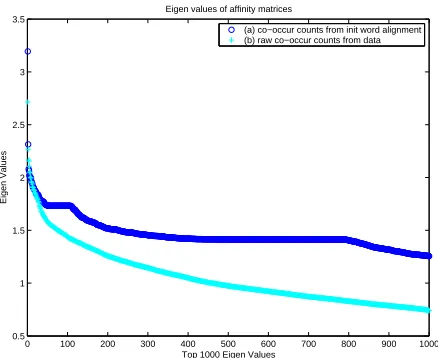
Figure 1 shows the ranked Eigen values for the co-occurrence matrix ofC{F,E}.
0 100 200 300 400 500 600 700 800 900 1000 0.5
1 1.5 2 2.5 3 3.5
Eigen values of affinity matrices
Top 1000 Eigen Values
Eigen Values
(a) co−occur counts from init word alignment (b) raw co−occur counts from data
Figure 1: Top-1000 Eigen Values of Co-occurrence Matrix
It is clear, that using the initial HMM word align-ment for co-occurrence matrix makes a difference. The top Eigen value using word alignment in plota.
4.2 Clustering Results
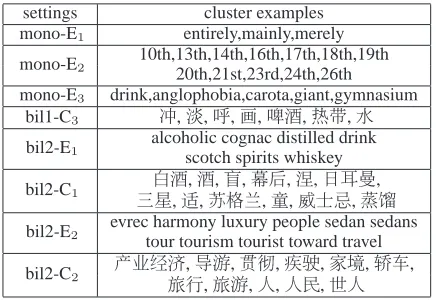
Clusters built via the two described methods are compared. The first method bil1 is the two-step op-timization approach: first optimizing the monolin-gual clusters for target language (English), and af-terwards optimizing clusters for the source language (Chinese). The second method bil2 is our proposed algorithm to compute the eigenstructure of the co-occurrence matrix, which builds the left and right subspaces, and finds clusters in such spaces. Top 500 eigen vectors are used to construct these sub-spaces. For both methods, 1000 clusters are inferred for English and Chinese respectively. The number of clusters is chosen in a way that the final word alignment accuracy was optimal. Table 2 provides the clustering examples using the two algorithms.
settings cluster examples mono-E1 entirely,mainly,merely
mono-E2 10th,13th,14th,16th,17th,18th,19th 20th,21st,23rd,24th,26th mono-E3 drink,anglophobia,carota,giant,gymnasium
bil1-C3 à, d, , , Ë, yQ, y
bil2-E1 alcoholic cognac distilled drink scotch spirits whiskey
bil2-C1 ¸Ë, Ë, , ô, 2, y,
®h, 7, Â}, 6, ,, k
bil2-E2 evrec harmony luxury people sedan sedans tour tourism tourist toward travel
bil2-C2 ², s, ´, û(, ¸, u°,
@q, @, |, |Ì, -|
Table 2: Bilingual Cluster Examples
The monolingual word clusters often contain words with similar syntax functions. This hap-pens with esp. frequent words (eg. mono-E1 and
mono-E2). The algorithm tends to put rare words
such as “carota, anglophobia” into a very big cluster (eg. mono-E3). In addition, the words within these
monolingual clusters rarely share similar transla-tions such as the typical cluster of “week, month, year”. This indicates that the corresponding Chi-nese clusters inferred by optimizing Eqn. 7 are not close in terms of translational similarity. Overall, the method of bil1 does not give us a good translational correspondence between clusters of two languages. The English cluster of mono-E3 and its best aligned
candidate of bil1-C3 are not well correlated either.
Our proposed bilingual cluster algorithm bil2 generates the clusters with stronger semantic
mean-ing within a cluster. The cluster of bil2-E1 relates
to the concept of “wine” in English. The mono-lingual word clustering tends to scatter those words into several big noisy clusters. This cluster also has a good translational correspondent in bil2-C1 in
Chi-nese. The clusters of bil2-E2 and bil2-C2 are also
correlated very well. We noticed that the Chinese clusters are slightly more noisy than their English corresponding ones. This comes from the noise in the parallel corpus, and sometimes from ambiguities of the word segmentation in the preprocessing steps. To measure the quality of the bilingual clusters, we can use the following two kind of metrics:
• Average²-mirror (Wang et al., 1996): The ² -mirror of a class Ei is the set of clusters in
Chinese which have a translation probability greater than². In our case,²is 0.05, the same value used in (Och, 1999).
• Perplexity: The perplexity is defined as pro-portional to the negative log likelihood of the HMM model Viterbi alignment path for each sentence pair. We use the bilingual word clus-ters in two extended HMM models, and mea-sure the perplexities of the unseen test data af-ter seven forward-backward training iaf-terations. The two perplexities are defined as P P1 = exp(−PJj=1log(P(fj|eaj)P(aj|aj−1, Eaj−1,
Fj−1))/J)andP P2 = exp(−J−1
PJ
j=1log(
P(fj|eaj)P(aj|aj−1)P(Fj−1|Eaj−1))) for the two extended HMM models in Eqn 3 and 4.
Both metrics measure the extent to which the trans-lation probability is spread out. The smaller the bet-ter. The following table summarizes the results on
²-mirror and perplexity using different methods on the unseen test data.
algorithms ²-mirror HMM-1 Perp HMM-2 Perp
baseline - 1717.82
bil1 3.97 1810.55 352.28
bil2 2.54 1610.86 343.64
table of P(aj|aj−1, E(eaj−1), F(fj−1)) is easily subject to overfitting, and usually gives worse per-plexities.
Average²-mirror for the two-step bilingual clus-tering algorithm is 3.97, and for spectral cluster-ing algorithm is 2.54. This means our proposed al-gorithm generates more focused clusters of transla-tional equivalence. Figure 2 shows the histogram for the cluster pairs(Fj, Ei), of which the cluster level
translation probabilitiesP(Fj|Ei) ∈ [0.05,1]. The
interval[0.05,1]is divided into 10 bins, with first bin [0.05,0.1], and 9 bins divides[0.1,1] equally. The percentage for clusters pairs withP(Fj|Ei) falling
in each bin is drawn.
Histogram of (F,E) pairs with P(F|E) > 0.05
0
Ten bins for P(F|E) ranging from [0.05, 1.0]
spec-bi-clustering two-step-bi-clustering
Figure 2: Histogram of cluster pairs(Fj, Ei)
Our algorithm generates much better aligned clus-ter pairs than the two-step optimization algorithm. There are 120 cluster pairs aligned withP(Fj|Ei)≥
0.9 using clusters from our algorithm, while there are only 8 such cluster pairs using the two-step ap-proach. Figure 3 compares the²-mirror at different numbers of clusters using the two approaches. Our algorithm has a much better ²-mirror than the two-step approach over different number of clusters.
Overall, the extended HMM-2 is better than HMM-1 in terms of perplexity, and is easier to train.
4.3 Applications in Word Alignment
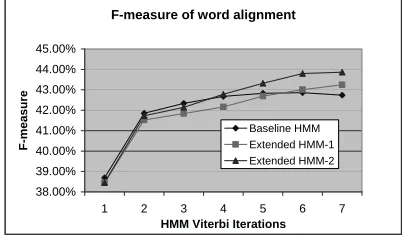
We also applied our bilingual word clustering in a word alignment setting. The training data is the TIDES small data track. The word alignments are manually labeled for 627 sentences sampled from the dryrun test data in 2001. In this manually aligned data, we include one-to-one, one-to-many, and many-to-many word alignments. Figure 4 sum-marizes the word alignment accuracy for different
e-mirror over different settings
0
BIL2: Co-occur raw counts
BIL2: Co-occur counts from init word-align BIL1: Two-step optimization
Figure 3:²-mirror with different settings
methods. The baseline is the standard HMM trans-lation model defined in Eqn. 2; the HMM1 is de-fined in Eqn 3, and HMM2 is dede-fined in Eqn 4. The algorithm is applying our proposed bilingual word clustering algorithm to infer 1000 clusters for both languages. As expected, Figure 4 shows that using
F-measure of word alignment
38.00%
Figure 4: Word Alignment Over Iterations
word clusters is helpful for word alignment. HMM2 gives the best performance in terms of F-measure of word alignment. One quarter of the words in the test vocabulary are unseen as shown in Table 1. These unseen words related alignment links (4778 out of 14769) will be left unaligned by translation models. Thus the oracle (best possible) recall we could get is 67.65%. Our standard t-test showed that signifi-cant interval is 0.82% at the 95% confidence level. The improvement at the last iteration of HMM is marginally significant.
4.4 Applications in Phrase-based Translations
are computed: phrase level fertilities, distortions, and lexicon scores. These scores are used in a lo-cal greedy search to extract phrase pairs (Zhao and Vogel, 2005). This phrase extraction is more sen-sitive to the differences inP(fj|ei) than the HMM
Viterbi word aligner.
The evaluation conditions are defined in NIST 2003 Small track. Around 247K test set (919 Chi-nese sentences) specific phrase pairs are extracted with up to 7-gram in source phrase. A trigram language model is trained using Gigaword XinHua news part. With a monotone phrase-based decoder, the translation results are reported in Table 3. The
Eval. Baseline Bil1 Bil2
NIST 6.417 6.507 6.582
BLEU 0.1558 0.1575 0.1644
Table 3: NIST’03 C-E Small Data Track Evaluation
baseline is using the lexiconP(fj|ei) trained from
standard HMM in Eqn. 2, which gives a BLEU score of 0.1558 +/- 0.0113. Bil1 and Bil2 are using
P(fj|ei)from HMM in Eqn. 4 with 1000 bilingual
word clusters inferred from the two-step algorithm and the proposed one respectively. Using the clus-ters from the two-step algorithm gives a BLEU score of 0.1575, which is close to the baseline. Using clus-ters from our algorithm, we observe more improve-ments with BLEU score of 0.1644 and a NIST score of 6.582.
5 Discussions and Conclusions
In this paper, a new approach for bilingual word clustering using eigenstructure in bilingual feature space is proposed. Eigenvectors from this feature space are considered as bilingual concepts. Bilin-gual clusters from the subspaces expanded by these concepts are inferred with high semantic correla-tions within each cluster, and high translation quali-ties across clusters from the two languages.
Our empirical study also showed effectiveness of using bilingual word clusters in extended HMMs for statistical machine translation. The K-means based clustering algorithm can be easily extended to do hi-erarchical clustering. However, extensions of trans-lation models are needed to leverage the hierarchical clusters appropriately.
References
P.F. Brown, Stephen A. Della Pietra, Vincent. J. Della Pietra, and Robert L. Mercer. 1993. The mathe-matics of statistical machine translation: Parameter es-timation. In Computational Linguistics, volume 19(2), pages 263–331.
David Graff. 2003. Ldc gigaword corpora: English gi-gaword (ldc catalog no: Ldc2003t05). In LDC link: http://www.ldc.upenn.edu/Catalog/index.jsp.
R. Kneser and Hermann Ney. 1993. Improved clus-tering techniques for class-based statistical language modelling. In European Conference on Speech Com-munication and Technology, pages 973–976.
Marina Meila and Jianbo Shi. 2000. Learning segmenta-tion by random walks. In Advances in Neural Informa-tion Processing Systems. (NIPS2000), pages 873–879.
A. Ng, M. Jordan, and Y. Weiss. 2001. On spectral clustering: Analysis and an algorithm. In Advances in Neural Information Processing Systems 14: Proceed-ings of the 2001.
Franz J. Och and Hermann Ney. 2000. A comparison of alignment models for statistical machine translation. In COLING’00: The 18th Int. Conf. on Computational Linguistics, pages 1086–1090, Saarbrucken, Germany, July.
Franz J. Och and Hermann Ney. 2003. A systematic comparison of various statistical alignment models. In Computational Linguistics, volume 29, pages 19–51.
Franz J. Och. 1999. An efficient method for determin-ing bildetermin-ingal word classes. In Ninth Conf. of the Europ. Chapter of the Association for Computational Linguis-tics (EACL’99), pages 71–76.
Kristina Toutanova, H. Tolga Ilhan, and Christopher D. Manning. 2002. Extensions to hmm-based statistical word alignment models. In Proc. of the Conference on Empirical Methods in Natural Language Processing.
S. Vogel, Hermann Ney, and C. Tillmann. 1996. Hmm based word alignment in statistical machine transla-tion. In Proc. The 16th Int. Conf. on Computational Lingustics, (Coling’96), pages 836–841.
Yeyi Wang, John Lafferty, and Alex Waibel. 1996. Word clustering with parallel spoken language cor-pora. In proceedings of the 4th International Con-ference on Spoken Language Processing (ICSLP’96), pages 2364–2367.