Automatic Essay Grading with Probabilistic Latent Semantic Analysis
Tuomo Kakkonen, Niko Myller, Jari Timonen, and Erkki Sutinen Department of Computer Science, University of Joensuu
P.O. Box 111, FI-80101 Joensuu, FINLAND [email protected]
Abstract
Probabilistic Latent Semantic Analysis (PLSA) is an information retrieval tech-nique proposed to improve the problems found in Latent Semantic Analysis (LSA). We have applied both LSA and PLSA in our system for grading essays written in Finnish, called Automatic Essay Assessor (AEA). We report the results comparing PLSA and LSA with three essay sets from various subjects. The methods were found to be almost equal in the accuracy mea-sured by Spearman correlation between the grades given by the system and a hu-man. Furthermore, we propose methods for improving the usage of PLSA in essay grading.
1 Introduction
The main motivations behind developing automated essay assessment systems are to decrease the time in which students get feedback for their writings, and to reduce the costs of grading. The assumption in most of the systems is that the grades given by the human assessors describe the true quality of an es-say. Thus, the aim of the systems is to “simulate” the grading process of a human grader and a sys-tem is usable only if it is able to perform the grad-ing as accurately as human raters. An automated as-sessment system is not affected by errors caused by lack of consistency, fatigue or bias, thus it can help achieving better accuracy and objectivity of assess-ment (Page and Petersen, 1995).
There has been research on automatic essay grad-ing since the 1960s. The earliest systems, such as PEG (Page and Petersen, 1995), based their grad-ing on the surface information from the essay. For example, the number of words and commas were counted in order to determine the quality of the es-says (Page, 1966). Although these kinds of sys-tems performed considerably well, they also re-ceived heavy criticism (Page and Petersen, 1995). Some researchers consider the use of natural lan-guage as a feature for human intelligence (Hearst et al., 2000) and writing as a method to express the intelligence. Based on that assumption, tak-ing the surface information into account and ignor-ing the meanignor-ings of the content is insufficient. Re-cent systems and studies, such as e-rater (Burstein, 2003) and approaches based on LSA (Landauer et al., 1998), have focused on developing the methods which determine the quality of the essays with more analytic measures such as syntactic and semantic structure of the essays. At the same time in the 1990s, the progress of natural language processing and information retrieval techniques have given the opportunity to take also the meanings into account.
LSA has produced promising results in content analysis of essays (Landauer et al., 1997; Foltz et al., 1999b). Intelligent Essay Assessor (Foltz et al., 1999b) and Select-a-Kibitzer (Wiemer-Hastings and Graesser, 2000) apply LSA for assessing essays written in English. In Apex (Lemaire and Dessus, 2001), LSA is applied to essays written in French. In addition to the essay assessment, LSA is applied to other educational applications. An intelligent tutor-ing system for providtutor-ing help for students
Hastings et al., 1999) and Summary Street (Stein-hart, 2000), which is a system for assessing sum-maries, are some examples of other applications of LSA. To our knowledge, there is no system utilizing PLSA (Hofmann, 2001) for automated essay assess-ment or related tasks.
We have developed an essay grading system,
Au-tomatic Essay Assessor (AEA), to be used to
ana-lyze essay answers written in Finnish, although the system is designed in a way that it is not limited to only one language. It applies both course materials, such as passages from lecture notes and course text-books covering the assignment-specific knowledge, and essays graded by humans to build the model for assessment. In this study, we employ both LSA and PLSA methods to determine the similarities between the essays and the comparison materials in order to determine the grades. We compare the accuracy of these methods by using the Spearman correlation be-tween computer and human assigned grades.
The paper is organized as follows. Section 2 ex-plains the architecture of AEA and the used grading methods. The experiment and results are discussed in Section 3. Conclusions and future work based on the experiment are presented in Section 4.
2 AEA System
We have developed a system for automated assess-ment of essays (Kakkonen et al., 2004; Kakkonen and Sutinen, 2004). In this section, we explain the basic architecture of the system and describe the methods used to analyze essays.
2.1 Architecture of AEA
There are two approaches commonly used in the es-say grading systems to determine the grade for the essay:
1. The essay to be graded is compared to the human-graded essays and the grade is based on the most similar essays’ grades; or
2. The essay to be graded is compared to the essay topic related materials (e.g. textbook or model essays) and the grade is given based on the sim-ilarity to these materials.
In our system, AEA (Kakkonen and Sutinen, 2004), we have combined these two approaches. The
rel-evant parts of the learning materials, such as chap-ters of a textbook, are used to train the system with assignment-specific knowledge. The approaches based on the comparison between the essays to be graded and the textbook have been introduced in (Landauer et al., 1997; Foltz et al., 1999a; Lemaire and Dessus, 2001; Hearst et al., 2000), but have been usually found less accurate than the methods based on comparison to prescored essays. Our method attempts to overcome this by combining the use of course content and prescored essays. The es-says to be graded are not directly compared to the prescored essays with for instancek-nearest neigh-bors method, but prescored essays are used to deter-mine the similarity threshold values for grade cat-egories as discussed below. Prescored essays can also be used to determine the optimal dimension for the reduced matrix in LSA as discussed in Kakko-nen et al. (2005).
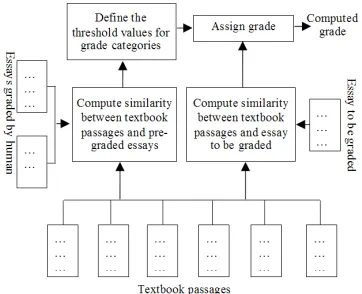
Figure 1: The grading process of AEA.
Figure 1 illustrates the grading process of our sys-tem. The texts to be analyzed are added into
word-by-context matrix (WCM), representing the number
base forms have to be used instead of inflectional forms when building the WCM, especially if a rel-atively small corpus is utilized. Furthermore, sev-eral words can become synonyms when suffixes are added to them, thus making the word sense disam-biguation necessary. Hence, instead of just stripping suffixes, we apply a more sophisticated method, a morphological parser and disambiguator, namely Constraint Grammar parser for Finnish (FINCG) to produce the lemmas for each word (Lingsoft, 2005). In addition, the most commonly occurring words (stopwords) are not included in the matrix, and only the words that appear in at least two contexts are added into the WCM (Landauer et al., 1998). We also apply entropy-based term weighting in order to give higher values to words that are more important for the content and lower values to words with less importance.
First, the comparison materials based on the rel-evant textbook passages or other course materials are modified into machine readable form with the method described in the previous paragraph. The vector for each context in the comparison materials is marked withYi. This WCM is used to create the
model with LSA, PLSA or another information re-trieval method. To compare the similarity of an es-say to the course materials, a query vectorXj of the
same form as the vectors in the WCM is constructed. The query vectorXj representing an essay is added or folded in into the model build with WCM with the method specific way discussed later. This folded-in queryXj˜ is then compared to the model of each text passageY˜iin the comparison material by using a
similarity measure to determine the similarity value. We have used the cosine of the angle between (Xj˜ ,
˜
Yi), to measure the similarity of two documents. The similarity score for an essay is calculated as the sum
of the similarities between the essay and each of the textbook passages.
The document vectors of manually graded es-says are compared to the textbook passages, in order to determine the similarity scores between the essays and the course materials. Based on these measures, threshold values for the grade cat-egories are defined as follows: the grade catcat-egories,
g1, g2, . . . , gC, are associated with similarity value
limits, l1, l2, . . . , lC+1, where C is the number of
grades, and lC+1 = ∞ and normally l1 = 0 or
−∞. Other category limitsli,2 ≤ i ≤ C, are de-fined as weighted averages of the similarity scores for essays belonging to grade categoriesgiandgi−1.
Other kinds of formulas to define the grade category limits can be also used.
The grade for each essay to be graded is then de-termined by calculating the similarity score between the essay and the textbook passages and comparing the similarity score to the threshold values defined in the previous phase. The similarity scoreSiof an es-saydi is matched to the grade categories according
to their limits in order to determine the correct grade category as follows: For each i, 1 ≤ i≤ C, if li < Si ≤li+1 then di∈gi and break.
2.2 Latent Semantic Analysis
Latent Semantic Analysis (LSA) (Landauer et al.,
1998) is a corpus-based method used in informa-tion retrieval with vector space models. It provides a means of comparing the semantic similarity be-tween the source and target texts. LSA has been successfully applied to automate giving grades and feedback on free-text responses in several systems as discussed in Section 1. The basic assumption behind LSA is that there is a close relationship be-tween the meaning of a text and the words in that text. The power of LSA lies in the fact that it is able to map the essays with similar wordings closer to each other in the vector space. The LSA method is able to strengthen the similarity between two texts even when they do not contain common words. We describe briefly the technical details of the method.
The essence of LSA is dimension reduction based on the singular value decomposition (SVD), an al-gebraic technique. SVD is a form of factor analy-sis, which reduces the dimensionality of the origi-nal WCM and thereby increases the dependency be-tween contexts and words (Landauer et al., 1998). SVD is defined asX = T0S0D0T, whereX is the
preprocessed WCM andT0 andD0are orthonormal
matrices representing the words and the contexts.S0
is a diagonal matrix with singular values. In the di-mension reduction, thekhighest singular values in
S0 are selected and the rest are ignored. With this
be-come evident (Deerwester et al., 1990).
In information retrieval and essay grading, the queries or essays have to be folded in into the model in order to calculate the similarities between the doc-uments in the model and the query. In LSA, the fold-ing in can be achieved with a simple matrix multipli-cation:Xq˜ =XqTT0S−
1
0 , whereXqis the term
vec-tor constructed from the query document with pre-processing, andT0andS0are the matrices from the
SVD of the model after dimension reduction. The resulting vectorX˜qis in the same format as the
doc-uments in the model.
The features that make LSA suitable for auto-mated grading of essays can be summarized as fol-lows. First, the method focuses on the content of the essay, not on the surface features or keyword-based content analysis. The second advantage is that LSA-based scoring can be performed with relatively low amount of human graded essays. Other meth-ods, such as PEG and e-rater typically need several hundred essays to be able to form an assignment-specific model (Shermis et al., 2001; Burstein and Marcu, 2000) whereas LSA-based IEA system has sometimes been calibrated with as few as 20 essays, though it typically needs more essays (Hearst et al., 2000).
Although LSA has been successfully applied in information retrieval and related fields, it has also re-ceived criticism (Hofmann, 2001; Blei et al., 2003). The objective function determining the optimal de-composition in LSA is the Frobenius norm. This corresponds to an implicit additive Gaussian noise assumption on the counts and may be inadequate. This seems to be acceptable with small document collections but with large document collections it might have a negative effect. LSA does not define a properly normalized probability distribution and, even worse, the approximation matrix may contain negative entries meaning that a document contains negative number of certain words after the dimen-sion reduction. Hence, it is impossible to treat LSA as a generative language model and moreover, the use of different similarity measures is limited. Fur-thermore, there is no obvious interpretation of the directions in the latent semantic space. This might have an effect if also feedback is given. Choosing the number of dimensions in LSA is typically based on an ad hoc heuristics. However, there is research
done aiming to resolve the problem of dimension se-lection in LSA, especially in the essay grading do-main (Kakkonen et al., 2005).
2.3 Probabilistic Latent Semantic Analysis
Probabilistic Latent Semantic Analysis (PLSA)
(Hofmann, 2001) is based on a statistical model which has been called the aspect model. The aspect model is a latent variable model for co-occurrence data, which associates unobserved class variables
zk,k∈ {1,2, . . . , K}with each observation. In our settings, the observation is an occurrence of a word
wj, j ∈ {1,2, . . . , M}, in a particular context di, i ∈ {1,2, . . . , N}. The probabilities related to this model are defined as follows:
• P(di) denotes the probability that a word
oc-currence will be observed in a particular con-textdi;
• P(wj|zk)denotes the class-conditional
proba-bility of a specific word conditioned on the un-observed class variablezk; and
• P(zk|di)denotes a context specific probability distribution over the latent variable space.
When using PLSA in essay grading or information retrieval, the first goal is to build up the model. In other words, approximate the probability mass func-tions with machine learning from the training data, in our case the comparison material consisting of as-signment specific texts.
Expectation Maximization (EM) algorithm can be
used in the model building with maximum likeli-hood formulation of the learning task (Dempster et al., 1977). In EM, the algorithm alternates between two steps: (i) an expectation (E) step where posterior probabilities are computed for the latent variables, based on the current estimates of the parameters, (ii) a maximization (M) step, where parameters are up-dated based on the loglikelihood which depends on the posterior probabilities computed in the E-step. The standard E-step is defined in equation (1).
P(zk|di, wj) = PKP(wj|zk)P(zk|di) l=1P(wj|zl)P(zl|di)
(1)
are alternated until a termination condition is met, in this case, when the maximum likelihood function has converged.
Although standard EM algorithm can lead to good results, it may also overfit the model to the train-ing data and perform poorly with unseen data. Fur-thermore, the algorithm is iterative and converges slowly, which can increase the runtime seriously. Hence, Hofmann (2001) proposes another approach called Tempered EM (TEM), which is a derivation of standard EM algorithm. In TEM, the M-step is the same as in EM, but a dampening parameter is intro-duced into the E-step as shown in equation (4). The parameterβ will dampen the posterior probabilities closer to uniform distribution, whenβ <1and form the standard E-step whenβ = 1.
Hofmann (2001) defines the TEM algorithm as follows:
1. Setβ := 1 and perform the standard EM with early stopping.
2. Setβ:=ηβ(withη <1).
3. Repeat the E- and M-steps until the perfor-mance on hold-out data deteriorates, otherwise go to step 2.
4. Stop the iteration when decreasingβ does not improve performance on hold-out data.
Early stopping means that the optimization is not done until the model converges, but the iteration is stopped already once the performance on hold-out data degenerates. Hofmann (2001) proposes to use the perplexity to measure the generalization perfor-mance of the model and the stopping condition for
the early stopping. The perplexity is defined as the log-averaged inverse probability on unseen data cal-culated as in equation (5).
P = exp
In PLSA, the folding in is done by using TEM as well. The only difference when folding in a new document or query q outside the model is that just the probabilitiesP(zk|q)are updated during the
M-step and theP(wj|zk)are kept as they are. The
sim-ilarities between a documentdi in the model and a queryqfolded in to the model can be calculated with the cosine of the angle between the vectors contain-ing the probability distributions (P(zk|q))Kk=1 and
(P(zk|di))Kk=1(Hofmann, 2001).
PLSA, unlike LSA, defines proper probability distributions to the documents and has its basis in Statistics. It belongs to a framework called Latent Dirichlet Allocations (Girolami and Kab´an, 2003; Blei et al., 2003), which gives a better grounding for this method. For instance, several probabilistic sim-ilarity measures can be used. PLSA is interpretable with its generative model, latent classes and illus-trations in N-dimensional space (Hofmann, 2001). The latent classes or topics can be used to determine which part of the comparison materials the student has answered and which ones not.
Set Field Training Test Grading Course Comp. mat. No. No. No. essays essays scale materials division type Passages Words
1 Education 70 73 0–6 Textbook Paragraphs 26 2397
2 Education 70 73 0–6 Textbook Sentences 147 2397
3 Communications 42 45 0–4 Textbook Paragraphs 45 1583
4 Communications 42 45 0–4 Textbook Sentences 139 1583
5 Soft. Eng. 26 27 0–10 *) Paragraphs 27 965
6 Soft. Eng. 26 27 0–10 *) Sentences 105 965
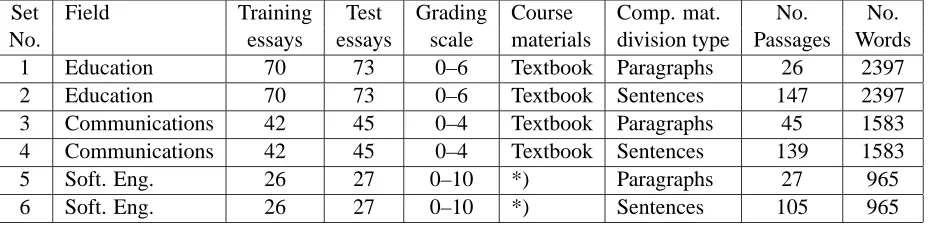
Table 1: The essay sets used in the experiment. *) Comparison materials were constructed from the course handout with teacher’s comments included and transparencies represented to the students.
have been discussed in Blei et al. (2003).
3 Experiment
3.1 Procedure and Materials
To analyze the performance of LSA and PLSA in the essay assessment, we performed an experiment using three essay sets collected from courses on edu-cation, marketing and software engineering. The in-formation about the essay collections is shown in Ta-ble 1. Comparison materials were taken either from the course book or other course materials and se-lected by the lecturer of the course. Furthermore, the comparison materials used in each of these sets were divided with two methods, either into paragraphs or sentences. Thus, we run the experiment in total with six different configurations of materials.
We used our implementations of LSA and PLSA methods as described in Section 2. With LSA, all the possible dimensions (i.e. from two to the num-ber of passages in the comparison materials) were searched in order to find the dimension achieving the highest accuracy of scoring, measured as the correlation between the grades given by the system and the human assessor. There is no upper limit for the number of latent variables in PLSA mod-els as there is for the dimensions in LSA. Thus, we applied the same range for the best dimension search to be fair in the comparison. Furthermore, a linear combination of similarity values from PLSA models (PLSA-C) with predefined numbers of la-tent variablesK∈ {16,32,48,64,80,96,112,128} was used just to analyze the proposed potential of the method as discussed in Section 2.3 and in (Hof-mann, 2001). When building up all the PLSA
mod-els with TEM, we used 20 essays from the training set of the essay collections to determine the early stopping condition with perplexity of the model on unseen data as proposed by Hofmann (2001).
3.2 Results and Discussion
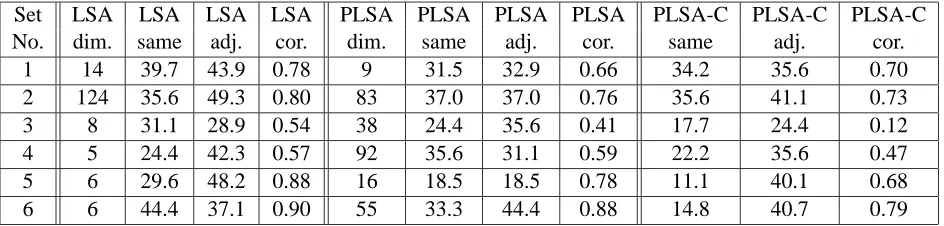
The results of the experiment for all the three meth-ods, LSA, PLSA and PLSA-C are shown in Table 2. It contains the most accurate dimension (column
dim.) measured by machine-human correlation in
grading, the percentage of the same (same) and adja-cent grades (adj.) compared to the human grader and the Spearman correlation (cor.) between the grades given by the human assessor and the system.
The results indicate that LSA outperforms both methods using PLSA. This is opposite to the re-sults obtained by Hofmann (2001) in information retrieval. We believe this is due to the size of the document collection used to build up the model. In the experiments of Hofmann (2001), it was much larger, 1000 to 3000 documents, while in our case the number of documents was between 25 and 150. However, the differences are quite small when using the comparison materials divided into sentences. Al-though all methods seem to be more accurate when the comparison materials are divided into sentences, PLSA based methods seem to gain more than LSA.
com-Set LSA LSA LSA LSA PLSA PLSA PLSA PLSA PLSA-C PLSA-C PLSA-C
No. dim. same adj. cor. dim. same adj. cor. same adj. cor.
1 14 39.7 43.9 0.78 9 31.5 32.9 0.66 34.2 35.6 0.70
2 124 35.6 49.3 0.80 83 37.0 37.0 0.76 35.6 41.1 0.73
3 8 31.1 28.9 0.54 38 24.4 35.6 0.41 17.7 24.4 0.12
4 5 24.4 42.3 0.57 92 35.6 31.1 0.59 22.2 35.6 0.47
5 6 29.6 48.2 0.88 16 18.5 18.5 0.78 11.1 40.1 0.68
6 6 44.4 37.1 0.90 55 33.3 44.4 0.88 14.8 40.7 0.79
Table 2: The results of the grading process with different methods.
bine several dimensions’ similarity values. In our case, it seems that linear combination of the simi-larity values is not the best option because the sim-ilarity values between essays and comparison mate-rials decrease when the number of latent variables increases. A topic for a further study would be to analyze techniques to combine the similarity values in PLSA-C to obtain higher accuracy in essay grad-ing. Furthermore, it seems that the best combina-tion of dimensions in PLSA-C depends on the fea-tures of the document collection (e.g. number of passages in comparison materials or number of es-says) used. Another topic of further research is how the combination of dimensions can be optimized for each essay set by using the collection specific fea-tures without the validation procedure proposed in Kakkonen et al. (2005).
Currently, we have not implemented a version of LSA that combines scores from several models but we will analyze the possibilities for that in future research. Nevertheless, LSA representations for dif-ferent dimensions form a nested sequence because of the number of singular values taken to approxi-mate the original matrix. This will make the model combination less effective with LSA. This is not true for statistical models, such as PLSA, because they can capture a larger variety of the possible depositions and thus several models can actually com-plement each other (Hofmann, 2001).
4 Future Work and Conclusion
We have implemented a system to assess essays written in Finnish. In this paper, we report a new extension to the system for analyzing the essays with PLSA method. We have compared LSA and PLSA as methods for essay grading. When our
re-sults are compared to the correlations between hu-man and system grades reported in literature, we have achieved promising results with all methods. LSA was slightly better when compared to PLSA-based methods. As future research, we are going to analyze if there are better methods to combine the similarity scores from several models in the context of essay grading to increase the accuracy (Hofmann, 2001). Another interesting topic is to combine LSA and PLSA to compliment each other.
We used the cosine of the angle between the prob-ability vectors as a measure of similarity in LSA and PLSA. Other methods are proposed to determine the similarities between probability distributions pro-duced by PLSA (Girolami and Kab´an, 2003; Blei et al., 2003). The effects of using these techniques will be compared in the future experiments.
If the PLSA models with different numbers of latent variables are not highly dependent on each other, this would allow us to analyze the reliability of the grades given by the system. This is not pos-sible with LSA based methods as they are normally highly dependent on each other. However, this will need further work to examine all the potentials.
informa-tion in LSA-based essay grading (Kakkonen et al., 2005). In addition, we plan to continue the work with PLSA, since it, being a probabilistic model, in-troduces new possibilities, for instance, in similarity comparison and feedback giving.
References
D. M. Blei, A. Y. Ng, and M. I. Jordan. 2003. La-tent Dirichlet Allocation. J. of Machine Learning
Re-search, 3:993–1022.
J. Burstein and D. Marcu. 2000. Benefits of modularity in an automated scoring system. In Proc. of the
Work-shop on Using Toolsets and Architectures to Build NLP Systems, 18th Int’l Conference on Computational Lin-guistics, Luxembourg.
J. Burstein. 2003. The e-rater scoring engine: Auto-mated essay scoring with natural language process-ing. In M. D. Shermis and J. Burstein, editors,
Auto-mated essay scoring: A cross-disciplinary perspective.
Lawrence Erlbaum Associates, Hillsdale, NJ.
S. Deerwester, S. T. Dumais, G. W. Furnas, T. K. Lan-dauer, and R. Harshman. 1990. Indexing By Latent Semantic Analysis. J. of the American Society for
In-formation Science, 41:391–407.
A. P. Dempster, N. M. Laird, and D. B. Rubin. 1977. Maximum likelihood from incomplete data via the em algorithm. J. of the Royal Statistical Society, 39:1–38.
P. W. Foltz, D. Laham, and T. K. Landauer. 1999a. Au-tomated Essay Scoring: Applications to Educational Technology. In Proc. of Wolrd Conf. Educational
Mul-timedia, Hypermedia & Telecommunications, Seattle,
USA.
P. W. Foltz, D. Laham, and T. K. Landauer. 1999b. The Intelligent Essay Assessor: Applications to Educational Technology. Interactive Multime-dia Electronic J. of Computer-Enhanced Learning,
1. http://imej.wfu.edu/articles/1999/
2/04/index.asp(Accessed 3.4.2005).
M. Girolami and A. Kab´an. 2003. On an Equivalence be-tween PLSI and LDA. In Proc. of the 26th Annual Int’l
ACM SIGIR Conf. on Research and Development in In-formaion Retrieval, pages 433–434, Toronto, Canada.
ACM Press.
M. Hearst, K. Kukich, M. Light, L. Hirschman, J. Burger, E. Breck, L. Ferro, T. K. Landauer, D. Laham, P. W. Foltz, and R. Calfee. 2000. The Debate on Automated Essay Grading. IEEE Intelligent Systems, 15:22–37.
T. Hofmann. 2001. Unsupervised Learning by Proba-bilistic Latent Semantic Analysis. Machine Learning, 42:177–196.
T. Kakkonen and E. Sutinen. 2004. Automatic As-sessment of the Content of Essays Based on Course Materials. In Proc. of the Int’l Conf. on Information
Technology: Research and Education, pages 126–130,
London, UK.
T. Kakkonen, N. Myller, and E. Sutinen. 2004. Semi-Automatic Evaluation Features in Computer-Assisted Essay Assessment. In Proc. of the 7th IASTED Int’l
Conf. on Computers and Advanced Technology in Ed-ucation, pages 456–461, Kauai, Hawaii, USA.
T. Kakkonen, N. Myller, E. Sutinen, and J. Timonen. 2005. Comparison of Dimension Reduction Methods for Automated Essay Grading. Submitted.
T. K. Landauer, D. Laham, B. Rehder, and M. E. Schreiner. 1997. How well can passage meaning be derived without using word order? A comparison of Latent Semantic Analysis and humans. In Proc. of the
19th Annual Meeting of the Cognitive Science Society,
Mawhwah, NJ. Erlbaum.
T. K. Landauer, P. W. Foltz, and D. Laham. 1998. In-troduction to latent semantic analysis. Discourse
Pro-cesses, 25:259–284.
B. Lemaire and P. Dessus. 2001. A System to Assess the Semantic Content of Student Essays. J. of Educational
Computing Research, 24:305–320.
Lingsoft. 2005. http://www.lingsoft.fi/ (Ac-cessed 3.4.2005).
E. B. Page and N. S. Petersen. 1995. The computer moves into essay grading. Phi Delta Kappan, 76:561– 565.
E. B. Page. 1966. The imminence of grading essays by computer. Phi Delta Kappan, 47:238–243.
M. D. Shermis, H. R. Mzumara, J. Olson, and S. Harring-ton. 2001. On-line Grading of Student Essays: PEG goes on the World Wide Web. Assessment &
Evalua-tion in Higher EducaEvalua-tion, 26:247.
D. Steinhart. 2000. Summary Street: an LSA Based
Intel-ligent Tutoring System for Writing and Revising Sum-maries. Ph.D. thesis, University of Colorado, Boulder,
Colorado.
P. Wiemer-Hastings and A. Graesser. 2000. Select-a-Kibitzer: A computer tool that gives meaningful feed-back on student compositions. Interactive Learning
Environments, 8:149–169.
P. Wiemer-Hastings, K. Wiemer-Hastings, and A. Graesser. 1999. Approximate natural lan-guage understanding for an intelligent tutor. In