Event-Based Extractive Summarization
Elena FilatovaDepartment of Computer Science Columbia University New York, NY 10027, USA
Vasileios Hatzivassiloglou
Center for Computational Learning Systems Columbia University
New York, NY 10027, USA
Abstract
Most approaches to extractive summarization define a set of features upon which selection of sentences is based, using algorithms independent of the fea-tures themselves. We propose a new set of feafea-tures based on low-level, atomic events that describe rela-tionships between important actors in a document or set of documents. We investigate the effect this new feature has on extractive summarization, compared with a baseline feature set consisting of the words in the input documents, and with state-of-the-art summarization systems. Our experimental results indicate that not only the event-based features of-fer an improvement in summary quality over words as features, but that this effect is more pronounced for more sophisticated summarization methods that avoid redundancy in the output.
1 Introduction
The main goal of extractive summarization can be concisely formulated as extracting from the input pieces of text which contain the information about the most important concepts mentioned in the input text or texts. This definition conceals a lot of impor-tant issues that should be taken into consideration in the process of summary construction. First, it is necessary to identify the important concepts which should be described in the summary. When those important concepts are identified then the process of summarization can be presented as:
1. Break the input text into textual units (sen-tences, paragraphs, etc.).
2. See what concepts each textual unit covers. 3. Choose a particular textual unit for the output
according to the concepts present in all textual units.
4. Continue choosing textual units until reaching the desired length of the summary.
Some current summarization systems add a clus-tering step, substituting the analysis of all the textual
units by the analysis of representative units from each cluster. Clustering is helpful for avoiding rep-etitions in the summary.
In this paper we propose a new representation for concepts and correspondingly a new feature on which summarization can be based. We adapt the algorithm we proposed earlier (Filatova and Hatzi-vassiloglou, 2003) for assigning to each sentence
a list of low-level, atomic events. These events
capture information about important named entities for the input text or texts, and the relationships be-tween these named entities. We also discuss a gen-eral model which treats summarization as a three-component problem, involving the identification of the textual units into which the input text should be broken and which are later used as the con-stituent parts of the final summary, the textual fea-tures which are associated with the important con-cepts described in the input text, and the appropri-ate algorithm for selecting the textual units to be in-cluded into the summary.
We focus on the latter two of those steps and ex-plore interdependencies between the choice of fea-tures (step 2) and selection algorithm (step 3). We experimentally test our hypothesis that event-based features are helpful for summarization by compar-ing the performance of three sentence selection al-gorithms when we use such features versus the case where we use another, widely used set of textual features: the words in the input texts, weighted by their tf*idf scores. The results establish that for the majority of document sets in our test collection, events outperform tf*idf for all algorithms consid-ered. Furthermore, we show that this benefit is more pronounced when the selection algorithm includes steps to address potential repetition of information in the output summary.
2 General Summarization Model
c1 c2 c3 c4 c5
t1 1 1 0 1 1
t2 1 0 0 1 0
t3 0 1 0 0 1
t4 1 0 1 1 1
Table 1: Matrix for Summarization Model
the concepts or features it covers, and the text level, where, before being added to the final output, tex-tual units are compared to each other on the basis of those features.
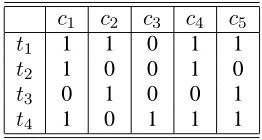
In Section 1 we presented a four-step pipeline for extractive summarization; existing summariza-tion systems largely follow this pipeline, although they introduce different approaches for every step in it. We suggest a model that describes the extrac-tive summarization task in general terms. Consider the matrix in Table 1.
Rows of this matrix represent all textual units into which the input text is divided. Columns represent the concepts discovered for the input text. Every concept is either absent or present in a given textual
unit. Each conceptcihas also an associated weight
wiindicating the importance of this concept. These
weights can be used for scoring the textual units. Thus, the input text and the important
informa-tion in it is mapped onto anm×nmatrix. Using the
above matrix it is possible to formulate the extrac-tive summarization problem as extracting the mini-mal amount of textual units which cover all the con-cepts that are interesting or important. To account for the cost of long summaries, we can constrain the total length of the summary, or balance it against the total weight of covered concepts.
The presented model can be also used for com-paring summaries consisting of different textual units. For example, a summary consisting only of
textual unitt1 renders the same information as the
summary consisting of textual unitst2andt3. Both
these summaries cover the same set of concepts,
namely c1, c2 and c3. We explore properties of
this model in more detail in (Filatova and Hatzivas-siloglou, 2004).
3 Associating Concepts with Features
Before extracting a summary, it is necessary to de-fine what concepts in the input text are important and should be covered by the output text. There is no exact definition or even agreement between dif-ferent approaches on what an important concept is. In order to use the model of Section 2 one has to approximate the notion of “concept” with some tex-tual features.
Current summarization approaches use text fea-tures which give high scores to the textual units that contain important information, and low scores to those textual units which are not highly likely to contain information worth to be included in the final output.
There exist approaches that deal mainly with lex-ical features, like tf*idf weighing of words in the input text(s), words used in the titles and section headings (Luhn, 1958; Edmundson, 1968), or the presence or absence of certain cue phrases like
sig-nificant, important, and in conclusion (Kupiec et
al., 1995; Teufel and Moens, 1997). Other
sys-tems exploit the co-occurrence of particular con-cepts (Barzilay and Elhadad, 1997; Lin and Hovy, 2000) or syntactic constraints between concepts (McKeown et al., 1999). Concepts do not have to be directly observable as text snippets—they can rep-resent abstract properties that particular text units may or may not satisfy, for example, status as a first sentence in a paragraph or generally position in the source text (Baxendale, 1958; Lin and Hovy, 1997). Some summarization systems assume that the im-portance of a sentence is derivable from a rhetorical representation of the source text (Marcu, 1997).
The matrix representation of the previous section offers a way to formalize the sharing of information between textual units at the individual feature level. Thus, this representation is most useful for content-related concepts that should not be repeated in the summary. The representation can however handle independent features such as sentence position by encoding them separately for each textual unit.
4 Atomic Events
Atomic events link major constituent parts of the actions described in a text or collection of texts through the verbs or action nouns labeling the event itself. The idea behind this technique is that the major constituent parts of events (participants, lo-cations, times) are usually realized in text as named entities. The more important the constituent part, the more often the corresponding named entity is mentioned.
Not all the constituent parts of events need to be represented by named entities. For example, in an airline crash it is important to report information about the passengers and the crew. These are not marked by named entities but are highly likely to be among the most frequently used nouns. Thus, we add the top ten most frequent nouns to the list of named entities.
It involves the following steps:
1. Analyze each input sentence1one at a time;
ig-nore sentences that do not contain at least two named entities or frequent nouns.
2. Extract all the possible pairs of named enti-ties/frequent nouns in the sentence, preserving their order and all the words in between. We call such pairs of named entities relations, and the words in-between the named entities in a relation connectors.
3. For each relation, count how many times this relation is used in the input text(s).
4. Keep only connectors that are content verbs or action nouns, according to WordNet’s (Fell-baum, 1998) noun hierarchy. For each connec-tor calculate how many times it is used for the extracted relation.
After calculating the scores for all relations and all connectors within each relation, we calculate their normalized scores The normalized relation score is the ratio of the count for the current rela-tion (how many times we see the relarela-tion within a sentence in the input) over the overall count of all relations. The normalized connector score is the ra-tio of the count for the current connector (how many times we see this connector for the current relation) over the overall count for all connectors for this re-lation.
Thus, out of the above procedural definition, an atomic event is a triplet of two named entities (or frequent nouns) connected by a verb or an action-denoting noun. To get a score for the atomic event we multiply the normalized score for the relation by the normalized score for the connector. The score indicates how important the triplet is overall.
In the above approach to event detection we do not address co-reference, neither we merge together the triplets which describe the same event using paraphrases, inflected forms and syntactic variants (e.g., active/passive voice). Our method uses rel-atively simple extraction techniques and shallow statistics, but it is fully automatic and can serve as a first approximation of the events in the input text(s). Our approach to defining events is not the only one proposed—this is a subject with substantial work in linguistics, information retrieval, and infor-mation extraction. In linguistics, events are often defined at a fine-grained level as a matrix verb or a single action noun like “war” (Pustejovsky, 2000). In contrast, recent work in information retrieval
1
We earlier showed empirically (Filatova and Hatzivas-siloglou, 2003) that a description of a single event is usually bound within one sentence.
within the TDT framework has taken event to mean essentially “narrowly defined topic for search” (Al-lan et al., 1998). Finally, for the information extrac-tion community an event represents a template of re-lationships between participants, times, and places (Marsh and Perzanowski, 1997). It may be possible to use these alternative models of events as a source of content features.
We earlier established empirically (Filatova and Hatzivassiloglou, 2003) that this technique for atomic event extraction is useful for delineating the major participants and their relationships from a set of topically related input texts. For example, from a collection of documents about an airplane crash the algorithm assigns the highest score to atomic events that link together the name of the airline, the source and destination airports and the day when the crash happened through the verb crashed or its synonyms. It is thus plausible to explore the usefulness of these event triplets as the concepts used in the model of Section 2.
5 Textual Unit Selection
We have formulated the problem of extractive sum-marization in terms of the matrix model, stating that mapping concepts present in the input text onto the textual units out of which the output is con-structed can be accomplished by extracting the min-imal amount of textual units which either cover most of the important concepts. Every time we add a new textual unit to the output it is possible to judge what concepts in it are already covered in the final summary. This observation can be used to avoid re-dundancy: before adding a candidate textual unit to the output summary, we check whether it contains enough new important concepts.
We describe in this section several algorithms for selecting appropriate textual units for the output summary. These algorithms differ on whether they take advantage of the redundancy reduction prop-erty of our model, and on whether they prioritize im-portant concepts individually or collectively. They share, however, a common property: all of them op-erate independently of the features chosen to repre-sent important concepts, and thus can be used with both our event-based features and other feature sets. The comparison of the results allows us to empir-ically determine whether event-based features can help in summarization.
5.1 Static Greedy Algorithm
unit independently. Textual units are included in the summary if and only if they cover lots of concepts. More specifically,
1. For every textual unit, calculate the weight of this textual unit as the sum of the weights of all the concepts covered by this textual unit. 2. Choose the textual unit with the maximum
weight and add it to the final output.
3. Continue extracting other textual units in order of total weight till we get the summary of the desired length.
5.2 Avoiding Redundancy in the Summary
Two popular techniques for avoiding redundancy in summarization are Maximal Marginal Relevance (MMR) (Goldstein et al., 2000) and clustering (McKeown et al., 1999). In MMR the determination of redundancy is based mainly on the textual over-lap between the sentence that is about to be added to the output and the sentences that are already in the output. Clustering offers an alternative: before start-ing the selection process, the summarization system clusters the input textual units. This step allows an-alyzing one representative unit from each cluster in-stead of all textual units.
We take advantage of the model matrix of Sec-tion 2 to explore another way to avoid redundancy. Rather than making decisions for each textual unit independently, as in our Static Greedy Algorithm, we globally select the subset of textual units that cover the most concepts (i.e., information) present in the input. Then our task becomes very similar to a classic theory problem, Maximum Coverage.
GivenC, a finite set of weighted elements, a
col-lection T of subsets of C, and a parameter k, the
maximum coverage problem is to findk members
ofT such that the total weight of the elements
cov-ered (i.e., belonging to thek members of the
solu-tion) is maximized. This problem is NP-hard, as it can be reduced to the well-known set cover problem (Hochbaum, 1997). Thus, we know only approxi-mation algorithms solving this problem in polyno-mial time.
Hochbaum (1997) reports that a greedy algorithm is the best possible polynomial approximation algo-rithm for this problem. This algoalgo-rithm iteratively
adds to the solution S the set ti ∈ T that locally
maximizes the increase in the total weight of
ele-ments covered byS∪ti. The algorithm gives a
so-lution with weight at least1/(1−e)of the optimal
solution’s total weight.
5.3 Adaptive Greedy Algorithm
The greedy algorithm for the maximum coverage problem is not directly applicable to summariza-tion, because the formulation of maximum
cover-age assumes that any combination ofk setsti (i.e.,
k sentences) is equally good as long as they cover
the same total weight of concepts. A more realistic limitation for the summarization task is to aim for a fixed total length of the summary, rather than a fixed total number of sentences; this approach has been adopted in several evaluation efforts, including the Document Understanding Conferences (DUC). We consequently modify the greedy algorithm for the maximum coverage problem to obtain the following
adaptive greedy algorithm for summarization:
1. For each textual unit calculate its weight as the sum of weights of all concepts it covers. 2. Choose the textual unit with the maximum
weight and add it to the output. Add the con-cepts covered by this textual unit to the list of concepts covered in the final output.
3. Recalculate the weights of the textual units: subtract from each unit’s weight the weight of all concepts in it that are already covered in the output.
4. Continue extracting text units in order of their total weight (going back to step 2) until the summary is of the desired length.
5.4 Modified Adaptive Greedy Algorithm
The adaptive greedy algorithm described above pri-oritizes sentences according to the total weight of concepts they cover. While this is a reasonable ap-proach, an alternative is to give increased priority to concepts that are individually important, so that sen-tences mentioning them have a chance of being in-cluded in the output even if they don’t contain other
important concepts. We have developed the
fol-lowing variation of our adaptive greedy algorithm, termed the modified greedy algorithm:
1. For every textual unit calculate its weight as the sum of weights of all concepts it covers. 2. Consider only those textual units that contain
the concept with the highest weight that has not yet been covered. Out of these, choose the one with highest total weight and add it to the final output. Add the concepts which are covered by this textual unit to the list of concepts covered in the final output.
4. Continue extracting textual units, going back to step 2 each time, until we get a summary of the desired length.
The modified greedy algorithm has the same mechanism for avoiding redundancy as the adaptive greedy one, while according a somewhat different priority to individual sentences (weight of most im-portant concepts versus just total weight).
6 Experiments
We chose as our input data the document sets used in the evaluation of multidocument summa-rization during the first Document Understanding Conference (DUC), organized by NIST (Harman and Marcu, 2001). This collection contains 30 test document sets, each with approximately 10 news stories on different events; document sets vary sig-nificantly in their internal coherence. For each doc-ument set three human-constructed summaries are provided for each of the target lengths of 50, 100, 200, and 400 words. We selected DUC 2001 be-cause ideal summaries are available for multiple lengths.
Concepts and Textual Units Our textual units are sentences, while the features representing con-cepts are either atomic events, as described in Sec-tion 4, or a fairly basic and widely used set of lexical features, namely the list of words present
in each input text. The algorithm for extracting
event triplets assigns a weight to each such triplet, while for words we used as weights their tf*idf
val-ues, taking idf values fromhttp://elib.cs.
berkeley.edu/docfreq/.
Evaluation Metric Given the difficulties in com-ing up with a universally accepted evaluation mea-sure for summarization, and the fact that obtain-ing judgments by humans is time-consumobtain-ing and labor-intensive, we adopted an automated pro-cess for comparing system-produced summaries to “ideal” summaries written by humans. The method, ROUGE (Lin and Hovy, 2003), is based on n-gram overlap between the system-produced and ideal summaries. As such, it is a recall-based measure, and it requires that the length of the summaries be controlled to allow meaningful comparisons.
ROUGE can be readily applied to compare the performance of different systems on the same set of documents, assuming that ideal summaries are available for those documents. At the same time, ROUGE evaluation has not yet been tested exten-sively, and ROUGE scores are difficult to interpret as they are not absolute and not comparable across source document sets.
50 100 200 400 events better 53.3% 63.3% 80.0% 80.0% tf*idf better 23.3% 26.7% 20.0% 20.0% equal 23.3% 10.0% 0.0% 0.0%
Table 2: Static greedy algorithm, events versus
tf*idf
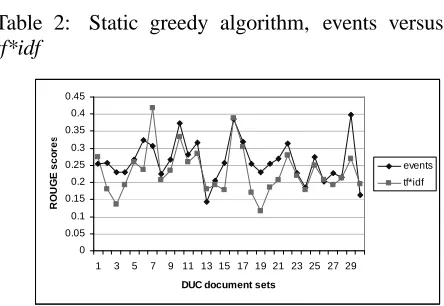
Figure 1: ROUGE scores for 400-word summaries for static greedy algorithm, events versus tf*idf
50 100 200 400 events better 53.3% 66.7% 86.7% 80.0% tf*idf better 23.3% 20.0% 13.3% 20.0% equal 23.3% 13.3% 0.0% 0.0%
Table 3: Adaptive greedy algorithm, events versus
tf*idf
In our comparison, we used as reference sum-maries those created by NIST assessors for the DUC task of generic summarization. The human annota-tors may not have created the same models if asked for summaries describing the major events in the in-put texts instead of generic summaries.
Summary Length For a given set of features and selection algorithm we get a sorted list of sen-tences extracted according to that particular algo-rithm. Then, for each DUC document set we create four summaries of length 50, 100, 200, and 400. In all the suggested methods a whole sentence is added at every step. We extracted exactly 50, 100, 200, and 400 words out of the top sentences (truncating the last sentence if necessary).
6.1 Results: Static Greedy Algorithm
0
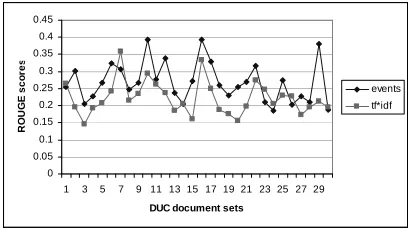
Figure 2: ROUGE scores for 400-word summaries for adaptive greedy algorithm, events versus tf*idf
times each system is better rather than the average ROUGE score in each case because ROUGE scores depend on each particular document set.
It is clear from Table 2 that the summaries cre-ated using atomic events are better in the majority of cases than the summaries created using tf*idf. Figure 1 shows ROUGE scores for 400-word sum-maries. Although in most cases the performance of the event-based summarizer is higher than the per-formance based on tf*idf scores, for some docu-ment sets tf*idf gives the better scores. This phe-nomenon can be explained through an additional analysis of document sets according to their inter-nal coherence. Atomic event extraction works best for a collection of documents with well-defined con-stituent parts of events and where documents are clustered around one specific major event. For such document sets atomic events are good features for basing the summary on. In contrast, some DUC 2001 document sets describe a succession of mul-tiple events linked in time or of different events of the same type (e.g., Clarence Thomas’ ascendancy to the Supreme Court, document set 7 in Figure 1, or the history of airplane crashes, document set 30 in Figure 1). In such cases, a lot of different par-ticipants are mentioned with only few common ele-ments (e.g., Clarence Thomas himself). Thus, most of the atomic events have similar low weights and it is difficult to identify those atomic events that can point out the most important textual units.
6.2 Results: Adaptive Greedy Algorithm
For the second experiment we used the adaptive greedy algorithm, which accounts for information overlap across sentences in the summary. As in the case of the simpler static greedy algorithm, we observe that events lead to a better performance in most document sets than tf*idf (Table 3). Table 3 is in fact similar to Table 2, with slightly increased numbers of document sets for which events receive higher ROUGE scores for the 100 and 200-word
50 100 200 400 static better 0.0% 3.3% 20.0% 23.3% adaptive better 10.0% 16.7% 26.6% 40.0% equal 90.0% 80.0% 53.3% 36.7%
Table 4: Adaptive greedy algorithm versus static greedy algorithm, using events as features
-0.15
Figure 3: Gain in ROUGE scores (400-word sum-maries) when using events instead of tf*idf for the static and adaptive greedy algorithms
50 100 200 400 static better 3.3% 26.7% 43.3% 50.0% adaptive better 3.3% 13.3% 30.0% 50.0% equal 93.3% 60.0% 26.7% 0.0%
Table 5: Adaptive greedy algorithm versus static greedy algorithm, using tf*idf as features
summaries. It is interesting to see that the differ-ence between the ROUGE scores for the summariz-ers based on atomic events and tf*idf features be-comes more distinct when the adaptive greedy al-gorithm is used; Figure 2 shows this for 400-word summaries.
As Table 4 shows, the usage of the adaptive greedy algorithm improves the performance of a summarizer based on atomic events in comparison to the static greedy algorithm. In contrast, the re-verse is true when tf*idf is used (Table 5). Figure 3 shows the change in ROUGE scores that the intro-duction of the adaptive algorithm offers for 400-word summaries. This indicates that tf*idf is not compatible with our information redundancy com-ponent; a likely explanation is that words are corre-lated, and the presence of an important word makes other words in the same sentence also potentially important, a fact not captured by the tf*idf feature. Events, on the other hand, exhibit less of a depen-dence on each other, since each triplet captures a specific interaction between two entities.
6.3 Results: Modified Greedy Algorithm
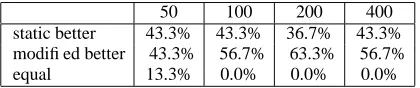
com-50 100 200 400 static better 43.3% 43.3% 36.7% 43.3% modified better 43.3% 56.7% 63.3% 56.7% equal 13.3% 0.0% 0.0% 0.0%
Table 6: Modified adaptive greedy algorithm versus static greedy algorithm, using events as features
50 100 200 400 static better 6.7% 26.7% 36.7% 26.7% modified better 30.0% 40.0% 56.7% 73.3% equal 63.3% 33.3% 6.7% 0.0%
Table 7: Modified adaptive greedy algorithm versus static greedy algorithm, using tf*idf as features
50 100 200 400 events better 56.7% 70.0% 80.0% 66.6% tf*idf better 33.3% 30.0% 20.0% 33.3% equal 10.0% 0.0% 0.0% 0.0%
Table 8: Modified adaptive greedy algorithm, events versus tf*idf
parison with the summarizers using the static greedy algorithm for both events and tf*idf (Tables 6 and 7). In other words, the prioritization of individ-ual important concepts addresses the correlation be-tween words and allows the summarizer to benefit from redundancy reduction even when using tf*idf as the features. The modified adaptive algorithm of-fers a slight improvement in ROUGE scores over the unmodified adaptive algorithm. Also, as Table 8 makes clear, events remain the better feature choice over tf*idf.
6.4 Results: Comparison with DUC systems
For our final experiment we used the 30 test doc-ument sets provided for DUC 2003 competition, for which the summaries produced by participat-ing summarization systems were also released. In DUC 2003 the task was to create summaries only of length 100.
We calculated ROUGE scores for the released summaries created by DUC participants and com-pared them to the scores of our system with atomic events as features and adaptive greedy algorithm as the filtering method. In 14 out of 30 cases our sys-tem outperforms the median of the scores of all the 15 participating systems over that specific document set. We view this comparison as quite encourag-ing, as our system does not employ any of the ad-ditional features (such as sentence position or time information) used by the best DUC summarization systems, nor was it adapted to the DUC domain. Again, the suitability (and relative performance) of the event-based summarizer varies according to the
type of documents being summarized, indicating that using our approach for a subset of document sets is more appropriate. For example, our system scored below all the other systems for the docu-ment set about a meteor shower, which included a lot of background information and no well-defined constituents of events. On the contrary, our sys-tem performed better than any DUC syssys-tem for the document set describing an abortion-related murder, where it was clear who was killed and where and when it happened.
7 Conclusion
We have introduced atomic events as a feature that can be automatically extracted from text and used for summarization, and described algorithms that utilize this feature to select sentences for the sum-mary while minimizing the overlap of information in the output. Our experimental results indicate that events are indeed an effective feature, at least in comparison with words in the input texts that form the basis of many of current summarizers’ feature
sets. With all three of our summarization
algo-rithms, we achieved a gain in performance when
using events. This gain was actually more
pro-nounced with the more sophisticated sentence se-lection methods, establishing that events also ex-hibit less interdependence than features based di-rectly on words. The advantage was also larger in longer summaries.
Our approach to defining and extracting events can be improved in many ways. We are currently looking at ways of matching connectors that are similar in meaning, representing paraphrases of the same event, and methods for detecting and prioritiz-ing special event components such as time and loca-tion phrases. We are also considering merging infor-mation across many related atomic events to a more structured representation for each event, and allow-ing for partial matches between such structures and input sentences.
8 Acknowledgements
We wish to thank Rocco Servedio and Mihalis Yannakakis for valuable discussions of
theoreti-cal foundations of the set cover problem. We
also thank Kathy McKeown and Noemie Elhadad
for comments on an earlier version. This work
References
James Allan, Jaime Carbonell, George Dodding-ton, Jonathan Yamron, and Yiming Yang. 1998. Topic detection and tracking plot study: Final re-port. In Proceedings of the DARPA Broadcast
News Transscription Workshop, April.
Regina Barzilay and Michael Elhadad. 1997. Us-ing lexical chains for text summarization. In
Pro-ceedings of the ACL/EACL 1997 Workshop on Intelligent Scalable Text Summarizaion, Madrid,
Spain, July.
P. B. Baxendale. 1958. Machine-made index for technical literature—An experiment. IBM
Jour-nal of Research and Development, 2:354–361.
H. P. Edmundson. 1968. New methods in automatic extracting. Journal of the Association for
Com-puting Machinary, 23(1):264–285, April.
Christiane Fellbaum, editor. 1998. WordNet: An
Electronic Lexical Database. MIT Press.
Elena Filatova and Vasileios Hatzivassiloglou. 2003. Domain-independent detection, extraction, and labeling of atomic events. In Proceedings
of RANLP, pages 145–152, Borovetz, Bulgaria,
September.
Elena Filatova and Vasileios Hatzivassiloglou. 2004. A formal model for information selection in multi-sentence text extraction. In Proceedings
of COLING, Geneva, Switzerland, August.
Jade Goldstein, Vibhu Mittal, Jaime Carbonell, and Jamie Callan. 2000. Creating and evaluating multi-document sentence extract summaries. In
Proceedings of the 9th CIKM Conference, pages
165–172.
Donna Harman and Daniel Marcu, editors. 2001.
Proceedings of the Document Understanding Conference (DUC). NIST, New Orleans, USA,
September.
Dorit S. Hochbaum. 1997. Approximating cov-ering and packing problems: Set cover, vertex cover, independent set, and related problems. In Dorit S. Hochbaum, editor, Approximation
Al-gorithms for NP-hard Problems, pages 94–143.
PWS Publishing Company, Boston, MA.
Julian Kupiec, Jan Pedersen, and Francine Chen. 1995. A trainable document summarizer. In
Pro-ceedings of the 18th ACM SIGIR Conference,
pages 68–73, Seattle, Washington, May.
Chin-Yew Lin and Eduard Hovy. 1997. Identify-ing topic by position. In ProceedIdentify-ings of the 5th
ANLP Conference, Washington, DC.
Chin-Yew Lin and Eduard Hovy. 2000. The au-tomated acquisition of topic signatures for text
summarization. In Proceedings of the COLING
Conference, Saarbr¨ucken, Germany, July.
Chin-Yew Lin and Eduard Hovy. 2003. Auto-matic evaluation of summaries using n-gram co-occurrence statistics. In Proceedings of
HLT-NAACL, Edmonton, Canada, May.
H. P. Luhn. 1958. The automatic creation of lit-erature abstracts. IBM Journal of Research and
Development, 2(2):159–165, April.
Daniel Marcu. 1997. From discourse
struc-tures to text summaries. In Proceedings of the
ACL/EACL 1997 Workshop on Intelligent Scal-able Text Summarizaion, pages 82–88, Madrid,
Spain, July.
E. Marsh and D. Perzanowski. 1997. MUC-7 eval-uation of IE technology: Overview of results. In
Proceedings of MUC-7.
Kathleen R. McKeown, Judith L. Klavans, Vasileios Hatzivassiloglou, Regina Barzilay, and Eleazar
Eskin. 1999. Towards multidocument
sum-marization by reformulation: Progress and
prospects. In Proceedings of AAAI.
James Pustejovsky, 2000. Events and the
Seman-tics of Opposition, pages 445–482. CSLI
Publi-cations.
Simone Teufel and Marc Moens. 1997. Sentence extraction as a classification task. In
Proceed-ings of the ACL/EACL 1997 Workshop on Intelli-gent Scalable Text Summarization, pages 58–65,