A Joint Phrasal and Dependency Model for Paraphrase
Alignment
Kapil T HADAN I
1Scot t MART IN
2M ichael W H I T E
2 (1) COLUMBIA UNIVERSITY, New York NY 10027(2) OHIO STATE UNIVERSITY, Columbus OH 43210
[email protected], {scott,mwhite}@ling.ohio-state.edu
A
BSTRACTMonolingual alignment is frequently required for natural language tasks that involve similar or comparable sentences. We present a new model for monolingual alignment in which the score of an alignment decomposes over both the set of aligned phrases as well as a set of aligned dependency arcs. Optimal alignments under this scoring function are decoded using integer linear programming while model parameters are learned using standard structured prediction approaches. We evaluate our joint aligner on the Edinburgh paraphrase corpus and show significant gains over a Meteor baseline and a state-of-the-art phrase-based aligner.
T
ITLE ANDA
BSTRACT INF
RENCHUn modèle de phrases et de dépendances pour l’alignement
des paraphrases
L’alignement monolingue s’impose fréquemment dans les tâches de langue naturelle qui comprennent des phrases similaires. Nous présentons un nouveau modèle pour l’alignement monolingue dans lequel le score d’un alignement tient compte de l’ensemble de phrases alignées et d’un ensemble d’arcs de dépendance alignés. Cette fonction de score donne des alignements en utilisant l’optimisation linéaire, et nous effectuons l’apprentissage des paramètres du modèle avec des méthodes standardes de prédiction structurée. Nous évaluons notre système mixte par rapport au corpus de paraphrases d’Edinburgh et nous démonstron un avantage significatif par rapport á Meteor et á un système de pointe fondé sur l’alignement des phrases.
K
EYWORDS:
monolingual alignment, integer linear programming, structured prediction.1 Introduction
Textual alignment involves the identification of links between words or phrases which are
effectively semantically equivalent in their respective input sentences.Monolingualalignment
in particular is often needed in natural language problems which involve pairs or groups of related sentences such as textual entailment recognition, multidocument summarization, text-to-text generation and the evaluation of machine translation systems. For example, paraphrase recognition systems can use alignments between input sentences to identify mentions of repeated concepts and determine the degree to which the input sentences overlap.
Recent work on monolingual alignment problems (MacCartney et al., 2008; Thadani and McKeown, 2011) has focused on phrase-based techniques in which the alignment between a pair of sentences is represented through a set of aligned phrase pairs; this has demonstrated advantages over token-based aligners such as Chambers et al. (2007) as well as standard aligners used in machine translation (Och and Ney, 2003; Liang et al., 2006). This paper presents an improved model for monolingual phrase-based alignment that elegantly accounts
for syntactic relationships between tokens by additionally considering anarc-basedalignment
representation comprising a set of aligned pairs of dependency arcs consistent with the phrase-based representation. Under this formulation, the score of any alignment is simply defined to factor over all aligned phrase pairs and arc pairs in the alignment. However, recovering a full sentence alignment that optimizes this joint scoring function is non-trivial due to both the interdependence among individual phrase alignments as well as the interaction between phrase-based and arc-based alignments to ensure consistency between the two representations. In this paper, we describe a technique to recover joint phrasal and arc-based alignments by using integer linear programming (ILP). Given a feature-based scoring function, standard structured prediction techniques can be leveraged to learn parameters that weight features over phrasal and arc-based alignments. We evaluate this joint aligner on a human-annotated paraphrase corpus (Cohn et al., 2008) and show significant gains over phrase-based alignments generated by the Meteor metric for machine translation (Denkowski and Lavie, 2011) as well as a state-of-the-art discriminatively-trained phrase-based aligner (Thadani and McKeown, 2011).
2 Related Work
Text alignment is a crucial component of machine translation (MT) systems (Vogel et al., 1996; Och and Ney, 2003; Liang et al., 2006; DeNero and Klein, 2008); however, the general goal of multilingual aligners is the production of wide-coverage phrase tables for translation. In contrast, monolingual alignment is often consumed directly in applications like paraphrasing and textual entailment recognition; this task therefore involves substantially different challenges
and tradeoffs.1Nevertheless, modern MT evaluation metrics have recently been found to be
remarkably effective for tasks requiring monolingual alignments (Bouamor et al., 2011; Madnani et al., 2012; Heilman and Madnani, 2012)—even used off-the-shelf with their default parameter settings—and for this reason we use Meteor as a baseline in this paper.
Monolingual token-based alignment has been used for many natural language processing applications such as paraphrase generation (Barzilay and Lee, 2003; Quirk et al., 2004). Depen-dency arc-based alignment has seen similar widespread use in applications such as sentence fusion (Barzilay and McKeown, 2005; Marsi and Krahmer, 2005), redundancy removal (Thadani and McKeown, 2008) and textual entailment recognition (Dagan et al., 2005). Furthermore,
joint aligners that simultaneously account for the similarity of tokens and dependency arcs have also been explored (Chambers et al., 2007; Chang et al., 2010). Monolingual phrase-based alignment was first tackled by the MANLI system of MacCartney et al. (2008) and was subsequently expanded upon by Thadani and McKeown (2011) to incorporate exact inference. ILP has seen widespread use in natural language problems involving formulations which cannot be decoded efficiently with dynamic programming but can be expressed as relatively compact linear programs. DeNero and Klein (2008) and Thadani and McKeown (2011) proposed ILP approaches to finding phrase-based alignments in a multilingual and monolingual context respectively. Chang et al. (2010) describe a joint token-based and arc-based alignment technique using ILP to ensure consistency between the two alignment representations. Our proposed joint phrasal and arc-based aligner generalizes over both these alignment techniques.
3 Corpus
As our dataset, we use a modified version of the human-aligned corpus of paraphrases described
by Cohn et al. (2008), which we call theEdinburgh corpus. We derive this dataset from the
original corpus first by standardizing the treatment of quotes (both single and double) and by truecasing the text (Lita et al., 2003). Following MacCartney et al. (2006), we collapse named
entities using the Stanford named entity recognizer2trained on the pre-built models distributed
with it (Finkel et al., 2005). For example, the corpus contains a sentence with the named entity
Bank of Holland, which we collapse to the single tokenBank_of_Holland. In future work, we plan to leave the original corpus uncollapsed and annotate named entities by token index.
Our training/testing splits are as follows. We use all of the nonoverlapping portions of the
Edinburgh corpus (those only aligned by a single human annotator) as training data. We then randomly sample training instances from the overlapping portions of the corpus: 45 instances from the ‘trial’ portion drawn from the ‘mtc’ subcorpus, 19 from the ‘news’ portion, and 10 from the ‘novels’ portion. The testing data includes all of the instances in the overlapping portions of the corpus that are not selected as training data, plus the five remaining ‘trial’ instances. The resulting splits yield 70% for training and 30% for testing, with identical ratios from the three subcorpora (‘mtc’, ‘news’, and ‘novels’) in both training and testing. The training set has 715 paraphrase pairs with a total of 29,827 tokens and an average of 20.9 tokens per sentence,
while the test set has 305 paraphrase pairs with 14,391 tokens and 23.6 tokens/sentence on
average. Finally, rather than using the merged alignments from the Edinburgh corpus for the overlapping portions, we randomly select one of the two annotators to use as the reference
alignment in an unbiased way, with each annotator chosen exactly half of the time.3
4 Corpus Analysis and Example
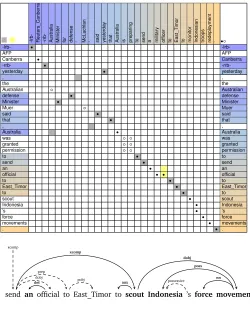
Figure 1 shows an example paraphrase pair from the training portion of the corpus. At the top are the Meteor alignments as visualized by the Meteor X-ray tool using shaded boxes,
along with the gold standard alignments using filled circles for SUREalignments and open
circles for POSSIBLEalignments. Below the alignment grid, the recall errors (SUREonly) in the
Meteor alignments that are supported by Stanford parser dependencies are shown in bold. These recall errors are supported in the sense that the missed aligned tokens participate in
dependencies with other aligned tokens. For example, Meteor fails to alignscoutwithmonitor.
This token-level alignment is supported by two aligned dependencies, namely the alignment of
2http://nlp.stanford.edu/software/CRF-NER.shtml
!! -lrb- Reuters_Canberr
a
-rrb- Austr
alia
Minister for def
ense
, McLachlan , said yesterda
y
that Austr
alia
is prepar
ing
to send a militar
y
officer to East_Timor to monitor Indonesian troops redeplo
yment
. •◦
-lrb- •
-lrb-AFP AFP
Canberra • Canberra
-rrb- •
-rrb-yesterday • yesterday
, ,
the the
Australian ◦ Australian defense • defense Minister • Minister
Muer ◦ Muer
said • said
that • that
, ,
Australia • Australia
was ◦ ◦ was
granted ◦ ◦ granted permission ◦ ◦ permission
to • to
send • send
an • an
official • • official
to • to
East_Timor • East_Timor
to • to
scout • scout
Indonesia • Indonesia
’s • ’s
force • force
movements • movements
. •.
. . . sendan official to East_Timor to scout Indonesia’s force movements
xcomp
detdobj prep
pobj aux
xcomp
poss
possessive nn dobj
. . . senda military officer to East_Timor to monitor Indonesian troops redeployment
xcomp
det amod
dobj prep
pobj aux
xcomp
amod
[image:4.420.79.329.76.386.2]nn dobj
Figure 1: At top, example Meteor alignments (shaded boxes, gray for exact matches and yellow
for stem/synonym/paraphrase matches) along with gold SUREand POSSIBLEalignments (circles,
filled for SUREand open for POSSIBLE); at bottom, Meteor recall errors (SUREonly, in bold) that
send−−−→xcomp scoutwithsend−−−→xcomp monitorandscout−→aux towithmonitor−→aux to. Here, the other tokens in the dependencies are identical, and thus the dependencies provide strong evidence for the token-level alignment. Interestingly, the final three recall errors involve interrelated dependencies, suggesting the need for joint inference.
Using this notion of dependency arc alignments supporting token-level alignments, we counted how frequently the token alignments were supported by dependency alignments, and found that
64% of the SUREalignments and 65% of the SURE+POSSIBLEalignments in the training corpus
were supported in this way. We also tabulated how often the dependencies were aligned, and
found that 54% of the dependency arcs were aligned based on the SUREtoken alignments, and
62% were aligned based on the SURE+POSSIBLEalignments, thus indicating the greater potential
of dependencies to aid alignment when including the POSSIBLEs. The alignment percentages
varied considerably by type: of the non-rare dependency types, 74% of theauxdependencies
were aligned (including the POSSIBLEs), while only 38% of thercmoddependencies were aligned,
with most core dependency types such asxcompanddobjin the 64-70% range.4
5 Joint alignment framework
Consider a pair of text segments〈T1,T2〉where eachTsrepresents a set ofnstokens. We denote
Ts¬{tsi: 1≤i≤ns}where eachtisrepresents a token in theith position of segments. We also
use the notationts
i...j¬{tk:tk∈Ts,i≤k≤j}to indicate the subsequence of contiguous tokens
from positionsitoj(inclusive) inTs. EachTsis also associated with a dependency graphDs
which is treated as a set of labeled arcs, i.e.,Ds¬{dsi j:tsjis a dependent oftsi∈Ts∪ {ROOT}}.
5.1 Alignment representations
Our proposed alignment formulation has its roots in the phrase-based representation proposed
in MacCartney et al. (2008) and Thadani and McKeown (2011). An alignmentEbetweenT1
andT2is represented by a set of edits{e1,e2, . . .}which indicate the modifications that would
be needed to convertT1toT2. We consider two types of edits:
1.Phrase editscapture the changes that would need to be made to subsequences of tokens
to transformT1toT2and vice versa. These are of two types: the first represents the
alignmentof equivalent phrases inT1andT2while the other denotesdeletionor
non-alignment of phrases from either Ts. A valid phrase-based alignment configuration,
denoted byEphrmust have every token participating in exactly one edit.
2.Arc editssimilarly capture the alignments or deletions of edges in a dependency graph.
For a dependency alignment configurationEarcto be meaningful, the edits in it must
be keptconsistentwith the phrase-based alignment configurationEphr. Specifically, two
edges that have both their source and target tokens aligned (i.e., participating in the same alignment edit) must also participate in an alignment edit.
We assume that the score for an alignmentEfactors over the phrase and arc edits present inE.
Usinge∗to represent alignment edits ande−to represent deletion edits, this can be written as:
score(E) =X
e∗ phr∈E
αphr(e∗
phr) +
X
e− phr∈E
δphr(e−
phr) +
X
e∗ arc∈E
αarc(e∗
arc) +
X
e−arc∈E
δarc(e−
arc) (1)
4Note that dependencies can fail to be aligned for a variety of reasons, including parse errors, head-dependent
where scoring functionsαphr:〈t1i...j,t2k...l〉 →Rindicate the score of aligning a pair of token
sequences, andδphr:ts
i...j→Rindicate the score of deleting any token sequence of segments
from the alignment.αarc:〈d1
i j,dkl2〉 →Randδarc:di js →Rare defined analogously for scoring
alignments and deletions of arc edits respectively.
5.2 Features and learning
The scoring function described above is parameterized by features over the different categories
of edits, i.e.,score(E) =Pe∈Ew·Φ(e)whereΦ(e)is a feature vector for editeandwis a
vector of parameter weights. The features defined over phrase edits are similar to MacCartney et al. (2008); these encode the type of edit (alignment or deletion), the size of the phrases in alignment edits, the similarity of the phrases determined by leveraging various lexical resources, as well as contextual and positional features. Features for arc edits simply encode the type of edit for an arc of a given class of dependency label, e.g., whether an alignment edit involves
twosubjdependencies, or whether a deletion edit involves adetdependency.
Given a inference technique for alignments under the parameterized scoring function, feature
weightswcan be learned using any appropriate structured prediction technique. We employ
the structured perceptron (Collins, 2002) in our experiments.
5.3 Inference via ILP
We now describe an integer linear program that recovers optimal solutions to the problem of
jointly recovering a phrasal and arc alignment given any parameter configurationw. Although
ILPs in general do not have guarantees on returning solutions efficiently, the programs for alignment problems over text segments consisting of a few sentences are relatively small and
can be easily tackled with highly optimized general-purpose solvers.5
First, we define indicator variables for all potential phrase and arc edits in an alignment, as well as indicators that denote which pairs of tokens are aligned.
• ys
i j∼kl∈ {0, 1}represents an alignment between the token sequenceti...js fromTsandtsk...l′
fromTs′. We uses′as shorthand for the segment index other thans, i.e.,s′=3−s. Note
thatys
i j∼klandys
′
kl∼i jare equivalent for a giveni,j,k,land refer to the same indicator.
• ¯ys
i j∈ {0, 1}represents a non-alignment or deletion of the token sequencetsi...jfrom either
segmentTs.
• zs
i j∼kl∈ {0, 1}represents an alignment between the dependencydi js ∈Dsanddkls′∈Ds′.
Note thatzs
i j∼klandzs
′
kl∼i jare equivalent for a giveni,j,k,land refer to the same indicator.
• ¯zs
i j∈ {0, 1}represents a non-alignment or deletion of the dependencydi js ∈Ds.
• Finally,xs
p∼q∈ {0, 1}indicates whether the tokentsp∈Tsparticipates in some
phrase-based alignment withts′
q ∈Ts′.
xs p∼q=
(
1, iff∃i,j,k,l s.t. ys
i j∼kl=1, i≤p≤j, k≤q≤l
0, otherwise (2)
Now, finding the optimal alignment between any sentence pair〈T1,T2〉is equivalent to solving
the following optimization problem over the edit indicator variables:
max
y,z n1 X
i=1 min(Xn1,i+λ)
j=i n2 X
k=1 min(Xn2,k+λ)
l=k
yi j∼klαphr(〈t1i...j,t2k...l〉)
+ X
i,j: d1
i j∈D1 X
k,l: d2
kl∈D2
zi j∼klαarc(〈di j1,dkl〉2 )
+ X
s∈{1,2}
ns
X
i=1 min(Xns,i+λ)
j=i
¯
ys
i jδphr(tsi...j) +
X
ds i j∈Ds
¯
zs i jδarc(di js)
(3)
where the parameterλcontrols the maximum number of tokens permitted in a phrase for
alignment. The optimization problem requires some linear constraints in order to specify a
complete and consistent alignment. The following constraints are applied for alli=1 . . .ns,
j=i. . . min(ns,i+λ),k=1 . . .ns′, andl=k. . . min(ns′,k+λ)wheres∈ {1, 2}.
1. Exactly one phrase edit must be active per token, ensuring a consistent segmentation for the phrase-based solution. Similarly, only one arc edit can be active per dependency.
X
i,j: i≤p≤j
X
k,l ys
i j∼kl+¯yi js =1 ∀p∈1 . . .ns (4)
X
k,l zs
i j∼kl+¯zi js =1 ∀i,j,k,l s.t.di js ∈Ds, dskl′∈Ds′ (5)
2. An activated token pair indicator must participate in exactly one phrase alignment. X
i,j: i≤p≤j
X
k,l: k≤q≤l
ys
i j∼kl=xsp∼q ∀p∈1 . . .ns, q∈1 . . .ns′ (6)
3. In order to ensure that the phrase-based solution is consistent with the arc-based solution, arc alignments must activate corresponding token-pair alignment indicators.
zs
i j∼kl≤xsi∼k ∀i,j,k,l∈1, . . .ns (7)
zs
i j∼kl≤xsj∼l ∀i,j,k,l∈1, . . .ns (8)
4. If the governor and dependent of a dependency arc in one sentence are aligned to those of an arc in the other sentence, the corresponding arc alignment must be active.
xs
i∼k+xsj∼l≤zi js∼kl+1 ∀i,j,k,l s.t.dsi j∈Ds, dkls′∈Ds′ (9)
6 Experiments
We trained models with and without the dependency features using 20 epochs of averaged
perceptron learning. Separate models were trained on the training corpus with just the SURE
alignments and with the SURE+POSSIBLEalignments.6We used the unconstrained approach of
Thadani and McKeown (2011) as a phrase-based baseline; this is an extension of MacCartney
6Note that all alignments are considered equally when evaluating on the SURE
Alignments System Prec% Rec% F1% Exact%
Meteor 81.82 71.90 75.49 11.22
Tokens/SURE Phrase-based 74.83 83.25 77.85 12.21
Phrase+Arc 76.57 83.79 79.20 12.21
Meteor 85.40 64.76 72.32 10.56
Tokens/SURE+POSSIBLE Phrase-based 70.84 82.54 75.37 13.53
Phrase+Arc 73.03 84.60 77.57 14.85
Meteor 84.64 58.03 65.60 17.49
Deps/SURE Phrase-based 76.07 78.42 75.10 23.10
Phrase+Arc 73.56 84.27 76.30 20.79
Meteor 91.19 51.80 62.57 12.87
Deps/SURE+POSSIBLE Phrase-based 80.09 80.74 78.79 22.11
[image:8.420.79.327.69.192.2]Phrase+Arc 77.04 88.76 80.92 22.44
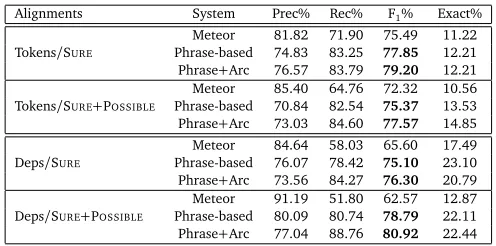
Table 1: Test set macro-averaged results on token alignments and projected dependency
alignments over Stanford parses.F1increases are statistically significant in each case (see text).
et al. (2008) which outperforms a number of other alignment techniques (Och and Ney, 2003; Liang et al., 2006; Chambers et al., 2007). As an additional baseline, we ran Meteor on the
test corpus using its precision-focusedmax accuracysetting, which we found to yield higher
F-measure on the training corpus than themax coverageoption. Table 1 shows the results.
It is evident that the feature-based aligners have much higher recall than Meteor, with some
unsurprising loss in precision due to the conservativemax accuracymatching. Compellingly, the
joint model increases both precision and recall on aligned tokens over the phrasal model, with
greater increases using the SURE+POSSIBLEalignments as expected. Jointly aligning arcs also
helps considerably in recovering the dependency alignments projected onto Stanford parses
from the gold standard phrase alignments. Wilcoxon signed-rank tests on F1indicate that all
increases are statistically significant, withp<0.001 in all cases except one, namely the increase
on the SUREsyntactic dependencies of the joint model over the phrasal model, wherep<0.05.
Conclusion
We have presented a monolingual alignment strategy that jointly produces phrasal and syntactic dependency alignments using a discriminative structured prediction framework and an exact inference technique using ILP. Our alignment technique shows significant gains over recent phrase-based aligners and alignments obtained via the well-known Meteor metric. In future work, we intend to apply joint alignment approaches to additional corpora and develop more powerful similarity features over phrases and arcs.
Acknowledgments
This work was supported in part by the Air Force Research Laboratory under a subcontract to FA8750-09-C-0179 and in part by the Intelligence Advanced Research Projects Activity (IARPA)
via Department of Interior National Business Center (DoI/NBC) contract number D11PC20153.
The U.S. Government is authorized to reproduce and distribute reprints for Governmental purposes notwithstanding any copyright annotation thereon.
References
Barzilay, R. and Lee, L. (2003). Learning to paraphrase: an unsupervised approach using
multiple-sequence alignment. InProceedings of HLT-NAACL, NAACL ’03, pages 16–23.
Barzilay, R. and McKeown, K. R. (2005). Sentence fusion for multidocument news
summariza-tion.Computational Linguistics, 31(3):297–328.
Bouamor, H., Max, A., and Vilnat, A. (2011). Monolingual alignment by edit rate computation
on sentential paraphrase pairs. InProceedings of ACL-HLT, pages 395–400.
Chambers, N., Cer, D., Grenager, T., Hall, D., Kiddon, C., MacCartney, B., de Marneffe, M.-C., Ramage, D., Yeh, E., and Manning, C. D. (2007). Learning alignments and leveraging natural
logic. InProceedings of the ACL-PASCAL Workshop on Textual Entailment and Paraphrasing,
pages 165–170.
Chang, M.-W., Goldwasser, D., Roth, D., and Srikumar, V. (2010). Discriminative learning over
constrained latent representations. InProceedings of HLT-NAACL, HLT ’10, pages 429–437.
Cohn, T., Callison-Burch, C., and Lapata, M. (2008). Constructing corpora for the development
and evaluation of paraphrase systems.Computational Linguistics, 34(4):597–614.
Collins, M. (2002). Discriminative training methods for hidden Markov models. InProceedings
of EMNLP, pages 1–8.
Dagan, I., Glickman, O., and Magnini, B. (2005). The pascal recognising textual entailment
challenge. InProceedings of the PASCAL Challenges Workshop on Recognising Textual Entailment.
DeNero, J. and Klein, D. (2008). The complexity of phrase alignment problems. InProceedings
of ACL-HLT, pages 25–28.
Denkowski, M. and Lavie, A. (2011). Meteor 1.3: Automatic Metric for Reliable Optimization
and Evaluation of Machine Translation Systems. InProceedings of the EMNLP 2011 Workshop
on Statistical Machine Translation.
Finkel, J. R., Grenager, T., and Manning, C. (2005). Incorporating non-local information into
information extraction systems by Gibbs sampling. InProceedings of the 43rd Annual Meeting
of the Association for Computational Linguistics.
Heilman, M. and Madnani, N. (2012). ETS: Discriminative edit models for paraphrase scoring. InProceedings of *SEM: The First Joint Conference on Lexical and Computational Semantics, pages 529–535.
Liang, P., Taskar, B., and Klein, D. (2006). Alignment by agreement. InProceedings of
HLT-NAACL, HLT-NAACL ’06, pages 104–111.
Lita, L. V., Ittycheriah, A., Roukos, S., and Kambhatla, N. (2003). tRuEcasIng. InProceedings of
the 41st Annual Meeting of the Association for Computational Linguistics.
MacCartney, B., Galley, M., and Manning, C. D. (2008). A phrase-based alignment model for
MacCartney, B., Grenager, T., de Marneffe, M.-C., Cer, D., and Manning, C. D. (2006). Learning
to recognize features of valid textual entailments. InProceedings of the Human Language
Technology Conference of the NAACL, Main Conference, pages 41–48.
Madnani, N., Tetreault, J., and Chodorow, M. (2012). Re-examining machine translation
metrics for paraphrase identification. InProceedings of HLT-NAACL, pages 182–190.
Marsi, E. and Krahmer, E. (2005). Explorations in sentence fusion. InProceedings of the
European Workshop on Natural Language Generation, pages 109–117.
Och, F. J. and Ney, H. (2003). A systematic comparison of various statistical alignment models.
Computational Linguistics, 29:19–51.
Quirk, C., Brockett, C., and Dolan, W. B. (2004). Monolingual machine translation for
paraphrase generation. InProceedings of EMNLP, pages 142–149.
Thadani, K. and McKeown, K. (2008). A framework for identifying textual redundancy. In
Proceedings of COLING, pages 873–880.
Thadani, K. and McKeown, K. (2011). Optimal and syntactically-informed decoding for
monolingual phrase-based alignment. InProceedings of ACL-HLT, HLT ’11, pages 254–259.
Vogel, S., Ney, H., and Tillmann, C. (1996). HMM-based word alignment in statistical