Learning Decision Lists with Known Rules for Text Mining
Venkatesan Chakravarthy
IBM India Research Lab
Sachindra Joshi
IBM India Research Lab
Ganesh Ramakrishnan
IBM India Research Lab
Shantanu Godbole
IBM India Research Lab
Sreeram Balakrishnan
IBM Silicon Valley Lab
Abstract
Many real-world systems for handling unstructured text data are rule-based. Examples of such systems are named entity annotators, information extraction systems, and text classifiers. In each of these appli-cations, ordering rules into a decision list is an im-portant issue. In this paper, we assume that a set of rules is given and study the problem (MaxDL) of or-dering them into an optimal decision list with respect to a given training set. We formalize this problem and show that it is NP-Hard and cannot be approxi-mated within any reasonable factors. We then propose some heuristic algorithms and conduct exhaustive periments to evaluate their performance. In our ex-periments we also observe performance improvement over an existing decision list learning algorithm, by merely re-ordering the rules output by it.
1 Introduction
Rule-based systems have been extensively used for several problems in text mining. Some problems in text mining where rule-based systems have been successfully used are part of speech tagging (Brill, 1992), named entity annotation (Grishman, 1997; Appelt et al., 1995), information extraction (May-nard et al., 2001), question answering (Riloff and Thelen, 2000) and classification (Han et al., 2003; Li and Yamanishi, 1999; Sasaki and Kita, 1998). Sev-eral studies have been conducted that compare the performance of rule-based systems and other ma-chine learning techniques with mixed results. While there is no clear winner between the two approaches in terms of performance, the rule-based approach is clearly preferred in operational settings (Borth-wick, 1999; Varadarajan et al., 2002). Rule-based systems are human comprehensible and can be im-proved over time. Therefore, it is imperative to de-velop methods that assist in building rule-based sys-tems.
A rule-based system consists of a set of rules. These rules can either be manually designed or could be learnt from a training set using rule-induction techniques (J. and G, 1994; Cohen, 1995). Each rule consists of anantecedent orpattern and aconsequentorpredicted annotation. In this paper, we will restrict our attention to a broad class of rules in which the antecedent describes a series of condi-tions on the input item and the consequent specifies the label that applies to instancescoveredby the an-tecedent. The conditions could also be expressed as patterns in regular or more powerful grammars.
In general, rules could be ambiguous,i.e., multi-ple rules could cover an instance. A common ap-proach for resolving this ambiguity is to define an ordering on the rules (Maynard et al., 2001; Borth-wick, 1999). A decision list is one such mecha-nism (Rivest, 1987). A set of rules that are intended to be interpreted in a sequence is called adecision list. In other words, a decision list is an ordering of the given set of rules. Given an instancet, the rules are applied in the specified order until a pattern of a ruleR coverst. The instancetis assigned the pre-dicted annotation associated withR.
tasks. In contrast, we assume that the rules are given to us and study the problem of arranging them into an optimal decision list, where optimality is deter-mined over a training data set. Our approach is mo-tivated by the observation that in many operational settings, it is easier and preferred to get a set of rules designed by domain experts (Lewis et al., 2003). Al-ternatively, the set of rules can be determined using existing techniques for rule learning (J. and G, 1994; Cohen, 1995; Califf and Mooney, 1998). The sepa-ration of rule ordering from rule genesepa-ration allows us to analyze the problem of ordering in detail and to develop effectivemethods for rule ordering. We demonstrate the usefulness of the proposed methods for ordering manually designed rules in the task of named entity annotation and machine learnt rules in the task of classification.
We determine the ordering of the given set of rules based on a training set. A training set consists of a set of pairs (ti, ai) where ti is an instance and ai
is its actual annotation. Given a set of rules and a training data set, we define the problem as follows: Arrange the rules into a decision list such that max-imum number of instances are assigned the correct annotation.We refer to this problem as the MAXDL problem. We show that this problem is NP hard and cannot approximated within a factor of n1−, for any > 0. We then propose some heuristics and present an experimental study of these heuris-tics. Our experimental results show performance im-provement over an existing decision list learning al-gorithm, by merely reordering the rules output by that algorithm. We also illustrate the performance improvements obtained by applying our algorithms for ordering named entity annotation rules and clas-sification rules.
In the rest of the paper we formalize the MAXDL problem (§2), show it is NP-hard and can’t be approximated within reasonable factors (§3), and propose heuristics in a greedy framework (§4). We present experiments (§5) and conclude with Section§6.
2 MAXDLProblem Definition and Notations
The input consists of a set of instances T = {t1, t2, . . . , tm}, a set of annotationsAand a set of
rulesR={R1, R2, . . . , Rn}. Each ruleRi = (p, a)
is a pair, wherepis called thepatternanda∈ Ais called thepredicted annotation. The pattenpwill be given as a setp ⊆ I; we say that the instances in parecoveredbyR. The input also includes a map-pingA : T 7→ A, that provides for each instancet an annotationA(t), called theactual annotationof t. The pair(T, A)is thetraining data.
Given the above input, adecision listLis an or-dering (i.e. permutation) of the input rules. The list Lassigns an annotation to each instancetas defined below. We consider each rule according to the order-ing given byLuntil we find a ruleRi = (p, a)that
coverstand assign the annotationatot. We denote byL(t) the annotation assigned byLtot. Thus,L defines a functionL :I 7→ A. We say that the list L correctly annotates an instance t, if the annota-tion assigned byLmatches the actual annotation of t, i.e.,L(t) =A(t).
Given the above input, the MAXDL problem is to to construct a decision listL such that the number of instances correctly annotated byL, is maximized i.e., we want to maximize|{t|A(t) =L(t)}|.
Notations:
LetR= (p, a)be a rule andtbe an instance covered by R. We say that a rule R correctly covers t, if a=A(t). Similarly,Rsaid toincorrectly covert, if a6=A(t).
LetLbe a decision list. We say that an instance tis happyunder L, ifL correctly annotates t, i.e., L(t) = A(t). Let Happy(L)denote the set of in-stances that are happy under L. Notice that the MAXDL problem asks for a decision listLsuch that
|Happy(L)|is maximized.
3 NP-Hardness and Inapproximability
In this section, we prove that the MAXDL problem is NP-Hard and also show that the problem cannot even be approximated with any constant factor.
Theorem 1 TheMAXDLproblem isNP-Hard.
Proof:We give a reduction from the maximum inde-pendent set problem (MAXIS ), a well-known
LetG= (V, E)be the input graph having vertex setV ={v1, v2, . . . , vn}. We create an instance of
the MAXDL problem as follows. For each vertex vi, we add an annotationaitoA, an instancetitoT
and a ruleRi toR. We declareai to be the actual
annotation ofti. The predicted annotation of Ri is
set toai. We define Ri to cover only the instance
ti and the instances corresponding to the neighbors
ofvi. Meaning, Ri covers the instances in the set
{ti} ∪ {tj|(vi, vj)∈E}. This completes the
reduc-tion. We claim that given a decision list L having khappy instances, we can construct an independent set of sizek and vice versa. The NP-Hardness of MAXDL follows from the claim. We now proceed to prove the claim.
Consider a decision list L. Notice that for any instanceti, Ri is the only rule that correctly covers
ti. Take any two different instancestiandtjthat are
happy underL. Without loss of generality, assume thatRi appears before Rj inL. Now, ifRi covers
tj, tj would be unhappy under L. So,Ri does not
covertj, which implies thatvj is not a neighbor of
vi (i.e.,(vi, vj) 6∈ E). Hence, the setI = {vi|ti ∈
Happy(L)}is an independent set ofG. We note that |I|=|Happy(L)|.
Conversely, consider an independent set I ofG. LetR(I) ={Ri|vi ∈I}. Form a decision listLby
first arranging the rules fromR(I)in any arbitrary order followed by arranging the rest of rules in any arbitray order. Notice that for any vertex vi ∈ I,
Ri correctly covers ti and no other rule appearing
beforeRi covers ti. Thus, ti is happy under L. It
follows that |Happy(L)| ≥ |I|. We have proved that the MAXDL problem isNP-Hard. 2 In our NP-Hardness reduction, we had shown that given a decision list L, we can construct an inde-pendent set I such that |Happy(L)| = |I|, and vice versa. This means that any approximation algo-rithm for the MAXDL problem can be translated (by
combining it with our NP-Hardness reduction) into an equally good approximation algorithm for the MAXIS problem. Corollary 1 follows from (Zuck-erman, 2006).
Corollary 1 If NP 6= P then for any > 0, the MAXDL problem cannot approximated within a factor of n1−. In particular, the problem is not approximable within any constant factor.
4 Heuristic Algorithms for theMAXDL
Problem
As the MAXDL problem is hard to approximate, we turn to heuristic approaches. All our heuristics fall into a natural greedy framework, described below.
4.1 A Greedy Framework
Our greedy framework for finding a decision list is as follows. In each iteration we greedily choose a rule and output it. For this purpose, we use some scoring function for assigning scores to the rules and choose the rule having the maximum score. Then the chosen rule is deleted. The process is contin-ued until all the rules are output. The above proce-dure gives us a decision list. We present this general framework in the Figure 1. The only unspecified part in the above framework is the scoring function. In-tuitively, the scoring function tries to measure the goodness of a rule.
Given rule setR={R1, R2, . . . , Rn}, instance setT and the actual annotations
A(·)
whileR 6=nulldo
(re)compute scores for each rule inR, based on the scoring function select the ruleRthat has the maximum score
removeRfrom the setR
remove fromTall the instances covered byR
end while
Figure 1: A Greedy Framework for MAXDL prob-lem
For a ruleRand an instancet, we define follow-ing notations for further use:
InstR={t|Rcoverst}
Inst+R={t|Rcorrectly coverst} Inst−R={t|Rincorrectly coverst}
Rulest={R|tis covered byR} Rules+t ={R|tis correctly covered byR} Rules−t ={R|tis incorrectly covered byR}
4.2 Simple Precision Scoring
We now present our first candidate scoring function, which we call simple precision scoring. A natural score for a ruleRis itsprecision: the fraction of in-stances covered correctly byRamong the instances covered by it.
ScoreSP(R) = |Inst+
R|
|InstR|
= |Inst
+
R|
|Inst+R|+|Inst−R|
4.3 Weighted Precision Scoring
UnderScoreSP, the score of a ruleR is determined
only by the number of instances covered correctly (|Inst+R|) and incorrectly (|Inst−R|). The nature of instances are not taken into account. The variants of ScoreSPproposed here assigns weights to instances,
make them happy. For an instancet, define the hap-piness quotienth(t) to be the fraction of rules that correctly covertamong all the rules that covert:
h(t) =|Rules
+
t|
|Rulest|
.
The value h(t) is a measure of how easy it is to make t happy; the larger the value of h(t), it is easier to make thappy. For instance, ifh(t) ≈ 1, then|Rules+t | ≈ |Rulest|, meaning that almost any
rule that covers t will annotate it correctly. Thus, it is easy to make t happy. On the other extreme, ifh(t) ≈ 0, then only a small fraction of the rules that covertannotate it correctly. Thus it is harder to makethappy.
When we schedule a rule R, the instances in
Inst+R become happy and those in Inst−R become unhappy. Our new scoring functions give credit to R for each instance inInst+R and award a penalty R for each instance in Inst−R. The credit and the penalty depend on the happiness quotient of the in-stance. Informally, we want to give more credit R for making hard instances happy; similarly, we want to penalizeRfor making easy instances unhappy. A natural way of accomplishing the above is to award a credit of(1−h(t))for each instancet ∈ Inst+R
and a penalty ofh(t)for each instancet ∈ Inst−R. Below, we formally define the above quantities as gain andloss associated with R. For each rule R, define
Gain(R) = X
t∈Inst+R
(1−h(t))
Loss(R) = X
t∈Inst−R
h(t)
Based on the above quantities, we define a natural scoring function, calledWeighted Precision:
ScoreWP(R) =
Gain(R) Gain(R) + Loss(R)
4.4 Refined Weighted Precision Scoring
Our third scoring function is a refinement of the weighted precision scoring. InScoreWP, we
com-pute the happiness quotient of a token by taking in account the number of rules that cover the token and among those the ones that cover it correctly. The re-finement is obtained by also considering the nature of these rules. We define
hRP(t) = P
R∈Rules+t precision(R) P
R∈Rulestprecision(R)
.
Gain, loss and the scoring function are defined sim-ilar to that ofScoreWP:
GainRP(R) = X
t∈Inst+
(1−hRP(t))
LossRP(R) = X
t∈Inst−R
hRP(t)
ScoreRP(R) =
GainRP(R)
GainRP(R) + LossRP(R)
5 Experiments
In this section, we describe rule-ordering experi-ments on two real-world tasks. 1) named-entity (NE) annotation that relied on hand-crafted rules for MUC-7 dataset. 2) The second application we con-sider is rule-based multi-class text classification. We order rules learnt on benchmark text classification datasets and observe consistent improvements by merely re-ordering rules learnt by other rule learn-ers.
5.1 Named Entity Annotation
Rule-based named entity annotation is a natural in-stance of a decision list problem. Typically, rule-based NE annotation systems (Cunningham et al., 2002) require rules to be manually written as well as ordered manually. In this section, we show that our proposed rule-ordering algorithms perform bet-ter than the natural heuristic. Note that we do not intend to build a rule-based decision list which per-forms better than existing methods.
Setup: In our problem formulation of MAXDL , the set of instances T and mapping A from in-stances to actual annotations, together form a train-ing set. We have access to a set of documents D = {d1, d2, . . . , dm}, that have all its named
en-tities annotated. To generate pairs(T, A)using the set of documentsD, letTdirepresent the set of token sequences that are annotated in a documentdi∈D.
Let A(t) be the actual annotation for an instance t ∈ Tdi. Given a set of rules R and a document collectionD, each rule R ∈ R is applied to each documentdi ∈ D. The set of token sequences
(in-stances here) which Rcovers (InstR), is included
in the set of instancesT. For all instancest ∈Tdi, we add a mapping t → A(t) in A. For all other instancest ∈ {InstR−Tdi}, we have a mapping t → null included in A. We perform these addi-tions for each document and rule pair. Finally, we add a ruleR∗ = (∗, null)to the rule setR. The pat-tern∗matches every instancet ∈ [
R∈R,R6=R∗
and associates anullannotation with the instance. We only consider “person name”, “organization” and “place name” annotations. We use two different rule sets containing about30rules each.
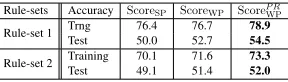
Table 1 presents accuracy achieved by our pro-posed algorithms for the two chosen rule sets. In all the cases our proposed methods perform better than ScoreSP. The result also shows that our proposed
methods generalize better than simpleScoreSP.
Rule-sets Accuracy ScoreSP ScoreWP ScoreP RWP
Rule-set 1 Trng 76.4 76.7 78.9 Test 50.0 52.7 54.5 Rule-set 2 Training 70.1 71.6 73.3 Test 49.1 51.4 52.0
Table 1: Accuracies (in %) for different algorithms
Dataset
Acc-(avg. # rules) -uracy JRip ScoreSP ScoreWP ScoreP RWP
la2s (37) Trng 86.16±0.39 86.02±0.16 86.68±0.16 87.04±0.17 Test 76.93±0.43 77.88±0.16 78.05±0.17 78.1±0.15 oh5 (28) Trng 86.95±0.41 88.26±0.21 88.8±0.16 89.06±0.17 Test 76.43±0.58 79.08±0.37 79.37±0.38 79.24±0.35 tr45 (17) Trng 91.88±0.38 92.61±0.18 92.84±0.23 93.3±0.21 Test 78.9±0.47 80.99±0.29 81.19±0.28 81.3±0.3
Table 2: Accuracies (in %) forRipRules
Data set Accu- Multi-class
-racy J48 NaiveBayes ScoreSP ScoreWP ScoreP RWP
la2s (18) Trng 94.75±0.39 85.78±0.29 94.64±0.14 95.9±0.03 95.99±0.01 Test 73.43±0.64 73.68±0.37 78.0±0.21 78.46±0.23 78.64±0.29 oh5 (30) Trng 95.08±0.21 99.56±0.09 96.27±0.14 98.43±0.09 98.45±0.09 Test 78.08±0.76 74.16±0.77 82.72±0.25 83.16±0.24 83.98±0.26 tr45 (30) Trng 97.91±0.11 87.16±1.18 97.71±0.14 98.93±0.06 98.98±0.05 Test 85.25±1.02 69.91±1.33 84.06±0.44 86.1±0.39 86.42±0.41
Table 3: Accuracies (in %) forBinRules
5.2 Ordering classification rules
In this section, we show another application of our algorithms in ordering classification rules. The antecedent of a classification rule is a series of tests on the input and the consequent gives the class label. Since different rules can assign conflicting classes, rule-ordering becomes important in choosing a correct class. These rules come from a variety of sources and could be hand-crafted or machine-learnt. Machine learnt rules could be generated using association mining (Agrawal and Srikant, 1994), inductive logic programming (Lavrac and Dzeroski, 1994), or Ripper (Cohen, 1995). Even classifiers can be seen as rules,e.g., linear discrim-inants are rules that assign one of two classes to exclusive partitions of input space. Due to domain
specificity and unavailability of hand-tuned rules we illustrate rule-ordering on: (1) rules induced by Ripper (Cohen, 1995) (RipRules), and (2) a heterogeneous set of rules obtained from naive Bayes and decision trees (BinRules).
Setup: We used benchmark text classification datasets (Forman, 2003) available from the Weka site1. These multi-class datasets represent 229 binary text classification problems, with positive class size avg. 149, and class skews avg. 1 : 31. These are subsets of various benchmark tasks like Reuters, TREC, and Ohsumed (oh). We present only a subset of the results (with only ScoreWP
and ScoreP RWP) here for lack of space. We report experiments over10random50 : 50train-test splits. The training split is used to learn rules and their ordering. The orderings are evaluated on the test split and average train and test accuracies reported.
Results:
The RipRules setting: We induce rules (from the train split) using the JRip implementation in Weka2(Witten and Frank, 2005). We apply our vari-ous algorithms to merely re-order the rules output by JRip. In Table 2 we present results comparing JRip output with their re-ordered versions obtained from ScoreSP, ScoreWP and ScoreP RWP. Along with the
name of each data set, the average number of rules induced from the training splits are also mentioned in parentheses. The best accuracies are marked in bold. We observe that the re-ordered rule-sets us-ingScoreWPandScoreP RWPperform better than both
baselinesScoreSPand JRip with lower deviations.
The BinRules setting: For an n-class problem we obtain classification rules by training a heteroge-neous collection of one-vs-rest binary classifiers. Each classifier is either a naive Bayes or a decision tree classifier trained to discriminate one class from the rest (2nclassifiers). We treat each binary clas-sifier as a classification rule thatcoversan instance if the binary classifier assigns its associated class to that instance. In addition, corresponding to every class, we introduce a default classification rule that assigns the associated class to any instance it
en-1http://www.cs.waikato.ac.nz/ml/weka/
index_datasets.html
2
counters. This gives us3nrules. We used the naive Bayes and J48 implementations in Weka to obtain binary rules, ordered usingScoreWPandScoreP RWP,
and compared with ScoreSP baseline in Table 3.
We also show individual classifier accuracy, and the best are marked bold. It is encouraging to note that all our rule-ordering techniques always outperform their multi-class counterparts on the test data set. We outperform the baselineScoreSPmethod on all data
sets with lower deviations.
6 Conclusions
In this paper, we formulated and studied the MAXDL problem. We proved the hardness of the problem. We then proposed some heuristic ap-proaches and established the usefulness of our meth-ods experimentally. We observed improved perfor-mance in classification task by merely reordering the rules obtained by an existing decision list learning algorithm. In future work, we would like to ex-plore how rule-ordering formulation can be applied to ordering heterogeneous classifiers in the ensem-ble learning setting.
References
Rakesh Agrawal and Ramakrishnan Srikant. 1994. Fast algorithms for mining association rules. In VLDB, pages 487–499.
D. Appelt, J. Hobbs, J. Bear, D. Israel, M. Kameyama, D. Martin, K. Myers, and M. Tyson. 1995. Sri inter-national fastus system: Muc-6 test results and analysis. InMUC6 ’95: Proc. of the 6th conf. on Message un-derstanding.
A. Borthwick. 1999. A Maximum Entropy Approach to Named Entity Recognition. Ph.D. thesis, New York University.
Eric Brill. 1992. A simple rule-based part-of-speech tag-ger. InProceedings of ANLP.
M. E. Califf and R. J. Mooney. 1998. Relational learning of pattern-match rules for information extraction. In Working Notes of AAAI Spring Symposium on Apply-ing Machine LearnApply-ing to Discourse ProcessApply-ing.
William W. Cohen. 1995. Fast effective rule induction. InICML, pages 115–123.
H. Cunningham, D. Maynard, K. Bontcheva, and V. Tablan. 2002. GATE: A framework and graphi-cal development environment for robust NLP tools and applications. InProceedings of ACL.
George Forman. 2003. An extensive empirical study of feature selection metrics for text classification. JMLR Special Issue on Variable and Feature Selection, 3:1289–1305.
M. R. Garey and D. S. Johnson. 1979. Computers and Intractability. Freeman.
R. Grishman. 1997. Information extraction: Techniques and challenges. InSCIE ’97: Intnl. summer School on Information Extraction.
Hui Han, Eren Manavoglu, C. Lee Giles, and Hongyuan Zha. 2003. Rule-based word clustering for text classi-fication. InSIGIR, pages 445–446. ACM Press.
Furnkranz J. and Widmer G. 1994. Incremental re-duced error pruning. In Machine Learning: Proc. of the Eleventh International Conference.
Nada Lavrac and Saso Dzeroski. 1994. Inductive Logic Programming:Techniques and Applications. El-lis Horwood, New York.
David D. Lewis, Rayid Ghani, Dunja Mladenic, Isabelle Moulinier, and Mark Wasson. 2003. Workshop on operational text classification. In conjunction with SIGKDD.
Hang Li and Kenji Yamanishi. 1999. Text classification using ESC-based stochastic decision lists. InCIKM.
D. Maynard, V. Tablan, C. Ursu, H. Cunningham, and Y. Wilks. 2001. Named entity recognition from di-verse text types. InRANLP.
Ellen Riloff and Michael Thelen. 2000. A rule-based question answering system for reading comprehension tests. In ANLP/NAACL 2000 Workshop on Reading comprehension tests as evaluation for computer-based language understanding sytems.
Ronald L. Rivest. 1987. Learning decision lists. Ma-chine Learning, 2(3):229–246.
Minoru Sasaki and Kenji Kita. 1998. Rule-based text categorization using hierarchical categories. In Pro-ceedings of SMC-98, IEEE International Conference on Systems, Man, and Cybernetics, pages 2827–2830.
Sundar Varadarajan, Kas Kasravi, and Ronen Feldman. 2002. Text-mining: Application development chal-lenges. InProceedings of the Twenty-second SGAI In-ternational Conference on Knowledge Based Systems and Applied Artificial Intelligence.
Ian H. Witten and Eibe Frank. 2005.Data Mining: Prac-tical Machine Learning Tools and Techniques. Mor-gan Kaufmann.