Tools and resources for Tree Adjoining Grammars
François Barthélemy,
CEDRIC – CNAM, 92 Rue St Martin FR-75141 Paris Cedex 03
Pierre Boullier, Philippe Deschamp Linda Kaouane, Abdelaziz Khajour
Éric Villemonte de la Clergerie
ATOLL - INRIA, Domaine de Voluceau - BP 105
FR-78153 Le Chesnay Cedex [email protected]
Abstract
This paper presents a workbench for Tree Adjoining Grammars that we are currently developing. This workbench includes several tools and resources based on the markup language XML, used as a convenient language to format and exchange linguistic resources.
1 Introduction
Our primary concern lies in the developmen-t of efficiendevelopmen-t parsers for various grammadevelopmen-tical for-malisms of interest for Natural Language Pro-cessing. Tree Adjoining Grammars [TAG] is one of these formalisms, important from a linguistic point of view but also because it is possible to de-sign efficient parsers.
However, during our work on TAG, we were confronted with a lack of standardization of gram-mars, especially when dealing with wide cover-age grammars. The XTAG System1 (The XTAG Research Group, 1995) provides an implicit stan-dard, but it is not very readable and lacks explic-it specifications. The various grammars we stud-ied presented many variations. Moreover, we also noted many problems of consistencies in most of them.
Following others, amongst whom LT XML2 and especially (Bonhomme and Lopez, 2000), we considered that the markup language XML3
1
http://www.cis.upenn.edu/~xtag/
2
http://www.ltg.ed.ac.uk/
3
http://www.w3c.org/XML/
would be a good choice to represent TAG, espe-cially with the possibility of providing an explicit and logical specification via a DTD. Being textu-al, resources in XML can be read by humans and easily exchanged and maintained. Finally, there exists more and more supports to handle XML re-sources. We have also found that XML is a conve-nient language to store linguistic results, such as the shared derivation forests output by our TAG parsers.
The paper starts with a brief introduction to TAGs. Section 3 presents the different XML en-codings that we have designed for the representa-tion of grammars and derivarepresenta-tion forests. Secrepresenta-tion 4 presents several different maintenance tools we are developing to handle grammars and deriva-tion forests. Secderiva-tion 5 presents servers used to access different kind of informations. Interfaces for these servers are presented in Section 6.
2 Tree Adjoining Grammars
The TAG formalism (Joshi, 1987) is particular-ly suitable to describe many linguistic phenome-na. A TAG is given by a set of elementary trees partitioned into initial trees and auxiliary trees. Internal nodes are labeled by non-terminals and leaves by non-terminal or terminals. Each auxil-iary tree has a distinguished leaf, called its foot and labeled by a non-terminal, the same as the root node of .
Two operations may be used to derive trees from elementary trees. The first one, called
sub-stitution, replaces a leaf node labeled by a
non-terminal by an initial tree whose root is also
ad-Adjunction node v
Root
Foot Spine
Auxiliary Tree
Adjunction
A
A
A
A
A
β
Figure 1: Adjunction
junction, is illustrated by Figure 1. An auxiliary
tree whose root is labeled by may be adjoined
at any node labeled by . The subtree rooted
at is grafted to the foot of .
Feature TAGs extend TAGs by attaching to n-odes a pair of first-order terms represented by
Feature Structures [FS] and called top and bot-tom arguments. These feature structures may be
used, for instance, to handle agreement or enforce semantic restrictions.
Lexicalized (Feature) TAGs assumes that each elementary tree has at least one lexical node la-beled by a terminal. However, explicit lexicalized grammars would be huge, with one or more ele-mentary trees for each entry in the lexicon. The choice made by the XTAG group and by all the designers of wide coverage TAGs is to factor-ize the grammars and gives enough information to lexicalize parts of the grammars when needed. Morphological entries (or inflected forms) refer-ence one or more lemma entries, which, in turn, refer to families of tree schema. A tree schema is an elementary tree with a distinguished leaf called
anchor node that is to be replaced by a
morpho-logical entry. Each reference may be completed by additional constraints.
For instance, extracted from a small French grammar, Figure 2 shows the basic elements (morphological entry donne, lemma \DONNER\, and tree schema tn1pn2) used to build the tree tn1pn2(donne) corresponding to the syntactic pattern (1) and illustrated by sentence (2). The lemma part states that the subject NP and the
prepositional complement NP must both be
hu-man and that NP is introduced by the
preposi-tion à (co-anchoring). In the tree tn1pn2, the substitution nodes are marked with and the
an-chor node with .
(1) quelqu’un somebody
donne gives
quelque chose something
à to
quelqu’un somebody
(2) Yves
Yves
donne gives
un a
joli nice
livre book
à to
Sabine Sabine
donne: \DONNER,\ V {mode=,indnum=sing} \DONNER,\V: tn1pn2[p_2=à] {NP_0.t:restr=+,hum NP_2.t:restr=+hum}
S tn1pn2
NP VP
V
<>V
NP PP
P NP
Figure 2: Tree schema
3 XML Encoding
3.1 Representing grammars
We have designed a DTD4 that clearly specifies the relations between the various components of a grammar. For instance, the following DTD frag-ment states that a morphological entry is char-acterized by a field lex and includes zero or more description entries (for documentation) and at least one reference to a lemma (lemmaref). Similarly, an element lemmaref is character-ized by the fields name and cat, and may be completed by a FS argument (fs).
<!ELEMENT morph (desc*,lemmaref+)> <!ATTLIST morph lex CDATA #REQUIRED> <!ELEMENT lemmaref (fs?)>
<!ATTLIST lemmaref name CDATA #REQUIRED cat CDATA #REQUIRED>
Following the DTD, the various elements de-scribed in Figure 2 may be represented by the (tiny) following XML fragment, omitting the FS specification on nodes for sake of space and clar-ity.
<tag axiom="s"> <morph lex="donne">
<lemmaref cat="v" name="*DONNER*"> <fs>
<f name="mode"> <val>ind</val> <val>subj</val>
4
</f>
<f name="num"> <val>sing</val> </f>
</fs> </lemmaref> </morph>
<lemma cat="v" name="*DONNER*">
<anchor tree_id="family[@name=tn1pn2]"> <coanchor node_id="p_2">
<lex>à</lex> </coanchor>
<equation node_id="np_0" type="top"> <fs>
<f name="restr"> <val>plushum</val> </f>
</fs> </equation>
<equation node_id="np_2" type="top"> <fs>
<f name="restr"> <val>plushum</val> </f>
</fs> </equation> </anchor> </lemma>
<family name="tn1pn2"> <tree name="tn1pn2">
<node cat="s" adj="yes" type="std"> <node cat="np" id="np_0" type="subst" /> <node cat="vp" adj="yes" type="std">
<node cat="v" adj="yes" type="anchor" /> <node cat="np" type="subst" />
<node cat="pp" adj="yes" type="std"> <node cat="p" id="p_2" type="subst"/>
<node cat="np" id="np_2" type="subst"/> </node>
</node> </node> </tree> </family> </tag>
Currently, we have encoded a small French grammar (50 tree schemata, 117 lemmas and 345 morphological entries) and an English gram-mar (456 tree schemata, 333 lemmas and 507 morphological entries). We are processing some other larger grammars (for both English and French).
3.2 Encoding derivations
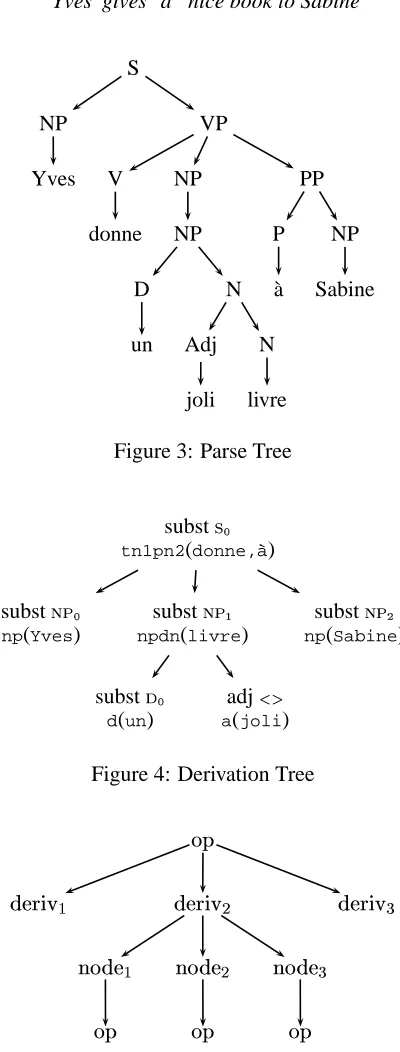
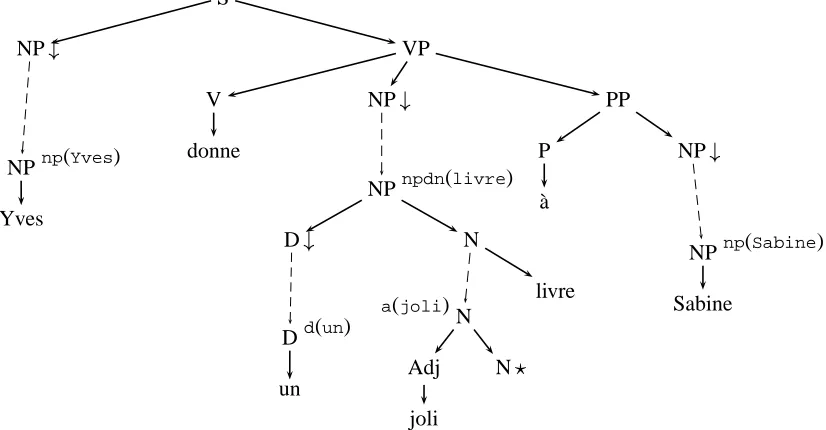
A (deterministic) TAG parser may return either the result of the analysis as a parse tree, or the steps of the derivation as a derivation tree. These two alternatives are illustrated for sentence (3) by Figures 3 and 4 (with Figure 5 showing the ele-mentary lexicalized trees). A derivation tree in-dicates which operation (substitution or adjunc-tion of some tree) has taken place on which node of which tree, for instance the adjunction of tree ajoli at node labeled N. It is worth noting that
the parse tree may be retrieved from the tion tree, which motivates our interest in
deriva-tion trees.
(3) Yves
Yves
donne
gives
un
a
joli
nice
livre
book
à
to
Sabine
Sabine
S
NP
Yves
VP
V
donne NP
NP
D
un
N
Adj
joli N
livre PP
P
à
NP
[image:3.612.81.286.39.376.2]Sabine
Figure 3: Parse Tree
subst
tn1pn2(donne,à)
subst
np(Yves)
subst
npdn(livre)
subst
d(un)
adj
a(joli)
subst
np(Sabine)
Figure 4: Derivation Tree
!"$#%'&
!"$#%(&
) !*"
) !"
) !",+
!*"$#%(& +
Figure 6: Organization of a derivation forest
In case of ambiguity (frequent in NLP), several or even an unbounded number of derivation trees may actually be compacted into a shared
deriva-tion forest, equivalent to a Context-Free Grammar
[image:3.612.313.513.58.584.2]Stn1pn2(donne,à)
NP VP
V
donne
NP PP
P
à
NP
NPnp(Yves)
Yves
NPnp(Sabine)
Sabine NPnpdn(livre)
D N
livre
Dd(un)
un
a(joli)N
Adj
joli
N
-Figure 5: Elementary trees
of a DTD5 to encode shared derivation forests. This DTD introduces the primary elements op,
deriv, andnodeas well as an elementopref
used to reference elementsop. The logical orga-nization of these elements is sketched in Figure 6. More precisely:
op , identified by its attributeid, denotes either an operation of substitution or of adjunction (attribute type) on some syntactic catego-ry (attribute cat) for some span of the in-put string (attributespan). Sub-elements of
opmay also be present to specify the feature values associated to the operation.
deriv details a possible derivation for some
oper-ation, based on some lexicalized tree given by a tree schema (attributetree) and an an-chor (anchor).
node specifies which operationophas been
per-formed on some node (attribute node_id) of an elementary tree during a derivation.
A derivation tree may be expressed in a nested way using only elementsop,deriv, andnode. A shared forest will require the use ofoprefto denote multiple occurrences of a same operation.
5
http://atoll.inria.fr/~clerger/forest.dtd,xml
The above derivation tree may be represented by the following XML fragment (omitting infor-mation about the feature structures).
<forest parser="Light DyALog">
<sentence> Yves donne un joli livre à Sabine </sentence>
<op cat="s" span="0 7" id="1" type="subst"> <deriv tree="tn1pn2" anchor="donne">
<node id="p_2"><opref ref="5" /></node> <node id="np_0"><opref ref="2" /></node> <node id="1"><opref ref="4" /></node> <node id="np_2"><opref ref="6" /></node> </deriv>
</op>
<op cat="np" span="0 1" id="2" type="subst"> <deriv tree="np" anchor="Yves" />
</op>
<op cat="np" span="2 5" id="4" type="subst"> <deriv tree="npdn" anchor="livre">
<node id="n_"><opref ref="10" /></node> <node id="0"><opref ref="8" /></node> </deriv>
</op>
<op cat="p" span="5 6" id="5" type="subst"> <deriv tree="p" anchor="à" />
</op>
<op cat="np" span="6 7" id="6" type="subst"> <deriv tree="np" anchor="Sabine" /> </op>
<op cat="d" span="2 3" id="8" type="subst"> <deriv tree="d" anchor="un" />
</op>
<op cat="n" span="3 5 4 5" id="10" type="adj"> <deriv tree="an" anchor="joli" />
</op> </forest>
4 Maintenance tools
4.1 For the grammars
[image:4.612.94.507.36.251.2]not correspond to the input formats expected by the two parser compilers we develop. One of them (DyALog) expects a prolog-like representa-tion of the grammars (Alonso Pardo et al., 2000) while the second one expects Range Concatena-tion Grammars [RCG] (Boullier, 2000).
XTAG XML TAG
RCG
LP
SQL LaTeX Checker Analyzer
[image:5.612.73.291.109.233.2]Strip
Figure 7: Maintenance Tools for the grammars
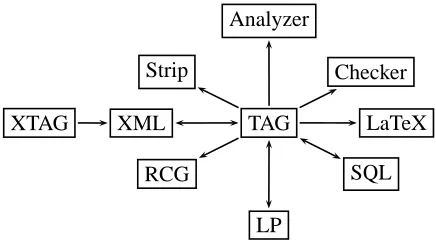
Therefore, we have developed in Perl a set of maintenance modules, for these conversions and for other tasks (Figure 7). The central module
TAG implements an object-oriented view of the
logical structure specified by the Grammar DTD. The other modules add new methods to the class-es introduced by TAG.
Besides the conversion modules LP and RCG, we also have a read/write XML module. Mod-ule Checker is used to check (partially) the co-herence of the grammar and to produce some s-tatistics. Module Analyzer extracts information needed for the compilation by the DyALog sys-tem. Module Strip deletes all information rela-tive to feature structures from the grammar. Mod-ule SQL may be used to store to and load from a SQL database.
Our choice of Perl has been motivated by the availability from archive sites of many Perl mod-ules to handle XML resources or database access. Moreover, the development of a Perl module is fast (for a prototype), generally only a few hours. For instance, we have realized a prototype mod-ule LaTeX, useful to build the documentation of a grammar. We are also thinking of an HTML module to build online versions.
4.2 For the derivation forests
Similarly, we have also developed a set of mod-ules to handle derivation forests (Fig. 8) with a
FOREST LP
RCG
XTAG Tree
XML HTML Dep
Figure 8: Maintenance Tools for the forests
central module FOREST and conversion mod-ules. Modules LP, RCG, and XTAG read the out-put formats of the derivation forests produced by our parsers and by the TAG parser6. The forests can then be emitted in XML format (module
XM-L), in HTML format (module HTMXM-L), as trees
(module Tree) or as dependency graphs (module
Dep).
Other modules should be added in the future, such as SQL module to read to and to write from a database used as a derivation tree-bank, a Strip module to remove features, or different filtering modules to extract subsets of a forest.
5 Servers
Exploiting some of these modules, but also other components developed in Java, we are installing several servers to access different kinds of infor-mation (parsers, grammars, forests) in uniform and distributed ways.
5.1 A server of parsers
We are exploring several ways to build efficient parsers for TAGs (Éric Villemonte de la Clerg-erie and Alonso Pardo, 1998; Alonso Pardo et al., 2000; Éric Villemonte de la Clergerie, 2001; Boullier, 2000; Barthélemy et al., 2001; Barthéle-my et al., 2000), which leads us to maintain a growing set of parsers. Moreover, we wish to be able to compare the output produced by these parsers to check soundness, completeness and level of sharing in the derivation forests. To achieve these objectives, we provide a uniform setting by installing a simple server of parsers, written in Perl. Once connected to this server, one
6
selects a parser and sends a sentence to parse; the server returns the shared derivation forest in raw, HTML, XML, Tree or Dep formats.
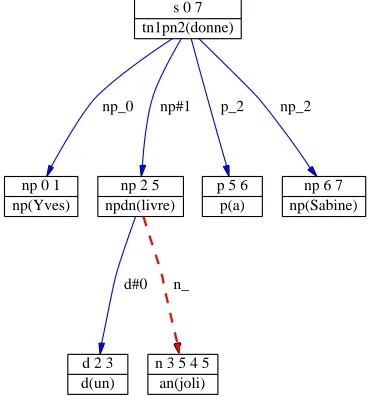
A WEB front-end7 may be used to connect to this server. Figures 9 and 10 show two views of a derivation forest built using the server.
Another WEB front-end8allows the direct sub-mission to the server of a derivation forest in one of the 3 recognized input formats (LP, RCG, XTAG). Submission in XML format should be added soon.
s 0 7 tn1pn2(donne)
np 0 1 np(Yves)
np_0
np 2 5 npdn(livre)
np#1
p 5 6 p(a) p_2
np 6 7 np(Sabine) np_2
d 2 3 d(un)
d#0
n 3 5 4 5 an(joli)
[image:6.612.88.273.174.375.2]n_
Figure 9: Derivation tree
5.2 A server of grammars
Because of the size of wide-coverage grammars, we believe that working with grammars stored in files is no longer a valid option (except for ex-changing them). Databases should be used in-stead where bits of information can be efficiently retrieved. Moreover, modern database managers provide server fonctionalities and security mech-anisms.
Around these ideas, we are currently develop-ing in Java a server of grammars.
First the grammars are loaded into a SQL database (namely MySQL9). It should be noted that the structure of the database reflects the XML structure for grammars and not directly the struc-ture of the grammars. This means that the loading
7
http://medoc.inria.fr/pub-cgi-bin/parser.cgi
8
http://medoc.inria.fr/pub-cgi-bin/forest.cgi
9
http://www.mysql.com/
phase may be performed for (almost) any kind of XML documents.
The second main component of the server is a small query language used to fetch information from the database while hiding, for non special-ists, the complexity of languages SQL, XQL or XPath. We have chosen an object oriented nota-tion which, once again, reflects the structure of the TAG DTD and which is also close to path equations familiar to computational linguists in, for instance, HPSG. We have several types such as
family,morph,treeornodecorresponding
to the different kinds of elements of the DTD. For each type, several methods are available. For ex-ample, the following query returns the name and the Database Id (DBId) of all trees belonging to familytn1pn2. A second kind of requests takes a DBId . and returns the full XML fragment
as-sociated to the XML element whose index in the database is. .
var tree t; select
t.name; t; where
t.family.name’ = ’tn1pn2 end
The grammar server works as a Java servlet, in-tegrated in a HTTP server Apache using JServ10. It may be accessed using URL with parameters (as done for CGI scripts). The server decodes the parameters and transforms the query into a SQL query send to the database corresponding to the selected grammar. The result is either a table en-coded in XML format or an XML fragment of the grammar. A small WEB interface11is available to display the results in a navigator (by transforming them into HTML) but it is also possible to get the results as an XML file. Tools can therefore query the server by sending a URL and getting back the results in XML.
The server should be soon completed for edi-tion tasks. Full deleedi-tion of an element and of its descendants may be achieved using DBIds. Ad-dition can be achieved by sending an XML frag-ment and a DBId (stating where to attach the XM-L fragment).
10
http://www.apache.org
11
Yves donne
un
joli
livre a
Sabine
np np_0 tn1pn2
npdn np#1
p p_2
np np_2
d d#0
an n_
Figure 10: Dependency view
5.3 A server of derivation forests
The development of a server of derivation forests has just started, along the same lines we followed for the server of grammars. Such a server will be an alternative to treebanks. Two main functional-ities are planned for this server. First the possi-bility to add a derivation forest to the underlying database (in order to build corpora of derivation-s) and second, ways to access these derivations through a simple but powerful query language.
6 Interfaces
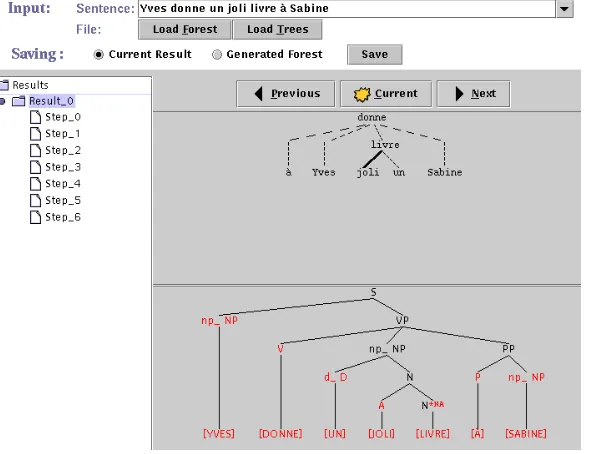
We have already mentioned WEB interfaces to the parser server and the grammar server. Besides these interfaces, we (Kaouane, 2000) have also modified and enriched a Java interface developed by Patrice Lopez (Lopez, 2000). The new version can import grammars and derivation forests that follow our XML DTD. It can also use the server of parsers, sending the sentence to parse and re-ceiving the shared derivation forest in XML for-mat.
The derivations are extracted from the deriva-tion forests and, for each derivaderiva-tion, the tool dis-plays both the derivation tree and the correspond-ing parse tree (see Figure 11). It is also possi-ble to follow step by step a derivation by moving forward or backward. We found this functionali-ty useful to understand or explain to students the workouts of TAG.
The viewer may also be used to browse the d-ifferent components of a grammar (trees and lex-icons), therefore helping in its maintenance.
This tool already exploits the parser server, but we also plan to extend it to exploit the grammar server (for browsing the grammars or displaying
a derived tree) and the forest server (for accessing derivation forests).
Conclusion
The experiments we have performed have strengthened our opinion that XML is really ad-equate to maintain and exchange linguistic re-sources and that XML allows us to quickly de-velop tools to handle these resources. Most of the components presented in this paper have been de-veloped over a short period of time, and, while still preliminary, are fully usable. We believe that XML and these tools gives us solid foundation-s to further develop a complete environment to handle TAGs, based on many simple and easy-to-maintain tools (instead of having a monolith-ic system). We also think that the availabili-ty of such tools or resources may prove useful for linguists (to develop grammars with browsing and maintenance tools), for parser developers (to browse grammars and derivations), and for stu-dents in computational linguistics (to understand Tree Adjoining Grammars).
The tools and resources that we develop are freely available. Tools are based on a modular ar-chitecture with a specification given by the DTD and we hope that new components will be added by other people.
References
Miguel Alonso Pardo, Djamé Seddah, and Éric
Ville-monte de la Clergerie. 2000. Practical aspects
in compiling tabular TAG parsers. In Proceedings of the /
th International Workshop on Tree
Figure 11: Screen capture of the Java derivation viewer
F. Barthélemy, P. Boullier, Ph. Deschamp, and É. Villemonte de la Clergerie. 2001. Guided pars-ing of range concatenation languages. In Proceed-ings of the 39th Annual Meeting of the Association for Computational Linguistics (ACL’01), Universi-ty of Toulouse, France, July. to be published.
Patrick Bonhomme and Patrice Lopez. 2000. TagML: XML encoding of resources for lexicalized tree ad-joining grammars. In Proceedings of LREC 2000, Athens.
Pierre Boullier. 2000. Range concatenation gram-mars. In Proceedings of the0
thInternational
Work-shop on Parsing Technologies (IWPT2000), pages 53–64, Trento, Italy, February. see also Rapport de recherche n1 3342, online athttp://www.inria.
fr/RRRT/RR-3342.html, INRIA, France, Jan-uary 1998, 41 pages.
Aravind K. Joshi. 1987. An introduction to
tree adjoining grammars. In Alexis
Manaster-Ramer, editor, Mathematics of Language, pages 87–115. John Benjamins Publishing Co., Amster-dam/Philadelphia.
Linda Kaouane. 2000. Adaptation et utilisation d’un environnement graphique pour les TAG au dessus du système DyALog. Mémoire de DEA, Université d’Orléans.
Bernard Lang. 1991. Towards a uniform formal
framework for parsing. In Masaru Tomita, editor, Current issues in Parsing Technology, chapter 11. Kluwer Academic Publishers. Also appeared in the Proceedings of International Workshop on Parsing Technologies – IWPT89.
Patrice Lopez. 2000. LTAG workbench: A general
framework for LTAG. In Proceedings of the /
th
In-ternational Workshop on Tree Adjoining Grammars and Related Formalisms (TAG+5), Paris, May.
Éric Villemonte de la Clergerie and Miguel
Alon-so Pardo. 1998. A tabular interpretation of
a class of 2-stack automata. In
Proceed-ings of ACL/COLING’98, August. online at
ftp://ftp.inria.fr/INRIA/Projects/ Atoll/Eric.Clergerie/SD2SA.ps.gz.
Éric Villemonte de la Clergerie. 2001. Refining tabu-lar parsers for TAGs. In Proceedings of NAACL’01, June. to be published.
The XTAG Research Group. 1995. A lexicalized