A u t o m a t i c A d a p t a t i o n of W o r d N e t to Sublanguages and to
Computational Tasks
Roberto B a s i l i ( + ) Alessandro Cucchiarelli (*) Carlo Consoli ( + )
Maria Teresa Pazienza ( + ) Paola Velardi ( ~ )
(+) Univer,fita' di Roma Tor Vergata (ITALY) (*) Universita' di Ancona (ITALY) (#) Universita' di Roma, La Sapienza (ITALY)
A b s t r a c t
Semantically tagging a corpus is useful for many intermediate NLP tasks such as: acquisition of word argument structures in sublanguages, ac- quisition of syntactic disambiguation cues, ter- minology learning, etc. Semantic categories al- low the generalization of observed word pat- terns, and facilitate the discovery of irecurrent sublanguage phenomena and selectional rules of various types. Yet, as opposed to POS tags in morphology, there is no consensus in literature about the type and granularity of the category inventory. In addition, most available on-line taxonomies, as WordNet, are over ambiguous and, at the same time, may not include many domain-dependent senses of words. In this pa- per we describe a method to adapt a general purpose taxonomy to an application sub[an- guage: flint, we prune branches of the Wordnet hierarchy that are too " fine grained" for the do- main: then. a statistical model of classes is built from corpus contexts to sort the different classi- fications or assign a classification to known and unknown words, respectively.
1 I n t r o d u c t i o n
Lexical learning methods based on the use of semantic categories are faced with the problem of overambiguity and entangled structures of Thesaura and dictionaries. WordNet and Ro- get's Thesaura were not initially conceived, de- spite their success among researchers in lexi- cal statistics, as tools for automatic language processing. The purpose was rather to pro- vide the linguists with a very refined, general purpose, linguistically motivated source of tax- onomic knowledge. As a consequence, in most on-fine Thesaura words are extremely ambigu- ous. with very subtle distinctions among senses. High ambiguity, entangled nodes, and asymme-
try have already been emphasized in (Hearst and Shutze, 1993) as being an obstacle to the effective use of on-line Thesaura in corpus lin- guistics. In most cases, the noise introduced by overambiguity almost overrides the positive effect of semantic clustering. For example, in (BriIl and Resnik, 1994) clustering P P heads ac- cording to WordNet synsets produced only a [% improvement in a P P disambiguation task. with respect to the non-clustered method. A subse- quent paper (Resnik. 1997) reports of a 40% precision in a sense disambiguation task. al- ways based on generalization through WordNet synsets. Context-based sense clisambiguation becomes a prohibitive task on a wide-scale basis, because when words in the context of unambigu- ous word are replaced by their s.vnsets, there is a multiplication of possible contexts, rather than a generalization. [n (Agirre and Rigau. 1996) a m e t h o d called Conceptual Distance is proposed to reduce this problem, but the re- ported performance in disambiguation still does not reach 50%. On the other hand, (Dolan. 1994) and (Krovetz and Croft. 1992) claim that fine-grained semantic distinctions are unlikely to be of practical value for many applications. Our experience supports this claim: often, what
matters is to be able to distinguish among con-
trastive (Pustejowsky. 1995) ambiguities of the
bank_river bank_organisation flavor. The
prob-
lem
however is that the notion o f " c o u t r a s t i v e "is domain-dependent. Depending upon the sub- language (e.g. medicine, finance, computers. etc.) and upon the specific NLP application (e.g. Information Extraction, Dialogue etc.) a given semantic label may be too general or too specific for the task at hand. For example, the
word line has 27 senses in WordNet. many of
which draw subtle distinctions e.g. line of ~cork
(sense 26) and line of products (sense [9). In aa
I
I
I
I
I
I
I
I
I
i
I
I
I
I
I
I
I
I
application aimed at extracting information on new products in an economic domain, we would be interested in identi~-ing occurrences of such senses, but perhaps all the o t h e r senses could be clustered in one or two categories, lbr exam- ple Artifact, grouping senses such as: telephone- line, railway and cable, and Abstraction, group-
ing senses such as series, conformity and indica-
tion. Vice versa, if the sublanguage is technical handbooks in computer science, we would like
to distinguish the cable and the string of words
senses (7 and 5, respectively), while any o t h e r distinction may not have any practical interest. T h e research described in this paper is aimed at providing some principled, and algorithmic,
methods to tune a general purpose taxonomy to
specific sublanguages and domains.
In this paper, we propose a method by which we select a set of core semantic nodes in the WordNet taxonomy t h a t "optimally" describe the semantics of a sublanguage, according to a scoring function defined as a linear combi- nation of general and corpus-dependent perfor- mance factors. The selected categories are used to prune WordNet branches t h a t appear, ac- cording to our scoring function, less pertinent to the given sublanguage, thus reducing the initial ambiguity. Then, we learn from the application corpus a statistical model of the core categories and use this model to further tune the initial taxonomy. Tuning implies two actions:
The first is to a t t e m p t a reclassification of relevant word:; in the corpus that are not covered bv the selected categories, i.e.. words belonging exclusively to pruned branches. Often. :hese words have domain- dependent .,;enses that are not captured in the initial WordNet classification (,e.g. the software sense of release in a software hand- books sublanguage). The decision to as- sign an unclassified word to one of the se- lected categories is based on a strong de- tected similarity between the contexts in which the word o.:curs, and the statistical model of the core categories.
The second iis to further reduce the ambigu- itv of words that :;till have a high ambigu- ity, with respect to the other word.s in the
corpus. For example, the word stock in a fi-
nancial domain still preserved the gunstock
81
sense, because i n s t r u m e n t a l i t y was one of the selected core categories for the domain. The expectation of this sense ,nay be low- ered, as before, by comparing the typical
contexts of stock with the acquired model
of instrumentality.
In the next sections, we first describe the al- gorithm for selecting core categories. Then, we describe the method for redistributing relevant words among the nodes of the pruned hierarchy. Finally, we discuss an evaluation experiment.
2 S e l e c t i o n o f c o r e c a t e g o r i e s f r o m
W o r d N e t
The first step of our m e t h o d is to select from
WordNet an inventory of core categories t h a t
appear particularly appropriate for the domain. and prune all the hierarchy branches t h a t does not belong to such core categories. This choice is performed as follows:
C r e a t i o n o f a l t e r n a t i v e s e t s o f b a l a n c e d c a t e g o r i e s
First, an iterative m e t h o d is used to create alter- native sets of balanced categories, using infor- mation on words and word frequencies in the ap- plication corpus. Sets of categories have an in- creasing level of generality. The set-generation algorithm is an iterative application of the algo- rithm proposed in (Hearst and Sht, tze. 1993) for creating WordNet categories of a fixed ~tverage size. [n short t. the algorithm works as follows: Let C be a set of WordNet svnsets s. iV the set
of different words (nouns) in the corpus. P(C)
the number of words ill W that are instances of C. weighted by their frequency in the cor-
pus, UB and LB the upper and lower bound
for P(C). At each iteration step i. a new synset
s is added to the c u r r e n t category set C~. iff
the weight of s lies within the c u r r e n t bound-
aries, that is. P(s) <_ UBi and P(s) >_ LBi.
If P(s) >_ UBi s is replaced in Ci by its de- scendants, for which the same constraints are
verified. If P(s) < LBi . s is added to a list of
"small;' categories SCT(C'i). [n fact. when re-
placing an overpopulated category by its sons. it may well be the case t h a t some of its sons are under populated.
I
I
I
I
I
I
I
S c o r i n g A l t e r n a t i v e S e t s o f C a t e g o r i e s
Second, a scoring function is applied to alter- native sets to identify the core set. The core set is modeled as the linear function of four
performance factors: generality, coverage of the
domain, average ambiguity, and discrimination power. For a formal definition of these four mea- sures, see (Cucchiarelli and Velardi, 1997). We provide here an intuitive description of these factors:
G e n e r a l i t y ( G ) : In principle, we would like to represent the semantics of the domain using the highest possible level of generalization. A small n u m b e r of categories allows a c o m p a c t repre- sentation of the semantic knowledge base, and renders word sense disambiguation more sim- ple. On the other side, over general categories fail to capture important distinctions. The Gen- erality is a gaussian measure that mediates be- tween over generality and overambiguity. C o v e r a g e ( C O ) This is a measure of the cov- erage that a given category set C'i has over the words in the corpus. The algorithm for balanced category selection does not allow a full coverage of the words in the domain: given a selected
pair < UB, LB >. it may well be the case t h a t
several words are not assigned to any category, because when branching from an overpopulated category to its descendants, some of the descen- dants may be under populated. Each iterative step that creates a C, also creates a set of un-
der populated categories SCT(Ci). Clearly, a
"good" selection of Ci is one that minimizes this problem (and has therefore a "high" coverage). D i s c r i m i n a t i o n P o w e r ( D P ) : A certain se- lection of categories may not allow a full dis- crimination of the lowest-level senses for a word (leaves-synsets hereafter). For example, if psy- chological_feature is one of the core categories, and if we choose to tag a corpus only with core categories, it would be impossible to discrimi-
nate between the business-target and business-
concern senses. Though nothing can be said about the practical importance of discriminat- ing between such two synsets, in general a good choice of Ci is one that allows as much as possi- ble the discrimination between low level senses of ambiguous words.
A v e r a g e A m b i g u i t y ( A ) : Each choice of Ci
in general reduces the initial ambiguity of the
corpus. In part. because there are leaves-synsets
that converge into a single category of the set. in part because there are leaves-synsets of a word that do not reach any of these categories. Though in general we don't know if. by cutting out a node. we are removing a set of senses inter- esting (or not) for the domain, still in principle
82
a good choice of categories is one t h a t reduces as much as possible the initial ambiguity. The cu- mulative scoring function for a set of categories
Ci is defined as the linear combination of the
performance parameters described above:
Sco~( C'i ) = aG(C~) + 3C.'0(C~) +
1
+,(DP(C~) + 6 A ( G ) (t)
E s t i m a t i o n o f m o d e l p a r a m e t e r s a n d re- f i n e m e n t s
An interpolation method is adopted to e s t i m a t e the parameters of the model against a reference. correctly tagged, corpus (SemCor, tile W o r d N e t semantic concordance). The performance of al- ternative inventories of core categories is evalu-
ated in terms of effective reduction of overam-
biguity. This measure is a combination of the system precision at pruning out spurious (for the domain) senses, and the global reduction of ambiguity. Notice that we are not measuring the precision of sense disambiguation in con- texts, but simply the precision at reducing a- priori the set of possible senses for a word. in a given domain.
The method above is weakly supervised: the parameters estimated have been used w i t h o u t re-estimation to capture core categories in o t h e r domains such as Natural Science and a UNIX manual. Details on portability of this choice are in (Cucchiarelli and Velardi. forthcoming 1998). In the different experiments, the best per- forming choice of core categories is the one with an upper population of 62.000 words (frequency weighted). This corresponds to the following list of 14 categories:
num.x:a.t=14 t = 6 1 U B = 6 2 0 0 0 L B = 2 4 8 0 0 N = 2 0 0 0 k----IO00 h = O . 4 0
p e r s o n , i n d i v i d u M , ~omeone. m o r t a l , h u m a n , soul in~trument.~lity, i n s t r u m e n t a t i o n
~ t t r | b u t e
w r | t t e n . ~ o m m u n i c a t l o n , w r l t t e n - l ~ n g u ~ g e m e s s a g e , c o n t e n t . ~ u b j e c t - m ~ t t e r . 3ubst.xnce measuL'e, q u a n t i t y , a m o u n t , q u a n t u m ~ction
:Lctivity group..~ction organiz~.tton p~ychologlealMe~t ure poJLeJsioa
.It ~,te |OC&ttOn
This selection of core categories is measured to have the following performance:
Precision: 77.6~.
I
I
I
I
I
I
.I
I
I
I
I
I
I
I
I
I
I
I
I
Coverage: - ~¢'
In (Cucchiarelli and Velardi, forthcoming 1998) a method is proposed to automatically increase the coverage of the core set with an additional set of categories, selected from the
set of under populated categories SCT(Ci) (see
step 1 of the algorithm). With the extension:
subt~nce, m&~ter e v e n t
gathering, assemblage phenomenon sgructure,const ruction na~urxl.object creation
the following performance is obtained: Precision: 78,9%
Reduction of Ambiguity: 26% Coverage: 93%
With some manual refinement of the ex- tended set , the precision rises to over 80%. Obtaining a higher precision is difficult because, neither SemCor nor WordNet can be considered a golden standard. In a recent workshop on se- mantic texts tagging (TAGWS 1997), the diffi- culty of providing comprehensible guidelines for semantic annotators in order to avoid disagree- ment and inconsistencies was highlighted. On the other side. there are m a n y redundancies and some inconsistencies in WordNet that makes the task of (manual) classification very complex. To make an example, one of the detected classi- ficatiou errors in our Wall Street Journal ex- periment was the selection of two possible core
senses for the word market: : organization and
act[city. Vice versa, in the economic fragment
of SemCor. market is consistently classifies as
socio-economic-class, which happens not to be a descendent of any of these two categories. Our intuition when observing the specific exam- ples was more in agreement with the automatic classification than with SemCor. Our feeling was that the selected core categories could, in many cases, represent a good model of clas- .~ification for words that remained unclassified with respect to the "not pruned" WordNet. or appeared misclassified in our evaluation experi-
i l l e u t .
in the next section we describe an method to verify" this hypothesis and. at the same time, to further tune WordNet to a domain.
83
3 R e d i s t r i b u t i o n o f w o r d s a m o n g
c o r e c a t e g o r i e s
The purpose of the method described hereafter is twofold:
• The first is to a t t e m p t a reclassification of words t h a t are not classified, or appeared as misclassified, with respect to the "'original" WordNet.
• T h e second is to further reduce the ambi- guity of words that are still very ambigu- ous with respect to the " p r u n e d " Word- Net. The general idea is that ambiguity of words is reduced in a specific domain, and enumeration of all their senses is un- necessary. Second, some words function as sense primers for others. Third, raw con- texts of words provide a significant bundle of information to guide disambiguation.
To verify this hypothesis systematically we need to acquire from the corpus a contextual model of the core categories, and then verify to what extent certain "interesting" words (for example, unclassified words) adhere to the con- textual model of one of such categories.
Our method, inspired by (Yarowsky, t992), works as follows (see (Basil[ et al, 1997} for de- tails}:
• Step 1. Select the most typical words in each core category:
Step 2. Acquire the collective contexts of these words and use them ms a (distribu- tional) description of each category:
Step 3. Use tile distributional descrip-
tions to evaluate the (corpus-dependent) membership of each word to the different categories.
Step l is carried out detecting tile more sig- nificant (and less ambiguous) words in any of the core classes : these sets are called the kernel of the corresponding class. Rather than train- ing the classifier on all the nouns in tile learning corpus ,as in (Yarowsky. [992). we select only a
subset of protot!lpical words for each category.
I
I
I
I
I
I
I
I
I
I
I
I
I
I
I
I
I
I
I
category C'. We define the
typicality
T~(C') ofw in C, as:
Nw,c
_ - - (2)
I'V w where:
,V,, is the total number of synsets of a word w, i.e. all the WordNet synonymy sets including w. .V,o.c is the number of synsets of w that belong to the semantic category C, i.e. synsets indexed with C in WordNet.
The
typicality
depends only on WordNet. Atypical noun
for a category C is one that is ei- ther non ambiguously assigned to C in Word- Net, or that has most of its senses (synsets) in C.The
synonymy S~,
of w in C, i.e. the degree of synonymy showed by words other than w inthe synsets of the class C in which w appears.
is modeled by the following ratio:
s , , , ( c ) _ o ,c (3)
O~
where:
O,. is the number of words in the corpus that appear in at least one of the synsets of w.
O , : . c is the number of words in the corpus appearing
ill at least one of the synsets of w, that belong to C.
"['lie
synonymy
depends both on WordNetand on the corpus. A noun with a high de- gree of synonymy in C is one with a high num- ber of synonyms in the corpus, with reference to a specific sense (synset) belonging to C.
Salient nouns
for C are frequent, typical, andwith a high synonymy in C. The
salient words
w. for a semantic category C, are thus identified maximizing the following function, that we call
SPo l'{~ :
= 0 . % × × S,.(C') (4)
where O.4~, are the absolute occurrences of w
in the corpus. The value of
Score
depends bothon the corpus and on '~,brdNet. O.4~, depends
obviously on the corpus.
The
kernel
of a categorykernel(C),
is the setof salient words w with a "high"
5core~(C).
In,[,able I some kernel words for the class
gather-
ing.as.~emblage
are reported.Step 2 uses the kernel words to build (as in (Yarowsky. i992)) a probabilistic model of a
84
Table 1: Some kernel elements for class gathering, assemblage
S c o r e W o r d S c o r e W o r d
17:
0.68835 executive 0.11108 business
0.55539 senate 0.11108 household
0.33828 public 0.10014 council
0.28485 court 0.08920 school
0.23815 family 0.08864 session
0.20869 commune 0.08780 form
0.14839 press 0.08667 town
0.11907 vote 0.07868 staff
class: this model is based on the distribution of class relevance of the surrounding terms in typical contexts.
In Step 3 a word is assigned to one. or more, classes according to the c o n t e x t s in which it
appears. Many c o n t e x t s may enforce the se-
lection of a given class, or multiple classifica- tions are possible when different c o n t e x t s sug-
gest independent classes. For a given word
w, and for each c a t e g o r y C, we evaluate the
following function, t h a t we call
Domain Sense
(DSense(w, C)):
where
1
DSense(w.C)
= -~= ~ Y(k.C') (5)k
Y(k'.C) = ~
Pr(..'.(')
× Pr(C),L,'6~:
(6)
where k's are tile c o n t e x t s of w. and
a"
is ageneric word in k.
In (6), P r ( C ) i s the (not uniform) probability of a class C, given by the ratio between the num- ber of collective c o n t e x t s for (7' 2 and the total number of collective contexts.
4 D i s c u s s i o n o f t h e e x p e r i m e n t
In this section we describe some preliminary re- suits of an experiment c o n d u c t e d on tile Wall Street Journal. We used 21 categories including [4 core categories plus 7 additional categories obtained with a u t o m a t i c extension of tile best
core set (see section 2). [n experiment I. we
selected the 6 most frequent unclassified words
in the corpus, and a t t e m p t e d a
reclassification
[image:5.612.318.522.89.194.2]according to the contextual description of the 21 categories. In experiment 2, we selected the 6 most frequent and still very ambiguous (ac- cording to the pruned WordNet) words, and a t t e m p t e d a reduction of ambiguity. For each word w and each category C, we c o m p u t e the
DSense(w, C) and then select only those senses that exhibit a membership value higher than the average membership of kernel words of C. T h e assignment of a word to a category is performed regardless of the current classification of w in the pruned WordNet.
The following Table 2 summarizes the results of experiment 1:
Table 2: Selected categories for some unclassi- fied words
W o r d / f r e q S e l e c t e d cate~;ories
w~.11/447 g~.t h e r i n g, w r i f t e n .x:o m m u n i c ~ . t i o n , o r & a . n i z a t i o n p e r t t a g o n / 1 8 3 g a t h e r i n g , [ o c ~,tio n . o r g a . n i z a . t i o n
p e o p l e / g 7 3 g ~ t h e r i n g
x i r p o r t / $ 9 co n s t r u c t i o n , l o c ~ t i o n c o n g r e s s / 4 5 6 ~ ; a . t h e r i n ~ , p e r s o n
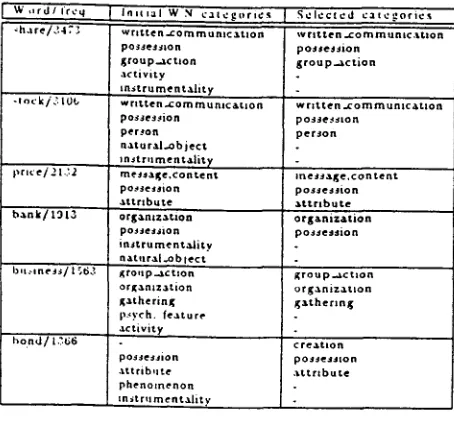
Table 3 reports on experiment 2. [n column 3. selected categories are reported in decreasing order of class membership evidence.
Ia Table 2, notice the apparently "strange"
classification of wall. The problem is that, in
the current version of our system, proper nouns are not correctly detected (this problem will
Table 3: Selected and Initial WN categories for some very ambiguous words
W ~ , r d , I r c q
,hare/347?~
p r i c e / 2 1 3 2
b ~ n k / t 3 t 3
b , t : o n e J $ / l "~63
b o . n d / l . 3 6 6
I I n l l l a l W 31 c a t e g o r t c s
w r | t t e n - c o rn rn u n i t ~ t l o n poJsesslon
r r o u p - } , c t l o n
a c t i v i t y m s t r u m e r t t a . l i t y
w r l t t e n - c o m r n u n l c & t l o n posres.~ion
per.~on n & t u r l l ~ b j e c t
In~t r u menta.lit~¢
r n e ~ s a K e , c o n t e n t p o . . s e ~ i o n . ~ t t r l b u t e orga, n l z 3 t i o n poJJe~Jion
i n s t r u m e n t a l i t y
r t a t u r a l . O b l e c t g r o q p . - ~ c t l o n o r g ~ , n l z ~ t i o n g ~ , t h e r i n g
p ~ y c h , f e a t u r e a c t i v i t y
po~Je$$ion ~ t t r i b u t e p h e n o m e n o n m i t r u r n e n t l l i t v
S e l e c t e d c a t c g o r i e r ,
w r i t t e n ..co m m urt tc.~.t,o rt
p o s s e J ~ i o n g r o u p . . x c t i o n
w r l t t e n . x o m r n u n | c ~ t l o r t p o s s e s s i o n
p e r s o r t
i n e s ~ a $ t e , c o n t e r t t
possesJion
~ t t r l b u t e
o r & ~ n i z ~ t i o n possession g r o u p _ ~ c t l o r t
o r g a n i z ~ . t l o n g ~ t h e r m &
cre~tlort po$$e$~|orl
,1.t t r i b u t e
85
be fixed shortly) since in the Wall S t r e e t Jour- nal there is no special syntactic tag for proper names. Erroneously, several proper names, such
as Wall Street, Wall Street Journal, Bush, Delta. Apple, etc. were initially classified as c o m m o n nouns, therefore causing some noise in t h e d a t a that we need now to eliminate 3.
The word wall is in fact part of the com-
plex nominals Wall Street and Wall Street
Journal, and it is very interesting that. based on the context, the system classifies
it correctly in the three categories: gather-
ing, written_communication, organization Notice
that the category: "gathering, assemblage" has
somehow an unintuitive label, but in the WSJ domain this class includes r a t h e r uniform words, most of which refer to political organizations, as shown in Table 1.
In Table 3. it is shown t h a t often some reduc- tion of ambiguity is possible. However. some
spurious senses survive, for example, t h e pro-
genitor (person) sense of stock. [t is very im- portant that. in all tile analyzed cases, the se- lected classes are a subset of the initial Word- Net classes: r e m e m b e r t h a t the assignment of a word to a category is performed only on the basis of its computed membership to t h a t cat- egory. There is one example of additional de- tected sense (not included in the pruned Word-
Net), i.e. the sense creation for the word hood.
Typical (for the domain) words in this class are:
plan. yeld. software, magazine, jottroal, is.~,e.
etc. therefore, the creation sense seems appro- priate.
Clearly. we need to perform a b e t t e r (in the large} experimentation, but the first results seem encouraging. A large scale e x p e r i m e n t re- quires, besides a better tuning of the statistical parameters and fixing some obvious bug (e.g. the identification of proper nouns}, the prepara- tion of a test set in which the correct classifica- tion of a large nurnber of words is verified man- ually in the actual corpus contexts. Finally, ex- periments should be extended to d o m a i n s other than WordNet. We already e x p e r i m e n t e d the algorithm for core category selection on a UNIX corpus and on a small Natural Science corpus. but again, extending the complete e x p e r i m e n t
[image:6.612.64.291.483.694.2]I
I
I
I
I
I
I
I
I
I
I
I
I
I
I
I
I
I
to other corpora is not trivial for the required intensive linguistic and statistical corpus pro- cessiug.
5 R e f e r e n c e s
(Agirre and Rigau, 1996) E. Agirre and G. Rigau, Word'Sense Disambiguation using Conceptual Density, proc. of COLING 1996
Basili, Della Rocca, Pazienza, 1997) R. Basili, M.Della Rocca, M.T. Pazienza, Towards a Bootstrapping Fr'amework for Corpus Semantic Tagging, in (TAGWS 1997)
Basili et al. 1995b.) Basili R., M. Della Rocca, M.T. Pazienza, P. Velardi. "Contexts and cat- egories: tuning a general purpose verb clas-
sification to sublanguages". Proceeding of
RANLP95, Tzigov Chark, Bulgaria, 1995. Brill and Resnik, /994) E. Brill and P. Resnik, A
transformation-based approach to prepositional phrase attachment disambiguation, proc. of COLING 1994
(Chen and Chen, 1996) K. Chen and C. Chen, A rule-based and MT-oriented Approach to
Prepositional Phrase Attachment, proc. of
COLING 1996
(Cucchiarelli and Velardi. forthcoming 1998) Cuc- chiarelli A., Velardi P. "Finding a Domain- Appropriate Sense Inventory for Semantically Tagging a Corpus" Int. Journal of Natural Lan- guage Engineering, in press. 1998
(Cucchiarelli and Velardi, 1997) Cucchiarelli A., Ve- lardi P. "Automatic Selection of Class Labels from a Thesaurus for an Effective Semantic Tag- ging of Corpora", 6th Conf. on Applied Nat- ural Language Processing, ANLP97. Washing- toll. April t-3 1997
(Dolau. 1994) W. Dolan. Word Sense Ambiguation: Clustering Related Senses. Proc. of Coling 1994 (Felibaum. [997) C. Fellbaum. "' Analysis of a hand-
tagging task" in (TAGWS 1997).
(Hearst and Schuetze. 1993) M. Hearst and H. Schuetze. Customizing a Lexicon to Better Suite a Computational Task, ACL SIGLEX. Workshop on Lexical Acquisition from Text, Columbus. Ohio, USA, 1993.
(Yarowsky. D. 1992), "Word-Sense disambiguation using statistical models of Roget's categories trained on large corpora". Nantes: Proceedings of COLING 92.
(Krovetz and Croft, I992) R. Krovetz and B. Croft, Lexical Ambiguity and Information Retrieval, in AC'M trans, on Information Systems, tO:2,
1992
(Gale et al. 1992) Gale. W. K. Church and D. Yarowsky. One sense per discourse, in proc. of
the DARPA speech and and Natural Language workshop, Harriman, NY, February 1992 (Pustejovsky, 1995) J. Pustejovsky, The generative
Lexicon, MIT Press, 1995
(Resnik, 1995) P. Resnik. Disambiguating Noun Groupings with respect to Wordnet Senses, proc. of 3rd Workshop on Very Large Corpora, 1995
(Resnik, 1997) P. Resnik, Selectional reference and Sense disambiguation, in TAGWS97
(TAGWS 1997) Proceedings of the workshop "Tag- ging Text with Lexical Semantics: Why, What, and How?", published by ACL, 4-5 April 1997, Whashington, USA