C u e P h r a s e S e l e c t i o n i n I n s t r u c t i o n D i a l o g u e U s i n g M a c h i n e L e a r n i n g
Y u k i k o I. N a k a n o
N T T I n f o r m a t i o n a n d C o m m u n i c a t i o n S y s t e m s L a b o r a t o r i e s
1-1 H i k a r i - n o - o k a , Y o k o s u k a - s h i , K a n a g a w a 239-0847 J a p a n
y u k i k o ~ n t t n l y . i s l . n t t . c o . j p
T s u n e a k i K a t o
N T T C o m m u n i c a t i o n Science L a b o r a t o r i e s
2-4 H i k a r i d a i , S e i k a - c h o , S o r a k u - g u n , K y o t o 619-0237 J a p a n
k a t o Q c s l a b . k e c l . n t t . c o . j p
A b s t r a c t
The purpose of this paper is to identify effective fac- tors for selecting discourse organization cue phrases in instruction dialogue that signal changes in dis- course structure such as topic shifts and attentional state changes. By using a machine learning tech- nique, a variety of features concerning discourse structure, task structure, and dialogue context are examined in terms of their effectiveness and the best set of learning <features is identified. Our result re- veals that, in addition to discourse structure, already identified in previous studies, task structure and di- alogue context play an important role. Moreover, an evaluation using a large dialogue corpus shows the utihty of applying machine learning techniques to cue phrase selection.
1 I n t r o d u c t i o n
Cue phrases are words and phrases, such as "first", "and", "now", that connect discourse spans and add structure to the discourse both in text and dialogue. They signal topic shifts and changes in attentional state (Grosz and Sidner, 1986) as well as expressing the relation between the individual units of discourse (Moore, 1995; RSsner and Stede, 1992). In this study, we focus on the former kind of cue phrases, organization cue phrases that signal the structural organization of discourse.
In instruction dialogue, the organization cue phrases play a crucial role in controlling dialogue and making the material easy to understand. More- over, in dialogue systems, the user cannot compre- hend the structural organization of the dialogue un- less the appropriate cue phrases are included in the system's utterances. Therefore, for dialogue gener- ation, we must identify the determining factors of organization cue phrases and select the cue phrases appropriately.
In previous studies that have investigated the rela- tionship between cue phrases and the types of struc- tural change (e.g. pop, push), the taxonomies of cue phrases have been presented (Grosz and Sid- ner, 1986; Cohen, 1984; Schiffrin, 1987). These tax- onomies are, however, not sufficient for generation because the correspondence between cue phrase and structural change is many-to-many quite often. For example, "now","and", and "next" are all classified as the category signaling push in attentional state. Therefore, the indication of structural shifts in dis-
course is not sufficient to fully constrain cue phrase selection.
In this study, we reveal what factors affect or- ganization cue phrase selection, and establish more precise selection rules for generating instruction dia- logues. As factors for cue phrase selection, we exam- ine a variety of features concerning discourse struc- ture, task structure, and dialogue context. The rea- son that we examine these three factors is as fol- lows. First, discourse structure is indispensable for selecting cue phrase as claimed in previous stud- ies (Grosz and Sidner, 1986; Cohen, 1984; Euge- nio et al., 1997). We examine some features con- cerning this factor such as the global structure of discourse and structural shifts in discourse. Sec- ond, while the discourse structure provides informa- tion about the preceding discourse, Cawsey (1993) claimed that information about the succeeding dis- course (e.g., length and complexity) is also necessary in order to select cue phrases dynamically in dialogue systems. From this point of view, task structure is expected to be effective because discourse structure strongly reflects task structure in task oriented di- alogue (Grosz, 1977; Guindon, 1986). Finally, in contrast to these structural aspects of dialogue, we think it important to consider sequential contexts of dialogue such as the types of dialogue exchange (StenstrSm, 1994) immediately preceding to the cue phrase.
In this paper, using a machine learning technique, C4.5 (Quinlan, 1993), we examine these features in terms of their effectiveness in selecting organization cue phrase and identify the most effective set of learning features. In addition, we evaluate the accu- racy of decision trees obtained using a large corpus. Our result reveals that, in addition to discourse structure whose effectiveness has already revealed in previous studies, task structure and dialogue context play important roles. Especially important are the place of the segment in the global structure of the dialogue and the type of the immediately preceding dialogue exchange.
2 R e l a t e d w o r k
While cue phrases can appear in different places in instruction dialogues, we focus on the organization cue phrases that occur at the beginning of discourse segments referring to goals or direct actions. This is because such kind of cue phrases have the im- p o r t a n t function of describing the basic structure of the dialogue. In a procedural instruction dialogue, the sequence of actions for the procedure is directed step by step. In terms of Rhetorical Structure The- ory (RST) (Mann and Thompson, 1987), it is c o n - sidered that the basic structure of such kind of dis- course is constructed by connecting segments that refer to goals or primitive actions with "sequence" relation (RSsner and Stede, 1992; Kosseim and La- palme, 1994). Therefore, the cue phrases which oc- cur at the beginning of segments that are connected with "sequence" relation and refer to goals or direct actions play important roles in signaling the basic structure of the dialogue. Moreoyer, such kind of cue phrases are observed very frequently in instruction dialogues. In their empirical study on the charac- teristics of task oriented dialogues, Oviatt and Co- hen (1990) reported that, in instruction dialogues on assembling a pump, cue phrases such as "Okay", "now" and "next" occur at the beginning of 98.6% of the new segments that instruct assembly actions in telephone dialogues. Based on the above, we think it important for dialogue generation to select and set appropriate cue phrases at the beginning of dis- course segments that refer to goals or direct actions. Moser and Moore (1995a) and Moser and Moore (1995b) investigated the relationship between cue placement and selection. They showed that the cue phrases are selected and distinguished depending on their placement. Somewhat differently, we tackle the problem of selecting cue phrases that occur at the same place in the segment (at the beginning of the segment).
As indicated in (Eugenio et al., 1997), in terms of natural language generation, cue usage consists of three problems, occurrence: whether or not a cue should be included, placement: where the cue should be placed, and selection: what cue should be used. We tackle the third problem, the selection of cue phrases. Our final goal is to establish a strategy for selecting organization cue phrases and apply it in the generation of instruction dialogues. While the empirical approach of this study is close to that of (Eugenio et al., 1997), they apply a machine learning technique to predicating cue occurrence and place- ment, not cue phrase selection.
3 A n n o t a t i o n o f d i a l o g u e c o r p u s
In this section, we mention the way of the annotation in our corpus. Then, the inter-coder agreement for the annotations is discussed.
3 . 1 C l a s s o f c u e p h r a s e s
The domain of our dialogue corpus in Japanese is to instruct the initial setting of an answering machine. T h e corpus consists of nine dialogues with 5,855 ut- terances. There are, 1,117 cue phrases in 96 distinct
ds3.3
ds3.4
ds3.5
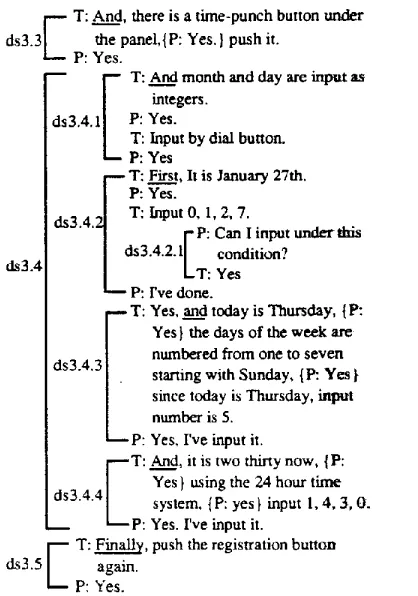
D T: And, there is a time-punch button under the panel,{P: Yes. } push it.
P: Yes.
I"" T: An.._.d month and day are input as
L
integers.ds3.4.1 P: Yes.
T: Input by dial button. P: Yes
f-- T: First, It is January 27th. P: Yes.
- - T ' I n p u t 0 1 2 7
ds3 4 21 . . .
• " | i-P: Can I input under this I ds3"4"2"1/ condition?
| l - T : Y e s t__ p: I've done.
i
T: Yes, ~ today is Thursday, {P: Yes } the days of the week are numbered from one to seven ds3.4.3 starting with Sunday, {P: Yes }
since today is Thursday, input number is 5.
t__p: Yes, I've input it.
•
--T: An._..d, it is two thirty now, {P: Yes } using the 24 hour time ds3.4.4 system, {P: yes } input 1, 4, 3, O. m a _ _ p : Yes. I've input it.B T: Finally, push the registration button again.
-- P: Yes.
Figure 1: An example of annotated
dialogue
cues 1. There are 31 cue phrases that occur more than five times.
As the result of classifying these 31 cue phrases based on the classification of Japanese connectives (Ichikawa, 1978; Moriyama, 1997) and cue phrase classification in Enghsh (Grosz and Sidner, 1986; Cohen, 1984; Knott and Dale, 1994; Moser and Moore, 1995b), 20 cue phrases, which occurred to- tal of 848 times, were classified into three classes: changeover, such as soredeha, deha ("now", "now then" in English), conjunctive, such as sore.de, de ("and", "and then"), and ordinal, such as mazu, tsugini ("first", "next"). Besides these simple cue phrases, there are composite cue phrases such as soredeha-tsugini ("now first"). Note t h a t meaning and the usage of each of these Japanese cue phrases does not completely correspond to those of t h e En- glish words and phrases in parentheses. For exam- ple. the meaning of the Japanese cue phrase sore- deha is close to the English word now in its discourse sense. However, soredeha does not have a sentential sense though now does.
The purpose of this study is to decide which of these three classes of simple cue phrases should be selected as the cue phrase at the beginning of a dis-
[image:2.612.340.549.60.358.2]course segment. We do not deal with composite types of cue phrases.
3.2 A n n o t a t i o n o f d i s c o u r s e s t r u c t u r e
As the basis for examining the relationship between cue phrase and dialogue structure, discourse seg- ment b o u n d a r y and the level of embedding of the segments were annotated in each dialogue. We de- fine discourse segment (or simply segment) as chunks of utterances that have a coherent goal (Grosz and Sidner, 1986; Nakatani et al., 1995; Passonneau and Litman, 1997). The annotation of hierarchical re- lations a m o n g segments was based on (Nakatani et
al.,
1995).Figure 1 shows an example from the annotated dialogue corpus. This dialogue was translated from the original Japanese. This example provides in- struction on setting the calendar and clock of the answering machine. T h e purpose of ds3.4 is to in- put numbers by dial buttons and each input action is directed in ds3.4.2, ds3.4.3, and ds3.4.4, for in- putting the date, the day of the week, and the time, respectively. Subdialogues such as confirmation and pupil initiative clarification are treated as one seg- ment as in ds3.4.2.1. T h e organization cue phrases are underlined in the sample dialogue. For example, the cue phrase for ds3.3 is "And", and that for ds3.5 is "Finally" 2
3.3 A n n o t a t i o n o f d i s c o u r s e p u r p o s e and p r e - e x c h a n g e
As the information about task structure and dia- logue context, we annotated the discourse purpose of each segment and the dialogue exchange at the end of the immediately preceding segment.
In annotating the discourse purpose, the coders selected the purpose of each segment from a topic list. The topic list consists of 127 topics. It has a hierarchical structure and represents the task struc- ture of the domain of our corpus. W h e n the dis- course purpose cannot be selected from the topic list, the segment was annotated as "others". In such segments, the information about task structure can- not be obtained.
T h e pre-exchange is annotated as a kind of dia- logue context and used as one of the learning fea- tures itself. The coders annotated the kind of pre- exchange by selecting one of nine categories of ex- changes which are defined in section 4.1 in detail. 3.4 I n t e r - c o d e r a g r e e m e n t for t h e a n n o t a t i o n As mentioned in the previous sections, we annotated our corpus with regard to the following characteris- tics: the class of cue phrases (ordinal, changeover, conjunctive), segment boundary, and hierarchical structure of the segment, the purpose of the seg- ment, and the dialogue exchange at the end of the immediately preceding segment.
T h e extent of inter-coder agreement between two coders in these annotation are calculated by using :When a cue phrase follows acknowledgement (Yes) or a stammer, these speech fragments that do not have ~ftropositional content axe ignored and the cue phrases er the fragments axe annotated as the beginning of the segment.
Cohen's K a p p a ~ (Bakeman and G o t t m a n , 1986; Carletta, 1996). The inter-coder agreement (to) about the class of cue phrase is 0.68, about the pur- pose of the segment is 0.79, and about the t y p e of pre-exchange is 0.67. The extent of agreement a b o u t the segment boundary and the hierarchical struc- ture is calculated using modified Cohen's K a p p a pre- sented by (Flammia and Zue, 1995). This Cohen's K a p p a is 0.66.
Fleiss et al. (1981) characterizes kappas of .40 to .60 as fair, .60 to .75 as good, and over .75 as ex- cellent. According to this categorization of levels of inter-coder agreement, the inter-coder agreement for cue phrase, pre-exchange, and discourse b o u n d a r y and structure is good. T h e agreement on segment purpose is excellent. Thus, these results indicate that our corpus coding is adequately rehable and objective.
When the two coders' analyses did not agree, the third coder judged this point; only those parts whose analysis is o u t p u t by more t h a n two coders was used as learning data.
4 L e a r n i n g e x p e r i m e n t 4.1 L e a r n i n g f e a t u r e s
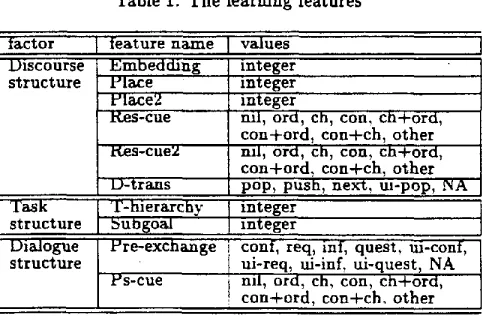
This section describes a learning experiment using C4.5 (Quinlan, 1993). First, we define 10 learning features concerned with three factors.
( 1 ) D i s c o u r s e s t r u c t u r e : Structural information about the preceding dialogue.
E m b e d d i n g The depth of embedding from the top level.
P l a c e The number of elder sister segments. P l a c e 2 T h e number of elder sister segments
except pupil initiative segments.
R e c e n t e l d e r s i s t e r ' s c u e ( R e s - c u e ) T h e cue phrase that occurs at the beginning of the most recent elder sister segment. T h e y axe classified into three kinds of simple cue phrases: ord (ordinal), ch (changeover), con (conjunctive) or a kind of composite cue phrase such as c h + o r d (changeover + ordinal).
R e s - c u e 2 The cue phrase that occurs at the beginning of the most recent elder sister segment except pupil initiative segments. D i s c o u r s e t r a n s i t i o n ( D - t r a n s ) T y p e s of
change in attentional state accompanied by topic change 3 such as push and pop. P o p from the pupil initiative subdialogue is cat- egorized as "ui-pop".
( 2 ) T a s k s t r u c t u r e : Information that estimates the complexity of succeeding dialogue.
factor
Discourse structure
Task
structure
Dialogue
structure
Table 1: The learning features
feature name
Embedding Fla~:e l~,lace2
H.es-cue
l~es-cue2
D-trans
T-hmraxchy ~ubgoal Fre-exchange
F s - c u e
values integer mteger mteger
nil, ord, Oh, con, ch+ord,
con÷ord, con+ch, other nil, ord, C[1, Cou, c n ÷ o r d ~ con+ord, con+ch, other pop, push, next, m-pop, ~ A integer
mteger
conf, req, inf, quest, ui-conf, ui-req, tti-inf, ui-quest, NA nil, oral, ch, con, ch+ord, con+ord, con+ch, other
T a s k - h i e r a r c h y ( T - h i e r a r c h y ) T h e number of goal-subgoal relations from the current goal to primitive actions. This estimates the depth of embedding in the succeeding dialogue.
S u b g o a l The n u m b e r of direct subgoals of the current goal. If zero, then it is a primitive action.
( 3 ) D i a l o g u e c o n t e x t Information a b o u t the pre- ceding segment.
P r e - e x c h a n g e T y p e of exchange t h a t occurs at the end of the immediately preceding segment, or t y p e of exchange immediately preceding the cue phrase. T h e r e are four categories, conf (confirmation-answer), req (request-answer), inf (information-reply). ques (question-answer). T h e y are also distinguished by the initiator of the ex- change; explainer initiative or pupil initia- tive. When the category of the exchange is not clear, it is classified as not applicable (NA). Therefore, there are nine values for this feature.
P r e c e d i n g s e g m e n t ' s c u e ( P s - c u e ) The cue phrase t h a t occurs at the beginning of the immediately preceding segment. T h e values of these features are shown in Ta- ble 1. Among the above learning features,
Embed-
ding, Place, Place$, Res-cue, Res-cue~, Ps-cue, and
D - t r a n s are derived automatically from the infor- mation about segment b o u n d a r y and the segment hierarchy annotated in the corpus (an example is shown in Figure 1). T h e depth of task hierarchy (T-hierarchy) and the n u m b e r of direct subgoais
(Sub-
goal) are determined by finding the a n n o t a t e d seg-
ment purpose in the given task structure.4 . 2 L e a r n i n g a l g o r i t h m
In this study, C4.5 (Quinlan, 1993) is used as learn- ing program. This p r o g r a m takes two inputs, (1)the definition of classes t h a t should be learned, and the names and the values of a set of features, and (2)
the d a t a which is a set of instances whose class a n d feature values are specified. As a result of m a c h i n e learning, the program o u t p u t s a decision tree fe~ judgement.
We use cross-validation for estimating t h e accu- racy of the model because this m e t h o d avoids the disadvantages common with small d a t a sets whose n u m b e r of cases is less than 1000. In this study, 10-fold cross-validation is applied, so t h a t in each run 90% of the cases are used for training a n d t h e remaining 10% are used for testing. T h e C4.5 p r o - g r a m also has an option that causes the values of discrete a t t r i b u t e to be grouped. We selected this, option because there are m a n y values in some fea- tures and the decision tree becomes v e r y complex if each value has one branch.
4 . 3 R e s u l t s a n d d i s c u s s i o n
Decision trees for distinguishing the usage o f t h r e e kinds of cue phrases (changeover, ordinal, a n d con- junctive) were computed by the machine learning al: gorithm C4.5. As learning features, the 10 features mentioned in section 4.1 are used. From n i n e dia- logues; 545 instances were derived as training d a t a . In 545 instances, 300 were conjunctive, 168 were changeover, and 77 were ordinal. T h e most frequent category, conjunctive, accounts for 557o of all cases. Thus, the baseline error rate is 4570. This m e a n s t h a t one would be wrong 45~0 of the t i m e if this category was always chosen.
[image:4.612.201.442.66.226.2]Table 2: The error rates with each model Embedding
'Place Place'~ -Res-cue
l-tes-cue2
D-trans T-hierarchy
" ' Subg0al
46.5 2:0.1 42.5 ± 0.4 43.8 ::k 0.4 44.9 ± 0.3 45.1 ± 0.4 45.0 ± 0.5 42.4 ± 0.3 42.5 ± 0.3
Fre-exchaage Fs-cue DS model Task model D(_, m o d e l All Ieature model Simplest model
41.5 ± 0.5 46,5 =k 0.3 35,6 ± 0.4 41,8 2:0.3 39.1 ::l:: 0.6 29.9 2:0.4 30.6 ± 0.3
Table 3: The set of learning features for each model
I Discourse Structure il rl'ask Structure
Model Embedd- Flace I Place2 Res- l-tes- { D-trans I T- 5ubgoal
in~; . : cue cue 2 hierarchy
DS ~ 4 4 4 V
,/
Task
V
,/
DC
An
feature¢
V
~
q
,/
¢ :,¢_
4Simplest', h f ~/ ' ~/
Ii
.. ~/II
Dialogue ContextI
Pre- Fs-cue exch~nse I4
4
4
4
4
4
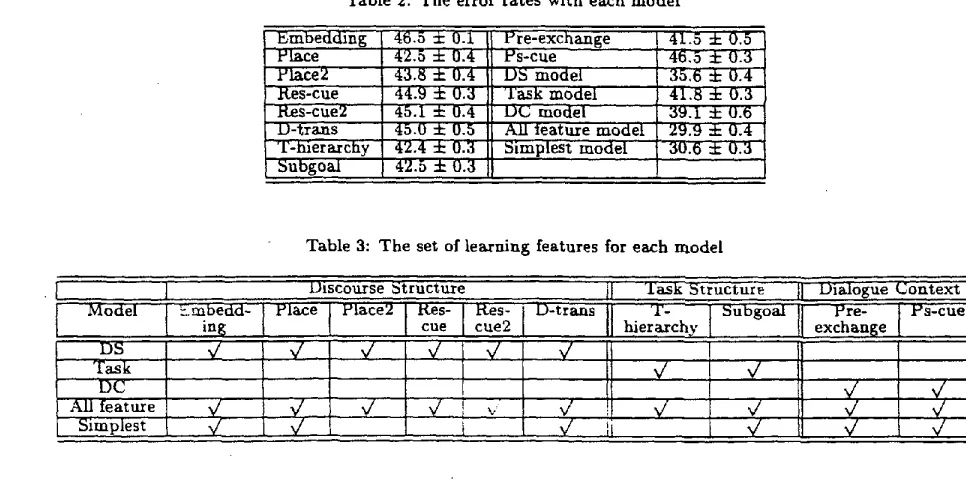
ture performs best, and its error rate is 41.5%. In all experiments, the error rates are more than 40% and none are considerably b e t t e r t h a n the baseline. These results suggest t h a t using only a single learn- ing feature is not sufficient for selecting cue phrases correctly.
As the single feature models are not sufficient, it is necessary to find the best set of learning features for selecting cue phrases. We call a set of features a model and the best model (the best set of features) is o b t a i n e d using the following procedure. First, we set some multiple features models and carry out learn- ing experiments using these models in order to find the best performing model and the best error rate. We then eliminate the features from the best perfor- mance model in order to make the model simpler. Thus, the best model we try to find is the one t h a t uses the smallest n u m b e r of learning features but whose performance equals the best error rate.
We construct four multiple feature models. T h e n a m e of the model a n d the combination of features in the model are shown in Table 3. The discourse s t r u c t u r e model (the DS model) used learning fea- tures concerned with discourse structure. The Task model used those concerned with task structure, and the dialogue context (the DC model) used those con- cerned with dialogue context. T h e All .feature model uses all learning features. The best error rate among these models is 29.9% in All .feature model as shown in Table 2. T h e error rate is reduced about 15% from the baseline.
Therefore, the best model is the one that uses fewer learning features than the All .feature model and t h a t equals the performance of that model. In order to reduce the n u m b e r of features considered, we examined which features have redundant infor- m a t i o n , and omitted these features from the All ]ea- ture model. The overlapping features were found by
examining the correlation between the features. As for numerical features t h a t take number values, the correlation coefficient between Place and Place~, and between T-hierarchy and Subgoal are high (p=0.694, 0.784, respectively). As for categorical features, agreement between Res-cue and Res-cue2 is 95%. These highly correlated features can be represented by just one of them. As the result of m a n y ex- periments varying the combination of features used, we determined the Simplest model which uses six features: Embedding, Place, D-trans, Subgoal, Pre- ezchange, and Ps-cue as shown at the b o t t o m line in Table 3. T h e error rate of the Simplest model is 30.6% as shown in Table 2. It is very close to that of the All ]eature model though the difference is statistically significant.
In addition to comparing only the overall er- ror rates, in order to c o m p a r e the p e r f o r m a n c e of these two models in more detail, we calculated the information retrieval metrics for each category, changeover, ordinal, and conjunctive. Figure 2 shows the equations used to calculate the metrics. For example, recall rate is the ratio of the cue phrases correctly predicted by the model as class X to the cue phrases of class X in the corpus. Precision rate is the ratio of cue phrases correctly predicted to be class X to all cue phrases predicted to be class X. In addition, in order to get an intuitive feel of over- all performance, we also calculated the s u m of the deviation from ideal values in each metric as in (Pas- sonneau and Litman, 1997). T h e summed deviation is calculated b y the following numerical formula:
(1 - Recall) + (1 - Precision) + Fallout + Error
[image:5.612.64.547.64.305.2]Table 4: Performance on training set using cross-validation [ M o d e l
All feature model
Simplest model
Cue phrase t.tecaU Precimon FaUout [ Error [ Summed Deviation I ordinal 0.50(0.HI) 0.64(0.10) 0.05(0.03) , 0.11 (0.03) , 1.03(0.23) , c h a n g e o v e r 0.53 (0.1,:) 0.58 (0.07) 0.17 (0.05) [ 1 0 " 2 6 (0.04) 1.32 (0.23) conjunctive 0.80 (0.01;) 0.73 (0.05) 0.38 (0.11) 0.28 (0.04) 1.12 (0.16) ordinal 0.48 (0.17) 0.66 (0.17) 0.45 (0.03) 0.11 (0.02) 1.01 (0.26) I changeover I 0.50 (0.12) 0.62 (0.08) 0.14 (0.03) 0.25 (0.05) 1.27 (0.24) I I conjunctive [ 0.85 (0.04) 0.72 (0.04) 0.40 (0.08) 0.26 (0.04) 1.09 ~0.17) I
Class-X C4.5
Program not-Class-X
Corpus Class-X not-Class-X
a b
c d
Recall = a Fallout = b
(a+c) (b+d)
Precision = a Error = (b+c) (a+b) (a+b+c+d)
Figure 2: Information retrieval metrics
the metrics on the test set in each run of 10-fold cross-validation. Comparing the summed deviation. the performance of the Simplest model is better than that of the All feature model in all categories of cue phrases. The summed deviations of the Simplest model, 1.01 for ordinal, 1.27 for changeover, and 1.09 for conjunctive, are lower than those of the All fea- ture model. Thus, as a result of evaluating the mod- els in detail using the information retrieval metrics, it is concluded that the Simplest model is the best performing model. In addition, the Simplest model is the most elegant model because it uses fewer learn- ing features than the All feature model. Just six features, Embedding, Place, D-trans, Subgoal, Pre- exchange, and Ps-cue, are enough for selecting orga- nization cue phrases.
Classifying the six features in the Simplest model, it is found that these features come from all fac- tors, discourse structure, task structure, and dia- logue context. Embedding, Place, D-trans are the features of discourse structure, Subgoal is about task structure, and Pre-exchange and Ps-cue are about dialogue context. This result indicates that all the factors are necessary to predict cue phrases. The i m p o r t a n t factors for cue phrase selection are task structure and dialogue context as well as discourse structure, the focus of many earlier studies.
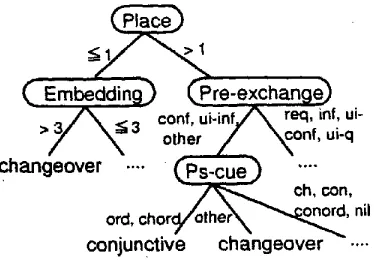
While we identified the six features from the three kinds of factors, by looking at the decision trees cre- ated in the learning experiment, we found which fea- tures were more important than others in selecting cue p h r ~ e s . The features appearing near the root n o d e are more important. Figure 3 shows the top
part of a decision tree obtained from the Simplest model. In all 10 decision trees resulting from the cross-validation experiment in the Simplest model, Place feature appears at the root node. In 7 of 10 trees, Embedding and Pre-exchange appeared just below the root node. In these trees, if the Place of the segment is the first at that level (i.e. there is no elder sister.), then Embedding appears at the next node, otherwise if the segment is not the first one at that level, then Pre-exchange appears a t t h e next node. Thus, if there are some elder sister segments, information about dialogue context is used for se- lecting cue phrases. On the o t h e r hand, if there is no elder sister segment, information a b o u t discourse structure is used for the judgement. These results suggest t h a t the information a b o u t discourse struc- ture, especially place of segments and the depth of embedding, and the dialogue context, especially the kind of immediately preceding dialogue exchange, play important roles in cue phrase selection. 5 C o n c l u s i o n a n d F u r t h e r w o r k
This paper reported the results of using a ma- chine learning algorithm for identifying learning fea- tures and obtaining decision trees for selecting cue phrases. It also reported the result of a quantitative evaluation of the decision trees learned. Learning features concerning three factors, discourse struc- ture, task structure, and dialogue context, were ex- amined. By carrying out many experiments in which the combinations of learning features were varied, we found the most simple and effective learning feature set. The accuracy of the best model that uses 6 learning features is about 70%. T h e error rate is re- duced about 25% from the baseline. These results support the claims of previous studies that discourse structure influence cue selection. In addition, it is revealed that task structure and dialogue context are also indispensable factors.
(
Ernbedding~
~Pre-exchan'ge)
> 3 ~ 3
¢onf, ui-inf,~ req, inf, ui-
o t h e r s
"X~onf, ui-q
changeover .... ~
....
~ Oh, con, .ord, chord//other~ ~
nilconjunctive
changeover ....
Figure 3: Top part of a decision tree
segments, the methods presented here will be useful in extending our model so as to select other kinds of cue phrases.
R e f e r e n c e s
Roger Bakeman and John M. Gottmaa. 1986. Ob- serving Interaction. Cambridge University Press. Jean Carletta. 1996. Assessing agreement on clas-
sification tasks: The kappa statistic. Computa- tional Linguistics, 22(2):249-254.
Alison Cawsey. 1993. Explanation and Interaction: The Computer Generation of Expalanatory Dia- logues. MIT Press.
Herbert H. Clark. 1997. Using language. Cambridge University Press.
Robin Cohen. 1984. A computational theory of the function of clue words in argument understand- ing. In Proceedings of the lOth International Con- ference on Computational Linguistics. pages 251- 258.
Michael Elhadad and Kathleen R. McKeown. 1990. Generating connectives. In Proceedings of the 13th International Conference on Computational Lin- guistics, pages 97-101.
Barbara Di Eugenio; Johanna D. Moore, and Mas- simo Paolucci. 1997. Learning features that pre- dict cue usage. In Proceedings of the 35th An- nual Meeting o] the Association for Computa- tional Linguistics and the 8th Conference of the European Chapter off the Association off Computa- tional Linguistics, pages 80-87.
Giovanni Flammia and Victor Zue. 1995. Empirical evaluation of human performance and agreement in parsing discourse constituents in spoken dia- logue. In Eurospeech, pages 1965-1968.
J. L. Fleiss, J. Cohen, and B. S. Everitt. 1981. Statistics Methods for Rates and Proportions. Wi- ley.
Barbara J. Grosz and Candace L. Sidner. 1986. At- tention, intentions, and the structure of discourse. Computational Linguistics, 12(3):175-204. Barbara J. Grosz. 1977. The representation and use
of focus in dialogue understanding. Technical Re- port 151, Artificial Intelligence Center, SRI Inter- national.
Raymonde Guindon. 1986. The structure of user- adviser dialogues: Is there method in their mad- ness? In Proceedings off the 2$th Annual Meeting of the Association/or Computational Linguistics, pages 224-230.
Takashi Ichikawa. 1978. Bunshouron gaisetsu (in Japanese). Kyouiku shuppan.
Alist~r Knott and Robert Dale. 1994. Using lin- guistic phenomena to motivate a set of coherence relations. Discourse Processes, 18:35---62.
Leila Kosseim mad Guy Lapalme. 1994. Content and rhetorical status selection in instruction texts. In Proceedings of the 7th International Workshop on Natural Language Generation, pages 53-60. William C. Mann and Sandra A. Thompson. 1987.
Rhetorical structure theory: A theory of text organization. Technical Report ISI/RS-87-190,
USC/ISI.
Johanna D. Moore. 1995. Participating in Explana- tory Dialogues: Interpreting and Responding to Questions in Context. MIT Press.
Takurou Moriyama, 1997. Speech and Grammar (in Japanese), chapter 5. Kuroshio Shuppan.
Megan Moser and Johanna D. Moore. 1995a. In- vestigating cue selection and placement in tuto- rim discourse. In Proceedings of the 33th An- nual Meeting of the Association for Computa- tional Linguistics, pages 130--135.
Megan Moser and Johanna D. Moore. 1995b. Us- ing discourse analysis and automatic text genera- tion to study discourse cue usage. In A A A I 1995 Spring Symposium Series: Empirical Methods in Discourse Interpretation and Generation, pages 92-98.
Christine H. Nakatani, Barbara J. Grosz, David D. Ahn, and Julia Hirschberg. 1995. Instructions for annotating discourses. Technical Report TR-21- 95, Center for Research in Computing Technology, Harvard University.
Sharon L. Oviatt and Philip R. Cohen. 1990. Dis- course structure and performance efficiency in in- teractive and noninteractive spoken modalities. Technical Report CSLI-90-138, Center for the Study of Language and Information.
Rebecca J. Passonneau and Diane J. Litman. I997. Discourse segmentation by human and automated means. Computational Linguistics, 23(1):103- 139.
John Ross Quinlan. 1993. C~.5: Programs for Ma- chine Learning. Morgan Kaufmann.
Deitmar RSsner and Manfred Stede. 1992. Cus- tomizing nST for the automatic production of technical manuals. In R. Dale, E. Hovy, D. RSsner, and O. Stock. editors, Proceedings of the 6th International Workshop on Natural Language Generation, pages 199--215. Springer- Verlag.
Deborah Schiffrin. 1987. Discourse markers. Cam- bridge University Press.
[image:7.612.103.290.59.194.2]