I Putu Indra Kusuma
Ganesha University of Education, Singaraja -Indonesia
Abstract: This research and development (R&D) aimed at 1) developing reading material for the fifth grade students of elementary schools in tourism area, and (2) investigating the quality of the material developed. To gather the data, this study used scoring rubric, questionnaires, observation sheets, interview guide, and test. This study used the development model proposed by Sugiyono (2011) and was developed based on the characteristics of good reading material proposed by Tomlinson (1998). The results showed that (1) reading material was developed by involving some of local contents and (2) reading material had high validity and practicality and was proven to be effective. It then can be concluded that to make good quality of a reading material, the development of it should involve local content and should be based on the criteria of good material.
Keywords: Reading Material, Tourism Area, Local Culture
INTRODUCTION
Learning English as a foreign language is very essential. This is due to the fact that English is internationally-used language that connects people around the world. A good English competence therefore has to be acquired. It becomes a great demand in Indonesia which has a lot of tourist destinations like Bali as well-known island around the world.
colonialism of Netherland, some old and magnificent temples, and etc. Those, of course, become the one of destinations that visitors must visit.
As people who live in an area which has world tourism destination, People in Buleleng regency is required to have competency in using English better than in other areas. Therefore, inhabitants in Buleleng regency are expected to be able to give correct information about Bali in English since it is the international language used in almost all countries. Therefore, they need competency in using English which is better to be done in early age.
However, the competency of English is not the only requirement of Balinese children. The knowledge of local culture is also needed to make them competent as the prospective tourism doers. In line with this idea, School-Based Curriculum (the curriculum implemented in Indonesia) states that the education in Indonesia should be based on the potency, development, and needs of the students and their neighborhood (BSNP, 2006). It means that Balinese culture, as one of the cultures in Indonesia, is important to be inserted in the education since Bali is a tourism object and almost all students are the prospective participants of tourism industry in the future.
Balinese culture can be inserted through Reading as one aspect of English. Reading is one of the four skills which is viewed as the most important language skill that should be developed in the classroom. Moreover, reading empowers the mind and expands the students‟ understanding of the world around them. Besides, the insertion of culture through reading is also considered as an important point since the material will be contextual and it can activate the students‟ prior knowledge.
job listings, instruction manuals, maps, and so on. In line with this statement, Indonesian government has considered about the importance of reading in teaching English where they provide sets of standard competency and basic competency as the minimal requirements that should be achieved by the students in reading skills. According to Indonesian Standard of Education or BSNP (2006), reading in elementary school includes: 1) reading written sentences/ very simple texts with good pronunciation, pitch, and intonation, and 2) understanding the meaning of written sentences/ very simple texts with accurate, fluent, and understood way.
Based on the preliminary observation conducted in elementary schools in Kalibukbuk distric as one famous district in Buleleng
regency, it was found that their textbooks were not contextual as expected by the students and the teachers since some of the material was not contextual. Further, the topics in the current textbook did not insert local references (culture) in which they were useful for the students.
Beside the results of evaluation to the books used by the students in Kalibukbuk, the classroom observations had also been conducted in two elementary schools in Kalibukbuk. The observations result showed that students of both schools did not understand the content of the reading material given by the teacher. They just kept silent when the teacher read the texts in front of the class. It may be caused by the language used in the texts since the language was beyond their comprehension level as the fifth grader. Without being supported by teacher‟s explanation in Indonesian language, they could not understand at all about the content of the texts given. For example, the teacher read a text entitled School‟s Canteen. Then after reading, she gave some questions related to the text. However, the students could not answer some of those questions.
students in Kalibukbuk knew. Another thing, the language used was quite difficult to be understood by the fifth graders.
Based on the aforementioned statement, it is urgent to develop a reading material which involves local culture to solve those problems. It is urgent because by developing the reading material which involves local culture, the students are hoped to be able to improve their understanding about the material given since the material will be contextual and close with their culture and to be able to preserve the Balinese culture in the modernity of the globalization era. Therefore, the study is intended 1) to develop the culture-based reading material for the fifth grade students of elementary schools in
Buleleng regency and 2) to investigate the quality of culture-based reading material for the fifth grade students of elementary schools in
Buleleng regency.
LITERATURE REVIEW Culture
The word „culture‟ comes from the Latin cultura stemming from colere, meaning „to cultivate‟, a term that has some different meanings (Supartono, 2004:3). According to Louise (1987), there are several notable characteristics of culture that have been woven and rewoven into definitions and the theories upon which they are built. 1. Culture is learned. If it can be learned, it can be taught or acquired. 2. Cultures and cultural patterns change. It is more important to learn
how to learn a culture or adapt to these changes than to learn the “facts” and “truth” of the moment.
3. Culture is a universal fact of human life. There is no human group or society without culture. Cultural patterns and themes are related to universal human needs and life conditions.
5. Language and culture are closely related and interactive. Culture is transmitted in great part through language. Cultural patterns in turn are reflected in language.
6. Culture functions as filtering device between its bearers and the great range of stimuli presented by the environment. This filtering device is both protective and limiting. Intercultural communicators must traverse the boundaries of their own filtering systems or screens and enter the systems of others.
Culture-Based Learning
Culture-based learning can be said as a representation of contextual-learning approach. Contextually, the learning process should be relevant to the real situation and the culture where the learners are. The culture-based itself encompasses all principles, norms, and such practical orientation which exist among the society. This evidence then is used as the orientation in developing the reading material; culture-based reading material is referred to the use of material taken from Balinese culture. In line with this case, the learning process will be more beneficial and interesting for the learners in Bali since it directly applies their daily lives.
Based on constructivism theory developed by Piaget (in Richardson, 1997), every individual has his own definition toward his learning and he will relate it to his prior knowledge. A learner, moreover, will achieve such knowledge through the process of adding, modifying, renewing, and revising all the information during his learning. Constructivism theory also strengthens that every individual exactly bring along his prior knowledge during the learning. Having such relevance among the new information, the prior knowledge possessed, and both inner and integrated understanding will surely create a meaningful and an effective learning process.
Brooks & Brooks (1993) state the culture-based learning which goes along with the constructivism theory will create such a very convenient learning process. A teacher is more playing a role as a professional educator; helping the learners to do some of the following things:
1. Seeing the relevance between principle of the subject matter and the different culture context.
2. Understanding all the subject matter and the culture where the learners are.
3. Actively participating in the culture-based learning process.
4. Having the learners‟ knowledge and experience by varying the classroom activities.
5. Understanding the nature of culture as such community where the learners are being learned and as it is seen from the educational point of view.
6. Having an understanding and being competent to perceive all things around the learners‟ daily lives.
Reading
is an important educational goal for children and adults because the ability to read opens up new worlds and opportunities. So, it enables students to gain new knowledge, enjoy literature, and do everyday things that are part and parcel of modern life, such as, reading the newspapers, job listings, instruction manuals, maps and so on.
Supporting the above explanation, Winch et al. (2006) appointed that Reading is the process of constructing meaning from a text, whether written or graphic, paper-based or digital. The text may be wholly-printed as in most novels, or contain visual elements such as illustrations, diagrams, maps, and graphs as in most children‟s books and many information books, magazines, and newspaper.
Further, Winch et al. (2006) stated that children begin moving along the road to literacy before they come to school. They begin the journey on the day they are born from the first time they hear a human voice. Talk leads them into making a range of meanings with spoken language and it leads them into written words and into books. However, According to Ross et al. (1996), children who do not understand the important of learning to read will not motivated to learn. Learning to read takes efforts, and children who see the value of reading in their personal activities will be more likely to work hard than those who fail to see the benefits. It means that teacher should consider about these problems and should be willing to do some efforts to conduct the students to be well motivated in learning to read.
Criteria of a Good Material
According to Howard and Major (2005), there are six keys that participants need to take account when embarking on the design of teaching material for their learners, such as:
1. Learners
2. Curriculum and the context 3. Resources and facilities
4. Personal confidence and competence of the teachers 5. Copyright complaints
6. Time
Further they offer guidance in developing material for ESL students that there are some points should be considered, such as: 1. English Language Teaching materials should be contextualized. 2. Materials should stimulate interaction and be generative in terms
of language.
3. English Language Teaching material should encourage learners to develop learning skills and strategies.
4. English Language Teaching material should allow for a focus on form as well as function.
5. English Language Teaching material should offer opportunities for integrated language use.
6. English Language Teaching material should be authentic.
7. English Language Teaching material should link to each other to develop a progression of skills, understanding, and language use. 8. English Language Teaching material should be attractive.
9. English Language Teaching material should have appropriate instructions.
10. English Language Teaching material should be flexible.
In line with the guidelines of developing material, Tomlinson (1998: 7-21) explains some principles of second language acquisition relevant to the development of materials for the teaching of language. They are:
1. Material should achieve impact
2. Materials should help learners to feel at ease
4. What is being taught should be perceived by learners as relevant and useful
5. Materials should require and facilitate learner self-investment 6. Learner must be ready to acquire the points being taught
7. Materials should expose the learners to language in authentic use 8. The learners‟ attention should be drawn to linguistic features of
the input
9. Materials should provide the learners with opportunities to use the target language to achieve communicative purposes
10. Materials should take into account that the positive effects of instruction are usually delayed
11. Material should take into account that learners differ in learning styles
12. Materials should take into account that learners differ in affective attitudes
13. Material should permit a silent period at the beginning of instruction
14. Material should maximize learning potential by encouraging intellectual,
15. Material should not rely too much on controlled practice 16. Material should provide opportunities for outcome feedback
However, not all principles above can be used in designing reading material because those are used when the material researchers want to develop the material in general which include four skills (listening, speaking, reading, and writing). The principles above should be summarized again and adjusted with the need of developing reading material.
METHODS
Setting and Subject of the Study
The general setting of this study was elementary schools in
English teachers in elementary schools in Kalibukbuk were take as subjects of this study. Fifth grade students were chosen because the students in that level had known enough vocabularies to support them in understanding very simple reading text.
The object of this study was reading material where the content of the material was about local culture (Balinese culture) which was close with students‟ lives such as traditional clothes, traditional foods and drinks, animals which exist in Bali, parts of the body, and public places. The material was based on criteria of good EFL/ESL material proposed by Tomlinson.
Research Procedure
Since this present study purposed in developing the reading material for the fifth year students of elementary school, Research and Development (R&D) design was implemented. The steps in developing the reading material were (1) identifying potency and problem, (2) collecting data, (3) designing product, (4) validating design, (5) revising design, (6) administering product try-out, and (7) revising product.
Data Collections and Analysis
Generally, there were 5 methods of data collection used in this study; observation, interview, administering questionnaire, conducting tests, and document study. Meanwhile, the instruments used were observation sheet, interview guide, checklist, questionnaire, scoring rubric, and tests.
In this study, the data had been analyzed descriptively. The data obtained from observation, interview, and document study conducted in preliminary observation had been described qualitatively. It is to know the problem faced in real situation. The results of checklist for students were described quantitatively.
standard competency and basic competence of teaching reading for elementary school grade five.
After that, library research was conducted in order to gain the theories and empirical studies where they were used as supporting basis in this study. These results were also used as considerations in inserting Balinese culture to reading material developed. The data was described qualitatively.
In measuring the quality of the prototype being developed, the data gathered through some instruments was analyzed quantitatively. As stated previously, the quality of the prototype being developed could be measured through its validity (content and
construct validity), practicality, and effectiveness.
FINDINGS & DISCUSSION Findings
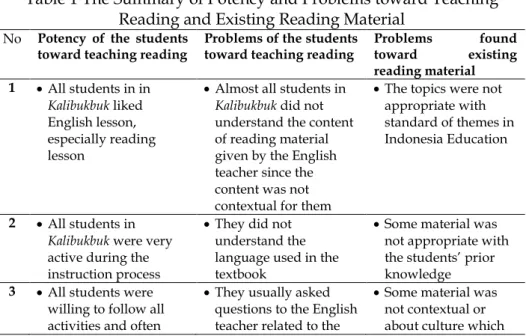
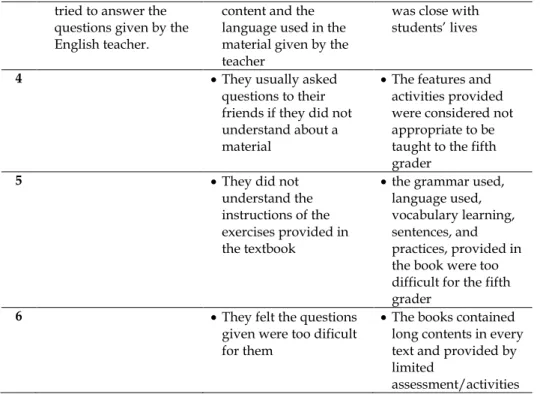
The study was conducted by implementing the need analysis to know the potency and problems faced by the students toward their reading material. The results can be seen as shown in the following table.
Table 1 The Summary of Potency and Problems toward Teaching Reading and Existing Reading Material
No Potency of the students
toward teaching reading Problems of the students toward teaching reading Problems toward existing found reading material 1 All students in in
Kalibukbuk liked English lesson, especially reading lesson
Almost all students in
Kalibukbuk did not understand the content of reading material given by the English teacher since the content was not contextual for them
The topics were not appropriate with standard of themes in Indonesia Education
2 All students in
Kalibukbuk were very active during the instruction process
They did not understand the language used in the textbook
Some material was not appropriate with the students‟ prior knowledge
3 All students were willing to follow all activities and often
They usually asked questions to the English teacher related to the
tried to answer the questions given by the English teacher.
content and the language used in the material given by the teacher
was close with students‟ lives
4 They usually asked
questions to their friends if they did not understand about a material
The features and activities provided were considered not appropriate to be taught to the fifth grader
5 They did not
understand the instructions of the exercises provided in the textbook
the grammar used, language used, vocabulary learning, sentences, and practices, provided in the book were too difficult for the fifth grader
6 They felt the questions
given were too dificult for them
The books contained long contents in every text and provided by limited
assessment/activities
Then, through library research, it was found the characteristics of a good material. Furthermore, the development of reading material was based on the potency of the students as well as the characteristics of good reading material. As the results, the development could be summarized as follow.
Table 2 The Development of Reading Material by Inserting Local Culture
Aspects Development
Content 1) Material developed with interesting colors, text, and images 2) Containing material with interesting topics and illustrations 3) Containing topics about culture and contextual material
4) Using many different text types taken from many different types of sources
5) Containing some features which are slightly above each learner‟s current state of proficiency.
6) Providing some vocabularies related to the topic Language
Used
1) Formality of the language use
2) Easiness of students in understanding the language used 3) Simplification of the texts and instructions
Activities and Assessment
1) Containing the students with choices of focus and activity
communication
4) Including activities which involve the learners in discussing their attitudes and feelings about the course and the materials
5) Including grammar practice
6) Providing the students with some questions related to the topic/texts
The data about the quality of the reading material developed can be seen in the following table.
Table 3. Quality of Reading Material
Quality Domains Measurement Category
Validity 4.25 Good
Practicality 4.6 Excellent
Effectiveness 4.57 Excellent
Discussion
Based on the data gathered in preliminary observation, the potency found during reading lesson was the students‟ confession that they like English. Moreover, they like reading lesson. These confessions were supported by the teacher‟s confession during the interview that the students in Kalibukbuk like to learn English and reading lesson.
The researcher also found that almost all students were very active during the instructional process in every English class. They were willing to answer some questions given by the teacher. They were also very active in every challenging activity given by the teacher.
Although the students stated that they did not understand the instructions of the exercises provided in the textbook, they often tried to answer the questions both from the teacher and the questions in the textbook. This could be seen as potency of the students since this was a good point for every learner to keep trying although they faced some difficulties in learning.
contextual for the students in Kalibukbuk. Even, the materials did not insert local references (culture) in which they were useful for the students.
Talking about something contextual, it has a close relationship with culture and prior knowledge. Winch et al. (2006) stated that “prior knowledge is knowledge that comes from the past experiences with the world and with other texts. What reader knows about a text before they begin to read influences their level of comprehension of that text”. Students need prior knowledge about the topic of the text, the text type, the structure, layout and features, and vocabulary.
According to Pang et al. (2003:11), “having more prior knowledge generally aids comprehension. A reader‟s interest in a subject matter will also influence the level of prior knowledge. All of these participants are important to different degrees, depending on the reading task”.
Looking deeply about students‟ interests in learning to read, prior knowledge will affect their interest and to understand the importance of learning to read. According to Ross et al. (1996), children who do not understand the importance of learning to read will not be motivated to learn. Learning to read takes efforts, and children who see the value of reading in their personal activities will be more likely to work hard than those who fail to see the benefits. It means that teacher should consider about these problems and should be willing to do some efforts to lead the students to be well motivated in learning to read.
If the material on the current textbook provided some materials about Balinese culture, perhaps, those would help to activate the students‟ prior knowledge since those will be contextual for the students. Balinese culture is something that they begin with, learning with, and they live in every day.
from the grammar used, difficulties of words, sentences, and practices provided in the book. There were also some mistakes on grammar use in the textbook. The textbook also did not provide the students with choices of focus and activity. Everything in the textbook seemed had been set up chronologically without giving any choices for the students to follow based on their interests. Sometimes, one activity did not support another one or they stood alone to achieve different indicators. After a text, there was no question at all about the content of the text where sometimes, it was followed by other activities or was continued to another new material which did not have any relationship with the previous text but they were still put under the same theme.
Those were considered as problems since those were different with the criteria proposed by Tomlinson (1998) about good material for ESL and EFL learner. According to Tomlinson (1998:8), material should help learners to feel at ease. Most language learners benefit from feeling at ease and they lose opportunities for language learning when they feel anxious, uncomfortable or tense. The features provided in the current textbook were considered not appropriate to be taught to the fifth grader seen from the grammar used, difficulties of words, sentences, and practices provided in the book, the material could not help the students in teaching reading. It is possible that the students will feel reading is difficult for them since the grammar are confusing, the materials are unusual, and the practices are difficult. These will affect the students to avoid learning English at all since they feel uncomfortable with English as foreign language for them.
adjusted with the fifth graders‟ language proficiencies. The texts were supported by authentic pictures to make easier for the students to understand the contents. The texts were also provided with some exercises such as multiple choices, true/false statements, vocabularies learning, students‟ discussion, students‟ observation, coloring pictures based on the description given, grammar practices, etc.
During the development, researcher designed the material based on the new syllabus constructed. The syllabus consisted of Unit 1 Clothes, Unit 2 Animals, Unit 3 Foods & Beverages, Unit 4 Parts of the Body, and Unit 5 Public Places. In developing every unit, the researcher tried to find out some literature reviews through Library Research as the considerations to develop the activities in every unit. Through this step, the researcher found some appropriate activities to be involved in every unit. Those were Singing a song, Vocabulary Learning, Reading texts, Coloring Activities, Grammar Exercises, and Group Observation.
A product cannot be judged as having excellent quality when it is seen only from the contents involved. But it must be seen from other points such as the validity (Content and construct), practicality, and effectiveness of the product.
To complete the explanation above, expert judgment toward the product had been conducted. Based on the results of expert judgment toward the prototype, the score given from all experts showed that the prototype had Good quality where the mean score of the experts was 4.25 and the criteria of Good category was 3.49 ≤ Sr< 4.485. It means that 3.49 ≤ 4.25< 4.485.
As stated previously, practicality of the prototype was measured from the ability of the teacher in implementing the product in teaching and learning process, students‟ activeness during the implementation, and from the responds of the teachers and the students toward the product. Based on the result, the ability of the teacher in implementing the product was 4.6 where 4.6≥ 4.485. Therefore, the ability of the teacher in implementing the product was categorized as Excellent. Another result found was students‟ activeness during the implementation. Their activeness was 4.57 where 4.57≥ 4.485. It means that the students were very active during the implementation of culture-based reading material. Based on the result gathered, the responds of the teachers and the students toward the prototype were 4.7 and 4.49 where 4.7 ≥ 4.485 and 4.49 ≥ 4.485. Therefore, both the teacher and students liked reading material very much.
The effectiveness of the product was seen from the table 3 which was categorized as excellent. The results above also showed that the activities involved in culture-based reading material were effective in reading lesson. The effectiveness of the product also proves that the cultural contents involved in reading material aid the students‟ comprehensions since the cultural contents are close with the students‟ prior knowledge. According to Pang et al. (2003), having more prior knowledge generally aids comprehension. A reader‟s interest in a subjectmatter will also influence the level of prior knowledge. Therefore, the cultural contents involved in the product had caught the students‟ interests and could also help them in reading.
CONCLUSION
Based on the findings, it can be concluded that the fifth grade students of elementary schools in Buleleng regency had some potency and problems toward the use of existing reading material. Those potency and problems later underlined the development of culture-based reading material where its development was culture-based on the criteria of good material proposed by Tomlinson and it also had high validity and practicality and was proven to be effective to improve the reading competency of the students.
REFERENCES
Badan Standar Nasional Pendidikan. (2006). Pedoman Penyusunan Kurikulum Tingkat Satuan Pendidikan Jenjang Pendidikan Dasar dan Menengah.Jakarta: Depdiknas.
Brooks, Jacqueline G., and Brooks, Martin G. (1993). In Search of Understanding: The Case for Constructivist Classrooms.
Alexandria, VA: Association for Supervision and Curriculum Development.
Louise, Damen. (1987). Culture Learning: The Fifth Dimension in the Language Classroom. USA: Addison-Wesley Publishing Company, Inc.
McCutheon. (2011). Self-Efficacy in Mathematics: Affective, Cognitive, and ConativeDomains of Functioning. Victoria University of Wellington.
Nieven, N., Akker, Jan Van Den, Bannan Brenda, Kelly, Anthony E., & Plomp, Tjeerd. (2007). An Introduction to Educational Design Research. Netherland: Netherland Institute for Curriculum.
Pang, Elizabeth S., Muaka, A., Bernhardt, E. B., and Kamil, M. L. (2003). Teaching Reading. International Academy of Education.
Prasetya, Joko Tri. (2004). Ilmu Budaya Dasar. Jakarta: PT. Rineka Cipta.
Ross, P. E., Burns, P. C., & Roe, B. D. (1996). Teaching Reading in Today‟s Elementary School: Sixth Edition. USA: Houghton Mifflin Company.
Sugiyono. (2008). Metode Penelitian Pendidikan. Pendekatan Kuantitatif, Kualitatif, dan R&D. Bandung: Penerbit Alfabeta.
Sugiyono. (2011). Metode Penelitian Kuantitatif, Kualitatif, dan R&D. Bandung: Penerbit Alfabeta.
Supartono. (2004). Ilmu Budaya Dasar. Jakarta: Ghalia Indonesia.
Tomlinson, Brian. (1998). Materials development in Language Teaching. U. K: Cambridge University Press
Westwood, Peter. (2008). What Teachers Need to Know about Teaching Methods.Australia: Acer Press