FABIOLE, a Speech Database For Forensic Speaker Comparison
Moez Ajili, Jean-Franc¸ois Bonastre, Juliette Kahn, Solange Rossato, Guillaume Bernard
University of Avignon, National Metrology and Testing Laboratory , University of GrenobleAvignon, Paris, Grenoble
{moez.ajili, jean-francois.bonastre}@univ-avignon.fr,{juliette.kahn,guillaume.bernard}@lne.fr, [email protected]
Abstract
A speech database has been collected for use to highlight the importance of “speaker factor” in forensic voice comparison. FABIOLE has been created during theFABIOLE projectfunded by the French Research Agency (ANR) from 2013 to 2016. This corpus consists in more than 3 thousands excerpts spoken by 130 French native male speakers. The speakers are divided into two categories: 30target speakers who everyone has100excerpts and 100“impostors” who everyone has only one excerpt. The data were collected from
10different French radio and television shows where each utterance turns with a minimum duration of30sand has a good speech quality. The data set is mainly used for investigatingspeaker factorin forensic voice comparison and interpreting some unsolved issue such as the relationship between speaker characteristics and system behavior. In this paper, we present FABIOLE database. Then, preliminary experiments are performed to evaluate the effect of the “speaker factor” and the show on a voice comparison system behavior.
Keywords:forensic voice comparison, intra-speaker variability, speaker recognition, FABIOLE database.
1.
Introduction
Speaker recognition (SR) system comparison is made pos-sible by the organization of evaluation campaigns such as those organized by theNational Institute of Standards and Technology (NIST), NIST-SRE. Since the first organiza-tion in 1996, SR systems have achieved significant pro-gresses and have reached low error rate (≈ 1%). The ro-bustness of this kind of evaluation is ensured by using a very large number of voice comparison samples. The num-ber of samples per speaker as well as the characteristics of the speakers themselves, except for their native language and sex, are not taken into account in the evaluation plan. A major challenge for present SR systems is their toler-ance to speaker differences and variations in context. Dif-ferences in speaker characteristics are a major source of inter- and intra-speaker variation which should be taken into consideration. Some research have attempted to deal with some aspects of this variability (Kahn et al., 2010; Doddington et al., 1998) in which authors have shown that speaker recognition performance depends on “speaker fac-tor”. If inter-speaker variability is an important factor, intra-speaker variability is not less important (Kahn et al., 2010). It involves many factors as speaker accent or dialect, speaking style, prosody, emotion and even speaker age. Re-garding the latter, (Matveev, 2013) show a clear trend of degradation of the performance of automatic speaker recog-nition systems in a time interval of up to 4 years. Conse-quently, both inter- and intra-speaker variability should be studied in order to have a reliable assessment. These infor-mation could prove useful in some sensitive applications such as forensic voice comparison.
The availability of good speech databases is crucial for “speaker factor” assessment. SR evaluation is emphasized by numerous evaluation campaigns over the last decades, among which the annual NIST SRE evaluations since 1996. Although, it is the most commonly used framework for the evaluation, it does not allow to have a deep study on the speaker factor impact. We take for example NIST’SRE 2008 where there are a large number of speaker (≈300)
but every speaker disposes only3speech files in average, inter-speaker variability is high but intra-speaker variability can not be studied because of the low number of utterances per speaker. Moreover, even forensic databases (Ramos et al., 2008; van der Vloed et al., 2014; Morrison et al., 2015), -that should pay attention to all important factors- could not bring out the importance of this factor for the same reason (low utterance number per speaker). We take for example a recent forensic database (Morrison et al., 2015) where a large number of speakers (301 male and 231 females) are provided but every one disposes a limited number of speech recordings (only 5 male and 19 female have been registered more than 3 times). Intra-speaker variability is very im-portant and should not be neglected anymore especially for forensic voice comparison. In this context, ”FABIOLE”1,
a large French speech database has been collected for use in order to allow a robust study of the inter- and intra-speaker variability as it is a major issue in scientific research gen-erally and in forensic voice comparison particularly. The corpus consists of more than3100speech utterances of 130 French speakers distributed as follow:30“targets speakers who everyone has100speech recordings and100 “impos-tors” who everyone has only one utterance. Speakers could be politicians, interviewers, chronicles, etc. FABIOLE data were collected from French radio and television shows. The corpus differs from previous corpora in three ways: a) The number of speech file per speaker is high. So, the number of target and non-target trials per speaker would be quite large to have a reliable investigation on intra-speaker variability.
b) Utterance conditions: excerpts are quite long and have a good quality. Each utterance turns with a minimum dura-tion of30s.
c) Presence of speaker with different role and variation in context. This allow to investigate the impact of “speaker’s role” on the strength system behavior.
The aim of this study is not dedicated to decrease the
per-1
formance measure or to improve the recognition strength as much as it is dedicated to focus on the relatively unex-plored issue, dependence of system performance on intrin-sic speaker characteristics, that could be conclusive in some forensic cases.
This paper is structured as follows. Section 2 presents FABIOLE database. Section 3 describes a first example of FABIOLE use. Then, section 4 presents first conclusion and some perspectives.
2.
Database Description
FABIOLE is a new speech database created during the ANR-12-BS03-0011 FABIOLE project. The main goal of this database is to investigate the speaker factor, including intra-speaker variability. That is why we tried to control as much as possible the other factors. First, channel variabil-ity is reduced as all the excerpts come from French radio or television shows. Second, for most pairs, the quality of recordings are high in order to decrease noise effects as our main interest is the speaker factor. Third, all the speech files have a minimum duration of30seconds of speech (short ut-terance is no longer a matter). Then, we selected only male speakers, female are not selected because we does not find 30 women who have enough excerpts with the desired char-acteristics (see subsection 2.1. for the details). Finally, the number of targets and non targets trials per speaker is fixed. A common design technique, used in many databases, such as Switchboard-1, is to record a smaller set of speakers in many sessions and a separate, larger set of speakers in a sin-gle session. With this technique, one can achieve both good sampling of inter-speaker variability in potential impostor speakers, and of intra-speaker variability in client speakers. Fabiole database is based on the same technique as shown in the following subsection 2.1..
Furthermore, the database should not be too far from other French data that can be used as training data to build state-of -art models and enable us to perform automatic transcrip-tions. In the literature the following databases are available:
• ESTER 1 (Galliano et al., 2006): About 100 hours of transcribed data make up the corpus, recorded be-tween 1998 and 2004 from six French speaking radio stations: France Inter, France Info, RFI, RTM, France Culture and Radio Classique. Shows last from 10 min-utes up to 60 minmin-utes. They consist mostly of prepared speech such as news reports, and a little conversational speech (such as interviews).
• ESTER 2 (Galliano et al., 2009) comes to supplement ESTER 1 corpus with about 100 hours of transcribed broadcast news recorded from 1998 to 2004.
• REPERE (Kahn et al., 2012; Galibert and Kahn, 2013) It currently contains 60 hours of video with multi-modal annotations. The systems have to answer the following questions: Who is speaking? Who is present in the video? What names are cited? What names are displayed? The challenge is to combine the various information coming from the speech and the images.
• ETAPE corpus (Gravier et al., 2012) consists of 30 hours of TV and radio broadcasts, selected to cover
a wide variety of topics and speaking styles, empha-sizing spontaneous speech and multiple speaker areas.
FABIOLE contains the same type of records as those con-tained in these databases. The list of speakers of REPERE, ETAPE and ESTER that must be excluded to avoid biasing the system is provided in the package FABIOLE.
2.1.
Speaker information
Regarding inter-speaker variability, it is of course desir-able to include many speakers to achieve a good sam-pling of a speaker population. At the same time, it is of-ten desirable to get a good sampling of individual speak-ers over multiple sessions to study intra-speaker variabil-ity. Note that a single-session database is not useful for estimating the absolute level of performance for a speaker recognition system in a practical application because it does not include intra-speaker variability. Consequently, every speaker should be represented in the database by a large number of speech file recorded in different shows. With only limited resources for database creation, a trade-off be-tween the number of speakers, number of sessions and total cost is often necessary.
The challenge consists in having different speakers with sufficient number of test files each one in order to study inter- and intra-speaker variability. FABIOLE database contains 130 male French native speakers divided into two sets:
• SetT: 30targets speakers who everyone has at least 100speech files. Hence, each speaker can be associ-ated with a large number of targets trials, which is a clear advantage compared to various other databases in which the number of target trials per speaker is very low.
• SetI:100impostors who everyone has one speech file (one session). These test files are used essentially to create non-targets trials. It allows to associate a given impostor recording with all theT speakers, removing one of the frequent bias in NIST-based experiments.
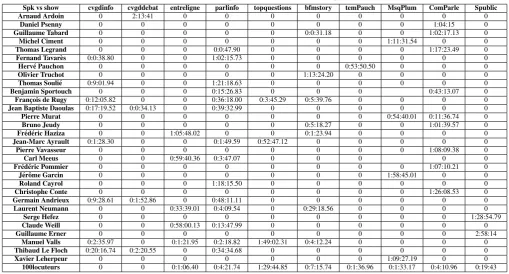
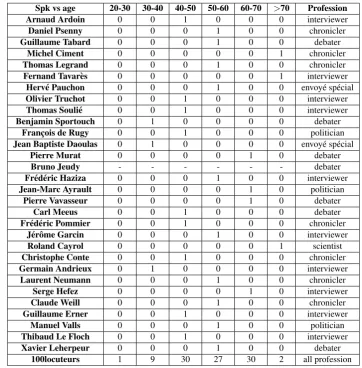
Table 1 presents the amount of data per broadcaster for ev-ery speaker. The 30 speakers are a homogeneous group of native male speakers, speak the same dialect and range in age from 30 to more than 70 years old. Speakers have different professions and their collected speech is totally used for public speaking. We find interviewers asOlivier Truchot, politicians asJean-Marc Ayrault, chroniclers as
Daniel Psenny, debater asBruno Jeudy, etc. Hence, some speakers exhibit a relatively small variation in profession. We can see also that some speakers appear only in one show as Arnaud Ardoin andMichel Cimentwhereas others ap-pear in more than one show asManuels Vallsas shown in Table 1: 13speakers were recorded from 1kind of show, 10speakers from2kinds of shows and7speakers from3-5 kinds of shows. The effective duration of speech in each call is approximately30seconds.
2.2.
Shows and sampling
Table 1: Amount of data per broadcaster for every speaker.
Spk vs show cvgdinfo cvgddebat entreligne parlinfo topquestions bfmstory temPauch MsqPlum ComParle Spublic
Arnaud Ardoin 0 2:13:41 0 0 0 0 0 0 0 0
Daniel Psenny 0 0 0 0 0 0 0 0 1:04:15 0
Guillaume Tabard 0 0 0 0 0 0:0:31.18 0 0 1:02:17.13 0
Michel Ciment 0 0 0 0 0 0 0 1:11:31.54 0 0
Thomas Legrand 0 0 0 0:0:47.90 0 0 0 0 1:17:23.49 0
Fernand Tavar`es 0:0:38.80 0 0 1:02:15.73 0 0 0 0 0 0
Herv´e Pauchon 0 0 0 0 0 0 0:53:50.50 0 0 0
Olivier Truchot 0 0 0 0 0 1:13:24.20 0 0 0 0
Thomas Souli´e 0:9:01.94 0 0 1:21:18.63 0 0 0 0 0 0
Benjamin Sportouch 0 0 0 0:15:26.83 0 0 0 0:43:13.07 0
Franc¸ois de Rugy 0:12:05.82 0 0 0:36:18.00 0:3:45.29 0:5:39.76 0 0 0 0
Jean Baptiste Daoulas 0:17:19.52 0:0:34.13 0 0:39:32.99 0 0 0 0 0 0
Pierre Murat 0 0 0 0 0 0 0 0:54:40.01 0:11:36.74 0
Bruno Jeudy 0 0 0 0 0 0:5:18.27 0 0 1:01:39.57 0
Fr´ed´eric Haziza 0 0 1:05:48.02 0 0 0:1:23.94 0 0 0 0
Jean-Marc Ayrault 0:1:28.30 0 0 0:1:49.59 0:52:47.12 0 0 0 0 0
Pierre Vavasseur 0 0 0 0 0 0 0 0 1:08:09.38 0
Carl Meeus 0 0 0:59:40.36 0:3:47.07 0 0 0 0 0
Fr´ed´eric Pommier 0 0 0 0 0 0 0 0 1:07:10.21 0
J´erˆome Garcin 0 0 0 0 0 0 0 1:58:45.01 0 0
Roland Cayrol 0 0 0 1:18:15.50 0 0 0 0 0 0
Christophe Conte 0 0 0 0 0 0 0 0 1:26:08.53 0
Germain Andrieux 0:9:28.61 0:1:52.86 0 0:48:11.11 0 0 0 0 0 0
Laurent Neumann 0 0 0:33:39.01 0:4:09.54 0 0:29:18.56 0 0 0 0
Serge Hefez 0 0 0 0 0 0 0 0 0 1:28:54.79
Claude Weill 0 0 0:58:00.13 0:13:47.99 0 0 0 0 0 0
Guillaume Erner 0 0 0 0 0 0 0 0 0 2:58:14
Manuel Valls 0:2:35.97 0 0:1:21.95 0:2:18.82 1:49:02.31 0:4:12.24 0 0 0 0
Thibaud Le Floch 0:20:16.74 0:2:20.55 0 0:34:34.68 0 0 0 0 0 0
Xavier Leherpeur 0 0 0 0 0 0 0 1:09:27.19 0 0
100locuteurs 0 0 0:1:06.40 0:4:21.74 1:29:44.85 0:7:15.74 0:1:36.96 0:1:33.17 0:4:10.96 0:19:43
speech recordings from television and radio sequences of 10 programs (same shows used in databases mentioned above) recently recorded (from 2013 to 2014). Excerpts come from:
temPauchon cvgdinfo bfmStory cvgddebat entreligne topQuestions ServPublic masquePlume parlinfo comonousparle
Figure 1: Proportion of shows contribution in FABIOLE database ranged from the lowest (Blue) to the highest (Or-ange) contribution.
• Debates such as “Ca vous regarde - Le d´ebat” ( cvgdde-bat), “Entre les Lignes” (entreligne), “Le masque et la plume” (MsqPlum).
• Chronic as “Service public” (Spublic), “Comme on nous parle” (ComParle).
• Interviews as “Un Temps de Pauchon” (temPauch).
• Parliamentary jousting as “Top Questions” ( topques-tions).
• News such as “BFM Story” (bfmstory), ”LCP Info” (parlinfo), ”Ca vous regarde-l’Info (cvgdinfo)”.
This variety can involve different speaking style and thereby it allow to study its effect on the system behavior. The amount of data per broadcaster is showed in Fig 1. We can see that excerpts come from 10different shows with high difference of contribution. For example, Comme on nous parle is 22.5% of Fabiole while temps de Pauchon
is only 2.2% from all the database. We are aware of the limits of this distribution in terms of analysis but it is very difficult to find an equal distribution of speakers and shows since speakers tend to always address the same show.
2.3.
Others parameters: Age, Speaking style and
profession
[image:3.595.55.286.452.626.2]As our main interest are speakers of setT, we present in Table 2 detailed information related to their age and profes-sion while for speakers of setIinformation is given glob-ally. Table 2 shows that the majority of target speakers are 40to60years old and the most of them are interviewers (10 Spks), chroniclers(7 Spks) and debaters(7Spks). Note that for some speakers asBruno Jeudy, age informa-tion is missing.
2.4.
Data transcription
Table 2: Speakers ages and professions.
Spk vs age 20-30 30-40 40-50 50-60 60-70 >70 Profession
Arnaud Ardoin 0 0 1 0 0 0 interviewer
Daniel Psenny 0 0 0 1 0 0 chronicler
Guillaume Tabard 0 0 0 1 0 0 debater
Michel Ciment 0 0 0 0 0 1 chronicler
Thomas Legrand 0 0 0 1 0 0 chronicler
Fernand Tavar`es 0 0 0 0 0 1 interviewer
Herv´e Pauchon 0 0 0 1 0 0 envoy´e sp´ecial
Olivier Truchot 0 0 1 0 0 0 interviewer
Thomas Souli´e 0 0 1 0 0 0 interviewer
Benjamin Sportouch 0 1 0 0 0 0 debater
Franc¸ois de Rugy 0 0 1 0 0 0 politician
Jean Baptiste Daoulas 0 1 0 0 0 0 envoy´e sp´ecial
Pierre Murat 0 0 0 0 1 0 debater
Bruno Jeudy - - - debater
Fr´ed´eric Haziza 0 0 0 1 0 0 interviewer
Jean-Marc Ayrault 0 0 0 0 1 0 politician
Pierre Vavasseur 0 0 0 0 1 0 debater
Carl Meeus 0 0 1 0 0 0 debater
Fr´ed´eric Pommier 0 0 1 0 0 0 chronicler
J´erˆome Garcin 0 0 0 1 0 0 interviewer
Roland Cayrol 0 0 0 0 0 1 scientist
Christophe Conte 0 0 1 0 0 0 chronicler
Germain Andrieux 0 1 0 0 0 0 interviewer
Laurent Neumann 0 0 0 1 0 0 chronicler
Serge Hefez 0 0 0 0 1 0 interviewer
Claude Weill 0 0 0 1 0 0 chronicler
Guillaume Erner 0 0 1 0 0 0 interviewer
Manuel Valls 0 0 0 1 0 0 politician
Thibaud Le Floch 0 0 1 0 0 0 interviewer
Xavier Leherpeur 0 0 0 1 0 0 debater
100locuteurs 1 9 30 27 30 2 all profession
are transcribed thanks to Speeral, LIA automatic transcrip-tion system (Linares et al., 2007).
This system used for the transcription of REPERE devel-opment set (contains speech recordings close acoustically to FABIOLE excerpts) reaches an overallWord Error Rate
(WER) of29%(Bigot et al., 2013). These highW ERare mainly due to speech disfluencies and to adverse acoustic environments (for example, calls from noisy streets with mobile phones).
Transcriptions are provided in LIA transcription encoding and follow common guidelines of orthographic transcrip-tion. From the transcription, task specific information can be exported into appropriate formats (stm, mdtm, etc). We show in Fig 2, an example of a transcription of1 speech recording.
The transcription does not have a speaker turn because ev-ery file correspond entirely to a single speaker. The tran-scription file includes information on the name and gender of the speaker, if he is a native speaker or not, the speech type, the channel if it is a telephone vs. studio (In our case, all excerpts are from studio). The transcription file is fur-ther divided into speech segments.
The transcription includes punctuation and is case-sensitive. In particular, the transcription indicates disflu-encies such as the word “euh” in French.
Figure 2:An example of a transcription of one utterance.
3.
Examples of FABIOLE use
[image:4.595.112.475.89.458.2]3.1.
BASELINE Voice comparison System
In all experiments, we use as baseline the LIA SpkDet system presented in (Matrouf et al., 2007). This system is developed using the ALIZE/SpkDet open-source toolkit (Bonastre et al., 2005) (Bonastre et al., 2008) (Larcher et al., 2013). It uses I-vector approach (Dehak et al., 2011). Acoustic features are composed of 19 LFCC parameters (cepstral parameters using a linear scale) issued from a fre-quency window restricted to 300-3400 Hz2, its derivatives,
and11second order derivatives. A (file-based) normaliza-tion process is applied, so that the distribunormaliza-tion of each co-efficient is 0-mean and 1-variance for a given utterance. The Universal Background Model(U BM) has512 com-ponents and is trained by EM/ML. TheU BM and the total variability matrix, T, are trained on Ester 1&2, REPERE and ETAPE databases on male speakers that do not appear in FABIOLE database. They are estimated using7,690 ses-sions from2,906speakers whereas the inter-session matrix W is estimated on a subset (selected by keeping only the speakers who have pronounced at least two sessions) using 3,798 sessions from672speakers. The dimension of the I-Vectors in the total factor space is400.
For scoring, PLDA scoring model (Prince and Elder, 2007) is applied. The speaker verification score given two I-vectorswAandwBis the likelihood ratio described by:
score=logP(wA, wB|Hp) P(wA, wB|Hd)
(1)
where the hypothesisHpstates that inputswAandwBare from the same speaker and the hypothesisHd states they are from different speakers.
3.2.
Experimental protocol
All the experiments presented in this paper are performed based upon FABIOLE database. FABIOLE proposes 150,000targets trials and about5millionsnon-targets tri-als. In this paper, we use only a subset of comparisons trials. We adopt the following protocol. We use all the tar-get trials and only300,000non-targets trials. The selection will be detailed below. The trials are divided into30 sub-sets, one for each T speaker (the speakers of the set T). So, for one subset, all the voice comparison pairs are com-posed with at least one recording pronounced by the corre-spondingTspeaker. It gives for a given subset14950pairs of recordings distributed as follows: 4950 same-speaker pairs and10,000different-speakers pairs. The target pairs were obtained from all the combinations of the100 record-ings available for the correspondingTspeaker (C2
100targets
pairs). Whereas, non-targets pairs are obtained by pairing each of theT speaker’s recording (100are available) with each of the100speakers of theIset, forming consequently (100×100 = 10000)non-targets pairs.
As we mentioned before, this database will be used to study the inter- and intra-speaker variability. A first step forward is to focus on an eventual link between speaker and sys-tem performance. To do so, we compute the log-likelihood-ratio cost(Cllr) independently on each of the30trials sub-sets. We selected theCllr -largely used in forensic voice
2
we select only a restricted frequency band because there are some utterance taken by telephone.
comparison- because it is a loss in terms of likelihood ratio discrimination power which does not require threshold and hard decisions likeequal error rate(EER) (Br¨ummer and Du Preez, 2006; Castro, 2007; Gonzalez-Rodriguez and Ramos, 2007; Morrison, 2009). Cllr has the meaning of a cost or a loss: lower is theCllr, better is the performance. We use the calibratedCllr and the minimum value of the Cllr (denoted respectivelyCllrcalandCllrmin). Cllrcalinvolves calibration loss while Cllrmin contains only discrimination loss. We can judge the quality of the calibrationQcal(i.e., the mapping from score to log-likelihood-ratio which is ac-tually present in the detector) by:
Qcal=Cllrcal−C min
llr . (2)
For comparison, False Rejectrate (F R) andFalse Alarm
rate (F A) are also computed using a threshold estimated onto the whole test set and tuned to correspond at the global EER.
Note that parameters of calibration are estimated based on the pooled conditions (all the subset are put together) using FoCal Toolkit (Brummer, 2007).
3.3.
Speaker factor
The globalCmin
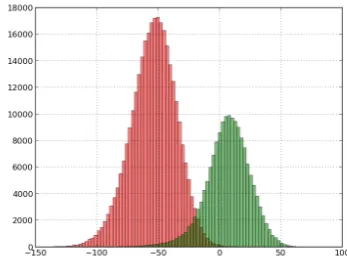
[image:5.595.330.504.435.566.2]llr (respectivelyCllrcal)(computed using all the trial subsets put together) is equal to 0.1765bits (re-spectively0.1867bits) and the corresponding globalEER is4.52%. Fig 3 presents the corresponding target and non-target score distributions.
Figure 3: Target and non-target score distributions for the pooled condition (all the comparison tests taken together.
This global representation is close to performance estima-tion approach of the main evaluaestima-tion campaigns (like the NIST’s ones). It hides the impact of the inter-speaker dif-ferences due to the speaker factor.
In order to highlight this aspect, in Fig 4, we presentCmin llr estimated individually for eachTspeaker subset. The sub-sets are ranked from the lowest to the highest values of Cllrmin.F R%andF A%are also provided.
Figure 4:Cmin
llr ×100,Cllrcal×100,F A%,F R%for all speakers of setT.
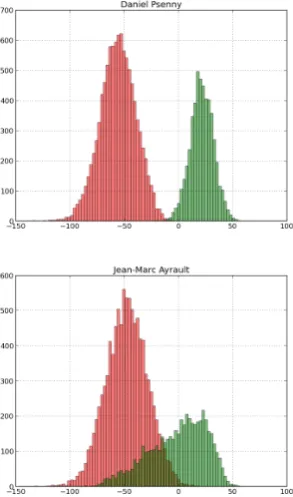
Figure 5: Examples of target and non-target score distribu-tions for two speaker who imply different SR behavior.
The large difference between the two set of distributions highlight the importance of speaker factor: even if the trial subsets are mainly similar (number of recordings, duration, signal quality, channel variability, etc.) and if the impostor examples (in terms of speakers as well as in recordings) are strictly identical for all the subsets, a large performance variability is still present between the test sets. As the main difference between the sets is theT target speaker, it seems to indicate that speakers do not behave the same way.
To investigate more deeply the speaker effect, we come back to Fig 4: 3 speakers show a Cllrmin higher than0.4 bits, when16speakers present aCmin
llr lower than0.09bits while the remaining speakers present a medium cost close
to the global one.
3.4.
Show impact
[image:6.595.96.243.312.561.2]To study the effect of the show on the performance, trials where the two recordings come from the same show are put together. We obtain at the end 10subsets corresponding to our different shows. Then, Cllrcal, Cllrmin andEERare calculated for each subset. Results are presented in Table 3.
Table 3: Performance per show. NT andNN are respec-tively numbers of target and non target trials.
Emiss. vs perf. Cllrcal C min
llr EER NT NN
ServPublic 0.1136 0.0924 2.51 18811 5607
temPauchon 0.2026 0.0857 2.5 4950 200
ComonNouParle 0.0986 0.0904 2.42 36616 4704
masqPlume 0.3 0.207 6.32 19549 790
bfmStory 0.1531 0.0983 2.54 5933 1848
cvgddebat 0.0056 - - 4959 0
cvgdinfo 0.67 - - 1413 0
entreligne 0.1322 0.089 2.9 13721 654
parlinfo 0.2269 0.209 5.82 24762 3822
topquestions 0.466 0.36 11.2 8214 9400
C¸ a vous regarde le d´ebatandC¸ a vous regarde l’infoare ex-cluded from the analysis because of the low number of non-target comparisons. Table 3 shows that SR behavior is in-fluenced by the show. The “show’s performance” presents a large variability: Cmin
llr is varying from 0.085 bits for
Temps de Pauchonto0.36bitsforTop Questions.
4.
Conclusions and perspectives
In this paper, we present FABIOLE corpus created dur-ing the FABIOLE project funded by the French Research Agency (ANR). This corpus would help to increase signif-icantly the work dedicated to highlight the importance of speaker factor in forensic process. [image:6.595.306.553.455.583.2]from10different shows including different speaking style such as debates, political speech, news, etc.
Speakers have a large variability in profession. Indeed, FABIOLE includes interviewers, politicians, chroniclers, debaters, etc. FABIOLE also presents data from speakers with large age differences (from30to more than70years old).
To highlight the importance of “speaker factor”, we pre-sented preliminary results that shows the variation inCllr according to the30target speaker. We showed that SR sys-tem presents different behavior: high discrimination power for the majority of speakers (lowCllr), while for3 speak-ers its discrimination power degrades (high Cllr). More-over, radio and TV shows influence the SR system behav-ior: Trials where both voice recordings came fromComme on nous parlehave a lowCllr (0.09 bits) while those from
Top Questionspresent a highCllr(0.46 bits).
It is our hope and belief that this database will be a useful speech resource and contribute to the advances of state-of-the-art in forensic speaker comparison long after the end of the project.
5.
Acknowledgements
The research reported here was supported by ANR-12-BS03-0011 FABIOLE project. Authors thank all thartici-pants in this Working Group in particular Olivier Galibert.
6.
Bibliography
Ajili, M., Bonastre, J.-F., Rossato, S., and Kahn, J. (2016). Inter-speaker variability in forensic voice comparison:a preliminary evaluation. InAcoustics, Speech and Signal Processing (ICASSP), 2016 IEEE International Confer-ence on. IEEE.
Bigot, B., Senay, G., Linares, G., Fredouille, C., and Du-four, R. (2013). Combining acoustic name spotting and continuous context models to improve spoken person name recognition in speech. InINTERSPEECH, pages 2539–2543.
Bonastre, J.-F., Wils, F., and Meignier, S. (2005). Alize, a free toolkit for speaker recognition. In ICASSP (1), pages 737–740.
Bonastre, J.-F., Scheffer, N., Matrouf, D., Fredouille, C., Larcher, A., Preti, A., Pouchoulin, G., Evans, N. W., Fauve, B. G., and Mason, J. S. (2008). Alize/spkdet: a state-of-the-art open source software for speaker recog-nition. InOdyssey, page 20.
Br¨ummer, N. and Du Preez, J. (2006). Application-independent evaluation of speaker detection. Computer Speech & Language, 20(2):230–275.
Brummer, N. (2007). Focal toolkit. Available in http://www. dsp. sun. ac. za/nbrummer/focal.
Castro, D. R. (2007). Forensic evaluation of the evidence using automatic speaker recognition systems. Ph.D. the-sis, Universidad aut´onoma de Madrid.
Dehak, N., Kenny, P., Dehak, R., Dumouchel, P., and Ouel-let, P. (2011). Front-end factor analysis for speaker veri-fication.Audio, Speech, and Language Processing, IEEE Transactions on, 19(4):788–798.
Doddington, G., Liggett, W., Martin, A., Przybocki, M., and Reynolds, D. (1998). Sheep, goats, lambs and
wolves: A statistical analysis of speaker performance in the nist 1998 speaker recognition evaluation. Technical report, DTIC Document.
Galibert, O. and Kahn, J. (2013). The first official repere evaluation. InSLAM@ INTERSPEECH, pages 43–48. Galliano, S., Geoffrois, E., Gravier, G., Bonastre, J.-F.,
Mostefa, D., and Choukri, K. (2006). Corpus descrip-tion of the ester evaluadescrip-tion campaign for the rich tran-scription of french broadcast news. In Proceedings of LREC, volume 6, pages 315–320.
Galliano, S., Gravier, G., and Chaubard, L. (2009). The ester 2 evaluation campaign for the rich transcription of french radio broadcasts. InInterspeech, volume 9, pages 2583–2586.
Gonzalez-Rodriguez, J. and Ramos, D. (2007). Forensic automatic speaker classification in the “coming paradigm shift”. In Speaker Classification I, pages 205–217. Springer.
Gravier, G., Adda, G., Paulson, N., Carr´e, M., Giraudel, A., and Galibert, O. (2012). The etape corpus for the evalu-ation of speech-based tv content processing in the french language. InLREC-Eighth international conference on Language Resources and Evaluation, page na.
Kahn, J., Audibert, N., Rossato, S., and Bonastre, J.-F. (2010). Intra-speaker variability effects on speaker veri-fication performance. InOdyssey, page 21.
Kahn, J., Galibert, O., Quintard, L., Carr´e, M., Giraudel, A., and Joly, P. (2012). A presentation of the repere chal-lenge. InContent-Based Multimedia Indexing (CBMI), 2012 10th International Workshop on, pages 1–6. IEEE. Larcher, A., Bonastre, J.-F., Fauve, B. G., Lee, K.-A., L´evy, C., Li, H., Mason, J. S., and Parfait, J.-Y. (2013). Al-ize 3.0-open source toolkit for state-of-the-art speaker recognition. InINTERSPEECH, pages 2768–2772. Linares, G., Noc´era, P., Massonie, D., and Matrouf, D.
(2007). The lia speech recognition system: from 10xrt to 1xrt. InText, Speech and Dialogue, pages 302–308. Springer.
Matrouf, D., Scheffer, N., Fauve, B. G., and Bonastre, J.-F. (2007). A straightforward and efficient implementation of the factor analysis model for speaker verification. In
INTERSPEECH, pages 1242–1245.
Matveev, Y. (2013). The problem of voice template ag-ing in speaker recognition systems. InSpeech and Com-puter, pages 345–353. Springer.
Morrison, G., Zhang, C., Enzinger, E., Ochoa, F., Bleach, D., Johnson, M., Folkes, B., De Souza, S., Cummins, N., and Chow, D. (2015). Forensic database of voice recordings of 500+ australian english speakers. URL:) http://databases. forensic-voice-comparison. net. Morrison, G. S. (2009). Forensic voice comparison and the
paradigm shift. Science & Justice, 49(4):298–308. Prince, S. J. and Elder, J. H. (2007). Probabilistic linear
discriminant analysis for inferences about identity. In
Computer Vision, 2007. ICCV 2007. IEEE 11th Interna-tional Conference on, pages 1–8. IEEE.
ahumada iii: a public real-casework database in spanish. InInterspeech. International Speech Communication As-sociation.