Positional Information in Vertebrate Limb Development
An interview with Lewis Wolpert
0214-6282/02/$25.00 © UBC Press
Printed in Spain
CHERYLL TICKLE*
Department of Anatomy and Developmental Biology, University College London, U.K.
Lewis Wolpert is internationally renowned for having for-mulated the concepts of Positional Information. His ideas have had a very substantial influence on developmental biology over the last 30 years or so and have been widely applied (even to flag design!). In 1965, Lewis Wolpert began to formulate the concepts of Positional Information, when he became Professor of the Department of Biology at the Middlesex Hospital Medical School. He soon started applying these concepts to development of the limb with Amata Hornbruch. Denis Summerbell made the limb the subject of his PhD and Julian Lewis joined the group. In 1972, I obtained a Medical Research Council fellowship and started to work with Lewis. Later on in the 70’s, several students including John McLachlan, Jim Smith, Geoff Shellswell and Nigel Holder worked on different aspects of limb development; Anthony Smith (another PhD student) and later Jonathan Slack studied limb regeneration. Anne Crawley, and for shorter periods Margaret Goodman, Margaret Bateman and Muriel Sampford provided technical support.
Since vertebrate limb development is one of the particular models to which Lewis very successfully applied his ideas, it seemed appropriate to interview Lewis once again for this Limb Development Special Issue, following the interview by Jim Smith for a former Special Iissue of The International Journal of Develop-mental Biology entitled "DevelopDevelop-mental Biology in Britain" (Smith, 2000). Here as well as reminiscing about the past, Lewis gives his assessment of the current understanding of limb development and
looks forward to the future; answering questions such as, is limb development essentially solved?
Lewis, you are associated in most biologists’ minds with the concepts of positional information. How were you first alerted to the limb as being a good model in which you could test your ideas?
It was really because we had been working on Hydra at Kings which was a nice model (Hicklin, et al., 1969, Webster and Wolpert, 1966). Then, when I went to the Middlesex Hospital Medical School, it didn’t seem to be quite right, in a medical school, to be putting so much emphasis on Hydra, so I looked around for another model. The limb looked quite interesting because, well in many ways, it is like a hydra and looked a nice system. I knew nothing about the limb but I was looking for a vertebrate system to look at pattern formation. I think the real point was that the limb had a very well- defined clear pattern along two axes and that made it seem attractive.
Was 1969 (Wolpert, 1969) the first time that you ever wrote about the limb?
Oh yes definitely. I suppose I had already begun to think about the limb and when I was thinking about positional information, I read some of the literature. The idea that the polarising region was really a signalling region and was setting up positional information along the anterior-posterior axis was already in my mind.
A
B
C
We should come back to antero-posterior patterning in aminute because that’s probably the best example of a gradient model in the limb. But, in the original paper in 1969, you suggested a gradient model for proximo-distal patterning too. That soon changed to a slightly different kind of model which became known as the progress zone model (Summerbell, et al., 1973). So I wondered how you, Denis [Summerbell] and Julian [Lewis] came upon the idea of the progress zone and how that evolved from your earlier ideas? Well I remember the discussions we had in trying to think up how you could set up a gradient along the proximo-distal axis. We knew that something peculiar was involved with the apical ridge. There was this zone under the ridge, which we called, at one stage, the magic zone - we knew there was something magical about that region. It was one of those things about which the discussion went on and on. Then the idea of time, the idea of how long cells spent in the zone emerged. Denis then did all those experiments with grafts to show that it didn’t terribly matter, that
So after that then, the gradient model was kept for the anterior-posterior axis. Yes.
I remember that an important issue that arose about polarising region signalling was whether it was short-range or long-range.
Absolutely.
What do you think of this now? There was a time when this issue was discussed at length (Iten and Murphy, 1980, Iten et al., 1981, Wolpert and Hornbruch, 1981). I think it is still, as far as I can see, a bit unresolved. I think that one of the real difficulties with vertebrate morphogens or even in the insect, has been to establish is there really a gradient? What is the gradent? How does the gradient get set up? And so forth. This applies even to John Gurdon’s experiments with activin in Xenopus which is probably one of the best examples experimentally (Gurdon et al., 1994). And if you read the recent papers on dpp in the insect wing, it's complicated. There’s endocytosis…(Entchev, et al., 2000). Michel and I have published a paper saying how difficult it is not to make things saturated (Kerszberg and Wolpert, 1998). Its hard with external diffusion not to saturate the receptors but still get out the gradient. Well it get’s quite technical and, it’s not easy.
I was going to ask you about your recent work with Michel [Kerszberg]. The fact that you are still writing about gradients seems to suggest that there is quite a lot of cell biology still to be discovered.
I think the basic cell biology of gradients is totally unsolved. I know it's embarrassing but that’s the way it is.
I wanted to move on from the early days and formulating models to what happened later on when molecules began to be
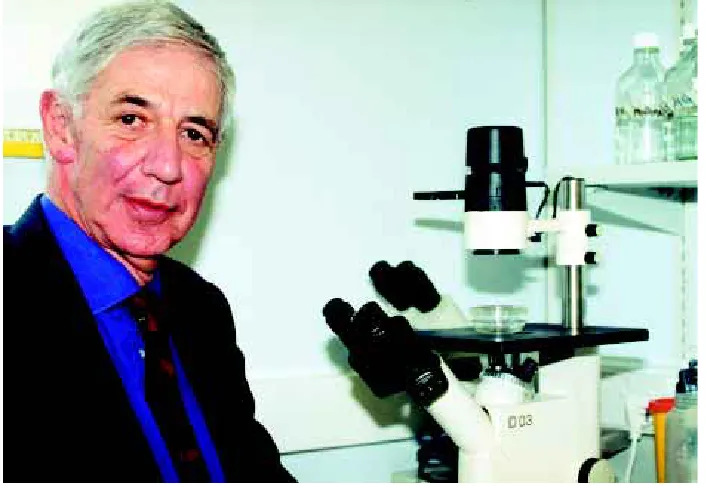
Lewis Wolpert photographed in 1998 in his laboratory at University College London.
Fig. 1. (A) Whole mount of a 10 day embryonic chick wing showing a well-defined skeletal pattern along two axes (see B). Digits are numbered 2, 3, 4 from anterior to posterior. (B) An illustration of the main two axes: the Proximal -Distal axis is the long axis of the wing running from shoulder to digits; the Anterior-Posterior axis runs at right angles to the Proximal-Distal axis across the limb i.e.from digit 2 to digit 4. (C) An early
many, many downstream targets and I think the great intellectual challenge for the future is not only how to investigate it but how to think about it. But its tricky, I don’t know if you agree – it’s really hard and I think while, yes, you get all these interesting phenotypes when you knock out Hox genes, some of which make sense - in terms of mechanism, we understand nothing. I am not trying to be negative, but it's true in the insect too, it's not just the limb.
Another basic issue about the limb that you recognised early on, which is not to do with Hox genes but another set of regulatory genes, which are probably going to be equally complicated, are those to do with the differences between wing and leg. I always remember that you were interested in that as a problem that could be addressed molecularly. And that of course had nothing to do with me but I think that the recent work is wonderful.
Limb development at the Middlesex Hospital Medical School, December 1976.
Photograph taken on the roof outside the 6th floor laboratories,
the Windeyer Building, The Middlesex Hospital Medical School. From left to right: John McLachlan, Julian Lewis, Anne Crawley, Margaret Bateman, Nigel Holder, Geoff Shellswell, Jim Smith, Margaret Bateman (almost hidden), Muriel Sampford. Lulwah Al-Ghaith, Cheryll Tickle, Lewis Wolpert, Julia Hunt.Slide had been forgotten and was found during sort-out in 1998. Printing and restoration by Chris Sym.
discovered and ask you how important this has been. Do you think that the fact that we know that the polarising region expresses sonic hedgehog and bone morphogenetic proteins…..?
Fundamental. I think that it was terribly, terribly important to actually identify some of these signals. I think this has been an absolutely major advance. It’s all very well having models but the only hope of actually finding out what the real cell biology is, is to know what the signalling molecules are. So I regard that as an absolutely major advance. I think FGF’s and Sonic Hedgehog have really transformed the way we think about the limb - and also of course the Hox genes.
Yes, I was going ask about Hox genes because I feel that the Hox genes were the first important genes to be identified in the limb. Yes they were and if you remember we were wildly excited about that.
"Positional Information vs. Compartmentalization". Lewis Wolpert with Antonio García-Bellido in 1977.
I remember even before the work with Denis (Duboule) (Izpisua-Belmonte, et al., 1991) that you recognised immediately that they could be a really important key (Lewis –terribly important) to understanding the limb. How do you think this has stood up to the test of time?
But you recognised that particular problem?
I think basically because the signals are the same in wing and leg, it’s really how you interpret it and I think the discovery of the Tbx genes is just wonderful (Gibson-Brown, 1996, Logan and Tabin, 1999, Takeuchi, et al., 1999, Rodriguez-Esteban, et al., 1999).
Having discovered theTbx genes tells us something about how wing and leg become different and this is encouraging but it still doesn’t explain it all.
It’s just like antennapaedia. Yes, you change one gene, you turn an antenna into a leg but what are the downstream targets and that’s exactly the same. It will come but it’s tough and there maybe many, many downstream targets.
I suppose what we are talking about is the general question of what you originally called “interpretation”? (with respect to positional information).
Yes it is.
And your ideas always placed a big burden on “interpretation”! Yes it was my way out.
I think the Tbx genes give you an “in” into interpretation in that you can say that if one or other of these genes are expressed something different happens?
It’s changing the interpretation.
You’ve written some things about the importance of discovering that signalling mechanisms are common between chick wing and Drosophila wing. Have you been surprised at the extent of conservation of mechanisms?
that would be terrific. As thus far, from the point of view of surgeons, nothing that has happened in limb research has got the slightest medical benefit yet.
I was going to go on to regeneration because in your last interview for The International Journal of Development and Biology (Wolpert, 2000), you seemed to end up by suggesting that it’s limb regeneration where all the action is now! I was going to ask you, do you really think that limb development is solved1?
I think the general principles of limb development have stood up quite well. But there is still a lot of work to do on the molecular details, I think I underestimated how complicated the downstream targeting of the Hox genes would be, for example, and how little we know about it. I didn’t want to imply that limb regeneration was the solution. The advantage of limb regeneration is that if you wanted to look for the molecular basis of positional value in the amphibian limb, we know the roots, because the limb regenerates and keeps it. It would be my guess that positional value is easier to investigate there.
So to go back to limb development then – do you think it is a question of just filling in the details?
I think I have underestimated the complexity of the molecular details. And I am ashamed to say that, even after all this time, if you really ask how the gradient is set up along the anterior-posterior axis, it is still not clear. And then I think the downstream targets of the Hox genes are still complicated - there is an enormous amount of work still to be done, yes.
I suppose the other question is how much detail does one need to know?
I wish I knew the answer to that. I think you need to know enough about details to feel sort of comfortable and that you understand what’s going on and certainly we are not at that stage yet.
Note 1: This interview was conducted early in 2001; given the rekindled interest and
debate about the progress zone model, the answer to this question now would be an even more emphatic “NO”! (see Dudley et al., 2002; Sun et al., 2002; Tickle and Wolpert, 2002)
and things like that. And I thought, if evolution had taken the trouble to do something as important as development, it would have done the same thing. I actually think I say it in the '69 paper, so although I am delighted, I am not surprised, I expected it.
One of your well known phrases about the limb, especially one that you used to use in grant applications, was that the development of the limb is important in its own right. So how much do you think the work on chick limb development has actually impinged on medicine?
I would say hardly at all, I am sorry to say. I don’t think we still really understand thalidomide properly. We have models in terms of the progress zone and it makes sense (Wolpert, et al., 1979, Tabin, 1998). I think that in terms of congenital malformations, basic research on limb development is really quite important in relation to limb regeneration. You know, in the long run if one could understand limb regeneration in amphibians and do something about it for mammals,
Do you think we ever will be?
It is something that I give a great deal of thought to at the moment and what Michel [Kerszberg] and I are thinking about is how is one going to handle all the details. Let´s say there are a hundred downstream targets of the Hox genes; how will one understand what their effects are on limb morphology? I think it’s something that one has to think about really quite deeply.
KEY WORDS:
positional information, limb development, Hox genes,
positional value
References
DUDLEY, A.T., ROS, M.A. and TABIN, C.J. (2002). A re-examination of proximodistal patterning during vertebrate limb development. Nature 418: 539-544.
ENTCHEV, E., SCHWABEDISSEN, A. AND GONZALEZ-GAITAN, M. (2000) Gradient formation of the TGF-beta homolog Dpp. Cell 103: 981-991.
GIBSON-BROWN, J. J., AGULNIK, S. I., CHAPMAN, D. L., ALEXIOU, M., GARVEY, N., SILVER, L. M., PAPAIOANNOU, V. E. (1996) Evidence of a role for T-box genes in the evolution of limb morphogenesis and the specification of forelimb/hindlimb identity. Mech. Dev. 56: 93-101.
GURDON, J. B., HARGER, P., MITCHELL, A. AND LEMAIRE, P. (1994) Activin signalling and response to a morphogen gradient. Nature 371: 487-92. HICKLIN J., HORNBRUCH, A. AND WOLPERT, L. (1969) Inhibition of hypostome
formation and polarity re-versal in Hydra. Nature 221: 1268-71.
ITEN, L. E. AND MURPHY, D. J. (1980) Pattern regulation in the embryonic chick limb: supernumerary limb formation with anterior (non-ZPA) limb bud tissue. Dev. Biol. 75: 373-85.
ITEN, L. E., MURPHY, D. J. AND JAVOIS, L. C. (1981) Wing buds with three ZPAs. J. Exp. Zool. 215: 103-6.
IZPISUA-BELMONTE, J. C., TICKLE, C., DOLLE, P., WOLPERT, L. AND DUBOULE, D. (1991) Expression of the homeobox Hox-4 genes and the specification of position in chick wing development. Nature 350: 585-9.
KERSZBERG, M. AND WOLPERT, L. (1998) Mechanisms for positional signalling by morphogen transport: a theoretical study. J. Theor. Biol. 191: 103-114. LOGAN, M. AND TABIN, C. J. (1999) Role of Pitx1 upstream of Tbx4 in specification
of hindlimb identity. Science 283: 1736-9.
RODRIGUEZ-ESTEBAN, C., TSUKUI, T., YONEI, S., MAGALLON, J., TAMURA, K. AND IZPISUA BELMONTE, J. C. (1999) The T-box genes Tbx4 and Tbx5 regulate limb outgrowth and identity. Nature 398: 814-8.
SMITH, J.C. (2000) From Engineering to Positional Information to Public Under-standing. Int. J. Dev. Biol. 44: 85-91.
SUMMERBELL, D., LEWIS, J. H. and WOLPERT, L. (1973) Positional information in chick limb morphogenesis. Nature 244: 492 - 496.
SUN, X., MARIANI, F.V. and MARTIN, G.R. (2002). Functions of FGF signalling from the apical ectodermal ridge in limb development. Nature 418: 501-508. TABIN, C. (1998) A developmental model for thalidomide defects. Nature 396:
322-323.
TAKEUCHI, J. K., KOSHIBA-TAKEUCHI, K., MATSUMOTO, K., VOGEL-HOPKER, A., NAITOH-MATSUO, M., OGURA, K., TAKAHASHI, N., YASUDA, K. AND OGURA, T. (1999) Tbx5 and Tbx4 genes determine the wing/leg identity of limb buds. Nature 398: 810-4.
TICKLE, C. and WOLPERT, L. (2002). The progress zone - alive or dead? Nature Cell Biol. 4: E216-217.
WEBSTER, G. and WOLPERT, L. (1966) Studies on pattern regulation in hydra. I. Regional differences in time required for hypostome determination. J. Embryol. Exp. Morphol. 16: 91-104.
WOLPERT, L. (1969) Positional information and the spatial pattern of cellular differen-tiation. J. Theor. Biol. 25: 1-47.
WOLPERT, L., (2000) From engineering to positional information to public understand-ing. An interview with Lewis Wolpert by James C.Smith. Int. J. Dev. Biol. 44: 85-91. WOLPERT, L., TICKLE, C. AND SAMPFORD, M. (1979) The effect of cell killing by x-irradiation on pattern formation in the chick limb. J. Embryol. Exp. Morphol. 50: 175-93.