A Rule Based Approach to Discourse Parsing
Livia
Polanyi, Chris
Culy, Martin
van
den
Berg, Gian
Lorenzo
Thione, David
Ahn
1FX Palo Alto Laboratory
3400 Hillview Avenue, Bldg 4
Palo Alto CA 94304
{polanyi|culy|vdberg|thione}@fxpal.com ; [email protected]
Abstract
In this paper we present an overview of recent developments in discourse the-ory and parsing under the Linguistic Discourse Model (LDM) framework, a semantic theory of discourse structure. We give a novel approach to the prob-lem of discourse segmentation based on discourse semantics and sketch a limited but robust approach to sym-bolic discourse parsing based on syn-tactic, semantic and lexical rules. To demonstrate the utility of the system in a real application, we briefly describe the architecture of the PALSUMM sys-tem, a symbolic summarization system being developed at FX Palo Alto Labo-ratory that uses discourse structures constructed using the theory outlined to summarize written English prose texts. 1
1
Introduction
In this paper we present an overview of recent theoretical and computational developments in discourse theory and parsing under the Linguistic Discourse Model (LDM) framework, a semantic account of discourse structure. In Section 2, we
1 Current address:
Language and Inference Technology Group, ILLC, University of Amsterdam,
Nieuwe Achtergracht 166,
1018 WV Amsterdam, The Netherlands
present an overview of what we will term the Classical LDM (C-LDM) and identify critical problems encountered in implementing the model: the difficulty in segmenting complex sentences within a text and calculating the at-tachment site and relationship of an incoming unit to an appropriate node in a developing Dis-course Tree. In Sections 3 and 4 we introduce the Unified Linguistic Discourse Model (U-LDM) that incorporates solutions to these problems. Specifically, in Section 3 we describe a novel approach to discourse segmentation based on the relationship of sentential syntax to discourse semantics. In Section 4, a limited but robust ap-proach to symbolic discourse processing based on syntactic, semantic and lexical rules is given. In Section 5, we sketch the architecture of the PALSUMM system, a summarization system being developed at FX Palo Alto Laboratory that uses algorithms operating on discourse represen-tations generated by a U-LDM parser to summa-rize written English prose texts. In Section 6 we present our conclusions and suggest directions for future research.
2
The Classical Linguistic
Dis-course Model (C-LDM)
and van den Berg, 1996) is a syntactically in-formed, semantically driven model developed to provide proper semantic interpretation for every utterance in a discourse despite the apparent dis-continuities that are present even in well struc-tured written texts. In its focus on understanding discourse meaning, the LDM is close in spirit to Structured Discourse Representation Theory (S-DRT) (Asher, 1993). While S-DRT attempts to account for discourse structure purely semanti-cally, the LDM framework is concerned to main-tain a separation between discourse “syntactic” structure, on the one hand, and discourse inter-pretation on the other. Therefore, like DSM and RST, the LDM incorporates an explicit tree structured model of relationships between dis-course segments as its model of disdis-course “syn-tax”. In discourse parsing under the LDM, any attachment to the developing discourse tree of a textual unit is treated as an instruction to update an appropriate semantic representation. We con-struct dynamic semantic representations (DSRs), similar to the Discourse Representation Struc-tures (Kamp, 1981; Kamp and Reyle, 1993) used in S-DRT as its model of discourse semantics. The DSRs correspond to the contexts relative to which subsequent segments can be interpreted.
The analysis of intra-sentential structure is done by sentential syntax which identifies the syntactic and semantic structures within the sen-tence and makes the resulting analysis available for discourse processing.
2.1 Overview of the Classic LDM
In the Linguistic Discourse Model (LDM) dis-course is formed through the recursive combina-tion of discourse constituent units (DCUs). The structure of a discourse is represented by an open right tree of DCUs. Basic discourse units (BDUs), resulting from a segmentation of the discourse according to rules of discourse seg-mentation, form the content of the leaves of the tree. Once a text has been segmented into BDUs, an open right tree representing the structure of the discourse is built up. The completed tree shows, for any given point in the discourse, which discourse units (DCUs) remain available for continuation and which DCUs are no longer available. Because discourse anaphora resolution is critically constrained by discourse structure, the tree representation makes clear the domain in which the antecedent for a given anaphoric refer-ential expression is to be found. Antecedents must be available at a node along the right edge of the discourse tree. (Polanyi, 1985; Grosz and Sidner 1986; Webber, 1991)
The LDM posits three structural relations be-tween discourse units:
1. discourse coordination
a. Units related by bearing a similar rela-tionship to an existing or newly formed common parent in the tree (lists, narra-tives).
b. Available at the C-node is information common to all child nodes.
2. discourse subordination
a. Units related by an elaboration relation-ship in which the subordinated unit pro-vides more information about an entity or situation described in the subordinat-ing unit.
b. Units unrelated to existing units avail-able on the right edge of the tree, viewed as intrusions or interruptions. c. Available at the S-node is information
specific only to the subordinating or dominant constituent (usually the left child).
3. n-ary constructions
a. Units related by logical or rhetorical, genre or interactional conventions spe-cific to a given language.
b. Preposed modifier, sentence initial ad-verbial, “cue word”, (reported speech) attribution phrase.
c. Available at N-nodes is information about each constituent and the relation-ship connecting them.
Although we believe that the general approach to discourse structure captured by the Classical LDM is essentially sound, there are three critical problems with the existing framework:
1. Segmenting the incoming text into BDUs 2. Determining the existing or new node at
which to attach an incoming BDU
3. Determining the relationship between the incoming BDU and the attachment node
Although very difficult challenges associated with each of these discourse parsing tasks re-main, in developing the Unified Linguistic Dis-course Model (U-LDM) we have made significant progress recently on solving them. These are discussed in Sections 3 and 4 below.
3
Discourse Segmentation
structure of the discourse is an extremely diffi-cult one. Each discourse theory must specify how “segments” should be identified in light of the questions the theory is set up to answer. Models based on Grosz and Sidner’s 1986 work, especially those which form the basis of spoken language systems, define segments in terms of the intentions of the speaker: when the speaker’s intention shifts, the segment associated with that intention ends and immediately following talk is included in new (or resumed) segments. While very useful in dealing with task oriented talk where speakers move between asking questions, informing others and giving commands, this model is less applicable to determining discourse segments within a sentence. The problem is an acute one for the analysis of written texts be-cause often a subsequent, not necessarily adja-cent, segment will continue the development of material introduced in a sub-sentential, often subordinate, constituent. Construction of the appropriate representation of the rhetorical or semantic structure of discourse must therefore keep sub-sentential units available for attach-ment at independent nodes on the tree along. The entire sentence or sentential main constituent must also be available to be continued after any continuation on sub-sentential units has been completed. As reported by Carlson et al. (2003), under RST2, lexical and syntactic information used to segment discourse into Elementary Dis-course Units (EDUs) is based on verbal constitu-ents including clauses and infinitives.3
As we show below, the approach taken to segmentation under the U-LDM, while it in-cludes as segments (and non-segments) many of the constructions currently used in RST, pro-vides a rationalization for the choice of units. Rather than posit which syntactic objects func-tion as discourse segments, we started by estab-lishing the semantic basis for functioning as a segment and then identified which syntactic con-structions carry the semantic information needed for discourse segment status. We then identified as Basic Discourse Units (BDUs) segments that have the potential to independently establish an anchor point for future continuation. We then drew a further distinction between BDUs as a class of syntactic structures with the potential to
2 Under S-DRT, no explicit structural tree is
constructed and no explicit segmentation criteria have been proposed in the literature.
3 Although some clauses are not treated as
ele-mentary units and “a small number of phrasal EDUs are allowed, provided that the phrase begins with a strong discourse marker.”
establish anchor points and the actual BDUs in a given sentence which can function as indexical anchor points in a specific discourse. We believe these distinctions, while cumbersome, are neces-sary for both theoretical and practical text analy-sis.
3.1 Discourse Segments under the U-LDM
As a semantic theory, the U-LDM must account for the interpretation of utterances. Specifically, we must account for the availability for update of appropriate discourse contexts or sub-contexts introduced in earlier text. In order to do so, we must be able to match incoming discourse utter-ances with their target contexts, some of which may have been introduced in syntactically sub-ordinated positions within a sentence. Therefore, in designing U-LDM discourse segmentation, we have identified the syntactic reflexes of the se-mantic content of the linguistic or paralinguistic phenomena making up discourse.
Since elementary discourse units are needed to build up discourse structure recursively, we have identified as discourse segments the syntac-tic constructionsthat encode a minimum unit of
meaning and/or discourse function interpretable relative to a set of contexts. We understand a minimum unit of meaning to communicate in-formation about not more than one “event”, “event-type” or state of affairs in a “possible world” of some type4. Clauses, and many other verb based structures, carry indexical informa-tion that ties the content to the context in which it is to be interpreted. Minimal functional units, on the other hand encode information about how previously occurring (or possibly subsequent) linguistic gestures relate structurally, semanti-cally, interactionally or rhetorically to other units in the discourse or to information in the context in which the discourse takes place5.
Examples of discourse segments are given in Table 1. Note that while discourse segments un-der the U-LDM are the syntactic reflex of a lin-guistically realized semantic “gesture” interpreted relative to context, they need not be contiguous, but may completely surround an-other segment (e.g. an appositive, or non-restrictive relative clause.) Discontinuous
4 Roughly speaking an “elementary
proposi-tion”, “event-type predicate” etc. In a Davidsonian style semantics, quantification over an event vari-able signals a separate unit of meaning.
5 Greetings, discourse PUSH/POP markers and
ments occur when there is overt material on both sides of the intervening segment. With fragmen-tary segments, the full interpretation remains unrecoverable from surrounding context. For example: a single word answer to a question is a complete segment, whereas the same word ut-tered but “left hanging” would be an un-interpretable fragment. (See Appendix for exten-sive example of a segmented text.)
3.2 Basic Discourse Units
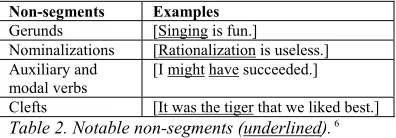
An important contrast between the U-LDM and other approaches to segmentation concerns the distinction made in the U-LDM between dis-course segments such as those we have identified above and Basic Discourse Units (BDUs). While all BDUs under the U-LDM are segments, not all segments are BDUs. BDUs, under this model, are discourse segments of a type that can be in-dependently continued: operator segments are one example of non-BDU segments. Other verb bases constituents that might be expected to be segments are not because they do not establish an interpretation context independent of other segments that can be updated by subsequent units. In general, these “notable non-segments”, summarized in Table 2, are heavily integrated into other nominal or verbal constructions and cannot be accessed for independent continuation.
Non-segments Examples
Gerunds [Singing is fun.]
Nominalizations [Rationalization is useless.] Auxiliary and
modal verbs
[I might have succeeded.]
[image:4.612.92.515.66.256.2]Clefts [It was the tiger that we liked best.]
Table 2. Notable non-segments (underlined). 6
6 In answer to a reviewer who asked if in
"Sing-ing is fun", singing should not be an independent
In order to account for continuation in specific sentences, we further identify one class of in-stances of BDU: Active BDUs (A-BDUs) are BDUs on the right edge of a discourse tree. The main clause of any sentence will be an A-BDU and, depending on the deployment of BDU seg-ments within a given sentence, other BDUs may also be accessible for continuation. (See Section 4 below.)
4
Discourse
Parsing
with
the
U-LDM
Ascertaining the relationship of a BDU to the discourse is a complex parsing process involving lexical, semantic, structural and syntactic infor-mation7. For the case of written prose we are concentrating on here, the unit of analysis is the sentence (or sentence fragment). Sentences are attached to the DPT of the text as a unit8. Dis-course attachment of the sentence involves two decisions: where along the right edge to attach, and what is the relationship to the attachment point. The process, which includes constructing a BDU tree of the sentence, can be summarized as follows:
segment, we would answer that this sentences con-cerns one eventuality (something being fun), not two. Since any noun can be referred to by a pronoun in the next sentence simply referring to the noun is not equivalent to referring to the eventuality in which the referent of the noun is a participant.
7 Although the linguistic (and lexical)
informa-tion we discuss could be augmented with processes relying upon high level world knowledge and infer-ence, we believe that it is extremely significant to see how far one can get with discourse parsing with-out invoking non-linguistic information.
8 See discussion of MBDU below.
Segments Common realizations Examples
Content segments
Clauses: main, subordinate [I heard the dog] [that was barking.]
Predication [California elected Schwarzenegger] [governor]
Participial modifiers [The donkey [braying next door] was annoying.] Eventualities (activities or
states) and their participants.
[image:4.612.91.289.618.687.2]Infinitival modifiers [We persuaded them] [to leave.] [They left] [to get the tickets.]
Parentheticals [The show [(and what a show it was)] lasted 4 hours.]
Appositives [The building, [an example of the Mozarabic style,] was
recently restored.] Interpolations
Interruptions [They were [– Stop that! –] leaving at 8:00.]
Fragments Section headings [4. Discussion]
List items [e.g., [hydrogen,] [helium]]
“Restarted” material [My dog,] [no,] [my cat ran away.]
Operator Segments
Conjunction Conjunctions [We arrived] [and] [got seats.]
Discourse operators “scene-setting” preposed
modifi-ers
[On Tuesday,] [we will see the sites.]
“cue” words [Anyway,] [we did get there on time.]
• Identify potential BDUs within sentence using sentential syntax
• Construct a BDU-tree from the segments of the sentence, using sentential syntactic in-formation and discourse rules to map seg-ments and relationships among them. This BDU-tree is itself an Open Right Tree domi-nated by the node corresponding to the Main clause of sentence9. (This is the Main BDU or MBDU).
• Attach the BDU-tree as a unit to the Dis-course Parse Tree by computing the rela-tionship of MBDU and preposed modifiers, if any, to accessible DCUs aligned along the right edge of the tree using rules of dis-course relations (See Section 4.1 below). Lexical information used for attachment de-cisions can come from anywhere in the BDU tree.
• Once the BDU-tree is attached, its terminal leaves are terminal nodes of the Discourse Parse Tree (DPT) and any terminal or inter-mediary nodes on the right edge of the BDU tree are DCUs on the DPT accessible for at-tachment in the next iteration of the process.
In order to determine which accessible DCUs are candidates for M-BDU attachment and what re-lationship obtains between the incoming unit and the selected DCU, a number of distinct types of evidence are used, including:
1) lexical information
reuse somewhere in the BDU tree of the same lexeme, synonym/antonym, hypernym, or participation in the same lexical frame or “semantic field” as item in target node.
2) syntactic information
parallel syntactic structure; topic/focus and centering information, syntactic status of re-used lexemes, pre-posed adverbial constitu-ents, etc.
3) semantic information
realis status, genericity, tense, aspect, point of view etc. in the MBDU
9 This process is too complex to describe in
de-tail here but it involves looking at both the F-structure of the sentential parsing information re-turned by the XLE and applying discourse rules to the BDUs identified. Soricut and Marcu (2003) also build up RST sentential trees to use in discourse parsing. Both the information and methods used to construct RST trees as well as the trees themselves differ from ours.
4) constituents of incomplete n-ary construc-tions on the right edge
Questions, initial greetings, genre-internal units like sections and sub-sections, etc.
5) structure of both the local attachment point and the BDU-tree
While we are still experimenting with under-standing the complexities involved in attach-ment, we believe that different types of evidence have different weights10 and that the combined weight of evidence determines the attachment point. We have noted, however even at this stage of our investigations, that the weight given to each type of information differs for attachment site selection and relationship determination. Lexical information, for example, is often very important in determining site, while semantic and syntactic information is most relevant in determining relationship. In the remainder of this section we will give a small set of robust rules for determining the attachment site and relation-ship of an incoming BDU-tree to the existing parse tree of the discourse.
4.1 Rules for Determining Discourse Attachment Site Candidates and Attachment Relations
Both the attachment site choice and the actual attachment process rely on partially ordered sets of hybrid rules, each of which are conditioned on a set of constraints. Constraints for rules used in attachment site selection are primarily lexical constraints, although other information is also relevant.
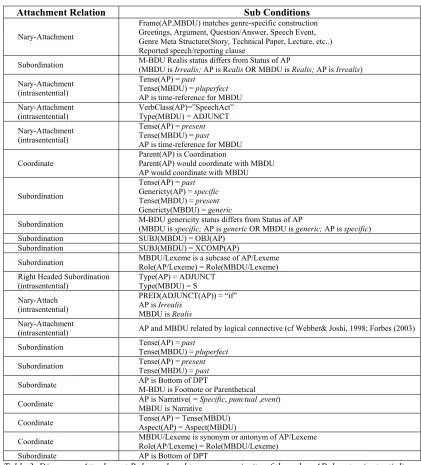
All types of evidence play a role in choosing the attachment relation. A rule is a pair: Rule <C, O> where C is the set of constraints that enable the rule and O is the associated operation. The operation associated with a rule can there-fore be either the markup of a DCU as a possible attachment site, or an actual discourse relation, such as Subordination, Coordination or N-ary. A rule is enabled when all sub-conditions in Care satisfied and no other rules having priority are enabled. Rules may combine different sources of evidential information (semantic, syntactic, structural and lexical). If more than one rule is enabled at the same time, ambiguous parses are produced11. Some rules are listed in Table 3.
10 We assign weights heuristically at this point. 11 At this stage in our research, we rely only on a
deci-The parsing process at the Discourse Parse Tree (DPT) level works as follows. When a BDU-Tree has been constructed and is ready to be attached to the right edge of the DPT, each DCU along the right edge is examined and the lexical information in the right-edge DPT nodes are compared with the lexical evidence retrieved
sions and (2) the extent to which discourse ambigu-ity generated in this fashion is legitimate and how to reduce grammar overgeneration by more efficient handling of interactions among rules and the weigh-ing of the lweigh-inguistic evidence.
from the incoming BDU-Tree. This process, guided by the set of discourse rules, produces an ordered set of active DCUs, representing the possible attachment points in order of likelihood. The set can then be pruned of its n lowest scor-ing constituents, accordscor-ing to an appropriate policy such as a threshold.
In a second stage, each attachment rule is checked against possible attachment sites. Rules that fire successfully attach the BDU-Tree to the DPT at the chosen site with the relationship specified by the rule. Local semantic, lexical and syntactic information is then percolated up to the
Attachment Relation Sub Conditions
Nary-Attachment
Frame(AP,MBDU) matches genre-specific construction Greetings, Argument, Question/Answer, Speech Event, Genre Meta Structure(Story, Technical Paper, Lecture, etc..) Reported speech/reporting clause
Subordination M-BDU Realis status differs from Status of AP (MBDU is Irrealis; AP is Realis OR MBDU is Realis; AP is Irrealis)
Nary-Attachment (intrasentential)
Tense(AP) = past Tense(MBDU) = pluperfect AP is time-reference for MBDU Nary-Attachment
(intrasentential)
VerbClass(AP)=”SpeechAct” Type(MBDU) = ADJUNCT Nary-Attachment
(intrasentential)
Tense(AP) = present Tense(MBDU) = past AP is time-reference for MBDU
Coordinate
Parent(AP) is Coordination
Parent(AP) would coordinate with MBDU AP would coordinate with MBDU
Subordination
Tense(AP) = past
Genericty(AP) = specific
Tense(MBDU) = present
Genericty(MBDU) = generic
Subordination M-BDU genericity status differs from Status of AP (MBDU is specific; AP is generic OR MBDU is generic; AP is specific)
Subordination SUBJ(MBDU) = OBJ(AP)
Subordination SUBJ(MBDU) = XCOMP(AP)
Subordination MBDU/Lexeme is a subcase of AP/Lexeme Role(AP/Lexeme) = Role(MBDU/Lexeme) Right Headed Subordination
(intrasentential)
Type(AP) = ADJUNCT Type(MBDU) = S Nary-Attach
(intrasentential)
PRED(ADJUNCT(AP)) = “if” AP is Irrealis
MBDU is Realis
Nary-Attachment
(intrasentential) AP and MBDU related by logical connective (cf Webber& Joshi, 1998; Forbes (2003)
Subordination Tense(AP) = Tense(MBDU) = pastpluperfect
Subordination Tense(AP) = Tense(MBDU) = presentpast
Subordinate AP is Bottom of DPT M-BDU is Footnote or Parenthetical
Coordinate AP is Narrative( = MBDU is Narrative Specific, punctual ,event)
Coordinate Tense(AP) = Tense(MBDU) Aspect(AP) = Aspect(MBDU)
Coordinate MBDU/Lexeme is synonym or antonym of AP/Lexeme Role(AP/Lexeme) = Role(MBDU/Lexeme)
[image:6.612.94.515.70.535.2]Subordinate AP is Bottom of DPT
DCU consisting of the parent of both attachment point and incoming MBDU according to con-straints of the discourse relation selected. If mul-tiple attachments at different sites are possible, ambiguous parses are generated; less preferred attachments are discarded and the remaining attachment choices generate valid parse trees.
5
PALSUMM Text Summarization
So far, we have described the U-LDM only as a theoretical approach to discourse parsing. We now turn briefly to describe a computational implementation of these methods. The PALSUMM Text Summarization System is a domain independent symbolic sentence extrac-tion system that produces high level readable summaries that preserve the language and style of the original text and eliminate problems with unresolved or incorrect reference. Our system is currently used to summarize a corpus of 300 technical reports produced by our laboratory. 12
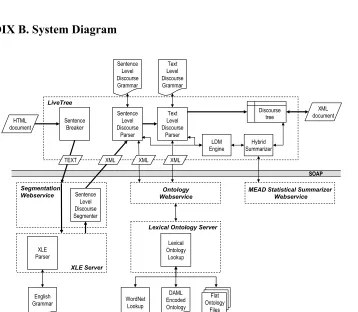
The PALSUMM System relies on the Xerox Linguistic Environment (XLE) to parse the sen-tences of our source texts. The f-structure output of the XLE parser is segmented into units ac-cording to the criteria identified above. The seg-ments are then combined into a BDU-tree. Using syntactic information about syntactic coordina-tion and subordinacoordina-tion relacoordina-tions, lexical onto-logical information taken from WordNet and a customized lexical domain ontology as well as discourse rules, the M-BDU of the sentence along with any other BDUs that must be accessi-ble along the right edge of the discourse tree to accommodate possible continuations are identi-fied, Both the site of attachment and the attach-ment relation are then computed using discourse attachment rules of the type presented above. Text summarization algorithms are then applied to the resulting tree.
Running in purely symbolic mode, the tree is pruned at a given level of embeddedness to pro-duce a summary of a desired length or degree of summarization.13 Because the resulting
12 For illustration purposes, we present in
Ap-pendix A a summary of a document that was hand coded using the rules given and then summarized automatically using the PALSUMM tree pruning al-gorithm. The PALSUMM Summaries were judged to be significantly more readable than summaries produced by MEAD in a small comparative study. In Appendix B, we present a diagram of the PALSUMM system.
13 Although closely related to methods reported
by Marcu (1999, 2000) for summarization using
ries may be longer than desired, alternatively we also use statistical methods to identify salient information (see discussion and references in Marcu 2003) and then construct a partial dis-course tree that includes only information identi-fied as most salient and the text at all nodes dominating that salient information.
6
Conclusions and Directions for
future work
The U-LDM discussed in this paper represents a significant advance in the theoretical understand-ing of the nature of discourse structure. The ex-plicit rules for discourse segmentation based on the syntactic reflexes of semantic structures al-low analysts for the first time to relate the se-mantics underlying the syntactic structure of sentences to the discourse segments needed to account for continuity. In order to adapt the rules to other languages which may have different syntactic reflexes of semantic information, un-derstanding the semantic justification for the choice of segments is important. In addition, the rules for discourse attachment for the first time make clear the principles of discourse continuity for “coherent” discourse. In the future, we plan to deepen our understanding of the rules for dis-course attachment and, in particular, begin to apply machine learning techniques to increase our understanding of the complex interrelation-ship that obtain among them.
While full implementation of the principles of discourse organization outlined here are be-yond the state of the art in some respects (i.e. determining that a sentence is generic in English is non-trivial in many instances although ma-chine learning techniques might be useful in this regard), we believe that the PALSUMM System demonstrates the practicality of symbolic dis-course parsing using the U-LDM Model. The infrastructure for this system has been success-fully applied to the task of summarizing docu-ments without a complex semantic component, extensive world knowledge and inference or a subjectively annotated corpus. We believe that the U-LDM parsing methods discussed here can be used for all other complex NLP tasks in which symbolic parsing is appropriate, especially
those involving high value document collections where precision is critical. In addition, the struc-tures generated through symbolic parsing by the system will be invaluable for training statistical and probabilistic systems.
References
Nicholas Asher. 1993. Reference to Abstract Objects in English: A Philosophical Seman-tics for Natural Language Metaphysics. Klu-wer Academic Publishers.
Lynn Carlson, Daniel Marcu, and Mary Ellen Okurowski. To appear. Building a Discourse-Tagged Corpus in the Framework of Rhetori-cal Structure Theory. In Current Directions in Discourse and Dialogue, Jan van Kuppevelt and Ronnie Smith eds. Kluwer Academic Publishers.
Katherine M. Forbes, Eleni Miltsakaki, Rashmi Prasad, Anoop Sarkar, Aravind Joshi and Bonnie Webber. 2003. D-LTAG System - Discourse Parsing with a Lexicalized Tree-Adjoining Grammar, Journal of Language, Logic and Information, 12(3).
Barbara Grosz and Candace Sidner. 1986. Atten-tion, Intention and the Structure of Discourse.
Computational Linguistics 12:175-204.. Hans Kamp. 1981. A theory of truth and
seman-tic representation.” In Formal Methods in the Study of Language. Jeroen A. G. Groenendijk, Theo Janssen, and Martin Stokhof (eds.). Am-sterdam: Mathematisch Centrum, 277-322. Hans Kamp and Uwe Reyle. 1993. From
Dis-course to Logic: Introduction to Model-theoretic Semantics of Natural Language, Formal Logic and Discourse Representation Theory. Kluwer Academic Publishers, Dordrecht, The Netherlands.
William C. Mann and Sandra A. Thompson. 1988. Rhetorical Structure Theory: Towards a Functional Theory of Text Organization.Text
8(3)243-281.
Daniel Marcu. 1999. Discourse trees are good indicators of importance in text. In Advances in Automatic Text Summarization. I. Mani and Mark Maybury (Eds.), 123-136, The MIT Press.
Daniel Marcu. 2000. The Theory and Practice of Discourse Parsing and Summarization. The MIT Press. Cambridge, MA.
Daniel Marcu. 2003. Automatic Abstracting,
Encyclopedia of Library and Information Sci-ence, 245-256, 2003.
Livia Polanyi. 1988. A Formal Model of Dis-course Structure. Journal of Pragmatics 12: 601-639.
Livia Polanyi and Martin van den Berg. 1996. Discourse Structure and Discourse Interpreta-tion. In Proceedings of the 10th Amsterdam
Colloquium on Formal Semantics. University of Amsterdam.
Livia Polanyi and Remko Scha. 1984. A syntac-tic approach to discourse semansyntac-tics. In Pro-ceedings of COLING 6. Stanford, CA. 413-419.
Dragomir Radev, Timothy Allison, Sasha Blair-Goldensohn, and John Blitzer, Arda Çelebi, Elliott Drabek, Wai Lam, Danyu Liu, Hong Qi, Horacio Saggion, Simone Teufel, Michael Topper, Adam Winkel. 2003. “The MEAD Multidocument Summarizer”.
http://www.summarization.com/mead/
Radu Soricut and Daniel Marcu. 2003. Sentence Level Discourse Parsing using Syntactic and Lexical Information. In Proceedings of HLT/NAACL’03, May 27-June 1, Edmonton, Canada
Bonnie Webber.1991. Structure and Ostension in the Interpretation of discourse Deixis. In Lan-guage and Cognitive Processes, 6(2):107-135. Bonnie Webber and Aravind Joshi. 1998.
An-choring a Lexicalized Tree-Adjoining Gram-mar for Discourse. ACL/COLING Workshop on Discourse Relations and Discourse Mark-ers, Montreal, Canada.
APPENDIX A. PALSUMM Example
The text below, taken from a recent issue of The New Yorker magazine (Alec Wilkinson, 2003)14, has been analyzed by hand using the segmenta-tion and discourse structure construcsegmenta-tion rules given in Sections 3 and 4 above, resulting in the Discourse Parse Tree given in Figure 1. The summary of the text was automatically generated using the automatic summarization algorithm mentioned in Section 5 and a Genre Specific rule for stories in which stories are treated as consist-ing of an Orientation, Narrative and Coda. The first specific, non-habitual eventive clause closes the Orientation and begins the Narrative Section. The function of a Coda is to make the point of a story explicit. This is often done, as in the pre-sent case, by using an anaphor that refers to an entire section of text (Webber, 1991)15.
(1) In the spring of 1947, (2)William Katavolos is the solitary occupant of the Ram’s Head Inn, (3) on Ram Island,(4) off eastern Long Island. (5) Katavolos is twenty-three. (6) His father has leased the inn. (7) Katavolos has returned from the war (8) and (9) wants a place (10) where he can paint (11) and (12) be left alone. (13) The hotel is reached by a causeway from Shelter Is-land, (14) and the causeway sometimes floods, (15) leaving Katavolos as isolated as a light-house keeper. (16) To amuse himself one evening, (17) he puts some water in a glass, (18) covers the rim of the glass with waxed paper, (19) then presses the paper into the water (20) to create a vacuum. (21) He secures the paper to the glass with a rubber band, (22) then turns the glass upside down. (23) The water fills the vacuum, (24) preserving the dome (25) — it looks like the bottom of a wine bottle. (26) Then he begins to wonder (27) what would happen (28) if he re-peated the experiment on a larger scale.(29) A few days later, (30) he throws a tarpaulin over a section of Gardiners Bay (31) He weights down the edges (32) so that no air can get beneath the tarpaulin, (33) then he swims underneath it. (34) Using two oars, (35) he raises the center of the tarpaulin. (36) The water fills the cavity (37) and
14 Alec Wilkinson. 2003. Talk of the Town,
Sep-tember 26, 2003, New Yorker
15 Bonnie Webber.1991. Structure and Ostension
in the Interpretation of discourse Deixis. In Lan-guage and Cognitive Processes, 6(2):107-135.
he swims into it, (38) floating above sea level, (39) which, (40) he says later, (41) “fascinated the hell out of me.” (42) This is the beginning of (43) what Katavolos will call hydronics, (44) the practice of making buildings from soft plastic forms (45) filled with water. (46) In 1949, (47) Katavolos gives up painting (48) to design furni-ture (49) — his chairs are in the collections of the Museum of Modern Art, the Metropolitan Museum, and the Louvre— (50) and, (51) in 1960, (52) he begins teaching architecture at the Pratt Institute, (54) in Brooklyn, (55) where he will become the co-director of the Center for Experimental Structures. (56) In 1970, (57) in a courtyard at Pratt, (58) he builds the first hy-dronic structure (59) — a plastic dome filled with water (60) and supported by a plastic cylin-der, (61) also filled with water. (62) The plastic is like Saran Wrap, (63) only thicker. (64) Each year after that, (65) he builds a new structure (66) He calls the structures (67) liquid villas. (68) They consist of columns, arches, and vaults. (69) The elements, (70) that is (71) of classical architecture.
Summary 152/363 = 42%
In the spring of 1947, William Katavolos is the solitary occupant of the Ram’s Head Inn, Katavolos is twenty-three. To amuse himself one evening, he puts some water in a glass, covers the rim of the glass with waxed paper, then presses the paper into the water. He secures the paper to the glass with a rubber band, then turns the glass upside down. A few days later, he throws a tarpaulin over a section of Gardiners Bay.
Figure 1. Discourse Parse Tree of the New Yorker text.
APPENDIX B. System Diagram
WordNet Lookup
Flat Ontology
Files DAML
Encoded Ontology HTML
document
XLE Server
XLE Parser
Segmentation Webservice
Lexical Ontology Server Ontology Webservice
Lexical Ontology
Lookup
English Grammar
LiveTree
Sentence Breaker
Sentence Level Discourse
Parser
Text Level Discourse
Parser
Discourse tree
XML
XML document
Hybrid Summarizer
MEAD Statistical Summarizer Webservice
Sentence Level Discourse Segmenter
Sentence Level Discourse Grammar
Text Level Discourse Grammar
LDM Engine
TEXT XML XML
SOAP
[image:10.612.137.495.258.570.2]