Classifying Speech Acts using Verbal Response Modes
Andrew Lampert
†‡
†
CSIRO ICT Centre
Locked Bag 17, North Ryde
NSW 1670 Australia
[email protected]
Robert Dale
‡
C´ecile Paris
†
‡
Centre for Language Technology
Macquarie University
NSW 2109 Australia
[alampert,rdale]@ics.mq.edu.au
Abstract
The driving vision for our work is to provide intelligent, automated assistance to users in understanding the status of their email conversations. Our approach is to create tools that enable the detec-tion and connecdetec-tion of speech acts across email messages. We thus require a mech-anism for tagging email utterances with some indication of their dialogic function. However, existing dialog act taxonomies as used in computational linguistics tend to be too task- or application-specific for the wide range of acts we find repre-sented in email conversation. The Ver-bal Response Modes (VRM) taxonomy of speech acts, widely applied for discourse analysis in linguistics and psychology, is distinguished from other speech act tax-onomies by its construction from cross-cutting principles of classification, which ensure universal applicability across any domain of discourse. The taxonomy cat-egorises on two dimensions, characterised as literal meaning and pragmatic mean-ing. In this paper, we describe a statisti-cal classifier that automatistatisti-cally identifies the literal meaning category of utterances using the VRM classification. We achieve an accuracy of 60.8% using linguistic fea-tures derived from VRM’s human annota-tion guidelines. Accuracy is improved to 79.8% using additional features.
1
Introduction
It is well documented in the literature that users are increasingly using email for managing requests
and commitments in the workplace (Bellotti et al., 2003). It has also been widely reported that users commonly feel overloaded when managing mul-tiple ongoing tasks through email communication e.g. (Whittaker and Sidner, 1996).
Given significant task-centred email usage, one approach to alleviating email overload in the workplace is to draw on Speech Act Theory (Searle, 1969) to analyse the intention behind email messages and use this information to help users process and prioritise their email. The basic tenet of Speech Act Theory is that when we utter something, we also act. Examples of such acts can include stating, questioning or advising.
The idea of identifying and exploiting patterns of communicative acts in conversations is not new. Two decades ago, Flores and Winograd (1986) proposed that workplace workflow could be seen as a process of creating and maintaining networks of conversations in which requests and commit-ments lead to successful completion of work.
Recently, these ideas have begun to be ap-plied to email messages. Existing work analysing speech acts in email messages differs as to whether speech acts should be annotated at the message level, e.g., (Cohen et al., 2004; Leuski, 2004), or at the utterance or sentence level, e.g., (Corston-Oliver et al., 2004). Our thesis is that a single email message may contain multiple commitments on a range of tasks, and so our work focuses on utterance-level classification, with the aim of be-ing able to connect together the rich tapestry of threads that connect individual email messages.
classi-fier of literal utterance meaning.
The driving vision for our work is to eventually provide intelligent, automated assistance to email users in understanding the status of their current email conversations and tasks. We wish to as-sist users to identify outstanding tasks easily (both for themselves and their correspondents) through automatically flagging incomplete conversations, such as requests or commitments that remain un-fulfilled. This capability should lead to novel forms of conversation-based search, summarisa-tion and navigasummarisa-tion for collecsummarisa-tions of email mes-sages and for other textual, computer-mediated conversations. The work described here represents our first steps towards this vision.
This paper is structured as follows. First, in Sec-tion 2, we describe related work on automatically classifying speech and dialogue acts. In Section 3 we introduce the VRM taxonomy, comparing and contrasting it with other speech act taxonomies in Section 4. Then, in Section 5, we describe our statistical VRM classifier, and in Section 6 we present what we believe are the first results in the field for automatic VRM classification of the lit-eral meaning of utterances. Finally, in Section 7 we discuss our results. Section 8 presents some concluding remarks and pointers to future work.
2
Related Work
There is much existing work that explores au-tomated processing of speech and dialogue acts. This collection of work has predominantly fo-cused around two related problems: dialogue act prediction and dialogue act recognition. Our work focuses on the second problem, and more specifi-cally on speech act recognition.
Examples of dialogue act recognition include work by Core (1998) which uses previous and current utterance information to predict possible annotations from the DAMSL scheme (Core and Allen, 1997). Similar work by Chu-Carroll (1998) on statistical “discourse act” recognition also uses features from the current utterance and discourse history to achieve accuracy of around 51% for a set of 15 discourse acts. In particular, Chu-Carroll’s results were significantly improved by taking into account the syntactic form of each utterance.
The use of n-gram language models is also a popular approach. Reithinger and Kle-sen (1997) apply n-gram language models to the VERBMOBIL corpus (Alexandersson et al.,
1998) and report tagging accuracy of 74.7% for a set of 18 dialogue acts. In common with our own work, Webb et al. (2005) approach dialogue act classification using only intra-utterance features. They found that using only features derived from n-gram cue phrases performed moderately well on the SWITCHBOARD corpus of spoken dialogue (Godfrey et al., 1992).
To our knowledge, however, there has been no previous work that attempts to identify VRM cat-egories for utterances automatically.
3
Verbal Response Modes
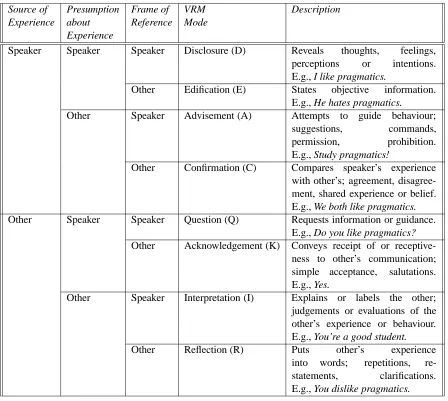
Verbal Response Modes (VRM) is a principled taxonomy of speech acts that can be used to clas-sify literal and pragmatic meaning within utter-ances. Each utterance is coded twice: once for its literal meaning, and once for its communica-tive intent or pragmatic meaning. The same VRM categories are used in each case.
Under the VRM system, every utterance from a speaker can be considered to concern either the speaker’s or the other’s experience. For example, in the utterance “I like pragmatics.”, the source of experience is the speaker. In contrast, the source of experience for the utterance “Do you like prag-matics?” is the other interlocutor.
Further, in making an utterance, the speaker may need to make presumptions about experience. For example, in saying “Do you like pragmatics?”, the speaker does not need to presume to know what the other person is, was, will be, or should be thinking, feeling, perceiving or intending. Such utterances require a presumption of experience of the speaker only. In contrast, the utterance “Like pragmatics!” attempts to impose an experience (a liking for pragmatics) on the other interlocutor, and has a presumption of experience for the other. Finally a speaker may represent the experience either from their own personal point of view, or from a viewpoint that is shared or held in common with the other interlocutor. The three example ut-terances above all use the speaker’s frame of ref-erence because the experience is understood from the speaker’s point of view. In contrast, the ut-terance “You like pragmatics.” takes the other’s frame of reference, representing the experience as the other interlocutor views it.
The principles are dichotomous — each can take the value of speaker or other (other interlocutor) — and thus define eight mutually exclusive VRM categories, as shown in Table 1.
With 8 VRM modes and 2 separate dimensions of coding (literal and pragmatic meaning), there are 64 possible form-intent combinations. The 8 combinations of codings in which the literal and pragmatic meanings coincide are referred to as pure modes. The other 56 modes are labelled mixed modes. An example of a mixed-mode ut-terance is “Can you pass the sugar?” which is codedQA. This is read Question in service of Ad-visement, meaning that the utterance has a Ques-tion form (literal meaning) but Advisement intent (pragmatic meaning). In this way, the VRM tax-onomy is designed to simply and consistently clas-sify and distinguish direct and indirect speech acts.
4
Comparison with Other Speech Act
Taxonomies
There are, of course, alternate speech and dia-logue act taxonomies, some of which have been applied within natural language processing appli-cations. Unfortunately, many of these taxonomies tend to offer competing, rather than complemen-tary approaches to classifying speech acts, mak-ing it difficult to compare experimental results and analyses that are based on different taxonomies. It would clearly be desirable to unambiguously re-late categories between different taxonomies.
One specific drawback of many speech and dia-logue act taxonomies, including taxonomies such as those developed in the VERBMOBIL project (Alexandersson et al., 1998), is that they are do-main or application specific in their definition and coverage of speech act categories. This often stems from the taxonomy being developed and used in a rather ad hoc, empirical manner for analysing discourse and utterances from a single or small set of application domains.
While the VRM research grew from studying therapist interventions in psychotherapy (Stiles, 1992; Wiser and Goldfried, 1996), the VRM sys-tem has been applied to a variety of discourse genres. These include: American Presidential speeches (Stiles et al., 1983), doctor-patient inter-actions (Meeuswesen et al., 1991), courtroom in-terrogations (McGaughey and Stiles, 1983), busi-ness negotiations (Ulijn and Verweij, 2000), per-suasive discourse (Kline et al., 1990) and
tele-vision commercials (Rak and McMullen, 1987). VRM coding assumes only that there is a speaker and an intended audience (other), and thus can be applied to any domain of discourse.
The wide applicability of VRM is also due to its basis of clearly defined, domain-independent, systematic principles of classification. This en-sures that the VRM categories are both extensive and exhaustive, meaning that all utterances can be meaningfully classified with exactly one VRM category1. In contrast, even widely-applied, com-plex taxonomies such as DAMSL (Core and Allen, 1997) resort to the inclusion of an other category within the speech act component, to be able to classify utterances across domains.
In addition, the VRM principles facilitate more rigorous and comparable coding of utterances from which higher-level discourse properties can be reliably calculated, including characterisation of the roles played by discourse participants. If re-quired, the eight VRM modes can also be further divided to identify additional features of interest (for example, the Question category could be split to distinguish open and closed questions). Impor-tantly, this can be done within the existing frame-work of categories, without losing the principled basis of classification, or the ability to compare di-rectly with other VRM analyses.
Table 2 compares the VRM categories with Searle’s five major speech act categories (1969; 1979). Searle’s categories are largely subsumed under the subset of VRM categories that offer the speaker’s source of experience and/or frame of reference (Disclosure, Edifications, Advise-ments and Questions). The coverage of Searle’s speech acts seems more limited, given that the other VRMs (Reflection, Interpretation, Confir-mation and Acknowledgement), all other on at least two principles, have no direct equivalents in Searle’s system, except for some Interpretations which might map to specific subcategories of Dec-laration.
5
Building a VRM Classifier
As discussed earlier, the VRM system codes both the literal and pragmatic meaning of utterances. The pragmatic meaning conveys the speaker’s ac-tual intention, and such meaning is often hidden or
1
Source of Presumption Frame of VRM Description Experience about Reference Mode
Experience
Speaker Speaker Speaker Disclosure (D) Reveals thoughts, feelings, perceptions or intentions. E.g., I like pragmatics.
Other Edification (E) States objective information. E.g., He hates pragmatics. Other Speaker Advisement (A) Attempts to guide behaviour;
suggestions, commands, permission, prohibition. E.g., Study pragmatics!
Other Confirmation (C) Compares speaker’s experience with other’s; agreement, disagree-ment, shared experience or belief. E.g., We both like pragmatics. Other Speaker Speaker Question (Q) Requests information or guidance.
E.g., Do you like pragmatics? Other Acknowledgement (K) Conveys receipt of or
receptive-ness to other’s communication; simple acceptance, salutations. E.g., Yes.
Other Speaker Interpretation (I) Explains or labels the other; judgements or evaluations of the other’s experience or behaviour. E.g., You’re a good student. Other Reflection (R) Puts other’s experience
[image:4.612.81.529.47.448.2]into words; repetitions, re-statements, clarifications. E.g., You dislike pragmatics.
Table 1: The Taxonomy of Verbal Response Modes from (Stiles, 1992)
Searle’s Classification Corresponding VRM Commissive Disclosure
Expressive Disclosure Representative Edification
Directive Advisement; Question Declaration Interpretation;
Disclo-sure; Edification
Table 2: A comparison of VRM categories with Searle’s speech acts
highly dependent on discourse context and back-ground knowledge. Because we classify utter-ances using only intra-utterance features, we can-not currently encode any information about the discourse context, so could not yet plausibly tackle the prediction of pragmatic meaning. Discern-ing literal meanDiscern-ing, while somewhat simpler, is
akin to classifying direct speech acts and is widely recognised as a challenging computational task.
5.1 Corpus of VRM Annotated Utterances Included with the VRM coding manual (Stiles, 1992) is a VRM coder training application for training human annotators. This software, which is freely available online2, includes transcripts of spoken dialogues from various domains seg-mented into utterances, with each utterance anno-tated with two VRM categories that classify both its literal and pragmatic meaning.
These transcripts were pre-processed to remove instructional text and parenthetical text that was not actually part of a spoken and coded
utter-2
ance. Several additional example utterances were extracted from the coding manual to increase the number of instances of under-represented VRM categories (notably Confirmations and Interpreta-tions).
The final corpus contained 1368 annotated ut-terances from 14 dialogues and several sets of iso-lated utterances. Table 3 shows the frequency of each VRM mode in the corpus.
VRM Instances Percentage
Disclosure 395 28.9%
Edification 391 28.6%
Advisement 73 5.3%
Confirmation 21 1.5%
Question 218 15.9%
Acknowledgement 97 7.1%
Interpretation 64 4.7%
[image:5.612.306.518.47.405.2]Reflection 109 8.0%
Table 3: The distribution of VRMs in the corpus
5.2 Features for Classification
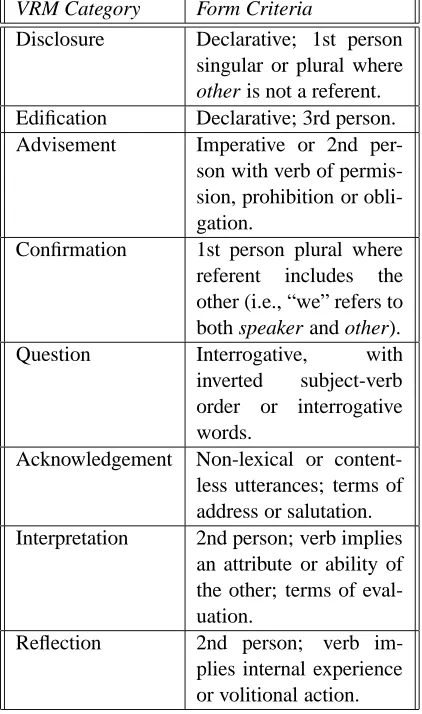
The VRM annotation guide provides detailed in-structions to guide humans in correctly classifying the literal meaning of utterances. These suggested features are shown in Table 4.
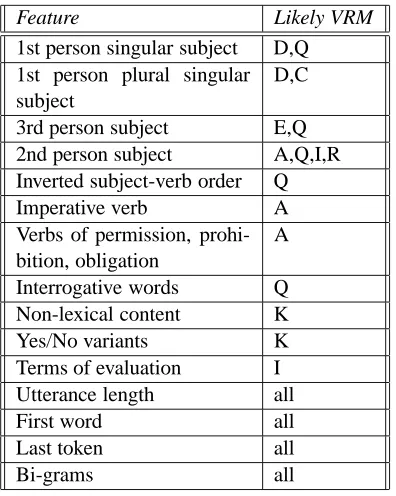
We have attempted to map these features to computable features for training our statistical VRM classifier. Our resulting set of features is shown in Table 5 and includes several additional features not identified by Stiles that we use to fur-ther characterise utterances. These additional fea-tures include:
• Utterance Length: The number of words in the utterance.
• First Word: The first word in each utter-ance, represented as a series of independent boolean features (one for each unique first word present in the corpus).
• Last Token: The last token in each utterance – either the final punctuation (if present) or the final word in the utterance. As for the First Word features, these are represented as a series of independent boolean features.
• Bigrams: Bigrams extracted from each ut-terance, with a variable threshold for includ-ing only frequent bigrams (above a specified threshold) in the final feature set.
VRM Category Form Criteria
Disclosure Declarative; 1st person singular or plural where other is not a referent. Edification Declarative; 3rd person. Advisement Imperative or 2nd
per-son with verb of permis-sion, prohibition or obli-gation.
Confirmation 1st person plural where referent includes the other (i.e., “we” refers to both speaker and other). Question Interrogative, with inverted subject-verb order or interrogative words.
Acknowledgement Non-lexical or content-less utterances; terms of address or salutation. Interpretation 2nd person; verb implies
an attribute or ability of the other; terms of eval-uation.
[image:5.612.307.518.52.409.2]Reflection 2nd person; verb im-plies internal experience or volitional action.
Table 4: VRM form criteria from (Stiles, 1992)
The intuition for including the utterance length as a feature is that different VRMs are often associ-ated with longer or shorter utterances - e.g., Ac-knowledgement utterances are often short, while Edifications are often longer.
To compute our utterance features, we made use of the Connexor Functional Dependency Gram-mar (FDG) parser (Tapanainen and Jarvinen, 1997) for grammatical analysis and to extract syn-tactic dependency information for the words in each utterance. We also used the morphological tags assigned by Connexor. This information was used to calculate utterance features as follows:
• Functional Dependencies: Dependency functions were used to identify main subjects and main verbs within utterances, as required for features including the 1st/2nd/3rd person subject, inverted subject-verb order and im-perative verbs.
in-formation was determined using the Con-nexor parser. This information was used to identify the main utterance subject where de-pendency information was not available.
• Morphology: Morphological tags, also gen-erated by Connexor, were used to distinguish between first and third person pronouns, as well as between singular and plural forms of first person pronouns. Additionally, we used morphological tags from Connexor to iden-tify imperative verbs.
• Hand-constructed word lists: Several of the features used relate to closed sets of com-mon lexical items (e.g., verbs of permission, interrogative words, variations of “yes” and “no”). For these features, we employ hand-constructed simple lists, using online thesauri to expand our lists from an initial set of seed words. While some of the lists are not ex-haustive, they seem to help our results and involved only a small amount of effort; none took more than an hour to construct.
Feature Likely VRM 1st person singular subject D,Q 1st person plural singular subject
D,C
3rd person subject E,Q 2nd person subject A,Q,I,R Inverted subject-verb order Q Imperative verb A Verbs of permission, prohi-bition, obligation
A
Interrogative words Q Non-lexical content K Yes/No variants K Terms of evaluation I Utterance length all
First word all
Last token all
[image:6.612.306.518.358.523.2]Bi-grams all
Table 5: Features used in VRM Classifier
6
Results
Our classification results using several different learning algorithms and variations in feature sets are summarised in Table 6. We experimented with using only the linguistic features suggested
by Stiles, using only the additional features we identified, and using a combination of all features shown in Table 5. All our results were validated using stratified 10-fold cross validation.
We used supervised learning methods imple-mented in Weka (Witten and Frank, 2005) to train our classifier. Through experimentation, we found that Weka’s Support Vector Machine implemen-tation (SMO) provided the best classification per-formance. Encouragingly, other relatively simple approaches, such as a Bayesian Network classifier using the K2 hill-climbing search algorithm, also performed reasonably well.
The baseline against which we compare our classifier’s performance is a OneR (one rule) clas-sifier using an identical feature set. This baseline system is a one-level decision tree, (i.e., based on a set of rules that test only the single most discrim-inative feature). As shown in Table 6, the accuracy of this baseline varies from 42.76% to 49.27%, de-pending on the exact features used. Regardless of features or algorithms, our classifier performs sig-nificantly better than the baseline system.
Mean Algorithm Feature Set Accuracy Abs
Error
SVM All 79.75% 0.19
[image:6.612.81.279.367.615.2]SVM Only Stiles’ 60.82% 0.20 SVM No Stiles’ 74.49% 0.19 Bayes Net All 78.51% 0.06 Bayes Net Only Stiles’ 60.16% 0.12 Bayes Net No Stiles’ 75.68% 0.07 Baseline All 49.27% 0.36 Baseline Only Stiles’ 49.27% 0.36 Baseline No Stiles’ 42.76% 0.38
Table 6: VRM classifier results
Another tunable parameter was the level of pruning of n-grams from our feature set according to their frequency of occurrence. Heuristically, we determined that a cut-off of 5 (i.e., only n-grams that occur five or more times in our corpus of utter-ances were included as features) gave us the high-est accuracy for the learning algorithms thigh-ested.
7
Discussion
our results. In classifying only the literal meaning of utterances, we have focused on a simpler task than classifying in-context meaning of utterances which some systems attempt.
Our results do, however, compare favourably with previous dialogue act classification work, and clearly validate our hypothesis that VRM annota-tion can be learned. Previous dialogue act clas-sification results include Webb et al. (2005) who reported peak accuracy of around 71% with a vari-ety of n-gram, word position and utterance length information on the SWITCHBOARD corpus us-ing the 42-act DAMSL-SWBD taxonomy. Earlier work by Stolcke et al. (2000) obtained similar re-sults using a more sophisticated combination of hidden markov models and n-gram language mod-els with the same taxonomy on the same corpus. Reithinger and Klesen (1997) report a tagging ac-curacy of 74.7% for a set of 18 dialogue acts over the much larger VERBMOBIL corpus (more than 223,000 utterances, compared with only 1368 ut-terances in our own corpus).
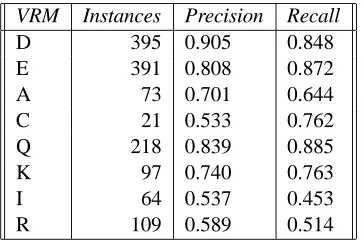
VRM Instances Precision Recall
D 395 0.905 0.848
E 391 0.808 0.872
A 73 0.701 0.644
C 21 0.533 0.762
Q 218 0.839 0.885
K 97 0.740 0.763
I 64 0.537 0.453
[image:7.612.81.263.350.471.2]R 109 0.589 0.514
Table 7: Precision and recall for each VRM
In performing an error analysis of our results, we see that classification accuracy for Interpre-tations and Reflections is lower than for other classes, as shown in Table 7. In particular, our con-fusion matrix shows a substantial number of trans-posed classifications between these two VRMs. Interestingly, Stiles makes note that these two VRMs are very similar, differing only on one prin-ciple (frame of reference), and that they are often difficult to distinguish in practice. Additionally, some Reflections repeat all or part of the other’s utterance, or finish the other’s previous sentence. It is impossible for our current classifier to detect such phenomena, since it looks at utterances in isolation, not in the context of a larger discourse. We plan to address this in future work.
Our results also provide support for using both
linguistic and statistical features in classifying VRMs. In the cases where our feature set con-sists of only the linguistic features identified by Stiles, our results are substantially worse. Sim-ilarly, when only n-gram, word position and ut-terance length features are used, classifier perfor-mance also suffers. Table 6 shows that our best results are obtained when both types of features are included.
Finally, another clear trend in the performance of our classifier is that the VRMs for which we have more utterance data are classified substan-tially more accurately.
8
Conclusion
Supporting the hypothesis posed, our results sug-gest that classifying utterances using Verbal Re-sponse Modes is a plausible approach to com-putationally identifying literal meaning. This is a promising result that supports our intention to apply VRM classification as part of our longer-term aim to construct an application that exploits speech act connections across email messages.
While difficult to compare directly, our classifi-cation accuracy of 79.75% is clearly competitive with previous speech and dialogue act classifica-tion work. This is particularly encouraging con-sidering that utterances are currently being clas-sified in isolation, without any regard for the dis-course context in which they occur.
In future work we plan to apply our classifier to email, exploiting features of email messages such as header information in the process. We also plan to incorporate discourse context features into our classification and to explore the classification of pragmatic utterance meanings.
References
Jan Alexandersson, Bianka Buschbeck-Wolf, Tsutomu Fujinami, Michael Kipp, Stephan Koch, Elisa-beth Maier, Norbert Reithinger, Birte Schmitz, and Melanie Siegel. 1998. Dialogue acts in VERBMOBIL-2. Technical Report Verbmobil-Report 226, DFKI Saarbruecken, Universitt Stuttgart, Technische Universitt Berlin, Universitt des Saarlandes. 2nd Edition.
Victoria Bellotti, Nicolas Ducheneaut, Mark Howard, and Ian Smith. 2003. Taking email to task: The design and evaluation of a task management centred email tool. In Computer Human Interaction
Jennifer Chu-Carroll, 1998. Applying Machine
Learn-ing to Discourse ProcessLearn-ing. Papers from the 1998 AAAI Spring Symposium., chapter A statistical
model for discourse act recognition in dialogue in-teractions, pages 12–17. The AAAI Press, Menlo Park, California.
William W Cohen, Vitor R Carvalho, and Tom M Mitchell. 2004. Learning to classify email into ”speech acts”. In Dekang Lin and Dekai Wu, edi-tors, Conference on Empirical Methods in Natural
Language Processing, pages 309–316, Barcelona,
Spain. Association for Computational Linguistics.
Mark Core and James Allen. 1997. Coding dialogs with the DAMSL annotation scheme. In AAAI
Fall Symposium on Communicative Action in Hu-mans and Machines, pages 28–35, Cambridge, MA,
November.
Mark Core. 1998. Predicting DAMSL utterance tags. In Proceedings of the AAAI-98 Spring Symposium
on Applying Machine Learning to Discourse Pro-cessing.
Simon H Corston-Oliver, Eric Ringger, Michael Ga-mon, and Richard Campbell. 2004. Task-focused summarization of email. In ACL-04 Workshop: Text
Summarization Branches Out, July.
John J Godfrey, Edward C Holliman, and Jane Mc-Daniel. 1992. SWITCHBOARD: Telephone speech corpus for research and development. In
Proceed-ings of the IEEE Conference on Acoustics, Speech and Signal Processing, volume 1, pages 517–520,
San Francisco, CA, March.
Susan L Kline, C L Hennen, and K M Farrell. 1990. Cognitive complexity and verbal response mode use in discussion. Communication Quarterly, 38:350– 360.
Anton Leuski. 2004. Email is a stage: discovering people roles from email archives. In Proceedings of
Annual ACM Conference on Research and Develop-ment in Information Retrieval, Sheffi eld, UK.
Karen J McGaughey and William B Stiles. 1983. Courtroom interrogation of rape victims: Verbal re-sponse mode use by attourneys and witnesses during direct examination vs. cross-examination. Journal
of Applied Social Psychology, 13:78–87.
Ludwein Meeuswesen, Cas Schaap, and Cees van der Staak. 1991. Verbal analysis of doctor-patient communication. Social Science and Medicine,
32(10):1143–50.
Diana S Rak and Linda M McMullen. 1987. Sex-role stereotyping in television commercials: A verbal re-sponse mode and content analysis. Canadian
Jour-nal of Behavioural Science, 19:25–39.
Norbert Reithinger and Martin Klesen. 1997. Dia-logue act classifi cation using language models. In
Proceedings of Eurospeech ’97, pages 2235–2238,
Rhodes, Greece.
John R Searle. 1969. Speech Acts : An Essay in the Philosophy of Language. Cambridge University
Press.
John R Searle. 1979. Expression and Meaning. Cam-bridge University Press.
William B Stiles, Melinda L Au, Mary Ann Martello, and Julia A Perlmutter. 1983. American campaign oratory: Verbal response mode use by candidates in the 1980 american presidential primaries. Social
Be-haviour and Personality, 11:39–43.
William B Stiles. 1992. Describing Talk: a taxonomy
of verbal response modes. SAGE Series in
Interper-sonal Communication. SAGE Publications. ISBN: 0803944659.
Andreas Stolcke, Klaus Ries, Noah Coccaro, Elizabeth Shriberg, Rebecca Bates, Daniel Jurafsky, Paul Tay-lor, Rachel Martin, Marie Meteer, and Carol Van Ess-Dykema. 2000. Dialogue act modeling for au-tomatic tagging and recognition of conversational speech. Computational Linguistics, 26(3):339–371.
Pasi Tapanainen and Timo Jarvinen. 1997. A non-projective dependency parser. In Proceedings of the
5th Conference on Applied Natural Language Pro-cessing, pages 64–71, Washington D.C. Association
for Computational Linguistics.
Jan M Ulijn and Maurits J Verweij. 2000. Question be-haviour in monocultural and intercultural business negotiations: the Dutch-Spanish connection.
Dis-course Studies, 2(1):141–172.
Nick Webb, Mark Hepple, and Yorick Wilks. 2005. Dialogue act classifi cation based on intra-utterance features. In Proceedings of the AAAI Workshop on
Spoken Language Understanding.
Steve Whittaker and Candace Sidner. 1996. Email overload: exploring personal information manage-ment of email. In ACM Computer Human
Interac-tion conference, pages 276–283. ACM Press.
Terry Winograd and Fernando Flores. 1986.
Under-standing Computers and Cognition. Ablex
Publish-ing Corporation, Norwood, New Jersey, USA, 1st edition. ISBN: 0-89391-050-3.
Susan Wiser and Marvin R Goldfried. 1996. Ver-bal interventions in signifi cant psychodynamic-interpersonal and cognitive-behavioral therapy ses-sions. Psychotherapy Research, 6(4):309–319.
Ian Witten and Eiba Frank. 2005. Data Mining:
Prac-tical machine learning tools and techniques.