STROUD, LORI LUCAS. Using Program Theory-Driven Evaluation to Examine the Quality and Impact of Digital Resources Provided by the North Carolina 4-H Horse Program. (Under the direction of Dr. Kevin Oliver).
This mixed-methods study sought to examine and evaluate how current digital resources that are
shared via the North Carolina Extension Equine Husbandry website and social media are being
utilized and if they are meeting the needs of our stakeholders: 4-H members, parents, Extension
agents, and adult volunteers that participate in, lead, and advise 4-H Horse clubs in North
Carolina. Program theory guided the evaluation; the program stakeholders, and investigator
shared open conversations about how the current resources offered by the program were, or were
not, meeting their needs. The first part of the study consisted of three, qualitative, focus-group
interviews, with 9-11 active stakeholders in each group (n=30). These interviewees provided positive and negative feedback on the website and social media pages. The participants also
voiced recommendations for improvement and expansion of existing content, identified potential
barriers to usage, and ideas for future content and services not currently provided. Focus-group
participants also provided feedback on the layout and design of the website menu, and they
overwhelming recommended a more concise list of main topics. Participants also expressed
support of the development of a YouTube channel with instructional videos, and an app to
communicate with state 4-H horse show participants during the show. The perceptions and
suggestions by the focus-group participants were utilized to develop a quantitative, electronic,
census survey that was distributed state-wide to all 4-H horse program stakeholders. Over a
twenty-one day period, n=277 Qualtrics surveys were completed (4-H’ers 11-18, n=91; parents,
Manual, State 4-H Horse Show information, and Horsemanship camp information were visited the most frequently. Survey respondents answered similarly to the focus-group participants when
asked what made them dissatisfied with the ease of use of the website (n=24); open-ended responses referred to a difficult menu structure that made it hard to navigate and search for
particular topics or items. Only 4.28% (n=7) of respondents indicated dissatisfaction with the content on the website, with a recommendation to include more information for club leaders and
sample curriculum. When asked to rate their satisfaction with the ease of use and content of the
social media sites, 42.66% (n=93) and 39.45% (n=85) of respondents said they were extremely satisfied, respectively. Horse judging, hippology, and horsebowl were ranked as the top three
topics of interest for videos for a new YouTube channel. In conclusion, as a result of this process
evaluation study, Extension Equine Husbandry staff will be able to reflect on the stakeholders’
interview and survey responses to focus time and resources modifying the identified troublesome
aspects and creating digital materials that will benefit stakeholders and grow the program.
© Copyright 2019 by Lori Lucas Stroud
by
Lori Lucas Stroud
A thesis submitted to the Graduate Faculty of North Carolina State University
in partial fulfillment of the requirements for the degree of
Master of Science
Digital Learning and Teaching
Raleigh, North Carolina 2019
APPROVED BY:
_______________________________ _______________________________ Dr. Kevin Oliver, Committee Chair Dr. Shannon Pratt-Phillips
_______________________________
ii
BIOGRAPHY
Lori L. Stroud is an Extension Assistant for Extension Equine Husbandry at North
Carolina State University. She grew up participating in the North Carolina 4-H Horse Program as
a Gaston county 4-H’er. She graduated from East Gaston High School in Mount Holly.
After high school, Lori attended North Carolina State University, where she was a
Teaching Fellow and earned her Bachelor of Science in Agricultural Education. Following
graduation, she taught Exploring Biotechnology at Clayton Middle School for eighteen years.
She earned National Board Certification in Career and Technical Education/Early Adolescence
Through Young Adulthood in 2002. In 2014 she joined the Animal Science department at North
Carolina State University, in her current role. In 2015, she began her Master’s studies in the
iii
ACKNOWLEDGMENTS
First, I would like to thank my husband David and my son Landon for being supportive
and understanding in my journey to earn this degree. Thank you for being patient on the
evenings and weekends when I had to spend time writing and finishing school work, and had to
neglect spending time with you and completing household chores. Next, I would like to express
appreciation to my advisor and committee chair, Dr. Kevin Oliver. Thank you for all your
suggestions and guidance through the development and completion of this project. I would also
like to thank Dr. Todd See and Dr. Shannon Pratt-Phillips for serving on my committee and
being available to answer questions and provide recommendations throughout the research and
writing process.
I would also like to acknowledge my colleagues in Extension Equine Husbandry that
provided support and assistance with my project, Alaina Cross and Sierra Simmerman. Finally, I
owe a huge debt of gratitude to all the North Carolina 4-H Horse Program stakeholders that
attended the focus group meetings and completed the electronic survey. Thank you for your
iv
TABLE OF CONTENTS
LIST OF TABLES ... vi
LIST OF FIGURES ... vii
CHAPTER 1: INTRODUCTION ... 1
Introduction to the Problem ... 1
Introduction to Theoretical Framework ... 3
Research Questions ... 5
Purpose ... 7
Significance... 8
Methods... 9
Role of the Researcher ... 10
Summary and Overview ... 11
Key Terms ... 11
CHAPTER 2: REVIEW OF LITERATURE ... 14
Theoretical Framework ... 14
Program Theory-Driven Evaluation ... 14
Diffusion of Innovation Theory ... 21
Adult Learning Theory ... 23
Digital Tools and Communications ... 24
Measuring Digital Resource Effectiveness ... 24
Website Communication Effectiveness ... 25
Volunteer Response to Digital Training Methods ... 26
Extension Professionals Use of Online Tools ... 26
CHAPTER 3: METHODOLOGY ... 28
Introduction ... 28
Research Questions ... 30
Design of Study... 31
Data Collection ... 31
Sample... 32
Instrumentation ... 37
Qualitative ... 37
Quantitative ... 39
Procedures ... 40
Qualitative ... 40
Quantitative ... 41
Validity ... 42
CHAPTER 4: FINDINGS ... 44
Platform Use and Suitability ... 44
RQ 1: Reach, Timeliness, and Usefulness of Program Communications Across Platforms ... 44
Platform Content ... 49
v
RQ 3: New Tools, Apps or Sites Recommended by Stakeholders ... 51
RQ 4: Recommendations for Additional/Expanded Platform Content... 53
User Experience ... 55
RQ 5: Barriers or Frustrations with Digital Platforms ... 55
CHAPTER 5: DISCUSSION ... 59
Introduction ... 59
Application of Findings to Improve Program Communications... 59
Platform Use and Suitability ... 60
Platform Content ... 64
User Experience ... 64
Limitations ... 65
Study Implications ... 66
Future Research ... 68
Conclusion ... 68
REFERENCES ... 69
vi
LIST OF TABLES
Table 1. Steps in Developing a Logic Model ... 18
Table 2. Focus Group Meeting Attendee Demographics. ... 32
Table 3. Survey Responses by Stakeholder Group ... 35
Table 4. Stakeholder Group Years of Involvement Survey Responses ... 35
Table 5. Survey Responses to Website Usage ... 45
Table 6. Survey Responses to Social Media Usage ... 45
Table 7. Survey Responses to Social Media Platform Preference ... 46
Table 8. Frequency of Page Visits on Extension Equine Husbandry ... 50
Table 9. YouTube Channel Content Preferences ... 53
Table 10. Satisfaction with Content on Website and Social Media. ... 54
vii
LIST OF FIGURES
Figure 1. Program Impact Theory Model ... 4
Figure 2. NCSU Extension Equine Husbandry Website Screenshot ... 7
Figure 3. NC 4-H Horse Program Facebook Page Screenshot ... 7
Figure 4. NC 4-H Horse Program Instagram Screenshot ... 7
Figure 5. NC 4-H Horse Program Twitter Screenshot ... 7
Figure 6. Example Logic Model ... 19
Figure 7. Fundamental Evaluation Typology ... 20
Figure 8. Evaluation Purposes ... 21
Figure 9. Centers for Disease Control and Prevention Framework ... 28
Figure 10. Focus Group Representation by Stakeholder Group ... 33
Figure 11. Survey Completion Comparison ... 36
Figure 12. NC 4-H Horse Program Facebook Page Qualtrics Survey Invitation Post ... 37
Figure 13. Desktop Version of Survey ... 39
Figure 14. Mobile Version of Survey ... 39
Figure 15. Neural Network Analysis ... 49
1
CHAPTER 1: INTRODUCTION Introduction to the Problem
Undeniably, digital communication tools have shaped the way we function in everyday
life. With a simple click, we can reach a massive audience or obtain an answer to a dire question.
Technology provides the quickest and most cost-effective way to reach a large target audience.
The mission of the Cooperative Extension Service is to provide research-based information to
citizens that can improve the quality of their lives. Staff and budget cuts constantly force
Extension personnel to find creative and effective ways to disseminate information to their target
audience. Digital communication methods, such as websites and social media platforms, are
quick, easy, and efficient ways to share information. However, authors and distributors of the
information must perform evaluations to determine if digital communications are reaching their
stakeholders and meeting their needs.
4-H is a youth organization whose programming is delivered by one hundred public
universities across the nation through the Cooperative Extension Service. Across the United
States, 3500 volunteer leaders devote their time to the 4-H program and six million youth, ages
five to nineteen, are members of 4-H (National 4-H Council, 2018). The North Carolina 4-H
Horse Program serves approximately 1400 youth members and their parents, and 200 club
leaders across the state. Those individuals, along with the Extension agents that serve them, were
the focus of this study. Currently, the state program staff consists of an Extension Associate,
Extension Assistant, and two undergraduate student employees. The current number of
employees is a significant reduction of the two PhDs, two Technicians, and two students who
were employed in 2013. Despite the decrease in staff, program components and the number of
2 remain as key goals and expectations of the program. One way to disseminate information to
stakeholders in a timely and cost-effective manner is through digital methods. Digital resources
and learning tools continue to grow and improve across all content areas. Distributing
information and resources through digital formats provides numerous benefits, including saving
time and money.
Evaluation is a key component of Cooperative Extension programming. According to
Arnold and Cater (2016), Extension evaluation typically focuses on outcomes; “...measuring
program quality rather than outcomes is a radical departure...” from traditional methods. Carol
Weiss (2004) states there are three key attributes of evaluation:
1. Its task- to find out how interventions are functioning, what kinds of effects they are having, and how well they are satisfying the needs and desires of several constituencies;
2. Its situation-as part of the world of practice, evaluation should be responsive to the desires and wants of program constituents; and
3. Its mission-to help improve the social, economic, and cultural condition of society (p. 154).
The purpose of this study was to conduct a process evaluation to evaluate both the Extension
Equine Husbandry website and social media platforms. Stakeholders were interviewed and
surveyed to determine which materials, activities, and resources are effective, and identify which
components are lacking, or need improvement. According to Chen (2004), program evaluations
are the most effective when stakeholders that have a close connection and knowledge of the
program are deeply involved in the process. Input from stakeholders that are heavily involved
and active participants can provide powerful information that will identify aspects of the
program that are working well and those that need improvement. Clarke and Dawson (1999)
emphasize that the goal of evaluation is to study how well existing resources and tools are being
3 guide future improvements. Duerden and Witt (2012) declare “The effective evaluation of both
program impacts and evaluation can provide Extension educators with a more holistic
perspective of their programs and an increased ability to identify and disseminate best program
practices” (p. 1).
Introduction to Theoretical Framework
The primary theoretical framework that guided this study was Program Theory-Driven
evaluation science. Adult Learning Theory and Diffusion of Innovations Theory were also be
referenced in the design and implementation of this project, in addition to studies that involve
digital learning across Cooperative Extension. Bush, Mullis, and Mullis (1995) define program
theory as, “The underlying components and relationships upon which a program is based.”
Program Theory-Driven evaluation is typically applied to sort out aspects of a program that are
working well versus those that are not as effective or impactful for its users. According to
Scriven (1991), this process is needed because without it, “there is no way to distinguish the
worthwhile from the worthless” (p. 4). In this study, that aspect was digital tools and
communications that are distributed via the Extension Equine Husbandry website, and social
media platforms. The interpretation of the evaluation results and the resulting changes that are
made can assist with maintaining the effectiveness of the program (Donaldson, 2007, p. 17). “A
typical program impact theory illustrates how a program is expected to result in important
desired outcomes, solve the problems of interest, or meet the needs of its target population”
(Donaldson, 2007, p. 24). The completion of this study and the analysis of the responses, will
allow program staff to identify problems and revise and expand digital content across the
Extension website, and social media platforms based on the opinions, and requests of our
4 tools, volunteer leaders will increase their knowledge and skill level. Ultimately, it is expected
that with more educated, confident, and prepared leaders, there will be an increase in youth
participation in contests and events, which will also result in deeper knowledge. According to
Donaldson (2007), most program-theory driven evaluations include a diagram which illustrates
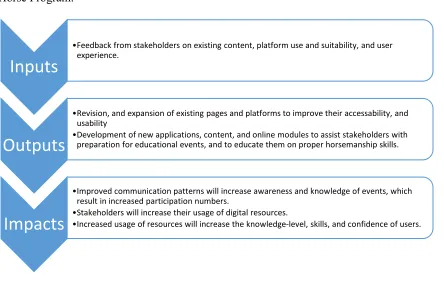
the impact the evaluation is expected to create. Figure one illustrates the application of the
knowledge obtained from this study, and how it could potentially impact the North Carolina 4-H
Horse Program.
Figure 1. Program impact theory model. Anticipated impacts of the NC 4-H Horse Program digital communications evaluation study.
In a commentary published in a 2014 issue of the Journal of Extension, Borden, Perkins, and Hawkey state: “The 4-H Program must...view evaluation as a core implementation task for
all 4-H Programs and projects. 4-H needs to be leading the way in using innovative evaluative
methods to determine effectiveness and improve programming” (p. 3). Determining effectiveness
of current resources and tools and making improvements to the existing structure were two of the
Inputs
•Feedback from stakeholders on existing content, platform use and suitability, and user experience.
Outputs
•Revision, and expansion of existing pages and platforms to improve their accessability, and usability
•Development of new applications, content, and online modules to assist stakeholders with preparation for educational events, and to educate them on proper horsemanship skills.
Impacts
•Improved communication patterns will increase awareness and knowledge of events, which result in increased participation numbers.
•Stakeholders will increase their usage of digital resources.
5 core purposes of this study. According to Chen, “...program improvement remains the ultimate
goal of program evaluation…” (p. 147).
The objective of this research was to use Program Theory-Driven evaluation science to
guide the development of evaluation tools to measure the quality and impact of the digital
content provided to the stakeholders of the North Carolina 4-H Horse Program. Analytic user
data generated by websites and social media platforms are powerful tools to determine the scope
and reach of posted content. Analytics can tell you how many times the information was viewed,
shared, or liked. User traffic is important, but it does not tell the full story. An evaluation of this
nature fills the gap of user impressions and experience. In the case of Cooperative Extension
programs, such as the North Carolina 4-H Horse Program, there are several important research
questions that needed to be answered, which fell into three categories: platform use and
suitability, platform content, and user experience. Because websites and social media platforms
have ubiquitous access, it is impossible to discern if the target audience is being reached without
directly surveying the source.
Research Questions
In order to effectively evaluate content usage and quality, identify unanticipated or
unidentified barriers to platform or content usage, and assess the accessibility of existing digital
platforms, an evaluation study involving stakeholders was needed. Future improvements and
expansion of content and resources will be guided by the findings, and will, therefore, be the
most beneficial and impactful for users.
6 1. Are stakeholders receiving program communications with the current digital platforms:
Extension Equine Husbandry website, Facebook, Twitter, and Instagram? Are social
media posts timely, useful, and reaching stakeholders?
2. Within the website platform in particular, which content and pages are accessed or
used most frequently?
3. Are there digital tools, apps, or social media sites that stakeholders would like to see
used by the NC 4-H Horse Program that are not currently offered?
Platform Content:
4. Do any of the website pages or social media platforms need additional or expanded
content and resources?
User Experience:
5. Have stakeholders experienced any barriers or frustrations when using any of the
digital platforms, and if so, how can they be removed?
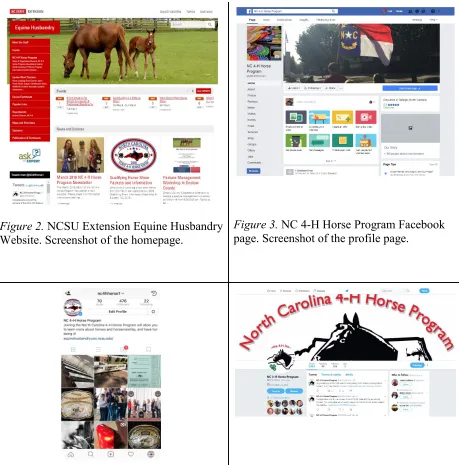
In conjunction with the North Carolina Cooperative Extension Service web portal, the
Extension Equine Husbandry website (see Figure 2.) houses content related to 4-H Horse
Program contests, events, resources, and workshops. The website, email, and social media tools
(Facebook, Instagram, and Twitter) are the primary technological tools used to promote and
7
Figure 4. NC 4-H Horse Program Instagram.
Screenshot of the Instagram profile page. Figure 5. Screenshot of the Twitter profile page. NC 4-H Horse Program Twitter.
Purpose
Meeting the needs of our stakeholders and building a strong and effective program are
two major priorities of the North Carolina 4-H Horse Program. We want to encourage
8 due to a reduction in staff numbers and budget constraints, providing face-to-face training is not
always feasible. Digital tools can help us reach our goals, as long as our volunteer leaders are
aware of their existence and are comfortable using and sharing them. Through this study and its
evaluative nature, an understanding of the needs and reservations of our consumers has been
gained, and now we can develop tools and publish materials that will be useful, effective, and
widely accessed.
Volunteer club leaders that organize and lead youth horse clubs are the primary target
audience of the North Carolina 4-H Horse Program. Volunteer leaders are the backbone of the
organization; they lead, educate, and coach youth. The Extension Equine Husbandry staff that
oversee the North Carolina 4-H Horse Program and its volunteer leaders strive to provide the
most up to date and useful information and tools in order to make involvement in the program as
accessible and enjoyable as possible. Technology and digital tools can help us deliver
information and content, but to what extent is it being used within local clubs? Gathering input
from the leaders revealed topics and materials that they would like to see expanded.
Significance
Through this study, the needs of North Carolina 4-H Horse Program stakeholders were
revealed so State Extension staff can plan and create content that will be beneficial for users. The
program offers numerous contests and events, which require a high level of preparation and
attention to detail. Ideally, time and resources will be spent to expand and improve the content
areas that have the greatest interest and need; the only way to know these needs was to directly
ask the consumers. Website and social media analytics provide a narrow portrait of user activity,
9 measure the quality of the user experience and if it met their needs. A study of this type provided
those answers and the results will be used to guide improvements that are desired.
This study fills a gap in current literature because it specifically evaluates digital content,
using the input of the stakeholders. As previously mentioned, evaluating program quality rather
than program outcomes is also a departure from the norm. Furthermore, there is a limited amount
of research that focuses on evaluating adult volunteer and youth engagement and experience with
digital resources and on digital content quality across Extension platforms. Most of the published
literature on digital technologies in Cooperative Extension focus on Extension personnel’s
adoption and implementation and perceptions of the tools. Digital communication and
information methods are widespread and used throughout all program areas of Cooperative
Extension. In order to be effective communicators and educators with our stakeholders, we must
be aware of their needs, resource and/or technology limitations, and communication preferences,
which requires research and evaluation. This study provided an example of how any Extension
program can apply program theory-driven evaluation to guide an evaluation study of their
programming efforts.
Methods
In order to gather as much information as possible to answer the research questions, a
pragmatic philosophical approach was utilized and the methodology design was Exploratory
Sequential Mixed Methods (Creswell 2014). The study used both qualitative interviews and
quantitative survey data. The design of the study had two distinct phases and each phase received
equal emphasis. In the first phase, the qualitative portion of the research focused on small,
focus-group interviews that were conducted to provide insight, and greater understanding of
10 phase two, the quantitative survey was administered across the state and open to all stakeholders.
The survey also contained open-ended questions that offered stakeholders the opportunity to
provide additional suggestions that were not included in the survey questions. The phases
followed a pragmatic framework, focusing on considering “multiple viewpoints, perspectives,
positions, and standpoints” (Johnson, Onwuegbuzie & Turner, 2007).
Role of the Researcher
According to Chen (1990), “Evaluators should use their expertise, knowledge, and
experience to provide an appropriate agenda for investigation and communicate their views to
key stakeholders” (p. 77). The researcher in this study is an Extension Assistant with the North
Carolina 4-H Horse Program and is responsible for updating and maintaining the Program’s
digital content across all platforms. Prior to obtaining this position, the researcher is a former
4-H’er, volunteer leader and state advisory council member of the North Carolina 4-H Horse
Program. Chen (1990) mentions that “it may be useful for theory-driven evaluators to regard
themselves as one of the stakeholders and to be concerned with doing a useful, high-quality
evaluation” (p. 77-78). Due to the researcher’s close professional and personal ties to the
organization, this was easily accomplished. The researcher served as the mediator for the
focus-group interviews and compiled the data from the interviews to formulate the survey. Applying
Hesse-Biber’s (2010) recommendation, the researcher exercised reflexivity during the focus
group interviews and when writing the survey questions. Reflexivity requires the researcher to
continually be conscious of the “values, attitudes, and concerns” they bring to the study
11
Summary and Overview
Chapter one introduces the study and provides background information on Cooperative
Extension and how evaluation efforts are typically handled. The chapter also introduces the
research problem and questions. The theoretical framework and program theory-driven
evaluation are also highlighted, in addition to the significance of the study. Furthermore, an
introduction to the methodology and the role of the researcher are provided. Chapter two
provides a review of literature related to program theory-driven evaluation, adult learning theory,
diffusions of innovations, and evaluating digital content. Chapter three focuses on the
methodological approaches for conducting the program theory-driven evaluation, using both
qualitative and quantitative methods. Chapter four analyzes the data that was collected and
chapter five discusses the findings of the study, and their implications for the future.
Key Terms
4-H- The youth organization component of the Cooperative Extension service. Members range in age from five to nineteen.
4-H Leader/Volunteer- An individual responsible for organizing and leading a 4-H club of youth, typically at the county level. 4-H volunteers also lead and assist with events at the district,
state and national level.
Cooperative Extension- Cooperative Extension was established by the Smith-Lever Act in 1914. The organization of the Extension Service begins with the United States Department of
Agriculture at the federal level and is disseminated through one-hundred public, land-grant
colleges and universities across the US. “NC State Extension helps create prosperity for North
Carolina through programs and partnerships focused on agriculture and food, health and
12 focuses are: health and nutrition, agriculture and food and 4-H youth development. County
offices house Extension agents.
Evaluation research- “The systemic application of social research procedures for assessing the conceptualization, design, implementation, and utility of social intervention programs” (Rossi
and Freeman, 1993).
Extension agent- An individual, based in a particular county Cooperative Extension office, that delivers programming and information on specific program content.
Focus group- “A group of individuals selected and assembled by researchers to discuss and comment on, from personal experience, the topic that is the subject of the research” (Powell and
Single, 1996, p. 499).
Formative evaluation- A type of evaluation that is conducted to identify the “strength and weaknesses of a program or intervention. Essentially this involves the evaluator gathering
information on program design and implementation” (Clarke and Dawson, 1999, p. 7-8).
North Carolina 4-H Horse Program- A statewide program offered to youth, ages 5-19, through the Cooperative Extension service. Program goals center on educating youth in all aspects of
horse management and care and building leadership skills and content knowledge through a
series of contests, events, and programs. 4-H’ers can participate at the county, district, state,
regional and national level in a variety of educational contests and shows. County programs and
clubs are typically led and organized by adult volunteer 4-H leaders, with the assistance and
guidance of a county 4-H Extension agent.
North Carolina 4-H Horse Program District Advisory Council- The State of NC Cooperative Extension Service is divided into five different Extension Districts: Southeast, South Central,
13 4-H Horse Program Volunteers leaders form an Advisory Council. The Advisory Council
organizes and plans contests (such as horse bowl), horse shows (qualifiers for the state 4-H horse
show) and clinics and retreats for the youth in that district.
Process Evaluation- “An assessment conducted during the implementation of a program to determine if the program is likely to reach its objectives by assessing whether or not it is
reaching its intended beneficiaries (coverage) and providing the intended services using
appropriate means (processes)” (P., 2009, p. 9).
Program theory- A specification of what must be done to achieve the desired goals, what other important impacts may also be anticipated, and how these goals and impacts would be generated
(Chen, 1990, p. 43).
Reflexivity- “Thinking about our research assumptions and becoming conscious of what values, attitudes, and concerns we bring to a given research program” (Hesse-Biber, 2010, p. 60).
14
CHAPTER 2: REVIEW OF LITERATURE Introduction
The purpose of this literature review is to introduce previous research that has been
published that relates to evaluating usage and content, adopting, implementing, and evaluating
programs and digital learning tools. The chapter will begin by providing the history and
development of Theory-Driven Evaluation, and its key concepts and structure of applying it in a
research context. The literature will focus on notable researchers and their definition and
description of evaluation theories and how they will be applied within the context of this study.
In addition, theories of adult learning and diffusion of innovations will be introduced.
The chapter will conclude with an examination of literature which focuses on evaluating digital
content.
Theoretical Framework
Program Theory-Driven Evaluation
Program Theory analyzes how the components of an organization work together to
produce the desired outcome; “evaluators use the program theory to define and prioritize
evaluation questions” (Mertens and Wilson, 2012, p. 63). For this study, stakeholders’
interaction with program digital resources and tools and how their usage impacts their
participation in activities and reaching their goals will be the primary focus (Wholey, 1987). This
particular type of evaluation can be defined as an evaluability assessment. Evaluability
assessments follow specific procedures to plan an evaluation, with the goal of considering
stakeholders’ interests, in order to maximize the usefulness of the evaluation (Rossi and
15 Evaluating and assessing programs and their impact became a prevalent practice during
the 1960s when the United States government began implementing a large number of social
programs designed to improve the health and welfare of the American people (Shadish, Cook
and Leviton, 1991). Due to the level of funding that was provided to run these programs, which
included healthcare, housing, education, and public safety, politicians and citizens pushed for
evaluating these efforts to verify they were being implemented as planned and the funding was
being allocated and spent appropriately. A large number of evaluation efforts taking place
sparked an increase in the number of published books and articles on the topic. In the 1970s,
publications continued to increase, a professional association was formed, and practitioners
developed more refined methods for conducting evaluations (Rossi and Freeman, 1993). During
this time period, the use of theoretical approaches in evaluation methods also started to emerge.
According to Shaddish, et al. (1991), “Evaluation theory tells us when, where, and why some
methods should be applied...and benefits to be expected from some methods as opposed to
others” (p. 34).
One of the earliest theorists and author of one of the most frequently referenced articles
of the time, “The Methodology of Evaluation” (1967, 1972), was Dr. Michael S. Scriven. In the
article, Scriven coined the phrases formative evaluation and summative evaluation. In a 1980 publication, he described how to use these tools to make evaluation efforts more responsive:
Evaluation may be done to provide feedback to people who are trying to improve
something (formative evaluation); or to provide information for decision-makers who are
wondering whether to fund, terminate, or purchase something (summative evaluation) p.
16 The formative evaluation approach will be used in this study, due to its focus on improving the
existing program. Scriven is also known for his use of the term valuing. Shaddish, et al. (1991)
define the steps of the logic of valuing or constructing a value statement as: “select criteria of
merit, set standards of performance, measure performance, and synthesize results into a value
statement” (p. 73). In the context of this research, valuing will be used to measure existing
content for its level of usage, applicability, and relevance, according to the stakeholders. Items
that do not receive adequate levels of usage or are not valued as highly, will be modified or
eliminated.
Lee Cronbach’s publications on evaluation focus on their implementation to study
programs. According to Cronbach (1982), the ideal evaluation study will reveal to stakeholders
what can be expected in regards to new content and modifications that will take place (Cronbach,
1982). He also pronounces that “the greatest service evaluation can perform is to identify aspects
of the course where revision is desirable” (Shadish, et al., 1991, p. 332). Cronbach developed a
notational system for identifying the different elements in an evaluation design: UTOS. U stands
for units, which identifies the population being studied; NC 4-H Horse Program Stakeholders. T
refers to treatments or the future plan for the program; expanded or increased offerings of digital
content. O identifies the observing operations or how the data will be collected; focus group
interviews and electronic survey. S establishes the setting for where the collected information
will be applied; digital communications, website and social media (Cronbach, 1982 and Greene,
2004). Cronbach was a proponent of using the evaluation process as a teaching opportunity:
“Teaching begins when the evaluator first sits down with members of the policy-shaping
community to elicit their questions. It continues during every contact the evaluator has with
17 Another notable researcher, writer, and educator in the field of evaluation is Carol Weiss.
Weiss’ sociology background led her to emphasize how evaluations should be designed to
“measure the effects of a program against the goals it set out to accomplish as a means of
contributing to subsequent decision making about the program and improving future
programming” (Weiss, 1972, p.4). Weiss accentuates in her writing that evaluations should be
usable; the information they collect should be readily applied to identify and influence changes
to improve a program (Weiss, 2004). Weiss was one of the first to promote the use of a mixed
methods design when conducting evaluations, citing their ability to collect data which is
representative of multiple stakeholders’ views (Shadish, et al., 1991). Weiss (1998) implies in
her writing that evaluators should form relationships with the stakeholders, if not already
established, so they can be more receptive and sympathetic to their needs and points of view. In
addition, Weiss is a huge proponent of using evaluation findings to the highest degree, including
instrumental use. Making decisions about program components due to the outcome of evaluation
findings is termed instrumental use (Mertens and Wilson, 2012).
Another researcher that holds views close to Weiss is Michael Quinn Patton. Patton’s
Utilization-Focused Evaluation (1986) is a combination of how to conduct evaluations and how
to apply what is learned in the evaluation results to make decisions and inspire improvements (p.
13). Patton’s literature emphasizes the importance of seeking input from stakeholders when
developing evaluations. When developing an evaluation strategy, the evaluator must take into
careful consideration every step of the process to ensure that the final results will be usable
(Patton, 2004). Patton also uses the phrase “personal factor” to describe the importance of
18 is receptive to their opinions, and is transparent about goals and strategies, there is a higher
chance that the evaluation findings will be put to greater use (Mertens and Wilson, 2012).
Joseph S. Wholey is a self-proclaimed advocate of evaluation utilization, or putting the
information uncovered in evaluations to good use (Wholey, 2004). In his description of program
theory, Wholey (1997) states that it involves identifying resources and activities that the program
provides, the outcomes that are expected and the linkages that connect them together. Wholey is
credited with developing logic models, which are graphics used to illustrate the relationships
involved in program theory: resources, activities, audience, external influences, and outcomes
(Jordan, 2013). Program managers, staff, and sometimes key stakeholders are involved in the
creation of the model (see Table 1.).
Table 1. Steps in developing a logic model. (Jordan, 2013, p. 147).
PROCESS: STEPS IN DEVELOPING A LOGIC MODEL
Step 1. Gather and absorb relevant program information from documents and people. Step 2. Describe the desired outcome space and program’s role in that space.
Step 3. Define specific success criteria for program outcomes and the target audiences.
Step 4. For each criterion, determine program, and non- program factors necessary for success. Step 5. Define activities, outputs and resources needed and iterate.
Step 6. Summarize in a diagram or an organized table with supporting text.
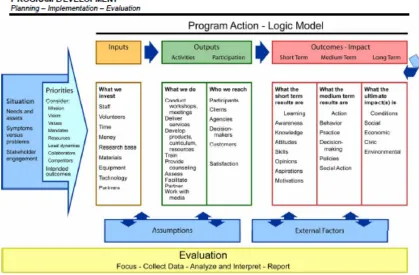
The logic model is made up of three main components: inputs, outputs, and outcomes. Inputs are
the items that are invested and outputs are the activities that are conducted and the participants
that are involved. Outcomes can be subdivided into short, medium and long term impacts. The
long term impact refers to the ultimate goal of the program (Taylor-Powell and Henert, 2008).
Figure seven illustrates a multi-directional logic model of the Wisconsin Cooperative Extension
19
Figure 6. Example Logic Model. University of Wisconsin-Extension logic model for Extension programming. (Taylor-Powell and Henert, 2008, p. 14).
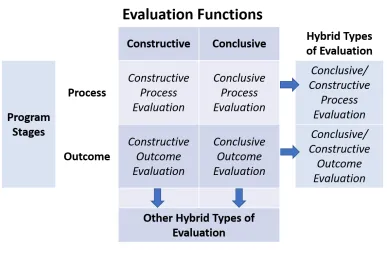
A modern pioneer in the field of evaluation science is Huey-Tsyh Chen. Chen categorizes
evaluations into basic types based on the goals for the process and what information is being
20
Figure 7. Fundamental Evaluation Typology. Huey-Tsyh Chen’s matrix of how program stages and evaluation types can be organized. (adapted from Chen, 2015, p. 10).
This study would be categorized as a hybrid of constructive and conclusive process evaluation.
“Constructive process evaluation provides information about the relative strengths/weaknesses of
the program’s structure or implementation processes, with the purpose of program improvement”
(Chen, 2015, p. 11). One feature of this study focused on identifying ways to expand and
improve digital offerings. On the other hand, conclusive process evaluation surveys the quality
of the implementation of existing content and if it is being accessed and reaching the target
audience. When combined, the conclusive and constructive evaluation type examines both the
integrity of the existing content and methods and seeks recommendations for future improvement
and expansion. Chen also emphasizes the need for evaluators to consider where a program is in
its life cycle, such as planning, initial implementation, mature implementation and outcome
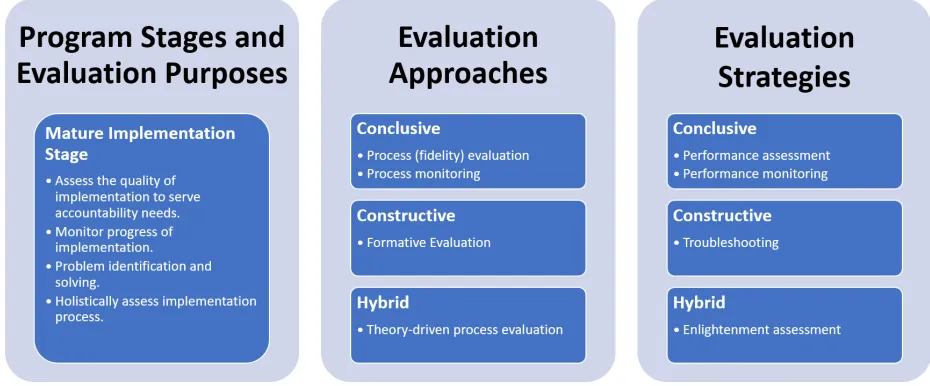
21 digital resources have been used for over five years, this study would be categorized as mature
implementation. Chen provides these descriptors for this stage (see Figure 8):
Figure 8. Evaluation Purposes, Approaches, and Strategies by Program Stage. An evaluation strategy for the North Carolina 4-H Horse Program (adapted from Chen (2015) p. 38).
One interesting feature of the mature implementation stage is the holistic nature of the evaluation
process and its ability to go “beyond assessing the quality of implementation to strengthening the
program processes” (Chen, 2015, p. 40).
In summary, Program Theory-Driven Evaluation was the primary guide in this study for
collaborating with stakeholders, writing evaluation questions, analyzing results, and applying
findings to create changes and improvements.
Diffusion of Innovation Theory
Most research that has been conducted within Extension that relates to the use of digital
tools reference Rogers (2003) and The Diffusion of Innovation Theory. Rogers (2003) states,
“Many innovations require a lengthy period of many years from the time they are available to the
time when they are widely adopted...a common problem for many...organizations is how to
speed up the diffusion on an innovation” (p. 1). In the case of the NC 4-H Horse Program, we
22 Although sharing information and resources via digital methods is not an entirely new process,
there are still some users that are not entirely familiar or comfortable using what is available. The
rate at which digital tools are accepted and utilized can be analyzed using Rogers’ (2003)
characteristics of innovations: relative advantage, compatibility, complexity, trial ability, and
observability. Relative advantage refers to the perception of the user that the tool or method is
better than the one that came before it. Convenience and satisfaction play major roles in how
relative advantage is perceived. If it is relatively easy to use and the user is happy with the
content, they will be likely to adopt and use it. This study aimed to identify ways to reduce
uncertainty, increase familiarity, and promote the benefits. Compatibility refers to how similar
the tool or resource is to older or past methods or experiences. If the level of correlation is high
and there are added or improved benefits or features, users will view it as more compatible and
will be receptive. The factor of complexity and perceived difficulty of usage were examined
closely as this relates to barriers to usage and adoption. Experimenting with and testing an idea
or tool is referred to as trial ability. If users have the opportunity to try out ideas or tools on a
level that is comfortable for them, they will be more likely to embrace and adopt the idea. As a
result of this study, tools that are not used due to lack of comfort and trial ability can be targeted
when face-to-face training is made available; for example, during the NC 4-H Leader’s
Conference and NC Extension Agent Training. “Observability is the degree to which the results
of an innovation are visible to others” (Rogers, 2003, p. 16). If an Extension agent or club leader
experiences success with digital tools and then shares that positive experience with others, it will
be more widely accepted. It is important for success stories to be shared to increase diffusion and
23
Adult Learning Theory
Since this study analyzed how adults use digital tools, some attention needs to be directed
toward the science of how adults learn or andragogy. Malcolm Knowles is cited with introducing
and applying the term andragogy to explain how adult learning is fundamentally different from
pedagogy (Merriam, 2001). The first tenet of Knowles (1984) is the concept of self-directed
learning; adults tend to be less dependent on guidance from a teacher and view learning as a
more exploratory process (p. 43). Learning often takes place in an independent manner. As a
result, “adult education must be primarily concerned with providing resources and support for
self-directed inquirers” (Knowles, 1980, p. 19). Next, the learners’ experience plays a large role
in andragogy. Due to their educational background, careers, or prior organizational involvement,
adults bring to the table a plethora of experiences that can be referenced, which will enrich their
learning experience. Adults gravitate towards active learning opportunities and situations where
they get to learn by doing and applying their new knowledge (Merriam, 2001). The third tenet of
adult learning described by Knowles (1984) is the readiness to learn. Adults are usually most
receptive to learning when they have been placed in a new role or job or are faced with tackling
an unexpected problem, which requires new knowledge. Adults typically learn new ideas,
concepts, or skills because they have a specific purpose or end task in mind that will simplify
their daily routine. Finally, adults’ orientation to learning typically revolves around an internal
desire to be more competent and knowledgeable (Knowles, 1984; Merriam, 2001).
In designing systems to empower and educate adults, one should take into consideration
the history of the adult education movement, the mission of adult educators, and the needs and
goals that should be addressed. Knowles (1980) states that the needs and goals of individuals,
24 program or tool for adult learners. Boone, Safrit, and Jones (2002) also emphasize that in adult
learning theory and education, evaluation is needed for “improvement of [a] program and its
operation” (p. 18). In the context of this study, we were interested in collecting data that will
determine if the digital materials and methods are meeting the needs and goals of our
stakeholders. If they are not, we would like to know what information or tools need to be
modified, added, or deleted that will help them reach their goals. From an institutional
standpoint, we can view this study as assisting NCSU, 4-H, and Cooperative Extension in
achieving the mission of providing the most up to date information and methods to the general
public. This cooperation and collaboration between Extension and the public create a more
educated and adaptable society. If there are barriers to communication or specific needs are not
being met, with the goal of revealing those through this study.
Digital Tools and Communication Measuring Digital Resource Effectiveness
Depending on the organization or business, digital tools and website quality can take on
different meanings and evaluation approaches. Existing research on the best way to evaluate
digital resources provides many different descriptions or qualities to consider. In examining the
different approaches, the goals of this study and the structure of Cooperative Extension, two
research methodologies that are very relevant are Wan (2000) and Aladwani and Palvia (2002).
Wan (2000) states that web quality attributes can be categorized in four ways: information,
friendliness, responsiveness, and reliability. In this study, these attributes were included in both
focus group interviews and the survey. Aladwani and Palvia (2002) developed and validated a
user-perceived web quality instrument. In developing the tools, they discovered that web content
25 aforementioned quality attributes, these dimensions were also included when interviewing and
surveying stakeholders.
Usability evaluation is a measure of how efficiently consumers can access and apply
content that is gathered, in order to achieve learning goals (Usability Evaluation Basics, 2013).
Especially in the case of websites, usability is the key factor to measure. Website designs should
maximize the user’s experience. According to the United States Department of Health and
Human Services website, the information that is presented should have the following criteria:
useful content, usable site that is easy to navigate, design elements that are pleasing to the eye,
easy to locate and navigate, accessible to all learners, and information that is credible and
trustworthy (2018). This study aimed to identify weaknesses in the user experience across all
digital platforms being assessed.
Website communication effectiveness
Denniston and Callahan (2005) conducted a study which measured the effectiveness of
the Colorado State University website to deliver information to 4-H Horse project youth, leaders,
and Extension agents. Their main purpose was to determine the effectiveness of the site at
disseminating information, motivations for accessing the site, and the perceived ease of use. An
electronic survey with fifteen Likert Scale questions was developed and it was disseminated via a
pop-up window that appeared when someone accessed the state website that was being
evaluated. The survey was available to any website user, youth included. The study findings
revealed that users were satisfied with the website and actually preferred obtaining information
via the website in lieu of hardcopy methods. The researchers applied statistical methods,
including frequencies, means, percentages, and standard deviations to analyze the survey
26 similar analytical approach was used. Furthermore, Denniston and Callahan’s (2005)
demographic questions were referenced when building the Qualtrics survey questions. For
example, the researchers solicited information regarding computer experience, the frequency of
use, age, and participation level in the program. Responses to these questions will be extremely
helpful in planning future content.
Volunteer Response to Digital Training Methods
There is very little research that explores the direct relationship between volunteers and
using digital tools to disseminate information. Frendo (2017) used a qualitative approach and the
Theories of Self Determination, Planned Behavior, and Adult Learning to compare thirty 4-H
volunteers’ training experiences that took place in person, partially online, and fully online.
Frendo (2017) selected a qualitative design for her methodology, “because there was no existing
research to compare the effects of medium and synchronicity in training on volunteer
motivation…” (p. 28). Field observations and post-training interviews were the primary data
sources that were utilized. By observing the volunteers during training and interviewing them
about their perceptions of the training, Frendo provided evidence of how Extension can use
computer-mediated training effectively to motivate volunteers and build their confidence to
implement their new knowledge.
Extension Professionals Use of Online Tools
This study not only examined volunteer leaders’, parents’, and 4-H’ers usage and
satisfaction with digital tools, but also that of Extension agents. Robinson (2013) conducted a
study that assessed factors that affected how Ohio Extension professionals use online tools in
their programs. The study revealed that professionals in the Extension community use online
27 large majority of seasoned professionals tend to rely heavily on what is comfortable and familiar
and are less likely to adopt and embrace new systems. Robinson’s (2013) research also revealed
that communication tools (such as email and text messaging), conferencing tools, and social
media were the most often used digital tools by Ohio Extension professionals. Website design
tools, audio tools, and course management tools were used the least frequently. As a result of her
findings, Robinson (2013) suggested that further research should be conducted to determine what
training or workshops should be held in order to increase Extension professionals’ usage of
online tools in their educational programs. Additional research is also needed to identify best
teaching practices within the Extension community. Online methods provide an outlet to
disseminate information in a timely and cost-effective manner, which are important benefits in
the Extension community.
In summary, the mixed-methods approach for this study was heavily influenced by the
writings of Carol Weiss, Michael Patton, and Huey-Tsyh Chen. Building stakeholder
relationships and being receptive to stakeholder thoughts and opinions, and conducting a process
evaluation with the goal of applying results to influence improvements are the major themes of
this study. The three research topics I chose for this study were also inspired by the literature.
Platform content and quality were analyzed based on the factors outlined by Aladwani and Palvia
(2002). Finally, platform use and suitability, and user experience research questions were
selected because the United States Department of Health and Human Services guidelines state
28
CHAPTER 3: METHODOLOGY Introduction
The research methods, design, and planned procedures are the focus of this chapter. An
exploratory sequential mixed methods design was used to collect qualitative and quantitative
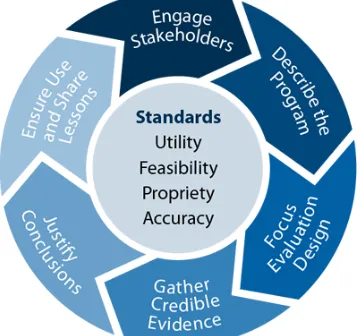
data (Creswell, 2014). The organization of the study mimicked the model adopted by the Centers
for Disease Control and Prevention for evaluating their public health programs (see Figure 9).
Figure 9. Centers for Disease Control and Prevention. Framework for program evaluation in public health.
The outer layer of the model outlines the six steps of the evaluation process that were
conducted. The first two steps involved engaging the stakeholders and describing the program.
Chen (1990) calls this the stakeholder approach because it is “...highly responsive to key
stakeholders’ perspectives, views, ideas, and/or expectations” (p. 66). To complete these two
steps, focus-group interviews were conducted with 4-H Horse Program stakeholders to describe
the focus of the study and the goals. During those interviews, suggestions, and ideas were
gathered to assist in writing survey questions. Mertens and Wilson (2012) state:
“Evaluators often work with advisory boards as a way to get input from representatives
29 national-level study (or a state-level or community-level study, in many instances).
Hence the use of an advisory board can allow for important dimensions of the community
to be represented” (p. 243).
This phase of the study was highly collaborative in nature and the focus-group interviews
revealed the key issues which were applied to develop the evaluation for step three. A key
advantage of using focus-groups is they “allow participants the freedom to raise issues that are
important to them, rather than merely respond to a set of predetermined questions” (Clarke and
Dawson, 1999, p. 77). To supplement and complement the data and feedback from the
stakeholders, a content analysis of the current program content was also conducted. For the
content analysis, the current website and social media content were outlined and summarized. In
addition, Google Analytic data from the different platforms was reviewed to summarize page
views, traffic patterns, and basic user demographics.
Step three involved focusing on the evaluation design. Using the feedback and views
from the focus groups, a Qualtrics survey was developed and distributed to stakeholders. The
Qualtrics survey contained twenty-five to thirty-two nominal and ordinal questions. The number
of questions varied based on responses within the survey. Administering the Qualtrics survey
statewide completed step four, which is gathering credible evidence. In step five, focus group
transcripts, and survey results were examined to justify conclusions. To complete the study and
ensure use and share lessons, the results of the study will be published and presented to
stakeholders and fellow Extension professionals. The results will be used to guide the
improvement and expansion of digital resource content for the North Carolina 4-H Horse
Program. The core of the framework involves four standards: utility, feasibility, propriety, and
30 1. Utility-serve the information needs of the intended users.
2. Feasibility-be realistic, prudent, diplomatic, and frugal.
3. Proprietary-behave legally, ethically, and with due regard for the welfare of those involved and those affected.
4. Accuracy-reveal and convey technically accurate information. (p. 12).
Research Questions
The overarching question of the study was: Are digital communication tools and
resources meeting the instructional and educational needs of North Carolina 4-H Horse Program
adult stakeholders? The previously outlined questions delved deeper into this question and fell
into the three categories of platform use and suitability, platform content, and user experience.
Platform Use and Suitability:
1. Are stakeholders receiving program communications with the current digital platforms:
Extension Equine Husbandry website, Facebook, Twitter, and Instagram? Are social
media posts timely, useful, and reaching stakeholders?
2. Within the website platform in particular, which content and pages are accessed or
used most frequently?
3. Are there digital tools, apps, or social media sites that stakeholders would like to see
used by the NC 4-H Horse Program that are not currently offered?
Platform Content:
4. Do any of the website pages or social media platforms need additional or expanded
content and resources?
User Experience:
5. Have stakeholders experienced any barriers or frustrations when using any of the
31
Design of Study
This study followed the Exploratory Sequential Mixed Methods design QUAL→QUAN
outlined by Creswell (2014).Combining the strengths of both qualitative (QUAL) and
quantitative (QUAN) data collection allowed for a more complete understanding of the research
questions, which aligns with pragmatism.
Data Collection
This project was approved by the Institutional Review Board at North Carolina State
University (Appendix A). Upon IRB approval, data collection began during the fall of 2018 and
ended in the spring of 2019. Focus group participants were recruited via an email message
(Appendix B). The solicitation to participate in the focus group was also shared on social media.
After participants completed the form stating their willingness to join one of the focus group
meetings, additional details were emailed, including a copy of the informed consent letter
(Appendix C). All participants were asked to complete a consent form that was approved by
IRB, and bring it with them to the meeting. The youth participants were required to have a parent
or guardian sign the form (Appendix D). The Qualtrics survey was conducted via an online
portal. Participants were also informed of their rights as research subjects in a cover letter on the
front page of the survey, (Appendix F) which explained the survey and the importance of their
participation. Participation and answers to the survey were completely anonymous, and
voluntary. A written signature waiver of consent, for all participants, was submitted to and
approved by IRB. In lieu of a signature consent, electronic consent was requested and approved.
32
Sample
Phase one was conducted with thirty stakeholders that were recruited through the North
Carolina 4-H Horse Program Newsletter, website, Facebook page, and email correspondence.
The three separate focus groups were composed of a mix of stakeholders (Extension agents,
youth, parents, and leaders), and represented three of the five different Extension districts
throughout the state. A fourth meeting was planned and scheduled but had to be canceled due to
inclement weather. The purpose of meeting with these participants and having them share their
viewpoints was to “provide insight into the research questions and … convince the audience of
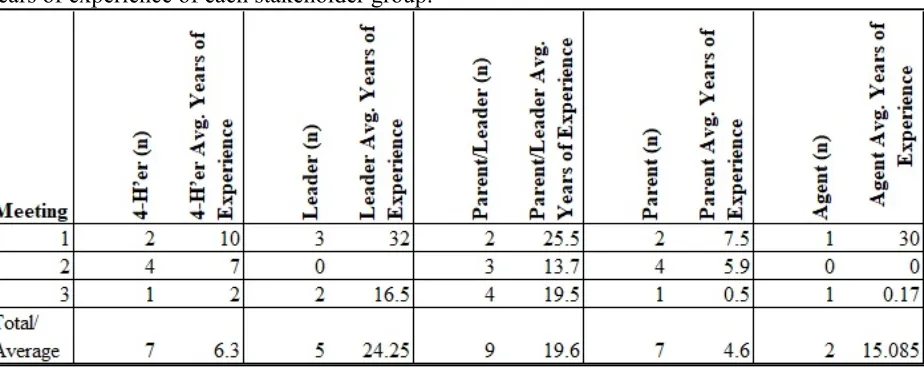
the research” (Emmel, 2013, p. 33). The demographics of the stakeholder participants are
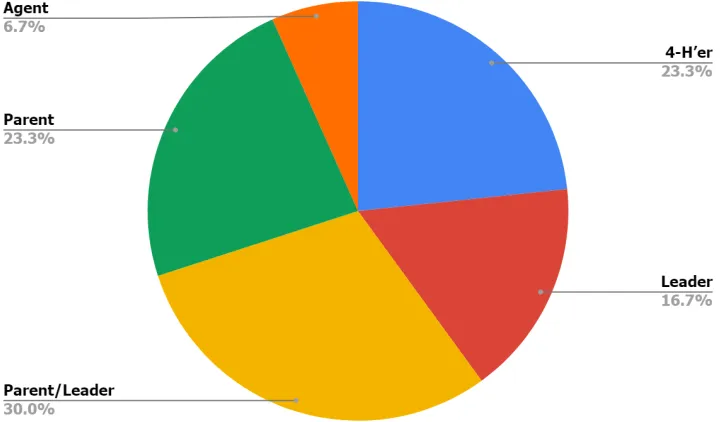
provided in Table 2. Figure 10 illustrates the distribution of representation of the different
stakeholder groups.
33
Figure 10. Focus Group Representation by Stakeholder Group Focus Group. Distribution of representation of the different stakeholder groups that attended the focus group meetings.
Phase two of the study was the state-wide distribution of a Qualtrics survey. The survey
was open to any individual that met the stakeholder criteria, and the access link was shared via
email, social media sites, and the North Carolina 4-H Horse Program Newsletter. North Carolina
4-H has not collected participation numbers based on project area (such as equine or horse) since
2012. For this study, and to also help us implement a new system for distributing information
about horse shows, a brief Google form was shared with the Extension agents and they were
asked them to record answers to the following questions:
1. County
2. Name of Extension Agent in charge of 4-H horse clubs
3. Extension Agent’s email address
4. Number of active 4-H horse clubs in your county
5. Number of active 4-H horse club members in your county
34 On the form, 62 Extension agents reported that they are in charge of 4-H horse clubs in their
county, and eighteen agents completed the Qualtrics survey, which is a 29% response rate.
According to those same agents, there are 100 active horse clubs in the state, comprised of 1,422
4-H’ers (ages 5-18), and led by 251 adult volunteers. Sixty-nine leaders completed the survey,
which calculates to a 27.5% response rate. The response rate calculations for the 4-H’ers had to
be estimated due to lack of data on the breakdown of members based on age. Per IRB, youth
ages 5-10 were not permitted to take the survey. Based on North Carolina’s 4-H Online general
membership database, there are 9,508 members and 42% of those members are 5-10. Using
4-H’s general membership percentages as a guide, approximately 825 of our horse club members
are 11-18. Ninety-one 4-H’ers took the survey, which is an 11% response rate using the
estimated figures previously described. The parent response rate was not calculated due to the
following unknown variables: number of parents in the household, and number of children in the
household active in the program. A summary of the responses of the stakeholder groups is
summarized in Table 3, and Table 4 breaks down the years of involvement that was reported by
35
Table 3. Survey Responses by Stakeholder Group. A summary of the percentage and the number of total responses of each stakeholder group that completed the Qualtrics survey.
Stakeholder Group % of Total Responses n
4-H Horse Club Member (age 11-18) 32.85% 91
4-H Horse Club Adult Leader 24.91% 69
Parent of a 4-H Horse Club Member 35.74% 99
County Extension Agent with 4-H Horse Club Responsibilities 6.50% 18
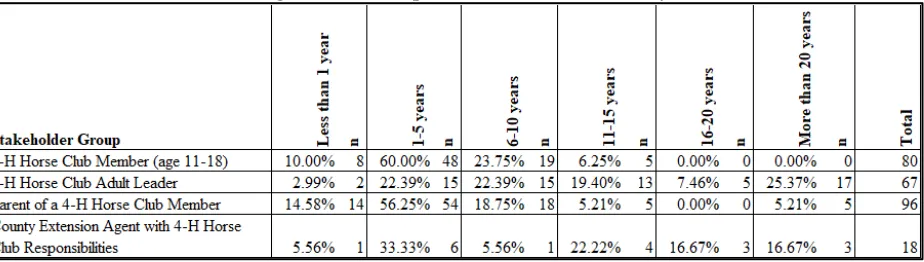
Table 4. Stakeholder Group Years of Involvement Survey Responses.A summary of the percentage and number of responses of each stakeholder group’s years of involvement with the North Carolina 4-H Horse Program that completed the Qualtrics survey.
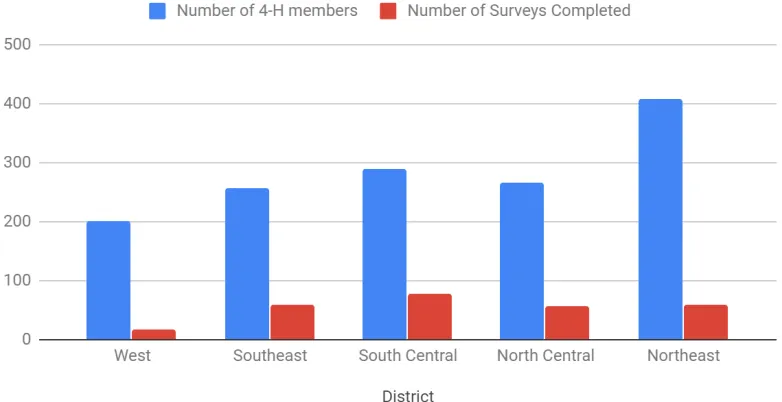
Figure 11 illustrates the distribution of the number of 4-H horse club members and number of
surveys completed based on Extension district. The North Central, Northeast, Southeast and
South Central districts all had similar response percentages, with the West having the fewest
36
Figure 11. Survey Completion Comparison. A comparison of number of surveys completed and number of 4-H horse club members by Extension district.
In addition to the email distribution method, a link and solicitation to participate in the
Qualtrics survey were shared on the 4-H Horse Program Facebook page (see Figure 12), which
has over two-thousand “likes”. Over the course of the twenty-one days, the survey was open,
twelve posts that promoted the survey were made. The Facebook posts reached followers 8,127
times, with 731 engagements, and 55 shares. The survey advertisements on the Twitter feed
collected 232 impressions. In addition to Facebook and Twitter, Instagram promotional posts
37
Figure 12. NC 4-H Horse Program Facebook Page Qualtrics Survey Invitation Post. A screenshot of the initial post inviting stakeholders to take the Qualtrics survey to evaluate the digital tools.
Instrumentation Qualitative
The phase one interviews took place following the protocols outlined by Creswell (2012).
38 one, designed to establish rapport, to questions two through six, which were targeted questions
and those that solicited particular needs. The investigator’s guide for the focus groups is found in
Appendix E. Questions focused on the stakeholder’s experience with digital resources, current
needs, and barriers to usage, training, and tools desired, and preferred platform for the tools.
During the interview process, the interviewer referenced the digital tool or tools with screenshots
to demonstrate or illustrate the questions. All three groups were asked the same interview
questions, which primarily focused on the content and accessibility research questions:
Stakeholder Demographics
Q: Please introduce yourself, tell us in which county you participate in 4-H, how long
you have been involved, and to which stakeholder group(s) to you belong?
Use and Suitability
Q: What suggestions do you have for improving the Extension Equine Husbandry/NC
4-H 4-Horse Program website, including design, information, and functionality?
Q: Are there digital tools, apps or social media sites that you would like to see used by
the NC 4-H Horse Program? Please describe the tool and how you envision it enhancing
the program.
Platform Content
Q: Are you able to find the information you need on the Extension Equine Husbandry/NC
4-H Horse Program website? If not, what is missing or difficult to find?
User Experience
Q: Tell me about a positive experience you have had with the Extension Equine
39 Q: Tell me about disappointments or frustrations you have had with the website or social
media? What made it a negative experience?
Quantitative
The data collected during the focus group interviews served as the foundation for the
development of the online survey. The twenty-five to thirty-two question survey (see Appendix
F.) was developed and conducted online using the Qualtrics survey platform (see Figures 13 and
14.). The survey opened and was shared on January 7, 2019, and closed on January 28, 2019.
Using Dillman’s (2006) recommendation, the survey was reviewed by Extension personnel with
a familiarity with the target population. The reviewer piloted the survey from start to finish and
ensured that the instrument was reliable and all links and communication were working
correctly. The pilot study utilized a variety of platforms: tablets, desktop computers, and
smartphones, to ensure that the appearance was consistent and user-friendly.
Figure 13. Desktop version of the survey. Screenshot of Qualtrics survey presentation on a desktop and/or laptop computer.