REVERSION INSTABILITY
OF
AN EXTREME POLAR MUTANTOF
THE
GALACTOSE OPERON1M. L. MORSE2
Department of Biophysics, University of Colorado Medical Genter and the Webb-Waring Institute for Medical Research, Denver, Colorado 80220
Received February 14, 1967
H E mutation gul-3 of the galactose operon of Escherichia coli (MORSE, LEDER-
BERG and LEDERBERG 1956) has been shown to be a mutant of the extreme polar type (KALCKAR, KURAHASHI and JORDAN 1959; SOFER 1961), making the cells deficient for the three enzymes of the operon. The extreme polar mutants (formerly called Oo) were thought to be changes of the operator region but are now believed to be nonsense mutations in the structural gene proximal to the operator region (
BECKWITH
1964). The gal-3 mutation has been mapped geneti- cally ( ADLER and KAISER 1963) and located in haploid cells either adjacent to orin the gene for the uridine diphosphogalactose epimerase. It is the purpose here to report an unusual aspect of gut-3, its ability to give rise to reversions which yield Gal- with high frequency, such that they resemble the heterogenotes pro- duced by lambda transduction. Mutants with similar properties have been noted in the lac operon of E. coli (COOK and LEDERBERG 1962; SCHWARTZ 1963, 1964, 1965). Preliminary reports of this study have appeared previously (MORSE 1963a, 1965).
MATERIALS A N D METHODS
The mutant studied, W2236, is a derivative of W892, a culture previously described (MORSE, LEDERBERG and LEDERBERG 1956), and has the phenotype F- T h r Leu- Thi- Lac- Gal- ( A ) . The galactose mutation of this strain occurred spontaneously and was isolated on Eosin Methylene Blue (EMB) agar.
Liquid cultures were grown either in Difco penassay broth or tryptone broth. Scoring for ability to utilize carbohydrates and the isolation of revertants was made on either cholate neutral red medium (C medium, MORSE and ALIRE 1958) or upon EMB medium containing the appro- priate carbohydrates. Quantitative measurement of the low reversion rates was accomplished using platings on minimal galactose agar, and for the high rates of instability C medium with galactose was employed.
Extracts for the assay of cellular enzymes were prepared as described previously (MORSE 1963c) using freezing and thawing in the presence of lysozyme. Enzyme assays were performed according to described procedures or modifications: galactokinase was assayed by measuring acid formation with bromthymol blue (SOLS and CRANE 1954), or in the buffer system with cresol red (DARROW and COLOWICK 1962) and relating the rates of acid production to that by wild-type cells. The kinase assays were read in a Beckman DB spectrophotometer using a blank without galactose. The results were recorded on a Photovolt Model 43 recorder. Uridyl phosphogalactose
' Supparled by Public Health Service Grant AI-01345-09. Contribution No. 264, Department of Biophysics ' Cui-eer Development Awardee, U.S. Public Health Service.
332 M. L. MORSE
transferase was assayed according to the procedure of KALCKAR et al. (1!359), which employs coupling to glucose-6-phosphate dehydrogenase. The transferase reaction was started by adding galactose-I-phosphate. The progress of the reaction, reduction of TPN, was recorded in the DB using air as a blank. Undine diphosphogalactose epimerase was assayed according to the one-step procedure of KALCKAR et al. (1959), employing undine diphosphoglucose dehydrogenase from yeast. The reduction of DPN was recorded with the above equipment using air as a blank. Pre- liminary experiments had indicated that spontaneous reduction of TPN, D P N in the transferase and epimerase assays was so slow as to not require correction. Reagents for the above assays were obtained from the Sigma Chemical Company. Enzyme induction was accomplished, where necessary, by growth in the presence of galactose, using fresh growth in the presence of 0.5% galactose for 2.5 hours as a standard procedure.
RES U LTS
The mutant gal-3 reverts to the Gal+ phenotype at a rate of 3.7 x 10-s/bac- terium/division, which is a rate about 20 times higher than that of any galactose mutant previously studied (MORSE 1963b). The revertants are largely of two phenotypes on C medium with galactose: (1) raised colonies with white borders, intermediate in red color; (2) flat-spreading colonies with deep red coloration and no white border to the colonies. The first of these phenotypes, called R1, is produced from the Gal- parent at a probability about 1/25 that of the second phenotype (Table 1 )
.
Many revertants of the RI phenotype are characterized by being unstable and yielding Gal- at a high rate (Table 2). This rate is about 104-fold the rate from Gal- to Gal+ and results in cultures containing 1 to 2% Gal-. The instability appears an inherent characteristic of all the cells in theTABLE 1
Reuersion of Gal,- to Gal+
Number of
Culture cells plated X 108 Total revertants RI phenotype Other phenotypes
1 4.4 43 7 89 348
2 4.8 123 39 84
3 4.8 192 36 156
4 3.2 669 123 546
5 7.2 297 114 183
6 3.2 91 23 51
7 6.0 1 2 0 25 95
8 4.4 47 8 39
9 3.6 247 105 1 42
10 4.8 30 5 25
153 median 38 median 1 19 median
8.6 mean
A protophic derivative of W2236 was divided into ten independent subclones, and, starting with small inocula, mini- mal glucose cultures were grown. Measured samples, assayed for cell numbers by separate p l a h g s on,nutrient agar of these subclones were plated on minimal galactose agar to score for ,Gal+ revertants. The revertants obtiuned after 5 days growth a t 37OC were of two kinds, small colonies and large colomes. Colonies from the platings of each subclone were restreaked on C medium with galactose to classify the revertants as to whether they were. the RI phenotype, o r ,its
TABLE 2
Instabiliiy of three independent reuertants of W2236
Retertant 1 Reiertant 2 Revertant 3 _____
Culture Gal+ Gal- Gal+ Gal- Gal+ Gal-
1 7158 21 2267 39 4284 24
2 5910 51 1745 59 3447 30
3 4860 60 1537 51 2955 24
4 3774 24 1719 51 3297 18
5 7722 21 1726 58 3150 30
6 6213 21 1887 53 4746 42
7 5301 33 1319 41 5637 18
8 4536 54 1829 70 3810 12
9 6498 72 1920 46 4761 6
10 4155 78 2052 42 2205 24
11 2029 54 2391 27
12 2015 75 3393 36
Mean divisions 5656 1890 3702
Median 42 52 24
Mean number
mutations 11.4 & 2.9 13.5 t 2.4 7.3 t 1.5
Mutation rate 2.0 x 1w 7.1 x l e 3 2.0
x
1 e 3Cultures of 0.3 ml volume were started from small inocula containing no Gal- and incubated a b u t 3 hr. Samples of 0.05 ml were then plated on cholate galactose agar. After 24 hr at 37OC the number of Gal+ and Gal- on these plates were counted and the content of the small cultures was calculated. The mean number of mutational events was computed using the method of the median, and the mutation rates (probability per bacterium per division of the change from Gal+ to Gal-) were obtained by dividing mean number of divisions.
unstable revertant culture, for in a series of restreakings of such a culture, all the colonies, either in the first restreaking, or via their progeny in a subsequent restreaking, were found capable of yielding Gal-. The incidence of stable Gal+ cells in the revertant clones must be the order of one in 1000 or less.
The Gal- issuing from the unstable revertants repeat the phenomenon shown by the gal-3 culture of yielding, at approximately the same frequency, Gal+ revertants which yield Gal- at a high rate. These Gal- are similar to gal-3 also, and the entire process has been repeated through 12 cycles of reversion followed by subsequent instability of the Gal+ produced. At each step the unstable Gal+ are produced at a rate of about per bacterium per division, and the Gal- are produced at a rate of about 1
o - ~
per bacterium per division.Biochemical and genetic analyses: The parent gal-3 and a sequence of six cul- tures ( 3 Gal+ revertants and 3 Gal- issuing from them) were examined for their ability to produce galactokinase, transferase and epimerase with and without prior induction with galactose (Table 3 ) . All of the Gal+ (unstable) produced all three enzymes constitutively, but at levels less than that of the fully induced Gal+ reference culture. The synthesis in these strains has therefore been dere- pressed. The Gal- produced by the unstable revertants appear biochemically similar to the W2236 parent culture in that they produce little of each of the three enzymes in the galactose pathway.
334 M. L. MORSE TABLE 3
Enzymatic activity in extracts of the Gal,- culture and six cultures deriued sequentially from it
Cultures
Kinase' Transferase: Gal
phenotype noninduced induced noninduced induced
Epimerasei noninduced induced
W3110 W2236 R2 SR2 RSR2 SRSR2 RSRSR2 SRSRSR2
+
2.8,2.1,2.8,3.8 0.22 <2.26 2.3,0.88 1.2, 1.9
0.0
0.89 1.2
0.08 2.0, 1.4 2.5
0.48 0.08
. . 4.6,4.7,
3.2
0.35 0.0
2.0, 1.9 3.2,4.9
0.24 0.13,0.08
2.6 2.8
. . . 0.01 3.8,2.6 5.1
0.17 0.01
6.9, 10.2
1.1 0.27 14.7 15.7
1.0 0.0, 0.67 5.0 7.6
. . 0.5
4.1 12.7 0.65 0.43
* The results of the kinase assay are given in optical density units per h r per m g protein. t pmoles TPN reduced per hr per mg protein.
t pmoles DPN reduced per hr per mg protein.
Results for W3110 are given for reference. The cultures shown were derived in a sequential manner from W2236; 223- R2+ S E + RSRl + SRSR2- RSRSR2+ SRSRSR2, by reverting the Gal- on cholate galactose medium and by select- ing Gal- issuing from the unstable revertants.
of enzymes, could be the consequence of either a change at the site of repressor action (operator region) or in the repressor itself. The first of these changes could result in a lack of sensitivity to repression, the second a repressor which fails to repress. The genetic location of the above changes would be at quite different places, the operator region being a portion of the gal operon and the regulator gene for this operon being located near the gene affecting lysine synthesis, some 38 minutes (clockwise) from the site of its activity (BUTTIN 1963a, b; TAYLOR
and THOMAN 1964).
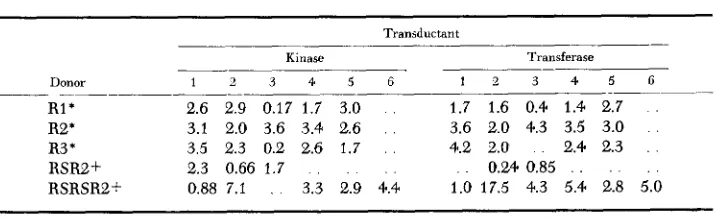
The site of the changes to constitutive production of enzyme shown by the Gal+ cultures in Table 2 can be localized by making transductions from them
TABLE 4
Enzyme actiuity in extracts of transductants formed between the unstable reuertants and a kt recipient culture
Transductant
Transferase
-
Kinase
Donor 1 2 3 4 5 6 1 2 3 4 5 6
R1* 2.6 2.9 0.17 1.7 3.0 . . 1.7 1.6 0.4 1.4 2.7 .
R2* 3.1 2.0 3.6 3.4 2.6 . . 3.6 2.0 4.3 3.5 3.0 . .
R3 * 3.5 2.3 0.2 2.6 1.7 . . 4.2 2.0 . 2.4 2.3 . .
RSR2+ 2.3 0.66 1.7 . . . . . . . 0.24 0.85 . . . . . .
RSRSR2+ 0.88 7.1 . 3.3 2.9 4.4 1.0 17.5 4.3 5.4 2.8 5.0
__ _ _ _ _ ~ _ _ _ _
* R1, R2, R3 are independent reversions derived from W2236.
.t The first (RSRB) and second (RSRSW) reversions derived sequential from R2.
with phage lambda which is restricted to transducing genes in the vicinity of the
gal region. Thus any changes to derepressed enzyme production as a consequence of a change in the regulator gene will not be transducible via lambda. Transduc- tions were made via lambda from the cultures to a kinaseless transferaseless (k-t-)
recipient synthesized by recombination, and the resulting heterogenotes were examined for ability to produce kinase, transferase and epimerase constitutively. The results, shown in Table 4, indicate that in each case transductants were formed which produced the three enzymes constitutively. Transductants formed by transducing from a repressed wild-type culture of the same kt- recipient did not produce kinase or transferase constitutively. Thus the site of the change to derepressed production of the enzymes of the gal operon is in the material trans- duced by lambda and presumed to be in the operator region.
The Gal- mutants shown in Table 3 produce little of the three enzymes neces- sary for galactose utilization, and they resemble the polar mutant parent of the series. Genetic identity with the parent, and among themselves, was tested via low frequency transduction with the phage lambda. The results indicated that there are no differences between the polar mutants, as detected by the formation
of wild-type transductants. However, it should be noted that in low frequency transduction there are only the order of several thousand transducing particles per ml, and that the revertibility of the polarity mutants is rather high, such that the formation of a small number of wild-type recombinants would not be detected. The identity of polarity mutants will be examined in future experiments in a sequence derived in a n Hfr strain.
Growth studies: The unstable lac suppressor mutation studied by SCHWARTZ (1964) produced a profound change in the cell, and resulted in a change in the generation time of the cells from 35 to 63 minutes in nutrient broth. The changes being dealt with here are not of such a profound nature since the growth curves
of the parent and of some derivatives
(4
Gal+ and 4 Gal-, derived sequentially) in nutrient broth indicate identical generation times.Aflect of acridine: Acridines have been shown in some instances to cause the loss from the cell of episomes, for example, of the
F
factor fromE.
coli (HIROTA1960). In the case of lac instability studied by SCHWARTZ, because of the action
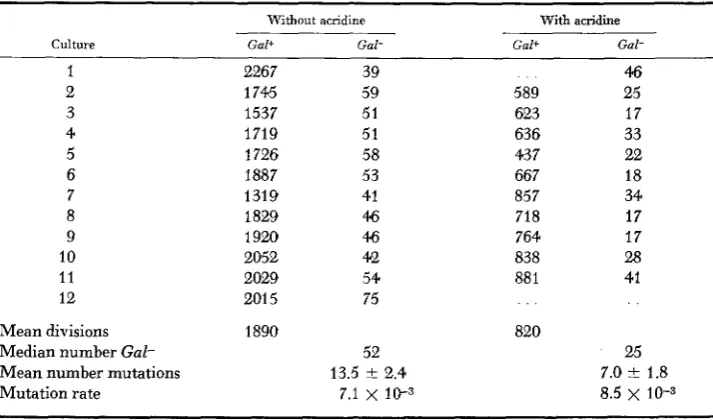
of acridine in accelerating the formation of stable colonies, it was concluded that the suppressor was located on an episome. I n the case of the unstable Gal+ revertants, there appears to be no action by 9-amino acridine on instability (Table 5 ) . and thus it appears that in this case the reversion is not associated with an episome acted upon by acridines. In addition, mixtures of the unstable
F- Gal+ with an
P
Gal- Str' failed to show transfer of the Gal+ character to theF- Gal- Strr tester strain.
Relationship to amber mutation suppressors: Many of the threonine, leucine, thiamine requiring strains of E . coli K-12 contain suppressors which permit the growth of amber mutants of T4 (EPSTEIN et al. 1963). A sequence of seven Gal+ revertants and seven Gal- derived from them, and the parental W2236 were used
336 M. L. MORSE
TABLE 5
The lack of effect of acridine on the production of Gal- by an unstable revertant
Without acridine With acridine -
Culture Gal+ Gal- Gal+ Gal-
1 2267 39 4.6
2 1745 59 589 25
3 1537 51 623 17
4 1719 51 636 33
5 1726 58 437 22
6 1887 53 667 18
7 1319 41 857 34
8 1829 46 718 17
9 1920 46 764 17
10 2052 42 838 28
11 2029 54 88 1 41
12 201 5 75
Mean divisions 1890 820
Median number Gal- 52 25
Mean number mutations 13.5
*
2.4 7.0 f 1.8Mutation rate 7.1 X lIF3 8.5
x
10-3The technic was the same as in Table 2 except that 9-amino acridine (2 X i o - 4 ~ final concentration) was added to one set of cultures. The acridine slowed the growth rate such that 0.43 as many divisions occurred in its presence as in its absence. No effect was observed in other experiments at lower concentrations of acridine.
approximating 0.3 to 0.9 that of CR63 and with no apparent significant variation between cultures. It is concluded that the changes in the galactose operon being observed are not related to the presence or absence of the amber suppressors. Like- wise several T4rZZ mutants were assayed on lambda lysogenic derivatives of some of the Gal+ and Gal- and all failed to grow.
Miscellaneous: The parental strain was
F-
Lac- Thr- Leu- Thi- (A). In this study it was necessary to make a number of derivative strains involving changes in these characters. During the derivation of these strains the following was noted:(1 ) curing the parental strain of lambda did not change the ability of the strain to form unstable revertants or the rate of instability of these revertants; (2) lysogeny with lambda of an unstable revertant derived in a lambda-sensitive
strain did not affect its stability; (3) addition of the F factor did not change the ability of the strain to give rise to unstable revertants; ( 4 ) a n
Hfr
strain isolated from an unstable revertant was as unstable as F- or F+ unstable revertants; ( 5 ) reversion of the lac, thr, leu markers was not accelerated in a strain unstable for the Gal+ character; (6) an unstable revertant did not produce auxotropic mutantsat a high rate.
DISCUSSION
enzymes of the galactose operon constitutively, and that the siie of the reversion is near the gal region.
The nature of the reversion to Gal+ remains to be demonstrated, but several models can be proposed and excluded. For example, a model dependent upon the existence of a mutator gene in the culture (TREFFERS, SPINELLI and BELSER 1954; SKAAR 1956) can be made. Against this proposal is the stability of the other genetic characteristics of the strain (thr, leu, lac, h, and the parental gal-3 itself) which is the same order as other strains in the laboratory, and there is no evidence indicating that this strain mutates to auxotrophy at a higher rate than any other strain. An explanation based on an “error-prone” DNA replicating enzyme is also excluded by the genetic stability of this strain.
The presence or absence of other factors. considered episomal, in the cell can also be excluded as an explanation. The presence of the bacteriophage lambda is not relevant since the basic phenomenon, i.e., instability of a class of revertants, can be repeated in gal-3 derivatives which have been “cured” of lambda lysogeny. Thus, an explanation based on transductions to self by phage lambda, an idea which prompted the study of this extreme polar mutant initially, cannot be employed here.
The fact that the
F
factor can be varied also eliminates another explanation. It has been proposed (NAGATA 1963) and that in F- cells, chromosomal replication commences at sites chosen at random, where in Hfr cells, replication commences at only one site, that of the integrated F factor. If the gal region of the unstable culture contains some rearrangement such that the replication enzyme, com- mencing once in a thousand times at the gal region, is caused to make errors, then instability might be apparent. Instability would disappear if a fixed site of replication was introduced into the cell. This can be acccomplished, according to NAGATA, by introducing an integrated F factor into the chromosome. An Hfrderivative which transfers methionine as an early marker was obtained in W2236, and the stability of its R1 revertants examined. These revertants were in no way different from R1 revertants of W2236 itself. Thus an explanation based on this model is not possible.
Instabilities associated with the presence of a n episome, or an episome to which was attached a duplication, have been proposed as an explanation for phenomena similar in some respects to that shown by gal-3 (DAWSON and SMITH-KEARY
1963; AMES, HARTMAN and
JACOB
1963; SMITH-KEARY and DAWSON 1964; SCHWARTZ 1965). In at least one of these cases (SCHWARTZ 1965) acridine orange was found to affect stability. No effect of 9-amino acridine on the rate of produc- tion of Gal- from the unstable Gal+ was noted in the present study.The high frequency of instability (1 O-3/bacterium/division) might be more easily explained on the basis of a recombinational event rather than mutation. A model based upon recombination between duplicated segments similar to the case of Bar eyes in Drosophila (STURTEVANT 1925) can be considered. The event that formed the gal-3 mutation was a duplication of some material of the gal
338 M. L. MORSE
the duplicated segments causing reversion of phenotype. During growth of the cells with a single reverted segment there is recombination between segments to yield the parent mutant type with two nonaltered segments (gul-3 phenotype) and a reciprocal recombinant type >with two altered (reverted) segments.
The mutant type with two reverted segments might be more strongly wild in character than the R1 revertant. Such a model could explain the observations if
it be argued that the non-R1 revertants represent the recombinant with two reverted segments. However, the formation of the parental gal-3 phenotype in the unstable R1 revertants would always be accompanied by the formation of a stable non-R1 clone. The results on stability indicate that the frequency of occurrence of stable Gal+ in the unstable clones is less than 1-1000, an argument against this model. However, the model assumes equivalent viability for the recombinants, and if this not be the case then the difficulty can be circumvented. A corollary of this model is that the gul-3 mutation itself is unstable and produces some other phenotype. In the absence of knowledge of this phenotype, it might be difficult to detect. However, there is some evidence for instability in W2236 (see below). The presence of duplications may possibly be detected in experiments in prog- ress which are measuring the cotransduction frequency of mutations on the out- side of the gal region. The “stretching” between outside mutations introduced by the duplicated genetic material present might result in lowered cotransduction frequencies. In addition, if the basis for the instability is a recombinational event, introduction of the rec- gene (CLARK and MARGULIES 1965), which pre-
vents recombination, into the unstable clone might cause a decrease in instability. It may be possible to test this hypothesis if a rec- gene can be introduced into W2236 or into one of the unstable cultures.
During the later stages of this study, W2236 and some of the reversions of W2236 were examined accidentally at 42.5”C. It appears that under these con- ditions mutation to and from isoleucine requirement at a rapid rate can be demon- strated in some of the cultures studied. These results suggest the presence of a suppressor or regulator gene for threonine deaminase in the vicinity of the gal
operon. Independent results suggesting this have been presented ( EGGERTSSON and ADELBERG 1965). The relationship of the threonine deaminase suppressor- gene locus to the phenomena described above remains to be clarified.
Note added in proof: HILL and ECHOLS (1966) als3 note instability of gaZ-3 revertants.
S U M M A R Y
339
L I T E R A T U R E C I T E D
ADLER, J., and D. KAISER, 1963
duction with phage P i . Virology 19: 117-126. AMES, B. N., P. E. HARTMAN, and F. JACOB, 1963
lation of histidine biosynthetic enzymes in Salmonella. J. Mol. Biol. 7: 2342. BECKWITH, J. R., 1964
Mapping of the galactose genes of Escherichia coli by trans- Chromosomal alterations affecting the re@-
A deletion analysis of the Lac operator region i n Escherichia coli. J. Mol. Biol. 8 : 427-430.
MQcanismes rkgulateur dans la biosynth6se des enzymes du mktabolisme du galactose chez Escherichia coli K-12. I. La biosynthhse induite de la galactokinase et l’induc- tion simultanks de la dquence enzymatique. J. Mol. Biol. 7: 164-182.
-
1963b Mkcanisme rkgulateur dans la biosynthhse des enzymes du mktabolisme du galactose chezEscherichia coli K-12. 11. La dCterminisme gknktique de la &gulation. J. Mol. Biol. 7: 173-205.
Isolation and characterization of recombination- BUTTIN, G., 1963a
CLARK, A. J., and A. D. MARGULIES, 1%5
COOK, A., and J. LEDEXBERG. 1962 Recombination studies of lactose nonfermenting mutants of
DARROW, R. A., and S. P. COLOWICK, 1962 Hexokinase from Baker’s yeast. pp. 226-235. Methods in Enzymology, V. S. P. COLOWICK and N. 0. KAPLAN, editors. Academic Press, New York. DAWSON, G. W. P., and P. F. SMITH-KEARY, 1963 Episomic control of mutation in Salmonella
typhimurium. Heredity 18 : 1-20.
EGGERTSSON, G., and E. A. ADELBERG, 1965 Map positions and specificities of suppressor muta- tions in Escherichia coli K-12. Genetics 5 2 : 319-340.
EPSTEIN, R. H., A. BOLLE, C. M. STEINBERG, E. KELLENBEXGER, E. BOY DE LA TOUR, R. CHEVALLY,
R. S. EDGAR, M. SUSMAN, G. H. DENHARLYF, and A. LEILAUSIS, 1963 Physiological studies of conditional lethal mutants of bacteriophage T4D. Cold Spring Harbor Symp. Quant. Biol.
28: 375-394.
HILL, C. W., and H. ECHOLS, 1966 Properties of a mutant blocked in inducibility of messenger RNA for the galactose operon of Escherichia coli. J. Mol. Biol. 19 : 38-51.
HIROTA, Y., 1960 The effect of acridine dyes on mating type factors in Escherichia coli. Proc. Natl. Acad. Sci. U.S. 46: 57-64.
KALCKAR, H. M., K. KURAHASRI, and E. JORDAN, 1959 Hereditary defects i n galactose metab- olism in Escherichia coli mutants. I. Determination of enzyme activities. Proc. Natl. Acad. sci. U.S. 45: 1776-1786.
populations. Genetics 49: 264-285.
Instability among reversions of a galactose mutant of E. coli K-12. (Abstr.) Proc. Soc. Gen. Microbiol. Spring Meeting. - 1963b Reverse mutation among galac- tose mutants of Escherichia coli. J. Bacteriol. 8 5 : 244245. - 1 9 6 3 ~ Galactose muta- tions of Escherichia coli K-12 not amenable to lambda transduction. Genetics 48: 835440.
__ A mutant of the Gal operon yielding unstable reversions. (Astr.) 9th Annual Meeting Biophysics Society, p. 91.
Transductional heterogenotes in Escherichia coli. Genetics 41 : 758-779.
An agar medium indicating acid production. J. Bacteriol.
The molecular synchrony and sequential replication of DNA in Escherichia
deficient mutants of Escherichia coli K-12. Proc. Natl. Acad. Sci. U.S. 53: 451-459.
Escherichia coli K-12. Genetics 47: 1335-1353.
LEA, D. E., and C. A. COULSON, 1949
MORSE, M. L., 1963a
The distribution of the numbers of mutants in bacterial
1965
MORSE, E. L., E. M. LEDEXBERG, and J. LEDERBERG, 1956
MORSE, M. L., and M. L. ALIRE, 1958 76: 270-271.
NAGATA, T., 1963
340 M. L. MORSE
SCHWARTZ, N., 1963 Nature of ethyl methane sulfonate induced reversions of lm-mutants of Escherichia coli. Genetics 48: 1357-1375.
-
1964 Suppression of a Lac00 mutation in Escherichia coli. J. Bacteriol. 88: 996-1001. - 1965 Genetic instability inEscherichia coli. J. Bacteriol. 89: 712-717.
SKAAR, P. D., 1956 A binary mutability system in Escherichia coli. Proc. Natl. Acad. Sci. U.S. SMITH-KEARY, P. F., and G. W. P. DAWSON, 1964 Episomic suppression of phenotype in
SOFER, R. L., 1961 Enzymatic expression of genetic units of function concerned with galactose
SOLS, A., and R. K. CRANE, 1954 Substrate specificity of brain hexokinase. J. Biol. Chem. 210:
STURTEVANT, A. H., 1925 The effects of unequal crossing over at the Bar locus in Drosophila.
TAYLOR, A. L., and M. S. THOMAN, 1964 The genetic map of Escherichia coli K-12. Genetics TREFFERS, H. P., V. SPINELLI, and N. 0. BELSER, 1954 A factor (or mutator gene) influencing
42: 245-249.
Salmonella. Gen. Res. 5: 269-281.
metabolism in Escherichia coli. J. Bacteriol. 8 2 : 471-478. 581-595.
Genetics 10: 117-147.
50: 659-677.