Abstract
In modern Georgia it is easy to start a business due to simple registration proce
-dures. Many entrepreneurs use this opportunity to start their own venture, but the attempts are often unsuccessful. The article analyzes the differences between en
-trepreneurs with the previous start-up experience and first time company founders to highlight positive effect of education, experience and knowledge on start-ups. To better understand entrepreneurs needs for information, in 2015-2016 structured questionnaire with open and closed ended questions was conducted among ran
-domly selected Georgian companies. The research defines that previous start-up experience as well as education, knowledge and the same industry work experi
-ence have significant effects on the success of start-up of a new venture. Keywords: Business Venture, Education, Experience, Georgia, Knowledge, Start-up JEL: H13
Establishing start-up in Georgia is an easy procedure. This is one of the reasons for many enthusiasts to try to establish their own company. Entrepreneurship is not an easy task and according to data provided by statistics department of Georgia for June 1 of 2015, out of 602668 registered business enti
-ties, only 116486 are currently active. Accordingly, only 20% of the ventures were able to cope with the market environment. One of the important components for the start-up success is the investment of experience and knowledge. Study focuses on these two important factors. Research aims to study en
-trepreneurs with and without previous experience/knowledge. The purpose of the article is to highlight positive effect of the knowledge and experience on ventures.
Study underlines essential importance of the experience and education for start-ups, and defines that on the basis of experience and knowledge better outcomes can be reached, as the two factors are important components for rational de
-cision making, which is critical characteristic for any start-up founder.
Introduction
Khatia KOBERIDZE*
Analysis of Knowledge and Experience Effect on
Start-up Success in Georgia
kose, 2013) the most common reason for starting business in Georgia is to become self’s own boss while participants agree that they did not have previous experience or relevant educa
-tion for starting the business. Some entrepreneurs may con
-sider that money is the most important element for the success of the start-up, while study by Pofeldt (2014) identifies the op
-posite. As study defines, money cannot ensure success of the venture, but vice versa, it may become obstacle for reaching success. Study highlights the importance of rational behavior; as excessive money supply can lead to neglecting important issues requiring further analysis, which emerge in start-up pro
-cess.
According to Aleksandre Laliashvili (2013) education level in Georgia is generally quite low. Study shows that education level in Georgia is lower than in our neighbor countries and presents comparison with Armenia. This study by Laliashvili presents that only 44 percent of business founders have bach
cannot be measured. The only way to measure them is to define/calculate their effect on company success. West et al. (2009) develop an idea that in most cases founders start busi
-nesses in industry they have previous experience in. Gomb
-ers, Konver, Lerner and Scharfstein (2006) conduct a research to define the effect of the founder’s previous experience on current start-ups. In most cases, it is observed that an entre
-preneur got his/her business idea, while working with the pre
-vious employer. Moreover, it is identified that predictable suc
-cess rate, in first time entrepreneurs, is 20.8 percent, while the same indicator in case of entrepreneurs with previous start-up experiences is 25.0 percent.
According to Papiashvili, Ghlonti and Koberidze (2015) students with the entrepreneurial education are likely to start their ventures after graduation. As survey respondents sug
-gest having skills and knowledge is important to be successful in their start-ups. 78 percent of the questioned random sample indicate to have willingness for starting business. Education is the important component of knowledge, as well as trainings, career development and so on. Effective management can be accomplished only through understanding the knowledge. In modern society, as the study of entrepreneurship advances, it becomes essential that “every business is knowledge busi
-ness” (Allee, 2002, p.1), as the relevant knowledge is one of the key elements for the company success.
In World Bank (Kuriakose, 2013) research, surveyed par
-ticipants (Georgian entrepreneurs) indicate that they consider previous work experience and knowledge as important el
-ements for success in business. Moreover, according to the principles of rational behavior, knowledge and experience are the components for making rational decisions, which is essen
-tial for every entrepreneur.
Methodology
Purpose of the research is to describe the entrepreneurship in terms of knowledge and experience. Survey conducted in the article links experience/education with the start-up suc
-cess, and moreover identifies the effect of previous start-up experience on current start-up. Sample for the study is chosen randomly. Survey was sent out to company founders, listed in public register of Georgia – napr.gov.ge.
Questionnaire was sent out to 150 entrepreneurs in 2015-2016. Sample size was calculated with confidence interval 95 percent and margin error of 8. Response rate was 70 percent, as 105 respondents filled in the questionnaire. Questionnaire was designed to highlight the company history and respon
-dents’ demographics. Survey aims to highlight experience and
knowledge level of the respondents and discusses the param
-eters in terms of their effect on companies.
The questionnaire consisted of 14 questions, with open ended and close ended questions. Questions were determined based on the literature analysis. Analysis of the survey is con
-ducted using SPSS and Microsoft Excel.
Results
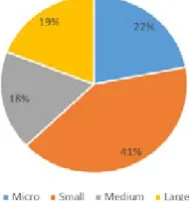
Company demographics are essential for further analysis. Survey included company turnover and employee number, combination of the parameters defines company sizes (Figure 1). Thus, the most part of surveyed enterprises is small and medium sized (SMEs). In terms of age, most companies are young, that is being in business 1-3 years (29,5 percent) and 3-5 years (29,5 percent).
Survey also analyzed enterprises in terms of funding. About half of the surveyed companies (48.6 percent) indicate that they funded their business with personal saving. There
-fore, personal savings can be identified as primary source for funding of start-up in Georgia. Bank loans were used by 18.1 percent of the entrepreneurs and 16.2 percent of companies were funded by friends and family funds. 5.7 percent of the respondents did not use any start-up funding because their start-ups were of an intellectual nature. 10.8 percent of the respondents funded start-ups with other sources, like microfi
-nance organizations, angel investors and so on.
The next part of survey included questions of owners’/ managers’ age, gender and educational level (Table 1). As observed most of survey participants possessed master and bachelor degree; 63% are male and 37% female. In terms of age most participants are between 24-55 years.
Figure 1. Surveyed Company Distribution According to Their Size
Survey participators were asked to define importance of their previous education and work experience for start-ups (Ta
-ble 2). Both questions were close ended and entrepreneurs were given ability to range work/education relevance.
Study defines that 54 participants (51.43 percent) of the survey indicate that their education/work experience strongly corresponds to the field their company operates in. Through the combination of both parameters (education relevance and work experience relevance) it was defined that 38 participants (36 percent) assume that their previous work experience as well as the education is relevant to the sphere of operation of their current start-up. To better understand interdependency between education relevance and previous work experience relevance correlation coefficient is calculated, which is 0.5. Correlation coefficient shows that there is moderately positive interdependency between these two variables (education rele
-vance and work experience rele-vance). Accordingly, it can be assumed that if entrepreneur has education relevant to his/her start-up operating sphere, it is more likely for him/her to have previous experience of working in the same sphere. Highlight
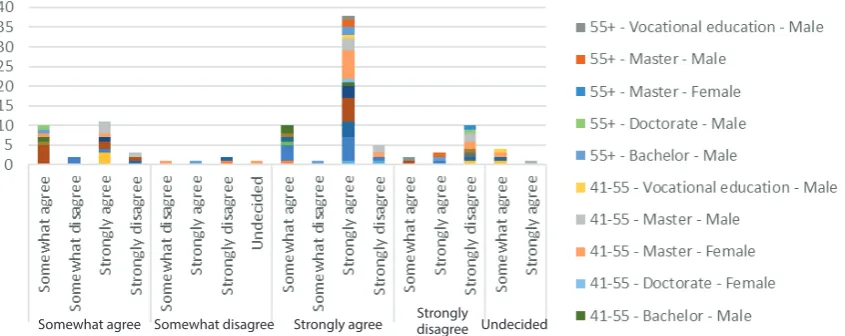
-ing of this two parameter interdependency is important as we can conclude that entrepreneurs with the relevant education, strive to get experience in the relevant field before starting their own company and vice versa. Figure 2 describes education/ experience distribution according to the participants’ demo
-graphic characteristics (age, gender, education).
To better understand the effect of experience/education, participants were asked to indicate if they were involved in start-up set up processes and in particular what was their con
-tribution to start-up. 60 percent of the surveyed participants indicated that they highly contributed to start-up set up pro
-cess, 19 percent indicated somewhat high, 4.8 percent could not decide whether or not he/she participated in business set up process. Only 16.2 percent participants in total indicate that their participation level was either somewhat low or very low in starting the business.
Afterwards, surveyed entrepreneurs were given open end
-ed question, with multiple choice options to define their partic
-ular contribution to the company. Most part of the participants (65 percent) participated in writing business plan, 65 percent participated in registration process. 61 percent of the surveyed company founders indicate that they participate in information collection process. According to the study, 59 percent defined their role in start-up as its funding. 52 percent indicate they helped in office organizing and 50 percent indicate they par
-ticipated in recruiting. These are the main trends identified by entrepreneurs, in terms of their contribution to start-up. Some small percent of the survey respondents indicated their partic
-ipation in other start-up activities, like: choosing software for company, organizing sales, market study, employee training and so on. Through the analysis of the Figure 3 it can be de
-fined that entrepreneurs with the previous experience/educa
Survey also tries to identify how previous start-up experi
-ence can affect the new venture. Around half - 43 out of 105 participants (41 percent) admit that this is not their first start-up. Most common reason for start-up failure identified by 18 percent of the respondents is insufficient management. Insuf
-ficient management can be interpreted as a result of irrational decision making. Moreover, approximately 12 percent of par
-ticipants indicated lack of experience as the reason of failure.
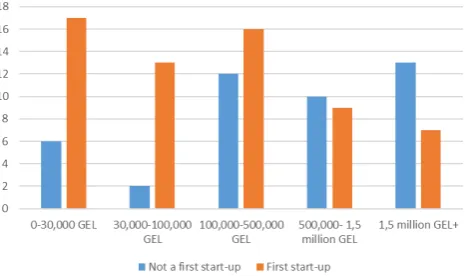
Analysis of the previous start-up experiences present in
-teresting picture (Figure 4). There is correlation between start-up experience and company’s turnover. Accordingly, it can be defined that entrepreneurs who gained experience/knowledge from previous start-ups are more likely to be more successful in the next start-ups, in comparison with the first time entre
-preneurs.
Therefore, conducted survey proves the idea developed in literature review. Education as well as previous knowledge/ experience is important component for the start-up success. In Georgia, trend of starting own business is very popular, which is also proved through the study conducted by World bank (2013) and survey conducted by Papiashvili et al. (2015). The trend is mostly motivated by Georgian mentality for being one’s own boss. However, above studies confirm that not all of entrepre
-neurs have enough skills for start-up. Our survey included en
-trepreneurs with various background, experience, knowledge and level of education. Participants with and without previous experience, knowledge and education were surveyed, in order to highlight the effect of education and previous experience on start-up as accurately as possible. Through the analysis of the survey, critical importance of previous knowledge is identified, as entrepreneurs with the relevant education/experience tend to be more involved in start-up activities, than entrepreneurs Figure 4. Previous Start-up Experience Effect on Company Turn
-over
Figure 3. Education/Previous Work Relevance Analysis in Correspondence with Start-up Contribution
without relevant background. Moreover, Entrepreneurs with the previous start-up experience tend to own higher turnover ventures, in comparison with first time entrepreneurs.
Conclusion
Starting business is the popular trend in Georgia, but business failure rate is also quite high. Through Georgian company analysis, it is identified that first three years are most critical for any venture, thus start-up stage failure rate is relatively high. The reasons for venture failure vary, but current study focused on knowledge/experience effect on start-ups. Literature review as well as conducted survey proved that there is positive cor
-relation between education/experience and start-up success and further business operation.
Our research is based on case study among randomly se
-lected business owners. Study confirms that education/expe
-rience background is an important resource of skills required for start-up, confirming it through entrepreneurial involvement into start-up activities and start-up turnover comparison chart.
Survey showed that more than a half of the participants have previous work experience or education of the relevant field, before starting their own business. Meaning that entre
-preneurs tend to realize benefits of previous experience before starting own venture. But still analysis of the Georgian mar
-ket present that overall education/experience level in start-up owners is quite low.
Based on the analysis of existing situation in Georgia, it is clear that more effort should be made to increase the level of business education in order to promote start-ups and SMEs development. As entrepreneurs with the previous experience/ education are more involved in start-up activities and take con
References
Allee, V. (2002). The future of knowledge. Routledge, USA. Gombers, P., Konver, A., Lerner, J., & Scharfstein, D. (2006). Skill vs. luck in entrepreneurship and venture capital: evidence from serial entrepreneurs. Harvard Business School Working
Paper, 9 (28).
Kuriakose, S. (2013). Fostering entrepreneurship in Georgia. Directions in development: Private sector development. Wash
-ington DC: World Bank. Retrieved December 5, 2015, from http:// documents.worldbank.org/curated/en/281821468244168985/ pdf/806730PUB0Fost00Box379809B00PUBLIC0.pdf
Laliashvili, A. (2013). Basic barriers for entrepreneurship de
-velopment in Georgia. Georgian Economics, 9(10), 57-62. Papiashvili, T., Ghlonti, G., & Koberidze, K. (2015). Is entrepre
-neurship education a gate to startup? A case study in Georgia. International Journal of Economics, Commerce and
Manage-ment, 3 (11), 276-284.
Pofeldt, E. (2014). Money is overrated. Inc., 36 (3), 18-19. Statistics Department of Georgia. (2015). Retrieved De
-cember 5, 2015, from http://www.geostat.ge/index.php?ac
-tion=page&p_id=233&lang=eng
West, G. P., & Noel, T. W. (2009). The impact of knowledge resources on new venture performance. Journal of Small