Design and Analysis of a Hash Ring-iterative Structure
*Shenghui Su1, Yixian Yang2, Bo Yang 2, and Shaolan Zhang2
1College of Computer Science, Beijing University of Technology, Beijing 100022, P. R. China 2School of Information Engineering, Beijing University of Posts & Telecom, Beijing 100876, P. R. China
Abstract: The authors propose a new type of hash iterative structure ─ the ring-iterative structure with feedback which is subdivided into the single feedback ring iteration and the multiple feedback ring iteration, namely SFRI and MFRI. Prove that SFRI is at least equivalent to the MD structure in security, and MFRI is at least equivalent to SFRI in security (property 1 makes people incline to believe MFRI is more secure than MD). Analyze the resistance of MFRI, which results from the joint event on message modification, endless loop on message modification and incompatibility of the sufficient conditions, to the multi-block differential collision attack. Argue the ineffectiveness of the D-way second preimage attack on MFRI. Discuss the time and space expenses of MFRI, and point out the advantage of MFRI over the tree-iterative structure and the zipper-iterative structure.
Keywords: Digital signature, Hash function, Security, Ring Iteration, Compression function.
1 Introduction
It is well known that hash functions are primarily employed for digital signature, data integrityand message authentication code which are widely used in trust computing systems. The security of hash functions is the foundation of security of digital signature.
At present, almost all famous hash functions ─ MD5, SHA-0, and SHA-1 [1] for example adopt the Merkle-Damgård (MD) iterative structure [2][3]. The design principle of this structure is that if there does not exist a computationally collision-free function h mapping a message of arbitrary polynomial length to a k-bit string, then there does not exist a computationally collision-free function f from m bits to k bits, where k < m [2]. Thereby, it has been universally thought that the problem of designing a collision-free hash function may be reduced to the problem of designing a collision-free compression function, namely iterative function.
However, the multi-block differential collision attack on MD5、SHA-0, and SHA-1 [4][5][6] indicates that a collision-free compression function is not a sufficient condition of a collision-free hash function, but only a necessary condition [7]. It means that a secure and collision-free hash function will be based
* This research is supported by SCRL.
not only on a collision-free compression function, but also on a collision-free iteration structure.
2 Design of Hash Ring-iterative Structures
2.1 Single Feedback Ring Iteration
Assume that a message to be hashed is X of l-bit length, and X is partitioned into nm-bit blocks X1, …, Xn, where n = l / m and l is exactly divided by m, that is, the padding problem is neglected by us, which does not influence our discussion.
Let IV be the initial value of the chaining variable, f be a compression function, every iterative output be Yi of k-bit, where k≤m, i = 1, …, n, and D be the last output, namely the message digest.
For MD, there are Y0 = IV, Yi = f (Yi – 1, Xi), and D = Yn.
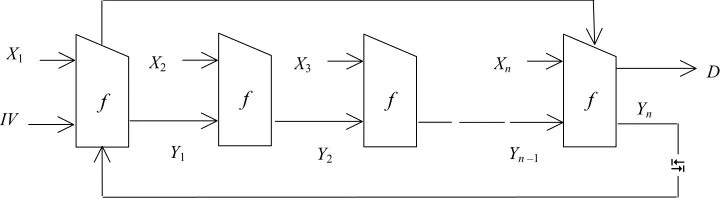
The single feedback ring iteration, shortly SFRI, is a simple structure. It feeds back the reverse of the MD output Yn into iterative box 1, sends the second output of iterative box 1 to iterative box n, and generates the message digest D last. See Figure 1.
Figure 1: The Single Feedback Ring-iterative Structure
In Figure 1, we define Xn + 1 = X1, Xn + 2 = Xn, and the message digest D = f (Xn + 2, f (Xn + 1, )Yn)). Although the inputs X1 and Xn of box 1 and box n are employed twice, and they have respectively two outputs, it is not incompatible in logicality according to the above definitions.
Note that sign ‘)’ denotes reversal operation, that is, the bits of a variable are rearranged in reverse order. For example, the reverse of ‘100110’ is ‘011001’.
2.2 Multiple Feedback Ring Iteration
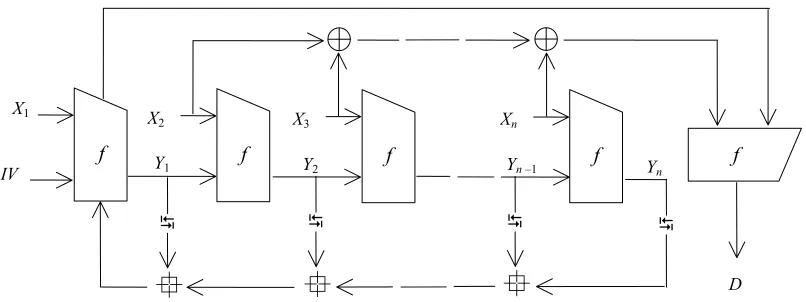
The multiple feedback ring iteration, shortly MFRI, is comparatively complicated. It feeds back the modular sum of reverses of all iterative outputs into iterative box 1, sends the second output of iterative box 1 to iterative box n, and generates the message digest D last. See Figure 2.
Yn–1 Y2
Y1 IV f
X1
f
X2
f
X3 D
Yn f
Xn
Figure 2: The Multiple Feedback Ring-iterative Structure
According to the above diagram, we define Xn + 1 = X1, Xn + 2 = X2 ⊕ …⊕ Xn, and the message digest D = f(Xn + 2, f (Xn + 1, )Y1…)Yn)), where sign ‘’ denotes modular addition operation.
Here, we substitute Xn + 2 = X2⊕…⊕Xn for Xn + 2 = Xn in SFRI to make the last D depend relatively uniformly on X1, …, Xn. X2⊕…⊕Xn may be regarded as a feedforward.
3 Security Analysis of Ring-iterative Structures
3.1 At Least Equivalent to MD Structure in Security
Assume that f is a compression function. It combines with any iteration structure to construct a one-way hash function H.
Definition 1: For a given message M, if we can not find in polynomial time a message M′≠M such that H(M′) = H(M), then H is called weakly collision-free.
Definition 2: If we can not find in polynomial time any two messages M and M′ satisfying M′≠M
and H(M′) = H(M), then H is called strongly collision-free.
Obviously, if a hash function is strongly collision-free, then it must be also weakly collision-free.
3.1.1 SFRI Structure Being at Least Equivalent to MD Structure in Security
We temporarily neglect the existence of the operator ) in SFRI. The SFRI without the operator )
is called the reduced one.
In cryptology, security is measured with time complexity of attack tasks, and thus, if either of two iteration structures is strongly collision-free, they both are said to equivalent in security.
Theorem 1: The reduced SFRI is equivalent to MD in security.
Proof:
IV f X1
Y1 f X2
Y2 f X3
Yn
Yn –1 f Xn
D
f
)
)
)
Let H1 be a hash function constructed with f and MD, and H2 be another hash function constructed
with f and the reduced SFRI structure.
1) Hypothesize that H1 is strongly collision-free.
We need to prove that H2 is also strongly collision-free. Proof by contradiction.
Presume that H2 is not strongly collision-free, namely we can find the two messages M and M′
satisfying M≠M′ and H2(M) = H2(M′) in polynomial time.
Suppose that M is exactly partitioned into nm-bit blocks X1, …, Xn, and M′ is exactly partitioned into n′m-bit blocks X′1, …, X′n′.
In terms of the reduced SFRI, there are
H2(M) = f (Xn, f (X1, Yn)), and H2(M′) = f (X′n′, f (X′1, Y′n′)),
where Yn = H1(M), and Yn′ = H1(M′).
Let M1 = M || X1 || Xn, and M′1 = M′ || X′1 || X′n′, where ‘||’ represents the concatenation of strings. By
comparing the structures of H1 and H2, there are
H2(M) = H1(M1), and H2(M′) = H1(M′1).
Therefore, in polynomial time, we can find the two messages M1 and M′1 which satisfy M1 ≠M′1
and H1(M1) = H1(M′1). It is in direct contradiction to the hypothesis, so H2 is also strongly
collision-free, which indicates that the security of H2 is not less than the security of H1.
2) Hypothesize that H2 is strongly collision-free.
We need to infer that H1 is also strongly collision-free.
According to [5] and [6], define the message block differential as ∆Xi = X′i– Xi, and the iterative output differential as ∆Yi = Y′i– Yi.
For the reduced SFRI, the collision differential characteristics will be ∆X1, …, ∆Xn, ∆Xn + 1, ∆Xn + 2,
and 0 = ∆Y0, ∆Y1, …, ∆Yn, ∆Yn + 1, ∆Yn + 2 = 0.
Note that ∆Xn + 1 = X′1– X1 and ∆Xn + 2 = X′n– Xn. Thus, ∆X1 = ∆Xn + 1 and ∆Xn = ∆Xn + 2.
If attackers set ∆X1 = ∆Xn = ∆Yn = 0, attack on the reduced SFRI degenerates to attack on MD. Thereby, if H1 is not strongly collision-free, H2 is also not strongly collision- resistant. It is in direct
contradiction to the hypothesis, so H1 is strongly collision-free, which means that the security of H1 is
not less than the security of H2.
To sum up, the reduced SFRI is equivalent to MD in security.
Corollary 1.1: SFRI is at least equivalent to MD in security.
Proof:
It is well known from the first part of the proof of theorem 1 that the security of H2 is not less than
the security of H1, which indicates that the reduced SFRI is at least equivalent to MD in security.
Further, considering the existence of the operator ) in SFRI, we say that SFRI is at least equivalent to MD in security.
Y1 = f(IV, X1)
Y2 = f(Y1, X2) ……
Yn – 1 = f(Yn – 2, Xn – 1)
X2⊕…⊕Xn – 1 = 0
)Y1…)Yn – 1 = 2k
We also have the following theorem.
Theorem 2: MFRI is at least equivalent to SFRI in security.
Proof:
For SFRI, D = f(Xn + 2, f(Xn + 1, )Yn)), where Xn + 1 = X1 and Xn + 2 = Xn.
For MFRI, D = f(Xn + 2, f(Xn + 1, )Y1…)Yn)), where Xn + 1 = X1 and Xn + 2 = X2⊕…⊕Xn. If we neglect the operations ()Y1…) and (X2⊕…⊕), then the output of MFRI is reduced to
D = f (Xn, f (X1, )Yn)) the same as the output of SFRI, which indicates that the reduced MFRI structure is equivalent to SFRI in security.
Considering the existence of the operations ()Y1 …) and (X2⊕…⊕) in MFRI, we say that
MFRI is at least equivalent to SFRI in security.
3.1.3 It Is Difficult to Find a Message Making Output of MFRI Equal That of SFRI
Further, we have the following property.
Property 1: It is difficult to find a message making the output of MFRI equal that of SFRI.
Proof:
Let the message M = X1 || … || Xn.
If we can find in polynomial time a set of values of X1, …, Xn which satisfies the two constraints ()Y1…)Yn) = )Yn, and (X2⊕…⊕Xn) = Xn,
the output of MFRI will equal that of SFRI.
According to the definitions of the operators and ⊕, we see that
()Y1…)Yn – 1) = u2k, and (X2⊕…⊕Xn – 1) = 0,
where u∈[1, n – 1] is a positive integer, and k is the bit-length of Yi.
Let u = 1 (if u equals other integers, it does not influence our discussion). In terms of MFRI, the X1, …, Xn – 1 must satisfy the following simultaneous equations:
Transparently, this equation system contains only two equations substantially, and has n – 1 variables X1, …, Xn – 1.
No matter how X1, …, Xn – 1 are sought, the easiest approach must contain the two steps:
c Determine values of any n – 3 variables among X1, …, and Xn – 1;
Without loss of generality, suppose that the values of X1, …, Xn – 3 are determined.
Further, the values of Xn – 2 and Xn – 1 need to be sought.
According to X2⊕…⊕Xn – 1 = 0, Xn – 2 can be expressed with the variable Xn – 1, namely
Xn – 2 = X2⊕…⊕Xn – 3⊕Xn – 1.
According to )Y1…)Yn – 1 = 2k, Substitution for Y1, …, Yn – 1 yields
)f(IV, X1) )f(Y1, X2) …)f(Yn – 3, Xn – 2) )f(Yn – 2, Xn – 1) = 2k.
That is,
)f(IV,X1) … )f(Yn – 3,X2 ⊕ … ⊕ Xn – 3 ⊕ Xn – 1))f(f(Yn – 3,X2 ⊕ … ⊕ Xn – 3 ⊕ Xn – 1),Xn – 1)=2k.
Clearly, seeking Xn – 1 from the above equation is at least equivalent to seeking a preimage of the
compression function f. In terms of the one-wayness of f, it is infeasible in polynomial time to seek preimages of f.
Therefore, it is difficult to find a message making the output of MFRI equal that of SFRI.
Note that property 1 makes us incline to believe MFRI is more secure than SFRI and MD.
3.2 Resistance to the Multi-block Differential Attack
3.2.1 Brief Presentation of the Multi-block Differential Attack
Reference [4], [5], and [6] manifest the multi-block near differential attack on the hash functions MD4, MD5, SHA-0, and SHA-1. This attack consists of the three steps:
c Find out a set of collision differential characteristics for M and M′ which are expected to produce a collision.
d Derive a set of sufficient conditions which are described by the bits of the chaining variables, and ensure that the collision differential characteristics hold.
e Modify the random message M through the single-step / multi-step or single-message / multi -message method in order to make almost all the sufficient conditions be satisfied.
Assume M is partitioned into nm-bit blocks X1, …, Xn, and the iterative outputs are Y1, …, Yn = D. Assume M′ is partitioned into nm-bit blocks X′1, …, X′n, and the iterative outputs are Y′1, …, Y′n = D′, where n≥ 2.
According to [5] and [6], define the message differential as ∆Xi = X′i– Xi, and the iterative output differential as ∆Yi = Y′i– Yi.
Note that a differential is computed by modular integer subtraction ‘–’ in [5] and [6] while it is computed by exclusive or ‘⊕’ in other references. Obviously, the combination of these two sorts of differentials can bring more information to attackers.
∆Yi is also the chaining variable difference. In terms of a concrete compression function, the attackers may set more detailed step-chaining variable differentials and round- chaining variable differentials [5][6].
3.2.2 MFRI Leading Block Modification to a Joint Event
In MFRI, let the collision differential characteristics be ∆X1, …, ∆Xn, 0 = ∆Y0, ∆Y1, …, ∆Yn, and the input chaining variable of the (n + 1)-th iteration be Yd
n, then Y
d
n = )Y1 … )Yn, where the superscript ‘d’ signifies time delay. Therefore,
∆Yd
n = ()Y′1…)Y′n) – ()Y1…)Yn) = ∆)Y1…∆)Yn≠)∆Y1…)∆Yn.
For example, when A = 11010100, A′ = 00101011, and ∆A = 10101001, there are )A = 00101011,
)A′ = 11010100, and ∆)A = 01010111, and so ∆)A≠)∆A.
This brings extra difficulties to the attackers who employ the differential analysis method.
From [5] and [6], it is not difficult to understand that if there are not the multiple feedbacks, the modification to every block Xi is an independent event, and when the modification is made, it is feasible to consider ∆Xi and ∆Yi only relevant to the block Xi but not to other blocks. However, when the multiple feedbacks exist, due to
∆Yd
n = ()Y′1…)Y′n) – ()Y1…)Yn),
the modification to every block Xi will influence the corresponding Yi, and further do ∆Ydn. Thereby,
the modification to every block Xi changes into an joint event from an individual independent event. Assume that through message modification techniques the attackers can decrease the time complexity of a block near collision O(2ki). In terms of [5] and [6], in MD, the modification to every
block is an independent event, and hence, the complexity of producing the n-block message collision is O(2k1 + … + 2kn). However, in MFRI, the modification to every block become a part of the joint
event, and hence, the probability that two n-block messages produce a collision is 1 / (2k1 … 2kn),
namely, the complexity of producing the message collision increases to O(2k1 + … + kn).
3.2.3 MFRI Leading Message Modification to an Endless Loop
variable is composed of a, b, c, d, and e five word variables. The values of the sufficient conditions for a block collision are expressed with 0, 1 or those prior to ai.
In MFRI, because of feedback and Xn + 1 = X1, the second modification to X1 is needed. However,
the second modification will surely influence the result of the first modification, that is, break the sufficient conditions satisfied and change the value of the chaining variable Y1, and further, cause Y2, …, Yn and the feedback Ydn to produce alteration. Thus, the attackers need to modify X1 once more. In
this way, MFRI will lead the modification to X1 and other blocks to an endless loop.
3.2.4 MFRI Leading Sufficient Conditions for Collision to Incompatibility
Due to Xn + 1 = X1, for MFRI, a key problem is whether the two sets of sufficient conditions
described with the chaining variables respectively in the 1-st iteration and (n + 1)-th iteration are compatible or not. If they are compatible, the two sets of sufficient conditions can be deduced theoretically. If they are contrary to each other, the two sets of sufficient conditions is radically impossibly deduced, and thus it is not ensured that the differential characteristics will hold and that the collision for two messages can be found.
Suppose that Λ = {a1, 1, …, a1, 32} is the set of 32 bits of the variable a1, then the size of its power
set is |Þ (Λ)| = 232. Let P∩NE denote the probability that the intersection of any two nonempty subsets
of Λ is empty, then
P∩NE = (C1 32(231 – 1) + … + C 31
32(21 – 1)) / (2C 2 |Þ (Λ)|) = (C1
32231 + … + C 31 3221 – C
1
32 – … – C 31
32) / (232 (232 – 1)) = (332 – 232 – 1 – (232 – 2)) / (232 (232 – 1))
= (1.6458 × 250) / (232 (232 – 1)) < (251) / (232 (232 – 1)) ≈ 1/213. Thereby, the probability that the intersection of any two nonempty subsets of Λ is nonempty is greater than (1 – 1/213), which means that probability at least 1 bit of the condition variable a1
produces overlap in the 1-st iteration and (n + 1)-th iteration is greater than (1 – 1/213).
We may suppose that a1, 1 overlaps, let a1 1, 1 denote the condition value of a1, 1 in the 1-th iteration,
and let an+1
1, 1 denote the condition value of a1, 1 in the (n + 1)-th iteration. If a1 1, 1 = a
n+1
1, 1 = 0 or 1, it indicates the two sets of sufficient conditions are compatible; otherwise the two sets of sufficient conditions are incompatible, that is, such two sets of sufficient conditions may impossibly exist simultaneously. Obviously, if the intersection contains only 1 bit, the probability of being incompatible is 1/2. If the intersection contains 2 bits, the probability of being incompatible is (1 – 1/4). Suppose that Pa1, Pb1, Pc1, Pd1 = 1 / 2 or 1 represent respectively the probabilities that the intermediate chaining variables a1, b1, c1, d1 are condition-compatible in the 1-th iteration and (n + 1)-th iteration. Then, for
a1, b1, c1, and d1, the probability that the conditions are incompatible is (1 – 1 / (Pa1Pb1Pc1Pd1)). For the other intermediate chaining variables a2, b2, c2, d2…, there exist similar conclusions.
the condition bits produce overlap is close to 1, and the probability that the values of the overlapping bits are incompatible is greater than 1/2.
3.3 Ineffectiveness of the D-way Second Preimage Attack
Joux puts forward a attack method called D-way which is employed for seeking the second preimage of an output of a hash function based on MD in [8]. For a given hash target value Y = H(M)
∈ {0, 1}k, the attackers first find 2d collisions on d-block messages M1, …, M2d making Hd = H(M1) =
… = H(M2d). Then, find the block Xd + 1 such that f (Hd, Xd + 1) = Y. In this way, the attackers succeed in
seeking the second preimage with the message M. In terms of [8], the time complexity of this attack is O(d2k / 2 + 2k).
For a hash function based on MFRI, because there are Xd + 1 = X1, Xd + 2 = X2⊕…⊕Xd, and X′d + 1 =
X′1, X′d + 2 = X′2⊕…⊕X′d, even though ∆Y1 = … = ∆Yd = 0, it can not be ensured that ∆Yd + 1 = 0 and ∆Yd + 2 = 0. That is, it is intractable to find out two d-block messages M1 and M2 for collision by the
birthday attack [8]. Therefore, the D-way method is ineffective on hash functions based on MFRI.
4 Performance Analysis of the Hash Ring-iterative Structure
For the same message M, MFRI is two f mapping operations, n reverse operations, n modular addition operations and (n – 1) exclusive OR operations more than MD. Reverse, modular addition and exclusive OR are fundamental operations, and they can not expend too much time. Hence, MFRI has comparatively fast operation speed. The two extra variables in memory space need to be increased respectively for the feedforward and feedback values. The initial values of these two variables may be set to zero. Then, the feedforward variable admit X2, …, and Xn one by one by exclusive OR, and the feedback variable admit )Y1, …, and )Yn one by one by modular addition.
At present, the tree structure and zipper structure for hash functions are also believed to be more secure than MD [9][10]. However, MFRI is more applicable than the tree structure since the compression mapping f in any existing hash function may be transplanted into MFRI with no change, and is more efficient than the zipper structure since the number of time of operation on the mapping f in MFRI is roughly half as many as in the zipper structure.
5 Conclusions
At the time every iteration output is fed back, first to do a reversal transform is important, which makes it impossible that ∆Yd
n is derived directly from ∆Y1, …, and ∆Yn.
is also uniform, independent and random. If MD can cause the avalanche effect of the hash output, MFRI can also cause the avalanche effect of the hash output. Note that for the input message X, only if it contains at least two blocks does MFRI take effect.
For the existing hash functions ─ MD5 and SHA-1 for example, if their compression functions are extracted and transplanted into MFRI, the preceding analysis shows that the existing attack methods will be ineffective on the newly forming hash functions.
Acknowledgment
The authors would like to thank Zhaozhi Zhang, and Xinxin Niu for their important counsel, suggestions, and corrections.
References
[1] A. J. Menezes, P. Van Oorschot, and S. Vanstone, Handbook of Applied Cryptography, CRC Press, London, UK, ch. 9, 1997.
[2] Ivan Damgard, “A design principle for hash functions”, Advances in Cryptology: CRYPTO 89, Springer-Verlag, Berlin, DE, pp. 416-427, 1989.
[3] Ralph Merkle, “One way hash functions and DES”, Advances in Cryptology: CRYPTO 89, Springer-Verlag, Berlin, DE, pp. 428-446, 1989.
[4] Eli Biham, Rafi Chen, Antoine Joux etc, “Collisions of SHA-0 and Reduced SHA-1”, Advances in Cryptology - EUROCRYPT 05, Springer-Verlag, Berlin, DE, pp. 36-57, 2005.
[5] Xiaoyun Wang, Yiqun Lisa Yin, and Hongbo Yu, “Finding collisions in the full SHA-1”, Advances in Cryptology - CRYPTO 05, Springer-Verlag, Berlin, DE, pp. 17-36, 2005.
[6] Xiaoyun Wang, Hongbo Yu, “How to Break MD5 and Other Hash Functions”, Advances in Cryptology - EUROCRYPT 05, Springer-Verlag, Berlin, DE, pp. 19-35, 2005.
[7] Praveen Gauravaram, William Millan, Ed Dawson etc, “Constructing Secure Hash Functions by Enhancing Merkle-Damgård Construction”, Conf. on ISP 06, LNCS v4058, Springer-Verlag, Berlin, DE, pp. 407-420, 2006. [8] Antoine Joux, “Multicollisions in Iterated Hash Functions. Application to Cascaded Constructions”, Advances in
Cryptology-CRYPTO 04, Springer-Verlag, Berlin, DE, pp. 306-316, 2004.
[9] Oded Goldreich, Foundations of Cryptography Volume II, Basic Applications, Cambridge University Press, Cambridge, UK, pp. 521-523, 2004.