International Journal of Advanced Research in Computer Science
REVIEW ARTILCE
Available Online at www.ijarcs.info
Comparative Study Of Decision Making Techniques For Multi-Attribute Decision
Making Problems
Tb. Ai Munandar
Information Tech. Faculty – Informatics Eng. Dept Universitas Serang Raya (UNSERA)
Banten Province – INDONESIA
Azhari, SN
Faculty of Math. & Natural Sciences Universitas Gajah Mada (UGM)
Yogyakarta - INDONESIA
Abstract: The selection of the method of decision-making in order to determine the expected outcomes of the solution of the case of multi attributes is difficult because faced with the problems associated with the subjectivity and inconsistency of the results of the calculation. Therefore, scientists continue to develop a variety of approaches in order to produce the proper method with a minimal degree of subjectivity from the decision maker. This article discusses the literature review three methods of decision making by utilizing the weighting of the criteria in determining the outcome of the decision process. They are Analytical hierarchy process (AHP), TOPSIS and PROMETHEE. The discussion in this article is not intended to discredit one or several existing methods, however, because the presence of these three methods has provided significant benefits in the process of determining an alternative to the concept of decision support systems, and in certain cases subjectivity is required in the absence of mathematical procedures specific to describe human creative process in assessing something.
Keywords: decision-making, subjectivity, inconsistency, AHP, TOPSIS, PROMETHEE
I. INTRODUCTION
The primary purpose of decision support systems are able to support and improve the decision making process to be performed by the decision makers, although in one hand, it is difficult to measure the outcomes of the decisions related to the quality and confidence decisions [1]. To meet these objectives, the research related to improving the quality of decision-making and confidence being developed, and resulted in the decision-making methods which were also developed along with the desire for quality and the right confidence to decision outcomes obtained, such as Technique for Order Preference by Similarity to Ideal Solution (TOPSIS), Analytic Hierarchy Process (AHP), PROMETEE, fuzzy AHP, Simple Additive weighting (SAW), Weighted Product (WP) and ELECTRE.
In a multi-criteria decision making, the most crucial thing is how to determine the value of the preference alternatives to existing criteria, and the determination of the weight values of criteria. Subjectivity still plays a major role, so the outcome of decisions sometimes less as expected. Not only that, the functions involved in each method, they require more in-depth scientific study to produce a more precise method. Therefore, the selection of appropriate methods, at least will give the most expected outcome. On the other hand, the existence of methods of decision-making continues to be studied more in depth by several scientists, in order to produce a method that minimizes subjectivity of decision makers.
For example, AHP subjective regarded in terms of determining the value of the pairwise comparison matrix [2], which is only determined by the scale value 1-9 thus affecting the level of Consistency Ratio (Lane and Verdini (1989) in [3]. Moreover, the use of principal eigen value on AHP priority vector to produce, yet meet the condition of order preservation (COP) and consistency ratio (CR) if it exceeds the value of 0.1
(10%), so that the pairwise comparison matrix should be re-examined, and calculations made from scratch [4].
Similarly with AHP, TOPSIS subjectivity in common in terms of determining the value of a decision matrix preference, sometimes vague and often inaccurate [5], especially if faced with incomplete information or not accessible [6]. Another problem is the determination of the criteria that are subjective weighting of decision makers [7] and inconsistent in considering the judgment because it did not have a comparison index as we have in AHP[8].
PROMETHEE method can not be separated from interfering decision makers, especially in the case of the determination of the evaluation table, decision makers are assumed to be able to determine the weight of each criterion in the absence of specific procedures in the process of determining the weight of a criterion [9] as well as on TOPSIS method. Excess PROMETHEE method is provided by many preference functions that can be used for determining the direction of preferences considered. However, this advantage is also a function of its own difficulties for selecting preferences is not as easy as imagined. The selection preference function must first understand whether using indifference thresshold or not, whether the criteria used by assessment be qualitative or not [10]. In this case, of course, the decision maker must really understand the workings of the PROMETHEE method and problems to be solved.
depending on the type of problems to be solved, whether it is feasible to use AHP, TOPSIS, PROMETHEE or the other.
In general, this paper is divided into five sections, the first is an introduction that describes the background of the comparative study conducted through literature review related journals. The second section discusses the literature review as well the basic theory used in this paper, the third section describes the research method, section four discusses the core of the problem in the form of a comparative study of some of the decision making techniques using the weighting method in determining the ranking of the alternatives. The last part is the suggestion that the cover can be used as well as a consideration in the determination of the appropriate decision-making techniques to the proper case.
II. LITERATUREREVIEW
A. Analityc Hiearchy Process (AHP
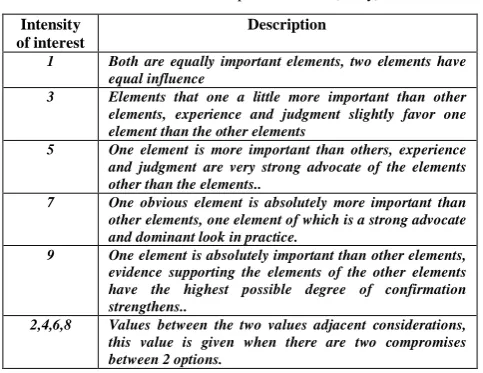
AHP is a decision support models developed by Saaty which decompose a complex problem into a form of hierarchy, so that more structured and systematic. This method uses a matrix of comparison in determining the preference value as the initial decision matrix with reference to the scale value of 1-9 set by Saaty. AHP is widely used for a variety of needs, such as for the assessment of the performance of an institution [11], evaluation of manufacturing systems [12] the selection of the transport system for mining [13] and in the field of project management, risk assessment is used for the needs of the project [14] and evaluate the performance of a project management [15]. he following is a step-by-step problem solving AHP for multi-attribute problem:
1) Define the problem and the desired solution, then made into a hierarchical structure where the top of the hierarchy is the goal to be achieved, the next level is the issue of criteria, sub-criteria below it is the problem (if possible) and the last level is the alternative decision.
[image:2.595.42.284.543.729.2]2) Create a pairwise comparison matrix that describes how each element level or above affected with another element. Determination of the value of the pairwise comparison matrix based on the following scale:
Table I. Scale comparison matrix (Saaty)
Intensity of interest
Description
1 Both are equally important elements, two elements have equal influence
3 Elements that one a little more important than other elements, experience and judgment slightly favor one element than the other elements
5 One element is more important than others, experience and judgment are very strong advocate of the elements other than the elements..
7 One obvious element is absolutely more important than other elements, one element of which is a strong advocate and dominant look in practice.
9 One element is absolutely important than other elements, evidence supporting the elements of the other elements have the highest possible degree of confirmation strengthens..
2,4,6,8 Values between the two values adjacent considerations, this value is given when there are two compromises between 2 options.
3) Compute eigenvalues and test the consistency, if not consistent then the retrieval of data and calculations repeated.
4) Repeat steps (2) and (3) for all levels of hierarchy
5) Calculate the eigen vector of each pairwise comparison matrices
6) Check the consistency of the hierarchy, based on the hierarchy consistency index ratio which should not exceed 0.1
B. Technique for Order Preference by Similarity to Ideal Solution (TOPSIS)
Just like AHP, TOPSIS is one method of decision-making for multi-criteria problems. This method was developed by Yoon and Hwang (1981), where the best solution in terms of ranking obtained by the closest distance to the positive ideal solution and the farthest distance from the negative ideal solution. Some application of TOPSIS, such as for the selection of suppliers [16] the selection of the place for the construction of a new town [17], evaluation of project and portfolio management information system [18], the evaluation of the quality assessment project [19] and even to analyze the influence of the working pressure on the company to its employees [20]. Here is a step-by-step problem solving using TOPSIS method :
1) Define the problem and the desired goal.
2) Create an initial decision matrix, and then normalize. 3) Create a weighted normalized decision matrix.
4) Determine the positive ideal solution and the negative ideal solution matrix.
5) Determine the distance between the value of each alternative to the positive ideal solution and negative ideal solution.
6) Calculate the value of closeness for each alternative.
C. Preference Ranking Organization Method for Enrichment Evaluation (PROMETHEE)
PROMETHEE included in the decision support tools such as multi-criteria AHP and TOPSIS [10]. This method has six preference criteria function that can be used to illustrate the differences between each criterion with each alternative. These six functions are:
1) Ordinary type (Usual Criterion), a basic type that does not have a threshold value or tendency, therefore this type is rarely used.
2) Quasi type, an assessment of the data types in terms of quality by using a predefined threshold, where an alternative has the same preference value is important for the difference or value of P(x) does not exceed the predetermined threshold.
3) Linear type, a type of quantitative assessment, using a threshold type, where the alternatives are equally important preference value, or the difference between the value of P(x) is lower than the threshold value.
4) Level type, this type of assessment using thresshod indifference (m) with the addition of one more thresshold preference (n) whose value should be above 0, while the value should be below the indifference preference.
5) Quasi-linear type, this type is similar to linear assessment only make use of two pieces of thresshold the preference and indifference.
6) Gaussioan type, often used to find the value in the data safe is continuous, ie using a Gaussian thresshold thresshold (σ) associated with the standard deviation values.
Here are the steps of decision making solutions using PROMETHEE method :
2). Determine several criteria. 3). Determining dominance criterion.
4). Determine the type of assessment, where this type of assessment has two types, namely; the minimum and maximum type.
5). Determine the type of preference for each criterion is most suitable based on the data and consideration of the decision maker. These preferences are (Usual, Quasi, Linear, Level, Linear and Quasi Gaussian).
6). Provide threshold value or the tendency for each criterion based on preferences you have selected.
7). Calculate the direction of preferences considered by the
index value leaving flow (Ф+), entering flow (Ф-), and the net
flow.
8). Results of the sequencing results of ranking.
III. RESEARCHMETHODOLOGY
This study uses a literature study approach, with a review of several studies that have been done earlier writers associated with decision-making method using the weights as a process of determining the outcome of the decision. The method discussed in this study, among others, AHP, TOPSIS and PROMETHEE. The study was conducted by collecting comparative literature as study materials based on previous research experience. Discussion in accordance with the comparison of three methods of library materials obtained and conclusion of the results of the discussion.
IV. RESULTANDDISCUSSION
A. Analityc Hiearchy Process (AHP
Problems in AHP, associated with the rating scale to fill the paired comparison matrix is often inconsistent because depending on the subjective assessment of the decision maker [2]. Confusion in determining the value for paired comparison matrix will influence the priority vector calculations, thus, giving a false comparison matrix values will result in non-fulfillment of the condition COP - Condition of Preservation Order [4]. COP conditions are not met in AHP pairwise comparison matrices occur if the ratio between the weight of two criteria priority vector pairs compared with other criteria for case pairs dominate or even dominate, in accordance with the conversion value of a verbal assessment of the proposed rate Saaty, are not met. More detailed explanation see [4].
Other inconsistencies, is scoring pairwise comparison matrix in AHP, causing an influence on the results of the consistency ratio, thus giving the value of the comparison matrix of pairwise comparisons should be re-examined [21]. Here are the steps to test the consistency of pairwise comparison matrices:
1) Total the elements of each column with the equation:
2) For each value in the column by using the results of step 1 (making matrix normalization), the following equation:
3) Calculate the average (mean) row i by the equation:
Consider the analogy of the case below. If the pairwise comparison matrix is given as follows:
Based on the above matrix, then we try to calculate whether the re-scoring pairwise comparison matrix is consistent or not. From step (1) and (2) normalized matrix is obtained as follows :
By using the step (3), produced an average value (p) for each criterion ie, p1 = 0.423; p2 = 0.277; p3 = 0.167; p4 = 0.104;
p5 = 0.028. Now let us prove, whether the pairwise comparison
matrix scoring, consistent or not. In the above matrix is known that the comparison of {x1, x2} = 2, but the results of
calculations based on the consistency test showed that {p1, p2}
= 0.423/0.277 = 1.53, then {p1, p3} = 0.423/0.167 = 2.53; {p1,
p4} = 0.423/0.104 = 4:05; and {p1, p5} = 0.423/0.028 = 15.029.
For the case of {p1, p2}, {p1, p3} may still be tolerated because
the difference is less significant, but what about the case of {p1,
p4} and {p1, p5} which has the distinction quite far from the
beginning of the comparison matrix. This case shows that, in determining the value for pairwise comparison matrices have to be careful, using either verbal or numeric valuation techniques.
B. Technique for Order Preference by Similarity to Ideal Solution (TOPSIS)
TOPSIS as AHP is a decision making tool that uses weights to produce an output decision in accordance with the objectives that have been defined. Determination of the weight of a full right of decision-makers, especially for weighting the criteria to be used, so that the degree of subjectivity is higher than the AHP method [7]. This is because there is no common procedures and mathematical models that can be used to replace human creativity to evaluate the value of a specific alternative criteria [22]. Therefore, the determination of the value of the initial decision matrix obtained by comparing the alternative criteria, often imprecise, vague and even faced with incomplete information.
This is because there is no common procedures and mathematical models that can be used to replace human creativity to evaluate the value of a specific alternative criteria [22]. Therefore, the determination of the value of the initial decision matrix obtained by comparing the alternative criteria, often imprecise, vague and Therefore, some scientists suggest expansion TOPSIS method uses fuzzy logic to deal with the (1)
(2)
incompleteness of the data and information that is not clear [5],[6] and [23]. The use of Fuzzy Logic in the TOPSIS method is expected to reduce the degree of subjectivity of the decision makers in determining the value of the initial matrix and weighting criteria to be used, although it can still be seen although subjectivity is more minimized.en faced with incomplete information.
C. Preference Ranking Organization Method for Enrichment Evaluation (PROMETHEE)
As described in the introduction, the main problem is the subjectivity associated PROMETHEE method is still valid, especially decision makers in determining the weighting of criteria and evaluation of the value in the table for each alternative against each criterion, and the difficulty in determining the appropriate preference function to be used [9] and [10]. Relation to the preference function [24] criticized the selection of preference functions that do decision-makers as well as the subjectivity that is also the value of the preference index only have intervals of 1 or 0, but still can be expanded as well as on the concept of fuzzy logic.
To overcome the problem of weighting that is still subjective, weighting determination approach also can be use the entropy method to recalculate any weight either predetermined or is not specified, so the total weight is 1 [25]. While the likelihood function selection preferences for decision makers should look at whether the provision of value against a criteria using quantitative criteria or not, if yes, then the suitable preference functions are functions of V-Shape (Type III) and linear preference function (Type V). Type I and IV is suitable for the determination of the conditions of qualitative criteria [10]. Universal preference function approach can also be used as an alternative in the determination of preference functions that will be used, where this concept can be inserted as an extension of the use of function referrers owned PROMETHEE [24].
V. CONLUSION
In the end, the discussion of the three methods are not intended to discredit the existing methods. Because after all, all three of these methods have been widely implemented in many different cases in proportion and function of each. The discussion here is intended to reopen the road any further development of the method by studying the parts that are considered crucial to the decision-making process. However, the selection method should still put forward the feasibility of the method to be used in solving a particular problem.
However, based on the above discussion of some of the literature, in essence, some decision-making methods are still faced with the dilemma of subjectivity decision makers. Especially in terms of determining the value of the evaluation table, weighting criteria and consistency of the calculation results afterwards. Therefore, scientists are working hard to find solutions in order to minimize the breakdown of subjectivity level decision makers. On the other hand, subjectivity would still be required in certain cases, in the absence of the specific mathematical procedures to describe human creative process in assessing something. So also with the selection of the method of decision-making, it is better adapted to the characteristics of the data so that appropriate methods can be used to solve specific problems related to the case of multi criteria.
VI. REFERENCES
[1] Turban, Efraim., Jay E. Aronson and Ting-Peng Liang, Decission Support System and Intelligent Systems, Seventh Edition, Prentice Hall of India, New Delhi, 2007.
[2] Choo, E.U., and W.C. Wedley, "A common framework for deriving preference values from pairwise comparison matrices", Computers & Operations Research 31 (2004) 893–908.
[3] Alonso, José Antonio and Ma Teresa Lamata, "Consistency In The Analytic Hierarchy Process: A New Approach", International Journal of Uncertainty,Fuzziness and Knowledge-Based Systems Vol. 14, No. 4 (2006), pp. 445−459
[4] e Costa, Carlos A. Bana dan Jean-Claude Vansnick, 2008, A critical analysis of the eigenvalue method used to derive priorities in AHP, European Journal of Operational Research 187 (2008) 1422–1428, ELSEVIER
[5] Nan, Jiangxia and Maojun Zhang, "Extension of the TOPSIS for Multiatribute Decision Making Under Intuitionistic Fuzzy Environment", Journal of Information & Computational Science 11:5, 2014, pp. 1635 – 1645
[6] Jahanshahloo, G.R., F. Hosseinzadeh Lotfi and M. Izadikhah, "Extension of the TOPSIS method for decission-making Problems with Fuzzy Data", Journal of Applied Mathematics and Computation, 2006, pp. 1544 – 1551.
[7] Olson, D.L, "Comparison of Weight in TOPSIS Models", Journal of Mathematical and Computer Modelling, ELSEVIER Science Ltd, 2004.
[8] Thor, Jureen., Siew-Hong Ding, and Shahrul Kamaruddin, "Comparison of Multi Criteria Decision Making Methods From The Maintenance Alternative Selection Perspective", The International Journal of Engineering And Science (IJES), Vol : 2, Issue : 6, 2013, pp. 27 – 34
[9] Maadi, Mansoureh and Marzieh Soltanolkottabi, "Extention of PROMETHEE Method for Solving Multi Objective Optimization Problems", International Journal of Computer Application, Vol. 89, No. 11, March 2014
[10] Deshmukh, S.C., "Preference Rangking Organization Method Of Enrichment Evaluation (Promethee)", International Journal of Engineering Science Invention, Vol. 2, Issue 11, 2013, Pp. 28 – 34.
[11] Goshal, Sujit Kumar., Sukanta Kumar Naskar and Dipankar Bose, "AHP in Assessing Performance of Diploma Institutes – A Case Study", Journal of Technical Education and Training (JTET), Vol. 3, No.2, 2011, pp. 67 – 81.
[12] Bayazit, Ozden, "Use of AHP in Decision-Making for Flexible Manufacturing Systems", Journal of Manufacturing Technology Management, Vol. 6, No. 7, 2005, pp. 808 – 819
[13] Zoran, Despodov., Mitic Sasa and Peltecki Dragi, "Application Of The Ahp Method For Selection Of A Transportation System In Mine Planning", Journal of Underground Mining Engineering 19 (2011), pp. 93-99.
[14] Mustofa, Mohammad A., and Jamal F. Al-Bahar, "Project Risk Analytic Assessment Using the Analitic Hierarchy Process", IEEE Transactions On Engineering Management, VOL. 38, NO. I, FEBRUARY 1991.
[15] Wang, Wei., Zhihao Wang., Shuzhong Wang and Guokun Qu, "Application of AHP Evaluation Method in Project Management of Residential Construction in China", Proceeding of 2012 International Conference on Ecology, Waste Recycling, and Environment Advances in Biomedical Engineering, Vol.7, 2012.
[17] Asadzadeh, Asad., Sujit Kumar Sikder, Farzin Mahmoudi and Theo Kötter, "Assessing Site Selection of New Towns Using TOPSIS Method under Entropy Logic: A Case study: New Towns of Tehran Metropolitan Region (TMR)", Journal of Environmental Management and Sustainable Development, Vol. 3, No. 1, 2014.
[18] Gerogiannis, Vassilis C., Panos Fitsilis and Achilles D. Kameas, "Evaluation Of Project And Portfolio Management Information Systems With The Use Of A Hybrid IFS-TOPSIS Method", Journal of Intelligent Decision Technologies 7 (2013), pp. 91– 105.
[19] Trstenjak, Bruno and Velimir Sanjkovic, "Evaluation of the Quality Projects in the EU Erasmus Programme Using Fuzzy TOPSIS Method", Proceeding of Electronic International Interdisciplinary Conference 2012.
[20] Senthilvel, S., R.Muruganandham, K.Ravichandran, E.Manokaran, and S.Subhashini, "Analysis of Corporate Stress using TOPSIS Method - A Case Study on Nationalized Banks in Madurai City", International Journal of Management & Business Studies (IJMBS) Vol.1, Issue 3, September 2011.
[21] Ishizaka, Alessio and Ashraf Labib, 2011, "Review of the main developments in the Analytic Hierarchy Process", Expert Systems with Applications, 38(11), 14336-14345, 2011
[22] Ovricovic, Serafim and Gwo-Hshiung Tzeng, "Compromise Solution by MCDM Methods : A Comparative Analysis of VIKOR and TOPSIS", European Journal of Operational Research 156, 2004, pp. 445 – 455
[23] Mohammadi, Ali., Abolfazl Mohammadi and Hossain Aryaeefar, "Introducing a new Method to Expand TOPSIS Decision Making Model to Fuzzy TOPSIS", The Journal of Mathematics and Computer Science, Vol. 2, No. 1, 2011, pp. 150 – 159
[24] Radojicic, Miroslav., Malisa Zizovic, Zoran Nesic and Jasmina Vesic Vasovic, "Modified Approach to PROMETHEE for Multi-Criteria Decision Making", Maejo International Journal of Science and Technology, Vol. 7, No. 03, 2013, pp. 408 - 421