Volume 2, No. 2, Mar-Apr 2011
International Journal of Advanced Research in Computer Science
RESEARCH PAPER
Available Online at www.ijarcs.info
Human-Computer Interface Through Biometric Recognition System
Mr. Gajanan P. Khetri*
Department of computer science ,Singhania Univ.
Rajasthan, India
Dr.
V. P. Pawar
Director Siddhant Institute Of Computer Applications,
Pune, India
[email protected]
[email protected]Prof. Dinesh Chandra Jain
Department of Computer Science & Engineering,
SVITS- Indore , India
[email protected]
Abstract: In today’s world many times need the human identification for the purpose of security of information, authentication, search criminals, find missing child. The biometric recognition uses for human identification because the biometrical characteristics are unique, and it’s based on two types are behavioural and physiological characteristics. This paper include biometric recognition system overview fingerprint recognition, face recognition, iris recognition, speech recognition and gesture recognition. overview include the various types of algorithm using in biometric recognition system are discrete cosine transform, key local variation, minutiae matching algorithm, PCA, active contour algorithm, fuzzy c-means clustering, LPCC Algorithm, LDA Algorithm and Fuzzy Neural Network. The standard techniques implement following some of algorithms and recognition rate is near prediction about 100%.
Keywords: Biometric Recognition, LDA, PCA Algorithms, Database.
I. INTRODUCTION
Biometric solutions address the security issues associated with traditional method of human recognition based on personal identification number (PIN), identity card; secrete password etc., and the traditional methods face severe problems such as loss of identity cards and forgetting/ guessing the passwords. Biometric measures based on physiological or behavioral characteristics are unique to an individual and have the ability to reliably distinguish between genuine person and an imposter. The physiological characteristics include Iris, Finger Print, Retinal, Palm Prints, Hand Geometry, Ear, Face and DNA, while the behavioral characteristics include Handwriting, Signature, Body Odor, Gait, Gesture, expression and thermal emission of human body [1].
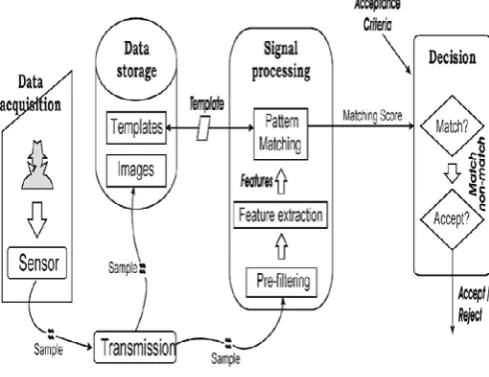
Any human physiological and/or behavioral characteristic can be used as a biometric characteristic as long as it satisfies the following requirements: Universality, Distinctiveness, Permanence, and Collectability. However, in a practical biometric system (i.e., a system that employs biometrics for personal recognition), there are a number of other issues that should be considered, including: Performance, Acceptability and Circumvention. A practical biometric system should meet the specified recognition accuracy, speed, and resource requirements, be harmless to the users, be accepted by the intended population, and be sufficiently robust to various fraudulent methods and attacks to the system [2].
Uniqueness refers to the fact that a feature must be unique: an identical feature should not appear in two different people. Universality means that the feature type is
[image:1.595.316.561.567.755.2]present/occurs in as many people as possible. Unfortunately we cannot assume that all people, for example, have all fingers or have one/two of the two irises not damaged. The Permanence property is related to the requirement that the feature not change over time, or at least that it vary very slowly. Measurability concerns the possibility to measure the feature with relatively simple technical instruments. User friendliness requires that the measure should be easy and comfortable to be done. Acceptability refers to the people’s acceptance of the measure in daily lives. Circumvention concerns the toughness to deceive the system by fraudulent methods. All these attributes must be taken into account designing a biometric system [3].
Gajanan P Khetri et al, International Journal of Advanced Research in Computer Science, 2 (2), Mar-Apr, 2011,168-173
The paper is organized as follows. Next section that is section II discussed the various standard tools and techniques and algorithm using Biometric Recognition System, section III Conclusion, and section IV includes References.
II. PRESENTTHEORIESANDPRACTICES
A. Standard Tools and Techniques-
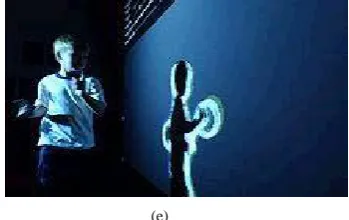
A Biometric Recognition System includes several Present Theories includes following Techniques are like Fingerprint Recognition, Face Recognition, Iris Recognition, Speech Recognition and Gesture Recognition. Each Recognition technique includes its need of input devices list and software which have use in commercial purposes in market. In Figure 2 includes figure of Fingerprint, Face, Iris, Speech and Gesture-A child simply hand detection.
(a)
(b)
(c)
(d)
[image:2.595.349.524.54.164.2](e)
Figure 2: - Biometric Recognition System a: Fingerprint, b) Face, c) Iris, d) Speech, (e) Gesture - A Child of simply hand detection.
[a] Fingerprint Recognition-
A fingerprint is the pattern of ridges and valleys on the surface of a fingertip, the formation of which is determined during the first seven months of fetal development. Fingerprints of identical twins are different and so are the prints on each finger of the same person. One problem with the current fingerprints recognition systems is that they require a large amount of computational resources, especially when operating in the identification mode. Finally, fingerprints of a small fraction of the population may be unsuitable for automatic identification because of genetic factors, aging, environmental, or occupational reasons [2].
Tools: - Finger print scanner / Reader, Optical print scanner, OS, Database.
Software: - VeriFinger 6.3 Standard SDK,
VeriFinger 6.3 Extended SDK, MegaMatcher
Software Development Kit (SDK), FingerCell 2.1 EDK and etc.
[b] Face Recognition-
Face recognition is a non-intrusive method, and facial images are probably the most common biometric characteristic used by humans to make a personal recognition. The applications of facial recognition range from a static, controlled “mug-shot” verification to a dynamic, uncontrolled face identification in a cluttered background (e.g., airport). The most popular approaches to face recognition are based on either (i) the location and shape of facial attributes, such as the eyes, eyebrows, nose, lips, and chin and their spatial relationships, or (ii) the overall (global) analysis of the face image that represents a face as a weighted combination of a number of canonical faces. In order that a facial recognition system works well in practice, it should automatically (i) detect whether a face is present in the acquired image; (ii) locate the face if there is one; and (iii) recognize the face from a general viewpoint (i.e., from any pose) [2].
Tools: - Digital Camera, webcam with 2Mpx, OS Database.
Software: - Google Picasa version 3.5 & onwards, Apple iphoto, Sony’s Picture Motion Browser (PMB), Facebook, ActiveX DLL 1.11, VeriLook Standard SDK (Windows) and etc.
[c] Iris Recognition-
Gajanan P Khetri et al, International Journal of Advanced Research in Computer Science, 2 (2), Mar-Apr, 2011,168-173
point to the feasibility of large-scale identification systems based on iris information. Each iris is distinctive and, like fingerprints, even the irises of identical twins are different. It is extremely difficult to surgically tamper the texture of the iris. Further, it is rather easy to detect artificial irises (e.g., designer contact lenses). Although, the early iris-based recognition systems required considerable user participation and were expensive, the newer systems have become more user-friendly and cost-effective [2].
Tools: - Using 3D imaging (e.g., stereo cameras), Iris Cameras, Digital Camera Eye Image, Operating System, Database
Software: - Girist, IrisAccelerator, MIRLIN SDK, IrisSABRE, VeriEye Algorithm Demo (For Windows) 2.0 and etc.
[d] Speech Recognition-
Speech recognition or Automatic Speech Recognition (ASR) system is converts the acoustic signal (audio) to a machine readiable format. ASR recognizes the words & these words are worked as input for a particular application, it may be worked as command or for document preparation. Now a day there is glamour of designing an intelligent machine that can recognize the spoken word & understand its meaning & capture corresponding actions. One of the most difficult aspects of performing research in speech recognition by machine is its interdisciplinary. The early studies focus on monolithic approach to individual problems [8].
Tools: - Sound card, Microphone, OS, Database
Software: - Via Voice Standard v 10., Naturally Speaking, Via Voice for Mac(OS10), Dragon Dictate Power Edition, Via Voice Pro v 10, etc.
[e] Gesture Recognition-
Gesture recognition can be seen as a way for computers to begin to understand human body language, thus building a richer bridge between machines and humans than primitive text user interfaces or even GUIs ( graphical user interfaces), which still limit the majority of input to keyboard and mouse. Gesture recognition enables humans to interface with the machine (HMI) and interact naturally without any mechanical devices. Using the concept of gesture recognition, it is possible to point a finger at the computer screen so that the cursor will move accordingly. This could potentially make conventional input devices such as mouse, keyboards and even touch-screens redundant. Gesture recognition can be conducted with techniques from computer vision and image processing. The literature includes ongoing work in the computer vision field on capturing gestures or more general human pose and movements by cameras connected to a computer [6].
Tools: - Depth-aware cameras, Stereo cameras, Controller-based Gestures Single Camera, OS, Database.
Software: - NIPPON SYSTEMWARE's Gesture Recognition, WiiGesture Gesture Recognition Software Demo, GestPoint Gesture Recognition for Presentation Systems, Accelerometer - Based Gesture Recognition, VIDEO: D7Video: Tech Demo with Canesta, and etc.
B. Algorithm-
[a] Discrete Cosine Transform-
This paper presents a novel iris coding method based on differences of discrete cosine transform (DCT) coefficients of overlapped angular patches from normalized iris images. The feature extraction capabilities of the DCT are optimized on the two largest publicly available iris image data sets, 2,156 images of 308 eyes from the CASIA database and 2,955 images of 150 eyes from the Bath database. On this data, we achieve 100 percent Correct Recognition Rate (CRR) and perfect Receiver-Operating Characteristic (ROC) Curves with no registered false accepts or rejects. Individual feature bit and patch position parameters are optimized for matching through a product-of-sum approach to Hamming distance calculation. For verification, a variable threshold is applied to the distance metric and the False Acceptance Rate (FAR) and False Rejection Rate (FRR) are recorded. A new worst-case metric is proposed for predicting practical system performance in the absence of matching failures, and the worst case theoretical Equal Error Rate (EER) is predicted to be as low as 2.59 x 10⁻⁴ on the available data sets [9].
[b] Key local Varaiation -
Unlike other biometrics such as fingerprints and face, the distinct aspect of iris comes from randomly distributed features. This leads to its high reliability for personal identification, and at the same time, the difficulty in effectively representing such details in an image. This paper describes an efficient algorithm for iris recognition by characterizing key local variations. The basic idea is that local sharp variation points, denoting the appearing or vanishing of an important image structure, are utilized to represent the characteristics of the iris. The whole procedure of feature extraction includes two steps: 1) a set of one-dimensional intensity signals is constructed to effectively characterize the most important information of the original two-dimensional image; 2) using a particular class of wavelets, a position sequence of local sharp variation points in such signals is recorded as features. We also present a fast matching scheme based on exclusive OR operation to compute the similarity between a pair of position sequences. Experimental results on 2 255 iris images show that the performance of the proposed method is encouraging and comparable to the best iris recognition algorithm found in the current literature [10].
[c] Minutiae Matching Algorithm-
Gajanan P Khetri et al, International Journal of Advanced Research in Computer Science, 2 (2), Mar-Apr, 2011,168-173
be performed using multiple impressions of enrollee's fingerprints [11].
[d] Iris Recognition Algorithm Based on PCA-
It is very important for the performance evaluation of iris recognition algorithms to construct very large iris databases. However, limited by the real conditions, there are no very large common iris databases now. In this paper, an iris image synthesis method based on Principal Component Analysis (PCA) and super-resolution is proposed. The iris recognition algorithm based on PCA is first introduced and then, iris image synthesis method is presented. The synthesis method first constructs coarse iris images with the given coefficients. Then, synthesized iris images are enhanced using super-resolution. Through controlling the coefficients, we can create many iris images with specified classes. Extensive experiments show that the synthesized iris images have satisfactory cluster and the synthesized iris databases can be very large [12].
[e] Ear Segmentation Using Active Contour Algorithm-
However, in prior work, the preprocessing of ear images has had manual steps and algorithms have not necessarily handled problems caused by hair and earrings. We present a complete system for ear biometrics, including automated segmentation of the ear in a profile view image and 3D shape matching for recognition. We evaluated this system with the largest experimental study to date in ear biometrics, achieving a rank-one recognition rate of 97.8 percent for an identification scenario and an equal error rate of 1.2 percent for a verification scenario on a database of 415 subjects and 1,386 total probes [13].
[f] Fuzzy c-Means clustering-
This paper describes a clustering-based system to enhance user authentication by applying fuzzy techniques to biometric data in order to deter password sharing. Fuzzy c-Means is used to train personal, per-keyboard profiles based on the keystroke dynamics of users when entering passwords on a keyboard. These profiles use DES encryption taking the actual passwords as key and are read at logon time by the access control mechanism in order to further validate the identity of the user. Fuzzy values obtained from membership functions applied to the input (i.e., keystroke latencies) are compared against profile values, and a match, within a certain precision threshold γ, will grant access to the user. With this technique, even when user A shares password PA with user B, B will still be denied access unless he is capable of mimicking the keystroke dynamics of A. We describe the motivation, design, and implementation of a prototype whose results indicate the accuracy level and feasibility of the approach [4].
[g] LPCC Algorithm-
In this paper, the iris recognition algorithm based on LPCC and LDA is first presented. So far, the two algorithms are not found for iris recognition in literature. In addition, a simple and fast training algorithm, particle swarm optimization (PSO), is also introduced for training the Probabilistic Neural Network (PNN). Finally, a comparative experiment of existing methods for iris recognition is evaluated on CASIA iris image databases. The proposed algorithms can achieve 100% recognition rates and the result is encouraging [5].
[h] LDA Algorithm-
The basic idea of LDA finds a linear transformation such that feature clusters are most separable after the transform [5].
[i] Fuzzy Neural Network-
The High protection mechanism and security is very essential things in A grow of computer world. Biometric Authentication is in rider seat of the computer society. Authentication and security based on “what you are?” rather than what you have? Like Identity Card, Physical Key and what you know? Like Password. Iris recognition a relatively new biometric technology, has great advantages, such as variability, stability and security, thus it is the most promising for high security environments. To determine the performance and recognition system a database grayscale eye images were used. Iris is part of eye between eyelids and surrounding. Fuzzy neural network algorithm used to extract the deterministic patterns in a person’s Iris in the form of feature vector. Identity is done with the help of the Hamming Distance operator [7].
C. Databases -
CASIA HFB Database [14], CASIA NIR Database [15], UBIRIS V2 [16], CASIA Iris V3 Database [17], XM2VTS Database [18], FGNET Database [19], FVC 2002 Database [11], FRGC Database [13], XM2VTS Database [13] [18], UCI Database [16], CASIA Fingerprint Database, CASIA 3D Face Database Version 1.0, MMU Iris Image Database [20], UBATH (University of Bath) Iris Image Database [20], UPOL Iris Image Database [20], ICE (Iris Challenge Evaluation) Database [20], WVU Database [20].
III. CONCLUSION
A biometric Recognition System can provide two following functions 1) Verification and 2) Authentication. The proposed techniques are using algorithms with high recognition rate. In Today’s World’s the above techniques are using identification of Human-Being in Railway Station, Hospital, Government Offices, Military area, Research center, and all area where the need of Human Identification. Other biometric strategies are gait recognition, tongue recognition, lips recognition, ear recognition, keystroke recognition, Handwriting recognition, Signature recognition, Hand veins recognition, facial thermogram, palm print recognition, retina recognition, odor recognition, DNA recognition, Palmprint recognition. In the near future, these biometric techniques can be solution for the current threats in world of Information security, Human-Identification, Data security.
IV. REFERENCE
[1] C. R. Prashanth, Shashikumar D. R, K. B. Raja, K. R. Venugopal, L. M. Patnaik, “High Security Human Recognition System using Iris Images,” International Journal of Recent Trends in Engineering, Vol, 1, No, 1, 2009.
Gajanan P Khetri et al, International Journal of Advanced Research in Computer Science, 2 (2), Mar-Apr, 2011,168-173
Technology, Special Issue on Image- and Video-Based Biometrics, Vol, 14, No, 1, pp, 1-29, 2004.
[3] M. Gamassi, Massimo Lazzaroni, M. Misino, Vincenzo Piuri, D. Sana, F. Scotti., “Quality Assessment of Biometric Systems: AComprehensive Perspective Based on Accuracy and Performance Measurement,” Ieee Transactions on Instrumentation and Measurement, VOL, 54, NO, 4, pp, 1489- 1496, 2005.
[4] Salvador Mandujano and Rogelio Soto, “Deterring Password Sharing: User Authentication via Fuzzy c-Means Clustering Applied to Keystroke Biometric Data,” Proceedings of the Fifth Mexican International Conference in Computer Science (ENC’04)0-7695-2160-6/04, 2004.
[5] Chia Te CHU and Ching-Han CHEN, “High Performance Iris Recognition Based on LDA and LPCC,” Proceedings of the 17th IEEE International Conference on Tools with Artificial Intelligence (ICTAI’05) 1082-3409/05, 2005.
[6] Pavlovic. V, Sharma. R. & Huang T., “Visual interpretation of hand gestures for human-computer interaction: A review,” IEEE Trans. Pattern Analysis and Machine Intelligence, Vol, 19(7), pp, 677-695, 1997.
[7] Dr. T. Karthikeyan., “Efficient Bio Metric IRIS Recognition System Using Fuzzy Neural Network,” Int. J. of Advanced Networking and Applications, Volume: 01, Issue: 06, pp, 371-376, 2010.
[8] Fundamental of speech recognition By-Lawrence Rabiner, Bing-Hwang Juang.
[9] Donald M. Monro, Soumyadip Rakshit, and Dexin Zhang, “DCT-Based Iris Recognition,” Ieee Transactions on Pattern Analysis and Machine Intelligence, VOL, 29, NO, 4, pp, 586 – 595, 2007. [10] Li Ma, Tieniu Tan, Yunhong Wang, Dexin Zhang.,
“Efficient Iris Recognition by Characterizing Key Local Variations,” IEEE TRANSACTIONS ON IMAGE PROCESSING, VOL, 13, NO, 6, pp, 739 -750, 2004. [11]Younhee Gil, Dosung Ahn, Sungbum Pan, Yongwha
Chung., “Access Control System with High Level Security Using Fingerprints,” Proceedings of the 32nd Applied Imagery Pattern Recognition Workshop (AIPR’03)0-7695-2029-4/03, 2003.
[12]Jiali Cui, Yunhong Wang, JunZhou Huang, Tieniu Tan, Zhenan Sun., “An Iris Image Synthesis Method Based on PCA and Super-resolution,” Proceedings of the 17th International Conference on Pattern Recognition (ICPR’04), 1051-4651/04, 2004.
[13]Ping Yan, Kevin W. Bowyer. “Biometric Recognition Using 3D Ear Shape,” Ieee Transactions on Pattern Analysis and Machine Intelligence, VOL, 29, NO, 8, pp, 1 – 12, 2007.
[14]Stan Z. Li, Zhen Lei, Meng Ao, “The HFB Face Database for Heterogeneous Face Biometrics Research,” In 6th IEEE Workshop on Object Tracking
and Classification Beyond and in the Visible Spectrum
(OTCBVS, in conjunction with CVPR 2009), Miami,
Florida, June, 2009.
[15]Stan Z. Li, RuFeng Chu, ShengCai Liao, Lun Zhang., "Illumination Invariant Face Recognition Using Near-infrared Images," IEEE Transactions on Pattern Analysis and Machine Intelligence (Special issue on Biometrics: Progress and Directions), VOL, 29, NO, 4, PP, 627-639, 2007.
[16]Hugo Proença, Sílvio Filipe, Ricardo Santos, João Oliveira, Luís A. Alexandre., "The UBIRIS.v2: A Database of Visible Wavelength Iris Images Captured On-the-Move and At-a-Distance," IEEE Transactions on Pattern Analysis and Machine Intelligence, VOL, 32, NO, 8, PP, 1529-1535, 2010.
[17]Zhenan Sun, Tieniu Tan., "Ordinal Measures for Iris Recognition," IEEE Transactions on Pattern Analysis and Machine Intelligence, Vol, 31, No, 12, pp, 2211 – 2226, 2009.
[18]Souheil Ben-Yacoub, Yousri Abdeljaoued, and Eddy Mayoraz, [1999],“Fusion of Face and Speech Data forPerson Identity Verification” IEEE TRANSACTIONS ON NEURAL NETWORKS, VOL, 10, NO, 5, PP, 1065- 1074, 1999.
[19]X.Geng, Z. H. Zhou, and K. Smith Miles, “Automatic age estimation based on facial aging patterns,” IEEE Trans. Pattern Anal. Mach. Intell., 29, pp, 2234 – 2240, 2007.
[20]Hugo Proenca, Lui’s A. Alexandr, “Toward
Noncooperative Iris Recongition: A Classification
Approach Using Multiple Signatures,” Ieee
Transactions on Pattern Analysis and Machine Intelligence, Special Issue on Biometrics, VOL, 9, NO, 4, pp, 607 – 612, 2007.
AUTHOR PROFILE
Gajanan P. Khetri received M.Sc (Information Technology) degree from Department of Computer Science and Information Technology from Dr. Babasaheb Ambedkar Marathwada University Aurangabad, Maharashtra (India) in 2008. He is working currently Ph.D. research fellow in Department of Computer Science, Singhania University, Pacheri Bari, Dist-Jhunjhunu, Rajasthan (India).
Dr.Vrushsen Pawar received MS, Ph.D.(Computer) Degree from Dept .CS & IT, Dr.B.A.M. University & PDF from ES, University of Cambridge, UK. Also Received MCA
(SMU), MBA (VMU) degrees
Gajanan P Khetri et al, International Journal of Advanced Research in Computer Science, 2 (2), Mar-Apr, 2011,168-173
London, ABC (USA) etc. He has published 90 and more research papers in reputed national international Journals & conferences. He has recognize has Ph.D Guide from University of Pune,SRTM University & Sighaniya University (India) He is senior IEEE member and other reputed society member. Currently working as a Professor & Director in SICA institute is affiliated to University of Pune, MS, India.
P
rof. Dinesh Chandra Jain hascompleted B.E (Comp-Sc) and
M.Tech (IT) degree and his
Research paper published in