Volume 2, No. 1, Jan-Feb 2011
International Journal of Advanced Research in Computer Science
RESEARCH PAPER
Available Online at www.ijarcs.info
ISSN No. 0976-5697
A Tabular Approach for Frequent itemset mining
G.Krishna Mohan
Reader, P.B.Siddhartha College, Vijayawada-10, Andhrapradesh, India.
Abstract: Frequent patterns are patterns that appear in a data set frequently. For example, a set of items, such as milk and bread that appear frequently together in a transaction data set is a frequent itemset. Frequent pattern mining searches for recurring relationships in a given data set. With massive amounts of data continuously being collected and stored, many industries are becoming interested in mining such patterns from their databases. The discovery of interesting correlation relationships among huge amounts of business transaction records can help in many business decision-making processes, such as catalog design, cross-marketing, and customer shopping behavior analysis. If we think of the universe as the set of items available at the store, then each item has a Boolean variable representing the presence or absence of that item. Each basket can then be represented by a Boolean vector of values assigned to these variables. The Boolean vectors can be analyzed for buying patterns that reflect items that are frequently associated or purchased together. A set of items is referred to as an itemset. An itemset that contains k items is a k-itemset. The occurrence frequency of an itemset is the number of transactions that contain the itemset. This is also known, simply, as the frequency, support count, or count of the itemset. The set of frequent k-itemsets is commonly denoted by Lk.
Keywords: Apriori; table; AND operation; database; frequent itemsets
I. INTRODUCTION
A set of items is referred to as an itemset. An itemset that contains k items is a k-itemset. The occurrence frequency of an itemset is the number of transactions that contain the itemset. This is also known, simply, as the frequency, support count, or count of the itemset. The set of frequent k-itemsets is commonly denoted by Lk
II. LITERATUREREVIEW .
The efficiency of frequent itemset mining algorithms is determined mainly by three factors: the way candidates are generated, the data structure that is used and the implementation details. Most papers focus on the first factor, some describe the underlying data structures, but implementation details are almost always neglected. Indexed Apriori algorithm operates on sorted transactions in the database according to the number of items in the transaction.
Apriori [1] is the most popular algorithm to find all the frequent sets. It is also called the level-wise algorithm. The nicety of the algorithm is that before reading the database at every level, it graciously prunes many of the sets which are unlikely to be frequent sets.
The first pass of the algorithm simply counts item occurrences to determine the frequent itemsets. A subsequent pass, pass k, consists of two phases. First, the frequent itemsets Lk-1 found in the (k-1)th pass are used to generate the candidate itemsets Ck, using the apriori candidate generation procedure. Next, the database is scanned and the support of candidates in Ck is counted. For fast counting, we need to efficiently determine the candidates in Ck
III. PROPOSEDPROCEDURE
contained in a given transaction ‘t’. The set of candidate itemsets is ubjected to a pruning process to ensure that all the subsets of the candidate sets are already known to be frequent itemsets. The candidate generation process and the pruning process are the most important parts of this algorithm.
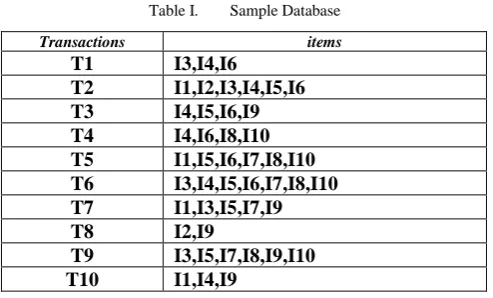
[image:1.595.315.562.435.584.2]The sample database considered to be as shown in the table I. The items involved are {I1,I2,I3,I4,I5,I6,I7,I8,I9,I10} and the minsupport is considered as 3.
Table I. Sample Database
Transactions items
T1 I3,I4,I6
T2 I1,I2,I3,I4,I5,I6
T3 I4,I5,I6,I9
T4 I4,I6,I8,I10
T5 I1,I5,I6,I7,I8,I10 T6 I3,I4,I5,I6,I7,I8,I10 T7 I1,I3,I5,I7,I9
T8 I2,I9
T9 I3,I5,I7,I8,I9,I10
T10 I1,I4,I9
Construct the Initial table as, Items as rows and Transactions as columns. Map the cells in the table with ‘1’ where the items occurred in a transaction. Calculate all the RCs.
Table II. Initial Table
T1 T2 T3 T4 T5 T6 T7 T 8
T 9
T 10
R C
I1 1 1 1 1 4
I2 1 1 2
I3 1 1 1 1 1 5
I4 1 1 1 1 1 1 6
I5 1 1 1 1 1 1 6
I6 1 1 1 1 1 1 6
I7 1 1 1 1 4
I9 1 1 1 1 1 5
I10 1 1 1 1 4
SimplifyTab1(D,minsupport):
Check the RCs in the Initial table, if there are any RCs less than minsupport then remove the corresponding items from the table. If there are no items left in the table, which implies there are no frequent item sets.
Table III. SimplifiedTab1
T 1
T 2
T 3
T 4
T 5
T 6
T 7
T 8
T 9
T 10
R C
I1 1 1 1 1 4
I3 1 1 1 1 1 5
I4 1 1 1 1 1 1 6
I5 1 1 1 1 1 1 6
I6 1 1 1 1 1 1 6
I7 1 1 1 1 4
I8 1 1 1 1 4
I9 1 1 1 1 1 5
I10 1 1 1 1 4
C
C 3 5 4 4 6 7 5 1 6 2
Find -1 :
Generate all items which were left in the simplifiedTab1 as 1_itemset frequent itemsets.
[image:2.595.311.546.53.106.2]L1
Table IV. SimplifiedTab2 = {I1},{I3},{I4},{I5},{I6},{I7},{I8},{I9}
SimplifyTab2(SimplifiedTab1,2,minsupport) :
Remove the transactions whose CCs is less than 2 and then remove the corresponding items whose RCs is less than minsupport from the SimplifiedTab1.
T 1
T 2
T 3
T 4
T 5
T 6
T 7
T 9
T 10
RC
I1 1 1 1 1 4
I3 1 1 1 1 1 5
I4 1 1 1 1 1 1 6
I5 1 1 1 1 1 1 6
I6 1 1 1 1 1 1 6
I7 1 1 1 1 4
I8 1 1 1 1 4
I9 1 1 1 1 4
I10 1 1 1 1 4
for item = I1
NewTabGenerateNewTab(SimplifiedTab2,item)
[image:2.595.40.277.168.332.2]Identifying the first item in the SimplifiedTab2, construct a NewTab considering all the transactions in which that item exists.
Table V. NewTab
T2 T5 T7 T10 RC
I1 1 1 1 1 4
I3 1 1 2
I4 1 1 2
I5 1 1 1 3
I6 1 1 2
I7 1 1 2
I8 1 1
I9 1 1 2
I10 1 1
CC 5 6 5 3
SimplifyTab2(NewTab,2,minsupport) :
Remove the transactions whose CC is less than 2 and then remove the corresponding items whose RCs is less than minsupport from the NewTab.
Table VI. SimplifiedTab
T2 T5 T7 T10 RC
I1 1 1 1 1 4
I5 1 1 1 3
Find -2 :
Generate all item combinations which were left in the SimplifiedTab as 2_itemset frequent itemsets for an item.
L2= {I1,I5}
SimplifyTab2(NewTab,3,minsupport) :
Remove the transactions whose CC is less than 3 and then remove the corresponding items whose RCs is less than minsupport from the SimplifiedTab.
Find -3 : L3
Table VII. NewTab = NULL
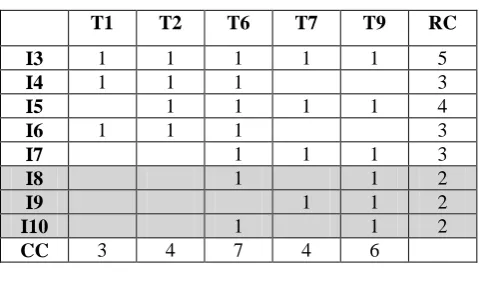
for item = I3
NewTabGenerateNewTab(SimplifiedTab2,item)
Identifying the next item in the SimplifiedTab2, construct a NewTab considering all the transactions in which that item exists.
T1 T2 T6 T7 T9 RC
I3 1 1 1 1 1 5
I4 1 1 1 3
I5 1 1 1 1 4
I6 1 1 1 3
I7 1 1 1 3
I8 1 1 2
I9 1 1 2
I10 1 1 2
CC 3 4 7 4 6
SimplifyTab2(NewTab,2,minsupport) :
[image:2.595.40.276.448.608.2]Remove the transactions whose CC is less than 2 and then remove the corresponding items whose RCs is less than minsupport from the NewTab.
Table VIII. SimplifiedTab
T1 T2 T6 T7 T9 RC
I3 1 1 1 1 1 5
I4 1 1 1 3
I5 1 1 1 1 4
I6 1 1 1 3
[image:2.595.318.558.453.595.2] [image:2.595.318.558.660.743.2] [image:2.595.30.266.670.775.2]Find -2 :
Generate all item combinations which were left in the simplifiedTab as 2_itemset frequent itemsets for an item.
L2= {I3,I4} {I3,I5} {I3,I6} {I3,I7}
SimplifyTab2(SimplifiedTab,3,minsupport) :
Remove the transactions whose CCs is less than 3 and then remove the corresponding items whose RCs is less than minsupport from the SimplifiedTab.
Find -3 :
Identify the 3 item transactions and check whether the items as a set are frequent , comparing with the rest of the transactions. If so, generate the items as a frequent itemset and remove the transaction along with the transactions which are of same.
T1 T2 T6 T7 T9 RC
I3 1 1 1 1 1 5
I4 1 1 1 3
I5 1 1 1 1 4
I6 1 1 1 3
I7 1 1 1 3
3 4 5 3 3
L3= {I3,I4,I6},
SimplifyTab2(SimplifiedTab,3,minsupport) :
Remove the transactions whose CC is less than 3 and then remove the corresponding items whose RCs is less than minsupport from the SimplifiedTab.
T2 T6 T7 T9 RC
I3 1 1 1 1 4
I4 1 1 2
I5 1 1 1 1 4
I6 1 1 2
I7 1 1 1 3
4 5 3 3
T2 T6 T7 T9 RC
I3 1 1 1 1 4
I5 1 1 1 1 4
I7 1 1 1 3
2 3 3 3
T6 T7 T9 RC
I3 1 1 1 4
I5 1 1 1 4
I7 1 1 1 3
3 3 3
[image:3.595.317.558.57.193.2]L3
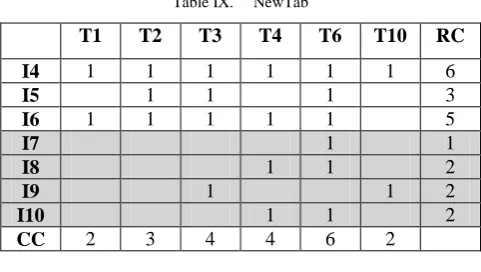
Table IX. NewTab
= {I3,I5,I7}
for item = I4
NewTabGenerateNewTab(SimplifiedTab2,item)
Identifying the next item in the simplifiedTab2, construct a NewTab considering all the transactions in which that item exists.
T1 T2 T3 T4 T6 T10 RC
I4 1 1 1 1 1 1 6
I5 1 1 1 3
I6 1 1 1 1 1 5
I7 1 1
I8 1 1 2
I9 1 1 2
I10 1 1 2
CC 2 3 4 4 6 2
SimplifyTab2(NewTab,2,minsupport) :
[image:3.595.36.281.230.343.2]Remove the transactions whose CC is less than 2 and then remove the corresponding items whose RCs is less than minsupport from the NewTab.
Table X. simplifiedTab
T1 T2 T3 T4 T6 T10 RC
I4 1 1 1 1 1 1 6
I5 1 1 1 3
I6 1 1 1 1 1 5
Find -2 :
Generate all item combinations which were left in the simplifiedTab as 2_itemset frequent itemsets for an item.
L2= {I4,I5} {I4,I6}
SimplifyTab2(SimplifiedTab,3,minsupport) :
Remove the transactions whose CCs is less than 3 and then remove the corresponding items whose RCs is less than minsupport from the SimplifiedTab.
T1 T2 T3 T4 T6 T1
0 R C
I4 1 1 1 1 1 1 6
I5 1 1 1 3
I6 1 1 1 1 1 5
CC 2 3 3 2 3 1
Find -3 :
Identify the 3 item transactions and check whether the items as a set are frequent comparing with the rest of the transactions. If so, generate the items as a frequent itemset and remove the transaction along with the transactions which are of same.
T2 T3 T6 RC
I4 1 1 1 3
I5 1 1 1 3
I6 1 1 1 3
CC 3 3 3
L3= {I4,I5,I6}
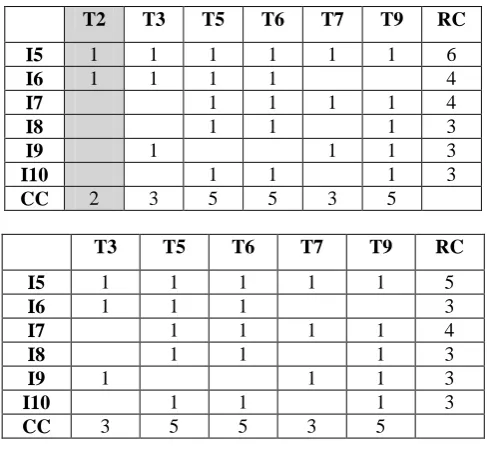
for item = I5
NewTabGenerateNewTab(SimplifiedTab2,item)
Table XI. NewTab
T2 T3 T5 T6 T7 T9 RC
I5 1 1 1 1 1 1 6
I6 1 1 1 1 4
I7 1 1 1 1 4
I8 1 1 1 3
I9 1 1 1 3
I10 1 1 1 3
CC 2 3 5 5 3 5
Find -2 :
Generate all item combinations which were left in the simplifiedTab as 2_itemset frequent itemsets for an item. L2= {I5,I6} {I5,I7} {I5,I8}{I5,I9} {I5,I10}
SimplifyTab2(SimplifiedTab,3,minsupport) :
Remove the transactions whose CC is less than 3 and then remove the corresponding items whose RCs is less than minsupport from the SimplifiedTab.
T2 T3 T5 T6 T7 T9 RC
I5 1 1 1 1 1 1 6
I6 1 1 1 1 4
I7 1 1 1 1 4
I8 1 1 1 3
I9 1 1 1 3
I10 1 1 1 3
CC 2 3 5 5 3 5
T3 T5 T6 T7 T9 RC
I5 1 1 1 1 1 5
I6 1 1 1 3
I7 1 1 1 1 4
I8 1 1 1 3
I9 1 1 1 3
I10 1 1 1 3
CC 3 5 5 3 5
Find -3 :
Identify the 3 item transactions and check whether the items as a set are frequent comparing with the rest of the transactions. If so, generate the items as a frequent itemset and remove the transaction along with the transactions which are of same.
T5 T6 T7 T9 RC
I5 1 1 1 1 4
I6 1 1 2
I7 1 1 1 1 4
I8 1 1 1 3
I9 1 1 2
I10 1 1 1 3
CC 5 5 3 5
T5 T6 T7 T9 RC
I5 1 1 1 1 4
I7 1 1 1 1 4
I8 1 1 1 3
I10 1 1 1 3
CC 4 4 2 4
T5 T6 T9 RC
I5 1 1 1 4
I7 1 1 1 4
I8 1 1 1 3
I10 1 1 1 3
CC 4 4 4
L3= {I5,I7,I8} {I5,I7,I10} {I5,I8,I10}
Find -4 :
Generate all item combinations which were left in the simplifiedTab as 4_itemset frequent itemsets for an item.
L4
Table XII. NewTab = {I5,I7,I8,I10}
for item = I6
NewTabGenerateNewTab(SimplifiedTab2,item)
Identifying the first item in the simplifiedTab2, construct a NewTab considering all the transactions in which that item exists.
T1 T2 T3 T4 T5 T6 RC
I6 1 1 1 1 1 1 6
I7 1 1 2
I8 1 1 1 3
I9 1 1
I10 1 1 1 3
CC 1 1 2 3 4 4
SimplifyTab2(NewTab,2,minsupport) :
Remove the transactions whose CC is less than 2 and then remove the corresponding items whose RCs is less than minsupport from the NewTab.
T1 T2 T3 T4 T5 T6 RC
I6 1 1 1 1 1 1 6
I7 1 1 2
I8 1 1 1 3
I9 1 1
I10 1 1 1 3
T3 T4 T5 T6 RC
I6 1 1 1 1 4
I7 1 1 2
I8 1 1 1 3
I9 1 1
[image:4.595.36.280.290.519.2]I10 1 1 1 3
Table XIII. SimplifiedTab
T3 T4 T5 T6 RC
I6 1 1 1 1 4
I8 1 1 1 3
I10 1 1 1 3
[image:4.595.36.284.596.778.2]Generate all item combinations which were left in the simplifiedTab as 2_itemset frequent itemsets for an item.
L2= {I6,I8} {I6,I10}
SimplifyTab2(SimplifiedTab,3,minsupport) :
Remove the transactions whose CCs is less than 3 and then remove the corresponding items whose RCs is less than minsupport from the SimplifiedTab.
T4 T5 T6 RC
I6 1 1 1 6
I8 1 1 1 3
I10 1 1 1 3
CC 3 3 3
Find -3 :
Identify the 3 item transactions and check whether the items as a set are frequent comparing with the rest of the transactions. If so, generate the items as a frequent itemset and remove the transaction along with the transactions which are of same.
[image:5.595.315.562.96.232.2]L3
Table XIV. NewTab = {I6,I8,I10}
for item = I7
NewTabGenerateNewTab(SimplifiedTab2,item)
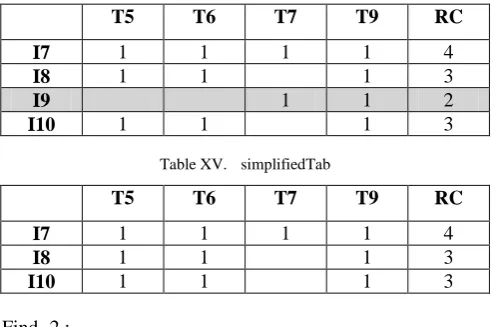
Identifying the first item in the simplifiedTab2, construct a NewTab considering all the transactions in which that item exists.
T5 T6 T7 T9 RC
I7 1 1 1 1 4
I8 1 1 1 3
I9 1 1 2
I10 1 1 1 3
CC 3 3 2 4
SimplifyTab2(NewTab,2,minsupport) :
Remove the transactions whose CC is less than 2 and then remove the corresponding items whose RCs is less than minsupport from the NewTab.
T5 T6 T7 T9 RC
I7 1 1 1 1 4
I8 1 1 1 3
I9 1 1 2
[image:5.595.34.283.391.484.2]I10 1 1 1 3
Table XV. simplifiedTab
T5 T6 T7 T9 RC
I7 1 1 1 1 4
I8 1 1 1 3
I10 1 1 1 3
Find -2 :
Generate all item combinations which were left in the simplifiedTab as 2_itemset frequent itemsets for an item.
L2= {I7,I8} {I7,I10}
SimplifyTab2(SimplifiedTab,3,minsupport) :
Remove the transactions whose CCs is less than 3 and then remove the corresponding items whose RCs is less than minsupport from the SimplifiedTab.
T5 T6 T7 T9 RC
I7 1 1 1 1 4
I8 1 1 1 3
I10 1 1 1 3
CC 3 3 1 3
T5 T6 T9 RC
I7 1 1 1 3
I8 1 1 1 3
I10 1 1 1 3
CC 3 3 3
Find -3 :
Identify the 3 item transactions and check whether the items as a set are frequent comparing with the rest of the transactions. If so, generate the items as a frequent itemset and remove the transaction along with the transactions which are of same.
L3
Table XVI. NewTab = {I7,I8,I10}
for item = I8
NewTabGenerateNewTab(SimplifiedTab2,item)
Identifying the first item in the simplifiedTab2, construct a NewTab considering all the transactions in which that item exists.
T4 T5 T6 T9 RC
I8 1 1 1 1 4
I9 1 1
I10 1 1 1 1 4
CC 2 2 2 3
SimplifyTab2(NewTab,2,minsupport) :
Remove the transactions whose CC is less than 2 and then remove the corresponding items whose RCs is less than minsupport from the NewTab.
Table XVII. simplifiedTab
T4 T5 T6 T9 RC
I8 1 1 1 1 4
I10 1 1 1 1 4
Find -2 :
Generate all item combinations which were left in the simplifiedTab as 2_itemset frequent itemsets for an item.
L2= {I8,I10}
SimplifyTab2(NewTab,3,minsupport) :
Remove the transactions whose CCs is less than 3 and then remove the corresponding items whose RCs is less than minsupport from the SimplifiedTab.
L3= NULL
for item = I9
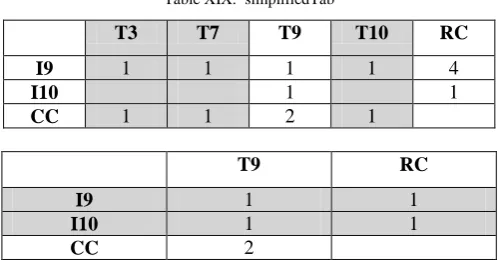
[image:5.595.35.284.542.705.2]Identifying the first item in the simplifiedTab2, construct a NewTab considering all the transactions in which that item exists.
Table XVIII. NewTab
T3 T7 T9 T10 RC
I9 1 1 1 1 4
I10 1 1
CC 1 1 2 1
SimplifyTab2(NewTab,2,minsupport) :
[image:6.595.33.283.96.168.2]Remove the transactions whose CC is less than 2 and then remove the corresponding items whose RCs is less than minsupport from the NewTab.
Table XIX. simplifiedTab
T3 T7 T9 T10 RC
I9 1 1 1 1 4
I10 1 1
CC 1 1 2 1
T9 RC
I9 1 1
I10 1 1
CC 2
Find -2 :
Generate all item combinations which were left in the simplifiedTab as 2_itemset frequent itemsets for an item.
L2
IV. ALGORITHM
= NULL
Input: database D, minsupport Output : All the frequent itemsets in D
1) [Produce the initiaTtable]
SimplifiedTab1 SimplifyTab1(D,minsupport) If SimplifiedTab1 = NULL
End, No frequent itemsets Else
[Finding 1_itemset frequent itemsets] L1 find_1
SimplifiedTab2
SimplifyTab2(SimplifiedTab1,2,minsupport)
2) [Repeat the procedure from first to last with one item in the table]
[start with the initial item in simplifiedTab2 as item] NewTabGenerateNewTab(SimplifiedTab2, item) [finding 2_itemset frequent itemsets with item]
L2 find_2.
[finding 3_itemset frequent itemsets to maximum column_count frequent itemsets]
While N from 3 to Max(CC) in the New Tab {
SimplifiedTab simplifyTab2(NewTab ,N, minsupport)
if (SimplifiedTab != NULL )
While (Any column count = N)
LN find_N [collection of exact N_item frequent itemsets in the New Tab ]
SimplifiedTab Remove(SimplifiedTab ,Transaction)
SimplifiedTab SimplifyTab2(SimplifiedTab ,N, minsupport )
if (SimplifiedTab != NULL )
[find out all other N frequent itemsets ]
[Find out all the possible N item combinations from New Tab items starting with item]
LN
3) [ find out all frequent item sets ]
find_N. [collection of all N_frequent itemsets in the New Tab]
Increment N NewTab=SimplifiedTab. End while
}
Take next item in the table as item and continue the above procedure
End procedure
Answers L1 U L2 U L3 U L4 --- U L
V. RESULTS
maxitem. 4) [END]
The Frequent itemsets that were generated on the sample database with a minimum support of 3 are L1 U L2 U L3 U L4
Where,
L1={I1},{I3},{I4},{I5},{I6},{I7},{I8},{I9}. L2={I1,I5}, {I3,I4},{I3,I5},{I3,I6},{I3,I7},
{I4,I5},{I4,I6}, {I5,I6},{I5,I7},{I5,I8},{I5,I9},{I5,I10}, {I6,I8},{I6,I10},{I7,I8},{I7,I10},{I8,I10}.
L3={I3,I4,I6},{I3,I5,I7},{I4,I5,I6},{I5,I7,I8},{I5,I7,I10}, {I5,I8,I10}, {I6,I8,I10}, {I7,I8,I10}.
L4
VI. CONCLUSION ={I5,I7,I8,I10}.
The performance of the proposed algorithm on some of the sample databases which contain the number of transactions as 20, 40, 60, 80, 100 is shown in the following graph in terms of CPU execution time.
performance, min_support=3
17
28
53
73
89
0 20 40 60 80 100
20 40 60 80 100
Number of Transactions
T
im
e i
n
N
an
o
se
co
n
d
s
time
[image:6.595.33.283.246.380.2]VII. REFERENCES
[1] Jiawei Han, Micheline Kamber, “Data Mining: Concepts and Techniques”, 2nd Edition.
[2] R. Agrawal and R. Srikant. Fast algorithms for mining association rules. The International Conference on Very Large Databases, pages 487–499, 1994.