DOI: http://dx.doi.org/10.26483/ijarcs.v9i2.5798
Volume 9, No. 2, March-April 2018
International Journal of Advanced Research in Computer Science
RESEARCH PAPER
Available Online at www.ijarcs.info
ISSN No. 0976-5697
A QOS AWARE MULTICAST ROUTING PROTOCOL FOR CONSTRUCTING
AN OPTIMAL PATH FOR MULTIMEDIA TRAFFIC IN WIRELESS SENSOR
NETWORKS
Padmaleela Damaraju
Dept. of Computer Science Gitam Institute of ScienceGitam,
Deemed to be University Vishakapatnam, India
Dr.M Sesha Shayee
Dept. of Computer Science Gitam Institute of Science,Gitam,
Deemed to be University Vishakapatnam, India
Abstract: Wireless Sensor Networks (WSNs) are communication networks having tiny sensors with sensing and transmitting capabilities .These systems adopting traditional routing protocols to organize communication, have design issues, and quality of service is still a challenging research factor. The key idea of this research is to discover the most efficient routing protocols based on the design of a reliable and efficient routing protocol to determine quality of services in a WSN. In this paper we propose a reliable and efficient path selection strategy by designing a Quality of Service Aware multicast routing protocol.This protocol discusses the multicast routing problem of WSN with multiple QoS constraints, by discovering a minimum resource consumption path while satisfying multiple constraints optimization conditions. Simulation results show that the fair link selection strategy can yield to a good solution for this traditionally NP complex problem, as compared to the best multicast algorithms known.
Keywords: WSN, multicast routing,Steiner tree, QoS-aware routing
1.INTRODUCTION
Wireless sensor network is a self-organized network system with low amount of resources and constitutes of tiny sensors. Nowadays, WSN is widely used as an effective communication interface medium to interact with physical world to exchange global information. In addition WSN consist of spatially distributed autonomous sensors to cooperatively monitor physical or environmental conditions. Broadcasting across autonomous sensors produces more communication issues due to the lack of resources such as energy, bandwidth, and memory etc.
From past few years, an intensive research was conducted to address the problems during data gathering and processing among group of sensors and to address the potential of collaboration among sensors. However, sensor nodes are constrained nodes and organizing large amount communication services is a problem due to the lack of energy resources and bandwidth.
Routing in WSNs is very challenging factor due to the inherent characteristics that distinguish these networks from other wireless networks like cellular networks and mobile adhoc networks[1] . Due to the large number of sensor nodes it is difficult to form a global addressing scheme to deploy sensor nodes with different IDs and addressing the nodes produces overhead to maintain individual IDs . So the traditional IP-based routing protocols may not be advisable or WSNs. Furthermore, sensor nodes are deployed in an ad hoc manner .
Multimedia applications typically require high bandwidth and reliable routing paths to achieve higher Quality of Service (QoS). In general, WSN is a large collection of autonomous sensors and the autonomous nature of each node needs cooperative communication with
other nodes. Interaction between nodes in such kind of infrastructure may cause network delay.
High bandwidth and low delay requirements are the most QOS required Multimedia applications of WSNs .Hence routing protocols which realise these QOS parameters need to be designed.[2] Many of the QOS aware routing protocols [3] in literature, focus on optimizing network resource utilization, avoiding traffic congestion, and balancing network traffic. These protocols calculate the optimal path from source to destination under best network conditions. They unfortunately do not consider the QOS requirements for these applications.
A multimedia application has different data flows for audio, video, text etc.[2] with differing QOS requirement .and these requirements should be considered for path decisions.
An optimal path decision can be made for each of these different flows take into consideration, the QOS and network conditions. This path decision should guarantee the required QOS and at the same time aim for effective network resource optimization. In such a scenario, multicast service is an efficient model. It can optimize the network resources and adapt to the bandwidth of wireless sensor network.
2.BACKGROUNDSTUDY
2.1.Steiner treeNetwork Model
A network 𝑊𝑊= {𝑁𝑁𝑤𝑤,𝐸𝐸𝑤𝑤}is represents as set of nodes 𝑁𝑁𝑤𝑤 and set of edges 𝐸𝐸𝑤𝑤where𝐸𝐸𝑤𝑤 ⊂ 𝑁𝑁𝑤𝑤×𝑁𝑁𝑤𝑤. The average number of edges are derived based on the set of nodes which is referred as out degree. From among these set of edges we derive the following delay and path cost functions,
Delay: 𝐸𝐸𝑤𝑤 → 𝑃𝑃+ {0}and path cost 𝐸𝐸𝑤𝑤 →{1}. The delay and path cost are defined as the sum of delay of all the edges of the paths.
In addition to this, the multicast group represent a set of multicast receivers and is defined as MR →Nw. According to [3][4], computing the Steiner tree is an NP-Complete problem. To compute a network tree to determine an optimal
[image:2.595.51.226.240.419.2]path by considering original probabilistic link descriptor
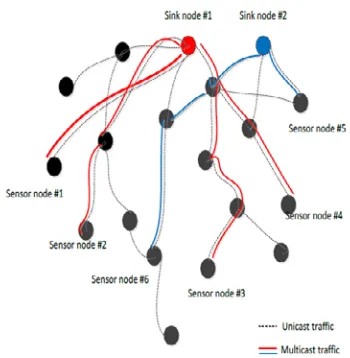
Fig 1: Multi-rate multicast wireless sensor network
3. QUALITY OF SERVICE AWARE MULTICAST
ROUTINGPROTOCOL(QOSMRP)
In this paper, we addressed the problem in Steiner tree network while constructing multicast routing ,duly considering Quality-of-Service requirements for each host and retaining fairness between links. To address this link fairness, we adopted two different techniques the Lagrangian Relaxation Method [5] and the Subgradient Method. These techniques determine the link capacity and improve link fairness.
By introducing Lagrangian Relaxation method [6] , Multiplier Vectors, primitive routing constraints, delay constraints and traffic constraints problem can be resolved .In multicast routing assignment, a set of routing decision variable {xp}’s corresponding multipliers can be used as each link’s arc weight. With the estimation of link’s arc weight, the highly loaded links can be avoided by considering the capacity allocation output from the last iteration’s dual problem. The routing modelling can be summarized as follows:
Link state of edge 𝑒𝑒𝑛𝑛 indicated by vector{𝑐𝑐,𝑑𝑑,𝑟𝑟}, where 𝑐𝑐is the link capacity, 𝑑𝑑 is the link delay and 𝑟𝑟 is routing transmission rate. For a set of source and destination pairs{𝑆𝑆𝑖𝑖,𝐷𝐷𝑖𝑖}, the available list of paths according to the Lagrangian Relaxation are determined by considering adaptive delay and capacity. The adaptive delay and
capacity of path 𝑃𝑃(𝑑𝑑)𝑎𝑎𝑛𝑛𝑑𝑑𝑃𝑃(𝑐𝑐) is measured in following equations
𝑃𝑃�𝑑𝑑𝑝𝑝�= ∑𝑛𝑛𝑖𝑖=1𝑑𝑑𝑒𝑒_𝑖𝑖𝑤𝑤ℎ𝑒𝑒𝑟𝑟𝑒𝑒𝑒𝑒𝑖𝑖𝑒𝑒𝑎𝑎𝑒𝑒𝑒𝑒𝑒𝑒𝑒𝑒𝑒𝑒𝑛𝑛𝑒𝑒𝑑𝑑𝑒𝑒𝑒𝑒(1)
𝑃𝑃�𝑐𝑐𝑝𝑝�= min𝑒𝑒_𝑖𝑖∈𝑝𝑝𝑐𝑐𝑒𝑒_𝑖𝑖(2)
The link utilization rate is estimated based on the above two equations
𝑈𝑈𝑒𝑒_𝑖𝑖 =𝑏𝑏𝑐𝑐𝑢𝑢𝑒𝑒__𝑖𝑖𝑖𝑖(3)
The available bandwidth rate can be derived for all paths as
𝐵𝐵𝑒𝑒_𝑖𝑖 = min1≤𝑖𝑖≤𝑛𝑛(𝑐𝑐𝑒𝑒_𝑖𝑖− 𝑏𝑏𝑢𝑢__𝑖𝑖)(4)
Based on the derived routing mechanism we can not only compute the link capacity it can also derives the link delay on different paths with respective to capacity. The bandwidth rate equation is derived from the minimum available resource rate, and the optimal path represents the minimum bandwidth cost presented by sum function of each link cost
𝑂𝑂𝑏𝑏= ∑𝑛𝑛𝑖𝑖=1𝜑𝜑(𝑏𝑏𝑢𝑢 𝑖𝑖+𝑏𝑏𝑟𝑟𝑒𝑒𝑟𝑟,𝑐𝑐𝑒𝑒_𝑖𝑖)(5)
According to the routing algorithms, to determine a feasible path to achieve the QoS requirements we need to consider the optimal path cost,and to achieve better QoS results, a feasible path selection is the one to satisfy all the QoS requirements in Steiner tree. In order to derive an efficient solution, this protocol organizes the routing process in two different steps, the first step is to determine the feasible paths which can assure link flow’s QoSrequirements and second step is to discover a best-effort path when feasible path doesn’t exist . If a feasible path exists, one of the best feasible paths is chosen for transmission flow. The section below presents the multicast transmission packet model.
3.1 Multicast Routing Packet Transmission Model
We modelled the Steiner tree Network Model as 𝐺𝐺({𝐸𝐸}, {𝑉𝑉}, {𝛼𝛼(𝑎𝑎𝑏𝑏)}, (𝑎𝑎,𝑏𝑏)∈ 𝐸𝐸)), where {𝐸𝐸} denotes the set of edges, {𝑉𝑉} is the set of vertices, {𝛼𝛼(𝑎𝑎𝑏𝑏)} is the set of descriptor links, (𝑎𝑎,𝑏𝑏)∈ 𝐸𝐸 can be a represented as bandwidth rate. The information source is a base station 𝐵𝐵 where 𝐵𝐵 ∈ 𝑉𝑉 , set of multicast nodes as 𝑀𝑀= {𝑀𝑀1,𝑀𝑀2,𝑀𝑀3… …𝑀𝑀𝑖𝑖−1}⊂ 𝑉𝑉. Let us assume that the
minimum transmission power needed for each node is
𝐸𝐸𝑎𝑎𝑏𝑏𝑇𝑇𝑇𝑇 =𝑔𝑔 ,∀(𝑎𝑎,𝑏𝑏)∈ 𝑉𝑉 (6)
The minimum probability of power required to receive successful packet is computed as
𝐸𝐸𝑎𝑎𝑏𝑏𝑅𝑅𝑇𝑇 =𝑒𝑒𝑒𝑒𝑝𝑝(𝜃𝜃𝑑𝑑𝑔𝑔𝑎𝑎𝑏𝑏𝛾𝛾) (7) Where 𝜃𝜃 represent hardware related threshold, 𝑑𝑑𝑎𝑎𝑏𝑏
represents distance from node 𝑎𝑎 to node 𝑏𝑏. 𝛾𝛾is a path loss exponent.
Let assume the communication between node 𝑎𝑎 to node 𝑏𝑏 uses packet acknowledgment ACK, to ensure the packet delivery over a particular link. In order to identify the packet confirmation we represent flags as 0 or 1. If the packet successfully reaches the receiver the ACK flag changes to 1 and if it fails it is changed to 0. The complete cycle of communication ends when both sender and receivers ACK flags are 1.
𝑃𝑃(𝜎𝜎𝑎𝑎𝑏𝑏) = (1− 𝑃𝑃𝑣𝑣𝑢𝑢)𝑚𝑚.𝑃𝑃𝑣𝑣𝑢𝑢
𝑤𝑤ℎ𝑒𝑒𝑟𝑟𝑒𝑒𝑃𝑃(𝜎𝜎𝑎𝑎𝑏𝑏) represents the unsuccessful packet distribution where as 𝑃𝑃(𝜍𝜍𝑎𝑎𝑏𝑏) defines the successful packet distribution
𝑃𝑃(𝜍𝜍𝑎𝑎𝑏𝑏) =𝑃𝑃𝑢𝑢𝑣𝑣. (1− 𝑃𝑃𝑢𝑢𝑣𝑣)𝑛𝑛.𝑃𝑃𝑢𝑢𝑣𝑣
The distribution delay 𝛿𝛿𝑎𝑎𝑏𝑏n over the link (𝑎𝑎,𝑏𝑏) is 𝑃𝑃(𝛿𝛿𝑎𝑎𝑏𝑏) = 𝑃𝑃(𝜎𝜎𝑎𝑎𝑏𝑏).g+𝑃𝑃(𝜍𝜍𝑎𝑎𝑏𝑏). 2𝑔𝑔
The overall packet transmission model represents six different fields and the packet structure is representedby six different parts, (1) packet head, (2) packet type ,(3) Source node ID, (4) unsuccessful packet distribution rate, (5) Successful packet distribution rate ,(6) Packet ID
Phead Ptype SID 𝜎𝜎 𝝇𝝇 PID
With the {src, dst} pair, available paths from sourceto destination are ranked dependingon bandwidth, delay, and utilization rate of the path.A feasible QOS aware path may or may not exist depending on the application’s data flow. An optimal path is constructed based on whether a feasible path exists or not.
3.1.1 Discovering a feasible path satisfying QoS requirements of the multimedia data: Delay, capacity and bandwidth are the main QOS constraint to be satisfied while constructing a feasible path.[2] The optimal path cost equation calculates each path’s bandwidth cost . The path that has the lowest cost and satisfies the bandwidth and delay requirements of the multimedia application is chosen as the optimal path.
The algorithm for finding the feasible path is given below.
Discovering Feasible path Algorithm :
Input : Number of nodes 𝑛𝑛, links 𝑒𝑒, number of paths 𝑒𝑒𝑝𝑝, minimum required bandwidth 𝑏𝑏𝑚𝑚𝑖𝑖𝑛𝑛, minimum required delay 𝑑𝑑𝑚𝑚𝑖𝑖𝑛𝑛
Output : bandwidth path cost, delay path cost at that particular path
1. set of nodes 𝑁𝑁= {𝑛𝑛}, set of paths 𝑒𝑒𝑝𝑝= {}
2 .For each node 𝑛𝑛: 1 𝑒𝑒𝑒𝑒𝑁𝑁
If 𝑛𝑛𝑒𝑒𝑑𝑑𝑒𝑒𝑛𝑛𝑖𝑖𝑑𝑑𝑖𝑖𝑒𝑒𝑐𝑐𝑒𝑒𝑣𝑣𝑒𝑒𝑟𝑟𝑒𝑒𝑛𝑛𝑗𝑗𝑛𝑛𝑒𝑒𝑑𝑑𝑒𝑒𝑒𝑒
Add 𝑒𝑒𝑝𝑝←{𝑒𝑒}∀𝑛𝑛𝑒𝑒𝑑𝑑𝑒𝑒𝑛𝑛𝑒𝑒
End if
Add the set of links to source and destination pairs as {𝑆𝑆𝑖𝑖,𝐷𝐷𝑖𝑖} ← 𝑒𝑒𝑝𝑝
End for
3. for a given set of source and destination pairs {𝑆𝑆𝑖𝑖,𝐷𝐷𝑖𝑖} 𝑤𝑤ℎ𝑒𝑒𝑟𝑟𝑒𝑒 1≥ 𝑖𝑖 ≤ 𝑛𝑛
for i:1 to n
if (𝑏𝑏𝑚𝑚𝑖𝑖𝑛𝑛 ≤ 𝑏𝑏𝑝𝑝𝑖𝑖&&𝑑𝑑𝑚𝑚𝑖𝑖𝑛𝑛 ≥ 𝑑𝑑𝑝𝑝𝑖𝑖) if(𝑐𝑐𝑒𝑒𝑒𝑒𝑒𝑒𝑏𝑏𝑝𝑝𝑖𝑖 >𝑐𝑐𝑒𝑒𝑒𝑒𝑒𝑒𝑏𝑏𝑝𝑝𝑖𝑖 + 1)
𝑃𝑃=𝑃𝑃𝑖𝑖+1
Add feasible paths as 𝑃𝑃=𝑃𝑃𝑖𝑖+1
End if End if End for
If the above feasible path algorithm doesn’t meet the QoS requirements, and if there is no set of feasible paths among the set of source and destination pairs when there is a link instability or obstacles, the following assumptions will be considered to achieve the QoS requirements.
Assumption 1: routing algorithm for bandwidth-constraint flows
Assumption 2: routing algorithm for delay-constraint flows Assumption 3: routing algorithm for OBSTRUCTED Links
Choosing of an appropriate bandwidth with respect to load on an over selected path is a key approach and for bandwidth sensitive flows , priority of bandwidth is muchhigher than latency.[2]The path with the lowest delay cost amongst the paths with unsatisfactory delay but satisfactory bandwidth requirement is selected as the optimal path.[7].
Hop count is defined as the metric for calculating delay cost in equations (8) and (9) and the path that has the minimum hop count is selected from the bandwidth satisfied paths . And the path with largest available bandwidth will be selected from among the paths which do not satisfy the bandwidth requirement.
The following two equations calculate the delay cost with hop count as the metric:
� 𝑐𝑐𝑒𝑒𝑒𝑒𝑒𝑒𝑑𝑑𝑒𝑒_𝑖𝑖 = 1, (𝑒𝑒𝑖𝑖 ∈ 𝑃𝑃) 𝑐𝑐𝑒𝑒𝑒𝑒𝑒𝑒𝑑𝑑𝑒𝑒 = 0, 𝑖𝑖𝑛𝑛𝑒𝑒𝑒𝑒ℎ𝑒𝑒𝑟𝑟𝑐𝑐𝑎𝑎𝑒𝑒𝑒𝑒
(8)
𝑐𝑐𝑒𝑒𝑒𝑒𝑒𝑒𝑑𝑑𝑝𝑝= ∑𝑛𝑛𝑖𝑖=1𝑐𝑐𝑒𝑒𝑒𝑒𝑒𝑒𝑑𝑑𝑒𝑒_𝑖𝑖 (9)
Procedure -1: Discovery of a path for bandwidth-
constraint flows
Let the set of nodes 𝑁𝑁= {𝑛𝑛}, set of paths 𝑒𝑒𝑝𝑝 = {} If �𝑏𝑏𝑟𝑟𝑒𝑒𝑟𝑟 ≤ 𝑏𝑏𝑝𝑝𝑖𝑖&&𝑑𝑑𝑟𝑟𝑒𝑒𝑟𝑟 ≤ 𝑑𝑑𝑝𝑝𝑖𝑖�
If �𝑐𝑐𝑒𝑒𝑒𝑒𝑒𝑒𝑑𝑑
𝑝𝑝𝑖𝑖 >𝑐𝑐𝑒𝑒𝑒𝑒𝑒𝑒𝑑𝑑𝑝𝑝𝑖𝑖+1�
𝑝𝑝=𝑝𝑝𝑖𝑖+1
Else if �𝑏𝑏𝑟𝑟𝑒𝑒𝑟𝑟 ≥ 𝑏𝑏𝑝𝑝𝑖𝑖� 𝑝𝑝=𝑝𝑝𝑖𝑖+1
End else End if End loop
In case there are no paths which satisfy the delay requirements, the path with lowest delay willbe chosen as an optimal path .
Procedure -2: Discovery of a path for delay- constraint flows
Let the set of nodes 𝑁𝑁= {𝑛𝑛}, set of paths 𝑒𝑒𝑝𝑝 = {} If �𝑑𝑑𝑟𝑟𝑒𝑒𝑟𝑟 ≤ 𝑑𝑑𝑝𝑝𝑖𝑖&&𝑏𝑏𝑟𝑟𝑒𝑒𝑟𝑟 ≥ 𝑏𝑏𝑝𝑝𝑖𝑖�
If �𝑐𝑐𝑒𝑒𝑒𝑒𝑒𝑒𝑏𝑏
𝑝𝑝𝑖𝑖 >𝑐𝑐𝑒𝑒𝑒𝑒𝑒𝑒𝑏𝑏𝑝𝑝𝑖𝑖+1�
𝑝𝑝=𝑝𝑝𝑖𝑖+1
Else if �𝑑𝑑𝑟𝑟𝑒𝑒𝑟𝑟 ≥ 𝑑𝑑𝑝𝑝𝑖𝑖� 𝑝𝑝=𝑝𝑝𝑖𝑖+1
End else End if End loop
MULTICAST ROUTINGALGORITHM ON OBSTRUCTED LINKS
Because of an inappropriate link information, the link state chooses distribution delay metric 𝛿𝛿𝑎𝑎𝑏𝑏 and deploys random variable to determine the random delay.[8] Based on the random delay information, we transfer data over random links to organize random search heuristic process. To determine efficient search process we introduce two different types of multicast tree routing process such as end-to-end routing process and bottle neck routing process.
We determine the bottleneck Steiner tree problem as max
(𝑎𝑎,𝑏𝑏)∈𝑇𝑇𝐸𝐸𝑎𝑎𝑏𝑏 <𝛼𝛼,𝑇𝑇 ∈ 𝑇𝑇
Where 𝑇𝑇 contains a set of trees ,𝐸𝐸𝑎𝑎𝑏𝑏 represents the maximum power required during transmission and 𝛼𝛼is the power limit.
1)Algorithm to get obstructed distance between (p1, p2, B)
Input: Locations, p1 and p2, of two vehicles and a predetermined binary search partition (BSP), B, of obstacles.
Output: The total obstructed distance: mo, the number of obstacle edge intersections: n.
1. mo ← 0; n ← 0
2. Initialize a maximum range, r, the distance from either point p1 or p2 to an obstacle center-point, that is used to filter the set of obstacles to the subset which are sufficiently nearby for calculation purposes (i.e., for optimization, exclude far-away obstacles).
3. Create a bounding box, b, for p1 and p2 and extend in all directions by r.
4. Get the set of potential obstacles, O. O ← the range search of b within B.
5. For every obstacle o ∈O, do:
6. If the distance from p1 or p2 to the obstacle centre is within range, r, then
7. for each edge s ∈o,
8. If s intersects a ray from p1 to p2
9. n ←n + 1 (i.e., found an obstructing wall)
10. Save the min. and max. distances from {p1, p2} to the intersection pt. (i.e., to find spanning interior distance among the edges of o)
11. mo ←mo + distance between min., max. Values in step 10 (i.e., spanning interior obstructed distance)
12. Return mo and n
4. EXPERIMENTS AND PERFORMANCE
EVALUATION
In this experiment we use Network Simulator Version-2 (NS2) [9] to simulate the proposed routing protocol QoSMRP. In this experiment we designed multi-hop WSN by configuring a routing protocol to evaluate the performance of proposed QoS-aware routing mechanism. In our simulation, the channel capacity of mobile hosts is set to the same value: 2 Mbps. We use the distributed coordination function (DCF) of IEEE 802.11 for wireless LANs as the MAC layer protocol. It has the functionality to notify the network layer about link breakage.
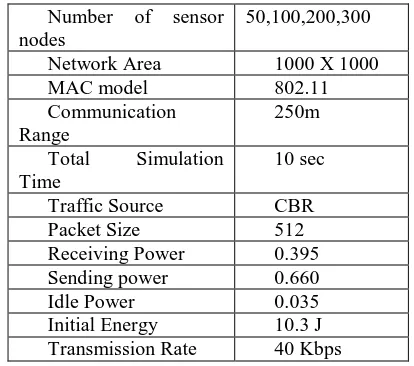
[image:4.595.333.540.305.488.2]In our simulation, we consider network area as a 1000 meter x 1000 meter region and we set a 10 seconds simulation time. All nodes have the same transmission range of 250 meters. The simulated traffic is Constant Bit Rate (CBR). Our simulation settings and parameters are summarized in table 1
Table I: Simulation Settings
Number of sensor nodes
50,100,200,300
Network Area 1000 X 1000
MAC model 802.11
Communication Range
250m
Total Simulation Time
10 sec
Traffic Source CBR
Packet Size 512
Receiving Power 0.395 Sending power 0.660
Idle Power 0.035
Initial Energy 10.3 J Transmission Rate 40 Kbps
5.1 Evaluation Results
We evaluate the performance of proposed QoS routing protocol by considering following metrics. We compare this protocol with Dynamic Quality of Service Stability based multicast routing protocol DQSMRP protocol by varying the number of nodes and by varying the bandwidth rate.
1)Average Packet Delivery Ratio: It is the ratio of the number .of packets received successfully and the total number of packets transmitted.
2)Average Packet Drop: It is the average number of packets dropped by the misbehaving nodes.
3)Delay: It is the time taken by the packets to reach the receiver.
4)Energy Consumption: It is the amount of energy
consumed by the nodes for the data transmission.
Fig 2: EndtoEnddelay : Number of nodes vs Delay (S)
Fig 3: PDR : Number of nodes vs PDR
[image:5.595.61.406.70.742.2]Fig 4: Average Throughput: Number of nodes vs Throughput
Fig 5: Energy Consumption: Number of nodes vs Energy
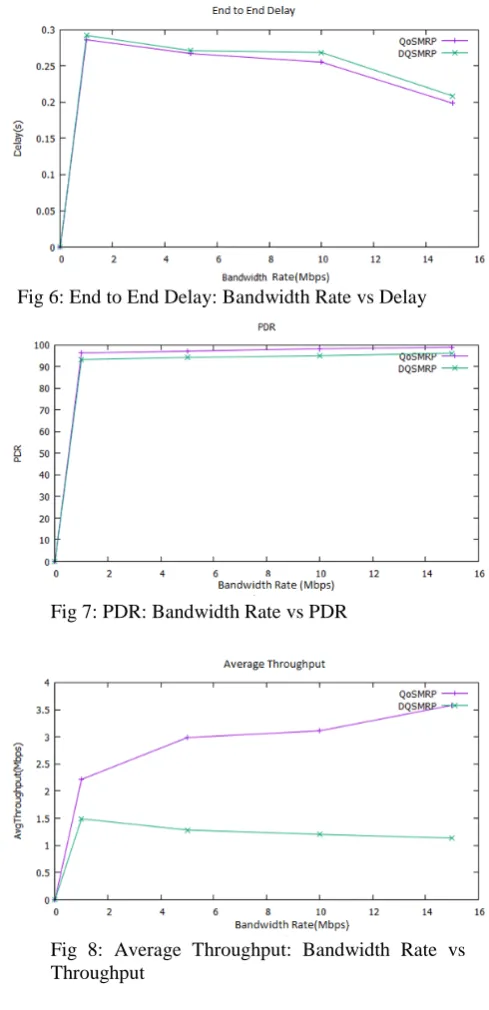
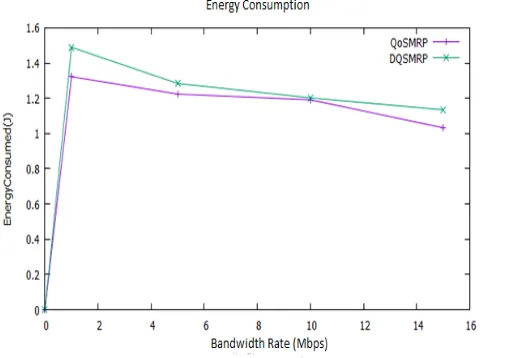
2) Based on Bandwidth :In this scenario we varied various bandwidth rates to determine the QoSMRP efficiency by comparing with existing DQSMRP protocol. According to the simulation results, the bandwidth rate improves the QoS constrains, based on the simuation results, the end-to-end delay reduced and throughput and packet delivery ration increased.
Fig 6: End to End Delay: Bandwidth Rate vs Delay
[image:5.595.50.287.71.408.2]Fig 7: PDR: Bandwidth Rate vs PDR
[image:5.595.326.571.138.644.2]Fig 9: Energy Consumption: Bandwidth Rate vs Energy
5.CONCLUSION
In this paper we discussed the Quality of Service constrains in WSN by identifying various quality constraints by analyzing various earlier contributed multicast routing algorithms and protocols. In order to minimize the link cost utilization we designed a novel Quality of service multicast routing protocol, which adopts Steiner tree model to minimize the utilization rate to discovery feasible path. Based on the fairness rate calculation rate results the optimal route selection strategy discovered a feasible path , which minimized the rate utilization which are derived using Lagrangian Relaxation Method. The simulation results clearly show the performance improvement on different scenarios
6.REFERENCES
[1] Jamal N. Al-Karaki Ahmed E. Kamal, “Routing Techniques in Wireless Sensor Networks: A Survey”, Dept. of Electrical
and Computer Engineering Iowa State University, Ames, Iowa 50011
[2] Li Han ,Shimin Sun , BokgyuJoo , Xianshu Jin and Sunyoung Han,“QoS-Aware Routing Mechanism in OpenFlow-enabled Wireless Multimedia Sensor Networks”,https://doi.org/10.1177/155014779378120
[3] Zhou Zeshun , Xu Yi , Yan Junjie , NieZhongwei , Li Layuan, “A Multiple Constrained QoS Routing Algorithm for the wireless sensor networks”, 2nd International Symposium on Computer, Communication, Control and Automation (ISCCCA-13)
[4] S. Basagni, et al. Location aware, dependable multicast for mobile ad hoc networks Computer Networks (2001), pp. 659-670
[5] K. Chen, K. Nahrstedt Effective Location- Guided Tree Construction Algorithms for Small Group Multicast in MANET Proc. INFOCOM (2002), pp. 1192-1201
[6] Bertsekas, D.; Gallager, R.G. Data Networks, 2nd ed.; Upper Shaddle River: Prentice Hall, NJ, USA, 1992.
[7] Bazlamaçcı, C.F.; Hindi, K.S. Minimum-weight spanning tree algorithms: A survey and empirical study. Comput.Oper. Res. 2001, 28, 767–785.
[8] Z. Xia, Y. Hong-Yi, and Z. Gang, “Bandwidth efficient collaborative quality of servicerouting for real-time flow in wireless multimedia sensor networks,” in Proceedings of the IEEE Asia-Pacific Services Computing Conference (APSCC), pp. 509–515, Hangzhou,China, December 2010. [9] Rakesh Kumar , MonowarHasan , SmrutiPadhy, Konstantin
Evchenko,”End-to-End Network Delay Guarantees for Real-Time Systems using SDN”, arXiv:1703.01641v2 [cs.NI] 3 May 2017
[10] L. Han, S. Sun, B. Joo, and S. Han, “QoS-based path switching mechanism in mobile SCTP”, International Journal of Distributed Sensor Networks, vol. 2014, Article ID282181, 12 pages, 2014.