A Novel Compact Feeding Network for Array Antenna
Pejman Mohammadi*, Asrin Piroutiniya, and Mohamad Hosein Rasekhmanesh
Abstract—A novel feeding network is investigated both theoretically and experimentally. The proposed system with combination of a Wilkinson power divider and two branch-Line couplers is established. The output signals of the system have the same amplitude and 90◦ phase difference with each other. The size reduction technique is applied to minimize the physical size of the proposed network. In this technique, the ground of the structure is defected, and distributed capacitors and inductors are added to empty space of the branch-line couplers. Moreover, meandered lines are used in order to match the output impedance of the Wilkinson power divider arms and reduce its size. The initial design realized in 2.5 GHz shows the fractional bandwidth of 24%. Then a miniaturized structure is fabricated with 42% smaller size than the main structure while it shows similar electrical performance. For both cases, measurement and simulation results are in good agreement with each other.
1. INTRODUCTION
The demand on the development of microwave compact components, such as couplers and power dividers in communication systems, has been increased, recently. These kinds of devices play an important role in today’s communications systems. In order to reach the requirements of telecommunication systems, various techniques and methods have been used to create different types of feeding networks such as sequential rotation and series-parallel feeding network and feeding networks based in CORPS, Butler matrix, etc. [1, 2–17]. In [2], a feeding network consists of seven quarter-wavelength transformers linked together in a sequential rotation manner with alternative parallel and series connection to form a front-port network. In [3], a microstrip-feed network is presented which has a 180◦ ring hybrid coupler, two 90◦ hybrid (branch-line) couplers and a delayed line on the topside of the antenna. A meta-lines based feeding network is also investigated in [4] that consists of two anti-parallel quadrature power splitters connected by a 180◦ out-of-phase power splitter. The Butler matrix, another type of feeding network, is a corporate multiple beam feed. Butler matrix is usually designed with an equal number of input (beam) and output (antenna) ports (N × N) [16].
In this project, a system which has four outputs with the same magnitude and 90◦ phase-difference is presented. The proposed structure consists of two branch-line quadrature hybrid couplers which are connected to each other by a Wilkinson power divider. A hybrid branch-line coupler shows 90◦ phase differences between output signals with equal amplitudes. These features make it a very useful component. On the other hand, power divider is a well-known three-port device which gives two equal outputs and provides high isolation between outputs [5]. In addition, all of its ports can be matched. As depicted in Fig. 1, a power divider produces two outputs with same amplitude and 180◦ phase difference. Output powers of a power divider are applied to couplers. Each coupler has two outputs with 90◦ phase-difference. The first coupler receives a power with 0◦ phase and divides it into two equal powers with 0◦ and 90◦ phases, and the second one converts 180◦ input power to two outputs with 180◦ and 270◦ phases. So a network with one input and four outputs is designed.
Received 10 February 2016, Accepted 21 March 2016, Scheduled 8 April 2016
L3 17.5 L14 3 W1 1.1
L4 16.6 L15 2 W2 1.1
L5 17.5 L16 6.7 W3 2
L6 13.7 L17 0.27 W4 1.1
L7 3 L19 4.6 W5 1.1
L8 4.1 a 72.2 W6 0.6
L9 4.1 b 31.7 W7 0.6
L10 4.1 c 28.8 W8 1.6
L11 4.1 L20 6
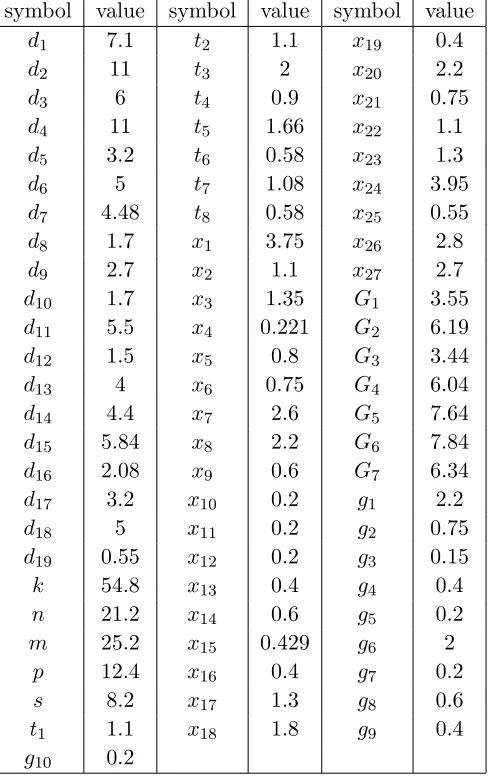
Table 2. Dimension of the structure in Fig. 3 and Fig. 4 (mm).
symbol value symbol value symbol value
d1 7.1 t2 1.1 x19 0.4
d2 11 t3 2 x20 2.2
d3 6 t4 0.9 x21 0.75
d4 11 t5 1.66 x22 1.1
d5 3.2 t6 0.58 x23 1.3
d6 5 t7 1.08 x24 3.95
d7 4.48 t8 0.58 x25 0.55
d8 1.7 x1 3.75 x26 2.8
d9 2.7 x2 1.1 x27 2.7
d10 1.7 x3 1.35 G1 3.55
d11 5.5 x4 0.221 G2 6.19
d12 1.5 x5 0.8 G3 3.44
d13 4 x6 0.75 G4 6.04
d14 4.4 x7 2.6 G5 7.64
d15 5.84 x8 2.2 G6 7.84
d16 2.08 x9 0.6 G7 6.34
d17 3.2 x10 0.2 g1 2.2
d18 5 x11 0.2 g2 0.75
d19 0.55 x12 0.2 g3 0.15
k 54.8 x13 0.4 g4 0.4
n 21.2 x14 0.6 g5 0.2
m 25.2 x15 0.429 g6 2
p 12.4 x16 0.4 g7 0.2
s 8.2 x17 1.3 g8 0.6
t1 1.1 x18 1.8 g9 0.4
Figure 1. Block diagram of proposed structure.
2. DESIGN PROCEDURE
The layout of the feeding network is shown in Fig. 2(a). These couplers and power divider are made of microstrip lines with different impedances. A branch-line hybrid coupler has four λ4 transmission lines wherein one pair has characteristic impedances of 35.4 Ω and the other pair has 50 Ω characteristic impedances. In this structure, two couplers are connected to output arms of the power divider. In fact, the power divider gives the signals with equal amplitudes and 180◦ phase differences to couplers. Two branch-line couplers have been used for dividing the outputs of the power into four equal outputs with the relative phases of 0◦, 90◦, 180◦, 270◦.
The substrate used is Ro4003 with a thickness of 0.508 mm, relative dielectric constant ofϵr= 3.55
(b) (a)
Figure 2. (a) Configuration of proposed system. (b) Wilkinson power divider with 180 phase difference.
50Ω±1 impedance. The length and width ofl2 do not affect the impedance matching becausel2 is very small in size, and it just alters the phase. So by changing both length and width, 180◦ phase difference is achieved. The amount of width and length are achieved by optimization.
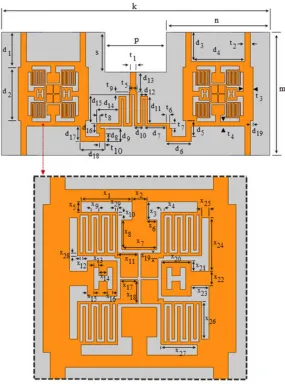
The dimensions of couplers and power divider are presented in Table 1 according to Fig. 2(a). The system in Fig. 2(a) is composed of two branch-line couplers which occupy a large area especially at low frequencies as 2.5 GHz. In the next step, the size of the structure is decreased. There are several methods to minimize the coupler’s size such as π-equivalent model [5, 6], T-shaped structure [7], dual TLs [8], quasi-lumped elements [9, 10], and fractal structure [11]. Defected Ground Structure (DGS) [12] and loading the transmission lines of couplers with inductance (L) and capacitance are used to reduce the size of the system. The dimensions are listed in Table 2. This technique is used on the ground face of the couplers of the feeding network which is shown in Fig. 3. Two different sizes of dumbbell shape DGS have been used in order to get a better result.
According to the formulas below, vp (Phase velocity) decreases by increasing L (inductance per
unit length) and C (capacitance per unit length). The values of L and C must be increased with the same ratio in order to keep the value of Z0 constant. The wavelength λ is also decreased with the mentioned condition, and the size reduction will be achieved.
λ = vp
f (1)
vp =
1 √
LC (2)
Z0 = √
L
C (3)
By using these two methods, the size of the feeding network is decreased about 42%. The miniaturized structure is indicated in Fig. 4. Using a meander microstrip-line is a way to make the whole size of a system compact [13]. The size reduction of the Wilkinson power divider was achieved by folding the quarter-wave transmission lines into tightly coupled meander line. The first one occupies 15.4 mm×21.5 mm, and the second one occupies 15.4 mm ×13.1 mm which shows nearly 40% size reduction. Because of the space needed for attaching the connectors, further size reduction is impossible.
(e)
(a) (b)
(c) (d)
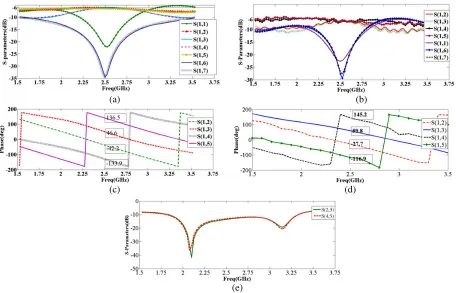
Figure 5. The first structure S-parameters, (a) magnitude simulation results, (b) magnitude measurement results, (c) phase simulation results, (d) phase measurement results, (e) isolation between ports.
3. MEASUREMENT AND SIMULATION RESULTS
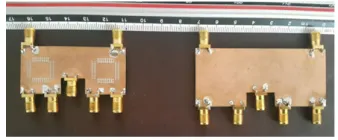
size of each coupler reaches 13.2 mm×14.3 mm. According to Fig. 6, the small-sized structure has the outputs of nearly −6 dB, and the phases of outputs are 164.7◦, 74.6◦,−16.1◦,−105.5◦. The measured phases are 126.5◦, 43◦, −43.3◦,−129.6◦ at 2.5 GHz that show about ±6◦ phase error. The return loss of input is better than−20 dB. Isolation ports of the system have reasonable responses in measurement about−16 dB. Finally, the top of the fabricated structures and bottom of them are illustrated in Fig. 7 and Fig. 8, respectively.
(e)
(a) (b)
(c) (d)
Figure 6. The results of the miniaturized structureS-parameters, (a) magnitude simulation results, (b) magnitude measurement results, (c) phase simulation results, (d) phase measurement results, (e) isolation between ports.
4. CONCLUSION
In this paper, a novel reduced-size feeding network is presented. The size reduction is achieved in the light of the DGS, and inductance and capacitance per unit length increment is 42%. This new form is established with a Wilkinson power divider and two branch-line couplers. The measurement results show four outputs with the same magnitudes and 90◦ phase differences. The fractional bandwidth is about 24% (2.2 GHz–2.8 GHz). Therefore, the proposed structure is a suitable solution for an array antenna feeding network.
REFERENCES
1. Huang, J., “A Ka-band circularly polarized high-gain microstrip array antenna,” IEEE Transactions on Antennas and Propagation, Vol. 43, No. 1, 113–116, Jan. 1995.
2. Maddio, S., “A compact wideband circularly polarized antenna array for C-band applications,”
IEEE Antennas and Wireless Propagation Letters, Vol. 14, 1081–1084, Dec. 2015.
3. Mohammadi, P. and V. Rafii, “High gain and broadband circularly polarized square slot antenna array,”Progress In Electromagnetics Research Letters, Vol. 43, 105–113, 2013.
4. Chung, K. L., “High-performance circularly polarized antenna array using metamaterial-line based feed network,” IEEE Transactions on Antennas and Propagation, Vol. 61, No. 12, 6233–6237, Dec. 2013.
5. Pozar, D. M., Microwave Engineering, John Wiley & Sons Press, 2005.
6. Tang, C. W. and M. G. Chen, “Miniaturized microstrip branch-line couplers with the approach of p-model,” Microw. Opt. Tech. Lett., Vol. 50, No. 2, 314–316, 2008.
7. Liao, S., P. T. Sun, N. C. Chin, and J. T. Peng, “A novel compact-size branch-line coupler,”IEEE Microw. Wirel. Compon. Lett., Vol. 15, No. 9, 588–509, 2005.
8. Tang, C. W., M. G. Chen, and C. H. Tsai, “Miniaturization of microstrip branch-line coupler with dual transmission lines,”IEEE Microw. Wirel. Compon. Lett., Vol. 18, No. 3, 185–187, 2008. 9. Liao, S. and J. T. Peng, “Compact planar microstrip branch-line couplers using the quasi-lumped
elements approach with nonsymmetrical and symmetrical T-shaped structure,” IEEE Trans. Microw. Theory Tech., Vol. 54, No. 9, 3508–3514, 2006.
10. Wang, C. W., T. G. Ma, and C. F. Yang, “A new planar artificial transmission line and its applications to a miniaturized Butler matrix,”IEEE Trans. Microw. Theory Tech., Vol. 55, No. 12, 2792–2801, 2007.
11. Ghali, H. and T. A. Moselhy, “Miniaturized fractal rat-race, branch-line, and coupled-line hybrids,”
IEEE Trans. Microw. Theory Tech., Vol. 52, No. 11, 2513—2520, 2004.
12. Eslamloo, M. K., P. Mohammadi, and M. Khoubrou, “Miniaturized wideband branch-line hybrid coupler with capacitive effect and defected ground structure (DGS),” Indian Journal of Science and Technology, Vol. 8, No. 35, December 2015.
13. Esa, M., N. Philip, I. P. Pohan, and N. A. Murad, “Miniaturized microwave meander coupled-line two-way wilkinson power divider,”International Symposium on Antennas and Propagation-ISAP, 2006.
14. Betancourt, D. and C. Del Ro, “Designing feeding networks with CORPS: Coherently radiating periodic structures,”Microwave and Optical Technology Letters, Vol. 48, No. 8, August 2006. 15. Panduro, M. A., “Design of beam-forming Networks for Scannable multi-beam antenna arrays
using CORPS,”.Progress In Electromagnetics Research, Vol. 84, 173–188, 2008.
16. Fakoukakis, F. E. and G. A. Kyriacou, “Novel nolen matrix based beamforming networks for series-fed low SLL multibeam antennas,”Progress In Electromagnetics Research B, Vol. 51, 33–64, 2013. 17. Gruszczyski, S., K. Wincza, and K. Sachse, “Reduced sidelobe four-beamN-element antenna arrays