Availability, selection and utilization of Instructional
Resources for
Mathematics
in Selected Primary Schools in Kiharu Division, Murang'a
County - Kenya
By
Nduati Morris Kamau
ESS/I0223/08
A Research project Submitted to the School of Education in Partial
Fulfillment of the Requirement
for Award of the Degree of Master of
Education of Kenyatta University.
August 2011
DECLARATION
This project is my original work and has not been previously presented for the award of a degree in
any
other UniversitySigned: ~Jl'(1y~/ _ Morris Kamau Nduati
E55/10223/08
This research project has been submitted with our approval as University Supervisors.
Signed:
<:::2
~
Date:6L~l
C)~J
l6
Prof: Grace Bunyi
Associate Professor
Department of Educational Management,
Policy,
and Curriculum Studies
,
(Date:
---~---Prof Malusu J.
DEDICATION To all parents who value education for their children
ACKNOWLEDGEMENTS
Many individuals have provided support and calm reassurance throughout this study. They have contnbuted vitally> energetically and patiently. I would like to thank them to the best of my ability for their contributions. I would like to thank my supervisors, Prof. Grace Bunyi and Dr. Waweru S. N. and Prof. Malusu who made it possible for me to complete this study through countless revisions and conversations, thank you for your patience and insights.
I am also grateful to the Ministry of Education Murang'a for their help during the piloting of the study. My sincere thanks goes to the staff in the DEOs office for assisting me contact teachers in the Division.
Many thanks also goes to my friends and colleagues I met and interacted with during the time of my studies. These include, Sue Muita, Ann Nyawira Macharia, Gullet and Christine Ndirangu. Special thanks goes to my wife Esther Njeri her encouragement helped me carryon with my studies despite the challenges I faced.
My thanks also go to my father and mother for their unceasing prayers and encouragements that led to the fruition of this work. God bless you abundantly.
ABSTRACT
Teaching learning resources increases learner's perception. They increase effective communication in education. Equipments and materials assist in the re-organization and re-defining of educational experiences considerable learning can be achieved through reinforcement that is through direct experiences boosted by observation and verbal reinforcement. Effectively prepared instructional resources show all activities presented by a teacher drawing attention, conveying information in teaching environment, however teachers have always overlooked the use of instructional resources especially when teaching mathematics in our primary schools hence always registering low grades. The purpose of this study was therefore to ascertain whether these resources are available in our schools, how they are selected and utilized.
The study was carried out in Kiharu Division of Murang'a County. The target population was 30 teachers from 15 sampled schools in the division.
The study adapted a descriptive survey design and employed questionnaires, interview scheduled and checklists schedule. The research instruments were piloted in three schools outside the sampled schools in Kiharu Division to ascertain their validity and reliability. Data collected was coded for computer analysis using SPSS.
Analysis using frequency and percentage was presented in form of tables, graphs and pie charts. The analysis was according to the main research objectives to review the major issues of concern.
The finding showed that there is shortage of text books, stationeries and teaching aids in these schools therefore this affects the teaching and learning of mathematics, teachers also do not utilize instructional resources when teaching mathematics neither do they improvise teaching learning resources. Schools should be funded enough so as to alleviate the problem of instructional resources and cost sharing should be done to improve the acquisition of instructional resources in our schools.
TABLE OF CONTENTS
DECLARATION ...•...•...•... ii
DEDICATION iii
ACKNOWLEDGEMENTS iv
ABSTRACT v
TABLE OF CONTENTS vi
LIST OF TABLES viii
LIST OF FIGURES ix
LIST OF ABBREVIATIONS x
CHAP'fER ONE ••.•.•.•.•.••..••...••.•.•.•...•.•...•..•....•..••...••...••....••.•..••..•...
1
IN'TRODUCTION •.•....•...•.••.•••.•...•...•...•...•... 11.1 Background
to
the Problem. 11.2 Statement to the Problem ~ 6
1.3
Purpose of the Study7
1.4 Research Objectives 8
1.5 Research Questions 8.
1.6 Significan.ce of the Stucly 8
1.7 Basic Assumption of the Study 9
1.8 Scope of the Study 10
1.8.1 Limitations 10
1.9
Theoretical Framework10
1.10 Conceptual Framework 11
1.11 Definition of Operational Tertns 13
• CHAPTER TWO ~...••••.•••••..•.•..•... 14 LITERA.TURE REVIEW ...•.•..•..•...•.•... eilit••••••••• 14
2.1 Introduction 14
CHAPTER THREE ...•...•.•••••••••_...••••••.•...•..•.•...:: 21 RESEARCH METHODOLOGY ••••••••••.•.••.•••••...•... 21
3.0
Introduction ..: 2J3.1
Research
Design
213.2 Location of the study 21
3.3 Target Population 22
3.4 Sample and Sampling Procedures 22
3.5 Research Instruments 23
3.6 Piloting 24
3.7 Validity. and Reliability 24
3.7.1 Validity 24
3.7.2 Reliability of Research lnstruments 25
3.8 Data Collection Procedure 25
3.9 Data Analysis Plan 26
V1
CHAnE-R FOUR ••••••••••••••.•••••••.••••••.•"'••••••••••.•••••••_••.•.•••••••••__•••••••••••• ._•••_. __ 27 DATA ANALYSIS, FINDINGS, PRESENTATIONS AND DISCUSSIONS •••••••.•••27 4.0 Introduction ...•...•...•...•...•..•.•... 27 4.1 Teacher's Background Information ...•..•... ;..27
4.2 Availability/status of Instructional Resources 29
4.3 Selection of mathematics instructional resources 37
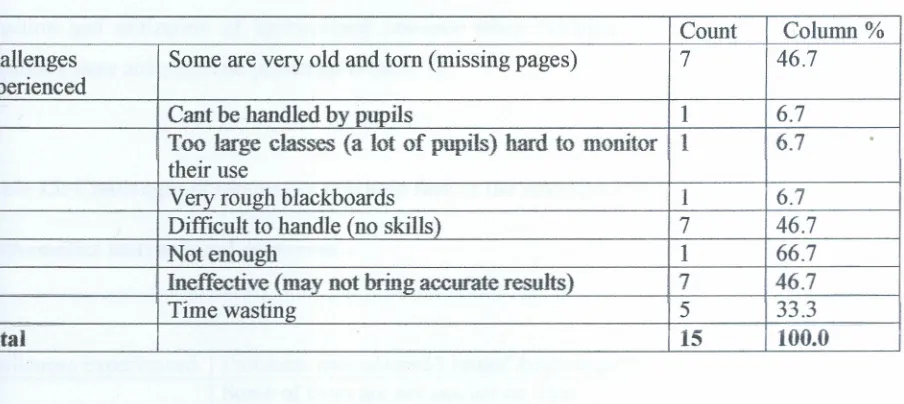
4.4 Acquisition of instructional resources for teaching mathematics 39 4.5 Utilization of matb.ernatics resources ..••...•....•...•...•.•... 44 4.6 Challenges mathematics teachers face in selection, acquisition and utilization of
mathematics instructional resources 47
C'HAPTER FIVE ••••••••••••••••.•.••••••••••••••••••••..•••.•••••••.••...••.•.••.•••..•.•••••...•...••.••...••..•..52 SUMMA.RY, CONCLUSIONS, IMPLICATIONS, RECOMMENDATION,
SUGGESTIONS FOR FURTHER RESEARCH~. __ •••••__ ._ •••_ •••.•.__ ••••_ ••_ 52
5.0 Introduction 52
5.1 Conclusion 52
5.2 Implications of Findings 54
5.3 Recommendations and Suggestions for further Research 55
REFERENCES 57
APPENDIX I: Questionnaire for mathematics teachers / head teacher " 61
APPENDIX II: Checklist 75
APPENDIX ill: Interview Schedule 84
APPENDIX IV: Primary Schools in Kiharu Division 85
APPENDIX V: Authorization Letter from Ministry of Education Murang'a 88
APPENDIX VI: Graduate School Letter ofApproval for the Study 89
• APPENDIX VI: Location ofKiharu Division and its Locations in Murang'a District.. ..90
Table 1: Table 2: Table 3: Table 4: Table 5: Table 6: Table 7: Table 8: Table 9: Table 10: Table 11: Table 12 Table 13 Table 14: Table 15 Table 16 Table 17 Table 18:
LIST OF TABLES
Teacher's Academic Qualification 29
Textbooks, Stationeries and Teaching aids 29.
Instructional Materials Improvisation 34
Problems Teachers Experience when Improvising 35
Solutions to Problems of Improvisation 36
Criteria used by teachers for selecting resources used in teaching mathematics
37
Source of information... 39
Means of acquisition 40
Problems teachers experienced when acquiring mathematics instructional
resources .42
Solutions to problems ofInstructionaI Resources Acquisition _ 42
Resources used in teaching mathematics 44
How mathematics instructional resources are used 45 Why teachers are not using Mathematics instructional resources 45 Challenges experienced when using resources when teaching mathematics 46 Challenges mathematics teachers face in the selection and utilization of
mathematics instructional resources 47
Resource rooms 48
Solutions to Problems Teachers Encountered When selecting Instructional
Resources 49
LIST OF FIGURES
Figure 1: Conceptual framework 12
Figure
2:
Genderof
the respondents _... 27Figure 3:Teachers age group 28
LIST OF ABBREVIATIONS
K.I.E: Kenya Institute of Education
Teaching Learning Resources
N.G.O:
S.P.S.S:
K.CP.E:
8-4-4:
Non government organization
Statistical Package for Social Science
Kenya Certificate for Primary Education
Education System which involves eight years of primary education, four years of Secondary education and 4 years of University education
9-4-3: Education system which involves nine years of primary education, four years of Secondary and three years of university education.
D.E.O:
C.D.F:
District Education Officer
CHAPTER ONE INTRODUCTION
This chapter discusses the background to the study, statement of the problem, purpose of the
study, research questions, assumptions of the study, limitations, significance of the study,
theoretical framework, conceptual framework, defmition of operational terms and abbreviations.
1.1 Background to the Problem
Allover the world, formal education is assumed to be the key that unlocks doors to
modernization. Availability and utilization of instructional resources in schools is very important
in enhancing learning and this has been advocated throughout the history of education. In
classical Greek period Plato and his students left evidence indicating their ardent belief in the
effectiveness of the use ofresources aswell as means of making learning relevant.
Malusu, Kisirikoi Florence and Wachira, (2008), observed that the purpose of using teaching
learning resources is to increase the learners' perception. They go on to emphasize that teaching
learning resources increases effective communication in education. Equipments and materials
can assist in. the re-organization and re-defioing of educational experiences. Considerable
learning can be achieved through reinforcement, that is through direct experience boosted by
observation and verbal reinforcement. It is also generally assumed that better facilities and use of
teaching aids in a school leads to better performance.
Efficiently prepared instructional materials may show all activities presented by a teacher
drawing attention, conveying information and one participation, drill and practice, providing
feedback, error correction, and evaluation in teaching environment. Although instructional resources do not offer an alternative which is to replace the teacher, it serves like assistance for
teachers to convey concepts tolearners. The usage of symbols, shapes, mental images, concrete
utilizing just one or two types of resources and ignoring the others will not support the process of
children having concepts of sufficiently. Providing diversity of resources and utilizing concrete
models in teaching will facilitate the meaningful instructions of on a large scale.
In this respect therefore, instructional resources support concepts for learners and help them
comprehend the concepts easily. Whether a teacher uses a flash card or concrete objects the main
aim is to increase the level of communication. Instructional resources helps in making right types
of association which facilitates learning and if effectively used helps learners acquire new skills
and learn facts and can save time. Written words and symbols are in their own category, verbal
word is the most abstract and symbols must be known to class.
Learners must learn to associate writing in a book with sounds of spoken language and with real
objects or picture, for example the word pen, girl, boy, car or book, should be displayed with
their pictures or reaIia.
According to Saunder (1974), psychologists recommend that the eye is the most important
gateway to the mind. They further emphasize that for most people the visual impression is the
one that can be most easily interpreted. The eye relates to other sensory experiences. They have
proved that learning is associated with a particular area of the brain called "retention centre". The
centre receives and stores impressions from the sensory organs such as the eye, finger and ears.
However this centre is activated differently among people. There are those who have better
auditory' memory and remember well what they hear, others remember well the things they
touch. Saunder claims that people remember 10% of what they hear 50% of what they hear and
see 90% of what they hear, see and do. This means that in teaching and learning the sensory
modality plays a great role particularly visual and auditory senses.
Wriggle, C. (1995) observes that today a great deal of time is being devoted in curriculum
development and to devising ways and means of improving the presentation of information. He
teachers. He further observes that teaching aids and technology should not be depended for their value and motivating effect alone but on their ability to help teachers accomplish their tasks more effectively as well.
Wriggle goes on to emphasize that the principle of using technology to achieve something that would not have been tempted before must nevertheless be treated with caution. The danger may be in the media giving a class something to do in an ostensibly easy manner. This may cut down the interaction between both pupil and pupil and also pupil and the teacher.
Ayot,
and
Patel, (1987) observed that the fundamental educational goals in Kenya are to prepare and equip the youths to be happy and useful members of the society. They further assert that quality education will entail the total development of the school subject through properly trained class teachers using appropriate audio-visual aids, text books and following communication techniques that impart maximum knowledge and skills to the pupils. This automatically impliesthat resources for teaching are necessary at all levels of education.
In Kenya, education system has undergone changes that have brought changes technologically, and socially. This has made the education system to undergo various changes with an aim of meeting the needs of the learners, their aspirations and attitudes.
The Ominde Report,' (1964) observed that the function of education for the newly independent government
were:-• To create national unity
• To reinforce the African cultural identity
• To reduce reliance on overseas help
The Bessay Report, (1972), advocated for changes in curricula to make it relevant for the local
needs. Gachathi Report, (1976) recommended a nine year basic education 9-4-3 with a bias on pre-vocational subjects. Mackay Report, (1981) recommended the education systems to be
structured to 8-4-4 and removed the A leveJ component Koech Commission (1999) recommended education for technological and industrial development. The commission also recommended reduction of examinable subjects in primary and secondary schools.
This means that like any other subjects has undergone the changes. This is supported by Kerre's
(1992) assertion that Kenya's educational system has been subjected to most scrutiny and
changes compared to other sectors because of the realization on the part of the government and
its people on the importance of human resources in national development.
However despite the important role plays in child's life there has been a consistent failure and negative attitude by pupils towards . The researcher taught in primary school for one year and
had a chance to see how poorly pupils performed in , how dull lessons were, despite the FPE, instructional resources are never enough in our primary schools. The modem provision of teaching demands appropriate equipments, instruments aswelJ as enough books for teaching.
A recent study conducted by Uwezo (2010), an N.G.O. working on education in Kenya exposed
certain weaknesses that urgently needed to be considered in teaching of in our country. The Uwezo-report said that leaner's performance in was the most dismal. The report further said that numbers are not to blame in-mathematical problems, but the attitude of the teachers. Teachers need to find practical ways of teaching .
The Uwezo report blamed the teachers who still stick to the old ways of teaching by saying we were taught like this. The Uwezo report blamed the teachers for not using a variety of teaching/learning resources. Rote memorization is the order of the day. A teacher can enter a
primary schools. Pupils need concrete objects to grasp concepts, the Uwezo report asserted. They need to discover by themselves and manipulate resources to internalize facts. Every pupil especially in lower primary can sing the math song and so it is difficult to tell which child had understood the concept and who did not.
Surprisingly at the end of the term nearly everybody scores 90% in , the report said. Trouble starts when application of concepts is required especially on topics perceived difficult by both teachers and pupils. With it comes the vice of copying, since it is true that some pupils are naturally bright and therefore pupils who are unable to manipulate numbers to solve problems copy from those who are naturally bright.
The Uwezo report noted that considering there were thousands of pupils who have almost similar hallowing experiences with their math's teachers it should then not come as surprise that today 30% of our standard eight pupils cannot solve a standard two problem.
With the problem of poor mathematical background it is of course easy to note the danger our pupils face but one should realize that they have to absorb large, amounts of information not just in math but in other subjects. Under such circumstances only the gifted can remember what they learned six years ago.
The danger here is that teachers keep on blaming the pupils and doing nothing. This is not going to help them get better in; on the contrary, it is going to aggravate the problem.
The Uwezo report highlighted that when pupils are given real life experiences they are able to solve problems with numbers easily. They only have difficulties when the concepts were too theoretical.
Teachers need to be innovative, improvise using local environment to teach. Teaching learning
materials should be planned and utilized in the most cost effective manner so as to bring out
effective provision, quality and relevance education.
The modem approach of teaching demands appropriate equipment, instruments as well as books
for teaching. It is out of these needs and such background that this study investigated the
availability, selection and utilization of resources in Kenyan primary schools with particular
interest to Kiharu Division ofMwang'a County.
The research focused on print resources which included textbooks and stationeries and teaching
aids. The focus was on whether they are available and how they are selected and utilizedin
primary schools. In addition, the focus was on their impact or effect in performance in the
Division.
1.2 Statement to the Problem
Instructional resources playa vital role in the process of teaching and learning. In order to teach
effectively at Primary school level. It is important that schools have sufficient instructional
resources. Patel and Mukwa (1993) argue that all forms of presentations must make allowance
for a two way exchange between the teachers and the learner or among the learners. They
continue to say that it is better to present fewer materials through audio visual techniques and
leave some time for discussions than present
fun
content leaving no time for discussion.This means that there must be enough time for learners to interact with resources and exchange
ideas based on them, Therefore, teachers should try to provide conducive environments for their
students in class to interact with the resources provided. Problem of this study was to investigate
into the availabjlity selection and utilization of resources for teaching and learning In primary
schools, with focus on print resources (text books and stationeries) and teaching aids.
The value of learning resources cannot be under estimated for they facilitate understanding and
approach to teaching and learning. The availability and utilization of resources for the teaching of any subject in the school curriculum included, is very crucial.
The teaching and learning of at primary schools could be facing problems because from the inception of the current syllabus a vast majority of primary teachers hold as a difficult subject.
This is supported by Sindu, K.S (1982), who asserts that vast majority of people hold as a "dry" and difficult subject full of abstract things. The result is that pupils take very little interest in it. To create the necessary interest is a constant problem for the teacher which demands the use of appropriate aids at every step in this respect is seen as a subject where "doing" is more prominent than reading and that's why a certain amount of equipment is indispensable in order to have effective teaching and learning of the subject.
From the analysis done after the Kenya certificate of Primary Education (K.C.P.E) 2007, 2008, 2009, there was an indication that the current teaching and learning of in Kiharu Division is not very effective. Although there might be other factors contributing to low score, ineffective, utilization and unavailability of instructional resources in teaching is affecting the general performance of in K.C.P.E .In line with the above mentioned the study investigated the availability, selection and utilization of teaching learning resources of the in Kiharu Division and their impact or effect in performance. This was important in that no similar research has been carried out in the Division.
1.3 Purpose of the Study
The study sought to investigate the availability, selection and utilization of learning resources for in public schools in Kiharu Division of Murang'a County.
The study specifically looked at print resources (text books and stationeries) and teaching aids. The study also sought to establish the source and cause of the mass failures of students in Kiharu
Division and more so whether it is because of inadequate resources and their ineffective utilization.
1.4 Research Objectives
The study was guided by the following objectives:
-1. To investigate the availability of instructional resources in the teaching of.
2. To determine the factors and criteria teachers consider in the selection of instructional resources m .
3. To find out how resources in the teaching of are acquired.
4. To ascertain the extent to which instructional resources are used in the teaching of.
5. To determine the challenges teachers face in the selection and utilization of instructional resources when teaching .
1.5 Research Questions
Thestudywas guided by the following research questions.
1. What is the status ofinstructional resources for in Murang'a County?
2. How are instructional resources for selected?
3. How do you acquire instructional resources for teaching?
4. How arethe available instructional resources used in the teaching of?
5. What challenges do teachers face in acquisition, selection and utilization of instructional
resources?
1.6 Significance of the Study
The study will be significant in that the infonnation collected, gathered and presented in this research highlights the challenges that primary school teachers face in the selection, acquisition
Trainers in colleges can
also
benefit from the findings of this study in advising -their trainee teachers on how to select, improvise and utilize instructional resources. This is because one of the topics covered in teacher training is production and utilization of teaching aids. On the other hand it is awake up call to publishers as towhich types of resources are in demand under the8-4-4
system of education. Ministry of education may use the findings of this study to discover the problems that the teachers face in using instructional resources.The Kenya institute of education on the other hand may use the findings of this study to recommend the appropriate resources when developing curriculum. The study could also form a take off stage for future research in the area of teaching resources in subject.
This study is significant in that the information collected gathered and presented in this research highlights the challenges that primary school teachers face in selection, acquisition and utilization of instructional resources. The study also provides essential picture of the present situation on resources for . Such information is useful to teachers, planners and administrators in their efforts to improve performance in primary schools in the Division.
1.7 Basic Assumption of the Study
The researcher assumed that. respondents were honest and accurate in giving information regarding their use of instructional resources. He also assumed that all teachers knew about
instructional resources and therefore those not using them were assumed to be out of choice.
In addition the researcher assumed that questions used were fair and thus they were not biased. He also assumed that all teachers follow KIE syllabus hence they use the same content and the recommended instructional materials.
Lastly the researcher assumed that the use of teaching learning resources Improves the understanding of in primary schools.
1.8 Scope of the Study
The research focused on the availability, selection and utilization of instructional resources in
selected primary schools. The study dealt with all levels of primary schools that is lower and
upper primary classes. Two classes in lower primary were selected and three classes in upper
primary, that is standard two and three four five and seven.
1.8.1 Limitations
The following were major bottlenecks of the study. First, the study was affected by financial
resources at the time due to limited resources. Secondly classified information was needed and it
took time and proper authorization to obtain such information from the relevant offices and lastly
some areas in our Division are a security threat due to movements of cults such as Mungiki
hence
it
was difficult to access some of the information needed.1.9 Theoretical Framework
The theoretical framework of the study was based in Hull (1943) motivation theory. Hull gives
the theory of motivation in relation to reinforcement He states that organisms can be regarded as
dandles of need. The needs occur due to the continuous active processes of the body. He further
states that the functions of behavior is to satisfy these needs so as to get the organism back in to
the state of equilibrium, thus the need brings about response.
Similarly, Hull observed that whatever the ftmdamental native of the learning process, learning
will not occur unless practice is reinforced. He states that reinforcements prevent the organisms
from learning any other responses other than what is desired. The reinforcement also serves to
prevent the organism from unlearning what it has already learnt by keeping it from reacting in
This theory therefore is applicable in the interest and enthusiasm created by instructional
resources. The curiosity that the learners may have in instructional resources may be seen as a
bundle of needs in reference to Hull theory. This may bring about the appropriate learning
response thus instructional resources viewed as reinforcements create a need in the learners in
form ofinterest in learning.
The learners' access to the instructional resources may be seen as a practice that reinforces
learning. It is therefore against this background that instructional resources enhance academic
performance. The ineffective utilization of instructional resources may withdraw the need and
interest and so this results in low performance because practice is less reinforced.
1.10 Conceptual Framework
The conceptual framework of the study was conceptualized under the theoretical framework
advanced by Hull (1943). In this concept instructional resources are viewed as reinforcements
that are very necessary and very essential in the learning process, if desired responses are to be
realized.
CONCEPTUAL MODEL
ADEQUATE INSTRUCTIONAL INCREASE IN HIGH ACADEMIC
RESOURCES
~
PERFORMANCE
INSTRUCITONAL
~
.
i
-
>
RESOURCETEACHER LEARNER
-
.
INSTRUCTIONAL RESOURCESC7
NOT EFFECTIVELY USED
r
LOW ACADEMIC PERFORMANCE
SOURCE: Adopted from Hull's (1943) Theory of Motivation
Thus the utilization 'of instructional resources in the teaching learning process may reinforce and
affect learning significantly hence learners' performance. 'This model is summarized here:
Therefore in this conceptual model:
-1. Toachieve increased academic performance teachers should utilize learning resources.
11. Learners should be exposed and given access to various learning resources for good
1.11 Definition of Operational Terms
Utilization - Making use of teaching resources during theprocess of teaching and learning.
Selection - Choosing instmctional materials which will accomplish the task of meeting learning objectives.
Availability - Accessibility of teaching resources during the teaching learning process.
Researees -
These are any items Jiving and used during the learning process, and include any action taken deliberately to change an existing school system.Teaching resources - Materials intended for use by a teacher to improve or extend his teaching. This may include staff resource support.
Instructional resources - Things that make teaching and learning more meaningful.
Education - Developmental process provided by a school or other institutions that are organizedbasically for instruction and learning.
Audio - visual aids - Instructional materials that combine both sight and sound.
Model -Physicalor conceptual representation of a system incorporating certain specific features of the original.
Performance - The final marks scored at the end of eight years.
Learning - A change in the stable relationship between a stimulus that an individual perceive and theresponse that ismade either covertly or overtly.
Printed Material- A generic term for textual and other paper based material produced by printing or reprography method.
CHAPTER TWO
LITERATURE REVIEW
2.1 Introduction.
This chapter deals with literature review which forms the basis of this study. The literature was reviewed from journals, text books, newspapers, thesis, dissertations and the internet. Instructional resources are an important aspect of the teaching process. They are many; some are real, reading and non reading materials, like charts, graphs, tables, chalkboards, teaching aids and so on.
However it should be noted that teachers determines the quality of learning. The teacher is expected to be an inspiration for pupils learning of the subjects, and a motivator. A teacher who is excited about lesson creates an atmosphere that makes others excited. An essential part of the teacher's work is to provide environment conducive to learning. A teacher has a duty of knowing all teaching aids, selecting appropriate ones for pupils needs and guiding pupils in the use of aids so as to get the information. Fenton (1967) says that objectives and teaching strategies imply materials can be for any purposes; some types are better suited for one cluster of objectives than others.
Russel (1986) advises that some resources that are useful in teaching and learning of can be drawn from the teachers and learners immediate environment. He further argues that 'such materials offer learners the potential for imagination and attainment of concepts.
This gives impression that the instructional resources are many and varied and that is why a teacher has to be selective in whatever he wants to use for teaching. Lawton (1971) observes that variety of teaching approaches has been aided by the variety of visual and audio visual aids available to a teacher. This is because visual aids are used because some objects cannot readily be shown as they might be too large, too small, too expensive, too dirty or too dangerous.
14
Wendt (1957) observes that teachers need to understand what each ofthe teaching materials will
do anduse it where it has the greatest strength. First the resource should tally with the objectives;
secondly the resource should involve the use of many senses of the children. Thirdly it should
suit the development ages of the children, for example young children need a lot of concrete
things to understand a point. The resources should also cater for individual differences and lastly
they should be evaluated to ensure that they are up to date and also they should be of good
physicalquality for example: books well printed, content materials should be authentic, clear and
lead to ease of understanding, be of help in development of critical thinking.
Theresource should be available, and time for the use of the resource should also be considered.
If the materials are not there, a teacher should improvise with his teaching audience in mind, this
improvised resource will often be far more effective, than costly materials designed for another
situation.
Davies (1995) notes that it is the responsibility of the head teachers to ensure that there are
adequate resources toimplement the school curriculum.
Lang et al (1995), suggests that in the course of selecting print resources such as maps it is not
wise to assume that they are free of bias. Students culture background affect their learning,
strength and preferences and influence their achievements. Teachers must therefore recognize
how the culture affects them, community and their students. They must be sensitive and respect
differences, recognize bias in instructional materials and become proficient in cross cultural
instruction.
Material resources entail planning, acquisition, allocation and controlling the use aid
maintenance of the material. He explains that planning for material resources involves the
identification of the resource requirements, assessing quality in terms of the needs, establishing
criteria for standards determining the cost per unit and use of the material whether by individual
or groups.
Bogonko (1992) observes that indigenous education was environment centered, localized and practical. The values, knowledge and skills of society were transmitted by the word of the mouth. Boys made models, huts, cattle pens, and staged mock battles. Girls in their part made dolls and cooked imaginary meals. Songs and stories were used to recall feats of clan, all aspects of ethnic
group;languages were learnt through riddles singing and folktales. The various groups involved arithmetic combination, geometry, property of numerals and the ability of the eye and hence
developed intellect. The practical nature, the learning by doing aspect was a value of indigenous education.When colonialism set in Kenya, the mode of education changed. The Western literacy
that was associated with modernization was introduced and the attention was drawn towards academic.
Mukwa (1979) notes that in order for education to cope with the challenges of development and modernization, it is essential that traditional method of education be modified and improved and schools be brought to close harmony with life requirement of a modern society. To achieve this goal one approach that several countries turned to is the application of the process of instructional development, involving the use of instructional media in education.
Kamunge report (1988), emphasized the importance of local communities, parents and sponsors
to assist in the provision of adequate reading materials, relevant books, teaching learning
resources in order to increase science facilities and equipments for proper teaching of subjects
both in primary and secondary levels. Adequate supplies of instructional materials were seen as a pre-requisite to meet the country's educational objectives.
information and experiences than people of previous generation. The proper and creative use of
instructional media can provide learners with unattainable opportunities to individualize and
harmonize the teaching learning environment.
Since independence in Kenya, the issue of provision of adequate instructions resources had been
addressed. The Kenya Education Commission of (1964) pointed out that the relative poverty of
many schools reduced greatly the teachers; opportunities to bring illustrative materials in the
classroom.take the children out on educational visits. Teacher training colleges were to make their craft rooms and workshops available at specified time to serve teachers. To meet these
objectives teachers were to be trained in the manufacture of simple teaching aids.
The Bessay Report (1972), observes that the provision of educational resources for learning in
Kenya varied from province to province. The report therefore advocated for a collection of local
support materials, which were to be housed in teacher colleges or teacher centers in reasonable
proximity to primary and secondary schools. These resources were to be made available to
provide immediate and uncomplicated access to learners.
The Gachathi Report (1976), states that books and other educational materials are the basic tools
for educational development. They must therefore be available for the learners in adequate
quantities and of good quality.
They must be available at a time they are required and at a cost the learner canafford. The report
recommended educationally suitable and culturally relevant materials were to be prepared as a
matter of priority for use in Kenyan schools.
The Kamunge Report (1988), emphasized the importance of local communities, parents and
sponsors to assist in the provision of adequate learning materials. Adequate supply of
instructional materials was seen as the pre-requisite to meet the Country's educational objectives.
The above discussion on the place and importance of resources in teaching and learning gives an
overview in this study which intends to investigate the extent to which the teaching and learning
resources in are actually available and how they are utilized.
Munyilu Francis (1985), carried out a study on availability of resources for in Kanthozweni
educational zone and found that the use of instructional resources varied from school to school.
That was in spite of the fact that primary teachers are generally strongly positively oriented to
the production and use of instructional resources. He saw that teachers use very few instruction
resources in any given lesson, and hardly refer to the immediate environment as a teaching
learning resource in fact little improvisation was made. Very few of instructional resources found
in schools were used. Lack ofvariety meant that instructional resources used were not effective
for instructional purposes. The uniqueness of this research was Munyilu tended tofocus more on
text books and print media. However this research focused on the broad domain of instructional
resources.
Isaack M. Mwangi (2004), carried out a study on how teachers select and utilize instructional
resources in English and found that teachers do not often vary the manner of utilizing
instructional resources; he also found that most teachers do not use instructional resource to
introduce, demonstrate or summarize their lessons. Apart from that, the dominant mode of utilizing instructional resources was the whole class mode. This practice hardly allows the
learner to practice hence poor acquisition of concepts. Though in English his study was implicit
from review of related literature that few studies had dealt with the aspect of selection and
utilization of instructional resources in ;in primary schools hence there was need to carry out
such a research.
Another related study by N. Kathuri (1986), to find the correlation between utilization of
instructional resource leads to better learning. Her work was general for allK.c.P.E. subjects but
not specific to , and this may mean that the instructional resources or facilities are unnecessary.
Good as they may be, their effectiveness below a certain level, may depend on how they are used
relatively and Kathuri accepted that their use is very critical in some subjects such subjects
definitely include .
According to Kiragu (1986), variation in achievement in subjects can be explained in terms of
factors which can be categorized in to two groups. These are in school and out of school factors.
The in school factors include; those that are directly influenced by the school, examples of such
are facilities, teaching strategies, teaching learning environment, teaching learning resources and
the school administration. From this argument there is an indication that the use of teaching /
instructional resources is important in achievement of educational objectives. The study by
Kiragu however, was not specific to but this study was specific to and the resources available,
how theyare selected and utilized in teaching and learning .
A research by D.T. Mwangi (1986), traced back the cause of poor performance in secondary
school to poor background in primary teaching of the subject. In the primary school it was
arguedthat the teaching of the was ineffective as facilities are inadequate and the environment
forstudying the subject often very poor. This once again puts blame on shortage of facilities for
failures.
In the above research Mwangi found that the adequacy ofresources was significantly related to
the performance. The schools which had adequate supplies performed well on average in , his
fmdings that the frequency of use of resources in isnot significantly related to performance may
not be true of primary school pupils as his work was with secondary school as opposed to
primary school pupils who may not have fully performed the capability to do abstract
manipulation verbally as supported by Piaget work. This study focused on primary schools.
Mueni (1999), carried out the study of methods and material used in teaching history and
government and found that there is a wide range of resources which can be used in teaching and
learning of a subject such as text books, graphical materials, magazine and others. However most
of the resources were inadequate in terms of quality and quantity, this in turn hampered their
utilization. She found that most teachers did not recognize the potential of community based
resources such as resource person.
However, Mueni did not note that if a teacher has a limited access to resource he/she might
develop a negative attitude towards their use. A teacher should have the interest of learning how
to effectively use all available resources without any bias. Imaginative teachers can do a better
jobeven without expensive resources. In the final analysis what matters most is the knowledge,
creativity, energy, devotion of the teachers to make the best use of whatever is available,
therefore the success of instructional resource depends on the teacher. The more the resources
available to the teacher the more the chances stndents have to fully understand the subject. Again there was no clear indication that the availability of instructional resources leads to better
CHAPTER THREE
RESEARCH METHODOLOGY
3.0 Introduction
This chapter presents the methodology of the study. The chapter focuses on research design,
location of the study, target population, sample and sampling procedure, research instruments, piloting of the study, validity and reliability of research instruments, data collection procedure
and data analysis plan.
3.1 Research Design
Orodho (2003), defined research design as the scheme, outline or plan that is used to generate
answers to research problems.
This study used descriptive survey design. The survey was most appropriate because the study
aimed at describing the availability and utilization of resources in primary schools as they were;
Mugenda and Mugenda (199:65), states that survey research seeks to obtain information that
descnbes existing phenomenon by asking individuals about their perception, attitudes, behavior
or values.Therefore, it is a type of descriptive research
3.2 Location of the study
The study was carried out in Kiharu Division of Murang' a County, central province of Kenya. It focused on primary school drawn from the Division. Kiharu Division is eighty kilometers from
Nairobi the capital city of Kenya.
The Division has about eighty thousand people most of whom are rural based and mostly
practice agriculture.
The selection of the Division was prompted by the fact that the Division has always performed
poorly in and no related research has ever been carried out in it. The researcher wanted to know
what is taking place in this Division as far as the teaching and learning resources in are
concerned.
3.3 Target Population
The target population of this study comprised of teachers teaching in lower and upper primary.
According to records available in the D.E.O's office Murang'a County, Kiharu Division has 77
schools. In this study 15 public primary schools were selected. This is 20% of the accessible
public primary school. Orodho (2004), states that 20% of the total population is enough for the
sample.Private schools were not included because they have different funding and management
systems, hence their availability selection and utilization of instructional resources varied greatly
with that of the public primary schools. Secondly performance in private schools is better and
thirdly they have different sources of fmding hence they vary significantly in resource
endowmentwith public schools.
The respondents of the study comprised 30 teachers one in lower primary and I in upper
primary, the 15 head teachers of the 15 sampled schools were also involved in the study.
3.4 Sample and Sampling
Procedures
In order to ensure a better representation, a list of all public primary schools in the Division was
obtained from the D.E.O's office. To get a sample of schools for this study, systematic' sampling
was used. According to Wiersma (1985), the major advantage of systematic sampling in
Insystematic sampling, a sample was drawn from fixed intervals on a list. Using the school
code,all public primary schools was arranged in an ascending order. After selecting the first case
onthe list, every nth item (nth
=
3) was selected fro~ the list. A sample of 15 public primaryschoolsfOTthis study was obtained.
In the sampled public primary schools one teacher was purposively selected in lower primary
and one in upper primary for this study. In the sampled schools with two or three streams the
most experienced teacher based on the years of service was purposively selected for this study.
Thirty (30) teachers were thus obtained.
3.5Research Instruments
For the purpose of this study data was collected using three instruments.
a) Head teachers andteachers' questionnaires
b) Checklist
c) Interview schedule for teachers.
The questionnaire was used to collect information from the teachers. The subject teachers'
questionnaire had two sections; Section A dealt with general information including name of the
school"class taught, age, sex, professional qualifications, teaching experience, other subjects
taught and number of lesson he teaches. Section B dealt with the teaching and learning resources
and teacher's opinions.
The researcher prepared an observation check list containing possible 'instructional resources
that can be used fOT this study two fOT each school sampled; one fOT lower primary and one for
upper primary to be used by teachers.
The interview schedule sought information on availability of instructional resource in public
primary schools in the Division, and how they are utilized by both teachers and learners. The
schedule also sought possible challenges and possible solutions to the challenge that are faced in
acquisition and usage of instructional resources in.
3.6 Piloting
Thepurpose of the piloting was:
-• .To test the instruments to check whether there were enough coverage in terms of range of
information.
• To check whether there was identifiable ambiguities in the wording of the questions in
order to make improvements. The main aim of piloting was to establish the validity and
reliability of the instruments.
The researcher conducted the pilot study in which instruments of the study were pre- tested
before the main study, in pre-testing the instrument; three convenient schools were selected
outside of the schools that were sampled for the study. The researcher administered the study
instruments on randomly selected teachers of in lower and upper primary schools in the pilot
study schools. In each school one teacher in lower primary and one teacher in upper primary
were selected randomly.
3.7 Validity and Reliability
3.7.1
ValidityContent and face validity of the research instrument was done at the design stage. Some of the
items in the questionnaires of the study were adopted from Munyilu Francis (1985) and Mwangi
Isaack Minae (2004). They had therefore been used before and thus this strengthened their
content validity.
Mugenda and Mugenda (1999), states the content validity is a measure of the degree to which
data collected using a particular instrument represented a specific domain of content.
Theoretically a content valid measure should contain all possible items used measuring content.
However since it is impossible to construct an instrument that includes all possible items then the
Thus in this study the content validity of the instruments were established by seeking advice
from my supervisors. Again since some of the items in the interview schedule and observation
schedule measured what the questionnaire purported to gather their responses' will be compared
to validate them accordingly,
3.7.2 Reliability of Research Instruments
Reliability refers to the dependability as a measuring device. Mugenda and Mugenda (1999),
states that it is the measure of degree to which a research instrument yields consistent data after
repeated trials. Thus the reliability of the research instrument in this study was established by
using split half technique. Data received from the pre-test was analyzed for this purpose. The
instrwnent was divided in to two parts by including all the even numbered items in one group
and all
odd-numbered in another group. The scores in the items were ranked and their differencesfound. These scores were then correlated using spearmen -Brown proficiency formula.
r=l
{n(n2 -I)} .
Where r=correlated coefficient between rank order.
D2
=
difference between the rankings.n= Number of pairs ofrankings.
A high co-efficient indicated a strong evidence of reliability of the research instrument at 0.5
level of significance.
3.8
Data Collection ProcedureThe researcher applied for a research permit form the Ministry of education D.E.O's office
Murang'a. After getting the permit to collect data the researcher proceeded to the sampled
primary schools and sought permission from the respective head teachers to collect data from the
schools.
The first instrument to be administered was the teachers' questionnaire. At every sampled
school.the researcher introduced himself to the head teacher and to the teacher. After explaining the purpose of the study to the teachers the researcher gave the teachers the respective
questionnaires that were collected later. Secondly the researcher proceeded to administer the
observation checklist. The researcher used the checklist to indicate the instructional resources that are available for teaching and learning. The researcher with the assistance of one lower and
upper primary teachers went either to the library, resource room, offices, stores where the
instructional resources are kept. The researcher ascertained the availability of the instructional
resources by ticking in the appropriate boxes on the observation checklist. After ascertaining the available instructional resources the researcher asked the teacher to respond on the issues of
adequacy and accessibility of the available instructional resources that he indicate in the
observation checklist.
Thirdly the researcher asked the teachers the convenient time for them when he can conduct the
interview schedule so as to obtain information on the extent to which instructional resource are
selected in primary schools and used in teaching and learning of.
3.9 Data Analysis Plan
This study generated both qualitative and quantitative data. Descriptive statistics were used to
analyze the data obtained. Qualitative analysis considered the inferences that were made from the
opinions of the respondents. The analysis was presented in a narrative form and where possible
tabular form. Descriptive statistics involving the use frequencies, total percentages and
tabulations were used. This process of data analysis requires the use of computer spreadsheet that was done by the researcher with assistance of computer specialist. The analyzed data was used to
CHAPTER FOUR
DATA ANALYSIS, FINDINGS, PRESENTATIONS AND DISCUSSIONS
4.0 Introduction
The purpose of this study was to investigate the availability, selection and utilization of
instructional resources for in selected primary schools in Kiharu Division ofMurang'a County.
The research approach used in this study was that of simple survey. The research approach
involved classroom observation, use of checklists, interview schedule and questionnaires. Data
was analyzed based on the purposes and objectives of the study.
The data was presented in fonn of tables, graphs and pie charts based on the objectives.
4.1 Teacher's Background Information
Teacher's background infonnationIBio data that included gender, academic qualifications,
teaching experience and his position in school was sought so as to determine his/her influence in
teaching. The researcher found that there were more male teachers than female teachers teaching
_male
_female 52%
Figure 2: Gender of the respondents
50
40
30
20
10
O
-
¥
-
---..,...---.---
-
('
30-34 35 and above 25-29
FigBl'e
3: Teachers age group
The study findings on teacher's age further revealed that 50% of the teachers were between 35
and above years, 32% were between 30-34 years while 18% were above 25- 29 years. Most of
the teachers were in their energetic years. Nevertheless, the study revealed that teachers age, sex
bad no impact on the selection and use of instructional resources in teaching.
However young people were more enthusiastic and wanted to perform compared to old ones and
with very long service who just assumed the resources. On the issue of teaching experience the
study indicated that most teachers in the sampJed schools in Kiharu Division has taught for a
long period. Experience is important because it exposes the teachers to a wide variety of
resources to be used in mathematics teaching.
Moore (1998) asserts that a teacher despite the age should know the importance of using
instructional resources and the technology involved. Teachers of mathematics like those of other
subjects should make teaching and learning resources an integral part of their teaching. Real life
experience are quite effective in promoting pupils understanding though they should be
Academic Qualifications
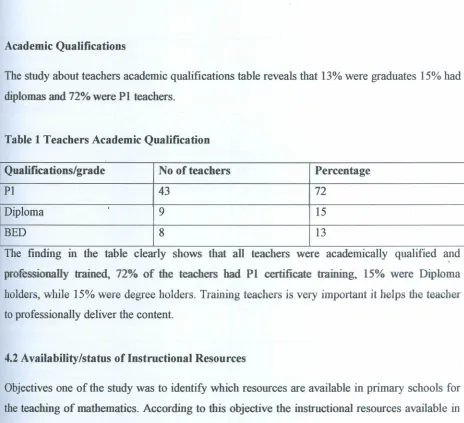
The study about teachers academic qualifications table reveals that 13% were graduates 15% had diplomas and 72% were PI teachers.
Table 1 Teachers Academic Qualification
Qualifications/grade No of teachers Percentage
PI 43 72
Diploma 9 15
BED 8 13
The finding in the table clearly shows that all teachers were academically qualified and professionally trained, 72% of the teachers had PI certificate training, 15% were Diploma holders, while 15% were degree holders. Training teachers is very important it helps the teacher
to professionally deliver the content.
4.2 Availability/status of Instructional Resources
Objectives one of the study was to identify which resources are available in primary schools for
the teaching of mathematics. According to this objective the instructional resources available in
the sampled schools were grouped into print resources (text books and stationery) (from the
observations made the researcher decided to investigate further whether the available resources
were adequate and accessible for both teachers and pupils). The data available of instructional
resources was analyzed and summarized in table 2.
Print Resources
Table 2 Textbooks, stationary and teaching aids
School code No. of pupils No of text books Recommended No
1 112 27 76
lower primary 136 57 56
Upper primary
2 92 25 51
lower primary 130 27 61
Upper primary
3 106 29 53
lower primary 136 46 46
Upperprimary
4 98 25 45
lower primary 126 44 51
Upperprimary
5 136 44 60
lower primary 140 42 34
Upper primary
6 106 22 53
lower primary 123 41 47
Upper primary
8 116 37 58
lower primary 140 30 46
I
Upper primary9 97 30 49
lower primary
-
126 34 33Upper primary
.
10 114 35 57
lower primary 123 42 52
Upper primary
11 101 36 51
lower primaIy 102 36 51
Upper primary
12 98 35 49
lower primary 124 37 44
Upperprimary
13 49 37 49
lower primary 110 32 58
Upper primary
14 96 36 48
lower primary 130 35 46
Upperprimary
15 112 40 56
lower primary 146 35 50
Upperprimary
Summary of the textbooks available
No of pupils No of class Recommended No oftext Recommended
text books No books No
Lo
w
e
r prim
a
ry 1
555
5
1
9
8
17
21
8
817
Upper primar
y
1
89
5
58
2
695
216
695
Totals 1101 1512
434
1512Stationeries available
No of pupils Stationeries Required number
available Lower primary
Excersise books 3215 3215
Foolscaps 0 0
Graph books 0 0
Tracing paper 0 1555
Others 0 0
Upper primary
Exercise boobs 3834 3834
Foolscaps 0 3834
Graph books 0 3834
Tracing paper 462 1895
Others 0 1895
Summary of the stationery availa ble
Lower primary 1555
U r rim 1895
3409 4527
3409 5387
Noof u Us No of Stationeries Recommended No
Totals
7936
8796
Summary of teaching aids available
No of pupils No of Stationeries Recommended No
11056 8426
Totals
5883
19482
Lower primary 1555 Upper primary 1895
4110 1773
Teaching Aids
The information from the table 2 revealed that print resources (textbooks and stationeries) and
teaching aids were resources available in the teaching and learning of mathematics in the
sampled schools in Kiharu Division of Murang' a County. Print resources available included:
exercise books, text books and supplementary books. Other least available resources included
graph books, foolscaps and scrap papers. Other form of stationery like tracing paper foolscaps
were found almost non-existent, from the table 2 analysis the researcher noted that there is
shortage of textbooks and also supplementary books. This was shown in the number of class text
books and supplementary books versus the recommended number in different schools, the
shortageexists despite funding from government through theF.PE.Programme.
Availability of stationeries.
From analysis in the table 2 it is evident that most schools have enough exercise books. The
findings further revealed that other writings materials like graph books, foolscaps, scrap papers,
tracing papers were other print materials available in the sampled schools but they very few and
some are non-existent. The availability of these resources is important in the teaching and learning of Mathematics for instance, graph books are very important when it comes to drawing
of any kind of graph. However the available graph books, tracing paper, foolscaps were
established to be inadequate for use in teaching and learning Mathematics.
The analysis in the table 2 shows that schools in Kiharu Division experience shortage of
stationery except exercise books. The researcher was told that schools give more than enough
exercise books to pupils because of F.P.E money, but the schools had less than 40% of other
stationery requirements.
The fmdings were similar to those of Mueni (1999) study on methods used in teaching History
and government in secondary schools which had established that there is a wide range of media
which could be used in teaching and learning a subject such as text books, graphic materials,
audiovisual and realia, however most of the resources were inadequate in terms of quality and
quantity which hampered their utilization. This shortage of other stationeries means that pupils
have to share in the classroom or write assignments on the chalkboard, hence more work for the
teacher and pupils which takes time that could he used for other mathematical activities.
Av.ailability of teaching Aids
From table 2 it can be seen that mathematics teachers involved in the study felt more strongly
Table 2 also shows that all schools combined had less than 50% of the teaching Aids required for
teaching mathematics. Therefore there is general shortage of teaching Aids. Table 4 also showed
that chalk board was the most available at 100% chalk was also rated at 100%, other available
teaching aids included graduated objects for lower primary at 100% other least available
teaching aids. Included geometrical sets, wall charts, capacity volume and clock faces, others
like Cuisenaire rods model solids, dice, were notknown toteachers leave alone their availability.
Others like bulletin boards andphoto graphs were almost nonexistent.
The availability of some of these resources like chalk board and manilla papers are important
because the chalk board is a major teaching resource used for developing and amplifying
mathematical ideas. Manilla papers are usedto summarize information, the fmdings showed that
chalkboards and cbalks were adequate while the rest of the teaching aids were inadequate.
This observation was similar to that one of Kinyanjui (1997) fmdings on his study on availability
and utilization of instructional media in teaching physical education in primary teacher colleges
i
in Kenya which had revealed that despite media availability, only chalkboard, text books andt=
handouts were extensively used in teaching the subject, The other available media were eitherI
I
I
used at lower level or not used at all due to lack of time to adapt their use in the alreadyI
overcrowded curriculum. Although there is general shortage of teaching Aids, in the schoolsstudiedteachers dovery little 'to help the situation through improvisation.
Throughthe teacher's questionnaire appendix 1item number 5, the researcher sought to establish
whether mathematics teachers improvise mathematics instructional materials. An item in the
questionnaire asked the teachers to list the resources they improvised for teaching mathematics .
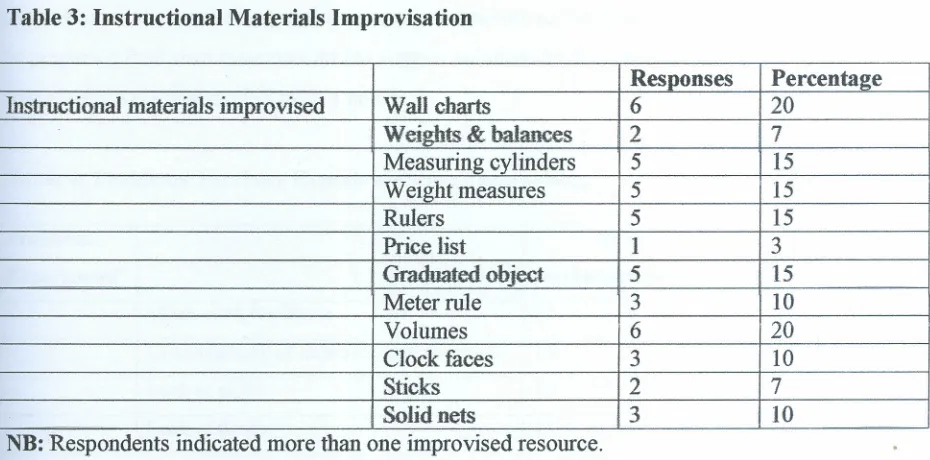
.An analysis
of 30 teacher's responsesis
presented in table 3Table 3: Instructional Materials Improvisation
Responses Percentage
Instructional materials improvised Wall charts 6 20
Weights &balances 2 7
Measuring cylinders 5 15
Weight measures 5 15
Rulers 5 15
Price list 1 3
Graduated object 5 15
Meter rule 3 10
Volumes 6 20
Clock faces 3 10
Sticks 2 7
Solid nets 3 10
NB:Respondents indicated more than one improvised resource.
The results in table three revealed that wall charts, weights, and balances, measuring cylinders,
rules, price list, graduated objects, meter rule, volumes, clock faces, sticks, solid nets, were
resources teachers improvised. The level of improvisation varied from school to school, and in
either case the number of improvised resources is very meager. In all sampled schools
improvised teaching Aids is less than 26% of the required teaching Aids.
According to Malusu (2008) the best instructional material is made by the teacher with his
audience in mind. This will be far more effective than costly materials purchased. Commercial
producers cannot produce enough resources to meet the growing demands of learning resources
for mathematics teaching.
Teachers should make efforts to improvise the resources, this will save time and money for our
schools. According to Kaime (1990) the best material for teaching and learning is made by the
teacher because he has the picture of the requirements of his learners. Therefore teachers should
always make efforts to improvise the teaching resources for simplicity in application by the
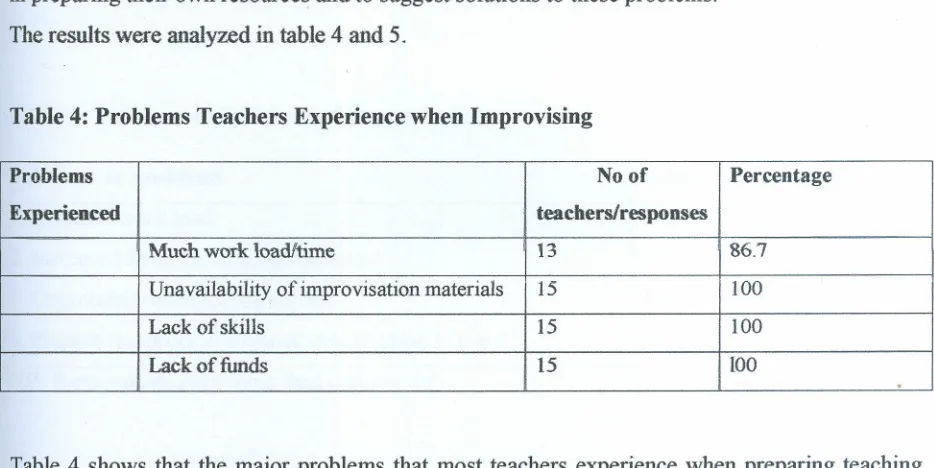
A question in the teacher's questionnaire asked teachers to list down the problems they encounter
in preparing their own resources and to suggest solutions to these problems.
The results were analyzed in table 4 and 5.
Table 4: Problems Teachers Experience when Improvising
Problems No of Percentage
Experienced teachers/responses
Much work loadltime 13 86.7
Unavailability of improvisation materials 15 100 Lack of skills 15 100 Lack of funds 15 100
.
Table
4
shows that the major problems that most teachers experience when preparing teachingresources was lack of adequate preparation time for improvisation which rated at 100%, other
problems included lack of skills which accounted for 86% and lack of funds which rated at 86%.
The study established that teachers lacked preparation materials such as manilla papers, felt pens
and felt inks. This then implies that either the schools lacked financial resources to purchase the
materials or the schools did not support the teacher's efforts for improvisation.
Too much work load too many lessons was another major concern for teachers which rated at
100%. Teachers said that it is one of the greatest factors that impended improvisation of
mathematics teaching resources. This is due to the fact that 8-4-4 curriculum is very demanding.
The researcher noted that the few available resources were kept in the deputy head teacher's
office instead of being of being utilized.
As for the solutions to the above problems, the results were analyzed. Majority of teachers 100%
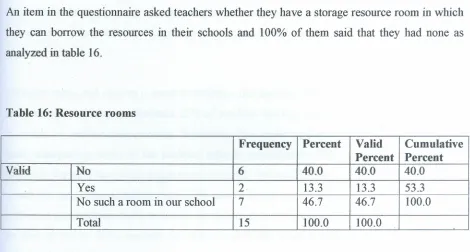
also said that there is no resource room where they can borrow materials for teaching
mathematics and the only time they share information on instructional materials for teaching
mathematics only when there is seminar, or in panel meetings which are not held often.
Table 5: Solutions to Problems of Improvisation
Solutions to problems Responses Percentage
1. Reduced work load 9 60
2. Increased funds from the government 11 73
3. Organizing seminars/workshops 13 86
4. Prepare resources in advance before going to class 9 60
NB: Respondents gave more than one answer.
Table 5 revealed that 6% of the teachers suggested that work load should be reduced so as they
can get enough time to improvise 73% of the teachers suggested that the government should
increase funds to schools to purchase enough materials while 86% indicated that seminars and
workshops should be organized for them to enhance skills in improvisation while 60% of the
teachers felt that the solution to resources improvisation is to prepare teaching resources in
advance before going to class.
To conclude on the issue of availability of instructional resources for teaching and learning
mathematics, it should be noted that the government should allocate more funds for schools
'with teaching and learning resources not only in mathematics but also in other subjects. Head
teachers should make sure that enough of these resources are bought whenever FPE funds are
allocated to their respective schools. The issue more emphasizes by Inyega (1997) who asserted
that money is more useful in schools is used to improve teaching and learning.
If funds are there and well managed any school should be rich in teaching and learning resources