Automatic Evaluation of Topic Coherence
David Newman,♠♣Jey Han Lau,♥Karl Grieser♦, and Timothy Baldwin,♠♥ ♠NICTA Victoria Research Laboratory, Australia
♣Dept of Computer Science, University of California, Irvine
♥Dept of Computer Science and Software Engineering, University of Melbourne, Australia ♦Dept of Information Systems, University of Melbourne, Australia
[email protected],[email protected], [email protected],[email protected]
Abstract
This paper introduces the novel task of topic coherence evaluation, whereby a set of words, as generated by a topic model, is rated for coherence or interpretability. We apply a range of topic scoring models to the evaluation task, drawing onWordNet,Wikipediaand the Google search engine, and existing research on lexical similarity/relatedness. In compar-ison with human scores for a set of learned topics over two distinct datasets, we show a simple co-occurrence measure based on point-wise mutual information overWikipedia data is able to achieve results for the task at or nearing the level of inter-annotator correla-tion, and that other Wikipedia-based lexical relatedness methods also achieve strong re-sults. Googleproduces strong, if less consis-tent, results, while our results over WordNet are patchy at best.
1 Introduction
There has traditionally been strong interest within computational linguistics in techniques for learning sets of words (aka topics) which capture the latent semantics of a document or document collection, in the form of methods such as latent semantic analysis (Deerwester et al., 1990), probabilistic latent seman-tic analysis (Hofmann, 2001), random projection (Widdows and Ferraro, 2008), and more recently, la-tent Dirichlet allocation (Blei et al., 2003; Griffiths and Steyvers, 2004). Such methods have been suc-cessfully applied to a myriad of tasks including word sense discrimination (Brody and Lapata, 2009), doc-ument summarisation (Haghighi and Vanderwende, 2009), areal linguistic analysis (Daume III, 2009) and text segmentation (Sun et al., 2008). In each
case, extrinsic evaluation has been used to demon-strate the effectiveness of the learned topics in the application domain, but standardly, no attempt has been made to performintrinsicevaluation of the top-ics themselves, either qualitatively or quantitatively. In machine learning, on the other hand, researchers have modified and extended topic models in a vari-ety of ways, and evaluatedintrinsicallyin terms of model perplexity (Wallach et al., 2009), but there has been less effort onqualitativeunderstanding of the semantic nature of the learned topics.
This research seeks to fill the gap between topic evaluation in computational linguistics and machine learning, in developing techniques to perform intrin-sic qualitative evaluation of learned topics. That is, we develop methods for evaluating the qual-ity of a given topic, in terms of its coherence to a human. After learning topics from a collection of news articles and a collection of books, we ask humans to decide whether individual learned top-ics are coherent, in terms of their interpretability and association with a single over-arching seman-tic concept. We then propose models to predict topic coherence, based on resources such as Word-Net, Wikipediaand the Google search engine, and methods ranging from ontological similarity to link overlap and term co-occurrence. Over topics learned from two distinct datasets, we demonstrate that there is remarkable inter-annotator agreement on what is a coherent topic, and additionally that our methods based onWikipediaare able to achieve nearly perfect agreement with humans over the evaluation of topic coherence.
This research forms part of a larger research agenda on the utility of topic modelling in gist-ing and visualisgist-ing document collections, and ulti-mately enhancing search/discovery interfaces over
document collections (Newman et al., to appeara). Evaluating topic coherence is a component of the larger question of what are good topics, what char-acteristics of a document collection make it more amenable to topic modelling, and how can the po-tential of topic modelling be harnessed for human consumption (Newman et al., to appearb).
2 Related Work
Most earlier work on intrinsically evaluating learned topics has been on the basis of perplexity results, where a model is learned on a collection of train-ing documents, then the log probability of the un-seen test documents is computed using that learned model. Usually perplexity is reported, which is the inverse of the geometric mean per-word likelihood. Perplexity is useful for model selection and adjust-ing parameters (e.g. number of topics T), and is the standard way of demonstrating the advantage of one model over another. Wallach et al. (2009) pre-sented efficient and unbiased methods for computing perplexity and evaluating almost any type of topic model.
While statistical evaluation of topic models is reasonably well understood, there has been much less work on evaluating the intrinsicsemantic qual-ity of topics learned by topic models, which could have a far greater impact on the overall value of topic modeling for end-user applications. Some re-searchers have started to address this problem, in-cluding Mei et al. (2007) who presented approaches for automatic labeling of topics (which is core to the question of coherence and semantic interpretabil-ity), and Griffiths and Steyvers (2006) who applied topic models to word sense discrimination tasks. Misra et al. (2008) used topic modelling to identify semantically incoherent documents within a docu-ment collection (vs. coherent topics, as targeted in this research). Chang et al. (2009) presented the first human-evaluation of topic models by creating a task where humans were asked to identify which word in a list of five topic words had been ran-domly switched with a word from another topic. This work showed some possibly counter-intuitive results, where in some cases humans preferred mod-els with higher perplexity. This type of result shows the need for further exploring measures other than
perplexity for evaluating topic models. In earlier work, we carried out preliminary experimentation using pointwise mutual information andGoogle re-sults to evaluate topic coherence over the same set of topics as used in this research (Newman et al., 2009).
Part of this research takes inspiration from the work on automatic evaluation in machine translation (Papineni et al., 2002) and automatic summarisation (Lin, 2004). Here, the development of automated methods with high correlation with human subjects has opened the door to large-scale automated evalua-tion of system outputs, revoluevalua-tionising the respective fields. While our aspirations are more modest, the basic aim is the same: to develop a fully-automated method for evaluating a well-grounded task, which achieves near-human correlation.
3 Topic Modelling
In order to evaluate topic modelling, we require a topic model and set of topics for a given document collection. While the evaluation methodology we describe generalises to any method which gener-ates sets of words, all of our experiments are based on Latent Dirichlet Allocation (LDA, aka Discrete Principal Component Analysis), on the grounds that it is a state-of-the-art method for generating topics.
LDA is a Bayesian graphical model for text docu-ment collections represented by bags-of-words (see Blei et al. (2003), Griffiths and Steyvers (2004), Buntine and Jakulin (2004)). In a topic model, each document in the collection ofDdocuments is mod-elled as a multinomial distribution over T topics, where each topic is a multinomial distribution over
W words. Typically, only a small number of words are important (have high likelihood) in each topic, and only a small number of topics are present in each document.
The collapsed Gibbs sampled topic model simul-taneously learns the topics and the mixture of topics in documents by iteratively sampling the topic as-signmentzto every word in every document, using the Gibbs sampling update:
p(zid=t|xid=w,z¬id)∝
Nwt¬id+β ∑
wNwt¬id+W β
Ntd¬id+α ∑
wherezid = tis the assignment of theith word in
documentd to topic t, xid = w indicates that the
current observed word isw, andz¬idis the vector of all topic assignments not including the current word.
Nwt represents integer count arrays (with the
sub-scripts denoting what is counted), andα andβ are Dirichlet priors.
The maximum a posterior (MAP) estimates of the topicsp(w|t),t= 1. . . T are given by:
p(w|t) = ∑ Nwt+β wNwt+W β
We will follow the convention of representing a topic via its top-nwords, ordered byp(w|t). Here, we use the top-ten words, as they usually provide sufficient detail to convey the subject of a topic, and distinguish one topic from another. For the remainder of this paper, we will refer to individ-ual topics by its list of top-ten words, denoted by
w= (w1, . . . , w10).
4 Topic Evaluation Methods
We experiment with scoring methods based on
WordNet(Section 4.1),Wikipedia(Section 4.2) and theGooglesearch engine (Section 4.3). In the case of Google, we query for the entire topic, but with
WordNetandWikipedia, this takes the form of scor-ing each word-pair in a given topicwbased on the component words(w1, . . . , w10). Given some (sym-metric) word-similarity measure D(wi, wj), two straightforward ways of producing a combined score from the 45 (i.e.(102)) word-pair scores are: (1) the arithmetic mean, and (2) the median, as follows:
Mean-D-Score(w) =
mean{D(wi, wj), ij∈1. . .10, i < j}
Median-D-Score(w) =
median{D(wi, wj), ij∈1. . .10, i < j}
Intuitively, the median seems the more natural rep-resentation, as it is less affected by outlier scores, but we experiment with both, and fall back to empir-ical verification of which is the better combination method.
4.1 WordNet similarity
WordNet (Fellbaum, 1998) is a lexical ontology that represents word sense via “synsets”, which are structured in a hypernym/hyponym hierarchy (nouns) or hypernym/troponym hierarchy (verbs).
WordNetadditionally links both synsets and words via lexical relations including antonymy, morpho-logical derivation and holonymy/meronym.
In parallel with the development of WordNet, a number of computational methods for calculating the semantic relatedness/similarity between synset pairs (i.e. sense-specified word pairs) have been de-veloped, as we outline below. These methods ap-ply tosynsetrather than word pairs, so to generate a single score for a given word pair, we look up each word inWordNetand exhaustively generate scores for each sense pairing defined by them, and calcu-late their arithmetic mean.1
The majority of the methods (all methods other than HSO, VECTORand LESK) are restricted to op-erating strictly over hierarchical links within a sin-gle hierarchy. As the verb and noun hierarchies are not connected (other than via derivational links), this means that it is generally not possible to calculate the similarity between noun and verb senses, for ex-ample. In such cases, we simply drop the synset pairing in question from our calculation of the mean. The least common subsumer (LCS) is a common feature to a number of the measures, and is defined as the deepest node in the hierarchy that subsumes both of the synsets under question.
For all our experiments overWordNet, we use the WordNet::Similaritypackage.
Path distance (PATH)
The simplest of the WordNet-based measures is to count the number of nodes visited while going from one word to another via the hypernym hierar-chy. The path distance between two nodes is de-fined as the number of nodes that lie on the short-est path between two words in the hierarchy. This
1We also experimented with the median, and trialled
count of nodes includes the beginning and ending word nodes.
Leacock-Chodorow (LCH)
The measure of semantic similarity devised by Leacock et al. (1998) finds the shortest path between two WordNet synsets (sp(c1, c2)) using hypernym and synonym relationships. This path length is then scaled by the maximum depth ofWordNet(D), and the log likelihood taken:
simlch(c1, c2) =−log
sp(c1, c2)
2·D
Wu-Palmer (WUP)
Wu and Palmer (1994) proposed to scale the depth of the two synset nodes (depthc1 anddepthc2) by
the depth of their LCS (depth(lcsc1,c2)):
simwup(c1, c2) =
2·depth(lcsc1,c2)
depthc1 +depthc2 + 2·depth(lcsc1,c2)
The scaling means that specific terms (deeper in the hierarchy) that are close together are more semanti-cally similar than more general terms, which have a short path distance between them. Only hypernym relationships are used in this measure, as the LCS is defined by the common member in the concepts’ hypernym path.
Hirst-St Onge (HSO)
Hirst and St-Onge (1998) define a measure of se-mantic similarity based on length and tortuosity of the path between nodes. Hirst and St-Onge attribute directions (up, down and horizontal) to the larger set ofWordNetrelationships, and identify the path from one word to another utilising all of these relation-ships. The relatedness score is then computed by the weighted sum of the path length between the two words (len(c1, c2)) and the number of turns the path makes (turns(c1, c2)) to take this route:
relhso(c1, c2) =
C−len(c1, c2)−k×turns(c1, c2)
whereCandkare constants. Additionally, a set of restrictions is placed on the path so that it may not be more than a certain length, may not contain more than a set number of turns, and may only take turns in certain directions.
Resnik Information Content (RES)
Resnik (1995) presents a method for weighting edges inWordNet(avoiding the assumption that all edges between nodes have equal importance), by weighting edges between nodes by their frequency of use in textual corpora.
Resnik found that the most effective measure of comparison using this methodology was to measure the Information Content (IC(c) = −logp(c)) of the subsumer with the greatest Information Content from the set of all concepts that subsumed the two initial concepts (S(c1, c2)) being compared:
simres(c1, c2) = max
c∈S(c1,c2)
[−logp(c)]
Lin (LIN)
Lin (1998) expanded on the Information Theo-retic approach presented by Resnik by scaling the Information Content of each node by the informa-tion content of their LCS:
simlin(c1, c2) =
2×logp(lcsc1,c2) logp(c1) + logp(c2)
This measure contrasts the joint content of the two concepts with the difference between them.
Jiang-Conrath (JCN)
Jiang and Conrath (1997) define a measure that utilises the components of the information content of the LCS in a different manner:
simjcn(c1, c2) =
1
IC(a) +IC(b)−2×IC(lcsa,b)
Instead of defining commonality and difference as with Lin’s measure, the key determinant is the speci-ficity of the two nodes compared with their LCS.
Lesk (LESK)
adapted this method to utiliseWordNetsense glosses rather than dictionary definitions, and expand the dictionary definitions via ontological links, and it is this method we experiment with in this paper.
Vector (VECTOR)
Sch¨utze (1998) uses the words surrounding a term in a piece of text to form a context vector that de-scribes the context in which the word sense appears. For a set of words associated with a target sense, a context vector is computed as the centroid vector of these words. The centroid context vectors each rep-resent a word sense. To compare word senses, the cosine similarity of the context vectors is used.
4.2 Wikipedia
In the last few years, there has been a surge of in-terest in usingWikipediato calculate semantic sim-ilarity, using theWikipediaarticle content, in-article links and document categories (Str¨ube and Ponzetto, 2006; Gabrilovich and Markovitch, 2007; Milne and Witten, 2008). We present a selection of such meth-ods below. There are a number ofWikipedia-based scoring methods which we do not present results for here (notably Str¨ube and Ponzetto (2006) and Gabrilovich and Markovitch (2007)), due to their computational complexity and uncertainty about the full implementation details of the methods.
As with WordNet, a given word will often have multiple entries in Wikipedia, grouped in a disam-biguation page. For MIW, RACO and DOCSIM, we apply the same strategy as we did with Word-Net, in exhaustively calculating the pairwise scores between the sets of documents associated with each term, and averaging across them.
Milne-Witten (MIW)
Milne and Witten (2008) adapted the Resnik (1995) methodology to utilise the count of links pointing to an article. As Wikipedia is self-referential (articles link to related articles), no ex-ternal data is needed to find the “referred-to-edness” of a concept. Milne and Witten use an adapted In-formation Content measure that weights the number of links from one article to another (c1→c2) by the total number of links to the second article:
w(c1 →c2) =|c1→c2| ×log ∑
x∈W |W| |c1, x)|
where x is an article in W, Wikipedia. This mea-sure provides the similarity of one article to another, however this is asymmetrical. The above metric is used to find the weights of all outlinks from the two articles being compared:
~
c1 = (w(c1→l1), w(c1→l2),· · ·, w(c1 →ln))
~
c2 = (w(c2→l1), w(c2→l2),· · ·, w(c2 →ln))
for the set of linkslthat is the union of the sets of outlinks from both articles. The overall similarity of the two articles is then calculated by taking the cosine similarity of the two vectors.
Related Article Concept Overlap (RACO)
We also determine the category overlap of two articles by examining the outlinks of both articles, in the form of the Related Article Concept Overlap (RACO) measure. The concept overlap of the sets of respective outlinks is given by the union of the two sets of categories from the outlinks from each article:
overlap(c1, c1) = ( ∪
l∈ol(c1)
cat(l)) ∩( ∪
l∈ol(c2)
cat(l))
where ol(c1) is the set of outlinks from article c1, andcat(l)is the set of categories of which the arti-cle at outlinklis a member. To account for article size (and differing number of outlinks), the Jaccard coefficient is used:
relraco(c1, c2) = (∪l∈ol(c
1)cat(l)
) ∩(∪
l∈ol(c2)cat(l))
∪l∈ol(c
1)cat(l)+∪l∈ol(c2)cat(l)
Document Similarity (DOCSIM)
In addition to these two measures of semantic re-latedness, we experiment with simple cosine simi-larity of the text ofWikipediaarticles as a measure of semantic relatedness.
Term Co-occurrence (PMI)
Selected high-scoring topics (unanimous score=3):
[NEWS]space earth moon science scientist light nasa mission planet mars ... [NEWS]health disease aids virus vaccine infection hiv cases infected asthma ... [BOOKS]steam engine valve cylinder pressure piston boiler air pump pipe ... [BOOKS]furniture chair table cabinet wood leg mahogany piece oak louis ...
Selected low-scoring topics (unanimous score=1): [NEWS]king bond berry bill ray rate james treas byrd key ... [NEWS]dog moment hand face love self eye turn young character ... [BOOKS]soon short longer carried rest turned raised filled turn allowed ... [BOOKS]act sense adv person ppr plant sax genus applied dis ...
Table 1: A selection of high-scoring and low-scoring topics
from the entire corpus of over two million English Wikipedia articles (∼1 billion words). PMI has been studied variously in the context of collocation ex-traction (Pecina, 2008), and is one measure of the statistical independence of observing two words in close proximity. Using a sliding window of 10-words to identify co-occurrence, we computed the PMI of all a given word pair(wi, wj)as, following Newman et al. (2009):
PMI(wi, wj) = log
p(wi, wj) p(wi)p(wj)
4.3 Search engine-based similarity
Finally, we present two search engine-based scor-ing methods, based on Newman et al. (2009). In this case the external data source is the entire World Wide Web, via the Google search engine. Unlike the methods presented above, here we query for the topic in its entirety,2meaning that we return a topic-level score rather than scores for individual word or word sense pairs. In each case, we mark each search term with the advanced search option + to search for the terms exactly as is and preventGooglefrom using synonyms or lexical variants of the term. An example query is: +space +earth +moon +science +scientist +light +nasa +mission +planet +mars.
Google title matches (TITLES)
Firstly, we score topics by the relative occurrence of their component words in the titles of documents returned byGoogle:
Google-titles-match(w) =1[wi =vj]
2
All queries were run on 15/09/2009.
where i = 1, . . . ,10 and j = 1, . . . ,|V|, vj are all the unique terms mentioned in the titles from the top-100 search results, and1is the indicator function to count matches. For example, in the top-100 re-sults for our query above, there are 194 matches with the ten topic words, so Google-titles-match(w) = 194.
Google log hits matches (LOGHITS)
Second, we issue queries as above, but return the log number of hits for our query:
Google-log-hits(w) =
log10(# results from search forw)
where w is the search string +w1 +w2 +w3 . . . +w10. For example, our query above returns 171,000 results, so Google-log-hits(w) = 5.2. and the URL titles from the top-100 results include a to-tal of 194 matches with the ten topic words, so for this topic Google-titles-match(w)=194.
5 Experimental Setup
We learned topics for two document collections: a collection of news articles, and a collection of books. These collections were chosen to produce sets of topics that have more variable quality than one typi-cally observes when topic modeling highly uniform content. The collection ofD = 55,000news arti-cles was selected from English Gigaword, and the collection ofD = 12,000books was downloaded from the Internet Archive. We refer to these collec-tions as NEWSand BOOKS, respectively.
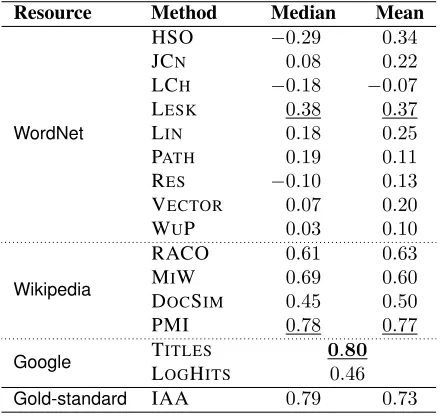
Resource Method Median Mean
WordNet
HSO −0.29 0.34
JCN 0.08 0.22
LCH −0.18 −0.07 LESK 0.38 0.37
LIN 0.18 0.25
PATH 0.19 0.11 RES −0.10 0.13 VECTOR 0.07 0.20 WUP 0.03 0.10
Wikipedia
RACO 0.61 0.63
MIW 0.69 0.60 DOCSIM 0.45 0.50
PMI 0.78 0.77
Google TITLES 0.80
[image:7.612.76.297.60.268.2]LOGHITS 0.46 Gold-standard IAA 0.79 0.73
Table 2: Spearman rank correlation ρ values for the different scoring methods over the NEWS dataset (performing method for each resource underlined; best-performing method overall inboldface)
topic models of NEWSand BOOKSusingT = 200
and T = 400 topics respectively. We randomly selected a total of 237 topics from the two collec-tions for user scoring. We asked N = 9 users to score each of the 237 topics on a 3-point scale where 3=“useful” (coherent) and 1=“useless” (less coher-ent).
We provided annotators with a rubric and guide-lines on how to judge whether a topic was useful or useless. In addition to showing several examples of useful and useless topics, we instructed users to decide whether the topic was to some extent coher-ent, meaningful, interpretable, subject-heading-like, and something-you-could-easily-label. For our pur-poses, the usefulness of a topic can be thought of as whether one could imagine using the topic in a search interface to retrieve documents about a par-ticular subject. One indicator of usefulness is the ease by which one could think of a short label to de-scribe a topic.
Table 1 shows a selection of high- and low-scoring topics, as scored by theN = 9 users. The first topic illustrates the notion of labelling coher-ence, asspace exploration, e.g., would be an obvi-ous label for the topic. The low-scoring topics dis-play little coherence, and one would not expect them
Resource Method Median Mean
WordNet
HSO 0.15 0.59
JCN −0.20 0.19 LCH −0.31 −0.15 LESK 0.53 0.53
LIN 0.09 0.28
PATH 0.29 0.12
RES 0.57 0.66
VECTOR −0.08 0.27 WUP 0.41 0.26
Wikipedia
RACO 0.62 0.69
MIW 0.68 0.70 DOCSIM 0.59 0.60
PMI 0.74 0.77
Google TITLES 0.51
LOGHITS −0.19 Gold-standard IAA 0.82 0.78
Table 3: Spearman rank correlationρvalues for the dif-ferent scoring methods over the BOOKS dataset (performing method for each resource underlined; best-performing method overall inboldface)
to be useful as categories or facets in a search inter-face. Note that the useless topics from both collec-tions are not chance artifacts produced by the mod-els, but are in fact stable and robust statistical fea-tures in the data sets.
6 Results
The results for the different topic scoring methods over the NEWS and BOOKS collections are pre-sented in Tables 2 and 3, respectively. In each ta-ble, we separate out the scoring methods into those based on WordNet(from Section 4.1), those based onWikipedia(from Section 4.2), and those based on
Google(from Section 4.3).
As stated in Section 4, we experiment with two methods for combining the word-pair scores (for all methods other than the twoGooglemethods, which operate natively over a word set), namely the arith-metic mean and median. We present the numbers for these two methods in each table. In each case, we evaluate via Spearman rank correlation, revers-ing the sign of the calculatedρvalue for PATH(as it
is the only instance of a distance metric, where the gold-standard is made up of similarity values).
[image:7.612.316.536.63.267.2]to be the upper bound for the task. This is calcu-lated as the average Spearman rank correlation be-tween each annotator and the mean/median of the remaining annotators for that topic. Encouragingly, there is relatively little difference in the IAA be-tween the two datasets; the median-based calcula-tion produces slightly higherρvalues and is empiri-cally the method of choice.3
Of all the topic scoring methods tested, PMI (term co-occurrence via simple pointwise mutual in-formation) is the most consistent performer, achiev-ing the best or near-best results over both datasets, and approaching or surpassing the inter-annotator agreement. This indicates both that the task of topic evaluation as defined in this paper is com-putationally tractable, and that word-pair based co-occurrence is highly successful at modelling topic coherence.
Comparing the different resources, Wikipedia is far and away the most consistent performing, with PMI producing the best results, followed by MIW and RACO, and finally DOCSIM. There is rela-tively little difference in results between NEWS and
BOOKSfor theWikipediamethods.Googleachieves the best results over NEWS, for TITLES (actually slightly above the IAA), but the results fall away sharply over BOOKS. The reason for this can be seen in the sample topics in Table 1: the topics for BOOKS tend to be more varied in word class than
for NEWS, and contain less proper names; also, the genre of BOOKSis less well represented on the web. We hypothesise that Wikipedia’s encyclopedic na-ture means that it has good coverage over both do-mains, and thus more robust.
Turning to WordNet, the overall results are markedly better over BOOKS, again largely because of the relative sparsity of proper names in the re-source. The results for individual methods are some-what surprising. Whereas JCN and LCHhave been shown to be two of the best-performing methods over lexical similarity tasks (Budanitsky and Hirst, 2005; Agirre et al., 2009), they perform abysmally at the topic scoring task. Indeed, the spread of re-sults across the WordNet similarity methods
(no-3Note that the choice of mean or median for IAA is
in-dependent of that for the scoring methods, as they are com-bining different things: annotator scores in the one hand, and word/concept pair scores on the other.
tably HSO, JCN, LCH, LIN, RES and WUP) is much greater than we had expected. The single most consistent method is LESK, which is based on lexi-cal overlap in definition sentences and makes rela-tively modest use of theWordNethierarchy. Supple-mentary evaluation where we filtered out all proper nouns from the topics (based on simple POS priors for each word learned from an automatically-tagged version of the British National Corpus) led to a slight increase in results for theWordNetmethods; the full results are omitted for reasons of space. In future work, we intend to carry out error analysis to deter-mine why some of the methods performed so badly, or inconsistently across the two datasets.
There is no clear answer to the question of whether the mean or median is the best method for combining the pair-wise scores.
7 Conclusions
We have proposed the novel task of topic coher-ence evaluation as a form of intrinsic topic evalu-ation with relevance in document search/discovery and visualisation applications. We constructed a gold-standard dataset of topic coherence scores over the output of a topic model for two distinct datasets, and evaluated a wide range of topic scor-ing methods over this dataset, drawscor-ing onWordNet,
Wikipediaand the Google search engine. The sin-gle best-performing method was term co-occurrence withinWikipedia based on pointwise mutual infor-mation, which achieve results very close to the inter-annotator agreement for the task. Google was also found to perform well over one of the two datasets, while the results for the WordNet-based methods were overall surprisingly low.
Acknowledgements
NICTA is funded by the Australian government as rep-resented by Department of Broadband, Communication and Digital Economy, and the Australian Research Coun-cil through the ICT centre of Excellence programme. DN has also been supported by a grant from the Institute of Museum and Library Services, and a Google Research Award.
References
re-latedness using distributional and WordNet-based ap-proaches. In Proc. of HLT: NAACL 2009, pages 19– 27, Boulder, Colorado.
S Banerjee and T Pedersen. 2002. An adapted Lesk algo-rithm for word sense disambiguation using WordNet. Proc. of CICLing’02, pages 136–145.
DM Blei, AY Ng, and MI Jordan. 2003. Latent Dirich-let allocation. Journal of Machine Learning Research, 3:993–1022.
S Brody and M Lapata. 2009. Bayesian word sense induction. In Proc. of EACL 2009, pages 103–111, Athens, Greece.
A Budanitsky and G Hirst. 2005. Evaluating WordNet-based Measures of Lexical Sematic Relatedness. Computational Linguistics, 32(1):13–47.
WL Buntine and A Jakulin. 2004. Applying discrete PCA in data analysis. In Proc. of UAI 2004, pages 59–66.
J Chang, J Boyd-Graber, S Gerris, C Wang, and D Blei. 2009. Reading tea leaves: How humans interpret topic models. InProc. of NIPS 2009.
H Daume III. 2009. Non-parametric bayesian areal lin-guistics. InProc. of HLT: NAACL 2009, pages 593– 601, Boulder, USA.
Scott Deerwester, Susan T. Dumais, George W. Furnas, Thomas K. Landauer, and Richard Harshman. 1990. Indexing by latent semantic analysis. Journal of the American Society of Information Science, 41(6). C Fellbaum, editor. 1998. WordNet: An Electronic
Lexi-cal Database. MIT Press, Cambridge, USA.
E Gabrilovich and S Markovitch. 2007. Computing mantic relatedness using Wikipedia-based explicit se-mantic analysis. In Proc. of IJCAI’07, pages 1606– 1611, Hyderabad, India.
T Griffiths and M Steyvers. 2004. Finding scientific top-ics. InProc. of the National Academy of Sciences, vol-ume 101, pages 5228–5235.
T Griffiths and M Steyvers. 2006. Probabilistic topic models. In Latent Semantic Analysis: A Road to Meaning.
A Haghighi and L Vanderwende. 2009. Exploring con-tent models for multi-document summarization. In Proc. of HLT: NAACL 2009, pages 362–370, Boulder, USA.
G Hirst and D St-Onge. 1998. Lexical chains as repre-sentations of context for the detection and correction of malapropism. In Fellbaum (Fellbaum, 1998), pages 305–332.
T Hofmann. 2001. Unsupervised learning by proba-bilistic latent semantic analysis. Machine Learning, 42(1):177–196.
JJ Jiang and DW Conrath. 1997. Semantic similarity based on corpus statistics and lexical taxonomy. In Proc. of COLING’97, pages 19–33, Taipei, Taiwan. C Leacock, G A Miller, and M Chodorow. 1998. Using
corpus statistics and WordNet relations for sense iden-tification. Computational Linguistics, 24(1):147–65.
M Lesk. 1986. Automatic sense disambiguation us-ing machine readable dictionaries: how to tell a pine cone from an ice cream cone. InProc. of SIGDOC’86, pages 24–26, Toronto, Canada.
D Lin. 1998. Automatic retrieval and clustering of sim-ilar words. InProc. of COLING/ACL’98, pages 768– 774, Montreal, Canada.
C-Y Lin. 2004. ROUGE: a package for automatic evaluation of summaries. In Proc. of the ACL 2004 Workshop on Text Summarization Branches Out (WAS 2004), pages 74–81, Barcelona, Spain.
Q Mei, X Shen, and CX Zhai. 2007. Automatic labeling of multinomial topic models. InProc. of KDD 2007, pages 490–499.
D Milne and IH Witten. 2008. An effective, low-cost measure of semantic relatedness obtained from Wikipedia links. In Proc. of AAAI Workshop on Wikipedia and Artificial Intelligence, pages 25–30, Chicago, USA.
H Misra, O Cappe, and F Yvon. 2008. Using LDA to detect semantically incoherent documents. InProc. of CoNLL 2008, pages 41–48, Manchester, England. D Newman, S Karimi, and L Cavedon. 2009. External
evaluation of topic models. InProc. of ADCS 2009, pages 11–18, Sydney, Australia.
D Newman, T Baldwin, L Cavedon, S Karimi, D Mar-tinez, and J Zobel. to appeara. Visualizing docu-ment collections and search results using topic map-ping. Journal of Web Semantics.
D Newman, Y Noh, E Talley, S Karimi, and T Bald-win. to appearb. Evaluating topic models for digital libraries. InProc. of JCDL/ICADL 2010, Gold Coast, Australia.
K Papineni, S Roukos, T Ward, and W-J Zhu. 2002. BLEU: a method for automatic evaluation of machine translation. In Proc. of ACL 2002, pages 311–318, Philadelphia, USA.
P Pecina. 2008.Lexical Association Measures: Colloca-tion ExtracColloca-tion. Ph.D. thesis, Charles University. P Resnik. 1995. Using information content to
evalu-ate semantic similarity in a taxonomy. InProc. of IJ-CAI’95, pages 448–453, Montreal, Canada.
H Sch¨utze. 1998. Automatic word sense discrimination. Computational Linguistics, 24(1):97–123.
M Str¨ube and SP Ponzetto. 2006. WikiRelate! comput-ing semantic relateness uscomput-ing Wikipedia. InProc. of AAAI’06, pages 1419–1424, Boston, USA.
Q Sun, R Li, D Luo, and X Wu. 2008. Text segmentation with LDA-based Fisher kernel. In Proc. of ACL-08: HLT, pages 269–272.
HM Wallach, I Murray, R Salakhutdinov, and DM Mimno. 2009. Evaluation methods for topic models. InProc. of ICML 2009, page 139. D Widdows and K Ferraro. 2008. Semantic Vectors:
A scalable open source package and online technol-ogy management application. InProc. of LREC 2008, Marrakech, Morocco.