Volume 2006, Article ID 49257, Pages1–8 DOI 10.1155/ASP/2006/49257
Performance Analysis of the Blind Minimum
Output Variance Estimator for Carrier Frequency
Offset in OFDM Systems
Feng Yang, Kwok H. Li, and Kah C. Teh
School of Electrical and Electronic Engineering, Nanyang Technological University, Singapore 639798, Singapore
Received 18 November 2004; Revised 13 July 2005; Accepted 29 December 2005
Recommended for Publication by Alexei Gorokhov
Carrier frequency offset (CFO) is a serious drawback in orthogonal frequency division multiplexing (OFDM) systems. It must be estimated and compensated before demodulation to guarantee the system performance. In this paper, we examine the perfor-mance of a blind minimum output variance (MOV) estimator. Based on the derived probability density function (PDF) of the output magnitude, its mean and variance are obtained and it is observed that the variance reaches the minimum when there is no frequency offset. This observation motivates the development of the proposed MOV estimator. The theoretical mean-square error (MSE) of the MOV estimator over an AWGN channel is obtained. The analytical results are in good agreement with the simulation results. The performance evaluation of the MOV estimator is extended to a frequency-selective fading channel and the maximal-ratio combining (MRC) technique is applied to enhance the MOV estimator’s performance. Simulation results show that the MRC technique significantly improves the accuracy of the MOV estimator.
Copyright © 2006 Hindawi Publishing Corporation. All rights reserved.
1. INTRODUCTION
Orthogonal frequency division multiplexing (OFDM) has been considered as a promising modulation scheme for the next generation wireless communication systems. OFDM signals are transmitted in parallel subchannels, which are frequency-nonselective and overlapped in spectra. Hence, OFDM systems are robust to frequency-selective fading and enjoy high bandwidth efficiency. As the symbol duration is extended, the OFDM scheme reduces the normalized de-lay spread and avoids intersymbol interference (ISI). Be-cause of these excellent characteristics, OFDM has been sug-gested and standardized for high-speed communications in Europe for digital audio broadcasting (DAB) [1] and ter-restrial digital video broadcasting (DVB) [2]. Furthermore, OFDM is standardized for broadband wireless local area networks, for example, ETSI-BRAN High-performance lo-cal area networks (Hiperlan/2) [3], IEEE 802.11a [4], and for broadband wireless access, for example, IEEE 802.16 [5]. One drawback of OFDM systems is that carrier frequency offset (CFO) between the transmitter and receiver may de-grade system performance severely [6]. CFO causes a num-ber of impairments, including the attenuation and phase ro-tation of each of the subcarriers and intercarrier interference
previous work [13], we proposed a new blind estimation al-gorithm which yields high bandwidth efficiency and high accuracy based on the minimum output variance (MOV). In [13], the performance of the MOV estimator is obtained by simulations. The main objective of this paper is to de-rive the theoretical mean and variance of the MOV estima-tor and examine the performance analytically. We also eval-uate the performance of the MOV estimator over frequency-selective fading channels and apply the maximal-ratio com-bining (MRC) technique to improve its performance.
The rest of the paper is organized as follows. InSection 2, the OFDM system model is briefly introduced. InSection 3, the MOV estimator is described and its performance is an-alyzed over additive white Gaussian noise (AWGN) chan-nels. Numerical results are presented in both AWGN and frequency-selective fading channels in Section 4. Finally, conclusions are drawn inSection 5.
2. OFDM SYSTEMS
OFDM is a form of mutlicarrier modulation and consists of a number of narrowband orthogonal subcarriers trans-mitted in a synchronous manner. The mth OFDM data block to be transmitted can be defined as s(m) = [s0(m), s1(m),. . .,sN−1(m)]T, where N is the number of
subcarri-ers. The OFDM signals can be formulated by inverse discrete Fourier transform (IDFT). Using the matrix representation, themth block of the modulated signal is
x(m)=x0(m),x1(m),. . .,xN−1(m)
T=
Ws(m), (1) whereWis the IDFT matrix given by
W= √1 N
⎡ ⎢ ⎢ ⎢ ⎢ ⎣
1 1 · · · 1
1 ejω · · · ej(N−1)ω
..
. ... . .. ... 1 ej(N−1)ω · · · ej(N−1)×(N−1)ω
⎤ ⎥ ⎥ ⎥ ⎥ ⎦
N×N
(2)
withω=2π/N. After the IDFT modulation, a cyclic prefix (CP) is inserted and its length is assumed to be longer than the maximum delay spread of the channel to avoid intersym-bol interference (ISI). The resultant baseband signal is up-converted to the radio frequency (RF) and transmitted over a multipath fading channel. At the receiver, the signal is down-converted and demodulated using discrete Fourier transform (DFT) to recover the desired signal. In the absence of CFO, the received signal is given by
y(m)=WHs(m) +n(m), (3) where
H=diagH0(m),H1(m),. . .,HN−1(m)
(4)
represents the channel response in the frequency domain. Af-ter down-conversion, the carrier frequency offsetΔf is in-curred because of the mismatch of carrier frequencies be-tween the transmitter and receiver. The received signal, after the removal of the CP, is
y(m)=ΦWHs(m) +n(m), (5)
where
Φ=diag1,ejφ0,. . .,ej(N−1)φ0 (6)
denotes the CFO matrix. Note thatφ0 =2πΔf Ts/N andTs
is the OFDM block duration.
3. ESTIMATION OF CARRIER FREQUENCY OFFSET
Due to spectra overlapping, OFDM systems are sensitive to CFO. The CFO destroys the orthogonality among subcarri-ers, results in intercarrier interference (ICI) and causes sys-tem performance degradation. To improve the syssys-tem per-formance, the CFO must be estimated and compensated be-fore the DFT demodulation.
3.1. Minimum output variance (MOV) estimator
In the presence of CFO, the received signal, after DFT de-modulation, is given by
d(m)=WHy(m)=WHΦWHs(m) +n(m), (7)
whereWHrepresents the DFT demodulation matrix,d(m)=
[d0(m),d1(m),. . .,dN−1(m)]T is the recovered signal vector
andn(m) is the noise term after the DFT operation. Because of the presence of CFO,WHΦWis no longer an identity
ma-trix and the desired signals(m) cannot be recovered properly. For the sake of simplicity, the block numbermwill not be in-cluded in the subsequent derivation. The recovered signal on subcarrierkis given by
dk=I0sk+ N−1
l=0,l=k
Il−ksl, (8)
where
In=
sinπΔf Ts
Nsin(π/N)Δf Ts+n
·exp
jπ N
(N−1)Δf Ts−n
.
(9)
In (8), I0 represents the attenuation and phase rotation of
the desired signal andIl−krepresents the ICI coefficient from
other subcarriers. From (8) and (9), it can be seen that the coefficientI0ofskis independent ofk. It implies that the
de-sired signals on all subcarriers experience the same degree of attenuation and phase rotation. Note that the ICI term is the addition of many independent random variables and can be approximated as a complex Gaussian random variable with zero mean [15,16]. Thus, the output of each subcarrier can be considered as a dominant signal embedded in addi-tive white Gaussian noise. To simplify the analysis, the BPSK modulation is employed in the OFDM scheme.
The ICI power is defined as
PICIE
N−1
l=0,l=k Il−ksl
2
0 0.05 0.1 0.15 0.2 0.25 0.3 0.35 0.4 0.45 0.5 ε=Δf Ts
−60
−50
−40
−30
−20
−10 0
PICI
(dB)
Exact calculation of ICI power Simulation of ICI power
Figure 1: The theoretical and the simulation results of the ICI power.
andPICIcan be obtained as [17]
PICI=
1
−1
1− |x|1−ej2πxdx
=1−sinc2(),
(11)
where=Δf Ts∈(−0.5, 0.5) is the CFO normalized to the
subcarrier spacing and sinc(x)=sin (πx)/(πx). The theoret-ical and the simulation results of the ICI power are presented inFigure 1. It is observed that the theoretical curve based on (11) matches the simulation results well.
Since the ICI can be approximated as a Gaussian random variable with zero mean, the variance of the ICI is equal to
σ2=P
ICI=1−sinc2(). (12)
From (8) and (9), it is clear that the dominant signal on thekth subcarrier isI0sk. Hence, the magnitude mean of the
dominant signal on thekth subcarrier is
m=I0sk=
sinππejπsk
=sinc(). (13)
Based on the analysis above, the probability density function (PDF) of the output|dk|can be approximated as Gaussian
mixture given by
p|dk|(x)=
1
√
2πσe
−(x−m)2/2σ2
+√1 2πσe
−(x+m)2/2σ2 u(x),
(14)
whereu(x) is the unit step function. Let us consider the ex-pectation and variance of the output|dk|. The expectation of |dk|is
Edk=
∞
−∞xp|dk|(x)dx
=
21−sinc2()
π exp
− sinc
2()
21−sinc2()
+ sinc()−2 sinc()Q
⎛
⎝ sinc() 1−sinc2()
⎞ ⎠,
(15)
where
Q(x)= √1
2π
∞
x e −t2/2
dt. (16)
The second moment of|dk|is
Edk2
=
∞
−∞x
2
p|dk|(x)dx
=m2+σ2−m2+σ2−1Q
m σ
=1.
(17)
The variance of|dk|can be expressed as
vardk=E
dk
2
−E2d
k. (18)
From (15), (17), and (18), it is observed that the expec-tation and variance of|dk|are functions of. Figures2(a),
2(b), and 2(c)show the expectation, the variance, and the second moment of|dk|versus the normalized CFO,
respec-tively. From these figures, it is observed that the simulation results match the theoretical results well. The results also show that the variance of|dk|monotonically increases and
the expectation of |dk| monotonically decreases when the
normalized CFO||increases. In other words, the minimum variance and maximum mean are obtained when=0. In-tuitively, this property can be explained as follows. The CFO does not change the total signal power in one received sym-bol [14], but the CFO causes the uncertainty of the output. More frequency offset causes more uncertainties and thus, the variance of the output|dk|increases. This is the principal
idea for the CFO estimator proposed in [13].
Based on this property, we have proposed a blind CFO estimator with minimum output variance (MOV) for OFDM systems in [13]. WhenNis sufficiently large, the expectation of |dk| is approximately equal to the average value of |dk|
amongNsubcarriers. From the previous analysis, the average value of|dk|attains a maximum value if the CFO is properly
compensated. Defining
Φe=diag
1,ejφe,. . .,ej(N−1)φe, (19)
we search forφein the range of (−π/N,π/N) such that
Λφe
1 N
N
i=1
WH
−0.5−0.4 −0.3 −0.2 −0.1 0 0.1 0.2 0.3 0.4 0.5
Δf Ts 0.8
0.85 0.9 0.95 1 E( | dk | ) Simulation result Theoretical result (a)
−0.5−0.4 −0.3 −0.2 −0.1 0 0.1 0.2 0.3 0.4 0.5
Δf Ts 0
0.1 0.2 0.3 0.4
var( | dk | ) Simulation result Theoretical result (b)
−0.5−0.4 −0.3 −0.2 −0.1 0 0.1 0.2 0.3 0.4 0.5
Δf Ts 0.8
0.9 1 1.1
E( | dk | 2) Simulation result Theoretical result (c)
Figure2: (a) Expectation of|dk|versus, (b) variance of|dk|versus , (c) second moment of|dk|versus.
achieves its maximum value forΦe=Φ, whereWiis theith
column of the matrixW. If thermal noise is present, the ac-curacy ofφemay be improved by searching for the maximal value in (20) with more blocks. Hence, the proposed MOV estimator is to search for oneφeto maximizeΛ(φe) [13], that
is,
φe=arg max φe
1
MN M
m=1 N
i=1
WH
i ΦHey(m), (21)
wherey(m) is defined in (5) andMis the number of blocks used by the MOV estimator. Based on (21), the DFT opera-tionWHi in MOV estimator can be implemented efficiently by means of the fast Fourier transform (FFT) algorithm. Al-though the above analysis is based on BPSK modulation, it is also applicable to higher-order modulation schemes such as QPSK, 8-QAM, 16-QAM, and 64-QAM, and so forth. Simu-lations have been conducted to verify that the MOV estima-tor is applicable to higher-order modulation methods.
3.2. Performance analysis of the MOV estimator
For the MOV estimator, we need to obtain the expected value of|dk|for each trial value ofφe. The expectation of|dk|is
ap-proximated by the average value of|dk|amongMNoutputs,
that is,
Edk=μφe ≈μφe =
1/MN
M
m=1 N
i=1
WH
i ΦHey(m).
(22)
When|dk|is embedded in AWGN, the accuracy of this
ap-proximation is affected and the difference between the ex-pected value and the approximated average value is the ma-jor contribution to the error variance of the MOV estimator. It is known thatμφe follows the Gaussian distribution with
meanμφeand varianceσ
2
w/MN[18], whereσw2represents the
variance of AWGN noise. Thus, it has a probability thatμφe
(forφe=φ0) is greater than the theoretical maximum mean
valueμφ0. When this happens, the estimation accuracy is
af-fected. Equivalently, the analysis can be addressed as follows. Suppose that we haveKtrial values ofφeamong the
estima-tion range and we obtain the average output for each trial value independently. For thekth trial value, the average out-put isμk=μk+nk, wherenkdenotes the noise term with zero
mean and varianceσ2
w/MN. The probability thatμkbecomes
the largest can be expressed as
Prμk=max
μ1,. . .,μK
=Prμk>μ1,μk>μ2,. . .,μk>μK
=Prμk+nk> μ1+n1,. . .,μk+nk> μK+nK
.
(23)
Note thatn1,n2,. . .,nK are independent noise. For a given nk, the conditional probability can be expressed as
Prμk=max
μ1,. . .,μK
|nk
=Prn1< μk−μ1+nk,. . .,nK< μk−μK+nk
=Prn1< μk−μ1+nk
× · · · ×PrnK< μk−μK+nk
=
⎛ ⎝1−Q
⎛
⎝μk−μ1+nk
2σ2 w/MN ⎞ ⎠ ⎞ ⎠ × · · · × ⎛ ⎝1−Q
⎛
⎝μk−μK+nk
2σ2 w/MN ⎞ ⎠ ⎞ ⎠. (24)
Thus, the probability thatμkbecomes the largest is obtained
as
Prμk=max
μ1,. . .,μK
= ∞ −∞Pr
μk|nk
pnk(x)dx, k=1, 2,. . .,K,
(25)
wherepnk(x) denotes the Gaussian PDF ofnkgiven by
pnk(x)=
1
2πσ2 w/MN
exp
− x2
2σ2 w/MN
0 5 10 15 20 25 30 Eb/N0(dB)
10−7 10−6 10−5 10−4 10−3 10−2 10−1
No
rm
al
iz
ed
M
S
E
T&H, 4 blocks MOV, 1 block MOV, 2 blocks
MOV, 3 blocks MOV, 4 blocks Theoretical results
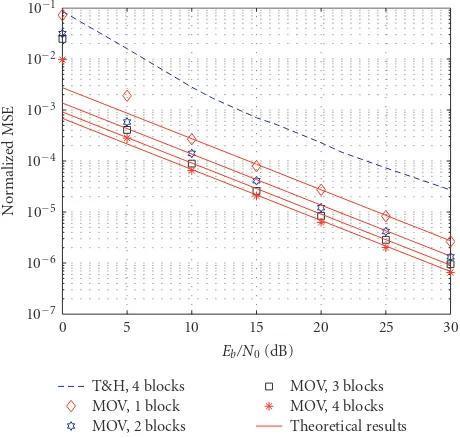
Figure3: Normalized MSE of the proposed MOV estimator versus
Eb/N0with various number of OFDM blocks over AWGN channels.
When all theK probabilities in (25) are obtained, the mean and variance of the estimated offset can be obtained accordingly. Here, the variance represents the mean-square error (MSE) of the MOV estimator. The MSE results will be validated in the next section.
4. NUMERICAL RESULTS AND ANALYSIS
In this section, numerical results are presented to illustrate the performance of the proposed MOV estimator in OFDM systems. In particular,N=64 subcarriers are used. The per-formance of the proposed MOV estimator is examined by the normalized MSE defined as
MSE=E φe−φ0 2
(2π/N)2
!
≈ 1
P P
p=1
φep−φ0 2
(2π/N)2 , (27)
whereφeis the estimate ofφ0andPis the number of Monte
Carlo runs. Simulations are conducted in both AWGN and frequency-selective fading channels.
4.1. Performance over AWGN channels
Figure 3shows the normalized MSE of the proposed MOV estimator over an AWGN channel. From the simulation re-sults, it is observed that the normalized MSE decreases as
Eb/N0increases. With more OFDM blocks, the accuracy of
the proposed MOV estimator is in general improved. The ap-proximated MSE values are the corresponding solid lines in Figure 3. The simulation results match the theoretical results well at highEb/N0, that is,Eb/N0>10 dB. The performance
curve of the T&H estimator [12] is also included for compar-ison, where the number of subcarriers isN=64, the number
1 2 4 6 8 10 12 14 16 18 20
Number of blocks,M 10−7
10−6 10−5 10−4 10−3
No
rm
al
iz
ed
M
S
E
Eb/N0=10 dB Eb/N0=15 dB Eb/N0=20 dB
Eb/N0=25 dB Eb/N0=30 dB Theoretical results
Figure4: Normalized MSE of the proposed MOV estimator versus number of blocks over AWGN channels.
of virtual carriers isL = 20, and the number of blocks for estimation isM=4. For the value of MSE=10−3, the
pro-posed MOV algorithm outperforms the T&H algorithm by more than 6 dB inEb/N0. The reason for the significant
im-provement is that the proposed MOV estimator takes the av-erage of the magnitude output and is robust to noise, but the orthogonality property utilized by the T&H estimator is more sensitive to noise. Also, the proposed MOV algorithm can be implemented by fast Fourier transform (FFT) with high efficiency. Thus, the computational complexity of MOV algorithm is generally lower than that of the T&H algorithm. InFigure 4, we present the MSE results of the proposed MOV algorithm with various numbers of OFDM blocks. From the simulation results, it is observed that the normal-ized MSE decreases with more OFDM blocks for estimation but using more blocks for estimation increases the complex-ity of the estimator. Also, the theoretical MSE results match the simulation MSE results well. Note that the normalized MSE is less than 10−3 for moderately high E
b/N0, which
makes the degradation caused by the CFO negligible even when only one OFDM block is used for the estimation. Thus, the proposed MOV estimator is also suitable for burst trans-mission.
4.2. Performance over frequency-selective fading channels
0 5 10 15 20 25 30 Eb/N0(dB)
10−5 10−4 10−3 10−2 10−1
No
rm
al
iz
ed
M
S
E
1 block 2 blocks
3 blocks 4 blocks
Figure5: Normalized MSE of the proposed MOV estimator ver-susEb/N0with various number of OFDM blocks over frequency-selective fading channels.
the channel information is not available. Figure 5 shows the normalized MSE results over frequency-selective fading channels. From the results, it is observed that the normalized MSE is less than 4×10⁻³whenE
b/N0≥10 dB. The error floor
is caused by the channel dispersion. It shows that the algo-rithm achieves high accuracy with only a few OFDM blocks under moderately highEb/N0. Thus, the proposed MOV
al-gorithm is effective and reliable over frequency-selective fad-ing channels.
InFigure 6, the normalized MSE of the proposed MOV algorithm is presented with different number of blocks over frequency-selective fading channels. It is observed that the accuracy is generally improved as the number of blocks increases but the improvement becomes insignificant for largeM. Considering the system performance requirement and complexity, the number of estimation blocksMshould be properly chosen.
4.3. Performance improvement with MRC technique
The MOV estimator takes the summation of the output over theN subcarriers. It is similar to the combining tech-niques in multicarrier CDMA (CDMA) [19]. In MC-CDMA systems, many diversity-combining techniques have been applied to improve the system performance, for exam-ple, equal-gain combining (EGC) and maximal-ratio com-bining (MRC). With the MRC technique, the output SNR is maximized [16, 21]. It is interesting to see whether the MRC technique can improve the performance of the pro-posed MOV estimator over frequency-selective fading chan-nels.
In this subsection, we assume that the channel estimation has been achieved and the channel attenuation and the phase
1 2 4 6 8 10 12 14 16 18 20
Number of blocks,M 10−5
10−4 10−3 10−2
No
rm
al
iz
ed
M
S
E
Eb/N0=10 dB Eb/N0=15 dB Eb/N0=20 dB
Figure6: Normalized MSE of the proposed MOV estimator versus number of blocks over frequency-selective fading channels.
shift on each subcarrier are known to the MOV estimator. Thus, the gain matrix for the MRC is given by [19,20]
G=diagH0∗,. . .,HN∗−1
, (28)
whereHnis the channel gain on thenth subcarrier in (4) and
the superscript (·)∗denotes the complex conjugation. Mul-tiplying with the gain matrixG, the strong signals on subcar-riers carry larger weights than weak signals. Thus, the SNR of the output is maximized and the performance of MOV esti-mator is improved.
According to the channel gain with MRC, the MOV esti-mator can be rewritten as
φe=arg max φe
Λφe
=arg max
φe
1
MN M
m=1 N
i=1
WH
i ΦHe Gy(m),
(29)
whereGrepresents the gain matrix for MRC.
The normalized MSE results of the proposed MOV es-timator versusEb/N0with MRC technique over
0 5 10 15 20 25 30 35 40 Eb/N0(dB)
10−7 10−6 10−5 10−4 10−3 10−2 10−1
No
rm
al
iz
ed
M
S
E
T&H, 4 blocks
MOV, 1 block (with MRC) MOV, 2 blocks (with MRC)
MOV, 3 blocks (with MRC) MOV, 4 blocks (with MRC)
Figure7: Normalized MSE of the proposed MOV estimator versus
Eb/N0 with MRC technique over frequency-selective fading chan-nels.
4.4. Compensation of the CFO
After the CFO estimation is accomplished, frequency offset can be properly compensated and corrected to allow for the data detection. Figure 8 shows the BER performance for three cases, namely, with 20% frequency offset, without frequency offset, and after offset correction over frequency-selective fading channels, respectively. It is observed that the BER has an error floor when there is a 20% frequency offset. The reason for the error floor is that the bit errors are mainly due to the ICI, not due to the noise for high Eb/N0. The
BER, after MOV estimation and correction, is very close to the BER without CFO, which validates that MOV estimator eliminates the effect of CFO effectively.
5. CONCLUSION
In this paper, we have examined the performance of the min-imum output variance (MOV) estimator in OFDM systems. The variance and the expectation of the output magnitude have been derived for the MOV estimator. The theoretical MSE of the MOV estimator has been derived and the theoret-ical MSE results match the simulation results well. From the simulation results, it is observed that the MOV algorithm has high accuracy in both AWGN and frequency-selective fading channels. It has also been shown that the MOV algorithm outperforms the T&H algorithm. The MOV estimator can be implemented by FFT efficiently, which causes the computa-tional complexity of the MOV estimator generally lower than that of the T&H estimator. Furthermore, the maximal-ratio combining (MRC) technique has been applied to the MOV estimator to improve the accuracy over frequency-selective fading channels. Simulation results verify that the MRC
tech-0 5 10 15 20 25 30 35 40
Eb/N0(dB) 10−5
10−4 10−3 10−2 10−1 100
BER
No frequency offset 20% frequency offset After offset correction
Figure8: BER versusEb/N0over frequency-selective fading chan-nels.
nique is effective and significantly improves the accuracy of the MOV estimator over frequency-selective fading channels.
REFERENCES
[1] E. T. Standard, “Radio broadcast systems; digital audio broad-casting (DAB) to mobile, portable, and fixed receivers,” Tech. Rep. preETS 300 401, March 1994.
[2] U. Reimers, “DVB-T: the COFDM-based system for terrestrial television,”Electronics & Communications Engineering Journal, vol. 9, no. 1, pp. 28–32, 1995.
[3] J. Khun-Jush, P. Schramm, U. Wachsmann, and F. Wenger, “Structure and performance of the HIPERLAN/2 physical layer,” inProceedings of IEEE Vehicular Technology Conference (VTC ’99), vol. 5, pp. 2667–2671, Amsterdam, The Nether-lands, September 1999.
[4] IEEE Std. 802.11a, “Wireless LAN medium access control (MAC) and physical layer (PHY) specifications: High-speed physical layer extension in the 5-GHz band,” IEEE, 1999. [5] Air Interface for Fixed Broad-Band Wireless Access Systems. Part
A: Systems Between 2-11 GHz, July 2001. IEEE 802.16ab-01/01 Std., Rev. 1.
[6] T. Pollet, M. Van Bladel, and M. Moeneclaey, “BER sensitiv-ity of OFDM systems to carrier frequency offset and Wiener phase noise,”IEEE Transactions on Communications, vol. 43, no. 2/3/4, pp. 191–193, 1995.
[7] P. H. Moose, “A technique for orthogonal frequency division multiplexing frequency offset correction,”IEEE Transactions on Communications, vol. 42, no. 10, pp. 2908–2914, 1994. [8] T. M. Schmidl and D. C. Cox, “Robust frequency and timing
synchronization for OFDM,”IEEE Transactions on Communi-cations, vol. 45, no. 12, pp. 1613–1621, 1997.
Transactions on Signal Processing, vol. 45, no. 7, pp. 1800–1805, 1997.
[10] M. Luise, M. Marselli, and R. Reggiannini, “Low-complexity blind carrier frequency recovery for OFDM signals over frequency-selective radio channels,” IEEE Transactions on Communications, vol. 50, no. 7, pp. 1182–1188, 2002. [11] U. Tureli, H. Liu, and D. Zoltowski, “OFDM blind carrier off
-set estimation: ESPRIT,”IEEE Transactions on Communica-tions, vol. 48, no. 9, pp. 1459–1461, 2000.
[12] U. Tureli, D. Kivanc, and H. Liu, “Experimental and analytical studies on a high-resolution OFDM carrier frequency offset estimator,”IEEE Transactions on Vehicular Technology, vol. 50, no. 2, pp. 629–643, 2001.
[13] F. Yang, K. H. Li, and K. C. Teh, “A carrier frequency off -set estimator with minimum output variance for OFDM sys-tems,”IEEE Communications Letters, vol. 8, no. 11, pp. 677– 679, 2004.
[14] J. Armstrong, “Analysis of new and existing methods of reduc-ing intercarrier interference due to carrier frequency offset in OFDM,”IEEE Transactions on Communications, vol. 47, no. 3, pp. 365–369, 1999.
[15] J.-P. Linnartz, “Performance analysis of synchronous MC-CDMA in mobile Rayleigh channel with both delay and Doppler spreads,”IEEE Transactions on Vehicular Technology, vol. 50, no. 6, pp. 1375–1387, 2001.
[16] W. C. Jakes,Microwave Mobile Communications, John Wiley & Sons, New York, NY, USA, 1978, new edition, 1994.
[17] M. Russell and G. L. Stuber, “Interchannel interference analy-sis of OFDM in a mobile environment,” inProceedings of IEEE Vehicular Technology Conference (VTC ’95), vol. 2, pp. 820– 824, Chicago, Ill, USA, July 1995.
[18] A. Papoulis and S. U. Pillai, Probability, Random Variables and Stochastic Processes, McGraw-Hill, New York, NY, USA, 4th edition, 2002.
[19] N. Yee, J.-P. Linnartz, and G. Fettweis, “Multi-carrier CDMA in indoor wireless radio networks,” inProceedings the 4th IEEE International Symposium on Personal, Indoor and Mobile Ra-dio Communications (PIMRC ’93), pp. 109–113, Yokohama, Japan, September 1993.
[20] S. Hara and R. Prasad, “Design and performance of multi-carrier CDMA system in frequency-selective Rayleigh fading channels,”IEEE Transactions on Vehicular Technology, vol. 48, no. 5, pp. 1584–1595, 1999.
[21] J. G. Proakis, Digital Communications, McGraw-Hill, New York, NY, USA, 4th edition, 2001.
Feng Yangreceived the B.S. degree in elec-trical engineering from Huazhong Univer-sity of Science and Technology, Wuhan, China, in 2002. He is pursuing the Ph.D. degree in electrical engineering at Nanyang Technological University, Singapore. His re-search interests include OFDM and mul-ticarrier communications, MIMO, UWB, synchronization, and digital signal process-ing.
Kwok H. Li received the B.S. degree in electronics from the Chinese University of Hong Kong in 1980 and the M.S. and Ph.D. degrees in electrical engineering from the University of California, San Diego, in 1983 and 1989, respectively. Since Decem-ber 1989, he has been with the Nanyang Technological University, Singapore. He is currently an Associate Professor in the Di-vision of Communication Engineering and
has served as the Programme Director of the M.S. programe in communications engineering since 1998. His research interest has centered on the area of digital communication theory with empha-sis on spread-spectrum communications, mobile communications, coding, and signal processing. He has published more than 100 pa-pers in journals and conference proceedings. He served as the Chair of IEEE Singapore Communications Chapter from 2000 to 2001. He was also the General Cochair of the 3rd, 4th, and 5th Inter-national Conference on Information, Communications, and Signal Processing (ICICS) held in Singapore and Thailand. Presently, he is serving as the Chair of the Chapters Coordination Committee of the IEEE Asia Pacific Board (APB).
Kah C. Teh received the B.E. and Ph.D. degrees in electrical engineering from Nanyang Technological University (NTU), Singapore, in 1995 and 1999, respectively. From December 1998 to July 1999, he was with the Center for Wireless Communica-tions, Singapore, as a StaffR&D Engineer. Since July 1999, he has been with NTU where he is currently an Associate Profes-sor in the Division of Communication