Volume 2009, Article ID 629285,18pages doi:10.1155/2009/629285
Research Article
A New Frame Memory Compression Algorithm with
DPCM and VLC in a 4
×
4 Block
Yongseok Jin, Yongje Lee, and Hyuk-Jae Lee
Department of Electrical Engineering and Computer Science, Inter-University Semiconductor Research Center, Seoul National University, Seoul 151-742, South Korea
Correspondence should be addressed to Hyuk-Jae Lee,hyuk jae [email protected]
Received 11 January 2009; Revised 8 July 2009; Accepted 15 November 2009
Recommended by Gloria Menegaz
Frame memory compression (FMC) is a technique to reduce memory bandwidth by compressing the video data to be stored in the frame memory. This paper proposes a new FMC algorithm integrated into an H.264 encoder that compresses a 4×4 block by differential pulse code modulation (DPCM) followed by Golomb-Rice coding. For DPCM, eight scan orders are predefined and the best scan order is selected using the results of H.264 intra prediction. FMC can also be used for other systems that require a frame memory to store images in RGB color space. In the proposed FMC, RGB color space is transformed into another color space, such as YCbCr or G, R-G, B-G color space. The best scan order for DPCM is selected by comparing the efficiency of all scan orders. Experimental results show that the new FMC algorithm in an H.264 encoder achieves 1.34 dB better image quality than a previous MHT-based FMC for HD-size sequences. For systems using RGB color space, the transform to G, R-G, B-G color space makes most efficient compression. The average PSNR values of R, G, and B colors are 46.70 dB, 50.80 dB, and 44.90 dB, respectively, for 768×512-size images.
Copyright © 2009 Yongseok Jin et al. This is an open access article distributed under the Creative Commons Attribution License, which permits unrestricted use, distribution, and reproduction in any medium, provided the original work is properly cited.
1. Introduction
Frame memory size and bandwidth requirements often limit the performance of a video processor designed for implementing a video compression standard such as
MPEG-2, MPEG-4, and H.263 or H.264/AVC [1–4]. Frame memory
compression (FMC) is a technique to reduce frame memory size by compressing the data to be stored in frame memory. Memory bandwidth requirement is also reduced by FMC
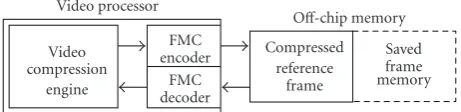
because data access requirements are reduced.Figure 1shows
a video processor in which the encoder and decoder of an FMC algorithm are integrated inside the processor. A
reference frame is, in general, stored in an off-chip memory.
When the video processor stores the reference frame in the
off-chip memory, the FMC encoder compresses the data. To
access the reference frame from the off-chip memory, the
video processor fetches compressed data from the off-chip
memory and the FMC decoder decompresses and restores the original data.
Three properties, low latency, random accessibility, and
low image quality degradation, are required for an efficient
FMC algorithm. Video processor performance is
signifi-cantly affected by the speed of the external memory, and
FMC algorithm latency delays the access of external memory. Therefore, low latency in the FMC algorithm is required to
minimize performance drop-off. Image compression
algo-rithms like JPEG2000 are not suitable for FMC because they are too complex for low latency implementation, although
their compression efficiency is high. The second property,
random accessibility, is needed because frame memory can be accessed at an arbitrary address. Finally, FMC algorithms, in general, adopt lossy compression to maintain relatively
high compression efficiency. Lossy compression typically
degrades image quality, and therefore, additional image quality degradation may limit the practical use of FMC algorithms.
Extensive research efforts have been made to reduce the
size and bandwidth requirements of frame memory [5–9]. A
popular technique for FMC is a transform-based approach in which a frame is decomposed into small blocks that are transformed into a frequency domain by a simple transform,
Video processor Video
compression engine
FMC encoder
FMC decoder
Off-chip memory Compressed
reference frame
Saved frame memory
Figure1: Video processor with an integrated FMC encoder and decoder.
Transform or its variations [7]. The frequency domain
coefficients are then compressed by quantization followed
by variable length encoding, such as Golomb-Rice coding. A
transform-based approach achieves an efficient compression
when the block size for a transform is large. For example,
the block size in the algorithm in [6] is 16×16. As the
transform block size increases, the hardware complexity of a transform as well as the compression latency also increases. Another approach is a spatial domain FMC that requires a
relatively small amount of computation [8,9]. The FMC in
[8] is a variable-ratio compression which achieves an average
of 40% memory reduction. The FMC in [9] is a
DPCM-based approach which achieves 50%-constant compression with pattern matching and selective quantization. This FMC is implemented in software, but it is not verified in hardware. Due to the sequential nature of the pattern decision, a large latency is expected if this algorithm is implemented in hardware.
Frame memory compression techniques for specific
applications have been proposed [10, 11]. For LCD, it is
often the case that data are over-driven to compensate for the slow response time of an LCD panel. To detect the
difference between the current and the previous frames,
the previous frame is stored in a frame memory. FMC is used to reduce the frame memory space and aggressive techniques are employed at the sacrifice of the image quality because a reconstructed image is used only to detect the
difference and slight image quality degradation is tolerable.
Another example use of FMC is texture compression in
graphics rasterization [12, 13]. In general, a slight image
quality degradation is allowed in texture image rasterization. Therefore, texture compression often uses the dictionary-based approach that aims an aggressive compression ratio at the sacrifice of image quality. Both algorithms for the LCD over-drive and texture compression allows image quality degradation, and consequently, they may not be suitable for image compression integrated in an H.264 compression chip. This paper proposes a new FMC algorithm that
com-presses frame data efficiently by using intraprediction
infor-mation provided by an H.264/AVC encoder. The proposed
algorithm divides an image frame into 4 ×4 blocks and
compresses each block independently by a 50% constant
compression ratio. For each 4×4 block, DPCM is performed
along a predefined scan order. To achieve high compression
efficiency, eight DPCM scan orders are predefined on an
analog of the eight 4×4 intraprediction modes (excluding
the DC prediction mode) for an H.264/AVC encoder. To select the best scan order, the FMC algorithm uses the information provided by H.264/AVC intraprediction because
those predictions evaluate the correlations among neigh-boring pixels and provide information about the direction between highly correlated pixels. Once H.264 intraprediction mode is selected, the scan order is selected from the intraprediction mode, and DPCM is performed. The DPCM results are further compressed by Golomb-Rice coding. If the
compression ratio does not reach 50%, the 4×4 block pixel
data are quantized by 1-bit right shifting, repeat DPCM, and entropy coding.
Frame memory is used not only in a video compression
processor but also in an LCD driver [10,11] or a 2D/3D
graphics processing chip [14]. A 50% compression of a
reference frame can also be used for these chips to save the frame memory bandwidth and space. However, these chips do not include an intraprediction module, so that the best scan mode must be decided by the FMC algorithm itself. Furthermore, video compression standards usually employ the YCbCr 4 : 2 : 0 color format in the frame memory, but other chips often employ the RGB 4 : 4 : 4 color format. Therefore, the FMC algorithm for a video processor is not directly applicable for an LCD driver or a 2D/3D graphics chip. The second part of this paper modifies the FMC algorithm proposed for an H.264/AVC encoder to be used for the frame memory compression for these chips. This modification includes the transform of the RGB color space
to another color space efficient for compression. Other
modifications are the inclusion of the step to select the best scan mode and the combined packetization of three color components.
The paper is organized as follows. In Section 2, the
proposed FMC algorithm is described. Then the FMC
algorithm for RGB color space is presented in Section 3.
Section 4 explains the hardware implementation of the
proposed FMC algorithm.Section 5compares image quality
degradation of the proposed FMC algorithm with a previous
algorithm. Conclusions are presented inSection 6.
2. FMC with H.264/AVC Video Compression
This section proposes an FMC algorithm that can be used to reduce frame memory for an H.264/AVC encoder.
2.1. Basic Idea. The proposed FMC algorithm was designed
to compress a 4×4 block by 50% and generate a 64-bit
packet. To achieve this aim, the proposed algorithm employs
DPCM, which calculates differences between successively
scanned data and uses those differences to represent the
data. For efficient DPCM compression, the differences
between successive data should be small so that the data can be represented by a small number of bits. The magnitude
of the difference depends on the image contents as well
as the scan order. For example, if a 4×4 block includes
vertical stripes, a DPCM scan along the vertical direction
results in a smaller difference than that along the horizontal
direction. Therefore, it is important to select a scan order
that minimizes the differences between data. To this end,
Mode 0 (a)
Mode 1 (b)
Mode 3 (c)
Mode 4 (d)
Mode 5 (e)
Mode 6 (f)
Mode 7 (g)
Mode 8 (h)
Figure2: Eight scan modes for DPCM. Arrows indicate the scan order.
4×4 intraprediction modes for an H.264 encoder. H.264
4×4 intraprediction is performed in nine different scan
modes, but Mode 2 (DC mode) is excluded from Figure 2
because Mode 2 did not provide information useful for scan order selection. An advantage resulting from Mode 2 exclusion is that only three bits are needed to represent the
remaining eight modes. The eight modes inFigure 2cover
various image types for DPCM scans. For example, Mode 0 is suitable for an image with vertical stripes while Mode 1 is suitable for horizontal stripes, and an image with diagonal stripes may be best suited to one of the other modes.
2.2. Algorithm. The flowchart of the proposed algorithm is
shown inFigure 3. A single 4×4 block is the input of the
algorithm and the output is a 64-bit packet. As this FMC is designed to reduce frame memory for H.264/AVC com-pression, the H.264/AVC compression operations, including intraprediction, are performed with FMC. To select two scan
modes from among the 8 modes shown inFigure 2, the 4×4
intraprediction result is assessed by the algorithm. The first mode is the same as that determined by intraprediction, excluding the DC mode. The horizontal and vertical modes,
in general, produce efficient FMC results. Thus, one of
these two modes is always selected as the second mode. For example, if modes 1, 3, 5, or 7 are selected first by H.264 intraprediction, then mode 0 is selected as the second mode, while if modes 0, 4, 6, or 8 are selected first, mode 1 is selected second. If the DC mode is selected by intraprediction, modes 0 and 1 are selected as the first and second modes, respectively.
The two selected scan orders are provided to the next step, which performs DPCM operations along the selected
scan orders. The input 4×4 pixels are quantized with the
quantization parameter (QP). For quantization, the input
4×4 pixels, Qp=0 Quantization
In
cr
ement QP
DPCM Golomb-rice encoding
Length<limits Packing 64-bit packet
4×4 intra prediction mode Scan mode decision
No Yes
Figure3: Flowchart of the proposed FMC algorithm.
data are right shifted by QP times. For example, if QP=2,
then the input data are shifted to the right twice. During this shift operation, the left most bit is replaced by 0. The quantization parameter is initially set to 0 and incremented later, if required. The DPCM results are compressed by Golomb-Rice coding and the required number of bits for a single packet is calculated. If this number is less than the limit (i.e., 64 bits), then the result of Golomb-Rice coding is packed into a 64-bit packet. Since two scan modes are selected and Golomb-Rice coding is performed for both modes, the one requiring the smaller number of bits is selected. If the Golomb-Rice coding result requires a larger number of bits than the limit, the QP is incremented by 1 and quantization, DPCM, and Golomb-Rice coding are performed a second time. The Golomb-Rice coding and packetizing steps are explained next.
the prediction. For a uniform quantizer, if the quantization
step sizeΔ(= 2QP) is sufficiently small, it is reasonable to
assume that the quantization error is uniformly distributed
in interval [−Δ/2,Δ/2]. Note that the QP value used in
the proposed FMC is small (seeFigure 20). Therefore, the
quantization error is likely to be distributed uniformly. This implies that the quantization errors in both the feedback loop and prequantization approaches have similar distribution of quantization error and consequently the coding errors of the
two DPCMs do not differ significantly.
On the other hand, the hardware complexity of the prequantization is just about a half of that required by the conventional feedback-loop approach because the con-ventional approach requires two adders in addition to the dequantizer for an encoder whereas the prequantization requires just a single adder. In summary, the prequantization DPCM is adopted in this paper because computational complexity is about a half of the feedback-loop DPCM although the prequantization DPCM increases slightly the coding error.
2.3. Golomb-Rice Coding. The Golomb-Rice coding [15,16] accepts only a nonnegative number as input. However, a DPCM result can be negative. Therefore, for Golomb-Rice coding input, a negative DPCM result is converted into a nonnegative number by
source=
⎛
⎝ 2|diff|, diff>0
2|diff| −1, otherwise
⎞
⎠, (1)
where diffrepresents a DPCM result and source represents
the input to the Golomb-Rice coding.
For Golomb-Rice coding, source is divided by 2k and
the division quotient is represented in unary notation that
represents a nonnegative integer,n, withnzeros, followed by
a single one. The quotient and remainder in conventionalk
bit binary notation are then concatenated to form a Golomb-Rice codeword. The length of a Golomb-Golomb-Rice codeword is
lengthGR=k+ 1 +
source
2k
. (2)
For a smallsource, a smallerkresults in a smaller
Golomb-Rice codeword length. As sourceincreases, a larger k may
produce a smallercodelength. Thus, the choice ofkdepends
on the value of source. For example, if k = 0, the length
increase is too large for a large source. On the other hand,
if k>2, the length is too large for a smallsource, and a k
greater than 2 is unacceptable for 50% compression because the minimum number of bits assigned to each pixel is 4.
Therefore, the chosen value ofkis either 1 or 2. For the eight
modes shown inFigure 2, a difference along the dotted line
is encoded withk=2 while a difference along the solid line
is encoded withk=1. DPCM results along dotted lines may
be large because the dotted lines cross edges. In this case, a
largekmay lead to a smaller number of bits to represent this
large difference. By assigning the largek(k=2) to the dotted
line and the smallk(k=1) to the rest, the total number of
bits generated by Golomb-Rice coding for all 16 pixels are, in general, reduced.
Scan mode (3 bits)
QP (3 bits)
First pixel ((8-QP) bits)
15 golomb-rice codewords (remaining bits)
Figure4: The format of a Golomb-Rice codeword packet.
2.4. Packetization. The Golomb-Rice codewords are
packe-tized as a 64-bit packet.Figure 4shows the packet format.
The 8 scan modes are coded with 3 bits and stored in the leftmost position and the 3-bit QP is stored next. The first
pixel requires (8−QP) bits stored next to the QP and the
remaining bits store the Golomb-Rice codewords for the remaining 15 pixels.
Video compression standards, such as H.264/AVC, employ the 4 : 2 : 0 format in the YCbCr color space to rep-resent an image. In general, the three color components are stored in separate spaces in frame memory. One reason for separate memory allocation is because the three components are not always accessed at the same time. For example, motion estimation in the H.264/AVC requires only the Y
color component. Another reason is the difference in the
amount of data in the Y and Cb (or Cr) color components. In the 4 : 2 : 0 format, Y color data are assigned to each pixel,
while single Cb (or Cr) data are assigned to every 2×2 pixels
[17]. Thus, the amount of data for the Cb (or Cr) color
component is one fourth of that for the Y color component. As a result, the Y color component requires four times larger memory space than the Cb (or Cr) color components. As the three colors are stored separately and accessed independently, they are also compressed independently. Thus, the FMC
algorithm in Figure 3 is performed independently three
times for Y, Cb, and Cr colors.
2.5. Example. Consider a 4×4 block as shown inFigure 5(a), and assume that the intraprediction mode resulting from H.264/AVC is 1. Thus, the first scan order selected is mode
1 and the second scan order is mode 0. QP=0 requires 91
bits for mode 1 and 212 bits for mode 0. Thus, QP=0 is not
acceptable for both modes. For QP=1, mode 1 scans data as
denoted by the arrow shown inFigure 5(b). The pixel values
quantized with QP =1 (i.e., shifted once to the right) are
also shown inFigure 5(b). The scanned data along the dotted
arrow are 121, 120, 118, 118, 109, 108, 104, 103, 110, 110, 107, 105, 110, 110, 108, and 107. Thus, the DPCM results are
121,−1,−2, 0,−9,−1,−4,−1, 7, 0,−3,−2, 5, 0,−2, and−1
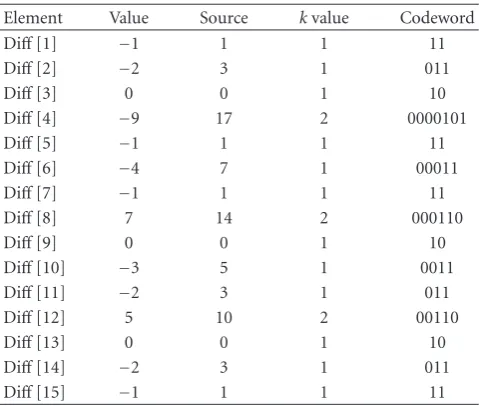
in the scanned order shown inFigure 5(c).Table 1shows the
Golomb-Rice codewords for the DPCM results. For example,
the fourth DPCM result, DPCM [4], is −9. From (1), the
source for this value is 17. From k = 2, the quotient and remainder are 4 and 1, respectively. The quotient in unary
notation is 00001 and the remainder ink-bit binary notation
is 01. The final codeword is the concatenation of the quotient
and remainder, that is, 0000101.Table 1shows the codewords
of all DPCM results. Fifty bits were required for all the words. In addition to these bits, 6 bits are necessary to store the mode and QP and 7 bits are required for the first datum.
As a result, the packet in mode 1 with QP=1 requires 63
242
216 209
206
236 237
241
214 221
221
219
211
216 220 221
215
(a)
121
108 104
103
118 118
120
107 110
110
109
105
108 110 110 107
(b)
121 −1 −2 0
−1 −4 −1 −9
7 0 −3 −2
−1 −−−222 0 5
(c)
Figure5: An example of 4×4 block: (a) Input 4×4 pixel values, (b) 4×4 pixel values after quantization by QP=1, and (c) DPCM results.
1. As mode 1 requires fewer bits than mode 0, it is chosen
as the best scan mode. Figure 6 shows the FMC result. In
Figure 6, the first three bits (001) and the next three bits (001) represent mode 1 and QP, respectively. The next seven bits
represent the first datum quantized by QP=1. The remaining
bits are the Golomb-Rice codewords of the next 15 DPCM results.
Table1: The Golomb-Rice Codewords of the 4×4 Block Shown in
Figure 5.
Element Value Source kvalue Codeword
Diff[1] −1 1 1 11
Diff[2] −2 3 1 011
Diff[3] 0 0 1 10
Diff[4] −9 17 2 0000101
Diff[5] −1 1 1 11
Diff[6] −4 7 1 00011
Diff[7] −1 1 1 11
Diff[8] 7 14 2 000110
Diff[9] 0 0 1 10
Diff[10] −3 5 1 0011
Diff[11] −2 3 1 011
Diff[12] 5 10 2 00110
Diff[13] 0 0 1 10
Diff[14] −2 3 1 011
Diff[15] −1 1 1 11
3. FMC of Frame Memory in RGB Color Space
There exist a number of applications other than H.264/AVC video compression that store video data in frame memory. For instance, an LCD display driver needs frame memory to
store its output video [10,11]. For another example, a 2D
or 3D graphics processor also requires frame memory [14].
The FMC algorithm proposed in Section 2 is not directly
applicable to these other applications because they cannot use the information obtained by H.264/AVC intraprediction. Moreover, these other applications, in general, store video
in the RGB color space while the algorithm inSection 2is
developed for video in the YCbCr color space. This section extends the algorithm proposed in the previous section and proposes the FMC algorithm suitable for video in the RGB color space.
3.1. FMC in the 4 : 4 : 4 Format and Combined Packetization. In an LCD display driver or 2D/3D graphic processor, an image is stored in the RGB 4 : 4 : 4 format in which each pixel is represented by R, G, and B color components. Unlike the YCbCr colors in the 4 : 2 : 0 format, RGB color components in the 4 : 4 : 4 format are, in general, accessed at
the same time [10–14]. Thus, an effective memory access is
possible by storing three color components for one pixel in consecutive memory addresses. As three color components are stored consecutively and accessed at the same time, these components can also be compressed at the same time to be packetized into a single combined packet. The combined
packet allows more efficient compression than the separate
packet because the scan mode and QP can be shared by these three colors. The format of the combined packet is
shown in Figure 7. The 4 ×4 block in the 4 : 4 : 4 format
consists of 16 pixels of three colors, so that total 384 bits are
required to store a single 4×4 block. By 50% compression,
0 0 1 0 0 1 1 1 1 1 0 0 1 1 1 0 1 1 1 0 0 0 0 0 1 0 1 1 1 0 0 0 1 1 1 1 0 0 0 1 1 0 1 0 0 0 1 1 0 1 1 0 0 1 1 0 1 0 0 1 1 1 1 Best scan mode 1st pixel
QP 15 DPCM results
Figure6: The packetized result of the example shown inFigure 5andTable 1.
Scan mode (3 bits)
QP (3 bits)
Three color components of the first pixel
Exp- golomb codewords of the remaining data
Figure7: The format of a combined Exp-Golomb codeword packet.
The scan mode and QP are stored in the leftmost 6 bits. Note that only one scan mode and QP are required for three colors. The first pixel data of three colors are stored next followed by remaining pixels. For the compression of the remaining data, it is observed experimentally that the Exp-Golomb coding is
more efficient than the Golomb-Rice coding (see details in
the next subsection).
3.2. Exp-Golomb Coding. Golomb-Rice codewords used in Section 2are efficient when the value of source is not large. Recall that the length of a Golomb-Rice codeword increases in proportion to its value. On the other hand, another entropy coding, the length of an Exp-Golomb codeword, is
lengthEG=k+ 1 + 2
log2
source
2k+ 1 . (3)
The details about Exp-Golomb coding are presented in
[17]. The length of an Exp-Golomb codeword increases in
proportion to log(source). Therefore, Exp-Golomb coding generates a shorter codeword than Golomb-Rice coding
when the value of source is large. It is observed by
experiments that Exp-Golomb coding is more efficient
than Golomb-Rice coding for combined packetization (see Figure 20). Similar to Golomb-Rice coding, a largek
gener-ates a short codeword when the value ofsourceis large. On
the other hand, a smallkis preferable for a smallsource. Thus,
the value ofkis chosen in the same manner as for
Golomb-Rice coding inSection 2; that is, 2 is chosen for thesource
(DPCM results) represented by the dotted line’s shown in Figure 2while 1 is chosen for the rest DPCM results.
3.3. Scan Mode Decision. Among the eight possible scan
modes shown inFigure 2, the mode that generates the
small-est packet size must be selected. InSection 2, two candidate
scan modes are determined from the intraprediction mode in H.264/AVC. Then, the results of the two modes are compared and the best mode is selected between the two candidate modes by comparing their packet sizes. For the FMC in the RGB color space, the information from H.264/AVC is not available. Thus, all eight scan modes are compared and the best mode is selected among them. To this end, the
parameter QP is set to 0 and the lengths of fifteen sources
(DPCM results) are evaluated and then added to obtain the packet size. The packet size must be evaluated for the whole
eight scan modes, so that a large amount of computation is required for the selection of the best scan mode.
The computation for best mode selection is reduced by taking advantage of the fact that there exist many DPCM results that are shared by multiple scan modes. For instance, in Figure 2, the first DPCM results of mode 1 and 2 are
identical (i.e., they are the difference between the leftmost
top pixel and its next pixel to the right). For the eight scan modes with fifteen DPCM results each, the code lengths of 120 DPCM results need to be evaluated. Among these 120 DPCM results, 57 results are shared by more than one scan modes. Thus, 63 DPCM results in total are necessary for the evaluation of the code lengths for eight scan modes.
To obtain the accurate packet size, the evaluation of the
lengths ofsources must be repeated until the packet size is
less than 192. However, the repeated evaluations require too much computation. Therefore, only the evaluation with QP
=0 is used to choose the best scan mode. Experiments show
that the order of the packet size chosen with QP=0 is almost
the same as the order with the best QP.
3.4. Color Transform. With experiments, it is observed that
the compression efficiency is improved when the RGB color
space is first transformed into the YCbCr color space and then the FMC is applied to the image in the YCbCr space (see Section 5for details on the experimental results). Note that the transformed image in this case is in the 4 : 4 : 4 format
instead of the 4 : 2 : 0 format as inSection 2. Thus, all three
color components are available for each pixel, and they are
packetized in the same format shown inFigure 7. One of the
reasons why the YCbCr color space is more efficient than
the RGB color space is because the data in the Cb and Cr colors vary more slowly than those in the R and B colors, respectively. As a result, the DPCM results in the Cb and Cr colors are smaller than those in the R and B colors, respectively. The combined packetization of Y, Cb, and Cr colors allow increased bits assigned to the Y color thanks to the reduced bits assigned for Cb and Cr colors. The increased bits assigned to the Y color decreases the error in the Y color, and consequently, the error in the Cb and Cr is also reduced because Y is used to derive Cb and Cr. Moreover, Y color
affects the subjective quality greater than Cb or Cr color.
As a result, image quality is, in general, improved by the
color space transform. The transform coefficients between
the RGB color space and the YCbCr color space are given by
ITU-R recommendation BT.601 [18].
One source of quality degradation with the YCbCr color
space transform is the round-off error in the transform.
For instance, consider the pixel with its value {R, G, B} =
{128, 128, 128}. Suppose that this pixel is transformed into
{Y, Cb, Cr} = {142.592,−8.46,−10.695}. By rounding
offthese values to integers to store in memory, this pixel
becomes {143,−8,−11}. Suppose that this pixel is
trans-formed back to the original RGB color space.{R, G, B} =
{131.784, 132.284, 124.058} is obtained. By rounding off
these values again to integers, the pixel becomes{R, G, B} =
{132, 132, 124} which is significantly different from the
original value {128, 128, 128}. This example shows that a
significant error is caused by the transformation.
For the FMC in the RGB color space, it is not mandatory to use the YCbCr color space. In the JPEG2000 standard for image compression, a modified YCbCr color space is
used for the removal of the transform error [19]. The FMC
algorithm can be applied to the JPEG2000 YCbCr color space just in the same way as the original YCbCr color space. The transformation error is reduced because the transformation is reversible. In JPEG2000, 9 bits are used to store each of Cb and Cr components so that no error is created by the transform. Thus, the image quality with the JPEG YCbCr space is better than that with the original YCbCr space.
A number of demosaicing algorithms [20–23] as well
as digital display interface such as low-voltage differential
signaling (LVDS) adopt the color space consisting of G, R-G, B-G instead of the YCbCr color space. One of the main advantages is a simple transformation from/to the RGB color space because only subtraction operations are needed for the transformation. Another advantage comes from the fact
that the error in R-G or B-G does not affect the G color
space so that the error in the G color space is less than that in R-G or B-G color space. This property can reduce the quality degradation by color transform because human eyes are more sensitive to the G color than the R or B color. For simplicity, Dr and Db are used hereafter to denote R-G and B-G spaces, respectively. Instead of the original YCbCr color space, the JPEG2000 color space or GDbDr color space
can also be used for FMC.Section 5presents experimental
comparisons among these color spaces.
In the packet shown inFigure 7, the first three pixels are
stored from the 7th bit. In the RGB color space, (8 – QP) bits are necessary to store one color component of the first pixel.
Thus, to store three colors, 3·(8−QP) bits are required.
For the original YCbCr color space, 8 bits are required to
represent Y, Cb, Cr color components. Thus, 3·(8−QP)
bits are necessary to store the first pixel in the packet shown inFigure 7. In the JPEG2000 YCbCr color space, (8 – QP) bits are needed for the first pixel. On the other hand, (8 – QP + 1) bits are needed for the Cb color of the first pixel because they include the sign bit. Similarly, Cr also requires (8 – QP
+ 1) bits. Therefore, (8−QP) + 2·(8−QP) bits are required
to store Y, Cb, and Cr colors of the first pixel. For the GDbDr color space, G requires 8 bits while Dr or Db requires 9 bits.
Thus, (8−QP) + 2·(8−QP) bits are also necessary for the
first pixel.
3.5. Algorithm. Figure 8 shows the flow chart of the FMC algorithm discussed in this section. This algorithm processes three color components in the YCbCr or GDbDr space
simultaneously, so that the number of bits for the input 4×4
pixels is 384 and that for the output packet is reduced to 192
384-bit pixel data Color transform
Quantization Scan mode decision
In
cr
ement QP
DPCM Golomb-rice encoding
Length<limits
Packing 192-bit packet No
Yes
Figure8: Flowchart of the FMC for the RGB color space.
by 50% compression. When compared with the algorithm
shown inFigure 3, the first step is added to the transform
from the RGB color space to YCbCr (or GDbDr) color space.
The scan mode decision step is different from that inFigure 3
because the best scan mode is decided by comparing all 8 scan modes. The Golomb-Rice coding is replaced by Exp-Golomb Coding, and Quantization, DPCM steps are the
same as those inFigure 3.
3.6. FMC by 75%. The data in the RGB color space can be compressed by 75% with the combination of color
trans-form, subsampling, and the FMC proposed in Section 2.
Subsampling from the 4 : 4 : 4 format to the 4 : 2 : 0 format achieves 50% compression. Recall that the FMC algorithm in Section 2 is applied to the subsampled data in the 4 : 2 : 0 format to achieve another 50% compression. Color transform to another color space like YCbCr is necessary because the subsampling of the Cb and Cr colors does not severely deteriorate the visual quality of an image because human eyes are more sensitive to the Y color than Cb and Cr colors. The original YCbCr color space may create a
round-offerror. To reduce this error, the JPEG2000 YCbCr color
space or the GDbDr color space is also considered as the
target color space. The effectiveness of three color spaces are
evaluated by experiments as presented inSection 5.
4. Hardware Implementation
This section explains the hardware implementation of the
proposed FMC algorithm inSection 2.
4.1. Encoder. The pipeline architecture of the FMC encoder
is shown in Figure 9(a). To increase the throughput, the
15 15 1
4 4
1
2
3
4
Stage 4×4 block
5 shifter 5 DPCM 5 DPCM
Compare length
Sources 5 GR encoder 5 GR encoder
Packet GR codes
GR codes Packet generation
Header GR codes (a)
4 4 1
2
3 Stage
Unpack
5 GR decoder
5 Inverse DPCM 5 shifter
Header & GR codes Packet
GR codes Header GR codes
Reconstructed 4×4 block (b)
Figure9: Block diagram of the FMC encoder and decoder.
encoding are performed for codeword generation. Initially, QP is chosen 0 and the codeword is generated. In Stage 3, if the codeword size is less than or equals to 64 bits, the pipeline moves to the next stage. Otherwise, the QP is incremented and Stages 1, 2 and 3 are repeated. The codeword generation and QP increment are repeated until the codeword size is less than or equal to 64. Five cycles are needed to complete a single iteration of Stages 1, 2, and 3. The total execution time is 5(QP + 1) + 1 cycles because Stages 1, 2, and 3 take
5 cycles. If QP is 0, a new 4×4 block is processed at every 5
cycle. The gate count of the FMC encoder is 19.8 K.
4.2. Decoder. In general, the execution time of an FMC encoder is not critical because the compressed data are not used immediately but they are stored in a frame memory for use in some time later. However, the execution time of an FMC decoder is critical because its result is immediately used. Therefore, an optimized hardware design is needed to
minimize the execution time of a decoder.Figure 9(b)shows
the proposed pipelined architecture of an FMC decoder. In Stage 1, a 64-bit packet is read from the frame memory. The proposed FMC decoder needs 5 cycles to complete one
4×4 block and processes a new 4×4 block for every 3
cycles. Assuming that the memory bandwidth is allowed to transmit 32 bits per a cycle, the throughput of the FMC decoder is larger than that of the frame memory. Therefore, the memory bandwidth is the bottleneck of the overall throughput and the addition of the FMC decoder does not decrease the data access throughput. The gate count of the FMC decoder is 11.3 K.
4.3. Complexity Comparison. The complexity of the pro-posed algorithm is compared with the previous work based
on Modified Hadamard Transform [7]. Table 2 shows the
numbers of additions (or subtractions) and shifts required for both encoding and decoding operations of FMC. For the
proposed FMC,N represents the number of iterations. The
Table2: Complexity comparison (FMC encoding/decoding).
Block size Addition (or
Subtraction) Shift
Proposed FMC in
Section 2
4×4 30N/15 16·(N−1)/16
MHT-based
FMC 1×8 27/27 68/36
Golomb-Rice coding is not considered for this comparison because it is common for both FMCs. Experiments show that
the average number ofN is equal to 2.43. If this number is
used for the equation inTable 2, the proposed FMC encoding
requires 72.9 additions (or subtractions) and 22.88 shifts for
each 4×4 block (16 pixels). The MHT-based FMC requires 27
additions (or subtractions) and 68 shifts for each 1×8 block
(8 pixels). To process 16 pixels (two 1×8 blocks), the
MHT-based FMC requires 54 additions (or subtractions) 136 shifts. Thus, the proposed FMC requires a comparable amount of computation. For decoding, the proposed FMC also requires less computation than the MHT-based FMC. The complexity reduction is possible by the proposed FMC because it makes use of the information given by an H.264 encoder.
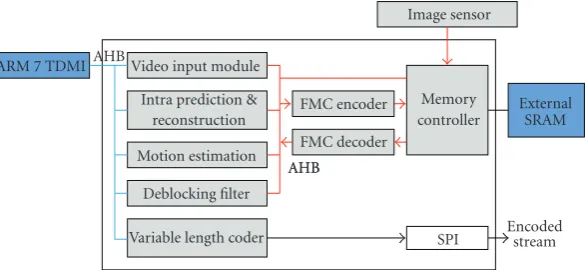
4.4. Integration into an H.264 Encoder Chip. The proposed FMC encoder and decoder are integrated with H.264 encoder [24].Figure 10shows a block diagram of the encoder. The hardware accelerators for motion estimation, deblocking filter, intraprediction, and variable length coder are imple-mented in hardware and the remaining part of computation is processed by the ARM7TDMI processor. VIM (Video Input Module) accepts image data from an image sensor and SPI interface outputs the encoded stream. Memory
Controller is designed for efficient data communication with
ARM 7 TDMIAHBVideo input module Intra prediction & reconstruction Motion estimation
Deblocking filter Variable length coder
FMC encoder FMC decoder AHB AHB
Memory controller
External SRAM Image sensor
SPI Encodedstream
Figure10: Block diagram of the H.264/AVC encoder integrated with the FMC encoder and decoder.
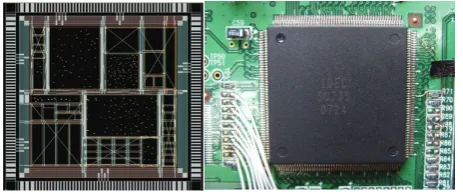
the communication between modules. One AHB bus is mainly used for the control of the hardware modules by ARM7TDMI processor and the other AHB bus is mainly used for data communication between hardware modules and external memory. The FMC encoder and decoder are placed between the AHB bus and the memory controller. Figure 11shows the layout and the chip photograph of the
H.264/AVC encoder shown in Figure 10. The die area of
the H.264/AVC encoder is 5 mm×5 mm using the Dongbu
1P6M 0.13 um CMOS technology.
5. Experimental Results
5.1. FMC Algorithm in an H.264 Encoder. Software
imple-mentation of the proposed algorithm in Section 2 is
inte-grated with H.264/AVC JM reference software version 13.2
[25] so that the reference frame is compressed by the
pro-posed FMC. Previous work, based on Modified Hadamard
Transform (MHT) proposed in [7], is also implemented and
the results are compared. The two algorithms are evaluated
with three CIF-size (352×288) video sequences: Foreman,
Mobile Calendar, and Table Tennis; as well as with two
HD-size (1920×1080) sequences: Blue sky and Pedestrian
area. For every sequence, 100 frames are used and the encoding speed is 30 frames per second. For experiments, the test sequence is encoded as a Baseline profile stream with the intraframe interval of 10, 3 reference frames for motion estimation, deblocking filter turned on, rate-distortion optimization also turned on, and four QP values, 20, 24, 28, and 32.
The rate distortion performances for Y component
are shown in Figure 12. The average PSNR degradations,
by the FMC algorithms, are measured and shown in Table 3. These values are obtained by Bjontegaard’s method
presented in [26]. For the three CIF-size sequences, the
average PSNR degradations are 0.77 dB and 2.39 dB by the proposed and MHT-based FMCs, respectively. For the two HD-size sequences, the average PSNR degradations are 0.38 dB and 1.72 dB by the proposed and MHT-based FMCs, respectively. For both CIF-size and HD-size video sequences, the proposed FMC makes a significant improvement over the previous MHT-based FMC. The results also show that
Table3: Average BD-PSNR(dB) degradation compared with the original H.264.
Sequence 8-mode FMC Proposed
FMC 1-mode FMC
MHT-based
FMC
Foreman 0.45 0.69 1.08 2.72
Mobile and calendar
0.76 1.00 1.32 2.41
Table
tennis 0.49 0.61 0.93 2.05
CIF
average 0.57 0.77 1.11 2.39
Blue sky 0.47 0.65 1.05 2.05
Pedestrian
area 0.06 0.11 0.24 1.38
HD
average 0.27 0.38 0.64 1.72
quality degradation of HD-size video is less than that of
CIF-size video. This is because spatial correlation of a 4×4
block generally increases as image size increases, so that compression with minimal loss of information is possible.
The simulation also evaluates the efficiency of the scan
mode decision step in Figure 3. The mode selected by
the scan mode decision step may not always be the scan
mode that maximizes the compression efficiency. Thus, all
8 modes are used by the FMC algorithm and the best
scan mode is then selected. In Figure 12, “8-mode FMC”
presents the results when the best scan mode is selected from among all 8 modes. Another simulation uses the scan mode selected by the H.264 intraprediction, “1-mode
FMC” (Figure 12). The computational complexity of
Table4: Ratio of the difference along the dotted line scan over that along the solid line scan.
Foreman mobile Table tennis Blue sky Pedestrian area Average
Dotted/solid line 177.6% 140.2% 151.5% 180.1% 312.7% 153.4%
Figure11: Chip layout and photograph.
proposed algorithm. For the two HD-size sequences, the 8-mode and 1-8-mode algorithms average 0.11 dB better and 0.26 dB worse, respectively, than the proposed algorithm. These results show that the proposed algorithm produces a
reasonable trade-offbetween complexity and quality.
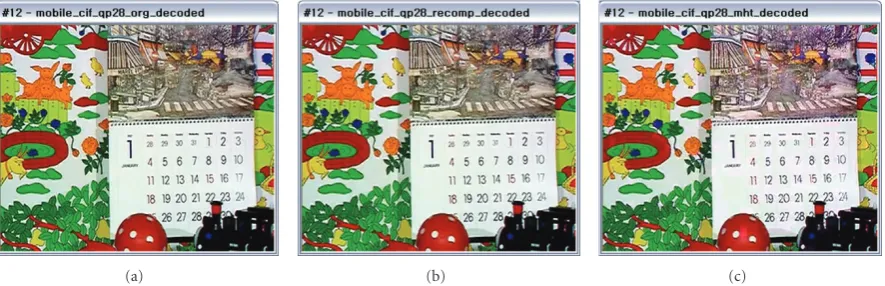
Figure 13 shows the subjective quality comparison. As
shown in the figure, the MHT-based FMC suffers from
the blur around the numbers while the number blurring is significantly reduced by the proposed FMC.
Within the 60 frames of the Foreman sequence, the
PSNR of each frame is shown inFigure 14. Three lines show
the proposed FMC, the MHT-based FMC, and the original H.264 encoder with no FMC. An intraframe is inserted once in every 10 frames, and the peaks in the graph represent the intraframes. The MHT-based FMC significantly drops the PSNR for all frames while the proposed algorithm produces notably less quality degradation.
Since the frame compression is lossy, this raises the issue of drift, as there may be a mismatch between the encoded frame written in the compressed file, and the decoded frame stored in the memory and used later for the prediction of successive frames. The decrease of PSNR is observed in Figure 14as the PSNR of a frame distant from an intraframe is less than that close to the intraframe not only with the proposed FMC but also with the H.264 encoder. This result
shows that the drift by the propose FMC does not affect
significantly the PSNR drop. In order to precisely measure the additional PSNR drop caused by the proposed FMC,
the PSNR difference between the original H.264 encoder
without the FMC and the integrated H.264 encoder with
the FMC is shown inFigure 15. As shown in this figure, the
PSNR difference does not vary significantly regardless of the
distance from an intraframe. This result also shows that the additional PSNR drop caused by the proposed FMC is not very significant. This experiment is performed with various intervals of intraframe period, and the results are similar to
that shown inFigure 15. Thus, the additional experimental
results are not presented in this paper.
The eight scanning modes given inFigure 2are employed
based on an analog of the 4× 4 intraprediction modes
for an H.264 encoder. Among the eight scanning modes, the best mode is selected to minimize the DPCM error. For the selected scanning mode, the scan along the solid line is the major scanning direction whereas the scan along the dotted line is, in general, perpendicular to the major
scanning direction. Therefore, the difference along the solid
line is likely to be smaller than that along the dotted line.
For example, consider the case when a 4×4 block includes
a virtual stripe pattern so that scanning mode 0 is selected. In this case, the scan along the dotted line crosses the vertical
stripe and the chance is very high that the difference along the
dotted line is larger than that along the solid line. Therefore, the “source” along the dotted line is expected to have a large value.
The expectation is supported by experimental results
given in Table 4. The numbers given in this table are the
ratios of the average difference along the dotted line over that
along the solid line. This table shows that the difference along
the dotted line is about 153.4% of that along the solid line. In an H.264 encoder, deblocking filter is the only module
that stores the reference frame. Figure 16 shows a 16 ×
16 macroblock (lightly shaded blocks) that is the current macroblock to be filtered. To perform deblock filtering,
the 4×16 pixels (dark shaded blocks) above the current
macroblock and 16 ×4 pixels in the left of the current
macroblock are necessary. Note that the 4×16 pixels are
already processed by the above macroblock and they are compressed before they are stored. Then, for the current
macroblock, the above 4×16 pixels are read again from
the reference memory and filtered and then written back again. Thus, these pixels are stored into reference memory twice. As they are compressed whenever they are stored into reference memory, they are compressed twice. The successive compressions increase the PSNR degradation.
One way to reduce the PSNR degradation is to store the
data without compression for the first write of the 4×16
pixels. These 4×16 pixels are read again and then compressed
in the second write. As the second write finally stores the reference frame which is to be used by the next frame, the goal of memory size reduction is achieved even though only the second write is compressed.
Table 5shows the BD-PSNR difference between the two approaches. The numbers in the table show the BD-PSNR
drop (i.e., the difference in the BD-PSNR between the
original H.264 encoder and the integrated H.264 encoder with the proposed FMC). The first column shows test video sequences and the second column shows the case when
both the first and second writes compress the 4×16 data
34 36 38 40 42
PSNR
(dB)
300 600 900 1200 1500 1800 2100 Bit rate (kbps)
Foreman
(a)
30 32 34 36 38 40 42 44
PSNR
(dB)
1000 2000 3000 4000 5000 6000 7000 8000 Bit rate (kbps)
Mobile and calender
(b)
32 34 36 38 40 42 44
PSNR
(dB)
500 1500 2500 3500 4500
Bit rate (kbps) Table tennis
(c)
36 38 40 42 44 46
PSNR
(dB)
5000 10000 15000 20000 25000 30000 Bit rate (kbps)
Blue sky
(d)
38 39 40 41 42 43 44
PSNR
(dB)
3000 8000 13000 18000 23000 28000 Bit rate (kbps)
Pedestrian area
Original H.264 H.264 + Proposed FMC H.264 + MHT-based FMC
H.264 + 8-mode FMC H.264 + 1-mode FMC (e)
(a) (b) (c)
Figure13: Subjective quality comparison for Mobile Calendar sequence: (a) original H.264, (b) H.264 + Proposed FMC, and (c) H.264 + MHT-based FMC.
36.2 36.7 37.2 37.7 38.2
PSNR
(dB)
0 10 20 30 40 50 60
Frame Original H.264
H.264 + proposed FMC H.264 + MHT-based FMC
Figure 14: PSNR variations in the Foreman sequence over 60 frames.
0 0.1 0.2 0.3 0.4
PSNR
dr
op
(dB)
0 10 20 30 40 50 60
Frame
Figure15: PSNR difference between the original H.264 encoder and the integrated H.264 encoder with the proposed FMC.
16×16 luma 8×8 chroma (Cb) 8×8 chroma (Cr)
Figure16: The pixels to be written twice for deblocking filter.
Table5: Effect of compression by the first write of deblocking filter in BD-PSNR degradation (dB).
Sequence
Compression in both the first and
second writes
Compression only in the second write
Foreman 0.69 0.65
Mobile and Calendar 1.00 0.79
Table Tennis 0.61 0.47
CIF average 0.77 0.65
Blue sky 0.65 0.49
Pedestrian Area 0.11 0.08
HD average 0.38 0.29
By storing the first write without compression, an average of about 0.12 dB improvement is achieved for CIF-size videos and an average of 0.09 dB improvement for HD size videos.
The H.264 Encoder has four modules that access the external memory. They are image sensor interface, video input module, motion estimation, and deblocking filter. The image sensor module receives pixel data from an image sensor in the YUV 4 : 2 : 0 format and stores it in the external memory. The video input module reads the input data to process H.264 encoding. The memory bandwidth to access the input data is as follows:
BWcurrent frame store/load=H×W×1.5×2, (4)
whereWandHrepresents width and height of a frame. For
the reference frame, both deblocking filter and motion esti-mation modules access the reference frame. The bandwidth required by deblocking filter is as follows:
BWDB store=
H
16 ×
W
16 ×(16×16×1.5 + 16×4×2),
BWDB load=
H
16 ×
W
16 ×(16×4×2).
The memory bandwidth requirement by motion estimation depends on the search range, search algorithm and data reuse scheme. The H.264 encoder in this paper adopts the full
search algorithm and level C data reuse scheme [27]. Thus,
the required memory bandwidth is
BWME luma
= H
16×(W+SRH−1)×(16 +SRV−1)×fref,
(6)
where SRH and SRV represent the horizontal and vertical
search ranges, respectively, andfrefis the number of reference
frame. The memory requirement for chrominance
compo-nents by motion estimation is as follows [28]:
BWME chroma=
W
16 ×
H
16 ×(16×3×3×2). (7)
Thus, the total memory requirement is
BWtotal
=BWcurrent frame(store/load)+BWDB store+BWDB load
+BWME luma+BWME chroma)×FrameRate.
(8)
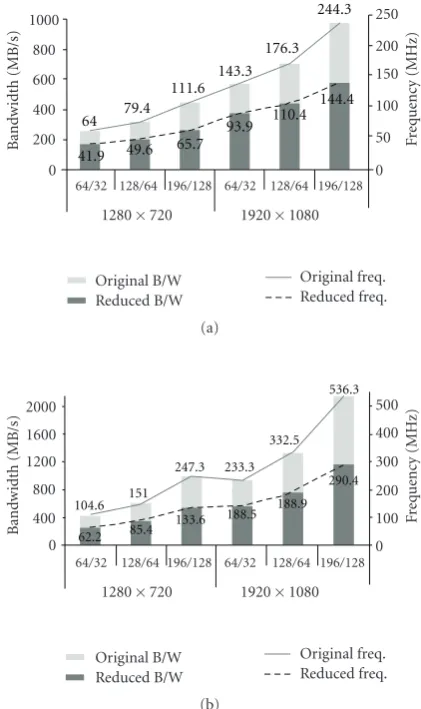
Figure 17 shows the required memory bandwidth that depends on the frame size and search range. The frame rate is 30 frames per second and all frames are encoded
as P-frame. The bar graphs given in Figure 17 show the
required bandwidth when search ranges (SRH/SRV) are
64/32 (H[−32, +31], V[−16, +15]), 128/64 (H[−64, +63],
V[−32, +31]), and 196/128 (H[−98, −97], V[−64, +63]),
respectively.
To support this memory bandwidth, the required oper-ating frequency is
Freqmin
= BWtotal
memory bus bit width×memory bus utilization.
(9)
Assuming that memory bus bit width is 32 and the memory bus utilization is 100%, the line graphs show the required operating clock frequency of the external memory. The solid line graph shows the frequency for the original H.264 encoder whereas the dotted line graph shows that for the integrated H.264 encoder with the proposed FMC. Figures 17(a)and17(b)show the cases when the number of reference frames is 1 and 3, respectively. With the proposed FMC, the total memory bandwidth is reduced to about 50% whereas the bandwidth required by the current frame remains the same. The performance of the H.264 encoder is limited when the memory bandwidth cannot meet the required bandwidth. For example, if the number of reference frames
is 3, the frame size is 1920×1080, and the search range is
64×32, then required clock frequency is 233.3 MHz. For
most commercially available SDRAMs (not DDR-SDRAM), this clock frequency is impossible. With the integration of the proposed FMC, the clock frequency is reduced to 138.9 MHz
64 79.4 111.6
143.3 176.3
244.3
41.9 49.6 65.7
93.9 110.4 144.4 0 200 400 600 800 1000 Band w idth (MB/s) 0 50 100 150 200 250 Fre q u en cy (M H z)
64/32 128/64 196/128 64/32 128/64 196/128
1280×720 1920×1080
Original B/W Reduced B/W Original freq. Reduced freq. (a) 104.6 151 247.3 233.3 332.5 536.3 62.2 85.4 133.6 188.9 188.5 290.4 0 400 800 1200 1600 2000 Band w idth (MB/s) 0 100 200 300 400 500 Fre q u en cy (M H z)
64/32 128/64 196/128 64/32 128/64 196/128
1280×720 1920×1080
Original B/W Reduced B/W
Original freq. Reduced freq. (b)
Figure 17: Reduction of the bandwidth requirement by the proposed FMC. (a) 1 reference frame. (b) 3 reference frames.
which is in the range of the normal operating frequency of
an SDRAM. The reduction of memory traffic also makes
decreases the power consumption.
5.2. FMC for the RGB Color Space. This subsection presents the experimental results to evaluate the FMC algorithm for
the RGB color space proposed in Section 3. To this end,
twenty-three images of size 768 ×512 in the RGB color
space shown in Figure 18are used. Image degradations by
the four FMCs with RGB 4 : 4 : 4 format, GDbDr 4 : 4 : 4 format, JPEG2000 YCbCr 4 : 4 : 4 format, and the standard YCbCr 4 : 4 : 4 format are compared. The quality degradation
represented by PSNR is presented inTable 6. The boldface
(1) (2) (3) (4) (5) (6)
(7) (8) (9) (10) (11) (12)
(18) (17)
(16) (15)
(14) (13)
(19) (20) (21) (22) (23)
Figure18: Test RGB bitmap images.
Table6: PSNR (db) of frame memory compression for 23 Images with various color transformations.
Image no. RGB 4 : 4 : 4 GDbDr 4 : 4 : 4 JPEG YCbCr 4 : 4 : 4 YCbCr 4 : 4 : 4
R G B R G B R G B R G B
(1) 39.63 39.65 39.64 45.42 49.52 43.94 43.82 43.76 46.51 41.80 46.63 39.69
(2) 45.96 45.93 46.05 48.33 52.60 47.78 47.69 50.77 48.99 43.32 47.23 42.83
(3) 46.97 46.92 47.06 48.62 53.40 47.29 47.09 47.16 48.11 44.20 46.67 43.03
(4) 44.97 44.91 44.96 47.18 51.36 46.67 47.08 49.05 47.50 42.78 46.51 41.94
(5) 39.20 39.14 39.21 42.07 47.06 40.34 42.64 43.10 42.67 40.86 45.48 39.22
(6) 41.16 41.23 41.29 46.17 50.17 44.27 44.61 43.77 45.89 41.95 46.58 40.92
(7) 45.99 46.06 45.97 48.24 52.42 45.97 45.42 45.78 46.50 43.60 46.91 42.50
(8) 38.77 38.77 38.92 43.53 47.84 42.26 43.69 44.20 43.79 41.31 45.60 39.60
(9) 45.80 45.83 45.84 49.59 53.56 48.11 47.40 46.30 47.12 44.40 46.95 42.32
(10) 45.12 45.14 45.24 48.29 52.92 47.83 47.36 45.98 46.84 44.21 47.30 42.34
(11) 42.39 42.49 42.47 46.83 50.64 44.39 45.64 45.72 45.61 42.58 46.04 41.25
(12) 46.68 46.56 46.67 50.15 54.13 49.32 47.18 46.41 47.72 44.35 47.01 43.61
(13) 36.20 36.20 36.32 41.27 45.76 38.32 40.86 40.42 41.59 39.94 44.26 38.61
(14) 41.46 41.54 41.48 44.50 48.45 41.11 43.24 43.92 42.88 41.58 46.03 40.02
(15) 44.76 44.64 44.78 45.85 51.09 45.25 46.72 46.40 46.91 42.99 46.81 41.71
(16) 44.88 44.90 44.86 49.76 53.47 49.54 45.66 45.98 47.72 43.97 48.03 41.65
(17) 44.14 44.39 44.43 48.64 51.62 45.15 46.10 46.75 46.38 43.49 47.27 41.70
(18) 39.73 39.82 39.87 43.07 46.87 39.61 42.19 42.28 42.23 40.81 45.25 39.68
(19) 43.02 43.17 43.15 47.19 50.99 45.31 43.90 45.47 46.88 42.26 46.83 41.40
(20) 44.49 44.65 44.69 48.37 52.04 46.07 44.96 46.03 46.86 43.29 47.79 42.51
(21) 41.12 41.19 41.27 46.74 50.23 43.87 43.88 44.79 45.29 42.18 46.02 41.14
(22) 42.97 43.15 43.21 45.55 49.06 42.52 43.59 44.22 44.81 41.86 46.28 40.67
(23) 46.72 46.91 46.94 48.67 53.10 47.81 47.04 47.34 47.46 43.88 46.95 42.88
(a) (b)
(c) (d)
(e) (f)
Figure19: (a), (c), and (e) are the original images of test 5, 13, 18 and (b), (d), and (f) are their GDbDr-based FMC compressed images.
As the human eyes are more sensitive to the G color than the B color, it is reasonable to choose the GDbDr-based FMC rather than the JPEG2000 YCbCr-based FMC. Note that the average PSNRs for R, G, and B achieved by the GDbDr-based FMC are 46.70 dB, 50.80 dB, and 44.90 dB, respectively. As the PSNR is very large, the quality degradation is hardly observed. Among the twenty-three test images, three images
with the lowest PSNR degradation are chosen and the images with the GDbDr-based FMC are compared with their
original images.Figure 19shows these images and it is very
hard to distinguish the original image from the compressed image.
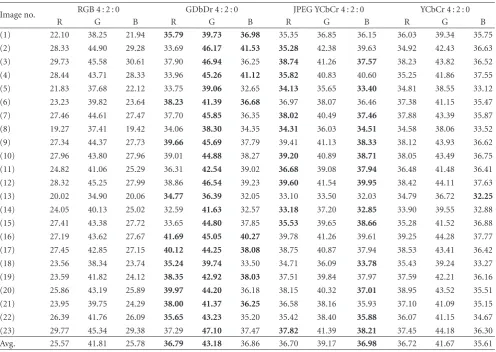
The FMC algorithm proposed in Section 3.6 is also
Table7: PSNR (db) of 75% frame memory compression for 23 Images with various color transformations.
Image no. RGB 4 : 2 : 0 GDbDr 4 : 2 : 0 JPEG YCbCr 4 : 2 : 0 YCbCr 4 : 2 : 0
R G B R G B R G B R G B
(1) 22.10 38.25 21.94 35.79 39.73 36.98 35.35 36.85 36.15 36.03 39.34 35.75
(2) 28.33 44.90 29.28 33.69 46.17 41.53 35.28 42.38 39.63 34.92 42.43 36.63
(3) 29.73 45.58 30.61 37.90 46.94 36.25 38.74 41.26 37.57 38.23 43.82 36.52
(4) 28.44 43.71 28.33 33.96 45.26 41.12 35.82 40.83 40.60 35.25 41.86 37.55
(5) 21.83 37.68 22.12 33.75 39.06 32.65 34.13 35.65 33.40 34.81 38.55 33.12
(6) 23.23 39.82 23.64 38.23 41.39 36.68 36.97 38.07 36.46 37.38 41.15 35.47
(7) 27.46 44.61 27.47 37.70 45.85 36.35 38.02 40.49 37.46 37.88 43.39 35.87
(8) 19.27 37.41 19.42 34.06 38.30 34.35 34.31 36.03 34.51 34.58 38.06 33.52
(9) 27.34 44.37 27.73 39.66 45.69 37.79 39.41 41.13 38.33 38.12 43.93 36.62
(10) 27.96 43.80 27.96 39.01 44.88 38.27 39.20 40.89 38.71 38.05 43.49 36.75
(11) 24.82 41.06 25.29 36.31 42.54 39.02 36.68 39.08 37.94 36.48 41.48 36.41
(12) 28.32 45.25 27.99 38.86 46.54 39.23 39.60 41.54 39.95 38.42 44.11 37.63
(13) 20.02 34.90 20.06 34.77 36.39 32.05 33.10 33.50 32.03 34.79 36.72 32.25
(14) 24.05 40.13 25.02 32.59 41.63 32.57 33.18 37.20 32.85 33.90 39.55 32.88
(15) 27.41 43.38 27.72 33.65 44.80 37.85 35.53 39.65 38.66 35.28 41.52 36.88
(16) 27.19 43.62 27.67 41.69 45.05 40.27 39.78 41.26 39.61 39.25 44.28 37.77
(17) 27.45 42.85 27.15 40.12 44.25 38.08 38.75 40.87 37.94 38.53 43.41 36.42
(18) 23.56 38.34 23.74 35.24 39.74 33.50 34.71 36.09 33.78 35.43 39.24 33.27
(19) 23.59 41.82 24.12 38.35 42.92 38.03 37.51 39.84 37.97 37.59 42.21 36.16
(20) 25.86 43.19 25.89 39.97 44.20 36.18 38.15 40.32 37.01 38.95 43.52 35.51
(21) 23.95 39.75 24.29 38.00 41.37 36.25 36.58 38.16 35.93 37.10 41.09 35.15
(22) 26.39 41.76 26.09 35.65 43.23 35.20 35.42 38.40 35.88 36.07 41.15 34.67
(23) 29.77 45.34 29.38 37.29 47.10 37.47 37.82 41.39 38.21 37.45 44.18 36.30
Avg. 25.57 41.81 25.78 36.79 43.18 36.86 36.70 39.17 36.98 36.72 41.67 35.61
this algorithm achieves 75% compression by combining the 50% FMC algorithm and another 50% compression by color transform and subsampling from RGB 4 : 4 : 4 format
into YCbCr (or GDbDr) 4 : 2 : 0 format.Table 7shows PSNR
values when the images are compressed by 75%. For the transform into the standard YCbCr color space and the JPEG YCbCr color space are evaluated and compared with
the GDbDr color space. As shown inTable 7, the FMC with
GDbDr color space achieves the best quality for the G and R color component while the FMC with JPEG2000 YCbCr color space achieves the best quality for B color components. The FMC with the standard YCbCr color space does not outperform for any image. When compared with the image
quality by the 50% FMC algorithm presented inTable 6, the
image quality is significantly degraded as PSNR is much less
than that in Table 6. The quality degradation is caused by
large compression ratio.
Figure 20shows the efficiency of the combined
packetiza-tion which is explained inSection 3.1.Figure 20(a)shows the
average QPs for the combined and separate packetizations. Note that QP + 1 corresponds to the number of iteration
in FMC encoding. To compare the efficiencies of
Golomb-Rice coding and Exp-Golomb Coding, both are used for
the compression and their results are compared. In this figure, GR and EG stand for Golomb-Rice and Exp-Golomb codings, respectively. The combined packetization reduces the average QP of G color, but it increases the average QP of Dr and Db colors. This implies that the degradation of G color is substantially reduced while those of R and B
colors may increase. Figure 20(b) compares the PSNR of
combined packetization with that of separated packetization. As shown in this figure, the PSNR of G colors as well as R and B colors increase when combined packetization is adopted. It is because the error reduction of the G color also
affects the error reduction of R and B colors, consequently
resulting in the improvement of PSNR for all three color components. It is also shown that Golomb-Rice coding
is efficient for separate packetization while Exp-Golomb
coding is efficient for combined packetization. This is shown
inFigure 20(a)because the QP of Exp-Golomb coding for combined packetization is slightly less than that of Golomb-Rice coding while the QP is substantially increased by
Exp-Golomb coding for separate packetization. InFigure 20(b),
0 0.02 0.04 0.06 0.08 0.12 0.14 0.1
QP
Dr, G, Db Dr G Db
Combined Separated
EG GR
(a)
35 40 45 50 55
PSNR
(dB)
R G B R G B
Combined Separated
EG GR
(b)
Figure 20: QP and PSNR comparison between combined and separate packetization. (a) The QP averaged over twenty-three test images shown inFigure 18. (b) The PSNR averaged over twenty-three test images shown inFigure 18.
6. Conclusions
This paper proposes an FMC algorithm that compresses video data to be stored into frame memory. The pro-posed FMC algorithm achieves lower image degradation than other transform based algorithms. The computational complexity is relatively small because the information given by H.264/AVC video encoding is used. By using the pixel correlation information, which comes from the H.264/AVC
intraprediction, an efficient DPCM scan order is selected
without a significant increase in the amount of computation.
The proposed algorithm performs the compression in a 4×
4 block, so that both horizontal and vertical correlations
are exploited. As a result, higher compression efficiency is
achieved than with an MHT-based algorithm, which exploits only the horizontal correlations. As a result, compared to an MHT-based algorithm, image quality is improved by an average of 1.62 dB and 1.34 dB for CIF-size and HD-size images, respectively.
The proposed FMC algorithm is modified for the system without an H.264/AVC encoder. As the intraprediction result from H.264/AVC is not available, an additional step to select the best scan order is necessary. This system, in general, stores RGB colors instead of YCbCr colors as in H.264/AVC
compression. For improved compression efficiency, the RGB
color space is transformed into another color space and then compression algorithm is performed for the transformed domain. Experiments with various color spaces show that the
most efficient result is obtained with the G, R-G, B-G color
space.
Acknowledgments
This work was sponsored by ETRI System Semiconductor Industry Development Center, Human Resource Develop-ment Project for IT-SoC Architect, and CAD tools were supported by the IDEC.
References
[1] Joint Video Team (JVT) of ISO/IEC MPEG and ITU-T VCEG, “Draft IITU-TU-ITU-T recommendation and final draft international standard of Joint Video Specification (ITU-T Rec. H264—ISO/IEC 14496-10 AVC),” inProceedings of the 7th Meeting on Document JVT-G050d35, Pattaya, Thailand, March 2003.
[2] T.-C. Chen, S.-Y. Chien, Y.-W. Huang, et al., “Analysis and architecture design of an HDTV720p 30 frames/s H.264/AVC encoder,”IEEE Transactions on Circuits and Systems for Video Technology, vol. 16, no. 6, pp. 673–688, 2006.
[3] T.-M. Liu, T.-A. Lin, S.-Z. Wang, et al., “A 125 μW, fully scalable MPEG-2 and H.264/AVC video decoder for mobile applications,”IEEE Journal of Solid-State Circuits, vol. 42, no. 1, pp. 161–169, 2007.
[4] Y. Chen, C. Cheng, T. Chuang, C. Chen, S. Chien, and L. Chen, “Efficient architecture design of motion-compensated temporal filtering/motion compensated prediction engine,” IEEE Transactions on Circuits and Systems for Video Technology, vol. 18, no. 1, pp. 98–109, 2008.
[5] V. G. Moshnyaga, “Reduction of memory accesses in motion estimation by block-data reuse,” in Proceedings of the IEEE International Conference on Acoustics, Speech and Signal Pro-cessing (ICASSP ’02), vol. 3, pp. 3128–3131, Orlando, Fla, USA, May 2002.
[6] W. Y. Chen, L. F. Ding, P. K. Tsung, and L. G. Chen, “Archi-tecture design of high performance embedded compression for high definition video coding,” inProceedings of the IEEE International Conference on Multimedia and Expo (ICME ’08), pp. 825–828, Hannover, Germany, June 2008.
[8] T. Song and T. Shimamoto, “Reference frame data compres-sion method for H.264/AVC,”IEICE Electronics Express, vol. 4, no. 3, pp. 121–126, 2007.
[9] Y. V. Ivanov and D. Moloney, “Reference frame compres-sion using embedded reconstruction patterns for H.264/AVC decoders,” inProceedings of the 3rd International Conference on Digital Telecommunications (ICDT ’08), Bucharest, Romania, July 2008.
[10] J. Someya, A. Nagase, N. Okuda, K. Nakanishi, and H. Sugiura, “Development of single chip overdrive LSI with embedded frame memory,” inProceedings of the International Symposium Digest of Technical Papers (SID ’08), vol. 39, pp. 464–467, Los Angeles, Calif, USA, May 2008.
[11] J. Someya, N. Okuda, and H. Sugiura, “The suppression of noise on a dithering image in LCD overdrive,” IEEE Transactions on Consumer Electronics, vol. 52, no. 4, pp. 1325– 1332, 2006.
[12] J. Strom and T. Akenine-Moller, “PACKMAN: texture com-pression for mobile phones,” in Proceedings of the 2nd International Conference on Computer Graphics and Interactive Techniques, p. 66, Singapore, August 2004.
[13] J. Strom and T. Akenine-Moller, “iPACKMAN: highquality, low-complexity texture compression for mobile phones,” in Proceedings of the ACM SIGGRAPH/EUROGRAPHICS Con-ference on Graphics Hardware, pp. 63–70, Los Angeles, Calif, USA, 2005.
[14] D. Kim, K. Chung, C.-H. Yu, et al., “An SoC with 1.3 Gtexels/s 3-D graphics full pipeline for consumer applications,” The IEEE Journal of Solid-State Circuits, vol. 41, no. 1, pp. 71–84, 2006.
[15] S. W. Golomb, “Run-length encodings,”IEEE Transactions on Information Theory, vol. 12, pp. 399–401, 1966.
[16] R. F. Rice, “Some practical universal noiseless coding tech-niques,” Tech. Rep., Jet Propulsion Laboratory, California Institute of Technology, Pasadena, Calif, USA, 1979.
[17] I. E. G. Richardson,H.264 and MPEG-4 Video Compression: Video Coding for Next-Generation Multimedia, John Wiley & Sons, New York, NY, USA, 2003.
[18] ITU-R BT.601-5, “Studio encoding parameters of digital television for standard 4:3 and wide-screen 16:9 aspect ratios,” ITU-T, 1995.
[19] C. Christopoulos, A. Skodras, and T. Ebrahimi, “The jpeg2000 still image coding systemml: an overview,”IEEE Transactions on Consumer Electronics, vol. 46, no. 4, pp. 1103–1127, 2000. [20] S. C. Pei and I. K. Tam, “Effective color interpolation in CCD
color filter arrays using signal correlation,”IEEE Transactions on Circuits and Systems for Video Technology, vol. 13, no. 6, pp. 503–513, 2003.
[21] K. Hirakawa and T. W. Parks, “Adaptive homogeneity-directed demosaicing algorithm,”IEEE Transactions on Image Process-ing, vol. 14, no. 3, pp. 360–369, 2005.
[22] D. Menon, S. Andriani, and G. Calvagno, “Demosaicing with directional filtering and a posteriori decision,” IEEE Transactions on Image Processing, vol. 16, no. 1, pp. 132–141, 2007.
[23] X. Li, “Demosaicing by successive approximation,” IEEE Transactions on Image Processing, vol. 14, no. 3, pp. 370–379, 2005.
[24] J.-S. Jung, G. Jin, and H.-J. Lee, “Early termination and pipelining for hardware implementation of fast H.264 intraprediction targeting mobile HD applications,”EURASIP Journal on Advances in Signal Processing, vol. 2008, Article ID 542735, 19 pages, 2008.
[25] Joint Model (JM)—H.264/AVC Reference Software, http:// iphome.hhi.de/suehring/tml/download/.
[26] G. Bjontegaard, “Calculation of average PSNR differences between RD curves,” inProceedings of the 13th VCEG Meeting in Joint Video Team (JVT) of ISO/IEC MPEG and ITU-T VCEG, Documents VCEG-M33, Austin, Tex, USA, March 2001.
[27] J.-C. Tuan, T.-S. Chang, and C.-W. Jen, “On the data reuse and memory bandwidth analysis for full-search block-matching VLSI architecture,”IEEE Transactions on Circuits and Systems for Video Technology, vol. 12, no. 1, pp. 61–72, 2002.