Volume 2010, Article ID 736301,8pages doi:10.1155/2010/736301
Research Article
An MCMC Algorithm for Target Estimation in
Real-Time DNA Microarrays
Haris Vikalo and Mahsuni Gokdemir
Department of Electrical and Computer Engineering, The University of Texas, Austin, TX 78712-0240, USA
Correspondence should be addressed to Haris Vikalo,[email protected]
Received 1 February 2010; Accepted 15 July 2010
Academic Editor: Harri L¨ahdesm¨aki
Copyright © 2010 H. Vikalo and M. Gokdemir. This is an open access article distributed under the Creative Commons Attribution License, which permits unrestricted use, distribution, and reproduction in any medium, provided the original work is properly cited.
DNA microarrays detect the presence and quantify the amounts of nucleic acid molecules of interest. They rely on a chemical attraction between the target molecules and their Watson-Crick complements, which serve as biological sensing elements (probes). The attraction between these biomolecules leads to binding, in which probes capture target analytes. Recently developed real-time DNA microarrays are capable of observing kinetics of the binding process. They collect noisy measurements of the amount of captured molecules at discrete points in time. Molecular binding is a random process which, in this paper, is modeled by a stochastic differential equation. The target analyte quantification is posed as a parameter estimation problem, and solved using a Markov Chain Monte Carlo technique. In simulation studies where we test the robustness with respect to the measurement noise, the proposed technique significantly outperforms previously proposed methods. Moreover, the proposed approach is tested and verified on experimental data.
1. Introduction
Molecular biosensors [1] are devices that contain a biological sensing element closely coupled with a transducer. They measure interaction of biomolecules of interest (target ana-lytes) with the biological sensing element, and generate signal proportional to the amount of the analyte molecules. Detec-tion in affinity biosensors [2] relies on chemical attraction between target analytes and their molecular complements, which serve as biological sensing elements (probes). The attraction between these biomolecules (their affinity for each other) leads to binding, in which probes capture target analytes. For instance, nucleic acid probes (DNA, RNA, or synthetic oligonucleotides) capture their Watson-Crick complements, antibody probes capture antigens, cell receptor probes capture ligands, and so forth. A transducer then converts the number of complex molecular structures that are formed due to the binding into a signal. Affinity biosensors can be multiplexed, which led to the development of microarrays—arrays of affinity biosensors capable of testing a large number of analytes simultaneously. DNA
microarrays [3], in particular, are capable of screening tens or even hundreds of thousands of different gene sequences at the same time, revealing critical information about the functionality of cells, effects of drugs on organisms, and so forth. Microarrays are time- and cost-efficient, and may enable exciting new applications in drug discovery, medicine, defense systems, and environmental monitoring.
of a binding process [7–9]. However, analyte estimation therein is typically performed using only the data collected in the equilibrium, and rarely relies on the kinetics [10].
In [11], analyte targets in real-time DNA microarrays are estimated using the temporally sampled kinetics of the binding process. However, the kinetics process there is described using a deterministic model. In this paper, we propose a comprehensive stochastic model of the binding process and state a Markov Chain Monte Carlo (MCMC) algorithm for the estimation of the target analytes. The performance of the proposed algorithm is tested on both synthetic and experimental data.
The paper is organized as follows. In Section 2, we describe the stochastic differential equation modeling the probe-target binding process. In Section 3, parameter esti-mation in discretely sampled diffusion processes is described, assuming noiseless data acquisition. An MCMC algorithm for the parameter estimation in the realistic noisy scenario is discussed inSection 4.Section 5shows simulation results, while the experimental verification is provided inSection 6.
Section 7concludes the paper and outlines future work.
2. Stochastic Model
Letntdenote the total number of analyte molecules, and let
nc(t) denote the number of those that are bound to their corresponding probes at timet. For simplicity, let us assume that the number of probe molecules,np, is greater thannt. Then the probability that a free analyte molecule becomes captured during the (t,t+Δt) time interval is
pb=k1
1−nc(t)
np
Δt, (1)
wherek1denotes the association rate of the capturing process assuming an unlimited amount of probe molecules, and (1−nc(t)/np) is the fraction of the probe molecules that are available. Assuming that the binding events are mutually independent and that nt is large, the number of analyte molecules captured during the (t,t+Δt) time interval follows Binomial distribution with mean (nt−nc(t))pband variance (nt−nc(t))pb(1−pb). For largent(which in the biosensor context is certainly the case), this Binomial distribution can be approximated by a Gaussian
N(nt−nc(t))pb, (nt−nc(t))pb
1−pb
. (2) Following a similar argument, it can be shown that the number of analyte molecules which are released during the (t,t+Δt) time interval is distributed with
Nnc(t)pr,nc(t)pr
1−pr
, (3)
wherepr =k−1Δtis the probability of release of a captured analyte molecule, and wherek−1 denotes the disassociation rate (for more details see, e.g., [12]).
Now, nc(t) is a continuous-time Markov process. Its states are discrete, but under some mild conditions [13] (the transition probabilities do not change abruptly andnc(t) is sufficiently large, both of which are readily satisfied in the
biosensor context), we can describe the dynamics ofnc(t) by the following stochastic differential equation (SDE)
nc(t+dt)−nc(t)=μ(nc,θ,t)dt+σ(nc,θ,t)dW, (4) whereθ=[nt np k1 k−1], the driftμ(nc,θ,t) and diffusion
σ(nc,θ,t) coefficients are given by
μ(nc,θ,t)=k1
np−nc
np
(nt−nc)−k−1nc,
σ(nc,θ,t)=
k1
np−nc
np
(nt−nc) +k−1nc 1/2
, (5)
and whereW denotes the Wiener process (detailed deriva-tion is in [12]).
Real-time DNA microarrays collect noisy observations of the temporally sampled diffusion process (4). Ultimately, we would like to use the collected observations to estimate parameters of the model θ (including nt, the number of target molecules). A survey of techniques for parameter estimation of discretely observed diffusion processes is given in [14]. These techniques include (i) estimating functions [15]; (ii) indirect inference and efficient method of moments [16]; (iii) Bayesian analysis and Markov Chain Monte Carlo (MCMC) methods [17–20]; (iv) analytical and numerical approximation of the likelihood function [21–23]. For Bayesian analysis and the MCMC methods, the SDE is first discretized in-sync with the measurements, using time incre-ments equal to the sampling period of the measureincre-ments. Additional time points are introduced between the samples [24], and the corresponding values of nc(t) are treated as missing data points. The MCMC techniques [25] are then used to generate the missing data points. We should point out that MCMC techniques may be employed to estimate parameters in fairly general SDE models where the drift and diffusion coefficients are allowed to be nonlinear functions of diffusion process, or where parameters may enter into these coefficients nonlinearly. This is the case for the SDE model of real-time biosensor arrays (4).
In this paper, we rely on MCMC techniques to estimate the parametersθof the SDE model (4) observed at discrete points in time and subject to measurement noise. In order to derive suitable proposal densities in the MCMC algorithm, we assume that the drift and diffusion coefficients satisfy the Lipschitz and linear growth conditions
μ(x,θ,t)−μy,θ,t +σ(x,θ,t)−σy,θ,t≤Cx−y, (6)
μ(x,θ,t)2
+|σ(x,θ,t)|2≤
C2 1 +|x|2 (7) for some positive constantC(see, e.g., [26]). For the sake of clarity of presentation, in the next section we first consider the noise-free case. Then, in the following section, we turn our attention to the noisy case.
3. Parameter Estimation in the Noise-Free Case
Denote the set of N observations acquired over [0,T] by
whereΔtdenotes the sampling (data acquisition) period. In principle, we may try to use the observed data to form the log-likelihood,
L(θ|nc(t1),. . .,nc(tN))= N
i=1
Li(θ), (8)
where Li(θ) = log{p(nc(ti),nc(ti+1);θ)}, and then find
θ by maximizing L(θ,·). The challenge, however, is that
p(nc(ti),nc(ti+1);θ), a closed form expression for the transi-tional density between two consecutive discrete observation points is unavailable for the system in (4). Therefore, the likelihood function is often approximated via various numerical techniques [27, 28]. Here we describe the data augmentation procedure.
Consider the SDE (4) over a time interval [0,T], and assume that we uniformly sample nc(t) every Δt = T/N. Therefore, we assume that the valuenc(ti−1) at the beginning of the time interval (ti−1,ti) is known. For convenience, denote xi = nc(ti). Finding exact analytical expression for the transition density p(xi|xi−1,θ) appears difficult to obtain. However, ifΔtis very small, we could approximate it byp(xi|xi−1,θ)∼N(μi,σi2), whereN(μi,σi2) denotes the normal distribution with meanμiand varianceσi2, and where
μi=xi−1+μ(xi−1,θ,ti−1)Δt,
σi2=σ2(xi−1,θ,ti−1)Δt.
(9)
On the other hand, the sampling time Δt used for data acquisition is typically not sufficiently small to justify the approximation above. Therefore, we further discretize the interval (ti−1,ti) dividing it intoMsubintervals, where each subinterval is of the lengthΔτ = Δt/M. Following [29], we employ the Euler-Maruyama integration scheme to generate points from a sample path ofnc(t) on (ti,ti+ (M−1)Δτ). [Note that ti+1 = ti +MΔτ.] Denote these points by zj,
j = 0, 1,. . .,M−1, wherez0 = xi. We put all these latent values between (ti−1,ti) intoz=(z1,z2,. . .,zM−1). The Euler-Maruyama scheme generateszjby recursively computing
zj=zj−1+μ zj−1,θ,ti+
j−1ΔτΔτ
+σ zj−1,θ,ti+
j−1ΔτΔWj,
(10)
j=1, 2,. . .,M−1, whereΔWj=W(ti+jτ)−W(ti+ (j− 1)τ)∼N(0,Δτ), and whereW(0)=0.
Now, we can form the joint distribution of latent values
zwithxigivenxi−1andθand then integrate out the missing values to find the transition density.
p(xi|xi−1,θ)=
p(xi,z|xi−1,θ)dz
= M
m=1
p(zm|zm−1,θ)dz
(11)
wherexi=zMandxi−1=z0and we use the Markov property of diffusion process. However, this multidimensional integral
is not easy to evaluate. As a standard approach, we can use Monte Carlo integration together with the importance sampler to approximate this integral:
p(xi|xi−1,θ)=
p(xi,z|xi−1,θ)
q(z) q(z)dz,
p(xi|xi−1,θ)= 1
K
K
k=1
M
m=1p(zm|zm−1,θ)
M−1
m=1q(zm|zm−1,θ)
,
(12)
In this equations, we are using the fact that nc(t) is a Markov process to write the joint distribution as a product of marginal distributions. We are generatingKsample paths of the nc(t) on the time interval (ti−1,ti) to approximate the transition density. Now, we must construct efficient importance samplers to draw the missing sampleszj.
The importance sampler that we consider drawszjfrom the Euler approximation of the SDE ([24]). Then, since the
p(zm|zm−1,θ) is also approximated using this discrete model; the first M −1 terms of the target density p(zm|zm−1,θ) and the density of the importance sampler q(zm|zm−1,θ) are identical and cancel each other and the only remaining term is thep(xi|zM−1,θ). After this cancelation, we have the following approximate transition density:
p(xi|xi−1,θ)= 1
K
K
k=1
p(xi|zM−1,θ). (13)
Therefore, the last point obtained by the scheme (10) is zM−1, which can be regarded as a sample of the process
nc(t) at ti−1 + (M − 1)Δτ. The Euler-Maruyama inte-gration procedure is repeated K times, generating points
z1
M−1,zM2−1,. . .,zMK−1. The approximation converges weakly to the desired process as M increases (see, e.g., [28] and the references therein). Thus the transition density can be approximated by
p(xi|xi−1,θ)≈p(xi|xi−1,θ)∼ 1
K
K
k=1
Nμki, σik 2
, (14)
where
μk
i =zkM−1+μ zkM−1,ti−1+ (M−1)Δτ,θ
Δτ,
σik 2
=σ2 zk
M−1,ti−1+ (M−1)Δτ,θ
Δτ,
(15)
for eachk=1, 2,. . .,K
To summarize, in each time interval (ti−1,ti) we perform the following steps.
(1) Starting fromz0=xi−1=nc(ti−1), employ the Euler-Maruyama technique (10) to generateK samples of the process nc(t) at t = ti−1 + (M −1)Δτ. These samples are denoted byzki, 1≤k≤K.
(2) Use z1
M−1,zM2−1,. . .,zMK−1 to estimate the transition density according to (14).
approximate transition densities p(xi|xi−1,θ) for each i = 1, 2,. . .,N, and form the likelihood function
L(θ)=
N
i=1
logp(xi|xi−1,θ). (16)
Finally, L(θ) is maximized over θ. For large M, K, the resultingθapproaches the true ML estimate ofθ.
To lower the computational complexity of the approach described in this section, various modifications have been proposed. For instance, alternative importance samplers are employed to accelerate the convergence of the Monte Carlo integration, resulting in significant computational savings (see, e.g., [30] and the references therein). We shall not pursue these alternative importance samplers here. Instead, we switch our attention to the estimation problem in the noisy measurement case.
4. An MCMC Algorithm for Parameter
Estimation in Noisy Case
The technique described in the previous section assumes noise-free data. In this section, we focus our attention on the more realistic noisy scenario. We do not explicitly form the likelihood function but instead rely on an MCMC technique which alternates between drawing missing data conditioned on parameters and observations, and the parameters con-ditioned on the missing data and the observations. Assume that the continuous diffusion (4) is sampled, and denote the obtained noisy observations by yiM, that is, assume the continuous-discrete model
dnc=μ(nc,θ,t)dt+
β(nc,θ,t)dW,
yiM=nc(ti) +vi=nc(iMΔτ) +vi,
(17)
where vi denotes iid Gaussian noise N(0,2), and where
β(nc,θ,t) = σ2(nc,θ,t) is introduced for notational con-venience. (Note that for the sake of simplicity we set the transduction coefficient in the measurement equation to 1.) LetO denote the set of collected noisy observations, O = {y0,yM,. . .,yiM,. . .,yK}, whereK =NM. Furthermore, we denote zi = nc(iΔτ) and collect the points zi into Z =
{z0,z1,. . .,zM,. . .,z2M,. . .,zK}. (Note that yiM is a noisy observation ofziM.)
Following [19], to enable estimation of the parameters
θ, we form the joint posterior density of the parameters and simulated missing data
p(Z,θ|O)∝p(θ)p(z0)
K−1
i=0
p(zi+1|zi,θ) N
i=0
pyiM|ziM,θ
,
(18)
where the transition density p(zi+1|zi,θ) and the measure-ment densityp(yi|zi,θ) are given by
p(zi+1|zi,θ)=N
zi+1;zi+μiΔτ,βiΔτ
,
pyi|zi,θ
=Nyi;zi,2
(19)
and where μi = μ(zi,θ,iΔτ), βi = β(zi,θ,iΔτ). We rely on the Gibbs sampling technique to draw the missing data conditioned on the current state of the parameters and observations, and draw the parameters conditioned on the simulated missing data and observations. This procedure generates a Markov chain whose stationary distribution is (18). Expressed algorithmically, we perform the following steps.
(1) Initialize parameters and latent values. Use linear interpolation between the measured points inO to initializeZ. Set the iteration counter tos=1. (2) In the iterations, drawZs∼p(·|θs−1,O).
(3) Draw θs ∼ p(·|Zs,O) via Gaussian random walk update.
(4) Sets=s+ 1 and go to step 2.
Finding the analytical expressions of the distributions in steps 2 and 3 appears infeasible. Hence, we employ the Metropolis-Hasting (M-H) algorithm to compute them numerically. In step 2, we generate a single component ofZ (i.e.,zi) at a time (the so-called single site update), where there are four different cases depending on the value of the time indexi. Case1deals with drawing the missing datazi for which there are no corresponding noisy observations in
O(i.e.,iis not an integer multiple ofM). On the other hand, Cases2–4deal with drawing the missing datazifor which we do acquire noisy measurements. Among these, Cases3
and4deal with the missing data at the start and at the end of the binding process, respectively (i.e., the boundary points corresponding toi=0 andi=K). Case2deals with drawing the remaining missing datazi(i.e.,iis an integer multiple of
M,i /=0, K).
Case 1. i(is not an integer multiple ofM). In this case, the conditional distribution is given by
p(zi|zi−1,zi+1,θ)∝p(zi|zi−1,θ)p(zi+1|zi,θ). (20)
Direct sampling from this distribution is not feasible. Therefore, we need to employ the M-H algorithm.
Following [17], when the drift and the diffusion coeffi -cients are constant it holds that
p(zi|zi−1,zi+1,θ)∼N
1
2(zi−1+zi+1), 1 2βΔτ
. (21)
diffusion. The rigorous proof is given in [17]. It follows that a suitable proposal densityq(z∗i|zi−1,zi+1,θ) is given by
Nzi∗; 1
2(zi−1+zi+1), 1
2β(zi−1,θ)Δτ
. (22)
It can be shown that
qz∗i |zi−1,zi+1,θ
−→p(zi|zi−1,zi+1,θ), (23)
asΔt → 0. The proposed data point
z∗i ∼N
1
2(zi−1+zi+1), 1
2β(zi−1,θ)Δτ
(24)
is accepted with probability min(1,α), where
α= p
z∗i |zi−1,θ
pzi+1|z∗i,θ
p(zi|zi−1,θ)p(zi+1|zi,θ) ×
q(zi|zi−1,zi+1,θ)
qz∗i |zi−1,zi+1,θ .
(25)
Here,zi−1is the value at the iterationsandzi+1is the value obtained at iterations−1 of the Gibbs Sampler.
Case 2(iis an integer multiple ofM,i /=0,K). In this case, the conditional distribution is
pzi|zi−1,zi+1,yi,θ
∝p(zi|zi−1,θ)p(zi+1|zi,θ)p
yi|zi,θ
. (26)
Starting from (22), we can form the joint density ofziandyi conditioned onzi−1,zi+1and as
N
1 2
zi−1+zi+1
zi−1+zi+1
,1 2
βi−1Δτ βi−1Δτ
βi−1Δτ βi−1Δτ+ 22
. (27)
From this joint Gaussian density, it is straightforward to obtain the conditional one
qz∗i |zi−1,zi+1,yi,θ
∼Nzi∗;ψ,γ
, (28)
where the mean and the variance are given by
ψ=(zi−1+zi+1)
2 +
Δτβi−1
yi−(1/2)(zi−1+zi+1)
βi−1Δτ+ 22
,
γ=βi−1Δτ
2 −
1 2Δτβi−1
1
2βi−1Δτ+ 2
−1
βi−11 2Δτ.
(29)
The proposed valuez∗i is accepted with probability min(1,α), where
α= p
yi|zi∗,θ
pz∗i |zi−1,θ
pzi+1|zi∗,θ
pyi|zi,θ
p(zi|zi−1,θ)p(zi+1|zi,θ)
× q
zi|zi−1,zi+1,yi,θ
qz∗i |zi−1,zi+1,yi,θ .
(30)
Case 3(i=0). The conditional distribution is given by
pz0|z1,y0,θ
∝p(z0)p(z1|z0,θ)p
y0|z0,θ
. (31)
Using the Euler approximation, we can write:
z0=z1−μ0Δτ+β1/20 ΔW. (32) Since sample paths of the diffusion process are continuous, and since drift and diffusion coefficients have bounded growth by assumption given in (7), μ and β are locally constant. Hence, we can approximateμ0byμ1andβ0byβ1 which leads to
z0≈z1−μ1Δτ+β1/21 ΔW. (33) Then,
p(z0|z1,θ)∼N
z0;z1−μ1Δτ,β1Δτ
. (34)
Combining this density with the measurement error density given by
py0|z0,θ
=Ny0;x0,2
, (35)
we obtain the joint density of y0 andz0 conditioned onz1 andθas
z0 y0 ∼N
z1−μ1Δτ
z1−μ1Δτ
,
β1Δτ β1Δτ
β1Δτ β1Δτ+2
. (36)
By applying the relation between the joint Gaussian distri-bution and its corresponding conditionals, we arrive to a suitable proposal density for the M-H algorithm given by
qz0∗|z1,y0,θ
∼Nz∗0;ψ,γ
, (37)
where the mean and the variance are defined as
ψ=z1−μ1Δτ+
Δτβ1
y0−
z1−μ1Δτ
β1Δτ+2
,
γ=β1Δτ−Δτβ1
β1Δτ+2 −1
β1Δτ.
(38)
The proposed valuez∗0 is chosen with probability min(1,α), where
α= p
z∗0
py0|z∗0,θ
pz1|z∗0,θ
p(z0)p
y0|z0,θ
p(z1|z0,θ) ×
qz0|z1,y0,θ
qz∗0 |z1,y0,θ .
(39)
Case 4(i=K). Now the conditional distribution is
pzK |zK−1,yK,θ
∝p(zK |zK−1,θ)p
yK|zK,θ
(40)
By using the Euler transition density p(zk|zk−1,θ) and the measurement error densityp(yk|zk,θ), we can form the joint density ofzkandykconditioned onzk−1andθas
zK yK ∼N μ μ ,
βK−1Δτ βK−1Δτ
βK−1Δτ βK−1Δτ+2
, (41)
whereμ=zK−1−μK−1Δτ. It follows that
pzK|zK−1,yK,θ
∼NzK;ψ,γ
where the mean and the variance are given by
ψ=zK−1+μK−1Δτ+ΔτβK−1
yK−
zK−1+μK−1Δτ
βK−1Δτ+2
,
γ=βK−1Δτ−ΔτβK−1
βK−1Δτ+2 −1
βK−1Δτ. (43)
In this case, we can directly sample from the above density, so there is no need for the M-H algorithm.
On another note, in step 3 of the Gibbs sampling algorithm we updateθasθ∗s =θs+Ω, whereΩ∼N(0,Γ) andΓ = diag(γi). (These variances determine the mixing properties of the generated Markov chain.) We again use the M-H algorithm and accept θ∗s with probability min(1,α), where
α= L
θ∗|Z,O L(θ|Z,O)
= K−1
i=1 p
zi+1|zi,θ∗
N
i=0p
yiM|ziM,θ∗ K−1
i=1 p(zi+1|zi,θ)Ni=0p
yiM|ziM,θ
.
(44)
When the noise variance is known,p(y|z,θ) is independent of the parametersθand thus we can simplifyαto
α= K−1
i=1 p
zi+1|zi,θ∗ K−1
i=1 p(zi+1|zi,θ)
. (45)
5. Simulation Results
We simulate the reaction (4), where the parameters are set to
np =105,nt =103,k1 =10−3, andk−1 =10−3. The signal is sampled (N = 300), where the samples are perturbed by an additive Gaussian noise (zero-mean, varianceε2). In
Figure 1, we compare the square root of the relative mean-square error,
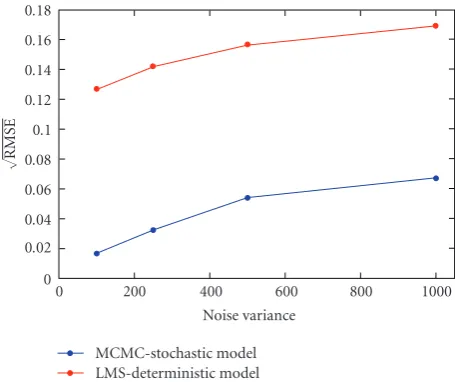
E{(nt−nt)2/n2t}, of the MCMC algorithm for stochastically modeled real-time microarrays and the least-mean-squares estimation approach for deterministi-cally modeled (by means of ordinary differential equations) real-time microarrays (see [11] for details). (We assume that all parameters other thanntare known.) The error is plotted as a function of the observation noise variance (the error is averaged over 100 trials). The simulation results indicate that the proposed approach significantly outperforms the least-mean-squares method over the broad range of parameters. The Gibbs Sampler is performed with M = 5 and K =
1500. The burn-in period of the algorithm is 500 iterations, while no more than 300-400 iterations are needed for the convergence (seeFigure 2).
6. Experimental Verification
To verify the proposed approach in experiments, we used the real-time microarray data reported in [11]. In those experiments, cDNA targets were generated from The RNA Spikes, a commercially available set of 8 purifiedEscherichia
0 200 400 600 800 1000
0 0.02 0.04 0.06 0.08 0.1 0.12 0.14 0.16 0.18
√ RMSE
Noise variance MCMC-stochastic model LMS-deterministic model
Figure 1: The square root of the relative mean-square error,
E{(nt−nt)2/n2t}, of the Gibbs Sampler and the
least-mean-squares estimation approach, as a function of the observation noise variance of 100, 250, 500 and 1000.
0 100 200 300 400 500 600 700 800 900 0
1000 2000 3000 4000 5000 6000 7000 8000 9000
N
u
mber
of
target
analy
tes
Number of iterations of Gibbs sampler
1000
Figure2: The convergence ofnt as a function of the number of
iterations.
ColiRNA transcripts purchased from Ambion Inc. Lengths of the RNA sequences in the set are (750, 752, 1000, 1000, 1034, 1250, 1475, 2000), respectively. The RNA sequences were reverse transcribed to obtain the cDNA targets, which were then labeled with Cy5 dyes. Eight probes (25 mer oligonucleotides) were designed and printed on slides, where each probe was repeated in 6 different spots; hence, the printed slides had 48 spots. We focus on two experiments, one where the concentrations of the targets was 80 ng/50μL, and the other where the concentrations of the targets was 16 ng/50μl.
0 0.5 1 1.5 2 2.5 3 3.5 ×10⁸
0 1000 2000 3000 4000 5000 (a)
3.6 3.7 3.8 3.9 4 4.1 4.2 4.3 ×10¹¹
0 1000 2000 3000 4000 5000 (b)
0 0.002 0.004 0.006 0.008 0.01 0.012 0.014
0 1000 2000 3000 4000 5000 (c)
0 1 2 3 4 5 6 ×10⁻³
0 1000 2000 3000 4000 5000 (d)
Figure3: The convergence of parameter estimatesnt(a),np(b),k1(c), andk−1(d) as a function of the number of iterations of the Gibbs sampler.
exploiting the linearity of our SDE model, the scaled down continuous-discrete model is given by
dnc(t)=μ(nc,θ,t)dt+σ(nc,θ,t)dW,
y(t)=nc(t) +v(t),
(46)
wherenc=nc/k,v=v/k,y=y/k, and
μ=k1
np−nc
np
(nt−nc)−k−1nc,
σ=
k1
np−nc
np
(nt−nc) +k−1nc 1/2
,
(47)
wherenp=np/kandnt=nt/k.
Moreover, since the noise variance is generally unknown, we add it to the vector of the unknown parameters, that is,
θ=[nt np k1 k−1 ]. This requires slight modification in the step 3 of the MCMC algorithm (as described previously). We applied the proposed Gibbs Sampler to the estimation of the parameters of the process which generated the described experimental data. We run 5000 iterations of the algorithm with M = 5 and K = 1500, and averaged its performance over 50 trials. For the first experiment, we obtainednt,1 = 3.3×10⁸, while in the second experiment
nt,2=1.1×10⁸.Figure 3and 4 show a sample convergence of the parameter estimates as a function of the number of iterations of the Gibbs sampler applied to the second data
0 2 4 6 8 10 12 14 16 18 ×105
0 1000 2000 3000 4000 5000
Iteration number of Gibbs sampler
V
ar
ianc
e
of
measur
ement
n
oise
Figure 4: The convergence of the noise variance estimate as a function of the number of iterations of the Gibbs sampler.
set. We note that the ratio of the estimated target amounts is
7. Summary and Conclusion
In this paper, we considered the problem of estimating the number of target molecules in stochastically modeled biomolecular sensors. We posed it as a parameter estima-tion problem in systems modeled by stochastic differential equations, where the noise-perturbed data is acquired at discrete points in time. Since the problem is analytically intractable, we employed MCMC techniques to obtain a numerical solution. In particular, we relied on the use of the Gibbs Sampler to alternate between drawing missing data conditioned on parameters and observations, and drawing parameters conditioned on the simulated missing data and the observations. We used the Metropolis-Hastings technique within the Gibbs Sampler to simulate analytically untractable densities. Simulation results indicate that the proposed algorithm significantly outperforms the existing least-mean-squares approach, and that the algorithm is robust with respect to the measurement noise. Moreover, we applied the algorithm to experimental data to verify the validity of the estimation algorithm in a realistic scenario.
There are several possible extensions of the current work. For instance, the MCMC algorithm described in this paper can also be applied to multivariate diffusion processes. Such processes arise in the context of gene regulatory network as well as in real-time biosensor arrays affected by cross-hybridization. For this scenario, one may extend the algorithm so that it handles unobserved parts of a multivariate diffusion process. On another note, a variation of the MCMC algorithm performs (random) block updating (see, e.g., [19,20]). It is worth pursuing this modification in the context of parameter estimation in real-time biosensors.
References
[1] J. Cooper and T. Cass, Eds., Biosensors, Oxford University Press, Oxford, UK, 2nd edition, 2004.
[2] K. R. Rogers and A. Mulchandani,Affinity Biosensors, Humana Press, Totowa, NJ, USA, 1998.
[3] K. R. M. Schena,Microarray Analysis, John Wiley & Sons, New York Ny, USA, 2003.
[4] L. Shi, L. H. Reid, W. D. Jones et al., “The MicroArray Quality Control (MAQC) project shows inter- and intraplatform reproducibility of gene expression measurements,” Nature Biotechnology, vol. 24, no. 9, pp. 1151–1161, 2006.
[5] E. Marshall, “Getting the noise out of gene arrays,”Science, vol. 306, no. 5696, pp. 630–631, 2004.
[6] S. Draghici, P. Khatri, A. C. Eklund, and Z. Szallasi, “Reliability and reproducibility issues in DNA microarray measurements,” Trends in Genetics, vol. 22, no. 2, pp. 101–109, 2006.
[7] D. I. Stimpson, J. V. Hoijer, W. Hsieh et al., “Real-time detection of DNA hybridization and melting on oligonu-cleotide arrays by using optical wave guides,”Proceedings of the National Academy of Sciences of the United States of America, vol. 92, no. 14, pp. 6379–6383, 1995.
[8] J. Bishop, A. M. Chagovetz, and S. Blair, “Kinetics of multiplex hybridization: mechanisms and implications,” Biophysical Journal, vol. 94, no. 5, pp. 1726–1734, 2008.
[9] M. R. Henry, P. W. Stevens, J. Sun, and D. M. Kelso, “Real-time measurements of DNA hybridization on microparticles
with fluorescence resonance energy transfer,”Analytical Bio-chemistry, vol. 276, no. 2, pp. 204–214, 1999.
[10] V. M. Mirsky, “Affinity sensors in non-equilibrium conditions: highly selective chemosensing by means of low selective chemosensors,”Sensors, vol. 1, no. 1, pp. 13–17, 2001. [11] H. Vikalo, B. Hassibi, and A. Hassibi, “Modeling and
estima-tion for real-time microarrays,”IEEE Journal on Selected Topics in Signal Processing, vol. 2, no. 3, pp. 286–296, 2008.
[12] S. Das, H. Vikalo, and A. Hassibi, “On scaling laws of biosensors: a stochastic approach,”Journal of Applied Physics, vol. 105, no. 10, Article ID 102021, 2009.
[13] E. Allen,Modeling with Itˆo Stochastic Differential Equations, Springer, New York, NY, USA, 2007.
[14] H. Sørensen, “Parametric inference for diffusion processes observed at discrete points in time: a survey,”International Statistical Review, vol. 72, no. 3, pp. 337–354, 2004.
[15] B. M. Bibby, “Estimating functions for discretely sampled dif-fusion type models,” inHandbook of Financial Econometrics, North-Holland, Amsterdam, The Netherlands, 2002. [16] A. R. Gallant and J. R. Long, “Estimating stochastic differential
equations efficiently by minimum chi-squared,” Biometrika, vol. 84, no. 1, pp. 125–141, 1997.
[17] B. Eraker, “MCMC analysis of diffusion models with appli-cation to finance,”Journal of Business and Economic Statistics, vol. 19, no. 2, pp. 177–191, 2001.
[18] G. O. Roberts and O. Stramer, “On inference for partially observed nonlinear diffusion models using the Metropolis-Hastings algorithm,”Biometrika, vol. 88, no. 3, pp. 603–621, 2001.
[19] A. Golightly,Bayesian inference for nonlinear multivariate dif-fusion processes, Ph.D. thesis, Newcastle University, Newcastle, UK, 2006.
[20] O. Elerian, S. Chib, and N. Shephard, “Likelihood inference for discretely observed nonlinear diffusions,”Econometrica, vol. 69, no. 4, pp. 959–993, 2001.
[21] Y. A¨ıt-Sahalia, “Maximum likelihood estimation of discretely sampled diffusions: a closed-form approximation approach,” Econometrica, vol. 70, no. 1, pp. 223–262, 2002.
[22] A. W. Lo, “Maximum likelihood estimation of generalized Ito processes with discretely sampled data,”Econometric Theory, vol. 4, pp. 231–247, 1988.
[23] R. Poulsen, “Approximate maximum likelihood estimation of discretely observed diffusion processes,” Tech. Rep. 29, Centre for Analytical Finance, University of Aarhus, 1999.
[24] A. R. Pedersen, “A new approach to maximum likelihood estimation for stochastic differential equations based on discrete observations,”Scandinavian Journal of Statistics, vol. 22, pp. 55–71, 1995.
[25] J. C. Spall, “Estimation via Markov chain Monte Carlo,”IEEE Control Systems Magazine, vol. 23, no. 2, pp. 34–45, 2003. [26] B. Oksendal,Stochastic Differential Equations: An Introduction
with Applications, Springer, Berlin, Germany, 2003.
[27] J. P. N. Bishwal,Parameter Estimation in Stochastic Differential Equations, Springer, New York, NY, USA, 2007.
[28] P. Kloeden and E. Platen, Numeric Solutions of Stochastic Differential Equations, Springer, New York, NY, USA, 1992. [29] M. W. Brandt and P. Santa-Clara, “Simulated likelihood
estimation of diffusions with an application to exchange rate dynamics in incomplete markets,”Journal of Financial Economics, vol. 63, no. 2, pp. 161–210, 2002.