Evaluation of Relations between Scales
in an IRT Framework
Khurrem Jehangir
Enschede, 2005
Supervisors
Prof Dr. C.A.W. Glas
Table of Contents
INTRODUCTION 4
CHAPTER 1 7
INTRODUCTION TO IRT 7
IRT & the Classical Test Theory 8
IRT Models 10
Dichotomous IRT Models 10
The Rasch Model or the 1-PL Model. 10
The 2-PL Model. 11
Polytomous IRT Models 12
The Generalized Partial Credit Model (GPCM): 12
The Sequential Model 15
The Graded Response Model 17
CHAPTER 2 19
EVALUATION OF RELATIONS BETWEEN SCALES IN AN IRT FRAMEWORK 20
Maximum Likelihood estimation of trait levels in IRT 20
Maximum Likelihood estimation of trait level for response patterns 21
Marginal Maximum Likelihood estimation 22
The EM algorithm 23
Evaluation of relation between scales 24
The limited information maximum likelihood for calculating between scales covariance: 25
Simulation setup 28
CHAPTER 3 30
RESULTS & CONCLUSIONS 30
Results of the Simulation Study 31
The Dichotomous Models 32
Simulation 1.2: The 1-PL model for β=1 33
Simulation 1.3: The 1-PL model for varying β 33
Simulation 1.4 : The 2-PL model 34
Discussion of results for dichotomous models: 35
The Polytomous Models 37
Discussion of results for Polytomous models: 39
Conclusions 40
BIBLIOGRAPHY 42
Introduction
In an ever changing world, psychological testing remains one of the flagships of applied psychology. Over the course of the past decade or two there have been currents of change in the domain of psychological testing. New testing techniques are emerging in response to contemporary needs in psychological testing. These techniques are also based on new principles underlying test development. One promising technique which has been gaining momentum since the last decade or two is called IRT or item response theory. It is the basis or mainstay for the creation of many a modern test. It is gradually phasing out the classical test theory (CTT) from the testing domain because of its more theoretically justifiable principles and greater potential to solve practical measurement problems.
IRT, also known as latent trait theory is model based measurement in which trait level estimates depend on both person responses and on the properties of items that were administered. The rules of measurement in IRT afford greater robustness, flexibility, efficiency and reliability in trait measurement than the classical test theory framework which was in use for most of the 20th century. The underlying principal used in IRT models for testing is that person and item parameters can be fully separated and this is brought to bear on measuring examinee traits and test characteristics with greater precision and flexibility.
Many diverse IRT models are now available for application to a wide range of psychological areas. Although early IRT models emphasized dichotomous item formats extensions to other formats has enabled applications in many areas; that is, IRT models have been developed for rating scales, partial credit scoring and multiple category scoring.
This report studies the application of a new procedure for measuring across-scales relationship in a multi-dimensional IRT test. A multi-dimensional test is one in which a test is divided into sub-sets and latent variables are measured separately for each scale. The latent variables are assumed to correlate and the new procedure called ‘limited information maximum likelihood estimation’ proposed by Rubin and Thomas (2001) is used to estimate this correlation. The authors did not indicate that they had empirically tested this new procedure and in this report empirical tests are carried out to observe the effects of different models and values of item and person parameters.
Chapter 1 of this report makes a comparison between the new IRT framework and the old Classical Test Theory (CTT) framework. Apart from highlighting the conceptual differences between IRT and CTT it also lists the array of advantages that are afforded by IRT to examiners. After stressing the importance of IRT as a testing framework, an explanation of the different IRT models for both dichotomous and polytomous scoring is given.
Chapter 3 is the concluding chapter; the results of the simulations carried out are presented followed by a discussion of the results and the feasibility of the methodology used for different IRT model configurations.
CHAPTER 1
Introduction to IRT
Introduction to IRT
In this chapter I give an introduction to the IRT framework. I begin by making a comparison between the old testing framework called the Classical Test Theory (CTT) and IRT. I discuss the advantages of IRT over CTT and how it is better equipped to meet the requirements of modern testing. After that I briefly trace the history of IRT evolution and present the basic IRT model in use today for dichotomous scoring called the Rasch model and its extensions (i.e. 2PL). After that I present three IRT models for polytomous scoring and describe how they can be evolved from the basic Rasch model.
IRT and the Classical Test Theory
The two testing theories that are in use today are the Classical Test Theory (CTT) and the IRT. CTT predates IRT and has been the mainstay of psychological testing for most part of the 20th century. However since the last decade or two IRT has become the dominant currency of testing, while CTT is become less popular. IRT is based on fundamentally different principles than CTT. IRT is a model based measurement that controls various confounding factors in score comparisons by a more complete parameterization of the measurement situation.
IRT differs substantially from CTT as a model based system of measurement. Unlike IRT in CTT item properties and person properties are confounded in the basic model which has many implications. Firstly, practical testing problems such as equating different test forms have been solved by using IRT. Furthermore, thanks to justifiable measurement scale properties of IRT inferential statistics about group differences as well as test score comparisons within or between persons have become possible.
item properties. By contrast, in CTT the true score has meaning only for a fixed population and item set; by not including item properties in the model, a true score can apply only to a particular set of items or their equivalent. Thus the properties of items are not explicitly linked to behavior in CTT but in IRT they are. The outcome of this is that for example the relative impact of difficult items on trait level estimates and item responses can be known from an IRT model.
Another weak link in CTT is that a persons true and error score may not be decomposed from a single test administration. The standard error of measurement in CTT applies to all scores in a particular population i.e. it is the same for all examinees in the population whereas in IRT based testing the standard error differs across scores or response patterns and gives a more accurate estimate of the conditional standard error for any particular examinee.
Another outcome of the IRT based testing is that tests do not have to be as lengthy as they were in CTT. A short test that is based on IRT can be more accurate than a longer test based on CTT. This is made possible by using adaptive testing in which the examinees are administered items which match their estimated abilities using the IRT framework. Rather than testing examinees with items that are spread out over the entire ability spectrum, the test items can be focused around the estimated ability estimates of the examinees thus resulting in a more accurate estimate coupled with a shorter test.
pencil based tests which are based on the CTT. IRT in its capacity as the framework on which computer adaptive testing relies will be the currency of future testing.
IRT Models
Item response theory (IRT) contains a large family of models. IRT development may be traced back to Lawley(1943) and Lord(1952). An important theoretical breakthrough was made by Georg Rasch(1960), a Danish mathematician who developed a family of IRT models that were applied to develop measures of reading. Rasch was particularly interested in the scientific properties of measurement models and he separated person and item parameters fully in his models. His student Anderson consequently elaborated estimation methods for the person and item parameters in Rasch’s model. Rasch developed many IRT models but his most famous model which is known by his name is the building block for many more complex or advanced models used in IRT today. Though there are many IRT models in use today I will only discuss the five IRT models that I use in this report. Two of these models are models for dichotomously scored items (in which there are only two possible outcomes) and three models are for modelling polytomously scored items (in which there are more than two possible outcomes).
Dichotomous IRT Models
The Rasch Model or the 1-PL Model.
P(Xsi= 1) = ) exp( 1 ) exp( i s i s
β
θ
β
θ
− + −where Xsi is the response of person s on item i,θsthe trait level of person s and
β
ithe itemdifficulty of item i . P (Xsi=1) is the probability of a correct response on item i for person s.
This is known as the Rasch model or the 1 parameter logistic (1PL) measurement model, due to the inclusion of only one item parameter (i.e. difficulty) to represent item differences.
The 2-PL Model.
The 2-PL model is a more ‘complete’ or complex IRT model than the Rasch model. This model includes two parameters to represent item properties. One is the item difficulty which was also there in the Rasch model and the other new parameter is called the discrimination parameter denoted by the symbol alpha. The discrimination parameter is also known as the slope parameter. The Rasch model can be extended to the two-parameter logistic model (2-PL) by allowing different discrimination two-parameters for each dichotomous item. Both item difficulty and item discrimination are included in the exponential form of the logistic model as follows:
P (Xsi=1) =
) ( exp 1 ) ( exp i s i i s i
β
θ
α
β
θ
α
− + −where Xsi is the response of person s on item i,θsthe trait level of person s and
β
ithe itemdifficulty of item i .
α
iis the discrimination parameter. P (Xsi=1) is the probability of acorrect response on item i for person s.
The discrimination or slope parameters indicate the steepness of the response function .An outcome of this property is that it is possible to observe how good the response function discriminates
θ
-values in the neighborhood ofβ
si.When the discriminationexaminee. Tests can be shorter if the discrimination parameter is also included in the model because its inclusion means that questions if carefully selected can give more information about the trait level of an examinee which can thus be more quickly identified.
Polytomous IRT Models
In this section I will discuss three models for polytomous item scoring. The models that were discussed earlier were for dichotomous scoring, i.e. there were only two possible response categories, either a correct score or an incorrect score. In polytomous scoring there are more than two possible response categories, i.e. there are more possibilities than either scoring correct or wrong. In other words a person may score an item partially correct. To model response behaviour on a test where there are more than 2 possible response categories models known as polytomous models have to be used. These models can be applied to any situation in which performances on an item or an assessment criterion are recorded in two or more ordered categories (e.g., rating scales) and there is an intention to combine results across items/criteria to obtain measures on some underlying variable. There are many models for polytomous scoring that have been proposed. In this section I discuss three of the more commonly used models which I will later use in the simulation studies.
The Generalized Partial Credit Model (GPCM)
) exp( 1 ) exp( 1 0 1 i j i j ij ij ij P P P δ θ δ θ − + − = + ,
where Pij1 is the probability of person j scoring 1 on item i.Pij0 is the probability of person
j scoring 0 on item i, and θj is the ability of person j. Furthermore,δ i denotes the difficulty of item i defined as the location on the ability scale at which a score of 1 on item i is as likely as a score of 0 (i.e., Pij0 = Pij1 = 0.5). The larger δ i, the smaller the probability of scoring 1 rather than 0 on item i.
The model is written here as a conditional probability to emphasize that it is a model for the probability of person j scoring 1 rather than 0. The above formula for the probability of scoring 1 rather than 0 also expresses the probability of person j scoring 1 on item i (i.e., the item response functionPij1), since Pij0 and Pij1 must obviously sum up
to 1.
When an item provides more than two responses categories (e.g., three ordinal categories scores 0, 1 and 2), a score of 1 is not expected to be increasingly likely with increasing ability. This is because beyond some points on the ability scale, a score 1 should become less likely as a score 2 becomes a more likely result. Nevertheless, it follows from the intended order 0 < 1 < 2 …. < mi of a set of response categories that the conditional
probability of scoring x rather than x-1 on an item i (i.e., given only two possible scores) should increase monotonically throughout the ability range. In the PCM, this expectation is modelled using Rasch’s model for dichotomous scoring:
exp( )
1 exp( )
1
Pijx j ix
Pijx Pijx j ix
θ δ
θ δ
− =
+ + −
− , x= 1, 2, … , mi
where Pijx is the probability of person j scoring x on item i, Pijx−1 is the probability of
person j scoring x-1 on item i. θj is the ability of person j, and δix is an item
in the polytomous case, unlike in the dichotomous case, it does not hold any longer that
1
−
ijx
P and Pijx sum up to 1 since there are now more than two probabilities involved.
Since it must hold that Pij0 + Pij1 + … + Pijx + … + Pijmi = 1, as shown by Masters
(1982), it can readily be derived that the item response functions (mostly denoted as category response functions) for Pijx (x = 1, 2, …, mi) and Pij0 in the PCM can be
formulated as follows:
exp( )
1
1 exp( )
1 1
x
x j ik
k Pijx m
h i
h j ik
h k θ δ θ δ − = = + − = = , 1 0
1 exp( )
1 1
Pij m
h i
h j ik
h θ k δ
=
+ −
= =
.
Defining for notational convenience 0 ( ) 0,
0 j ik
k= θ −δ ≡ the above two expressions above
for the response category functions can be formulated more compact as follows:
exp ( )
0
exp ( )
0 0 x j ik k Pijx m h i j ik h k θ δ θ δ − = = − = =
x = 0, 1, …, mi.
The PCM simplifies to the Rasch model if mi = 1, that is, for an item with only two
response categories. In other words, Rasch’s model for dichotomous scoring can be considered as a special case of the PCM or in other words the PCM belongs to the Rasch family of models.
It can be verified from the above formulas that δik indicates the location on the θ-scale
equal. Furthermore, it holds that the larger δik, the smaller the probability of scoring k
rather than k-1 on item i. It is also evident that the category response function for the lowest ordered category (i.e., category 0) is decreasing in θ, whereas the one for the highest ordered category (i.e., category mi) is increasing in θ. Since the sum of the
category response functions must sum up to 1 for each value of θ, it follows that all other response category functions (i.e., categories 1, 2,…, mi-1) must necessarily first be increasing in θ and next be decreasing in θ.
In order to allow for different slopes for the category response functions the PCM can be modified to the Generalized Partial Credit Model (GPCM) by incorporating the discrimination parameter in the model for the PCM. The GPCM which was originally developed by Muraki in 1992 and can be formulated in compact form as follows:
exp ( )
0
exp ( )
0 0
x
ai j ik k
Pijx m h
i
ai j ik
h k θ δ θ δ − = = − = =
x = 0, 1, …, mi,
where ai denotes the discrimination parameter for item i. The GPCM will boil down to
the PCM when all discrimination parameters are equal. The GPCM is a more flexible model than the PCM implying that a better fit to the data can be achieved, but at the expense of statistical elegance (i.e. no sufficient statistics).
The Sequential Model
administered the next conceptual Rasch item if a correct response was given to the previous one. It is assumed that if a conceptual item is administered, the Rasch model holds, so the probability of taking a step is given by:
) , , 1 ) | 1
(Yikm dikm i bkm
p = = θ =
) exp( 1 ) exp( km i km i b b − + − θ θ
Where dikm is a design variable for dichotomous items given by:
dikm = {1, if a response of person i to item k is available}
dikm = { 0 , if a response of person i to item k is not available}
bkm is the difficulty parameter of step m within item k. If we denote the number of steps
within item k by rikthen:
rk = =
k km km
M
m 1d y
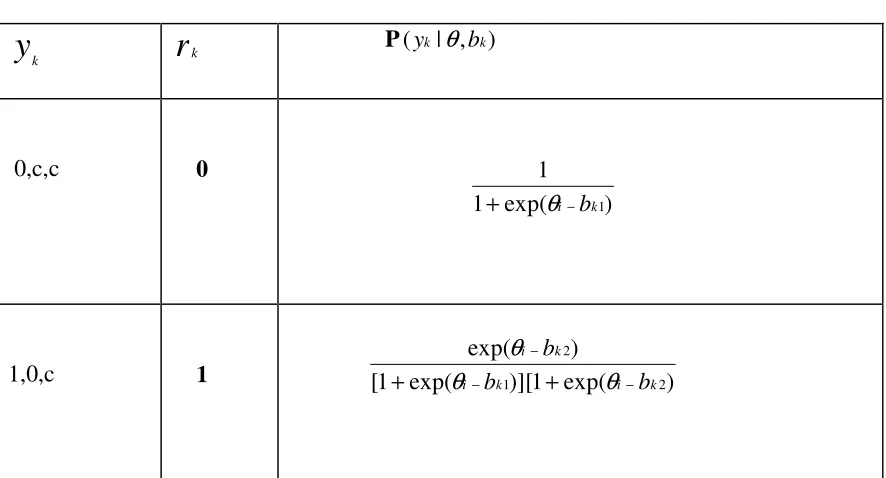
Using these formulas in the table given below are all possible responses for an item with
Mk=3 and the associated probabilities P(yk|θ,bk)
Table 1.0
y
kr
k P(yk|θ,bk)0,c,c 0
) exp( 1 1 1 k i−b
+ θ
1,1,0 2 [1+exp(θi−bkexp(1)][1θ+i−exp(bk1)θexp(i−bθki2)][−b1k2+)exp(θi−bk3)]
1,1,1 3 [1+exp(exp(θi−θib−k1b)][k11)+exp(exp(θiθ−ib−kb2)kexp(2)][1θ+iexp(−bk2θ)i−bk3)
From inspection of the above table it can be verified that in general:
) , (yk| bk
P θ =
∏
+ = = − + − ) 1 , min( 1 1 ) exp( 1 [ exp k kr M h km k m km k b M b r θ θWhere min(Mk, rk +1)stands for the minimum of Mk and rk +1.
The Graded Response Model
In 1969, the general graded response model was proposed by Samejima. It is different from adjacent category models or Continuous-ratio models .In Adjacent category models the definition of the probability that the score say Rk is equal to m conditional on the
event that it is either m or m-1 and is given by:
) ( ( ) 1 , , |
(Rk m Rk m or Rk m ak bkm
Where ψ is a logistic function. Above it was shown that this assumption leads to the GPCM.
Continuous ratio models on the other hand are based on the definition of probability of scoring equal to or higher than m given that the score is at least m-1:
P(Rk ≥m| Rk ≥m-1)= ψ ( ak (θ-bkm))
In the Graded response model however the probability is defined by:
P(Rk ≥m) =ψ (ak (θ-bkm ))
It follows that the probability of scoring in a response category m is given by
P(Rk = m) = P(Yikm =1| ,θ bk) = ψ ( ak (θ-bkm)) - ψ (ak (θ-bk(m+1)))
for m=1,……Mk-1.Since the probability of obtaining a score Mk+1 is zero and since everyone can at least obtain a score 0, P(Rk ≥Mk+1)=0 and P(Rk=0)=1.Thus
follows that
P(Rk = 0) = P(Yik0 =1| ,θ bk) = 1- ψ (ak (θ-bk1))
and
P(Rk = Mk) = P(YikMk =1| ,θ bk) = ψ (ak (θ-bkMk))
For this model to work it must hold that ψ (ak(θ-bkm))> ψ (ak (θ-bk(m+1))), which implies
that b1< b2< ,…….,< bMk.. Furthermore the discrimination parameter akmust be the same
for all steps.
CHAPTER 2
Evaluation of relations between scales
Evaluation of relations between scales in an IRT
framework
In this chapter I discuss the methodology that is tested in this report. It begins with an explanation of important concepts that are used for estimation of IRT model parameters like maximum likelihood scoring for single variable models. It also presents the marginal maximum likelihood estimation method (MML) that is used when there is more than one variable in the model. Then the EM or the estimation-maximization algorithm is
presented as it is used in the methodology studied in this report. The new methodology used for estimating across scale relation is described next. It is called ‘limited information maximum likelihood’ estimation.
Maximum Likelihood estimation of trait levels in IRT
The relationship between item responses and trait level is fundamentally different in IRT and CTT. Under CTT, trait levels are scored by combining responses across items. Typically, responses are summed into a total score and then converted into a standard score. However in IRT, determining the person’s trait level is not a question of how to add up the item responses.
of how item properties influence behavior (i.e. and IRT model), what trait level is most likely to explain the persons responses.
Supposing a person received very hard items on a test and answered nearly all of them correctly; this response pattern is not very likely if a person has a low trait level. The likelihood that a person with moderate trait level could have answered those questions correctly is somewhat higher, but the likelihood of the response pattern is even higher for a person who has a high trait level.
Finding the IRT trait level for a response pattern requires a search process rather than a scoring procedure. That is, the trait level that yields the highest likelihood for the responses is sought. In some cases, collateral information may be incorporated into the estimation procedure (e.g. trait distribution in the relevant procedure) so that more information than the response pattern isavailable. For instance when estimating the trait level distribution in a large class of examinees it is often assumed that the trait levels are normally distributed (i.e. pattern of distribution is like a normal distribution which has a bell shape). In IRT, trait levels are estimated in a model for a person’s responses, controlling for the characteristics of the items. Typically, trait levels are estimated by the maximum likelihood method; specifically the estimated trait level for a person maximizes the likelihood of his or her response pattern given the item properties. Thus to find the appropriate trait level ,one must(a) represent the likelihoods of a response pattern under various trait levels and (b) conduct a search process that yields the trait level that gives the highest likelihood.
Maximum Likelihood estimation of trait level from response patterns
Instead of plotting a graph of likelihoods (probabilities) of a response pattern against different values of the ability parameter to see which value of the ability parameter yields the highest likelihood (probability), one can simply find the maximum of function of the response pattern with respect to the trait level parameter in the function. The first step in calculating maximum likelihood of a response pattern is to translate the item response pattern into the probability of that item response pattern occurring under the given model. All item parameter values are considered known in the model with the exception of the unknown parameter ‘trait level’ which is yet to be estimated. The next step is to multiply all these probabilities for every item in the test. The resultant probability function is the probability of getting that response pattern over the whole test. This probability function contains one unknown parameter i.e. the trait level parameter. The next step is to maximize this probability function for the ability parameter so as to find out the value of the ability parameter for which the function gives a maximum value. (It can be shown that the probability function is single peaked so it returns only a single maximum value.).However finding the maximum of the likelihood function in this form is tedious from a mathematical point of view. So in practice the log likelihood of this function is calculated and maximized; because the log of the likelihood function also maximizes at the same trait level as the likelihood function in the original product form and is easier to calculate. The only exception to calculating maximum likelihood estimates are response patterns that are all correct or all wrong. These patterns will yield the value of ‘infinite’ ability for an all correct response pattern and a value of ‘negative infinity’ for an all wrong response pattern.
Marginal Maximum Likelihood estimation
variables marginalized (i.e., integrated). Let b denote the other variables. Let x denote observed data. Given the likelihood function p(x|a, b), the marginal likelihood of b is
P(x | b) = p(x|a,b)p(a|b)da,
where p(a| b) is the distribution of a conditional on b. In practice, b can be the item parameters or b can be the covariance matrix between ability dimensions (Bock & Aitkin, 1981)
The EM algorithm
The EM or the expectation-maximization algorithm is an algorithm for finding maximum likelihood estimates of parameters in probabilistic models, where the model depends on unobserved latent variables or missing data. EM alternates between performing an expectation (E) step, which computes the expected value of the latent variables, or missing data, and a maximization (M) step, which computes the maximum likelihood estimates of the parameters given the data and setting the latent variables or missing data to their expectation(in an exponential family model) or to their distribution (in other models).
Measurement of
between scales covariance
In the previous section I described how the IRT theory can be used to determine the ability level of examinees on a test. Usually, in IRT models it is assumed that there is one (dominant) latent variable θ that explains test performance. However, it may be a priori clear that multiple latent variables are involved. A test with items related to more than one latent variable is often labeled a within-item-multidimensional test (Adams, et al., 1997) and a multi-dimensional model is required for such tests. Adams et al. (1997) also write about another class of multidimensional IRT models, between-item-multidimensional models, in which one test can be divided into subtests or scales where the responses to the items of each scale can be described by a uni-dimensional IRT model. The latent variables, measured separately for each scale are assumed to correlate. It can be of interest to know the relationship between the different cognitive sub scale abilities. For instance it may be interesting to know the relationship between a persons I.Q. and math ability or I.Q. and language ability or math and language ability. The aim of this report is to test a new methodology for estimating the between scale relationships for a multi-dimensional test using a number of one-multi-dimensional models. A simulation is carried out in which a group of students is tested on a test with three dimensions or areas of ability, like math I.Q. and language. A matrix of 3 dimensional abilities is generated using a model in which we incorporate a known covariance matrix for configuring the between scales relationship. We then test the new method to find the between scales covariance from the available data using the new method and compare it with the known covariance used to model the data set.
information maximum-likelihood estimation in which the model is estimated in two steps: first the item and person parameters are estimated per dimension and secondly the covariance matrix is estimated given the estimates obtained in the first step. If the limited information maximum likelihood estimation works well it could then be considered a viable alternative for cases when the full information maximum likelihood estimates become too complex to compute.
The limited information maximum likelihood for calculating between
scales covariance
The limited information maximum likelihood method used here is based upon an application of the EM algorithm presented by Rubin and Thomas (2001). Rubin and Thomas (2001) discuss a two-stage procedure where the first stage consists of calibrating the uni-dimensional subscales using a uni-dimensional IRT model such as the GPCM and the second stage consists of estimating the covariance-matrix between the latent variables using a combination of parameter expansion and the EM-algorithm
The method calculates the covariance between scales by using observed data. These variance estimates include variance due to measurement error. The relationship between the missing data and the estimated abilities is given by the equation 2.0.
Equation 2.0
i
y =Kθi + εi
In this equation the parameter yi represents the estimates abilities of the students. The
parameter θirepresents the actual abilities of the students and the parameter K is a matrix
of the regression coefficients. The term
ε
i represents the measurement error.Equation 2.1
θt=K−1 yt
Equation 2.2
j
K = inv (θ Wjθt) * (θt j
W Yj ) where Wj= diag(τ1j,…….,τNj)
Note that Kj is both the maximum likelihood estimate and the least squares estimate of K
In equation 2.1 the parameter y represents the abilities of students estimated earlier in step 1 whereas the parameter θ represents the expectation of θ given the model in equation 2.0 and are treated as the missing data.
For the EM algorithm to begin an initial value of the matrix K is guessed. In our case it is the identity matrix. The E step then estimates a value for the missing data θ given the guessed parameter K in equation 2.1. This is followed by the M-step (given in equation 2.2.) in which the parameter K is estimated assuming the missing data θ are given by their estimated values in the E-step. This ‘updated’ estimate of the parameter K which is the matrix of regression coefficients is then reinserted into the E-step to get new values for the missing data θ in the E-step which is then reinserted into the M-step for calculating an improved estimate of K and so forth till convergence is achieved. It can be shown mathematically that with every iteration the values of the estimates of estimates of
K and are nearer to maximum likelihood estimates of these parameters.
Equation 2.3
=1/N =
N
i 1 θiθ
t i
the estimated matrix of missing data is multiplied by its transpose. This is done over all persons and the average of the result will yield the final covariance matrix.
Simulation setup
The objective of this simulations carried out in this report is to study the viability of a limited information EM algorithm technique proposed by Rubin and Thomas(2001) for finding the covariance between scales. The scales in the empirical example used in this report correspond to the multidimensional ability sub sets. The test is split in a number of sub sets and every subset relates to a specific ability parameterθt. The relationship or covariance between the ability estimates for the different sub-sets is represented in the form of a covariance matrix.
The simulation study begins with randomly drawing values of theta for different scales from a multivariate normal distribution with a known covariance matrix. Thus we know from the start the covariance used to model the multidimensional ability matrix. The value of this known covariance matrix is used later for comparison with the covariance matrices resulting from the estimation procedure of Rubin & Thomas (2001).
The values of ‘abilities’ obtained so far represent the real abilities of the students. The next step is to convert these real ability values into estimates of these real abilities along with estimates of the measurement error. This is done in two steps. First, by generating a response pattern for all examinees over all items in each sub scale of the test using the actual sub scale abilities under the respective response model. Secondly, by estimating the sub-scale abilities from the response patterns using ‘maximum likelihood’ which will then yield the estimates of the sub scale abilities and the associated measurement errors. The estimates of the abilities obtained using maximum likelihood will serve as the input matrix Y ( in equation 2.1) of the EM algorithm and likewise the estimates of the measurement error will serve as the diagonal elements of the matrix W (in equation 2.2).
of the limited information EM algorithm in calculating the covariance between scales for the different situations.
.
CHAPTER 3
Results & Conclusions
CHAPTER 3
In this concluding chapter the results of the simulations carried out are presented. The Chapter is divided into two sections, one for dichotomous testing and one for polytomous models. Results are tabulated for both sections followed by a discussion of those results. The chapter ends by concluding about the feasibility of the ‘limited information maximum likelihood estimation’ for various dichotomous and polytomous models.
Results of the Simulation Study
The simulation setup described in the previous section was implemented for the five models described earlier. In the section below we can observe the results of the simulation exercises for the five different models. The tables in this section shows the between the simulated covariance matrix and the original covariance matrix for various input configurations. This is followed by a discussion of these results.
The test parameters that are altered for the five different models (as shown in the tables) include the sample size denoted by M , test length denoted by K and the value of the non-diagonal elements of the original covariance matrix denoted by . The results of the simulation are represented in the form of the average of differences between the diagonal and off-diagonal elements of the original covariance matrix and the simulated covariance matrices. The simulated values of the covariance matrices represent an average of those values over 100 replications.
The Dichotomous Models
For the dichotomous models, four simulations setups were created. The first three simulation setups were for the Rasch model or the 1PL dichotomous model in which the values of the item difficulty parameter were varied. The last simulation setup was for the 2PL model. The aim was to observe any main effects of varying the item parameters and other test characteristics like sample size & test length. For every model in this section a table of results is presented followed by a discussion of those results. At the end of the section there is a general discussion of the differences in the results of the different models .
Simulation 1.1: The 1-PL model for
β=0
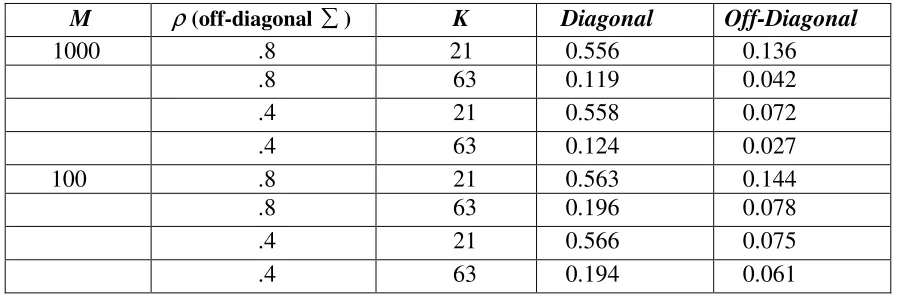
The first simulation was carried out for the 1PL model with the fixed values of the item difficulty parameter β = 0.The results are tabulated in the Table 1.1 below.
Table 1.1: Mean absolute error of the estimates of the covariance matrix (diagonal =1.0) for dichotomous items generated using the 1PL with β=0.
M ρ(off-diagonal ) K
Diagonal Off-Diagonal
1000 .8
21 0.556 0.136
.8 63 0.119 0.042
.4 21 0.558 0.072 .4 63 0.124 0.027
100 .8 21 0.563 0.144 .8 63 0.196 0.078 .4 21 0.566 0.075 .4 63 0.194 0.061
size; the estimates are more precise when the sample size is larger. There seems to be no effect of the covariance parameter on the diagonal elements but it seems to effect the off-diagonal values; the off-off-diagonal differences are almost twice as less for the cases when the covariance parameter is smaller, i.e. 4.
Simulation 1.2: The 1-PL model for
β=1
The second simulation was carried out for the 1PL model with the fixed values of the item difficulty parameter β = 1.The results are tabulated in Table 1.2 below.
Table 1.2: Mean absolute error of the estimates of the covariance matrix (diagonal =1.0) for dichotomous items generated using the 1PL with β=1.
M ρ(off-diagonal ) K Diagonal Off-Diagonal
1000 .8
21 0.803 0.182
.8 63 0.129 0.031
.4 21 0.810 0.079 .4 63 0.121 0.020
100 .8 21 0.805 0.189 .8 63 0.164 0.059 .4 21 0.807 0.082 .4 63 0.162 0.052
From the above table it can be seen that there is a main effect of varying the test length. When the test is longer the estimates are more accurate. There is a main effect of the covariance parameter for the non diagonal values which becomes greater when the test length is 21; the estimates are more precise when the covariance is lower. There is also a secondary effect of the sample size when the test is longer i.e. consists of 63 items; the estimates are slightly more accurate in all corresponding diagonal and off-diagonal cases.
Simulation 1.3: The 1-PL model for varying
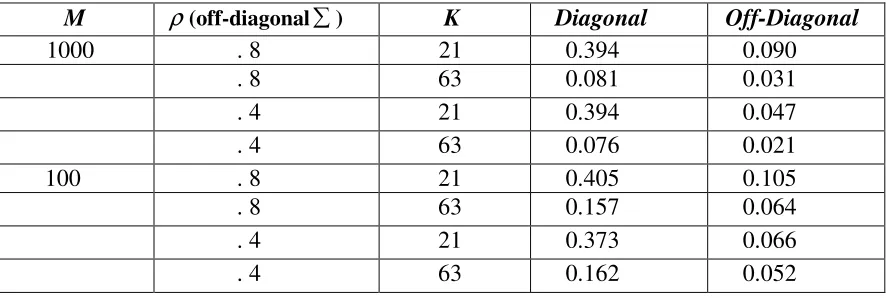
β-1.5 and + -1.5 such that the average value was zero. The results are tabulated in Table 1.3 below.
Table 1.3: Mean absolute error of the estimates of the covariance matrix (diagonal =1.0) for dichotomous items generated using the 1PL for varying values of β.
M ρ(off-diagonal ) K
Diagonal Off-Diagonal
1000 . 8
21 0.394 0.090
. 8 63 0.081 0.031
. 4 21 0.394 0.047 . 4 63 0.076 0.021
100 . 8 21 0.405 0.105 . 8 63 0.157 0.064 . 4 21 0.373 0.066 . 4 63 0.162 0.052
The results in the table above show that there is a main effect of test length. When the number of items is greater the estimates are significantly more accurate for both diagonal and off-diagonal elements of the covariance matrix. There is a secondary effect of the sample size when the test is longer; the estimates are more precise when the sample size is bigger .The covariance parameter does seem to have a main effect for the off-diagonal cases; when the covariance parameter is low the accuracy of the estimates is higher in each case, more so when the test is shorter.
Simulation 1.4: The 2-PL model
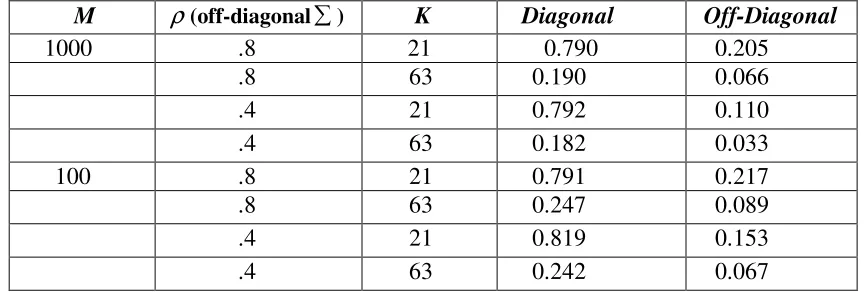
Table 1.4 : Mean absolute error of the estimates of the covariance matrix (diagonal =1.0) for dichotomous items generated using the 2PL model.
M ρ(off-diagonal ) K
Diagonal Off-Diagonal
1000 .8
21 0.790 0.205
.8 63 0.190 0.066
.4 21 0.792 0.110
.4 63 0.182 0.033
100 .8 21 0.791 0.217
.8 63 0.247 0.089
.4 21 0.819 0.153
.4 63 0.242 0.067
A main effect of test length is visible; when the test is longer the estimates are significantly more precise (for both diagonal and off-diagonal elements). There is a secondary effect of sample size when the test is longer, the estimates are more accurate for a bigger sample size. The covariance parameter has a main effect for the off-diagonal elements; when the covariance is low the accuracy of the estimates is better.
Discussion of results for dichotomous models
For all the dichotomous scoring cases it is evident that there is a main effect of the test length. When the test is longer the estimates are significantly more accurate. There is also a secondary effect in all the models: when the test is longer, the sample size affects the estimates. The estimates are more precise when the sample size is greater. The covariance parameter also seems to have a main effect on the off-diagonal cases especially more so when the number of items is lesser; when the covariance is lower the accuracy of the estimates is better.
also relatively good for the 1PL model with item difficulties for all items assigned a zero. The results were poorer for the 1PL model with all item difficulties being 1.0. The reason for this is that the abilities of the examinees were normally distributed with the average being zero. Thus a set of items with difficulty levels matching the average ability, i.e. zero, ought to yield less error in ability estimation as was the case in our simulations. This would in turn result in a more accurate estimation of the covariance between sub-scale abilities. Thus the 1PL with difficulty parameters fixed at 1.0 yielded poor results as questions were not concentrated in the vicinity where actual abilities were concentrated.
Results for varying item difficulties with average zero were better than for the simulation in which every item difficulty was fixed at zero. The plausible explanation is that though abilities were also averaged at zero, there was variation in the ability distribution and the variation in difficulties of the items administered in the tests was concurrent with the variation in the tested abilities. This provided more accuracy in ability estimation because more information can be gained from the response to an item whose difficulty is closer to the real ability of an examinee that is being tested.
Results were also relatively poor for the 2PL model with varying item difficulties and varying discrimination parameters. The distribution of the item discrimination parameters caused this effect. A plausible explanation is that the item discrimination parameters were assigned such that they were generally low for the cases when the item difficulties matched the actual abilities and generally higher in the case when difficulties of items administered were further from the actual ability level of the examinees. This would results in lesser information being gathered about the actual abilities of the examinees and thus a larger error term. This could be rectified to a certain degree by a more appropriate choice of item discrimination parameters.
The Polytomous Models
In the second part of the simulation study three models for polytomous item scoring were considered and simulations were carried out to observe any effects of model selection. The results of the simulation study were tabulated for the three models followed by a discussion of the differences in the results.
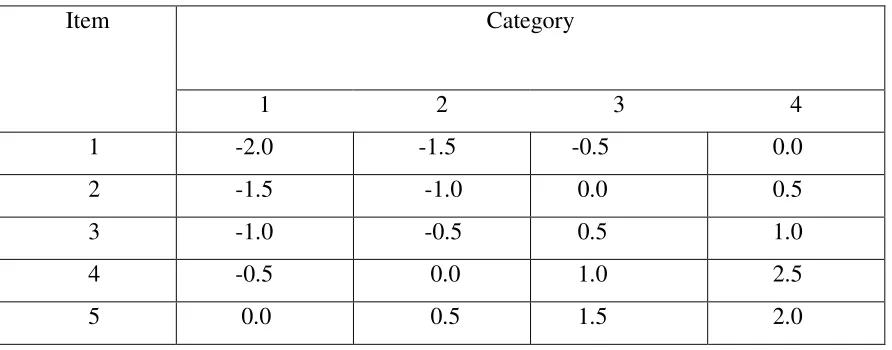
The set up of the simulation was as follows. In order to be able to compare the results for the three models the selection of the item and ability parameters had to be such that they are themselves not an underlying and unwarranted cause for variation in the simulations across the three models. To achieve this, the following steps were taken. For all three models the ability parameters were drawn from a standard normal distribution with mean zero as described earlier. The discrimination parameters were fixed at one. For the GPCM drawing the item parameters from a distribution was not considered, because the dependence between these parameters may result in very unfavorable values with the consequence of item categories without responses (Wilson & Masters, 1993). Therefore the β parameter values were fixed. The values of the first five items are given in the table below.
Table 2.0: Item parameter values used for simulating data using the GPCM
Category Item
1 2 3 4
1 -2.0 -1.5 -0.5 0.0 2 -1.5 -1.0 0.0 0.5 3 -1.0 -0.5 0.5 1.0 4 -0.5 0.0 1.0 2.5 5 0.0 0.5 1.5 2.0
two items are shifted to the left on the latent scale, the last two items are shifted to the right.
Data were then generated under the GPCM and using this data the item parameters of the SM and the GRM were estimated using maximum marginal likelihood (Bock & Atkin, 1981).The resulting item parameters of the SM and GRM were such that item category response curves for all three models were close. These estimated values were then used for generating data using the SM and the GRM which were then compared for all three models.
Simulation 2.1: The Generalized Partial Credit Model (GPCM)
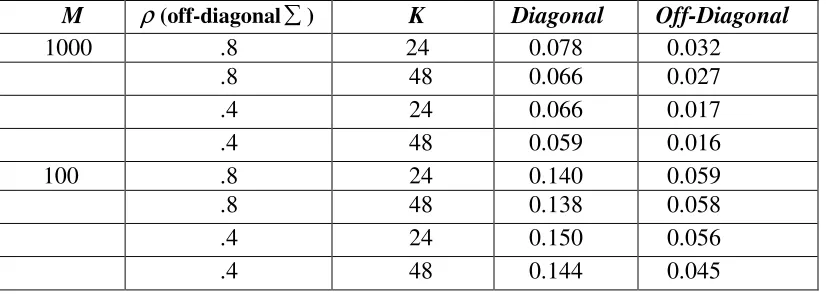
Table 2.1: Mean absolute error of the estimates of the covariance matrix (diagonal =1.0) for dichotomous items generated using the GPCM.
M ρ(off-diagonal ) K Diagonal Off-Diagonal
1000 .8
24 0.078 0.032
.8 48 0.066 0.027 .4 24 0.066 0.017 .4 48 0.059 0.016
100 .8 24 0.140 0.059 .8 48 0.138 0.058 .4 24 0.150 0.056 .4 48 0.144 0.045
Simulation 2.2: The Sequential Model(SM)
Table 2.2: Mean absolute error of the estimates of the covariance matrix (diagonal =1.0) for dichotomous items generated using the SM.
M ρ(off-diagonal ) K
Diagonal Off-Diagonal
1000 .8
24 0.094 0.033
.8 48 0.055 0.022
100 .8 24 0.183 0.070 .8 48 0.131 0.058 .4 24 0.174 0.061 .4 48 0.138 0.047
Simulation 2.3: The Graded Response Model (GRM)
Table 2.3: Mean absolute error of the estimates of the covariance matrix (diagonal =1.0) for dichotomous items generated using the GRM.
M ρ(off-diagonal ) K
Diagonal Off-Diagonal
1000 .8
24 0.085 0.027
.8 48 0.047 0.019
.4 24 0.080 0.021
.4 48 0.051 0.017
100 .8 24 0.178 0.071
.8 48 0.148 0.062
.4 24 0.204 0.067
.4 48 0.148 0.049
Discussion of results for Polytomous models
Conclusions
The aim of this study was to see how well the limited-information maximum-likelihood estimation technique suggested by Rubin and Thomas (2001) works as a function of test length, sample size, parameter choice for dichotomous items and model choice for polytomous items. Rubin and Thomas (2001) only give an empirical example in their paper which does not answer these questions. This study employs their technique in a simulation study for calculating between scales co-variance in order to know its feasibility via-a-vis parameter variation and model selection.
The setup of the study was divided into two parts, for dichotomous models and polytomous models. In the first instance simulations were carried out on three cases of the 1PL model in which the difficulty parameters were varied. A fourth simulation of the dichotomous case was of the 2PL model. For the polytomous cases model comparison was done between the GPCM, GRM and the SM.
Some results were as expected. There was a main effect of test length. The effect was stronger in the dichotomous models than in the polytomous models. In the polytomous models the strongest main effect was caused by the sample size; when the number of persons was greater there was a large improvement. In the dichotomous models there wasn’t any main effect caused by sample size. However there was a secondary effect of the sample size when the test length was longer. The covariance parameter also has a main effect in both polytomous and dichotomous model; the differences being more pronounced for the dichotomous models. The effect was that when the covariance is lesser the estimates are more precise. For the dichotomous models the improvement was even more when the number of itemswas lesser.
parameter was further away from the average of the drawn ability values the estimates were less accurate because of the larger measurement error in estimating the abilities. The results for the 2PL model were also poor which were caused due to selection of inappropriate discrimination parameters in relation to the abilities of the students and items administered to them.
In the polytomous models the estimates were similar for all three models and no significant change could be detected.
Bibliography
Dempster, A., Laird, N., and Rubin, D.(1977). Maximum Likelihood estimates from incomplete data via the EM algorithm(with discussion),Journal of the Royal Statistical Societ,Series B,39,1-38
Masters, G.N. (1982). A Rasch Model for Partial Credit Scoring. Psychometrika, 47, No. 2, pp. 149-174.
Masters, G.N. & Wright, B.D. (1997). Handbook of Modern Item Response Theory. van der Linden, W.J & Hambleton, R.K. (eds.). New York : Springer.
Muraki, E. (1992). A Generalized Partial Credit Model: Application of an EM Algorithm.
Applied Psychological Measurement, 16, No. 2, pp. 159-176.
Lord, F.M. (1952). A theory of test scores. Psychometric Monograph 7.
Lord, F.M. (1953a). An application of confidence intervals and of maximum likelihood to the estimation of an examinee's ability. Psychometrika, 18, 57-75.
Lord, F.M. (1953b). The relation of test score to the trait underlying the test. Educational and Psychological Measurement, 13, 517-548.
Rasch, G. (1960). Probabilistic models for some intelligence and attainment tests.