Available Online atwww.ijcsmc.com
International Journal of Computer Science and Mobile Computing
A Monthly Journal of Computer Science and Information Technology
ISSN 2320–088X
IJCSMC, Vol. 3, Issue. 3, March 2014, pg.1183 – 1187
RESEARCH ARTICLE
MULTIHOMING AND
MULTISTREAM PROTOCOL IN
COMPUTER NETWORKS
Syed Yasmeen Shahdad
1, Gulshan Amin
2, Pushpender Sarao
3Department of Computer Science & Engineering, Somany Institute of Technology & Management, Rewari, Haryana, India
[email protected] [email protected] [email protected]
Abstract
SCTP (stream control transmission protocol) is a reliable message oriented transport layer protocol. It is an IETF standard developed by the Transport Area Working Group (TSVWG). SCTP has been standardized by the IETF(Internet Engineering Task Force) in series of RFCs ,as a reliable transport protocol to transport SS7(Signaling System 7) signaling messages for internet applications such as ISDN over IP, telephony sinagaling , media gateway control, IP telephony[5]. SCTP is similar to TCP in many services. They are both unicast connection-oriented reliable protocols, provide in-sequence packet delivery and congestion control. SCTP preserves message boundaries and at the same time detects lost data, and out of order data. It uses 32 bit checksum as opposed to a 16 bit checksum of TCP. Although TCP has traditionally been used, we argue that SCTP provides better services than TCP in terms of reliability and performance. Due to its attractive features such as multi-streaming and multi-homing. SCTP has received much popularity, in terms of both research and development [6, 7]. SCTP provides multi-homing in that endpoints can use multiple IP addresses for the connection. SCTP may be more resistant to Man in the Middle (MITM) and Denial of Service (DoS). Multi-stream does not refer to multiple streams in the TCP sense but rather each stream represents a sequence of messages within a single association. These may be long or short messages which include flags for control of segmentation and reassembly.
Keywords- SCTP, Multi-homing, Multi-stream
Introduction
Stream Control Transmission Protocol (SCTP) [2] is a reliable, message oriented transport protocol that provides new services and features for IP communication. Before SCTP, TCP is used for reliable communication [1] as UDP is a unreliable protocol [4]. TCP is a stream oriented protocol. TCP has several deficiencies such as:
2) TCP is stream-oriented instead of message oriented.
3) TCP does not support multi-homing, that is, if there is a loss at any point, the whole data stream gets blocked .It cannot be tolerated if we are sending real time data such as audio or video
4) TCP is vulnerable to blind Denial of Service (DoS) attacks by SYN segments.
To overcome the above limitations of TCP for transport of signaling messages, a new transport protocol, Stream Control Transmission Protocol (SCTP), are used. SCTP provides several new features that are not available in TCP. The two most important of these are: 1) Multi-homing
2) Multi-stream service
Other additional benefits of SCTP are: 1) Allow half-closed connections. 2) Preservation of message boundaries. 3) Protect against SYN flooding attacks. 4) Selective acknowledgements. 5) Unordered data delivery.
COMPARISON OF FEATURES
Many of the features found in TCP and UDP can also be found in SCTP. By looking at Table 1, you can easily see the benefits of SCTP over TCP and UDP. SCTP, like TCP, provides a connection oriented, full duplex, reliable communication path. Many of the standard features you will find in TCP (congestion control, flow control, etc.) can also be found in SCTP. However, unlike TCP, SCTP provides a transport of messages, not just bytes. In this section we will go through the unique and strikingly different features found in SCTP (Multihoming and multistream).
Services/Features SCTP UDP TCP
Message-Oriented yes no yes
Byte-Oriented no no yes
Connection-Oriented yes No yes
Reliable data transfer Yes no yes
Partially-Reliable data transfer optional no no
Ordered data delivery yes no yes
Unordered delivery yes yes no
Multistreaming Yes no no
Multihoming yes no No
Flow control yes no yes
Congestion Control yes No yes
ECN Capable yes no yes
Selective Acknowledgments yes no optional
Application PDU fragmentation yes no Yes
Application PDU bundling yes no yes
Path MTU discovery yes no yes
SYN flooding attack prevention yes n/a no
Allows half-closed state no n/a yes
Time wait state no n/a yes
Reach-ability yes no optional
CRC based checksum yes no no
Authentication optional no optional
Pseudo-header for checks no yes yes
Table 1
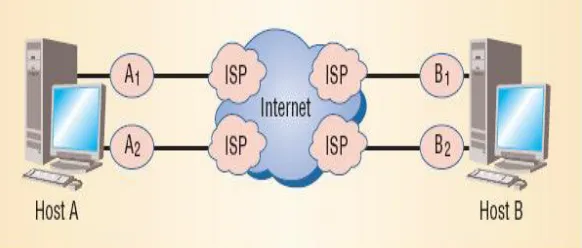
Multihoming
association between two endpoints span across multiple IP addresses or network interface cards. Multihoming is a desired functionality because it provides fault tolerance and guarantees a reliable connectivity for users. So many users, all around the world, are interested to use and benefit from this functionality. This built-in support for multihomed endpoints can utilize redundancy in the network, and allow high- availability applications perform switch over’s during link failure situations without interrupting data transfer.Multi-homing is an essential property of SCTP is its support of multi-homed nodes, i.e. nodes which can be reached under several IP addresses. If we allow SCTP nodes to support more than one IP address, during network failure data can be rerouted to alternative destination IP addresses. This makes the nodes more tolerant against physical network failures and other problems of that type. Multi-homing enables systems that have multiple interfaces, for redundancy, to use one over the other without having to wait.
Fig 1: Multihomed end hosts
Fig 2: Multihoming
In the above scenario [Fig 2] the client and server is connected to network with two different IP addresses for each. Therefore the client and server make an association using four different IP addresses. But at a time only single association is used if there is a block in selected association then it can switch to another association. Therefore, SCTP does not allow local sharing between associations (paths).
Multistream
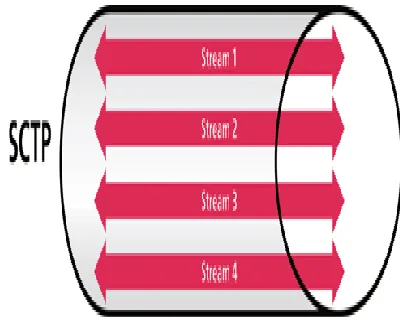
lost, the connection effectively grinds to a halt while it waits for the retransmission to be sent [3] . This phenomenon where packets are blocked by a previous packet in which has been lost is known as Head-of-Line blocking (HOL). TCP’s strict byte-order delivery gives rise to head-of-line (HOL) blocking in some applications. Multistreaming is used to alleviate the head-of-line (HOL) blocking effect.The benefit in having multiple independent data streams is that only the stream that is affected would be blocked; the other streams would continue to send data.An SCTP association is equivalent to a TCP connection. They both represent an end-to-end relationship between two transmitting nodes. In TCP multistreaming involves multiple opening TCP connections through which stream of data is sent, but this method is not efficient because it involves larger portion of available channel bath width .On the other hand, multistreaming in SCTP involves a single association where all streams reside.
Fig 3: Multi-streaming (SCTP Association)
Fig. 4: Multi-streaming
CONCLUSION
REFERENCES
[1] J. Postel, “Transmission Control Protocol”, RFC 793, September 1981.
[2] R. Stewart, “Stream Control Transmission Protocol”, RFC 4960, September 2007.
[3] M. Atiquzzaman and W. Ivancic. Evaluation of sctp multistreaming over satellite links. In 12th International Conference on Computer Communications and Networks, Oct 20-22 2003, Dallas TX. [4] J. Postel, “User Datagram Protocol”, RFC 768, August 1980.
[5] R. Stewart and Q. Xie, Stream Control Transmission Protocol (SCTP): A Reference Guide, Addison Wesley, 2001. ISBN: 0-201-72186-4.
[6] R. Stewart and C. Metz, “SCTP: New Transport Protocol for TCP/IP,” IEEE Internet Comp., vol. 5, no. 6, Nov./Dec. 2001, pp. 64–69.