PROGRAM
Ninth Annual Meeting of the American Society of Range Management Shirley-Savoy Hotel, Denver, Colorado, January 23-27, 1956
Monday, January 23 Board of Directors Meeting
Tuesday, January 24 Section Chairmen Meeting
Technical Session: Control of Undesir- able Vegetation
Chairman: Hudson G. Reynolds, Rocky Mtn. Forest & Range Expt. Sta. Range Weeds and Range Management,
M. Hironaka, University of Idaho. Progress and Problems in the Use of
Herbicides in Control of Undesirable Range Plants. Dr. Warren C. Shaw, Agr. Research Service
Controlled Burning in Forests. Effects on Reproduction, Grazing and Water Yield. Joe A. Wagner, Bureau of Indian Affairs
Use of Fire in Improving Grazing Val- ues on Jungled-up Timbered Range. Geo. A. Garrison, Pacific Northwest For. & Range Expt. Sta.
Revegetation of Big Dalton Fire. Geo. I?. Roskie, Los Padres Natl. Forest. Classification of Wildlands for their
Best Use
Desirability for Such Classification. Harold Hochmuth, Bureau of Land Management, Panel Chairman
Plant-Soil Relationships. E. Wm. An- derson, Soil Conservation Service Classification of Wildlands in the Sage-
brush-grass Region. Dr. Chas. E. Poul- ton, Oregon State Coil.
Classification of Wildlands in the Pa- cific Northwest. Wm. M. Johnson, Soil Conservation Service
Classification of Wildland in the South- west. Herbert C. Fletcher, Rocky Mtn. For. & Range Expt. Sta. Ecological Classification of Range
Lands. Dr. H. C. Hanson, Catholic Univ. of America
Evening
General Business Meeting Wednesday, January 25 Morning
Administration dt Management of Public Range Lands
Chairman : Incoming Vice Presideut President’s Address. A. P. Atkins, Guy-
mon, Okla.
Eeynote Addresses. W. E. Morgan, President, Colorado A. & M. College. Ervin L. Peterson, Assistant Secre- tary of Agriculture. Wesley D’Ewart, Assistant Secretary of the Interior. Administration of Canadian, State and
Provincial Lands. T. G. Willis, Do- minion Range Expt. Sta.
Management of Hawaiian Rangelands. E. V. Hosaka, Univ. of Hawaii.
Afternoon
Coordinating and Harmonizing the Multiple Uses in Watershed Resources Chairman: Wallace R. Hanson, Eastern
Rockies Forestry Conservation Board Water Yields for Irrigation, J. A. West,
Salt River Water Users
Watershed Resources in Relationship to Municipal and Domestic Uses. Ed Johnson, Governor of Colorado Trees versus Water and Grass. D. W.
Wingfield, Rimrock, Ariz.
Game and Recreation Needs. C. R. Gut- ermuth, Wildlife Management Insti- tute
Forestry’s Place in Watershed Manage- ment. Geo. W. Craddock, Intermoun- tain Forest & Range Expt. Sta. Ranchers’ and Stockmen’s Stake. Leav-
itt Booth, Farmers Home Adminis- tration
The Opportunity for Watershed Devel- opment Provided Under Public Law 566, Watershed Protection and Flood Prevention Act. Carl B. Brown, Soil Conservation Service.
Impact of Mineral Investigations and Exploitations on Surface Uses. Hale C. Tognoni, Arizona State Law Com- mission
Evening
Photographic and Kodachrome8 Slide Contest. Colored Movie: Range Prac- tices in Marsh and Longleaf Pine Lands. Mark Richard, Gulf Coast Soil Conservation District.
Thursday, January 26 Morning
How Grass Grows and the Influence of Growth Habits on Utilization Measures
of Proauctivity
Chairman : Ben A. Madson, University of California
Elementary Morphology of Grass Growth and How It Affects Utiliza- tion. C. A. Rechenthin, Soil Con- servation Service
Food Reserves in Grasses and Their Ef- fect on Seasonal Utilization. Ray- mond Price, Rocky Mtn. Forest & Range Expt. Sta.
How Growth Requirements of Range Plants Determine Sound Grazing Management. A. L. Hormay, Cali- fornia For. & Range Expt. Sta. What the Rancher Wants to Know
About Productivity of Ranges- Pounds of Forage and Pounds of Livestock Produced, Marvin Kniese, Wray, Colo.
Digestibility of Range and Pasture For- age Under Grazing Conditions. Dr. C. Wayne Cook, Utah State Agr. Col- lege
Need of a Unified Systetm for Measuring Range Productivity. M. D. Burdick, Soil Conservation Service
Evaluation of Grazing Lands Based on Animal Production. Neil C. Frisch- knecht, Intermtn. For. & Range Expt. Sta.
Afternoon
Field Trips. Bureau of Reclamation Laboratories at Federal Center or Safeway Distribution Center
Evening
Annual Banquet. Toastmaster, Judge Mortimer Stone, Denver, Colo.
Friday, January 27 Morning
. Possibilities and Economic8 of Improving Range Land
Chairman, : Frank C. A,rmer, Phoenix, Arizona
In the Pacific Northwest. Willard Bunch, Durkee, Oregon
In the Southwest. Bernie VanderWag- en, Gallup, N. Mex.
In the Northern Great Plains. Francis Murphy, Colorado Cattle Growers In the Southern Great Plains. G. 0.
Hedrick, Walnut Springs, Texas In the Intermountain and Great Basin.
Wm. S. Young, Wanship, Utah Grazing Capacity of Longleaf -Slash Pine
Forests. Lowell K. Halls, Georgia Coastal Plain Expt. Sta.
Management Pays on the Starkey in Eastern Oregon. Richard S. Driscoll, Pacific Northwest Forest & Range Expt. Sta.
Juniper Control in Arizona: Methods, Costs, Benefits. Joe F. Arnold, Rocky Mtn. Forest & Range Expt. Sta. Range Fertilization Trials. Dr. Wm. E.
Martin, Univ. of California Afternoon
Chairman: C. H. Wasser, Colorado A. & M. College
Range Management Education. Dr. David F. Costello, Pacific Northwest Forest & Range Expt. Sta.; Dr. T. B, Keith, Univ. of Idaho; Dr. Charles E, Poulton, Oregon State College; J. W, Southworth, Seneca, Oregon; Dr. E W. Tisdale, Univ. of Idaho.
The Place of Game in the Multiple Use of Southeastern Ranges. H. D, Burke, Southern Forest Exp. Sta. Compatablity of Farm Forestry and
Sheep Grazing in Willamette Valley, Fred Hall
L
Journal of
Volume
8, Number 6 November, W.3RANGE
MANAGEMENT
Where Have We Been and Where Are We
Going in Range Management?
ARTHUR W. SAMPSON
Professor of Forestry Emeritus, Ulziversity of Cdiforrtia Berkeley, California
This paper deals with two aspects of range management : (1) an ap-
praisal of the influence of research in formulating our present range management practices ; and (2) the
future research needs of the field of range management.
An optimistic outlook on the pro- duction from the Nation’s range- land in the next quarter century is held by many range technicians and graziers. As Renner (1954) has apt.ly pointed out, the outlook 25 years ago would likely have been on the pessimistic side. Up to that time little had been accomplished to curb the downward trend in range conditions and soil loss : reduction
in livestock numbers seemed to be the only answer for correcting the adverse situation. .
The timely financial help of the federal government to alleviate the plight of agriculture in the 30’s; the organization of the Bureau of Land Management beginning in 1934, though handicapped by in- adequate appropriations and per- sonnel; and the lucrative market values of livestock that followed, had much to do with the improve- ment that has taken place. Indirect results of this governmental assist- ance were : the perfection of ma-
chinery for eradication of noxious vegetation, techniques for reseed- ing, the formation of large numbers of soil conservation districts on livestock ranch areas and elsewhere, and the assistance of state govern-
1. Paper presented at the Eighth Annual Yeeting of the American Society of Range Managemertt at San Jose, Cali- fornia, January ~3’7, 1955.
ments in innumerable technical and practical ways. Since 1930, range livestock populations have in- creased sharply. In future years, progress in range rehabilitation will depend upon the effectiveness of the research program and the extent to which the findings have been applied.
Looking ahead 35 years or so, indications are that many more animal products and foods of all kinds will be needed in this and other countries. With living stand- ards continuously rising, and with populations increasing at rates not heretofore anticipated, demand for food, housing and clothing will in- crease tremendously. In 1950 the population of the United States was 150 million; in 1955 it is more than 160 million; and by 1975 it is esti- mated to reach 200 million.
According to the Mid-Century Conference on Resources for the Future, there is a note of pessimism as to whether the land can continue to produce to the extent that it has. Many feel that the world is al- ready overpopulated and that the remaining acreage suitable for agri- culture is relatively small.
Range Reseeding
Reports on depletion of the west- ern range mark the earliest welfare consideration of this resource. At various times during or even before the 1880’s, reports of range deple- tion in the Southwest and elsewhere made their appearance (Bentley 1898, Bidwell 1865). These reports were so disturbing that, in 1900,
241
the federal government, followed by the state experiment stations, appropriated a small fund for range reseeding.
This study continued slowly over the years with indifferent results. It was not until 1935 that a large scale reseeding study was initiated. Recently, federal appropriations for reseeding have been among the largest for specific projects in range research.
Some 25 grasses and a few leg- umes, half of which have been in- troduced in recent years, have been found useful on the range (Hafen- richter, 1955). Study has also dem- onstrated how, when and where to seed promising species. As a result, a goodly number of ranchers have reseeded their own lands and many are obtaining larger yields and a longer green feed period than was possible with the resident species.
Certainly a good start has been made in the general procedure of reseeding, but much more study is needed.
Site quality is deserving of more critical appraisal which would involve : soil classification as to
depth, pH and productivity; im- provement of soils for grass pro- duction; further study of fluctua- tions in distribution and amount of annual precipitation; and fur- ther consideration of the indicator significance of native plants as related to site quality.
Better standards for appraising the degree of success of
seeded
areas are needed. Hull (1954), among others, has made a good start in this direction; but, per- haps the agronomist, ecologist, physiologist and soil scientist could combine their talents to formulate a more widely useful guide to re- seeding appraisal.242
ARTHUR W. SAMPSON Since the resident species are welladapted to conditions within their range of tolerance, they present no special problem after establish- ment. Local strains or ecotypes of superior characteristics may be seg- regated and used for revegetation.
Critical study of the source of seed for planting seems justified. Earlier and larger yields of forage have frequently been obtained from seed produced 200 to 400 miles south, than from seed locally grown. ”
Breeding and genetic studies should be continued for the _im- provement of vigor, nutrition and yield and the development of early- growing and later-maturing forage plants. The chances of success in breeding forage plants should be as good as in cereal and orchard crops.
Paramount to all reseeding con- siderations are the costs and long- time returns on the investment. A much broader analysis of the eco- nomic aspects is needed.
Natural
Reseeding
Grazing management systems, designed to build up and maintain the natural plant cover, should be further tested to ascertain the best system or combination for each grazing region.
On high mountain ranges, de- ferred and rotation grazing are ac- cepted as essential to maintenance of ranges (Sampson, 1955). At lower elevations variable results have been reported from deferred- rotation grazing-some good, others of questionable application. Under southwestern conditions, a simpli- fied-rotation system used by Mer- rill, 1954, gave a steady trend to- ward improving range condition and increased financial returns. Similar systems in other localities may give beneficial results.
Further research on grazing sys- tems, particularly the deferred-ro- tation system, is needed in several climatic regions and plant associa- tions, including the annual-type range of California.
Brush Control
From the earliest records of agri-
cultural pursuits, graziers in far- flung regions have had to cope with undesirable, aggressive, and of ten persistent woody plants (Shantz, 1947). Conditions over much of the western United States particularly favor the growth of brush.
Researchers of the last 15 years have made a good beginning in showing how woody vegetation may be controlled, including the big sagebrush in the Great Basin re- gion, mesquite in the Southwest, and the chaparral found in Cali- fornia. Reseeding coupled with brush clearance is receiving much consideration by research workers and ranchers alike.
More information is needed on the causes of brush invasions into grasslands-historically, biological- ly and climatically. In the South- west, mesquite is reported to be in- creasing faster than it is being eradicated.
The cost of brush clearance and of seeding is often prohibitive, chiefly because of the difference be- tween the value of the site and the high cost of brush removal. For example, the cost of controlled burning of California chaparral is much higher than is generally an- ticipated ; it is less for areas of
about 400 acres than for smaller or larger areas (Sampson and Bur- cham, 1954). Certainly further study of the most economical size of brushfield to clear, and of keep- ing the area in a more useful kind of vegetation by whatever means, is justified in all the major brush- land types. R&able means of classifying the quality of brush- land sites for profitable clearing have long been needed.
There is evidence that brush can best be controlled by a combination of methods. More selective herbi- cides, more efficient machinery for removal of brush, and the develop- ment of suitable plants for seeding brush-cleared lands are needed. A strong grass cover is a good deter- rent to brush invasions.
Little information is presently available on the ecological life history of our dominant noxious brush species. Information is espe-
cially needed on: length of life; rate of growth; age when seed is first produced ; amount, frequency,
and viability of the seed crop; hazards during seedling establish- ment ; natural enemies; trends in seasonal food reserves and sprout- ing characteristics when cut or burned.
Range Fertilization
It is evident that various range soil types may be low in one or more of the essential nutrient ele- ments. Experimental trials have shown that nitrogen, phosphorus, and less commonly potassium, sul- fur, and certain trace elements, are needed in some localities for maximum forage yields and desir- able species composition.
Research should determine the nutrient deficiencies of various soil types and the economic returns to be expected from fertilizers. In some localities, selective fertiliza- tion of western rangelands has paid well; in other regions indifferent or negative results have been ob- tained.
In some areas of the annual-type foothill ranges of California, com- binations of nitrogen and phos- phorus have given increased yields and longer grazing seasons when applied under suitable conditions
(Martin and Berry, 1954 ; Miller
and Park, 1955).
Range fertilization should not be looked upon as a panacea for faulty grazing practices. It must be used with discretion if good results are to be achieved. It is significant, perhaps, that although fertilization tests were made on ranges in parts of the Southwest and the northern Great Plains Region before they were undertaken in California, re- sults were not sufficiently effective to justify their use.
In further studies of range fer- tilization, the following items might well be included:
1. Fundamental investigations of fertilizer effects on various vegeta- tional and soil types.
WHEItE ARE WE GOING IN RANGE MANAGEMENT? 243 ,
sufficiently by fertilizing to correct the deficit in phosphorus-deficient areas ?
3. The relative proportion of the total range acreage to be fertilized in relat,ion to particular livestock operations. For instance, on a cow- and-calf ranch producing feeder steers or on a ranch devoted to lamb production.
4. The effects of fertilization on the rate of range improvement, seed
production and plant succession. 5. The economics of fertilization under various site conditions. Must fertilizers be confined to the more productive sites ?
Poisonous Range Plants Although many range areas have improved in condition in recent years, the abundance of our poi- sonous plants seems not to have changed perceptibly. With some- what better quality of forage and practical directives for minimizing plant poisoning, losses from this source are presumably less serious than a quarter of a century ago. It has long been recognized that the crux to minimizing losses from poisonous plants lies in the field of good range and grazing manage- ment.
During the past decade, the in- terpretation of a poisonous plant has been greatly broadened, largely because of the discovery of certain seasonally toxic substances in com- mon forages. Plant species contain- ing lethal amounts of nitrogen have occasionally accounted for heavy livestock losses. As, for example, fiddle-necks (Amsinckia spp. ) and
milk thistle (Silyybum maritanum)
in California (Bellue, 1952). Under certain growth conditions little un- derstood, these and other plants may accumulate dangerous concen- trations of potassium nitrate (Gil- bert et al., 1946).
Nitrate accumulation may be fa- vored by applications of 2,4-D. In several instances, the leafage of sugar beets, after being sprayed with 2,4-D, has accumulated nitrate concentrations in excess of 8 per- cent, whereas, 1.5 percent is con- sidered lethal (Stahler and White-
head, 1950). On areas containing abundant manure, such as holding pastures, nitrogen-accumulating plants tend to build up lethal levels of nitrate. Since the symptoms of nitrate poisoning are similar to those of hydrocyanic acid, the se- riousness of nitrate toxicity has been underestimated.
More exploratory work is needed’ in coping with poisonous plants, particularly :
1. A d d i t i o n a 1 toxocological study of such confusing genera as
Lupinus and Astragalus.
2. Illuminating pictorial and popular descriptions of the more troublesome local species.
3. Descriptions of common habi- tats of species and study of condi- tions favoring lethal accumulations of such substances as hydrocyanic acid, nitrate, or selenium.
In this article Professor Samp- son gives us in broad perspective the accomplishments in range management and the future needs of range research. It reflects the rapid growth and development of the science and art of grazing management.
4. Development of further prac- tical guidance in preventive and remedial measures of plant poison- ing.
Although ranchers are generally familiar with the food plants of their range, they often do not recognize the poisonous species. This local problem can best be corrected through the help of state and federal agencies.
Grazing vs. Timber Reproduction Soon after the creation of the U. S. Forest Service in 1905, study of the effect of grazing on timber reproduction was undertaken. The study revealed that on conserv- atively grazed areas damage was nominal-except in parts of the ponderosa belt of the Southwest where sheep were grazed (Hill, 1917).
More recent study on forest lands in the South has shown that close and unseasonable grazing by cattle resulted in destruction of many hardwood seedlings and even young trees by literally “riding them down” to make up for short- age of forage (Biswell and koo- ver, 1945). Correction of this con- flict in interests is being made by adjusting the grazing season to correspond with the period of ade- quate nutritious forage, and to avoid overstocking.
Conclusions from the studies concerning coniferous forests are of two categories: (1) those of general application, and (2) those applying to regional or more local conditions. General application is concerned with overgrazing, poor livestock handling, unseasonable cropping, and grazing by the wrong kind of livestock. Those of regional application are chiefly based on climate and extent of timber reproduction, the South- western forests being much more subject to damage than those of the Northwest or in Montana and Wyoming.
Future researches should be di- rected to a consideration of the following :
1. The relative palatability to domestic livestock and deer of the different species of coniferous and hardwood reproduction.
2. Extent of damage to planta- tions and farm forests from brows- ing and trampling of livestock and its economic consequences.
3. The control of damage by deer browsing and rubbing in for- ests and plantations in the eastern states where these animals are a pest.
Range Utilization and Grazing Capacity
Improvement and maintenance of rangeland production are pri- marily governed by the closeness of grazing of the season’s forage crop. Too close utilization results in decline in forage production ;
I 244 ARTHUR W. SAMPSON be grazed without decline in for-
age yield or in lowering of its for- age potential 0
Recent researches have provided means of setting up standards of use for various-but not all- range associations and forage spe- cies, chiefly grasses. These stand- ards-largely based on clipping experiments to stimulate grazing -serve as guides for judging proper range use and grazing ca- pacity. The degree of utilization is expressed in percentage by com- paring average stubble height of the key species with corresponding heights of the same species for which the “form factor” or height- weight ratios have been deter- mined. From 35 to 50 percent of the current growth should usually be left ungrazed.
According to *recent researches, range condition, or “health” of the range, is the state of productivity of the forage and the soil compared with the potential of an area when properly utilized. Condition class- es are designated as excellent, good, fair, poor, or very poor; excellent being ideal, good as satisfactory, and the others as unsatisfactory. These classes are determined by density and composition of the cover, plant vigor, mulch and soil stabilit: Change from one con- dition class to another is Indicated by trend in the succession. Over- utilization causes the trend to de- cline downward, whereas proper utilization favors an upward trend or leaves it unchanged.
Stoddart (1952) and others have challenged the use of utilization standards because : (a) knowledge
of the physiological endurance of plants to defoliation is largely lacking ; and (b) the tremendous
fluctuations from year to year in forage production on the western range render utilization standards all but useless.
Additional study of the two sub- jects under discussion is needed. Perhaps the following points might be worthy of consideration:
1. Enlargement of the study of utilization standards to encompass
important species of forbs, shrubs and grasses.
2. Determination of the food reserve trends for important in- dicator species that might be in- cluded in the utilization standards study. Studies should be made on ungrazed plants a,nd plants defoli- ated in varying degrees, to simulate grazing.
3. Grazing capacity determina- tions in controlled experimental studies in the major range forage types. In each community where the experimental pastures are lo- cated, as suggested above, grazing capacity records-on ranges in good condition-should be com- piled in cooperation with the ranchers. At present there is a distinct lack of grazing capacity history to draw on. The tests should be continued until conclus- ive results on proper use and grazing capacity have been estab- lished.
4. Coordinate methods of survey based on range condition classifi- cation by unifying present varia- tions in methods of measurements, in rating of condition classes, and in estimating their grazing capaci- ties.
Rangeland Erosion Control and Watershed Management The potential increase in range and forest products in past years has been offset in large measure by loss of soil resulting from thin- ning of the vegetal mantle. The sorting action on exposed areas of water and wind separates and re- moves the organic matter and the clay and silt fractions, leaving the soil in an infertile state (Stall- ings, 1950). Correction is slow and costly.
The multiple use approach of wildland management-providing water for the valley farmer and urban dweller, grass for the ranch- er, timber for the lumberman and game for the sportsman-has en- dured for many years, though not without argument. Indeed, it has become an established practice on diversified public lands.
Present knowledge of the rela-
tive effectiveness of the different kinds of covers-trees, brush, grass, leaves, litter and organic matter-on water yield and as protection against erosion, is limit- ed. On experimental plots in Cali- fornia, for example, water yield is variable where brush has been removed, and seems to be influ- enced by the kind of vegetation and size of area cleared (Biswell, 1954). Since some soils erode more readily than others, those most sub- ject to dislodgement need a rela- tively abundant cover. Range in good condition with near maxi- mum density of desirable forage plants is generally associated with a stable soil. Range in fair to poor condition, with its typically incom- plete plant cover composed largely of undesirable plants, is common- ly associated with abnormal rates of erosion and poor watershed con- ditions (Ellison et al, 1951).
Various management guides or indicators may be employed to recognize downward trends in range condition and accelerated erosion.
Determination of accelerated erosion may be made by runoff plots and catchment tanks, or by a combination of indicators and inexpensive measurement devices such as developed by Gleason (11).
Future rangeland erosion con- trol and watershed management research should embrace the fol- lowing :
1. Both refined and broad bio- logical and physical studies, in- cluding consideration of the econ- omic feasibilities of engineering structure for critical areas.
2. Are there areas in the upper watersheds where dams and reser- voirs would serve better than vege- tal control ?
3. Are the long-time values ob- tained from conversion of brush areas or of timberland to grass justified in the interest of soil con- servation, forage production and water yield-especially on area? where grass does not occur in the successful pattern ?
WHERE ARE-3VE GOING IN .RANGE MANAGEMENT?
always obtained from
practices
that maintain a stable soil, or may non-conservation practices produce the largest benefits on some areas?5. What impact has the land ownership pattern-federal, state, private-on soil erosion and water yield? Are there land units where change in ownership is justified?
6, Is there justification for the use of undesirable range plants like foxtail fescue, red brome, or mustard, which form a cover quick- ly to stabilize the soil, such as on burned-over brushlands in Cali- f ornia ?
7. What are the effects of con- trolled fires, fertilization, reseed- ing and subsequent range manage- ment practices on percolation, run- off and erosion?
8. Are ranchers and others jus- tified in giving further support to studies of rain-making to favor the plant cover?
Wildlife Ma;nagement Until 1930, management of big game animals consisted largely in applying a few regulations con- cerning the “take”. Wildlife was considered a product of nature, not tied to the land upon which it lived. The regulatory measures resulted in vastly increased wild- life populations-in some localities well in excess of the food supply. Present-day wildlife manage- ment considers this resource as a crop and aims to provide suitable local habitats for the desired spe- cies and adequate seasonal forage, water and cover. Specially de- signed surveys show the supply of food, forage utilization, the ex- tent to which the animals are com- peting among themselves and with domestic livestock for food. The surveys also indicate the desirable size of the animal populations, and endeavor to develop effective prin- ciples
in
controlling wildlife num- bers.In some areas, protection is like- 1~ to’ destroy rather than to per_ petnate the herbivorous game ani-
mals. The number and sexes of big-game to be taken must be de- cided on the basis of the adequacy
This issue is dedicated to the development and improvement of grazing lands throughout the world. Technical assistance programs and inter- national cooperative efforts such as that of the Food and Agricultural Organization of the United N&ions have forcibly brought tc our atten- tion the similarity in problems faced by graziers throughout the world and the common objectives shared by range mana.gers in our own and neighboring countries.
The papers assembled in this International Issue describe the operation of the technical aslsistance programs its sponsored by the International Cooperation Administration and the FAO, and discuss the problems and management practices of several important grazing regions of the world. In tlhe first paper Wayne Miles of the Food and Agricultural Organiza- tion discusses the attributes and qualifications of technical.ly trained men for international cooperation programs in range management. Prior to his Chilean assignment in 1953, Miles served with the FAO as a range management advisor in Israel,
Hugh M. &an and H. Wa#yne Springfield present the broad problems
of range improvement in an arid land and the plan of attack as developed in the assistance program initiated under the former Foreign Operations Administration
Techniques for evaluating grazing resources and for the stimulation of interest and awareness of the principles of range management are described in the articles by Barry C. Park and Marvin Hlemme.
2. Naveh, in charge of Bange Besea,rch at the Experimental Farm Nve- Yaar at Behovot, Israel, presents an excellent perspective of recent work in range improvement in a representative Mediterranean area. T’hR paper
was originally givein at the Ankara meeting of tlhe FAO Working Party , on Mediterranean Pasture and Fodder Development.
The problems and progress in range management in an important South American grazing region are described by E. J. Woolfolk in a paper presented at the Eighth Annual Meeting of the Society in San Jose, California. Woolfolk participated in the 1953 International Pasture Management Course conducted by the Inter-American Institute of Agri- cultural Sciences, the Argentine government and the FAO.
of the habitat if catastrophe is to be avoided. On the other hand, supplemental feeding on winter range is being discouraged be- cause of high cost and also be- cause the over-utilization of nat- ural browse adjacent to the feed- lots.
Problems needing solution or further study in the interest of sustained game production in- clude :
1. Determination of the graz-
ing capacity of wildlife ranges in relation to establishing optimum populations of livestock and big game. At present woefully little is known about carrying capacity for big game mammals.
2. Improvement in
the method-
ology for obtaining
adequate har- vests of wildlife without sacrifice of recreational and aesthetic val- ues.24ti ARTHUR W. SAMPSON
ues of game in relation to other land uses. This would entail further study of the comparative food habits of big game and do- mestic livestock.
4. Effective means of manipu- lating the habitat, particularly of brush fields and cutover areas, with a view of increasing food for wildlife.
5. Provision of technical assist- ance to ranchers for improvement of rangelands for wildlife as a source of income through hunting.
6. Study of the control of ro- dents and predators in the interest of wildlife and livestock.
Range
Animal Husbandry A few readers will recall the gradual replacement on the range of the long-horned, long-legged cattle and light-shearing sheep of Spanish origin for animals of vast- ly improved conformation and usefulness. Federal and state or- ganizations have assisted in the improvement in quality of range livestock. Such improvement in breeding herds and bands consti- tutes one of the outstanding achievements of range animal hus- bandry but much remains to be done.The introduction and local breeding of Brahman bulls has re- sulted in measurably increased meat productoin in various parts of our warm, humid southern ranges as well as in some dry warm localities.
In sheep production not the least of the advancements are the cross-breeding experiments which have produced earlier and heavier lambs, and have shown how the basic breeding stock may be main- tained.
Among the
problems in need of
further
research, the following seem important :1. Further advancement in
breeding and selection t0 mini-
mize range livestock losses from disease and parasites.
2. Development of less costly means of wintering livestock on open range or in the feedlot.
3. Further study of the palata- bility and nutrition of range for- age, and the period when supple- mental range feeding is biological- ly needed and is economically jus- tified.
4. The relation of forage nutri- tion to abnormalities in livestock, such as “acorn” calves, decreased fertility, and the like.
Resume
This, then, is a much abbreviated account of the influence research has had on our present range prac- tices, and of the future needs of range research.
Perhaps an occasional look ahead is helpful lest we become overly complacent. Of one thing we can be certain: range research work- ers are not likely to run out of a job. From here on, however, be- cause of the more technical prob- lems arising on every side, better trained men will be needed. For this we must not only lean on the colleges and universities, but we must do a better job of familiariz- ing educators with the nature of our problems. Only in that way can we, as range mana.gers, have a part in shaping curricula the better to meet the educational requirements of our research per- sonnel.
LITELRATURX CITED BE~LUE, M. K. 1952. Nitrate accumula-
tion in toxic quantity discovered in
California. weeds. Calif. Dept. of Agr. Bull. 41(Z) : 103.
BENTLEY, H. L. 1898. A report upon the grasses and forage plants of cen- tral Texas. U. S. Dept. Agr., Div. Agrost. Bull. 10 : l-38.
BIDWELL, GENERAL T. 1865. An address delivered at the annual fair Agricul- tural Society of the Northern District of California., August 30, 1865. Trans. Calif, Agr, Sot. X364-65, 1865:202-213. BISWELL, H. H. 1954. The brush control
pr&lem
of California. Jour. Range Ma@. 7 (2) :57-62.Y AND M. D. HOOVER,. 1945. Appa- lachian hardwood trees browsed by
cattle. Jour. Forestry 43 (9) : 675-676. BRA~LJZX, W. B., H. F. EPPsON AND 0. A. BEATE. 1940. Livestock poisoning by oat hay and other plants containing nitrate. Wyo. Agr. Exp. Sta. Bull. 241: l-20.
CAMPBELL, R. S. 1944. The history of
western range research. Agriculture History 18 : 127-143.
DAVIDSON, W. B., J. L. DOUGHTY AND J L. BOLTON. 1942. Nitrate poisonin of livestock. Canadian Jour. Corn1 Med. 5 :303-313.
ELLISON, L., A. R. CROFT AND R. W BAILEY. 1951. Indicators of conditio and trend on high range-watersheds o the Inter-mountain Region. U. S. Depi Agr., Agricultural Handbook NO. 19 l-66.
GILBEXT, C. S., H. F. EPPSON, W. E BRADLEY AMJ 0. A. BEATH. 1946. Ni trate accumulation in cultivated plant and weeds. Wyo. Agr. Expt. Star Bul: 277 : l-37.
GL~SON, C. H. 1953. Indicators o erosion on watershed lands in Cab fornia. Trans. Amer. Geophys. Union 34(3) :419-426.
HAFENRICHTER, A. L. 1955. Grasses new and old for range reseeding Western Livestock Jour. 33 (8) :46, 124 126, 130, 133, 135.
BILL, R. R. 1917. Effect of grazing upon western yellow pine repro’ductiol on the national forests of Arizona am New Mexico. U. S. Dept. Agr. Bull 580 : l-27.
HULL, A. C., JR. 1954. Rating seeder stands on experimental range plots Jour. Range Mangt. 7(3) : 122-24. MARTIN, W. E. AND L. J. BF~RRY. 1954
Will range fertilization pay’8 Univ Calif. Agr. Ext. Service Prog. Rep 31 pp. Mimeo.
MERRILL, L. B. 1954. A variation ir deferred rotation grazing for use under Southwest range conditions. Jour Range Mangt. 7 (4) : 152-154.
MILLET, H. W. AND A. G. PARK. 1955. Fertilizer demonstrations point tc range improvement in California Western Livestock Jour. 33(8) :40, 41 104.
RENNER, F. G. 1954. The future of on range resources. Jour. Range Mangt 7(2) :55-56.
SAMPSON, A. W, Grazing systems. West ern Livestock Jour. 33 (8) :44. 1955
AND L. T. BURCHAM. 1954. Cost, and returns of controlled brush burn ing for range improvement in northern California. Galif. State Division o Forestry. Range Improvement Studie No. 1: l-41.
SHANTZ, H. L. 1947. The use of fir1 as a tool in the management of thl brush ranges of California. Cadif State Bd. Forestry. 156 pp.
STAB=, L. M. AND E. I. WHITEHEAD 1950. The effect of 2,4-D on potatasiun nitrate levels in leaves of sugar beet6 Science 112 (1821) : 749-751.
STALLINGS, J. H. 1950. Erosion Of top soil reduces productivity. U. S. De@ Agr., Soil Cons. Service : l-31. ST~DDART, L. A. 1952. Problems in eStj
Qualified Men for Technical Assistance
WAYNE MILES
Santiago,
Ciile
The success of foreign technical assistance programs depends to a
wry great degree on the ability, initiative and personality of the people sent out as advisers. It is a job worthy of our better teehni- &us.
The U. S. technician in a foreign laud is becoming more and more comn~onplace as we seek to help the “onderdeveloped countrirs” of the world. Those of us who have sppnt time overseas on technical assign- ments hare usually found the as- signment to be an eye-opening experience. A great man? other technicians have no doubt eonsid- ered whether thry want to seek such an assignment or to accept one that has been offered. Others who hare no interest in going “ver- seas are asking whether the techni- cal assistance programs are effee- tivr. Let us take a look at the sitn- ation RS it appear from orerseas.
TVe Americans are accustomed to houses with central heating, to hpated cars, supermarkets, canned hoods, the corner drug store, ready- mxllr clothes and a great many cow wnienees. Overseas the expwt and his family have to give up some of these luxuries. This is not to imply that xe must expect to live in a horrl and eat onlp local food. To mope into a far-away country does, hoverer, require certain adjust- ments in ways of living. On one hand ve may find ourselres with a frill-time maid for the first time in our lives and on the other hand in the coldest house ve hare ever lived in.
Experts who go for an assign- ment of one yrar or more are IIS”- ally encouraged to take their fami- lies along. This usually prows to be the best arrangement. This means, honevrr, that the rntire family must be prepared to make
the nrcrssary adjnstmrnts, includ- ing that of learning to speak in R new language in most cases.
Technically we are in for a cer- tain amount of adjustment as well. Those few who go out with the idea that they can just transplant IT. S. techniques to an nnenlighten~d area are due for a rude shock. Those who go as h+ers, who havr had a certain experience that may help local technicians to solve local problems, are much more likely to
succeed.
The “underdeveloped country” is likely to have some very intelligent and well read technicians. Some of the better local technicians may have studied in the U. 6. on their particular specialty. The U. S. technician may find that the local man has read the latest issues of the technical journals and that he has the latest texts available for refer- encp. The reverse may also be true
and there may be no local man in the field of work.
The good local technicians RR likely to be woefully underpaid, without adequate transportation, aud mixed with more than the usual number of lazy or ineompe- trnt government workers. Quite often the brtter local technicians have some good ideas as to what needs to be done. They may need help to find the key points that are delaying progress. The local man may also need the help and the prestige of the “Foreign Expert” to get an effective program in motion.
248 WAYNE MILES
,.
value and distribution. Range technicians from the U. S. may well ask themselves if thry have as de- tailed information on their own minor species as these uneducated Arabs hnvr accumulated through years of close observation.
Not all the problems are teehni- cal problems in the usually accept- ed sense. Local laws and customs are ofteu serious barriers to prog- ress. Lack of foreign exchange, customs r*gulations, import li- censes and other barrirrs quite often make the import of the latest type of maehinr or the best adapt- ed seeds practically impossiblr. This may make necessary the choice of alternative methods and locally available types of machines or even hand methods. The local technician may be a rich man’s son who feels that getting his hands dirty is be- low him. The man may not be actw ally lazy. In certain cultural groups educated men do not work with their hands.
The U. S. technician must learn as much as possible about the local situation and try to find acceptable solutions to the key problems. This requires a broad knowledge of the technical field, plus adaptability and common smse. Adaptability is
a particularly necessary trait. The ability to “make do” with thr facili- ties available usually spells success.
There is usually a great deal to be done and very limited facilities for doing the job. By study, con- mltation and careful evaluation, the work must be directed toward those activities and projects that promise the best results. Care is nrcessary to insure that projects are within the capabilities of the farmers and the country to carry out.
The technician who has B great deal of experirnce in actually car- rying out the details of the job aill find R ready use for these talents. Actual farm experience is particu- larly useful for those who work in various fields of agriculture. A range managmnent specialist may, for example, find himself trying to adjust a fmlty electric fence charger bring used on n grazing trial or helping to adjust R machine for cutting grass seed. It may even be that the particular job will fail if the expert cannot provide just this type of assistance.
The success of an expert depends as much upon his ability to win friends and influenre people as up- on his technical knowledge of his
field. B&h local experts and local farmers and ranchers must be sold on new techniques. This requires mthusiasm and salesmanship. It also requirrs that the expert be friendly, tactful and tolerant.
A sincere desire to help the peo- ple of the particular country to im- prove their farming methods and their standard of living is essential to the success of a technical assist- mre assignment. Local people are qrlick to sense the fact if an expert is more interested in being a tourist than in being a friendly helper. Those who take a foreign assign- ment principally for the trip are very likely to be discouraged and not too happy with their work.
The ability to met discourage rnent without giving up is also neo- essary. Seeds ordered by air mail for rush delivery may lie in cm- tom for five months while the sea- son for seeding slips away. Inex- cusable ? Sure it is inexcusable, but it happens. One must learn to post- pone the trial for which this par- ticular packet of seed was ordered and go ahead with other projects in the meantime. The man who would let such a thing spoil a year’s work has little business trying technical assistance work.
If you as a technician have not been discouraged by this list of re- quirements, then by all means try to see if there is a job for you in this type of work. There are cer- tainly plenty of countries needing help to bring up their agricultural production in order to provide higher living standards.
Range Management in Iraq-
Findings, Plan and Accomplishment
HUGH M. BRYAN AND H. WAYNE SPRINGFIELD’
Range Conservationist, Bureau of Land Manlagement, Salt Lake City, Uta,h; Range Conservationist, Rocky Moun- tain Forest and Range Experiment Station, Fort Collins, Colorad.
Invitations to advise Iraq in grazing matters were accepted with misgivings. Iraq is a new country established on an old site under British mandate after World War I. It is now an autonomous king- dom. It is the land of the Caliphs romantically described in the Ara- bian Nights; Mesopotamia of the Greek and Romans; Babylonia of Old Testament days; Sumeria of Abraham’s time, and, according to local tradition, the site of the Gar- den of Eden. The recorded history of the land covers more t,han 5,000 years. Still older cultures are being found below great ruins which indicate more ancient peo- ples.
Range men from a land where livestock grazing is only from 100 to 400 years old might be advising the descendants of those who do- mesticated the horse, cow, sheep, goat and donkey. The prospect was challenging. The Iraqi leaders had asked that their country be shown how to care better for the many and necessary livestock and still protect a limited and hard pressed grazing resource.
The welcome to Iraq was as warm as the weather. The Iraqi ministries are manned by educated and energetic men who are using income from taxes and oil to build facilities for health, education, im- proved agriculture and other ad- vantages for the people. Such works were very limited until recently when the discovery of oil gave the
1. Information for this paper was ob- tained while the authors were employed in Iraq with the Foreign Operations Ad- ministration, now the International Co- operatbn Administration.
wherewithal for public expendi- tures.
Full cooperation was provided by the Ministry of Agriculture in the form of office space, young Iraqi counterparts and means of travel. Field trips were designed to see sample areas of all Iraq at the appropriate season or seasons of the year. The trips were usually joint ventures of the American technicians and their trainee-coun- terparts. The balance were indi- vidual efforts but always with alert, local men.
Administratively, Iraq is made up of 14 provinces called Liwas, and smaller subdivisions. There are also two “desert” Liwas in western Iraq. In each Liwa is a representa- tive of the Crown and agents of many ministries including Agricul- ture. On the first expedition into each area the political leader was visited. The agricultural agents were our hosts. They are not exten- sion agents but administrative offi- cers who help collect the taxes levied in the form of a percentage of crops. These men devoted their time and interest to our work and, when other accommodations were lacking, entertained in their offices and homes.
Land Forms
Iraq is roughly the size of Mon- tana, but is much drier. The Tigris and Euphrates rivers enter from the north and join before flowing into the Persian Gulf (Fig. 1). Iraq is chiefly the delta of the rivers which are the lifeblood of the area. The land is flat; Baghdad is 300 miles from salt water but has an elevation of only 110 feet. Half of Iraq is less than 600 feet above
sea level. The uplands from 600 to 1,600 feet occupy the remaining half except for the northern fringe of mountains which are less than l/16 of the total area of the coun- try. The mountains, which are the home of the Kurdish people, enjoy a much greater interest than their area justifies.
The rivers are large, like the lower Snake and the middle Colo- rado rivers of this country. Their sources are in the mountainous areas of Turkey. Their chief trib- utaries in Iraq cut through the mountain ridges where they are being dammed for flood protection and irrigation. At the foot of the
mountains, whose peaks rise to lO,- 000 and 11,000 feet, are broad up- land benches which are dry farmed to winter crops of wheat and bar- ley. These upland benches are bounded by parallel ridges of foot- hills under which oil reserves have been located and brought into pro- duction.
The land between the rivers (Mesopotamia or Jezira) is flat and in part overflowed when floods are excessive. A relatively small part is irrigated. The part of the Jezira north of Baghdad produces scant to fair natural vegetation. The por- tion south of Baghdad supports lit- tle or no vegetation except in the swamps, rice lands, and palm gar- dens which are relatively large and richly vegetated. This part of Iraq is chiefly responsible for Iraq’s date crop which is claimed to be 70 per- cent of the world’s commercial crop.
250 HUGH M. BRYAN AND II. WAYNE SPRINGFIELD where bare rocks of old lava flows
shed water to start flood waters in westerly courses.
The flatness of most of Iraq is a great protection from water ero- sion. The rains are usually gentle but are heavy on occasion. The hills and lower mountains generally present rounded slopes of old topography even where farming has extended almost to their tops in what is called “shifting cultiva- tion.” The high ridges of the moun- tains are generally steep.
There are some badlands and dis- sected country. The chief local sources of sediment in the Tigris are the hills and cultivated lands in the Shatt (River) Al-Adhaim drainage. Water spreading among the dry farms might conserve run- off water and decrease the silt which muddied the drinking water of Baghdad in January 1953.
Dust storms occur in Iraq and dust is common in towns and vil- lages. Blowing damage is reduced by the deltaic nature of the soils which are clays generally suitable for brickmaking.
Livestock
Livestock are everywhere; no land is left ungrazed. The official estimate of the number of livestock in Iraq represents a greater number of animal units than have ever been claimed by any State except Texas. The callings of shepherd and camel driver are in favor with much of the population.
Grazing persists after all graz- able vegetation appears to have been consumed. The ranges have a swept appearance. In many in- stances they are literally swept as women, who have the burden of providing fuel, gather leaves, twigs, grass and manure in their search for something with which to cook. They also dig up bushes or shrubs in the open country and on irrigat- ed lands. Fuel is at a premium in this land of few trees.
The livestock, whether cattle, sheep, goats, camels or water buf- falo, are maintained primarily for their milk. Secondary products are power, meat, fiber, hides, etc. There are many owners. It is estimated
.“-L .--IL -w-z
TURKEY /
FIGURE 1. Map of Iraq, showing annual rainfall (in mms.) and mental farms and range areas.
location of experi-
that one out of each five persons is the owner of one or more animals. Livestock are the principal posses- sion and livelihood of the bedouin. They provide power and secondary food for the farmers (fellaheen) who live principally on cereals, milk, and tea, and enjoy meat only rarely. There are grazing game, gazelle and other antelope-like an- imals, wild pigs, wild goats and sheep, and upland and water fowl. The great numbers of these animals indicate that the people cannot af- ford to shoot their precious fire- arms.
The Arabian horse provides great satisfaction to the people. The donkey is a patient and efficient servant. Donkeys, mules favored by the Kurds, and horses are lightly fed, heavily laden and roughly treated. All grazing livestock are under constant herd by day and
protected at night, inside tents and dwellings if necessary. During parts of the year the village sheep and goats are bedded on the range. Women and girls assist in herding only during lambing season.
It is apparent that the returns from livestock operations are un- necessarily low. The quality of the stock is not admirable except that they have shown themselves able to live, procreate and produce milk under difficult conditions. The fat- tailed sheep are good examples. This breed stores fat in its tail as the camel develops its hump to tide it over the periods of little feed.
Forage
The forage or fodder which sup-
RANGE MANAGEMENT IN IRAQ “51
growth on fallow land. and from ditch hanks and salty, abandoned land. There is great production per nnit of land in the irrigated belt as growth is rirtuallg gearlong. The irrigation voter produces forage in summrr by seepage to low lands. In winter it is helped hy rains and dew. On dry-farnwd land, produe- tion is lighter but the areas are large. In the north the mountains provide abundant forage in season, and in thr south itn equal area of rice paddirs and swamps provides for water buffalo, cattle and sheep.
Native forage on untilled lnnds in chiefly annual forage prodnced in winter. Except in the mouw tains. the winters are propitious, with few days of freezing weather in the north and none in the south. ‘The rainfall is light, reported to range from 4 to 15 inches ontsidc thr mountains. In the higher monn- tains there is snow and total pre- cipitation up to 30 inches, with temperatures forbidding wintrr growth. During three or four months of minter and early spring most of Iraq hrcomes green. There are, hoarvrr, large barren areas which do not produce even in the best years.
Summer comrs with six months of no clouds and maximum tem- peratures uniformly above 100 de- grrrs and reaching 125 degrees. The ripe annual forage dries up entirely and somrtimes disappears, but not to the degree that annual vegetation vanishes in southern Arizona. The livestock which were grazing on the winter feed which furnishrd both feed and water, now gather around the permanent wells in the opw country or near the streams or ditches in the farmed
belt. Therr the aftermath and the fallow lands SZTW well for a while. Then comrs a long wait till winter rains provide a nrm crop.
rlsloll
*or
hvestoek and eonsider- III thr mountains there is a dif- ferrnt situation. Near certain vil- lages the livestock remain the year round. getting by whm there is snov, with straw (tihben) and oak hranrhes which are @hered grean in the fall and brought home to ferd the livestock and to proride for1 after the leavrs are consumed. In the low?r mountains this works 1~11 as the green comes in wintrr, often as a velvety blanket every- where. Tf7herr it is too cold for winter growth there is poor pro-^
able death losses oc,:ui-. There are also semi-nomadic herds which xnne out of the mountains in the fall, wjoy winter-grown forage in the lower foothills, and climb the mountains again as summer comrx. At the top of the mountains there is excellent summer range along the Iranian hordrr nhove the oak zone, more than R mile above sea level. The foresters have mapped the 500,000 RCWS of this treeless, choice rangr on each side of the border. In addition to a good selection of grasses and browse therr are choice forbs including lrgumes among which is a prostatr alfalfa growing rankly in its native haunt.
Range Use
252 HUGH M. at somewhat higher elevations. These plants are grazed by one or more kinds of livestock and are cut for fuel. How they have main- tained themselves through the years can only be explained by lack of stock water which has protected some areas. Near the established waters shrubs only rarely persist. When the first clouds appear in the autumn sky the black tents are readied and the families prepare to move. When the first rain falls, stock and people move to the open country and remain until the for- age or the last vestiges of it are so dry that water is required and cannot be reached from any avail- able source.
The same or more pressure is put on the grazing lands near rivers. With delay in winter forage, live- stock losses are reported to be as great as 30 percent of the total live- stock.
Local students of conservation say that it is incredible that graz- ing use could have been maintained for many years at the present level. Prior to the establishment of the current central government, tribal wars reduced numbers, there were more camels and horses and fewer sheep and goats, and there was more movement of livestock into what is now Turkey and Iran.
Farming
Helps
Farming makes possible the large numbers of livestock in Iraq. The chief crops are the winter cereals raised on lands which sur- round the villages but belong to the villagers only in rare cases. Irriga- tion is expanding through public works and by privately-financed pumping operations. The ratios of dry farm land and irrigated lands to the total land area are greater than such percentages in Utah. Farming operations are either by the crude Middle East wooden plow with its steel point and without the use of a wheeled implement or vehicle, or by modern motorized equipment including big plows and combines of U. S. or Canadian manufacture. A number of power outfits are owned and operated by
BRYAN AND H. WAYNE SPRINGFIEDD
the Ministry of Agriculture for co- operating land owners.
The fallow and cropped lands are available for use by livestock. These may be the village herd or herds, or the landlord’s or tribal herds. Sometimes the landlord rents his lands to livestock men in the non-farming season. Some bed- cuins depend upon irrigated lands and adjacent range to provide part- time for their livestock. Those con- tacted hoped to secure croplands of their own to avoid complications.
Barley is commonly planted using more than the regular quota of seed, to make pasturage for rental to livestock owners. If there is no rental the heavy seeding re- duces the grain crop. Fields near Abu Ghraib were watched as they were pastured. Where the use was restrained and irrigation was time- ly the result was propitious. Other- wise the grain crop suffered. In each case the livestock did well.
The limited supply of water for summer irrigation is generally de- voted to date palms, under which are grown other fruits, mainly cit- rus. Rice and cotton are grown and, near towns and cities, alfalfa. The alfalfa is harvested green and fed daily while still fresh. Prac- tically no crops were encountered except experimental pastures that were planted solely for the grazing of livestock. In a land where leg- umes are native and abundant none were seen planted to be grazed nor as part of the agricultural rotation for the good of the soil.
Land Control
It is generally believed that there are 5 million people in Iraq of whom more than 800,000 live in Baghdad. Although higher figures are sometimes quoted, a conserva- tive estimate for livestock of all kinds is 12,000,OOO head. No firm figure can be established for a num- ber of years as the nomads move their stock from country to country seeking pasturage. Such movements to and from Iran and Turkey are now quite limited. The order of relative numbers of kinds of stock is : sheep, goats, cattle, donkeys,
camels, waterbuffalo and mules.
The land ownership and control situation has not been as closely studied for grazing land as for cultivated land. In both there are questions of tribal, personal and governmental ownership. Time did not permit even fair understanding of the many phases of land owner- ship and their effects on grazing.
Local rules and customs govern the movement of village or river and bedouin flocks. Severe penal- ties are threatened or inflicted when the range rules are broken. Each tent or group of tents is an armed camp ready to do battle for its leader (shiek).
Grazing
Research
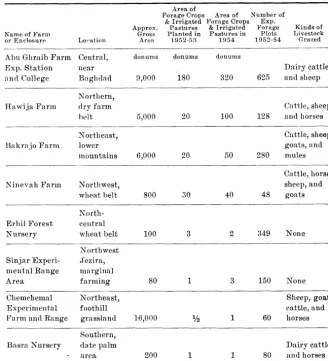
The term “Grazing” was widely understood but there was no rea- sonable translation of “range.” The Ministry of Agriculture put graz- ing research under grazing manage- ment. The office of Grazing was established in the Library at the Abu Ghraib Experimental Farm,
15 miles west of Baghdad. This ar- rangement allowed study of the records and review of the collected native vegetation with the curator of the Abu Ghraib herbarium. Grazing research was housed in the same building in the Field Crops Division.
Well trained leaders in agricul- ture had foreseen their problems, established experimental farms, and initiated studies. Trained as- sistants were few. An Agricultural College had been established at Abu Ghraib to train young Iraqis. Four American professors arrived to help in advancing the college to bachelor level. Agricultural exten- sionists were being trained.
The Ministry of Development had been shown the problems of agriculture. That far sighted group, trying to assist the rural people, appropriated 100,000 dinars (1 dinar equals $2.80) for agricultural
research and 1 million dinars for livestock improvement. The funds are available for carefully planned projects approved by both the Min- istries of Agriculture and Develop- ment.