Finding collisions for MD4 hash algorithm using
hybrid algorithm
Marko Cari´c
May 28, 2014
Abstract
The modification of message that meets the sufficient conditions for collision is found in the last step of differential attack proposed by Wang et all. (2005) on MD4 hash algorithm. Here we show how this attack phase, finding a collision starting from the list of sufficient con-ditions for the collision, can be implemented using a combination of two algorithms - evolutionary algorithm and hill climbing. Hybridization of evolutionary algorithm and hill climbing is a well-known technique for improving solutions, but it isn’t applied to this domain (at least by information that author has collected).
Keywords—Evolutionary algorithm, hill climbing, hash algorithm, MD4, collision, differential attack
1
Introduction
1. Selection of message difference,
2. Finding the differential path,
3. Finding sufficient conditions for collision,
4. Finding messages that satisfy sufficient conditions.
The first two stages can be automated to some extent [8, 9]. One way of realizing the last phase is to gradually modify randomly selected message. The modification of the message in different rounds of the MD4 algorithm is different in terms of difficulty. Modification to satisfy the conditions of the first round is the easiest; it requires changing one message word (basic modification). Modification to satisfy the conditions of the second round is more complicated; as it must not disarrange the already fulfilled conditions of the first round, it is necessary to change more than one word of message (advanced modification). Typically, a brute force is used to find modification satisfying the conditions of the third round. That is why the tendency is to include the most conditions for the modification of message in the first round [3]. One way to realize message modification is achieved using SAT solvers [6]. Based od author’s knowledge, there is no other effective way for solving this step.
This paper proposes a possibility of the realization of the last phase of the attack independently either by using evolutionary algorithms (EA) or by hill climbing, or by their combination. Alternating EA and hill climbing can improve the efficiency of EA while overcoming the lack of robustness of hill climbing.
2
Description of MD4
LetB ={0,1}. MD4 algorithm for arbitrary messageM calculates the hash value h(M) ∈ B128. An iterative compression function f :B128×B512 →
B128 is defined using functionsF, G, H :B32×B32×B32→B32:
F(X, Y, Z) =XY ∨XZ¯ = (X∧Y)∨(¬X∧Z)
G(X, Y, Z) =XY ∨XZ∨Y Z = (X∧Y)∨(X∧Z)∨(Y ∧Z)
H(X, Y, Z) =X⊕Y ⊕Z
sum and difference X and Y modulo 232, and let X s be the result of the cyclical shift of the contents of X for s bits to the left. Let ti ∈ B32,
i=−3,−2, ...48,T = (t−3, t−2, t−1, t0)∈B128 and M = (M0, M1, ...M15)∈ B128. Thenf(T, M) = (t−3+t45, t−2+t46, t−1+t47, t0+t48) where
ti= (ti−4+fi(ti−3, ti−2, ti−1) +Mpi+ci)si, i= 1,2, ...,48, (1)
and valuesfi,ci,pi,si,i= 1,2, ...,48, are shown in the following tables:
i fi ci si
1...16 F 0x00000000 3 7 11 19 3 7 11 19 3 7 11 19 3 7 11 19 17...32 G 0x5a827999 3 5 9 13 3 5 9 13 3 5 9 13 3 5 9 13 33...48 H 0x6ed9eba1 3 9 11 15 3 9 11 15 3 9 11 15 3 9 11 15
i pi
1...16 0 1 2 3 4 5 6 7 8 9 10 11 12 13 14 15 17...32 0 4 8 12 1 5 9 13 2 6 10 14 3 7 11 15 33...48 0 8 4 12 2 10 6 14 1 9 5 13 3 11 7 15
Calculation of ti, i = 16(j−1) +k, k = 1,2, ...,16 (1) makes the jth
round of MD4,j = 1,2,3.
Before calculating hash value, the messageMis first padded to the multi-ple of 512 by one, 447− |M| mod 512 zeroes (wherea mod b∈ {0,1, ..., b−
1} denotes the remainder of a division ofbby a) and 64 bits to represent a binary number|M|. Let expanded message beM0, M1, ..., Mn−1,Mi ∈B512,
i= 1,2, ..., n−1. The hash value of the message M ish(M) =Hn, where
H0 = (67452301,10325476, ef cdab89,98badcf e), (2)
(hex), andHi=f(Hi−1, Mi−1), i= 1,2, ..., n.
3
Differential path and set of sufficient conditions
To find collisions for MD4 algorithm it is enough to find collisions for the compression function f, i.e. an arbitrary pair (M, M0) ∈ B512, M = (M0, M1, ..., M15),M0 = (M00, M10, ..., M150 ), such thatf(H0, M) =f(H0, M0),
whereH0 is a constant (2). This equation is equivalent to (t45, t46, t47, t48) = (t045, t046, t047, t048), where, according to (1)
ti = (ti−4+fi(ti−3, ti−2, ti−1) +Mpi+ci)si,
t0i = (t0i−4+fi(t0i−3, t0i−2, t0i−1) +Mp0i+ci)si, i= 1,2, ...,48,
The message difference corresponding to collision (M, M0) is a series of differences (modulo 232) ∆M =M0−M = (∆M0,∆M1, ...,∆M15) = (M00− M0, M10 −M1, ..., M150 −M15). Let ti[j] and ti[−j] be the values obtained
from ti by changing the j-th bit; thereby, ti[j] means that the value of the
j-th bit is changed from zero to one, whileti[−j] means that value of thejth
bit is changed from one to zero. More generally, let ti[±j1,±j2, ...,±jl] be
obtained by changing the values of bits in indicated indexes. Thedifferential path is a series of expressions of the form
ti[±j1,±j2, ...,±jl], l=l(i), i= 1, ...,48 (4)
where l = 0 for i = 45,46,47,48. In order for a pair (M, M0) to be a collision, a set of sufficient conditions for a pair (M, M0) is determined by the differential (4) and conditions (3). This can be obtained starting from the properties of functions F, G i H. A message M that satisfies a set of sufficient conditions is called a weak message. If M is a weak message and M0 = M + ∆M, then the pair (M, M0) is collision. In this paper we use two message differences: ∆m4 = 22, ∆mi = 0, i 6= 4 [1, 11] and
∆m1 = 231, ∆m2 = 231−228, ∆m16 = −216, ∆mi = 0, i 6= 1,2,16 [4, 9].
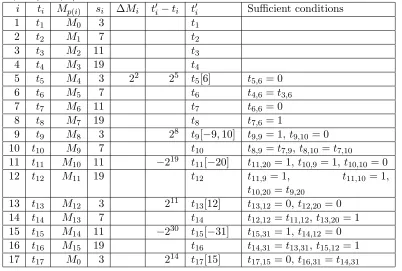
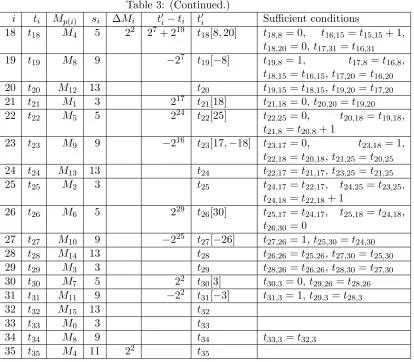
The first message difference corresponds to a set of 62 conditions [11], that is obtained starting from the differential path that consists of two branches:
t5[6] 3
−
→t9[−9,10] 3
−
→t13[12] 3
−
→t17[15] 5
−
→t18[20] 5
−
→t22[25] 5
−
→t26[30] 5
− →t30[3]
and
t5[6]−→3 t9[−9]−→11 t11[−20]−→11 t15[−31]−→9 t19[−8]−→9 t23[17,−18]→−9 t27[−26]−→9 t31[−3]
This differential path and corresponding 62 sufficient conditions for message
M are shown in Table 3.
The differencet19[−8] cancels the differencet19[8] caused by the influence
of ∆M4 in the second round. The differencet23[−18] cancels difference that
occurs as a continuation of the changes t17[15] in the first round. Similarly, if sufficient conditions are satisfied in steps:
t32←((t28+G(t31, t30, t29) +M15+ 5A827999)13)
t33←((t29+H(t32, t31, t30) +M0+ 6ED9EBA1)3)
t34←((t30+H(t33, t32, t31) +M8+ 6ED9EBA1)9)
then the differencest30[3] andt31[−3] cancel each other out in termst32,t33
and t34, while differencet31[−3] cancels the last changed word M4, and the
pair (M, M + ∆M) is collision. Second message difference corresponds to the second set of 123 (in the original paper [4] the conditions listed 122, and the work [7] shows that the two conditions are omitted; it turns out that one of the conditions expressed by the other two, so the number of sufficient conditions is 123), e.g. 146 sufficient conditions [9].
4
Algorithm for finding collisions
To search for collisions by evolutionary algorithm, or by hill climbing, it is necessary to choose a fitness function, whose optimization leads to the message M for which (M, M + ∆M) is collision. For this purpose, fitness functionc(M) is defined as maximalk such that the firstksufficient condi-tions are satisfied for the sequence in (1). The rest of this section presents an evolutionary algorithm, hill climbing algorithm and a hybrid algorithm, which is actually their composition.
4.1 Evolutionary algorithm
A population which is input to the evolutionary algorithm is made of N
process can be optionally continued using hill climbing algorithm. A general evolutionary algorithm can be described by the following code:
Algorithm EA(p, N, M)
Input:
p - initial population, a series of N messages
M- number of generations in the genetic algorithm
Output:
p - the final population after generation M
begin
for i← 1to M do
for j← 1toN/4 do
if p[2j−1] =p[2j]thenmutation(p[2j])
crossover p[2j−1], p[2j] creates p[N + 2j−1], p[N + 2j] mutation (p[N + 2j−1], p[N + 2j])
sort p by valuesc(p[j])) and keep the first N messages
for j← 2toN do
while(p[j] is equal p[k] for somek= 1,2, ..., j−1)do
mutation (p[j])
return p
end
EA uses elimination selection without duplicates. In each iteration, we crossover messages [2i−1] andp[2i] with random crossing point resulting in their children, the messagesp[N+ 2i−1] i p[N + 2i], i= 1,2, ..., N/4. The crossover is done in a standard way:
(α, β),(γ, δ)→(α, δ),(γ, β),0≤ |α|=|γ| ≤512
After each iteration, individuals are sorted according to fitness function value. The individuals with lower fitness are rejected in a way the population size remains unchanged. The fittest messages do not fall out of the popu-lation. Mutation of individuals is carried out in three cases: to avoid the crossover of the same message, in order to further distinguish parents from the children and after changing population to throw out possible duplicate messages. Mutation is performed in the following way: choose a random number 0≤n≤127 and xor message bits in positions 4n, 4n+ 1,4n+ 2,
4.2 Correction algorithm
Letd(x, y) denote the Hamming distance between vectorsxandy. For arbi-traryy∈B512letSt(y) ={x|d(x, y)≤t}denote the Hamming ball of radius
twith centery. If the fittest message from EA does not satisfy all sufficient conditions, we continue with correction algorithm (CA) — modification of the ”Steepest-ascent hill climbing” algorithm [10]. The fittest messages ob-tained from the evolutionary algorithm are inserted into the priority queue
Q. Correction algorithm in each iteration removes fromQthe message yof highest priority, computesc(z) for all z∈St(y) and inserts into Qall z for
which c(z)≥c(y). The algorithm is described by the following code:
Algorithm CA(Q, M AX, OP)
Input:
Q - array of messages
M AX - maximal possible message fitness
OP - limit for the number of tested messages achieving maximum fitness
Output:
collisions - array of weak messages
begin
collisions← ∅
counter ←0
y ←pullHighestPriorityElement(Q)
achievedF itness←y.f itness
while(y.f itness < M AX and counter < OP)
for allp∈S3(y) do
if p is newand p.f itness≥achievedF itness then
achievedF itness←p.f itness
Q←p
if achievedF itness=y.f itness then
increment counter
else
counter←0
y← pullHighestPriorityElement(Q)
collisions← {p|p∈Q, p.f itness=M AX}
return collisions
end
If the number of subsequent messages y with the same fitness less than
4.3 Hybrid algorithm
Hybrid algorithm is the composition of EA and CA.
Algorithm HA(N, M, M AX, OP, V)
Input: N - initial size of the population in EA
M - number of generations in EA
M AX - maximal possible message fitness
OP - limit for the number of tested messages which achieve maximum fitness
V - initial size of the queue for CA
Output: collisions- array of weak messages
begin
collisions← ∅
p← set ofN random messages
newP opulation←EA(p, N, M)
collisions← all weak messages from newP opulation
if collisions6=∅ then
return collisions
else
Q← first V messages from newP opulation
return CA(Q, M AX, OP)
end
5
Results
The population size N = 800 and the number of generations M = 1000 were chosen for the evolutionary algorithm. For theOP parameter used in correction algorithm valueOP = 7 was selected. The results of 10 tests of the first, second and the third set of sufficient conditions (with successively 62, 123 and 144 conditions) are shown in Table 1.
Table 1: Test results
test 62 conditions 123 conditions 144 conditions
number EA HA EA HA EA HA
1 56 62 123 0 144 0
2 54 62 123 0 138 144
3 52 62 123 0 130 144
4 55 62 116 123 144 0
5 54 62 104 123 144 0
6 51 62 115 115 143 144
7 54 62 105 105 140 144
8 52 62 116 116 144 0
9 51 56 99 99 144 0
10 59 59 115 115 133 144
messages on average. Specifically, for a population of 800 messages, after 1000 iterations, in the best case, the whole newly obtained population (of the last generation) satisfies all the conditions; then form≤9 EA continues to produce collisions. The results show that EA successfully produced collision with an incomplete set of sufficient conditions, which means that EA can also be used as a criterion to check the completeness of a set of sufficient conditions. The result of the experiment is quite satisfactory.
Tests were carried out on a computer with a processor AMD Phenom II X4 945 3.01 GHz and 4 GB of working memory. Evolutionary algorithm runs about ten minutes for all sets of conditions, while CA examines one message about 20 minutes. Although CA is designed to serve as a possible continuation of the EA, it is also independent of EA and can independently produce collisions. However, on average, it takes more time and produces fewer collisions than EA. From an initial population of randomly generated 800 messages, the fittest of them on average meets the first 9 conditions (probability of satisfying these conditions is 1/29), after which a message that satisfies all sufficient collisions is created by successive corrections.
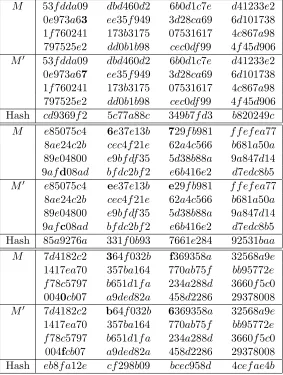
As an illustration of the results obtained, the examples of collisions de-tected for each of the three used sets of sufficient conditions are given. Mes-sagesM and M0 are different in the third bit of the fourth word in the case of 62 conditions, or in bits of the first, second and twelfth word in the case of 123 and 146 conditions (Table 2). The above collisions were obtained in experiments numbered by 6, 3, 4 in Table 1.
conditions did not give good results, except for the first, the smallest set of sufficient conditions.
6
Comparison with the other approaches
Message modification problem, which has been solved using SAT solvers [6] and which also gives collision in less than 10 minutes, is a somewhat faster solution as it has been obtained in a computer with a low performance. However, the heuristic approach discussed in this paper produces not one but multiple collisions. In the best case, if the evolutionary algorithm succeeds in producing collisions on its own, each message in the population may produce a collision.
7
Conclusion
After obtaining sufficient conditions for MD4 collision, message modification can be very demanding. This work explains a new method for replacing standard message modification phase in MD4 algorithm using evolutionary algorithm and hill climbing. Further research involves the application on this procedure to other hash algorithms belonging to the MD4 family.
References
[1] H.B. Yu, G.L. Wang, G.Y. Zhang, X.Y. Wang: The Second-Preimage Attack on MD4. CANS 2005, LNCS 3810, pp. 1-12.
[2] X.Y. Wang, H.B. Yu: How to Break MD5 and Other Hash Functions. Eurocrypt’05, LNCS 3494, pp. 19-35.
[3] Y. Sasaki, L. Wang, K. Ohta, N. Kunihiro: New Message Difference for MD4. In A. Biryukov, ed. FSE 2007, Proceedings, volume 4593 of LNCS, pp. 329-348. Springer, 2007.
[4] X.Y. Wang, X.J. Lai, D.G. Feng, H. Chen, X.Y. Yu: Cryptanalysis for Hash Functions MD4 and RIPEMD. Eurocrypt’05, May 2005.
[5] R.L. Rivest: The MD4 Message Digest Algorithm. Advances in Cryp-tology, Crypto’90, Springer 1991, pp. 303-311.
[7] Y. Naito, Y. Sasaki, N. Kunihiro, K. Ohta: Improved Collision Attack on MD4 with Probability Almost 1. In D. Won and S. Kim, eds. ICISC, volume 3935 LNCS, pp. 129-145. Springer, 2005.
[8] P.A. Fouque, G. Leurent, P. Nguyen: Automatic Search of Differential Path in MD4. ECRYPT Hash Worshop - Cryptology ePrint Archive, Report 2007/206 (2007) http://eprint.iacr.org/.
[9] M. Schl¨affer, E. Oswald: Searching for Differential Paths in MD4. Rob-shaw, FSE 2006, pp. 242-261.
[10] M. Mitchell: An introduction to genetic algorithms. MIT Press, Cam-bridge, Massachusetts (1999).
[11] M. Cari´c: Finding collisions in cryptographic hash functions, Master Thesis, Faculty of Mathematics, Belgrade, 2010 (in Serbian).
Table 2: Examples of collisions for the first, second or third set of sufficient conditions
M 53f dda09 dbd460d2 6b0d1c7e d41233e2
0e973a63 ee35f949 3d28ca69 6d101738 1f760241 173b3175 07531617 4c867a98 797525e2 dd0b1b98 cec0df99 4f45d906
M0 53f dda09 dbd460d2 6b0d1c7e d41233e2
0e973a67 ee35f949 3d28ca69 6d101738 1f760241 173b3175 07531617 4c867a98 797525e2 dd0b1b98 cec0df99 4f45d906 Hash cd9369f2 5c77a88c 349b7f d3 b820249c
M e85075c4 6e37e13b 729f b981 f f ef ea77 8ae24c2b cec4f21e 62a4c566 b681a50a
89e04800 e9bf df35 5d38b88a 9a847d14
9afd08ad bf dc2bf2 e6b416e2 d7edc8b5
M0 e85075c4 ee37e13b e29f b981 f f ef ea77 8ae24c2b cec4f21e 62a4c566 b681a50a
89e04800 e9bf df35 5d38b88a 9a847d14
9afc08ad bf dc2bf2 e6b416e2 d7edc8b5
Hash 85a9276a 331f0b93 7661e284 92531baa M 7d4182c2 364f032b f369358a 32568a9e
1417ea70 357ba164 770ab75f bb95772e
f78c5797 b651d1f a 234a288d 3660f5c0
0040cb07 a9ded82a 458d2286 29378008
M0 7d4182c2 b64f032b 6369358a 32568a9e
1417ea70 357ba164 770ab75f bb95772e
f78c5797 b651d1f a 234a288d 3660f5c0
004fcb07 a9ded82a 458d2286 29378008
Table 3: Differential path that corresponds to the message difference ∆m4 = 22,∆mi = 0, i6= 4.
i ti Mp(i) si ∆Mi t0i−ti t0i Sufficient conditions
1 t1 M0 3 t1
2 t2 M1 7 t2
3 t3 M2 11 t3
4 t4 M3 19 t4
5 t5 M4 3 22 25 t5[6] t5,6 = 0
6 t6 M5 7 t6 t4,6 =t3,6
7 t7 M6 11 t7 t6,6 = 0
8 t8 M7 19 t8 t7,6 = 1
9 t9 M8 3 28 t9[−9,10] t9,9 = 1, t9,10= 0
10 t10 M9 7 t10 t8,9 =t7,9,t8,10=t7,10
11 t11 M10 11 −219 t11[−20] t11,20= 1,t10,9 = 1, t10,10= 0
12 t12 M11 19 t12 t11,9= 1, t11,10= 1, t10,20=t9,20
13 t13 M12 3 211 t13[12] t13,12= 0,t12,20= 0
14 t14 M13 7 t14 t12,12=t11,12,t13,20= 1
15 t15 M14 11 −230 t15[−31] t15,31= 1,t14,12= 0
16 t16 M15 19 t16 t14,31=t13,31,t15,12= 1
Table 3: (Continued.)
i ti Mp(i) si ∆Mi t0i−ti t0i Sufficient conditions
18 t18 M4 5 22 27+ 219 t18[8,20] t18,8 = 0, t16,15=t15,15+ 1, t18,20= 0, t17,31=t16,31
19 t19 M8 9 −27 t19[−8] t19,8 = 1, t17,8 =t16,8, t18,15=t16,15,t17,20=t16,20
20 t20 M12 13 t20 t19,15=t18,15,t19,20=t17,20
21 t21 M1 3 217 t21[18] t21,18= 0, t20,20=t19,20
22 t22 M5 5 224 t22[25] t22,25= 0, t20,18=t19,18, t21,8 =t20,8+ 1
23 t23 M9 9 −216 t23[17,−18] t23,17= 0, t23,18= 1, t22,18=t20,18,t21,25=t20,25
24 t24 M13 13 t24 t22,17=t21,17,t23,25=t21,25
25 t25 M2 3 t25 t24,17=t22,17, t24,25=t23,25, t24,18=t22,18+ 1
26 t26 M6 5 229 t26[30] t25,17=t24,17, t25,18=t24,18, t26,30= 0
27 t27 M10 9 −225 t27[−26] t27,26= 1, t25,30=t24,30
28 t28 M14 13 t28 t26,26=t25,26,t27,30=t25,30
29 t29 M3 3 t29 t28,26=t26,26,t28,30=t27,30
30 t30 M7 5 22 t30[3] t30,3 = 0,t29,26=t28,26
31 t31 M11 9 −22 t31[−3] t31,3 = 1,t29,3=t28,3
32 t32 M15 13 t32
33 t33 M0 3 t33
34 t34 M8 9 t34 t33,3 =t32,3