Bloom Filter Encryption and Applications to Efficient
Forward-Secret 0-RTT Key Exchange
David Derler1,‡, Kai Gellert2, Tibor Jager2, Daniel Slamanig3, and Christoph Striecks3
1 DFINITY
2
University of Wuppertal, Germany
{kai.gellert, tibor.jager}@uni-wuppertal.de
3
AIT Austrian Institute of Technology
{daniel.slamanig, christoph.striecks}@ait.ac.at
Abstract. Forward secrecy is considered an essential design goal of modern key establishment (KE) protocols, such as TLS 1.3, for example. Furthermore, ef-ficiency considerations such as zero round-trip time (0-RTT), where a client is able to send cryptographically protected payload data along with the very first KE message, are motivated by the practical demand for secure low-latency com-munication.
For a long time, it was unclear whether protocols that simultaneously achieve RTT and full forward secrecy exist. Only recently, the first forward-secret 0-RTT protocol was described by G¨unther et al. (EUROCRYPT2017). It is based on Puncturable Encryption. Forward secrecy is achieved by “puncturing” the se-cret key after each decryption operation, such that a given ciphertext can only be decrypted once (cf. also Green and Miers, S&P 2015). Unfortunately, their scheme is completely impractical, since one puncturing operation takes between 30 seconds and several minutes for reasonable security and deployment parame-ters, such that this solution is only a first feasibility result, but not efficient enough to be deployed in practice.
In this paper, we introduce a new primitive that we term Bloom Filter Encryption (BFE), which is derived from the probabilistic Bloom filter data structure. We describe different constructions of BFE schemes, and show how these yield new puncturable encryption mechanisms with extremely efficient puncturing. Most importantly, a puncturing operation only involves a small number of very effi-cient computations, plus the deletion of certain parts of the secret key, which outperforms previous constructions by orders of magnitude. This gives rise to the first forward-secret 0-RTT protocols that are efficient enough to be deployed in practice. We believe that BFE will find applications beyond forward-secret 0-RTT protocols.
Keywords: Bloom filter encryptionBloom filter0-RTTforward secrecy
key exchangepuncturable encryption
This is a major extension of a paper which appears in Advances in Cryptology - EUROCRYPT
2018 - 37th Annual International Conference on the Theory and Applications of Cryptographic Techniques, Tel Aviv, Israel, April 29-May 3, 2018, Proceedings.
‡
1
Introduction
One central ingredient to secure today’s Internet are key exchange (KE) protocols with the most prominent and widely deployed instantiations thereof in the Transport Layer Security (TLS) protocol [45]. Using a KE protocol, two parties (e.g., a server and a client) are able to establish a shared secret (session key) which afterwards can be used to cryptographically protect data to be exchanged between those parties. The process of arriving at a shared secret requires the exchange of messages between client and server, which adds latency overhead to the protocol. The time required to establish a key is usu-ally measured in round-trip times (RTTs). A novel design goal, which was introduced by Google’s QUIC protocol [47] and is also adopted in TLS version 1.3 [45], aims at developing zero round-trip time (0-RTT) protocols with strong security guarantees. So far, quite some effort was made in the cryptographic literature, e.g. [49,35], and, in-deed, 0-RTT protocols are probably going to be used heavily in the future Internet as TLS version 1.3 adoption is growing rapidly. Besides TLS 1.3, Google’s QUIC protocol is used on Google webservers and within the Chrome and Opera browsers to support 0-RTT. Unfortunately, none of the above mentioned protocols are enjoying 0-RTT and full forward secrecy at the same time. Only recently, G¨unther, Hale, Jager, and Lauer (GHJL henceforth) [33] made progress and proposed the first 0-RTT key exchange pro-tocol with full forward secrecy for all transmitted payload messages. However, although their 0-RTT protocol offers the desired features, their construction is not yet practical.
In more detail, GHJL’s forward-secret 0-RTT key-exchange solution is based on puncturable encryption (PE), which they showed can be constructed in a black-box way from any selectively secure hierarchical identity-based encryption (HIBE) scheme. Loosely speaking, PE is a public-key encryption primitive which provides aPuncture algorithm that, given a secret key and a ciphertext, produces an updated secret key that is able to decrypt all ciphertexts except the one it has been punctured on. PE has been introduced by Green and Miers [31] (GM henceforth) who provide an instantia-tion relying on a binary-tree encrypinstantia-tion (BTE) scheme—or selectively secure HIBE— together with a key-policy attribute-based encryption (KP-ABE) [30] scheme for non-monotonic (NM) formulas with specific properties. In particular, the KP-ABE needs to provide a non-standard property to enhance existing secret keys with additional NOT gates, which is satisfied by the NM KP-ABE in [44]. Since then, PE has proved to be a valuable tool to construct public-key watermarking schemes [20], forward-secret proxy re-encryption [24]4, or to achieve chosen-ciphertext security for fully-homomorphic
encryption [17]. However, the mentioned PE instantiations from [17,20] are based on indistinguishability obfuscation and, thus, do not yield practical schemes at all.
When looking at the two most efficient PE schemes available, i.e., GM and GHJL, they still come with severe drawbacks. In particular, puncturing in GHJL is highly in-efficient and takes several seconds to minutes on decent hardware for reasonable de-ployment parameters. In the GM scheme, puncturing is more efficient, but the cost of decryption is very significant and increases with the number of puncturings. More pre-cisely, cost of decryption requires a number of pairing evaluations that depends on the number of puncturings, and can be in the order of210to220for realistic deployment
4
parameters. These issues make both of them especially unsuitable for the application in forward-secret 0-RTT key exchange in a practical setting.
Contributions. In this paper, we introduce Bloom filter encryption (BFE), which can be considered as a variant of PE [31,20,17,33]. The main difference to other existing PE constructions is that in case of BFE, we tolerate a non-negligible correctness error.5
This allows us to construct PE with highly efficient puncturing and in particular where puncturing only requires a few very efficient operations, i.e., todeleteparts of the secret key, but no further expensive cryptographic operations. Altogether, this makes BFE a very suitable building block to construct practical forward-secret 0-RTT key exchange. In more detail, our contributions are as follows:
– We formalize the notion of BFE by presenting a suitable security model. The intu-ition behind BFE is to provide highly efficient decryption and puncturing. Interest-ingly, puncturing mainly consists ofdeletingparts of the secret key. This approach is in contrast to existing puncturable encryption schemes, where puncturing and/or decryption is a very expensive operation.
– We propose efficient constructions of BFE. First, we present a direct construc-tion which uses ideas from the Boneh-Franklin identity-based encrypconstruc-tion (IBE) scheme [12]. This construction allows us to achieve constant size public keys. Sec-ond, we present a black-box construction from a ciphertext-policy attribute-based encryption (CP-ABE) scheme that only needs to be small-universe (i.e., bounded) and to support threshold policies, which allows us to achieve constant size cipher-texts. Third, we describe a generic construction from identity-based broadcast en-cryption (IBBE), which is efficiently instantiable with the IBBE scheme by Deler-abl´ee [22]. This construction allows us to simultaneously achieve compact public keys and constant size ciphertexts. Finally, we propose time-based BFE (TB-BFE), an enhancement of BFE which additionally provides forward secrecy and thus pre-vents message suppression attacks, and provide a generic construction of TB-BFE from selectively-secure HIBEs.
– We adapt the Fujisaki-Okamoto (FO) transformation [25] to obtain CCA security in the random oracle model (ROM) to the BFE setting. This is technically non-trivial, and therefore we consider it as another interesting aspect of this work. In particular, the original FO transformation [25] works only for schemes withperfect correctness. Recently, Hofheinz et al. [37] described a variant which works also for schemes withnegligiblecorrectness error. We formalize additional properties that are required to apply the FO transform, and show that our CPA-secure constructions satisfy them. This serves as a template that allows an easy application of the FO transform in a black-box manner to BFE schemes. Moreover, we also discuss how to achieve CCA security in the standard model.
– We provide a construction of a forward-secret 0-RTT key exchange protocol (in the sense of GHJL) from TB-BFE. Furthermore, we give a detailed comparison of (TB-)BFE with other PE schemes and discuss the efficiency in the context of the proposed application to forward-secret 0-RTT key exchange. In particular, our
5
construction of forward-secret 0-RTT key-exchange from TB-BFE has none of the drawbacks mentioned in the introduction (at the cost of a somewhat larger secret key, that, however, shrinks with the number of puncturings). Consequently, our forward-secret 0-RTT key exchange can be seen as a significant step forward to construct verypracticalforward-secret 0-RTT key exchange protocols.
On tolerating a non-negligible correctness error for 0-RTT. The huge efficiency gain of our construction stems partially from the relaxation of allowing a non-negligible correctness error, which, in turn, stems from the potentially non-negligible false-positive probability of a Bloom filter. While this is unusual for classical public-key encryption schemes, we consider it as a reasonable approach to accept a small, but non-negligible correctness error for the 0-RTT mode of a key exchange protocol, in exchange for the huge efficiency gain.
For example, a1/10000chance that the key establishment fails allows to use 0-RTT in
9999 out of 10000 cases on average, which is a significant practical efficiency improve-ment. Furthermore, the communicating parties can implement a fallback mechanism which immediately continues with running a standard 1-RTT key exchange protocol with perfect correctness, if the 0-RTT exchange fails. Thus, the resulting protocol can have the same worst-case efficiency as a 1-RTT protocol, while most of the time 0-RTT is already sufficient to establish a key and full forward secrecy isalwaysachieved.
Compared to other practical 0-RTT solutions, note that both TLS 1.3 [45] and QUIC [47] have similar fallback mechanisms. Furthermore, to achieve at least a very weak form of forward secrecy, they define so calledtickets[45] or server configura-tion (SCFG)messages [47], which expire after a certain time. Forward secrecy is only achieved after the ticket/SCFG message has expired and the associated secrets have been erased. Therefore the lifetime should be kept short. If a client connects to a server after the ticket/SCFG message has expired, then the fallback mechanism is invoked and a full 1-RTT handshake is performed. In particular for settings where a client connects only occasionally to a server, and for reasonably chosen parameters and a moderate life time of the ticket/SCFG message, which at least guarantees some weak form of forward secrecy, this requires a full handshake more often than with our approach.
Finally, note that puncturable encryption with perfect (or negligible) correctness error inherently seems to require secret keys whose size at least grows linearly with the number of puncturings. This is because any such scheme inherently must (implicitly or explicitly) encode information about the list of punctured ciphertexts into the secret key, which lower-bounds the size of the secret key [41]. By tolerating a non-negligible correctness error, we are also able to restrict the growth of the secret key to a limit which seems tolerable in practice.
de-livery can break forward secrecy of the primitive by compromising the receiving party’s secret at a later point in time, and retroactively decrypting all suppressed messages.
Hence, Green and Miers proposed to construct a time-based construction where the attack is only feasible until both parties move to the next time slot, achieving a form ofdelayedforward secrecy. As the time-based constructions were inspired by forward-secureencryption, the qualifier “forward-secure” was added to the primitive’s name. For a detailed discussion on the meaning of forward secrecy in non-interactive settings such as 0-RTT, we refer to a recent work by Gellert and Boyd [14].
We believe a distinction between time-based and non-time-based constructions is meaningful. It makes explicit that the non-time-based constructions puncture out ci-phertexts, in order to remove decryption capability for this ciphertext. In contrast, time-based constructions additionally allow to puncture time slots, which removes decryp-tion capability forall possibleciphertexts from previous time slots. For our construc-tions this also makes it possible to keep the size of secret keys smaller, as we explain in Section 4.
Differences to the conference version [23]. In contrast to the conference version [23], this extended version contains some additions and updates. First, we chose to present all constructions explicitly as Bloom Filter Key Encapsulation Mechanisms (BFKEMs) instead of referring to them as Bloom Filter Encryption (cf. Section 2 for a discussion). Second, we provide an additional generic construction of aBFKEMfrom identity-based broadcast encryption (IBBE) in Section 3.4. Furthermore, we have corrected some am-biguities and minor issues within the definitional framework. Third, we provide a more elaborate discussion on the choice of parameters to provide more insights and decision support for the practical application of our proposals.
Follow-up work. After the conference version of this paper, there was some follow-up work which we want to mention for completeness. Aviram et al. in [3] study practical forward secrecy for 0-RTT in TLS 1.3 and in particular the session resumption fea-ture of TLS 1.3. Lauer et al. [40] introduce a single-pass circuit construction protocol with forward secrecy for Tor, called Tor 0-RTT (T0RTT), which they construct from BFE. Dallmeier et al. [21] use BFE to implement the first fully forward-secret 0-RTT key exchange in Google’s QUIC protocol and analyze its performance. Finally, there is follow-up work on puncturable encryption from Sun et al. [?] providing further con-structions with negligible correctness error and different trade-offs.
2
Bloom Filter Encryption
Notation. Letλ∈Nbe the security parameter. For a finite setS, we denote bys←$S the process of samplingsuniformly fromS. For an algorithmA, lety←$A(λ, x)be the process of runningAon input(λ, x)with access to uniformly random coins and assigning the result toy. (We may omit to mention theλ-input explicitly and assume that all algorithms takeλ as input.) To make the random coins r explicit, we write A(λ, x;r). We say an algorithmAis probabilistic polynomial time (PPT) if the running time ofAis polynomial inλ. A functionf is negligible if its absolute value is smaller than the inverse of any polynomial (i.e., if∀ c ∃ k0 ∀ λ ≥ k0 : |f(λ)| < 1/λc). Furthermore, forn∈N, let[n] :={1, . . . , n}and letBilGenbe an algorithm that, on
input a security parameter1λ, outputs(q, e,
G1,G2,GT, g1, g2)←$BilGen(1λ), where
G1,G2,GT are groups of prime orderqwith bilinear map e : G1×G2 → GT and generatorsgi ∈ Gi fori ∈ {1,2}. Finally, we will use square brackets to access the individual bits of bitstrings, i.e.,T[i]denotes thei-th bit of a bitstringT ={0,1}m, for m∈N.
Bloom Filter Encryption. The key idea behind Bloom Filter Encryption (BFE) is that the key pair of such a scheme is associated to a Bloom filter (BF) [10], a probabilistic data structure for the approximate set membership problem with a non-negligible false-positive probability in answering membership queries. A BF initially represents a bit array ofmbits, all set to0. Insertion takes an element and inputs it tokdifferent hash functions each mapping the element to one of themarray positions, which are then set to1. When querying the BF on an element, it is considered to be in the BF if all positions obtained by evaluating the hash evaluations are set to1. The initial secret key skoutput by the key generation algorithm of a BFE scheme corresponds to an empty BF. Encryption takes a messageM and the public keypk, samples a random element s(acting as a tag for the ciphertext) corresponding to the universe U of the BF and encrypts a message using pk with respect to thek positions set in the BF by s. A ciphertext is then basically identified bysand decryption works as long as at least one index pointed to bysin the BF is still set to0. Puncturing the secret key with respect to a ciphertext (i.e., the tags of the ciphertext) corresponds to insertingsin the BF (i.e., updating the corresponding indices to1 and deleting the corresponding parts of the secret key). This basically means updatingsksuch that it no longer can decrypt any position indexed bys.
2.1 Formal Definition of Bloom Filters
A Bloom filter (BF) [10] is a probabilistic data structure for the approximate set mem-bership problem. It allows a succinct representationT of a setS of elements from a large universeU. For elements s ∈ S a query to the BF always answers 1 (“yes”), i.e., its false-negative probability is0. Ideally, a BF would always return0(“no”) for elementss6∈ S, but the succinctness of the BF comes at the cost that for any query to s6∈ Sthe answer can be1, too, but only with small probability (called thefalse-positive probability).
We will only be interested in the original construction of Bloom filters [10], and omit a general abstract definition. Instead we describe the construction from [10] di-rectly. For a general definition we refer to [43].
Definition 1 (Bloom Filter).ABloom filterBfor setU consists of algorithmsB = (BFGen,BFUpdate,BFCheck), which are defined as follows.
BFGen(m, k): This algorithm takes as input two integersm, k ∈ N. It first samples k universal hash functions H1, . . . , Hk, where Hj : U → [m], defines H :=
(Hj)j∈[k]andT := 0m, and outputs(H, T).
BFUpdate(H, T, u): GivenH = (Hj)j∈[k],T ∈ {0,1}m, andu∈ U, this algorithm defines the updated stateT0by first assigningT0:=T. Then, it setsT0[Hj(u)] := 1 for allj∈[k], and finally returnsT0.
BFCheck(H, T, u): GivenH = (Hj)j∈[k],T ∈ {0,1}m, andu∈ U, this algorithm returns a bitb:=V
j∈[k]T[Hj(u)].
Relevant properties of Bloom filters.Let us summarize the properties of Bloom filters relevant to our work.
Perfect completeness. A Bloom filter always “recognizes” elements that have been added with probability1. More precisely, letS= (s1, . . . , sn)∈ Unbe any vector ofnelements ofU. Let(H, T0)←$BFGen(m, k)and define
Ti=BFUpdate(H, Ti−1, si)fori∈[n].
Then for alls∗∈ Sand all(H, T
0)←$BFGen(m, k)withm, k∈N, it holds that Pr[BFCheck(H, Tn, s∗) = 1] = 1,
where the probability is taken over the random coins ofBFGen.
Compact representation ofS. Independent of the size of the setS ⊂ Uand the rep-resentation of individual elements ofU, the size of representationT is a constant number ofmbits. A larger size ofS increases only the false-positive probability, as discussed below, but not the size of the representation.
More precisely, letS= (s1, . . . , sn)∈ Unbe any vector ofnelements ofU. Then for anys∗∈ U \ S, the false positive probabilityµis bounded by
µ:=Pr[BFCheck(H, Tn, s∗) = 1]≤
1−e−(n+1m−1/2)k
k
,
where(H, T0)←$BFGen(m, k),Ti=BFUpdate(H, Ti−1, si)fori∈[n], and the probability is taken over the random coins ofBFGen. See Goel and Gupta [29] for a proof of this bound.
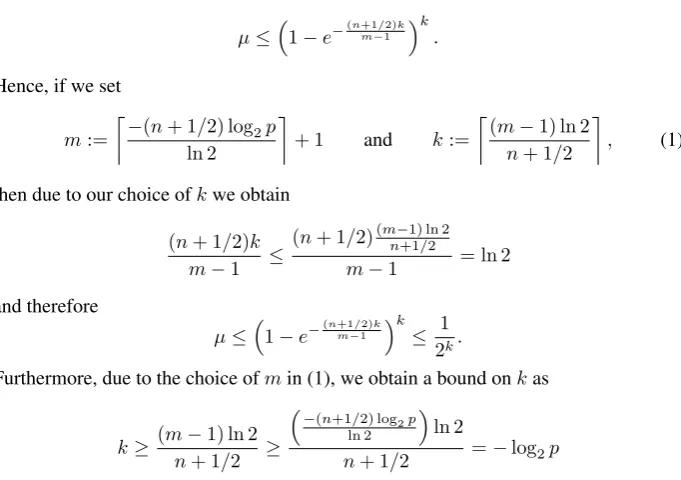
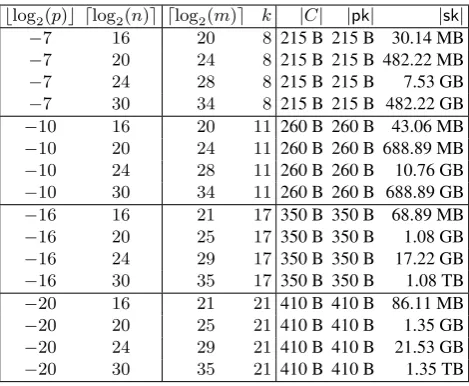
Discussion on the choice of parameters. In order to provide a first intuition on the concrete selection of Bloom filter parameters and their impact on the size of ciphertexts, public- and secret keys for BFE, we subsequently give some examples.
Suppose we are given an upper boundnon the number of elements inserted into the Bloom filter, and an upper boundpon the false positive probability for this number of elements that we can tolerate. Our goal is to determine the sizemof the Bloom filter and the numberkof hash functions to achieve a false positive probability ofµ≤pwith respect ton. As already mentioned above, Goel and Gupta [29] proved that the false positive probabilityµof a Bloom filter is strictly bounded by
µ≤1−e−(n+1m−1/2)k
k
.
Hence, if we set
m:=
−(n+ 1/2) log
2p
ln 2
+ 1 and k:=
(m−1) ln 2
n+ 1/2
, (1)
then due to our choice ofkwe obtain
(n+ 1/2)k
m−1 ≤
(n+ 1/2)(m−1) ln 2n+1/2
m−1 = ln 2
and therefore
µ≤1−e−(n+1m−1/2)k
k
≤ 1
2k.
Furthermore, due to the choice ofmin (1), we obtain a bound onkas
k≥(m−1) ln 2 n+ 1/2 ≥
−(n+1/2) log
2p ln 2
ln 2
n+ 1/2 =−log2p
which yields the desired boundµ ≤2−k ≤ pon the false positive probability of the Bloom filter.
blog2(p)c dlog2(n)e dlog2(m)e k |C| |pk| |sk| −7 16 20 8 215 B 215 B 30.14 MB
−7 20 24 8 215 B 215 B 482.22 MB
−7 24 28 8 215 B 215 B 7.53 GB
−7 30 34 8 215 B 215 B 482.22 GB
−10 16 20 11 260 B 260 B 43.06 MB
−10 20 24 11 260 B 260 B 688.89 MB
−10 24 28 11 260 B 260 B 10.76 GB
−10 30 34 11 260 B 260 B 688.89 GB
−16 16 21 17 350 B 350 B 68.89 MB
−16 20 25 17 350 B 350 B 1.08 GB
−16 24 29 17 350 B 350 B 17.22 GB
−16 30 35 17 350 B 350 B 1.08 TB
−20 16 21 21 410 B 410 B 86.11 MB
−20 20 25 21 410 B 410 B 1.35 GB
−20 24 29 21 410 B 410 B 21.53 GB
−20 30 35 21 410 B 410 B 1.35 TB
Table 1. Bloom filter parameters and size of public keys, secret keys, and ciphertexts of the construction from Section 3.1 (with 120-bit security level and using the pairing-friendly
BLS12-381curve) for different choices of the false positive probabilitypand the number of inserted elementsn.
Here we need to emphasize that initially the secret key (representing the empty BF) has its maximum size, but every puncturing (i.e., addition of an element to the BF), reduces the size of the secret key. Moreover, we stress that the false-positive probability represents an upper bound as it assumes that allnelements are added to the BF. The false positive probabilitybeforeninsertions, as a function of the number of inserted elements and for given parametersmandk, is discussed below. Finally, we note that when we use our time-based BFE approach (TB-BFE) from Section 4, we can even reduce the secret key size by reducing the maximum number of puncturings at the cost of switching the time intervals more frequently.
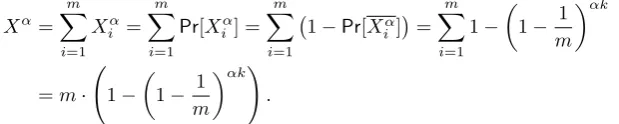
False-positive probabilitypbeforeninsertions. So far we have argued that we can bound the probability of an non-inserted element being recognized by a BF aftern elements have been added to the BF. However, we stress that this probability is far lower if only a fraction of thenelements have been added. We can illustrate this by computing the false-positive probability of an element after onlyα < ninsertions.
Lemma 1. Let(H, Tα)be a Bloom filter whereαrandom elements have been added. The false-positive probability of a random element u ∈ U being recognized by the Bloom filter is
Pr[BFCheck(H, Tn, u)] = 1−
1− 1 m
αk!k
.
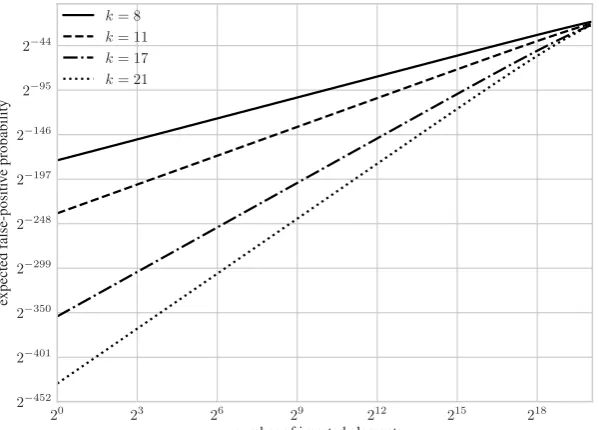
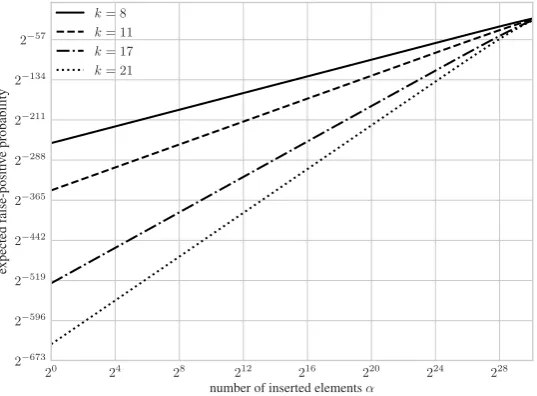
To give some intuition how the false-positive probability evolves over time, we plot the above function forn= 220andk ∈ {8,11,17,21} in Figure 1. Furthermore, we provide plots forn∈ {216,224,230}in Appendix C. It is clearly visible that the false-positive probability is overwhelmingly low if only a fraction of thenelements have been added to the Bloom filter.
20 23 26 29 212 215 218
number of inserted elementsα
2−452
2−401
2−350 2−299
2−248
2−197 2−146
2−95 2−44
expected
false-positi
v
e
probability
k= 8
k= 11
k= 17
k= 21
Fig. 1.The false-positive probability of a random element afterαelements have been added to a Bloom filter withn= 220
fork∈ {8,11,17,21}.
up-front. This is not the case in our application and we leave the study of BFs in adversarial environments for application in BFE for future work.
2.2 Formal Model of a BFKEM
Subsequently, we introduce the formal model for BFKEM, which is a KEM-variant of puncturable encryption (PE) [31,20,17,33] with the difference that with BFKEM we tolerate a non-negligible correctness error. Our Definition 2 below is a variant of the one in [33], except that we allow the key generation to take the additional parametersm andk(of the BF) as input, which specify the correctness error. As already mentioned in the introduction, resorting to present BFKEMs instead of BFE does not represent any limitation.
Definition 2 (BFKEM).A Bloom Filter key encapsulation scheme (BFKEM) with key spaceKis a tuple(KGen,Enc,Punc,Dec)ofPPTalgorithms:
KGen(1λ, m, k) : Takes as input a security parameterλ, parametersmandkand out-puts a secret and public key(sk,pk)(we assume thatKis implicit inpk, and that pkis implicit insk).
Enc(pk) : Takes as input a public keypkand outputs a ciphertextC and a symmetric keyK.
Punc(sk, C) : Takes as input a secret keysk, a ciphertextC and outputs an updated secret keysk0.
Dec(sk, C) : Takes as input a secret keysk, a ciphertextCand deterministically com-putes and outputs a symmetric keyKor⊥if decapsulation fails.
Correctness. We start by defining correctness of a BFKEM scheme. Basically, here one requires that a ciphertext can always be decapsulated with unpunctured secret keys. However, we allow that if punctured secret keys are used for decapsulation then the probability that the decapsulation fails is bounded by some non-negligible function in the scheme’s parametersm, k.
Definition 3 (Correctness).We require that the following holds for allλ, m, k ∈ N
and any(sk,pk)←$KGen(1λ, m, k).
For any (arbitrary interleaved) sequence of invocations of
skj+1←$Punc(skj, Cj),
wherej ∈ {1, . . . , n},sk1:=sk, and(Cj,Kj)←$Enc(pk), it holds that
Pr[Dec(skn+1, C∗)6=K∗]≤
1−e−(n+1m−1/2)k
k
+(λ),
where(C∗,K∗)←$ Enc(pk)and(·)is a negligible function in λ. The probability is over the random coins ofKGen,Punc, andEnc.
Remark 1. The bound 1−e−(n+1m−1/2)k
k
2.3 Additional Properties of a BFKEM
In this section, we will define additional properties of a BFKEM that we will use for the application to 0-RTT key exchange from [33] and to construct a CCA-secure BFKEM via the Fujisaki-Okamoto (FO) transformation, as described in Section 3.2. We will show below that our constructions of CPA-secure BFKEMs satisfy these additional properties, and thus are suitable for our variant of the FO transformation, and to con-struct 0-RTT key exchange.
Extended correctness. Intuitively, we first require an extended variant of correctness which demands that (1) decapsulation always yields a failure when attempting to de-capsulate under a secret key previously punctured for that ciphertext. This is analogous to [33]. Second, we additionally demand that (2) decapsulating an honest ciphertext with the unpunctured key does always succeed and (3) if decryption doesnotfail, then the decapsulated value must match the key returned by theEncalgorithm, for any key sk0obtained from applying any sequence of puncturing operations to the initial secret keysk.
Definition 4 (Extended Correctness).We require that the following holds for allλ, m, k, n∈Nand any(sk,pk)←$KGen(1λ, m, k).
For any (arbitrary interleaved) sequence of invocations of
skj+1←$Punc(skj, Cj)
wherej ∈ {1, . . . , n},sk1:=sk, and(Cj,Kj)←$Enc(pk), it holds that:
1. Impossibility of false-negatives:
Dec(skn+1, Cj) =⊥for allj≤n.
2. Perfect correctness of the initial secret key:
Dec(sk, C) =Kfor all(C,K)←$Enc(pk).
3. Semi-correctness of punctured secret keys:
IfDec(skj+1, C)6=⊥thenDec(skj+1, C) =Dec(sk, C).
Separable randomness. We require that the encapsulation algorithmEncessentially reads the keyKin(C,K)←$Enc(pk)directly from its random input tape. Intuitively, this will later enable us to make the randomnessrused by the encapsulation algorithm Encdependent on the keyKcomputed byEnc.
Definition 5 (Separable Randomness).LetBFKEM= (KGen,Enc,Punc,Dec)be a BFKEM. We say thatBFKEMhasseparable randomness, if one can equivalently write the encapsulation algorithmEncas
(C,K)←$Enc(pk) =Enc(pk; (r,K)),
for uniformly random(r,K)∈ {0,1}ρ+λ, whereEnc(·;·)is a deterministic algorithm whose output is uniquely determined bypkand the randomness(r,K)∈ {0,1}ρ+λ.
Enc0(pk; (r,K0)) : Run(C,K)←$Enc(pk;r), setC0 := (C,K⊕K0)return(C0,K0).
We need separability in order to apply our variant of the FO transformation, which is the reason why we have to make it explicit. Alternatively, we could have started from a non-separable BFKEM and applied the above construction. However, this adds an additional component to the ciphertext, while the construction given in Section 3.1 will already be separable, such that we can avoid this overhead.
Publicly-checkable puncturing. Finally, we need that it is efficiently checkable whe-ther the decapsulation algorithm outputs⊥ = Dec(sk, C), given not the secret key sk, but only the public key pk, the ciphertext C to be decrypted, and the sequence C1, . . . , Cwat which the secret keyskhas been punctured.
Definition 6 (Publicly-Checkable Puncturing).LetQ= (C1, . . . , Cw)be any list of ciphertexts. We say thatBFKEMallowspublicly-checkable puncturing, if there exists an efficient algorithmCheckPunctwith the following correctness property.
1. Run(sk,pk)←$KGen(1λ, m, k).
2. Compute(Ci,Ki)←$Enc(pk)andsk=Punc(sk, Ci)fori∈[w]. 3. LetCbe any string. We require that
⊥=Dec(sk, C) ⇐⇒ ⊥=CheckPunct(pk,Q, C).
From a high-level perspective, this additional property will be necessary to simulate the decryption oracle properly in the CCA security experiment when our variant of the FO transformation is applied. Together with the second and third property of Definition 4, it replaces the perfect correctness property required in the original FO transformation. Min-entropy of ciphertexts. Following [37], we require that ciphertexts of a rand-omness-separable BFKEM have sufficient min-entropy, even ifKis fixed:
Definition 7 (γ-Spreadness).LetBFKEM = (KGen,Enc,Punc,Dec)be a random-ness-separableBFKEM with ciphertext spaceC. We say thatBFKEMisγ-spread, if for any honestly generatedpk, any keyKand anyC∈ C
Prr
←${0,1}ρ[C=Enc(pk; (r,K))]≤2
−γ.
2.4 Security Definitions
We define three security properties for BFKEMs. The two “standard” security no-tions are indistinguishability under chosen-plaintext (IND-CPA) and chosen-ciphertext (IND-CCA) attacks. In addition, we define one-wayness under chosen-plaintext attacks (OW-CPA). The latter is the weakest notion among the ones considered in this paper, and implied by bothIND-CPAandIND-CCA, but sufficient for our generic construction ofIND-CCA-secure BFKEMs.
ExpT
A,BFKEM(λ, m, k):
(sk,pk)←$
KGen(1λ, m, k),(C∗,K0)←$Enc(pk),Q ← ∅
K1←$K,b←${0,1}
b∗←$AO,Punc(sk,·),Corr(pk, C∗,Kb)
whereO ← {Dec0(sk,·)}ifT=IND-CCAandO ← ∅otherwise. Dec0(sk, C)behaves asDecbut returns⊥ifC=C∗
Punc(sk, C)runssk←$
Punc(sk, C)andQ ← Q ∪ {C}
CorrreturnsskifC∗∈ Qand⊥otherwise
Ifb∗=bthen return1 return0
Fig. 2.Indistinguishability-based security for BFKEMs.
Definition 8 (Indistinguishability-Based Security of BFKEM).ForT∈ {IND-CPA, IND-CCA}, we define the advantage of an adversaryAin theTexperimentExpTA,BFKEM
(λ, m, k)as
AdvTA,BFKEM(λ, m, k) :=
PrhExpTA,BFKEM(λ, m, k) = 1
i
−1
2
.
A Bloom Filer key-encapsulation schemeBFKEMisT ∈ {IND-CPA,IND-CCA} se-cure, ifAdvTA,BFKEM(λ, m, k)is a negligible function inλfor allm, k >0and all PPT adversariesA.
One-wayness under chosen-plaintext attack. Figure 3 defines theOW-CPA experi-ment. The experiment is similar to theIND-CPAexperiment, except that the goal of the adversary is to recover the encapsulated key, given a random challenge ciphertext.
ExpOW-CPA
A,BFKEM(λ, m, k):
(sk,pk)←$KGen(1λ, m, k) ,(C∗,K
0)←$Enc(pk),Q ← ∅
K∗0←
$APunc(sk,·),Corr(pk, C∗)
wherePunc(sk, C)runssk←$
Punc(sk, C)andQ ← Q ∪ {C}
CorrreturnsskifC∗∈ Qand⊥otherwise IfK∗
0=K0then return1
return0
Fig. 3.OW-CPAsecurity for BFKEMs.
Definition 9 (One-Wayness Under Chosen-Plaintext Attack).We define the advan-tage of an adversaryAin experimentExpOWA,BFKEM-CPA (λ, m, k)as
AdvOWA,BFKEM-CPA (λ, m, k) :=PrhExpOWA,BFKEM-CPA (λ, m, k) = 1i.
Relation to “standard KEM security”. We would like to point out that it is possible to remove both the puncture and corrupt oracle and immediately send the secret key (punctured at the challenge ciphertext) to the adversary. However, this security defini-tion is only equivalent to our security definidefini-tion if an adversary cannot detect in which order ciphertexts have been punctured. That is, this security definition only provides reasonable security for schemes where the secret key does not reveal the order of punc-turings. A formalization of this can be found in [26].
3
BFKEM Constructions
In this section, we present differentBFKEMconstructions. We start with a CPA se-cure version inspired by the hashed Boneh-Franklin identity-based encryption (IBE) scheme [12] in Section 3.1 and then show how we can obtain a CCA secure variant via the Fujisaki-Okamoto (FO) transform [25] in the random oracle model (ROM) in Section 3.2. Then, in Section 3.3 we present a construction of a CPA secureBFKEM from ciphertext-policy attribute-based encryption (CP-ABE) schemes and discuss how to obtain CCA security via the FO transform in the ROM. Finally, in Section 3.4 we present a CPA secureBFKEMfrom identity-based broadcast encryption (IBBE) and discuss how to obtain CCA security via the FO transform in the ROM or the CHK transform [16] without requiring random oracles.
3.1 BFKEM from Hashed IBE
Construction. In the sequel, letParams:= (q, e,G1,G2,GT, g1, g2)←$BilGen(1λ), andgT = e(g1, g2). We will always assume that all algorithms described below im-plicitly receive these parameters as additional input. LetB = (BFGen,BFUpdate, BFCheck)be a Bloom filter for setG1. Furthermore, letG:N→G2andE: GT → {0,1}λbe cryptographic hash functions (which will be modeled as random oracles [7] in the security proof).
LetBFKEM= (KGen,Enc,Punc,Dec)be defined as follows.
KGen(1λ, m, k) : This algorithm first generates a Bloom filter instance by running
(H, T)←$BFGen(m, k). Then it choosesα←$
Zq, and computes and returns
sk:= (T,(G(i)α)i∈[m])andpk:= (gα1, H).
Remark. The reader familiar with the Boneh-Franklin IBE scheme [12] may note that the secret key containsmelements ofG2, each essentially being a secret key of the Boneh-Franklin scheme for “identity” i,i ∈ [m], with respect to “master public-key”gα
1.
Enc(pk) : This algorithm takes as input a public keypkof the above form. It samples a uniformly random key K←${0,1}λ and exponent r←$
Zq. Then it computes ij :=Hj(g1r)for(Hj)j∈[k]:=H, thenyj =e(g1α, G(ij))rforj∈[k], and finally
C:= g1r,(E(yj)⊕K)j∈[k]
.
Remark. Note that for eachj ∈ [k], the tuple (gr
1, E(yj)⊕K)is essentially a “hashed Boneh-Franklin IBE” ciphertext, encryptingKfor “identity”ij=Hj(g1r) and with respect to master public keygα
1, where the identity is derived determin-istically from a “unique” (with overwhelming probability) ciphertext component g1r. Thus, the ciphertextCessentially consists ofkBoneh-Franklin ciphertexts that share the same randomnessr, each encrypting the same key Kfor an “identity” derived deterministically fromg1r.
Note also that this construction ofEncsatisfies the requirement of separable ran-domness from Definition 5. Furthermore, ciphertexts are γ-spread according to Definition 7 withγ= log2p, becauseg1ris uniformly distributed overG1. Punc(sk, C) : Given a ciphertext C := gr1,(E(yj)⊕K)j∈[k]
and secret keysk = (T,(sk[i])i∈[m]), the puncturing algorithm first computes T0 = BFUpdate(H, T, gr
1). Then, for eachi∈[m]it defines
sk0[i] :=
(
sk[i] ifT0[i] = 0, and ⊥ ifT0[i] = 1,
whereT0[i]denotes thei-th bit ofT0. Finally, this algorithm returns
sk0:= (T0,(sk0[i])i∈[m]).
Remark. Note that the above procedure is correct even if the procedure is ap-plied repeatedly with different ciphertextsC, since theBFUpdatealgorithm only changes bits ofT from0to1, but never from1to0. So we can delete a secret key elementsk[i]onceT0[i]has been set to1. Furthermore, we havesk0[i] =⊥ ⇐⇒ T0[i] = 1. Intuitively, this will ensure that we can use this key to decrypt a ci-phertext C := gr
1,(E(yj)⊕K)j∈[k] if and only if BFCheck(H, T, gr1) = 0, where(H, T)is the Bloom filter instance contained in the public key. Note also that the puncturing algorithm essentially only evaluateskuniversal hash functions H = (Hj)j∈[k] and then deletes a few secret keys, which makes this procedure extremely efficient. Finally, observe that the filter state T can be efficiently re-computed given only public information, namely the list of hash functionsH con-tained inpkand the sequence of ciphertextsC1, . . . , Cwon which a secret key has been punctured. This yields the existence of an efficientCheckPunctaccording to Definition 6.
Dec(sk, C) : Given a secret keysk = (T,(sk[i])i∈[m])and a ciphertextC := (C[0], C[i1], . . . , C[ik])it first checks whetherBFCheck(H, T, C[0]) = 1, and outputs ⊥in this case. Otherwise, note that BFCheck(H, T, C[0]) = 0implies that there exists at least one index i∗ with sk[i∗] 6= ⊥. It picks the smallest index i∗ ∈ {i1, . . . , ik}such thatsk[i∗] =G(i∗)α6=⊥, computes
yi∗:=e(g1r, G(i∗)α), and returnsK:=C[i∗]⊕E(yi∗).
Note thatDec(skn, C)6=⊥ ⇐⇒ BFCheck(H, T, C[0]) = 0, which guarantees the first extended correctness property required by Definition 4. It is straightforward to verify that the other two extended correctness properties of Definition 4 hold as well.
Design choices. We note that we have chosen to base our BFKEM onhashed Boneh-Franklin IBE instead of standard Boneh-Boneh-Franklin for two reasons. First, it allows us to keep ciphertexts short and independent of the size of the binary representation of elements ofGT. This is useful, because the recent advances for computing discrete logarithms in finite extension fields [39] apply to the target group of state-of-the-art pairing-friendly elliptic curve groups. Recent assessments of the impact of these ad-vances by Menezes et al. [42] as well as Barbulescu and Duquesne [4] suggest that for currently used efficient curve families such as BN [6] or BLS [5] curves a conserva-tive choice of parameters for the 128 bit security level yields sizes ofGT elements of ≈4600−5500bits. The hash function allows us to “compress” these group elements in the ciphertext to 128 bits (the size of a symmetric encryption key). Even if future research enables the construction of bilinear maps where elements ofGT can be repre-sented by2λbits forλ-bit security (which is optimal), it is still preferable to hash group elements toλbits to reduce the ciphertext by a factor of about2. Second, by modelling Eas a random oracle, we can reduce security to a weaker complexity assumption. Correctness error of this scheme. We will now explain that the correctness error of this scheme is essentially identical to the false-positive probability of the Bloom filter, up to a statistically small distance which corresponds to the probability that two independent ciphertexts share the same randomnessr.
Form, k∈N, let(sk0,pk)←$KGen(1λ, m, k), letU :={C: (C,K)←$Enc(pk)} denote the set of all valid ciphertext with respect topk. LetS = (C1, . . . , Cn)be a list ofnciphertexts, where(Ci,Ki)←$Enc(pk), and runski = Punc(ski−1, Ci)for i∈[n]to determine the secret keysknobtained from puncturingsk0iteratively on all ciphertextsCi ∈ S.
Now let us consider the probability
Pr[Dec(skn, C∗)6=K∗: (C∗,K∗)←$Enc(pk), C∗6∈ S]
that a newly generated ciphertextC∗ 6∈ S is not correctly decrypted byskn. To this end, letC∗[0] =gr∗
1 denote the first component of ciphertextC∗= (gr ∗
1 , C1∗, . . . , Ck∗), and likewise letCi[0]denote the first component of ciphertextCifor allCi∈ S. Writ-ingskn = (Tn,(skn[i])i∈[m])andpk = (g1α, H), one can now verify that we have Dec(skn, C∗) 6= K∗ ⇐⇒ BFCheck(H, Tn, C∗[0]) = 1, becauseBFCheck(H, Tn, C∗[0]) = 0guarantees that there exists at least one indexjsuch thatskn[Hj(C∗[0])]6= ⊥, so correctness of decryption follows essentially from correctness of the Boneh-Franklin scheme. Thus, we have to consider the probability thatBFCheck(H, Tn, C∗[0])
= 1. We distinguish between two cases:
1. There exists an index i ∈ [n] such thatC∗[0] = Ci[0]. Note that this implies immediately thatBFCheck(H, Tn, C∗[0]) = 1. However, recall thatC∗[0] = gr
2. C∗[0]6=Ci[0]for alli∈[n]. In this case, as explained in Section 2.1, the soundness of the Bloom filter guarantees that
Pr[BFCheck(H, Tn, C∗[0]) = 1]≤
1−e−(n+1m−1/2)k
k
≤2−k.
In summary, the correctness error of this scheme from the discussion in Section 2.1 is approximately2−k +n/q. Sincen/q is negligibly small, this essentially amounts to the correctness error of the Bloom filter, which in turn depends on the number of ciphertextsn, and the choice of parametersm, k.
Flexible instantiability of this scheme. Our scheme is highly parameterizable in the sense that we can adjust the size of keys and ciphertexts by adjusting the correctness error (determined by the choice of parametersm, kthat in turn determine the false-positive probability of the Bloom filter) of our scheme.
Additional properties. As already explained in the remarks after the description of the individual algorithms ofBFKEM, the scheme satisfies the requirements of Defini-tions 4, 5, 6, and 7.
IND-CPA-security. We base IND-CPA-security on a bilinear computational Diffie-Hellman variant in the bilinear groups generated byBilGen.
Definition 10 (BCDH [12]).We define the advantage of adversary Ain solving the BCDH problem with respect toBilGenas
AdvBCDHA,BilGen(λ) :=Pr[e(g1, h2)rα←$A(Params, g1r, g α 1, g
α 2, h2)],
whereParams= (p, e,G1,G2,GT, g1, g2)←$ BilGen(1λ), and(gr1, gα1, gα2, h2)←$G21×
G22.
Theorem 1. From each efficient adversaryBthat issuesuqueries to random oracleE we can construct an efficient adversaryAwith
AdvINDB,BFKEM-CPA (λ, m, k)≤ku·Adv BCDH A,BilGen(λ). Proof. AlgorithmAreceives as input a BCDH-challenge tuple(gr
1, gα1, gα2, h2). It runs adversaryB as a subroutine by simulating theExpINDB,BFKEM-CPA (λ, m, k)experiment, in-cluding random oraclesGandE, as follows.
First, it definesQ:=∅, runs(H, T)←$BFGen(m, k), and defines the public key as pk:= (gα1, H). Note that this public key is identically distributed to a public key output byKGen(1λ, m, k). In order to simulate the challenge ciphertext, the adversary chooses a random keyK←${0,1}λandkuniformly random valuesY
j←${0,1}λ,j∈[k], and defines the challenge ciphertext asC∗:= (g1r,(Yj)j∈[k]). Finally, it outputs(pk, C∗,K) toB.
WheneverBqueries Punc(sk,·)on inputC = (C[0], . . .), thenAupdatesT by runningT =BFUpdate(H, T, C[0]), andQ ← Q ∪ {C}.
Whenever a random oracle query toG:N→G2is made (either byAorB), with input`∈N, thenAresponds withG(`), ifG(`)has already been defined. If not, then Achooses a random integerr`←$Zq, and returnsG(`), where
G(`) :=
(
h2·gr2` if`∈ {Hj(gr1) :j∈[k]}, and gr`
This definition ofGallowsAto simulate theCorroracle as follows. WhenBqueries Corr, then it first checks whetherC∗ ∈ Q, and returns⊥if this does not hold. Other-wise, note that we must have∀j ∈ [k] : T[Hj(gr1)] = 0, whereH = (Hj)j∈[k] and T[`]denotes the`-th bit ofT. Thus, by the simulation ofGdescribed above,Ais able to compute and returnG(`)α= (gr`
2 ) α= (gα
2)
r` for all`with`6∈ {H
j(gr1) :j∈[k]}, and therefore in particular for all`withT[`] = 1. This enables the perfect simulation ofCorr.
Finally, wheneverBqueries random oracleE :GT → {0,1}λ on inputy, thenA responds withE(y), ifE(y)has already been defined. If not, thenAchooses a random stringY ←${0,1}λ, assignsE(y) :=Y, and returnsE(y). Now we have to distinguish between two types of adversaries.
1. A Type-1 adversaryBnever queriesE on input of a valuey, such that there ex-ists j ∈ [k]such that y = e(gα
1, G(Hj(g1r)))r. Note that in this case the value Yj0 := E(e(gα
1, G(Hj(gr1)))r)remains undefined for allj ∈ [k]throughout the entire experiment. Thus, information-theoretically, a Type-1 adversary receives no information about the key encrypted in the challenge ciphertextC∗, and thus can only have advantageAdvINDB,BFKEM-CPA (λ, m, k) = 0, in which case the theorem holds trivially.
2. A Type-2 adversary queriesE(y)such that there existsj ∈[k]withy=e(gα 1, G( Hj(gr1)))r.Auses a Type-2 adversary to solve the BCDH challenge as follows. At the beginning of the game, it picks two indices(u∗, j∗)←$[u]×[k]uniformly random. WhenBoutputsyin itsu∗-th query toE, thenAcomputes and outputs W :=y·e(gα1, gr2)−r`. SinceBis a Type-2 adversary, we know that at some point it
will queryE(y)withy=e(g1α, G(Hj(g1r)))rfor somej∈[k]. If this is theu∗-th query and we havej=j∗, which happens with probability1/(uk), then we have
W =y·e(gr1, gα2)−r` =e(gα
1, G(Hj(g1r))) r·e(gα
1, g r 2)
−r`
=e(g1α, h2·g2r`) r·e(gα
1, g r 2)
−r` =e(gα
1, h2)r·e(gα1, g r`
2 ) r·e(gα
1, g r 2)
−r`
and thusW is a solution to the given BCDH instance. Note thatr`is chosen in the
simulation and therefore known. ut
OW-CPA-Security. The following theorem can either be proven analogous to Theo-rem 1, or based on the fact thatIND-CPA-security impliesOW-CPA-security. Therefore we give it without proof.
Theorem 2. From each efficient adversaryBthat issuesuqueries to random oracleE we can construct an efficient adversaryAwith
AdvOWB,BFKEM-CPA (λ, m, k)≤uq·Adv BCDH A,BilGen(λ).
3.2 CCA-Security of the BFKEM from Hashed IBE via Fujisaki-Okamoto
We obtain a CCA-secure BFKEM by adopting the Fujisaki-Okamoto (FO) transforma-tion [25] to the BFKEM setting. Since the FO transformatransforma-tion does not work generically for any BFKEM, we have to use the additional requirements on the underlying BFKEM that have been defined in Section 2.3. These additional properties enable us to overcome the difficulty that the original Fujisaki-Okamoto transformation from [25] requires per-fectcorrectness. We remark that Hofheinzet al.[38] give a new, modular analysis of the FO transformation, which also works for public keyencryptionschemes with negli-giblecorrectness error, however, it is not applicable to BFKEMs, because, due to their non-negligible correctness error, the bounds given in [38] provide insufficient security in this case.
Construction. LetBFKEM= (KGen,Enc,Punc,Dec)be a BFKEM withseparable randomnessaccording to Definition 5. This means that we can writeEncequivalently as (C,K)←$Enc(pk) = Enc(pk; (r,K))for uniformly random (r,K)←${0,1}ρ+λ. In the sequel, letR be a hash function (modeled as a random oracle in the security proof), mappingR : {0,1}∗ → {0,1}ρ+λ. We construct a new schemeBFKEM0 =
(KGen0,Enc0,Punc0,Dec0)as follows.
KGen0(1λ, m, k) : This algorithm is identical toKGen.
Enc0(pk) : AlgorithmEnc0samplesK←${0,1}λ. Then it computes(r,K0) :=R(K)∈ {0,1}ρ+λ, runs(C,K)←$Enc(pk; (r,K)), and returns(C,K0).
Punc0(sk, C) : This algorithm is identical toPunc.
Dec0(sk, C) : This algorithm first runsK←$Dec(sk, C), and returns⊥ifK=⊥. Oth-erwise, it computes(r,K0) = R(K), and checks consistency of the ciphertext by verifying that(C,K) = Enc(pk; (r,K)). If this does not hold, then it outputs⊥. Otherwise it outputsK0.
Correctness error and extended correctness. Both the correctness error and the ex-tended correctness according to Definition 4 are not affected by the Fujisaki-Okamoto transform. Therefore these properties are inherited from the underlying scheme. The fact that the first property of Definition 4 is satisfied makes the scheme suitable for the application to 0-RTT key establishment.
IND-CCA-security. The security proof reduces security of our modified scheme to the OW-CPA-security of the scheme from Section 3.
Theorem 3. LetBFKEM = (KGen,Enc,Punc,Dec)be a BFKEM scheme that satis-fies the additional properties of Definitions 4 and 6, and which isγ-spread according to Definition 7. LetBFKEM0 = (KGen0,Enc0,Punc0,Dec0)be the scheme described in Section 3.2. From each efficient adversaryAthat issues at mostqOqueries to oracleO andqRqueries to random oracleR, we can construct an efficient adversaryBwith
AdvINDA,BFKEM-CCA 0(λ, m, k)≤qR·AdvOWB,BFKEM-CPA (λ, m, k) +qO/2γ.
Game 0. This is the originalIND-CCAsecurity experiment from Definition 8, played with the scheme described above. In particular, the decryption oracleO0is implemented as follows (we omit the check forC=C∗):
O0(C)
K←$Dec(sk, C) IfK=⊥then return⊥
(r,K0) =R(K)
If(C,K)6=Enc(pk; (r,K))then return⊥ ReturnK0
Recall thatK0 denotes the encapsulated key computed by theIND-CCA experiment. K0is uniquely defined by the challenge ciphertextC∗viaK0 :=Dec(sk0, C∗), where sk0 is the initial (non-punctured) secret key, since the scheme satisfies extended cor-rectness (Definition 4, second property). LetA0 denote the event thatAever queries K0 to random oracleR. Note that A has zero advantage in distinguishing K0 from random, untilA0 occurs, because Ris a random function. Thus, we have Pr[A0] ≥
AdvINDA,BFKEM-CCA 0(λ, m, k). In the sequel, we denote withAithe event thatAever queries K0to random oracleRin Gamei.
Game 1. This game is identical to Game 0, except that after computingK←$Dec(sk, C) and checking whetherK 6=⊥, the experiment additionally checks whether the adver-sary has ever queried random oracleRon inputK, and returns⊥if not. More precisely, the experiment maintains a list
LR={(K,(r,K0)) :AqueriedR(K) = (r,K0)}
to record all queriesKmade by the adversary to random oracleR, along with the cor-responding response(r,K0) =R(K). The decryption oracleO1uses this list as follows (boxed statements highlight changes toO0):
O1(C)
K←$Dec(sk, C)
If@(r,K0) : (K,(r,K0))∈LRthen return⊥
(r,K0) =R(K)
If(C,K)6=Enc(pk; (r,K))then return⊥ ReturnK0
Note that Games 0 and 1 are perfectly indistinguishable, unlessAever outputs a ci-phertextC withO1(C) = ⊥, but O0(C) 6=⊥. Note that this happens if and only if Aoutputs C such that C = Enc(pk; (r,K)), wherer is the randomness defined by
(r,K0) =R(K), but without prior query ofR(K).
Game 2. We make a minor conceptual modification. Instead of computing(r,K0) =
R(K)by evaluatingR,O2reads(r,K0)from listLR. More precisely:
O2(C)
K←$Dec(sk, C)
If@(r,K0) : (K,(r,K0))∈LRthen return⊥
Define(r,K0)to be the unique tuple such that(K,(r,K0))∈LR. If(C,K)6=Enc(pk; (r,K))then return⊥
ReturnK0
By definition ofLR it always holds that(r,K0) = R(K)for all(K,(r,K0)) ∈ LR. Indeed(r,K0), is uniquely determined by K, because(r,K0) = R(K)is a function. SinceRis only evaluated byO1if there exists a corresponding tuple(K,(r,K0))∈LR anyway, due to the changes introduced in Game 1, oracleO2 is equivalent toO1and we havePr[A2] =Pr[A1].
Game 3. This game is identical to Game 2, except that wheneverAqueries a ciphertext Cto oracleO3, thenO3first runs theCheckPunctalgorithm associated toBFKEM(cf. Definition 6). IfCheckPunct(pk,Q, C) =⊥, then it immediately returns⊥. Otherwise, it proceeds exactly likeO2. More precisely:
O3(C)
IfCheckPunct(pk,Q, C) =⊥then return⊥ K←$Dec(sk, C)
If@(r,K0) : (K,(r,K0))∈LRthen return⊥
Define(r,K0)to be the unique tuple such that(K,(r,K0))∈LR. If(C,K)6=Enc(pk; (r,K))then return⊥
ReturnK0
Recall that by public checkability (Definition 6) we have ⊥ = Dec(sk, C) ⇐⇒ ⊥ = CheckPunct(pk,Q, C). Therefore the introduced changes are conceptual, and Pr[A3] =Pr[A2].
O4(C)
IfCheckPunct(pk,Q, C) =⊥then return⊥
K←$Dec(sk 0, C)
If@(r,K0) : (K,(r,K0))∈LRthen return⊥
Define(r,K0)to be the unique tuple such that(K,(r,K0))∈LR. If(C,K)6=Enc(pk; (r,K))then return⊥
ReturnK0
For indistinguishability from Game 3, we show thatO4(C) =O3(C)for all cipher-texts C. Let us first consider the case Dec(sk, C) = ⊥. Then public checkability guarantees thatO4(C) = O3(C) = ⊥, due to the fact thatDec(sk, C) = ⊥ ⇐⇒ CheckPunct(pk,Q, C) =⊥.
Now let us consider the caseDec(sk, C) 6= ⊥. In this case, the semi-correctness of punctured keys (3rd requirement of Definition 4) guarantees that Dec(sk, C) =
Dec(sk0, C) =K6=⊥.
After computingDec(sk0, C),O4performs exactly the same operations asO3after computingDec(sk, C). Thus, in this case both oracles are perfectly indistinguishable, too. This yields that the changes introduced in Game 4 are purely conceptual, and we havePr[A4] =Pr[A3].
Remark. Due to the fact that we are now using the initial secret key to decryptC, we have reached a setting where, due to the perfect correctness of the initial secret keysk0, essentially a perfectly-correct encryption scheme is used – except that the decryption oracle implements a few additional abort conditions. Thus, we can now basically apply the standard Fujisaki-Okamoto transformation, but we must show that we are also able to simulate the additional abort imposed by the additional consistency checks properly. To this end, we first replace these checks with equivalent checks before applying the FO transformation.
Game 5. We replace the consistency checks performed byO4 with an equivalent check. More precisely,O5works as follows:
O5(C)
IfCheckPunct(pk,Q, C) =⊥then return⊥ K←$Dec(sk
0, C)
If@(r,K0) : ((K,(r,K0))∈LR∧(C,K) =Enc(pk; (r,K)))then return⊥
ReturnK0such that(K,(r,K0))∈LR∧(C,K) =Enc(pk; (r,K))
This is equivalent, so that we havePr[A5] =Pr[A4].
Game 6. Observe that in Game 5 we check whether there exists a tuple(r,K0)with
(K,(r,K0)) ∈ LR and(C,K) = Enc(pk; (r,K), where Kmust match the secret key computed byK←$Dec(sk
0, C).
In Game 6, we relax this check. We test only whether there exists any tuple( ˜K,(˜r,
˜
whetherK˜ matches the valueK←$Dec(sk
0, C). Furthermore, the corresponding value
˜
K0is returned. More precisely:
O6(C)
IfCheckPunct(pk,Q, C) =⊥then return⊥ K←$Dec(sk
0, C)
If@(˜r,K˜0) : (( ˜K,(˜r,K˜0))∈LR∧(C,K˜) =Enc(pk; (˜r,K˜)))then return⊥
ReturnK˜0such that( ˜K,(˜r,K˜0))∈L
R∧(C,K˜) =Enc(pk; (˜r,K˜))
By the perfect correctness of the initial secret keysk0, we have
(C,K˜) =Enc(pk; (˜r,K˜)) =⇒ Dec(sk0, C) = ˜K, so that we must haveK= ˜K.O6is equivalent toO5, andPr[A6] =Pr[A5].
Game 7. This game is identical to Game 6, except that we change the decryption oracle again. Observe that the valueKcomputed byK←$Dec(sk
0, C)is never used by O6. Therefore the computation ofK←$Dec(sk0, C)is obsolete, and we can remove it. More precisely,O7works as follows.
O7(C)
IfCheckPunct(pk,Q, C) =⊥then return⊥
If@(˜r,K˜0) : (( ˜K,(˜r,K˜0))∈LR∧(C,K˜) =Enc(pk; (˜r,K˜)))then return⊥ ReturnK˜0such that( ˜K,(˜r,K˜0))∈L
R∧(C,K˜) =Enc(pk; (˜r,K˜))
We have only removed an obsolete instruction, which does not change the output dis-tribution of the decryption oracle. ThereforeO7 simulatesO6perfectly, and we have Pr[A7] =Pr[A6].
Reduction toOW-CPA-security. Now we are ready to describe theOW-CPA -adv-ersaryB.Breceives (pk, C∗). It samples a uniformly random keyK0←${0,1}λ and runs theIND-CCA-adversaryA as a subroutine on input(pk, C∗,K0). Whenever A issues aPunc- orCorr-query, thenBforwards this query to theOW-CPA-experiment and returns the response. In order to simulate the decryption oracleO, adversary B implements the simulated oracleO7from Game 7 described above. WhenAterminates, thenBpicks a uniformly random entry( ˆK,(ˆr,Kˆ0))←$L
R, and outputsKˆ.
Analysis of the reduction. LetQˆ denote the event thatAever queriesK0to random oracleR. Note thatBsimulates Game 7 perfectly untilA7occurs, thus we havePr[ ˆQ]≥ Pr[A7]. Summing up, the probability that the value Kˆ output byB matches the key encapsulated inC∗is therefore at least
Pr[ ˆQ]
qR
≥ Adv IND-CCA
A,BFKEM0(λ, m, k)−qO/2γ qR
.
Remark on the tightness. Alternatively, we could have based the security of our IND-CCA-secure scheme on theIND-CPA(rather thanOW-CPA) security ofBFKEM0. In this case, we would have achieved a tighter reduction, as we would have been able to avoid guessing the index( ˆK,(ˆr,Kˆ0))←$L
R, at the cost of requiring stronger security of the underlying scheme.
FromIND-CCA-secure KEMs toIND-CCA-secure encryption. It is well-known that IND-CCA-secure KEMs can be generically transformed intoIND-CCA-secure encryp-tion schemes, by combining it with a CCA-secure symmetric encrypencryp-tion scheme [25]. This construction applies to BFKEMs as well.
3.3 BFKEM from CP-ABE
We now present an alternative, generic construction of a BFKEM from ciphertext-policy attribute-based encryption (CP-ABE) [8]. In particular, the construction can be instantiated with any small-universe (i.e., bounded) CP-ABE scheme6that is adaptively
secure, supports at least OR-policies, and allows to encrypt messages from an exponen-tially large space. We note that since the formulation of KEMs in context of ABE is not widely used, we opt to start from a CP-ABE scheme which we implicitly turn into a KEM in the construction via the folklore compiler to obtain KEMs from encryptions schemes.
In contrast to the basic BFKEM construction in Section 3.1, we are able to gener-ically obtain constant-size ciphertexts (independent of the parametersmandk) if the underlying CP-ABE scheme beyond possessing the aforementioned properties, is also compact, i.e., provides constant-size ciphertexts, (as e.g. [18] and [2] which are ob-tained from static and parameterized assumptions, respectively). Compact-size cipher-texts come at the cost of increased secret key size in existing schemes (at least quadratic in the number of attributes). However, for forward-secret 0-RTT key-exchange storage cost at the server is less expensive than communication bandwidth and thus can be considered a viable trade-off.
CP-ABE. Before we describe our construction let us briefly recall CP-ABE. Therefore, letUbe the universe of attributes and we require only small-universe constructions, i.e., Uis fixed at setup and|U|is polynomially bounded in the security parameterλ(in our
BFKEM construction we will have|U|=m). Intuitively, in a CP-ABE scheme secret keys are issued with respect to attribute setsU0 ⊆Uand messages are encrypted with respect to access structures (policies) defined overU. Decryption works iff the attributes in the secret key satisfy the policy used to produce the ciphertext. Let us discuss this a bit more formally.
Definition 11 (Access Structure [8]).Let U be the attribute universe. A collection
A ∈ 2Uof non-empty sets is an access structure onU. The sets inAare called the
authorized sets, and the sets not inAare called the unauthorized sets. A collection A∈2Uis called monotone if∀B, C ∈A:ifB∈AandB⊆C, thenC∈A.
6
Subsequently, we do not require arbitrary monotone access structures, but only OR-policies (i.e., threshold OR-policies with threshold1). In particular, for some attribute set
U0 := (u1, . . . , un) ⊆Uwe consider policies of the formu1 OR . . . ORun, repre-senting an access structureA:= 2U
0 \ ∅.
Definition 12 (CP-ABE).A ciphertext-policy attribute-based encryption scheme is a tupleCP-ABE= (Setup,KGen,Enc,Dec)ofPPTalgorithms:
Setup(1λ,
U) : Takes as input a security parameterλ and an attribute universe
de-scription Uand outputs a master secret and public key(msk,mpk). We assume that all subsequent algorithms will implicitly receive the master public key mpk (public parameters) as input which implicitly fixes a message spaceM.
KGen(msk,U0) : Takes as input the master secret keymskand a set of attributesU0 ⊆
Uand outputs a secret keyskU0.
Enc(M,A) : Takes as input a messageM ∈ Mand an access structureAand outputs
a ciphertextC.
Dec(skU0, C) : Takes as input a secret keysk
U0and a ciphertextCand outputs a mes-sageM or⊥in case of decryption does not work.
Correctness of CP-ABE requires that for all λ, all attribute sets U, all (msk,mpk)
←$Setup(1λ,
U), allM ∈ M, allA∈2U\ ∅, allU0 ∈A, allskU0←
$KGen(msk,
U0)
we have thatPr[Dec(skU0,Enc(M,A)) =M] = 1.
Security of CP-ABE. Figure 4 defines adaptiveIND-TwithT∈ {CPA,CCA}security for CP-ABE. We stress that we use a formalization for small-universe schemes where the size ofUis polynomially bounded in the security parameterλ(for large universeU
is not required forSetup). We denote this value bynand consider the attribute set to be
U={1, . . . , n}.
ExpIND-T
A,CP-ABE(λ, n):
(msk,mpk)←$
Setup(1λ,U) b←${
0,1},Q ← ∅
(M0, M1,A∗)←$AO,KGen(msk,·)(mpk)
whereO ←Dec(·,·)ifT=CCA2andO ← ∅otherwise. KGen(msk,U0)returnsskU0and setsQ ← Q ∪U
0
ifM0, M1∈ M ∨ |M/ 0| 6=|M1| ∨A∗∩ Q 6=∅, letC∗← ⊥
else, letC∗←$
Enc(Mb,A∗)
b∗←$AO,KGen(msk,·)(C∗)
whereO ←Dec0(·,·)ifT=CCA2andO ← ∅otherwise. Dec0(U0, C)returnsDec(KGen(msk,U0), C)ifC6=C∗
and⊥otherwise.
KGen(msk,U0)returnsskU0ifU0∈/A∗and⊥otherwise
return1, ifb∗=b
return0
Definition 13 (IND-TSecurity of CP-ABE).We define the advantage of an adversary Ain theIND-TexperimentExpINDA,CP-T-ABE(λ, n)as
AdvINDA,CP-T-ABE(λ, n) :=
PrhExpINDA,CP-T-ABE(λ, n) = 1i−1
2
.
A ciphertext-policy attribute-based encryption schemeCP-ABEisIND-T,T∈ {CPA, CCA}, secure, ifAdvINDA,CP-T-ABE(λ, n)is a negligible function inλfor alln >0and all PPT adversariesA.
Intuition of the BFKEM construction. The intuition of constructing a CPA-secure BFKEM from CP-ABE is very simple. Basically, we map the indicesminT ∈ {0,1}m of a Bloom filter(H, T)to the attribute universe U. Then we generate for every
at-tributei ∈ [m](we considerU = {1, . . . , m}) a secret keysk{i}, set our secret key of the BFKEM scheme to besk := (T,(sk{1}, . . . ,sk{m}))and deletemsk. Encryp-tion is with respect to the attributes given by the indicesI obtained from sending a randomly sampled tagr through the hash functionsHj,j ∈ [k] of the Bloom filter. Decryption works by using one secret keysk{i}indexed byI. Puncturing a ciphertext simply amounts to discarding all the secret keyssk{i}indexed byI.
Construction. Subsequently, we describe the generic CPA-secure BFKEM construc-tion from a CP-ABE schemeABE. We, thereby, require a CP-ABE with exponentially large message spaceM, and assume that the key spaceK of the BFKEM scheme is equivalent toM.
KGen(1λ, m, k) : Runs((H
j)j∈[k], T)←$BFGen(m, k). Then it runs(msk,mpk)←$ ABE.Setup(1λ,[m]), and for alli∈[m] :sk
{i}←$ABE.KGen(msk,{i}). Finally it sets and outputs
sk:= (T,(sk{i})i∈[m])andpk:= (mpk,(Hj)j∈[k]).
Enc(pk) : Takes as input a public keypk. It samples uniformly at random a keyK←$M, as well as a value r←${0,1}λ, computes ∀j ∈ [k] : i
j = Hj(r), sets U0 =
{i1, . . . , ik}andA= 2U
0
\ ∅. Finally, it computesC0←$ABE.Enc(K,
A)and
out-puts(C,K)where ciphertextC:= (r, C0).
Remark. We remark that if a CP-ABE is used whereKandMare different, one can use standard randomness extraction techniques to extract a keyk∈ Kfrom a uniformly random messagem∈ M.
Punc(sk, C) : Takes as input a secret keysk:= (T,(sk{i})i∈[m])and ciphertextC :=
(r, C0). It computesT0←$BFUpdate((H
j)j∈[k], T, r)and for eachi ∈[m]it de-fines
sk0{i}:=
(
sk{i} ifT0[i] = 0, and ⊥ ifT0[i] = 1,
Dec(sk, C) : Takes as input a secret keyskand a ciphertextC:= (r, C0). It computes ∀j ∈ [k] : ij = Hj(r)and takes the first elementsk{ij} from(sk{i})i∈[m] with
sk{ij} 6= ⊥. If such ansk{ij}exists it outputsK←
$ABE.Dec(sk {ij}, C
0)and⊥ otherwise.
Correctness error of this scheme. Under the same argumentation as in the correctness proof in Section 3.1, we obtain that the correctness error is approximately2−k+n/2λ. CPA security. We directly relate the CPA-security of our construction to the hardness of breaking CPA-security for the underlying CP-ABE.
Theorem 4. From each efficient adversaryBagainst CPA-security of our BFKEM, we can construct an efficient adversaryA which breaks CPA-security of the underlying CP-ABE, with
AdvINDA,CP-CPA-ABE(λ, n)≥AdvINDB,BFKEM-CPA (λ, m, k).
Proof. We present a reduction which uses an adversaryBagainst CPA-security of the BFKEM to break CPA-security of the CP-ABE. First, we engage with a CPA challenger for a CP-ABE with respect to universe[m]to obtainmpk. Then we complete the setup by running the followingKeyGen0algorithm and obtainpk:
KeyGen0(mpk, m, k) : Runs((Hj)j∈[k], T)←$BFGen(m, k), sets
pk:= (mpk,(Hj)j∈[k]),
and outputspk.
Then, we choose(K0,K1)←$M × M,r←${0,1}λ, and compute∀j ∈ [k] : ij = Hj(r), setU0={i1, . . . , ik}, letA= 2U
0
\ ∅. We output(K0,K1,A)to the challenger
to obtainC0∗. We startBon(pk,(r, C0∗),K0)and simulate the oracles as follows: Punc(sk, C) : SetP←P∪ {C}, andT ←BFUpdate((Hj)i∈[k], T, r).
Corr: IfC∗ ∈/ Preturn⊥. Otherwise,∀j ∈[k] :ij =T[j], and, for allij = 0obtain skj ← KGen(j)using the key generation oracle provided by the challenger and returnsk←(T,{skj}j∈[k],ij=0).
IfB eventually outputs a bitb∗ we output b∗ to break CPA-security of the CP-ABE scheme with the same probability asBbreaks the CPA-security of the BFKEM. Note that theCorroracle can only be called after the challenge ciphertextC∗, and, therefore r, is determined. This ensures that we only request ”allowed” keys via theKGenoracle provided by the challenger.