© 2014, IJCSMC All Rights Reserved
297
Available Online at www.ijcsmc.comInternational Journal of Computer Science and Mobile Computing
A Monthly Journal of Computer Science and Information Technology
ISSN 2320–088X
IJCSMC, Vol. 3, Issue. 5, May 2014, pg.297 – 303
RESEARCH ARTICLE
Energy Efficient Trust Dependable
System for Wireless Sensor Networks
K.Anandaraj
1, N.Kumaratharan
2, D.Balasubramanian
31
PG Student, Department of IT, Sri Venkateswara College of Engineering, Anna University,
Sriperumbudur, 602117, Tamil Nadu, India
2
Professor, Department of IT, Sri Venkateswara College of Engineering, Anna University,
Sriperumbudur, 602117, Tamil Nadu, India
³Professor, Department of IT, Sri Venkateswara College of Engineering, Anna University,
Sriperumbudur, 602117, Tamil Nadu, India
1
[email protected];
2[email protected];
3[email protected]
Abstract— Accurately positioning nodes in wireless sensor networks is very important because the location of those devices and sensors is a critical input to many higher-level applications used for sensing. Faults occurring in the sensor nodes are commonly due to the sensor device and the environment which is harsh where the sensor nodes were deployed and used for data communication. To ensure the networks quality of service it is necessary for a WSN to be able to detect the faults and actions to be taken to avoid further degradation of the sensing service. The Extreme goal of this paper is to locate the faulty sensor nodes in the wireless sensor networks as well as to find trust for other nodes. We have propose an algorithm to deduct node fault using localized node fault detection and introducing Trust dependability to the non-faulty nodes for energy efficient data communication. The implementation complexity of this LF algorithm is less and the probability of correct diagnosis is high even in the presence of large fault sets.
Keywords— Localization; Feedback trust; Global Trust; Direct Trust; Indirect Trust
I. INTRODUCTION
© 2014, IJCSMC All Rights Reserved
298
information is one such information that is very important for many applications.
Localization refers to determining the physical position is a template of wireless devices or a sensor node which can be either static or mobile. we first performed a detailed study on the robustness of a broad array of localization algorithms to attacks that corrupt signal strength readings. The characterization of the response of algorithms provides insights to be taken into consideration by system designers when choosing localization systems for deployment. From the detailed robustness study, we observed that attackers can cause large localization errors using simple techniques.
II. RELATEDWORK
Node fault has been detected using the Pair wise linear relation but there are some errors like noise and small fluctuations that doesn’t match with the filter designed for detecting spike fault. Also it is not determined that the fault that has been occurred is due to spike voltage or due to damaged system. In existing system ARX-based spike fault detection method which does not require the system-input information or the a prior establishment of reference sensors is used in proposed system for LTI physical systems. The method is based on pair-wise relationships of sensors, and these relationships are learnt online when the system is functioning normal. The algorithm gives good performance it only loses part of all its effectiveness under situations where a pair of sensors which are highly correlated.
Energy efficient lightweight dependable trust system (EETS) for WSNs, which employ clustering algorithms First uses a trust decision-making scheme is proposed according to the nodes identities and usage (roles) in the clustered WSNs, which will be suitable for the WSNs because it facilitates energy conservation. Due to cancelling feedback occurs between cluster members (CM) or between cluster heads (CH), the approach which can be significantly used to improve efficiency of the system whenever reducing the effect of fault nodes.
III.PROPOSEDALGORITHM
A. Spike fault detection in wireless sensor node
The error of a localization algorithm is defined as the distance that is calculated between the true location X and the estimated location X1. The Received Signal Strength (RSS) readings collected from these two wireless sensor nodes. We calculate the performance of our fault detection schemes using detection rates and receiver operating characteristics. Our experiment results provide strong evidence of effectiveness of fault detection algorithms with high fault detection rates and low false positive alarm rates. Correspondingly, we found that most of the fault detection schemes provide qualitatively similar performance.
ALGORITHM IMPLEMENTATION:-
n: total number of sensors;
p: probability of failure of a sensor;
k: number of neighbour sensors;
S: set of all the sensors;
N(Si): set of the neighbors of Si;
xi: measurement of Si;
dtij: measurement diff between Si and Sj at time t,
dtij = xti − xtj;
Step 1: Each Sensor Si tests every member of Sj N(Si) to generate test Cij{0,1} Using the following method:
1. Each Sensor Si, set Cij = 0 and compute d t
ij;
2. IF
|
|
> 1 THEN3. Calculate
;
© 2014, IJCSMC All Rights Reserved
299
Step 2: Si generates a tendency value Ti based upon its neighbouring sensors test value:
1. IF Cij <
⌈|
| ⌉
, where|
|
is the number of the Si’s neighboring nodesTHEN 2. Ti = LG; 3. ELSE Ti = LF;
4. Communicate Ti to neighbours;
Step 3: Compare the number of Si’s LG neighboring nodes with different test results to determine its status:
1. IF
(
)
⌈|
| ⌉
THEN2. = GD;
3. Communicate to neighbours;
Step 4: For the remaining undetermined sensors do the following steps in parallel for Max d cycles: 1. For i = 1 to n
2. IF Ti = LG or Ti = LF THEN
3. IF Tj = GD
THEN
4. IF Cji = 0 THEN
5. Ti = GD;
6. ELSE Ti = FT;
7. ELSE repeat
8. Communicate Ti to neighbours;
Step 5: If ambiguity occurs, then the sensor’s own tendency value determine its status:
1. FOR each Si, IF Tj = Tk = GD
, where j
, and IF Cji
Cki THEN
2. IF Ti = LG (or LF) THEN
3. Ti = GD(or FT)
Each node inside the interested area are tested by its neighbors. Test results are either 0 or 1 depending upon the measurement difference and threshold value. Tendency value Ti is finalized at the third iteration. the analysis results obtained by applying the Localized Fault Detection Algorithm. Four out of nine sensor nodes in the area are fault. The other five nodes are good and there is no ambiguity occurring in this example. Each node’s neighbors with GD tendency value generate the same testing results when they determine the node’s status.
B. Lightweight dependability-enhanced trust calculation
Concept of Trust Values:
In the setup phase, the networks are partitioned into clusters, each with a randomly selected cluster head from nodes in a created cluster. Each sensor node chooses a random number m lies between 0 or 1. If m<T(n) for node n, the node becomes a cluster head. This decision is based on the threshold T(n).
The trust relationship is generally expressed as a specific quantitative value. This value can be a real number between 0 and 1 or an integer between 0 and 100. In this work, we transform this value into an unsigned integer in the interval between 0 and 10. Although presenting the trust values as a real number or an integer may be insignificant in traditional networks, this issue is of critical importance for WSNs because of limited memory as well as transmission and reception power.
C. Intracluster Trust Evaluation
The trust evaluation approach at CMs is given by
⌈(
© 2014, IJCSMC All Rights Reserved
300
i) CH-to-CM Feedback Trust Calculation:
Suppose in the existence of (n-1) CMs in a cluster. The cluster head will periodically broadcast the request packets within the cluster. In response, all CMs in the cluster will forward their trust values toward other CMs Then will maintain these trust values in a matrix, as shown below where is the direct trust of node on given equation. On the other hand, which means this value is the node’s ratings towards itself. To reduce boasting of, this value will be discarded by CH during feedback trust aggregation.
ii) Dependability analysis against malicious attacks:
We analyze the dependability of the LDTS protocol against Faults on a trust management system. In clustered WSNs, the main attacks from malicious nodes primarily these include two kinds of patterns:
D. Garnished fault and Bad mouth attack
In such a fault situations, malicious nodes behave well and bad alternatively with the aim of remaining undetected while causing damage. For instance, garnished malicious nodes may suddenly admit to faults as they accumulate higher trust worth.
As long as obtained feedback is considered, malicious nodes can provide dishonest feedback to frame good parties and or boost the trust values of malicious nodes that admits to faults. This fault, referred to as the bad mouthing, is the most straightforward fault. After providing some evidence of the malicious nodes’ objective, we can prove that our trust management system at both CM and CH levels is dependable against Faults from malicious nodes because this system can detect the malicious behavior and can prevent such nodes from fulfilling their own objectives.
( ) -⌈ ( | )⌉ (2)
where the nearest integer denotes the probabilities of binary events
| (3)
Analyzing (2) and (3) and (4), our feedback aggregation is found to be a lightweight method with some very simple mathematical formulas, which is suitable for resource-constrained nodes in a large-scale sensor network.
E. Trust model illustration
Each node evaluates trust worth of its neighbor nodes behavior by cross checking those neighbor nodes’ redundant sensing data using its own result by overhearing. The Trust model evaluates the trust worth and each node maintains the details of neighbor’s behavior with consistent count, inconsistent count, sensing success and sensing failure. Each node updates neighbor nodes’ behavior table, when valid data, then increment the consistent count and if not valid, then increment the inconsistent count, since malicious node may inject the false data. Using sensing success and sensing failure we can find out selfishness and normality of each node, since malicious nodes may not participate in the detection process as well as regular activity to save power, which asks the nodes’ behavior.
Trust model also includes the battery power, since less power device may not be used in detection process and selfishness behavior related the power. From these details we quantify the nodes’ behavior with consistent factor, Sensing Factor and battery power and also to compute the trust factor and with following trust quantification process and computation process.
IV.SIMULATIONRESULTS
© 2014, IJCSMC All Rights Reserved
301
Figure 1: Packet Delivery RatioFigure 1 shows the Packet Delivery Ratio performance comparison between Localization algorithm and ARX Based algorithm WSNs. Compare to the exiting the proposed algorithm has improved Packet Delivery Ratio.
Figure 2: Throughput
Figure 2 shows the number of nodes are increased, corresponding Throughput is also increased. Compare the existing and proposed algorithm; the proposed algorithm has improved Throughput.
Figure 3: Loss Percentage
© 2014, IJCSMC All Rights Reserved
302
increased, the loss is decreased. The proposed algorithm is reduced loss compared to the exiting algorithm.
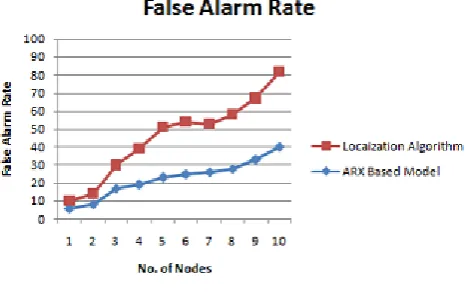
Figure 5: False Alarm Rate
Figure 4 shows, False alarm rate is increased, but the lifetime is decreased. The proposed algorithm is improved network lifetime compre than exiting algorithm.
V. CONCLUSION
In this paper, we use localized fault detection algorithm in wireless sensor networks and we are establishing trust relation between nodes on the basis of their prior interactions. This is efficient in establishing trust relations since it only counts on the direct interactions; however, it is lacking supervisors by other nodes. The mode with an addition of recommendation input part makes the supervisor by other nodes available to build trust in a more reliable way but less efficient (requiring extra local space for storing the recommendations) compared to the Localized algorithm. Our simulations result show that the Localized fault detection algorithm performs best in term of accuracy and Even though signatures bring additional costs, the proposed schemes are still affordable for WSNs after evaluation. Considering a large WSN, we also performed simulations on the proposed schemes.
Fault nodes are detected and further requirements and improvements could easily be done since these coding is mainly structured modular in nature. Improvements can be added by adding new modules of assigning the trust value calculations for the sensor nodes.
REFERENCES
[1] C. Lo, J. Lynch, and M. Liu(2011), “Reference-free detection of spike faults in wireless sensor networks,” in Proc. 4th International Symposium Resilient Control System., pp. 148–153.
[2] V. Ricquebourg, D. Menga, M. Delafosse, B. Marhic, L. Delahoche, and A. Jolly-Desodt(1991), “Sensor
failure detection within the tbm framework: A markov chain approach,” in Proc. Information Process Management., p. 323.
[3] Sung-Jib Yim and Yoon-HwaChoi(2010), “An Adaptive Fault-Tolerant Event Detection Scheme for W
ireless Sensor Networks”., Article sensors ISSN 2332-2347.
[4] J. Polastre, R. Szewczyk, A. Mainwaring, D. Culler, and J. Anderson(2004),“Analysis of wireless sensor
networks for habitat monitoring,” in Wireless Sensor Networks, USA: Springer-Verlag, pp. 399–423. [5] Bhaskar Krishnamachari, Sitharama Iyengar(2004) “Distributed Bayesian Algorithms forFault-Tolerant
Event Region Detection in Wireless Sensor Networks” IEEE Transactions on Computers, vol. 53, no. 3.
[6] J. Lynch, A. Sundararajan, K. Law, A. Kiremidjian, and E. Carryer(2004), “Embedding damage detection
algorithms in a wireless sensing unit for operational power efficiency,” Smart Mater. Structure, vol. 13, no. 4, p. 800.
[7] X. Dai, Z. Gao, T. Breikin, and H. Wang(2009), “Zero assignment for robust H2/H∞ fault detection filter
© 2014, IJCSMC All Rights Reserved
303
[8] R. A. Shaikh, H. Jameel, B. J. d’Auriol, H. Lee, and S. Lee(2009), “Group-based trust management scheme for clustered wireless sensor networks,” IEEE Transaction Parallel Distributed. System. ,vol. 20, no. 11, pp. 1698–1712.
[9] L. Lennart (1999), “System identification: Theory for the user,” in PTR Prentice Hall, NJ, USA: Upper Saddle River.
[10]F. Bao, I. Chen, M. Chang, and J. Cho(2012), “Hierarchical trust management for wireless sensor networks and its applications for trust-based routing and intrusion detection,” IEEE Transaction Network Service Management., vol. 9, no. 2, pp. 169–183.
[11]T. Kobayashi and D. Simon(2003), “Application of a bank of kalman filters for aircraft engine fault diagnostics,” DTIC, Fort Belvoir, VA, Tech. Rep.
[12]E. Aivaloglou and S. Gritzalis(2010), “Hybrid trust and reputation management for sensor networks,” Wireless Networks., vol. 16, no. 5, pp.1493–1510.