on a Random Linear Code
Daniel Smith-Tone1,2 and Cristina Tone1 1Department of Mathematics, University of Louisville,
Louisville, Kentucky, USA
2National Institute of Standards and Technology, Gaithersburg, Maryland, USA
[email protected],[email protected]
Abstract. We introduce a new technique for building multivariate en-cryption schemes based on random linear codes. The construction is ver-satile, naturally admitting multiple modifications. Among these modifi-cations is an interesting embedding modifier— any efficiently invertible multivariate system can be embedded and used as part of the inver-sion process. In particular, even small scale secure multivariate signa-ture schemes can be embedded producing reasonably efficient encryp-tion schemes. Thus this technique offers a bridge between multivariate signatures, many of which have remained stable and functional for many years, and multivariate encryption, a historically more troubling area.
Key words: Multivariate Cryptography, encryption, MinRank
1
Introduction
In the mid 1990s Peter Shor broke the cryptographic schemes that we currently use for information security in the public key setting, see [1]. If we accept that the construction of the technology to implement his attacks is an engineering challenge as opposed to a physical impossibility, then we admit that our current public key infrastructure is a paper tiger waiting to be crushed.
Since that time, several communities have emerged, devoted to various promis-ing avenues to security in a post-quantum world, that is, a world with the large scale quantum computing devices required to undermine current public key cryp-tography by Shor’s techniques. We can largely place these communities in four classes: code-based, isogeny-based, lattice-based and multivariate.
These families are all disparate, though there are sometimes some similarities between code-based and lattice-based techniques. Isogeny-based and multivari-ate cryptosystems, however, typically use tools that are far removed from those employed in the code-based and lattice-based camps.
part Land a quadratic partQplaying the roles of the matrix Aand the error distributionχ, respectively, in standard LWE, see [3]. The coefficients ofL are very large, whereas the coefficients ofQ are very small. When a small inputx is introduced, a small vector Q(x) is sampled and the “lattice point” L(x) is perturbed. As long as the parameters are quite large, and under some additional assumptions, the distribution of (L, Q(x) +L(x)) is close to that of (L, L(s) +e) whereeis drawn from an appropriate Gaussian distribution, so that the security of the scheme is based on the LWE assumption and the MQ problem, that is, the problem of solving quadratic systems of equations over a field.
A natural question to ask is whether it is possible to breed a hybrid code-based multivariate scheme and what properties is might possess. In this work, we present a new multivariate encryption scheme inspired and derived from linear codes. While the connection to code-based schemes is not so direct and apparent as the connection to LWE in [2], the construction appears versatile and amenable to adjustment for various security and performance properties as have multivariate schemes in general come to be known. As an example of this maleability, we propose, in addition to the fundamental scheme, a variant with a decryption algorithm approximately 1600 times faster than the original, and, in fact, much faster than any multivariate encryption scheme targeting CCA security at the 128-bit security level. In Appendix A, we provide a comparison with several multivariate encryption schemes including Simple Matrix (ABC), Extension Field Cancellation (EFC), HFERP and EFLASH, see [4–7].
This manuscript is organized as follows. In Section 2 we present the frame-work for the new scheme. Then, in Section 3 we examine the decryption failure rate and set constraints on parameters to satisfy reasonable bounds. We then conduct a security analysis against the known attack vectors in Section 4. In Sec-tion 5, we introduce modificaSec-tions, allowing fine tuning of security properties as well as dramatically improving performance, both in decryption time and in key size. We then present some concrete parameters for future scrutiny in Section 6. Finally, we conclude, discussing future directions for this line of reasoning.
2
Nonlinear Multivariate System from a Linear Code
LetFq be a finite field withqelements and letCbe a rankkrandom linear code of lengthnoverFq. LetGbe the generator matrix forC in standard form and letHbe the corresponding parity check matrix.
We construct a quadratic system of formulae as follows. First, randomly select kmatricesAiinMn×(n−k)(Fq). Next form the productsBi=AiH. Finally, let F :Fnq →Fkq be defined byF(x) = (F1(x), . . . , Fk(x)), whereFi(x) is given by
xBix>.
Given knowledge of the code C, preimages under F may be acquired by computing a set of representatives A of the cosets of C in Fn
there exists an x0 ∈ A and an bx∈C such thatx=x0+x; moreover, we noteb that sincexb=xGfor somex∈Fk
q, that y`= (x0+bx)B`(x0>+bx>)
=x0B`x0>+x0B`bx
>+
b
xB`x0>+xBb `xb
>
=x0B`x0>+x0A`HG>x>+xBb `x
0>+
b
xA`HG>x>
=x0B`x0>+bxB`x
0>
=x0B`x0>+xGB`x0>,
for 1≤`≤k, formk linear equations in thekunknown coefficients ofx. We further note a few simple facts. Efficient derivation of preimages of F requires thatn−kbe small. Then, necessarily, the matricesB`, which are of rank n−kat most, are of low rank. Given merely the multivariate representation ofF`, however, an adversary does not immediately recover a low rank representation of F`as a quadratic form. In general, there are aroundq(
n
2) matrix representations ofF`, many of which have high rank.
Still, the code structure ofC can be learned from F in this form by simply searching for roots of the system. Since any code wordx∈CsatisfiesF(x) =0, one simply searches, with complexity roughlyO(kqn−k), forkroots ofF which generate ak-dimensional subspace of roots ofF, andCis recovered. To prevent this attack, we use the plus (+) modifier, addingpadditional random formulae to F. These additional formulae are then mixed via an affine transformation T with thekformulae derived fromC, producing the public key of the code-based multivariate cryptosystem (CBM):
P =T ◦(FkQ), where Q : Fnq → F
p
q is a random quadratic map and T : F k+p q → F
k+p q is an invertible linear map. Preimages of P are then calculated by inverting T and following the above procedure for finding a preimage ofF.
Including the (+) modifier, the extra equations generated by Q must be satisfied as well, so we may need to check all values of x0 ∈ A to find a valid preimage. When p is not much larger than k, we expect in general that the preimage may not be a singleton. Thus, we must make p considerably larger thankso that the equations fromQprovide check equations that a single correct input has been found. We can therefore find parameters for which this scheme can be instantiated for public key encryption. For sufficiently largep, the system is statistically injective, in the sense that the probability of selecting an input producing a non-unique output is negligible inn.
3
Decryption Failure Rate
One would expect a random function fromFn
q toFkq to collide in every value approximately qn−k times; moreover, one would expect the distribution of mul-tiplicities for each output to be centered at qn−k. The value,n−k is small by design, however, and the output 0occurs at least qk times. Thus, the distribu-tion of multiplicities of the outputs must be skewed towards lower values while having a single large value aroundqk. We can say somewhat more.
Aside from codewords, there is a higher probability for a collision on the outputs of two elements in the same coset of the code. Recall that given a representativex0 of the cosetx0+C, that F`(x0+xG) =x0B`x0>+xGB`x0>. Thus, there is a collisionF(x0) =F(x0+xG) if the k×kmatrix
GB1x0>· · · GBkx0>
is singular. In particular, there are as many elements in the coset with the same output asx0as the size of the kernel of this map. Since ak×kmatrix is singular with probability approximately q−1 for sufficiently large k and, very roughly, the kernel is of dimension r with probability about q−r, the distribution of multiplicities of outputs is large near zero and decays exponentially in q, with the single exception of a very large multiplicity output of0. We experimentally verified this analysis. The results of a particular example can be found in Table 1.
Table 1.The frequency of multiplicities of outputs of the hidden mapF— that is, the number of outputs whose preimage under F is of a given size— for an instance ofF
with parametersq= 2,n= 12,k= 10, andp= 16.
Multiplicity 0 2 4 6 8 1030
Frequency 192 384 256 127 64 1
With this observation on the distribution of multiplicities, we can estimate a collision probability forP under the standard heuristic that random quadratic functions behave as random functions and the additional assumption that fail-ures are dominated by multiple preimages in C. We are able to establish the following theorem, whose proof is in Appendix B for space reasons.
Theorem 1 Under the heuristic that FC and Q are random functions, the
collision probability for the CBM satisfies the bound
pcol< q2k−n−p.
Furthermore, if limn→∞pn >1, thenpcol is negligible in n.
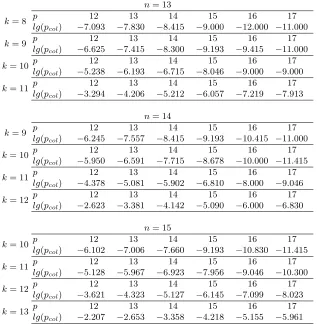
Table 2. The log collision rate for small scale variants of the scheme. Values are computed by encrypting all possible plaintexts and counting the number of plaintexts that cannot be uniquely decrypted. All experiments use the valueq= 2.
n= 13
k= 8 p 12 13 14 15 16 17
lg(pcol) −7.093 −7.830 −8.415 −9.000 −12.000 −11.000
k= 9 p 12 13 14 15 16 17
lg(pcol) −6.625 −7.415 −8.300 −9.193 −9.415 −11.000
k= 10 p 12 13 14 15 16 17
lg(pcol) −5.238 −6.193 −6.715 −8.046 −9.000 −9.000
k= 11 p 12 13 14 15 16 17
lg(pcol) −3.294 −4.206 −5.212 −6.057 −7.219 −7.913
n= 14
k= 9 p 12 13 14 15 16 17
lg(pcol) −6.245 −7.557 −8.415 −9.193 −10.415 −11.000
k= 10 p 12 13 14 15 16 17
lg(pcol) −5.950 −6.591 −7.715 −8.678 −10.000 −11.415
k= 11 p 12 13 14 15 16 17
lg(pcol) −4.378 −5.081 −5.902 −6.810 −8.000 −9.046
k= 12 p 12 13 14 15 16 17
lg(pcol) −2.623 −3.381 −4.142 −5.090 −6.000 −6.830
n= 15
k= 10 p 12 13 14 15 16 17
lg(pcol) −6.102 −7.006 −7.660 −9.193 −10.830 −11.415
k= 11 p 12 13 14 15 16 17
lg(pcol) −5.128 −5.967 −6.923 −7.956 −9.046 −10.300
k= 12 p 12 13 14 15 16 17
lg(pcol) −3.621 −4.323 −5.127 −6.145 −7.099 −8.023
k= 13 p 12 13 14 15 16 17
lg(pcol) −2.207 −2.653 −3.358 −4.218 −5.155 −5.961
In addition to possible lack of injectivity, there is another issue affecting CMB. If the plaintext happens to be a code-word, then the decryption method fails to provide any linear relations. In this case, inversion can still be achieved with high probability at the cost of searching through the code for the appro-priate preimage. Such searches are performed in the experiment presented in Table 2. For practical parameters, there are qk codewords andkmust be quite large; thus, inversion in this case is infeasible. Hence, we obtain the following theorem.
Theorem 2 Under the heuristics of Theorem 1, the decryption failure rate is
Thus, there is a phase transition for CBM around p = k. For plain CBM the decryption failure rate is dominated byqk−n, but for the fairly rich space of possible variants, it is possible for this transition to take place.
4
Security Analysis
Attacks on multivariate cryptosystems largely fall into a few categories: alge-braic, rank, differential, statistical and ad hoc. We here analyze the scheme pre-sented in Section 2 with respect to the first three of these categories. For space reasons, the statistical and ad-hoc techniques are addressed in Appendix C.
4.1 Algebraic Attack
The most fundamental attack in multivariate cryptography is the algebraic at-tack, that is, directly solving the system of equationsy=P(x). The complexity of this method is determined by the size of the Macaulay matrix at the solving degree. In practice, coincidence of the solving degree and the first fall degree in Gr¨obner basis calculations is sufficiently common that we conservatively as-sume that they are equal and select parameters for which the first fall degree is sufficiently large to guarantee security from this attack.
Following the analysis of [6], we calculate the semi-regular degree, i.e. the first fall degree assuming that as few relations as possible exist among the polynomials at each degree, as the first non-positive coefficient in the series expansion of
Sn,m(t) =
(1−tq)n(1−t2)m (1−t)n(1−t2q)m.
As seen in Section 3, to keep the decryption failure rate low we require that 2k−n−p is small. If we set this quantity to at most −64, we obtain p≥2k−n+ 64. If we further assume that the MinRank isr= 2(n−k) and is fixed at some value, then following the analysis in [8], we obtain an upper bound on the first fall degree of the minimum ofrand the semi-regular degree.
For practical values of n it is easy to find values of k for which the semi-regular degree is bounded by r and for which the above formula holds for p. Thus, under the assumption that the scheme is semi-regular, the complexity of the algebraic attack over GF(2) isO nrω
, where 2≤ω <3.
Table 3.First fall degreedf ffor small schemes at the transitions points of semi-regular degreedsrwithkas close as possible ton−10 such that the scheme is not degenerate. Ten experiments are conducted for each parameter set, all having the same results.
(n, k, p) (10,2,10) (11,3,11) (23,13,25) (24,14,26) (36,26,38) (37,27,39)
df f 3 4 4 5 5 6
dsr 3 4 4 5 5 6
4.2 Rank Attacks
Since for each coordinate ofF there exists a matrix representation of rankn−k, we may suspect that there is a relevant rank attack on the scheme separatingF fromQ. There are a couple of systematic forms we must consider to analyze rank attacks. One such representation, the upper triangular representation, seems to offer no weakness. Even though the non-standard matrix has rankn−kwhich may be low, the upper triangular form in general has much larger rank, see Table 4. On the other hand, if we ignore diagonal entries, symmetric represen-tations have a rank bound of 2(n−k) since we can construct such a symmetric representation by adding the non-standard representation of rankn−kwith its transpose.
Table 4.MinRank for some small example instances of the code-based multivariate scheme. In each instance, there exists a non-standard matrix representation of a linear combination of the public quadratic forms of rankn−k= 2; however, in each case the MinRank achieved is larger. In each case,q= 2 and the systematic form used for the MinRank is the upper-triangular representation.
n(k=n−2,p=n+ 4) 10 11 12 13 14 15
MinRank 4 5 5 7 7 8
Given a low rank linear combinationαof the symmetric forms ignoring the diagonal elements, one can take the corresponding linear combinationTαof the upper triangular representations representing a function in the span of the Fi. Once recovered, there is an efficient way to expose the codeC, undermining the scheme. One can randomly selectO(kqn−k) vectors and likely findkgenerators ci of C by testing whether linear combinations of roots ciTαc>i = 0 are also roots. We note explicitly that the secret non-standard matrix representations of Fishare the same kernel, but there is no need for the systematic representations to share this property.
a complexity of
O(p+ 1)ωq2dp+1n e(n−k)
.
4.3 Differential Attacks
Consider the differentialDP(a,x) =P(a+x)−P(a)−P(x) +P(0) of the public keyP. We may expand this quantity as follows:
DP(a,x) =D(T◦(FkQ))(a,x) =T(DFkDQ)(a,x).
The special structure ofDF implies that P has a subspace differential in-variant, see [9, Definition 2]. Specifically, suppose that Mis a linear projection ontoC. Then we obtain
DF(Ma,Mx) =F(ca+cx)−F(ca)−F(cx) +F(0) =0.
As noted in the previous subsection, since the systematic matrix forms ofFi are of low rank 2(n−k), it is inefficient to recover the differential invariant from rank techniques. The alternative, however, of modeling the differential invariant as a cubic system of equations in the unknown coefficients ofM andT−1 is no better, even though there are several dependencies in the system. Finding such an M in this way requires solving kn2 cubic equations in kn+km variables, which is much more complex than the brute force attack.
5
Modifications
One clear problem with CBM is the poor decryption failure rate. Since the legit-imate user needs to performqn−k linear algebra steps to invertF, this quantity must remain small; however, inversion is infeasible even with an unique preim-age whenx∈C. Also, as seen in Section 4, the linear algebra search MinRank attack has a complexity that is only a factor of 2pn greater in the exponent than decryption by a legitimate user. Thus, to achieve a high level of security, ex-tremely large parameters must be used. We propose a few modifications that provide the degrees of freedom required to make CBM more versatile.
5.1 OCBM
The first modification exploits polynomial morphisms to avoid infeasible inver-sion. Specifically, we can consider an embedding of the plaintext space insisting that output of the affine transformation U is never a codeword. We repeat the construction of CBM from Section 2 using n0 in place ofnand adding to every equation a random linear form. Thus, we have
wherebiis a random vector of dimensionn0. We then choose an invertible affine transformation T : Fk+p
q → Fk+pq , set n =n0−1 and select an injective affine transformation U : Fnq → Fn
0
q such that Im(U)∩C = ∅. The public key is then given by P = T ◦(FkQ)◦U. Clearly, the inversion process for F is the same because the extra summand from the bi merely changes the linear form associated with theith equation.
With this construction, which we call OCBM, infeasible inversion due to the plaintext being a codeword is impossible, and the decryption failure analysis simplifies to essentially the same as the injectivity probability of Theorem 1 in Section 3. Since, due to rank concerns, practical parameters make the decryption failure probability extremely low, OCBM is statistically injective.
5.2 ECBM
In this subsection we propose a modification of the scheme that decouples de-cryption for the legitimate user from a search through all cosets of the code. Specifically, we propose to use an embedded small instance of EFLASH+, see [7], to encode the syndrome corresponding to the plaintext, thus identifying uniquely the correct coset in which to solve for the valid preimage.
Let K be a degree d > n−k extension of Fq and let f : K → K be a
C∗ monomial, f(x) = xqθ+1 where (qθ + 1, qd−1) = 1. Let φ :
Fdq → K be an Fq-vector space isomorphism. Then E = φ−1◦f ◦φ is the vector-valued representation of the monomial functionf overFq. LetQE be a random system ofpE formulae indvariables. Further define
E0(x) = (Πa◦EkQE)(V(xH>)),
where Πa is a codimension a projection and V : Fqn−k → Fdq is linear of full rank. Finally, let U and T be invertible linear maps of dimensions n and m, respectively, and we compute the public key
P =T(FkE0kQ)◦U.
Inversion ofP is accomplished as follows. Given a ciphertexty, the user first computesv=T−1(y). Next,vis parsed intov1,v2, v3and v4, corresponding to the outputs ofF, Πa◦E, QE and Q, respectively. The user then randomly searches through the qa possible preimages of v2 under Πa, inverts E via ex-ponentiation by hsatisfying h(qθ+ 1) = 1 (mod qd−1), and finds a value t satisfying QE(t) = v3. The user then computes the preimage s of tunder V, obtaining the valid syndrome corresponding to the preimage u = U(x) of v1 underF. The valid syndrome reveals the coset ofCcontainingu, and inversion ofF to recoveruproceeds as in Section 2. Finally, the plaintext is recovered as x=U−1(u).
Thus the inversion ofF is sped up by as much as a factor of roughlyqn−k since the inversions of the small EFLASH+ instance are much more efficient than the inversions of the large linear systems. Second, since the complexity of inversion is decoupled from the quantityn−k, this value can be made much larger, making the MinRank attack much less efficient as long as the Q-rank of the EFLASH+ instance is sufficiently large. Finally, since we are introducing a C∗ monomial map in the scheme, we must revisit differential, Q-rank and algebraic attacks.
Luckily, it is straightforward to see that the analysis proving resistance to differential, Q-rank and algebraic attacks for EFLASH, see [7], are applicable in this context as well. Note that even though n can be chosen much larger than d, the input to the public key is compressed to a dimension of n−k < d before the application of the EFLASH instanceΠa◦E◦V; thus, there is a valid projection and an entire EFLASH instance in the central map. Therefore,P has no differential symmetries or invariants, and can be built to have Q-rank 2a.
5.3 PCBM
As demonstrated in [7], the expected solving degree of EFLASH instances with smallernis lower than the semi-regular degree for that size. Since adding extra equations may have the effect of lowering this degree further, we offer a more conservative and quite interesting additional optional modification that does not share this property of possible degradation of the solving degree. Instead of embedding an EFLASH instance among the plus equations, one can embed a PFLASH instance. Thus, we can use a multivariate signature scheme as part of the inversion process of this multivariate encryption scheme. This fact provides a very interesting plot twist in the development of CBM.
The construction for PFLASH is the same as that of EFLASH with the exception that it requires d =n−k+ 1 and a is chosen a bit larger to avoid any combinatorial attack. We still use the plus modifier as part of the PFLASH construction for efficiency. As a result, the efficiency of this modification is not quite as great as the EFLASH variant, but its performance is still comparable to other multivariate encryption schemes.
6
Parameter Selection
In selecting parameters, we consider the analyses of the previous section as well as efficiency. The most inefficient operation is inversion of the hidden mapFkQ; therefore, we begin by describing an efficient approach.
We find that the limiting attack from Section 4 is the linear algebra search variant of the MinRank attack. With a complexity on the order ofq2p(nn−k), we find that the legitimate user only has an advantage of a factor of 2pn in the exponent over an adversary. Thus np must be made large to allow efficient in-version while maintaining security. We examine the case that pn is sufficiently larger than 3 that the adversary must choose 4 vectors in the MinRank calcu-lation. Then parameters achieving the 128-bit security level are given byq= 2, n= 148,k= 132 andp= 476. For these parameters the semi-regular degree is 8 which achieves slightly over 128-bit security for the algebraic attack. For a static key version (OCBM), we propose the parameters q = 2, n = 148, n0 = 149, k= 133 and p= 475. The performance is fairly abysmal for these parameters, with decryption for our non-optimized implementation taking approximately 400 seconds.
The EFLASH variant of the code-based cryptosystem (ECBM) is much more efficient. Parameters achieving the 128-bit security level are q = 2, n = 148, k= 131, d=23, a= 5 and p= 298 for ephemeral use with a decryption failure rate of 2−16. With these parameters our non-optimized magma implementation decrypts in 66ms, about 6000 times faster than the code-based scheme without modification.
The EFLASH variant also allows us the freedom to choose parameters for static use. Since the decryption complexity is no longer related to n−k, we can set this quantity to a large value. This change has two effects. First, with a sufficiently large value of n−k, we no longer need an extremely large value forpto prevent the MinRank attack. In fact, if we chosen−karound 65, then even withp≈nthe MinRank attack does not affect our 128-bit security claim. Secondly, the allowance of smaller values of preduces key sizes. Therefore, for static keys we propose the parameters q = 2,n = 148,k = 83, d= 71, a= 5 andp= 160 achieving a decryption failure rate of 2−64.
In addition we propose a parameter set incorporating both of the mentioned modifiers, EOCBM. This scheme sacrifices a miniscule amount of speed and key size to allow for static keys. The proposed parameters for 128-bit security areq= 2, n= 148,n0 = 149,k= 132, d= 23,a= 5 and p= 297.
Similarly, the PFLASH variant (PCBM) also allows us to decouple inversion from the value n−k. We chose parameters n = 148, k = 78, d = 71, a = 7 andp= 160 achieving a decryption failure rate of 2−69. Incorporating the above modifier as well we obtain POCBM. For this scheme we chose parametersn= 148,n0= 149,k= 79,d= 71,a= 5 andp= 160 achieving a decryption failure rate of about 2−149.
7
Conclusion
a few multivariate encryption schemes with a claim to solid theoretical foun-dations, none of these schemes have achieved noteworthy performance at the security levels necessary for future public key applications.
Without modification, the code-based scheme of Section 2 seems to lie solidly in the region of poor performance inhabited by the past multivariate encryption schemes. To avoid truly colossal keys one must endure decryption with precom-puted keys that still takes minutes at the 128-bit security level. The reason for this slowness is that decryption is analogous to a form of syndrome decoding without an error-prone message provided. To use this analogy, the plaintext is like a noisy codeword and the ciphertext is like a very noisy hint about the noisy codeword and its syndrome in the form of several inner products of the noisy codeword with its syndrome. Given the private key, the inner products can be extracted, but the syndrome must be guessed before the message and then noisy message are recovered; however, the analogy stretches rather thin here since there is no distance bound for the error and consequently a need merely for uniqueness in the “noisy codeword” and not the codeword itself.
In contrast, modifying the scheme by including a miniature version of either EFLASH, PFLASH or any of many other multivariate encryption or signature schemes embedded in the system can enhance the performance dramatically. It is no longer the case that a search of complexity directly related to the corank of the code must be undertaken to discover the correct syndrome. The correct syndrome is encoded by the EFLASH/PFLASH component. Thus, the very effi-cient decoding process given the syndrome and hint allows for rapid decryption. In addition, due to the decoupling of the corank of the code from decryption efficiency, the corank can be increased a great deal resulting in much smaller keys while achieving greater efficiency. To our knowledge, this scheme is the first modular scheme capable of constructing a multivariate encryption scheme from a multivariate signature scheme.
References
1. Shor, P.W.: Polynomial-time algorithms for prime factorization and discrete loga-rithms on a quantum computer. SIAM J. Sci. Stat. Comp.26, 1484(1997) 2. Huang, Y., Liu, F., Yang, B.: Public-key cryptography from new multivariate
quadratic assumptions. In Fischlin, M., Buchmann, J.A., Manulis, M., eds.: Pub-lic Key Cryptography - PKC 2012 - 15th International Conference on Practice and Theory in Public Key Cryptography, Darmstadt, Germany, May 21-23, 2012. Proceedings. Volume 7293 of Lecture Notes in Computer Science., Springer (2012) 190–205
3. Regev, O.: On lattices, learning with errors, random linear codes, and cryptog-raphy. In Gabow, H.N., Fagin, R., eds.: Proceedings of the 37th Annual ACM Symposium on Theory of Computing, Baltimore, MD, USA, May 22-24, 2005, ACM (2005) 84–93
4. Tao, C., Xiang, H., Petzoldt, A., Ding, J.: Simple matrix - A multivariate public key cryptosystem (MPKC) for encryption. Finite Fields and Their Applications 35(2015) 352–368
5. Szepieniec, A., Ding, J., Preneel, B.: Extension field cancellation: A new central trapdoor for multivariate quadratic systems. In Takagi, T., ed.: Post-Quantum Cryptography - 7th International Workshop, PQCrypto 2016, Fukuoka, Japan, February 24-26, 2016, Proceedings. Volume 9606 of Lecture Notes in Computer Science., Springer (2016) 182–196
6. Ikematsu, Y., Perlner, R.A., Smith-Tone, D., Takagi, T., Vates, J.: HFERP - A new multivariate encryption scheme. [10] 396–416
7. Cartor, R., Smith-Tone, D.: EFLASH: A new multivariate encryption scheme. In Cid, C., Jr., M.J.J., eds.: Selected Areas in Cryptography - SAC 2018 - 25th Inter-national Conference, Calgary, AB, Canada, August 15-17, 2018, Revised Selected Papers. Volume 11349 of Lecture Notes in Computer Science., Springer (2018) 281–299
8. Ding, J., Hodges, T.J.: Inverting HFE systems is quasi-polynomial for all fields. In Rogaway, P., ed.: Advances in Cryptology - CRYPTO 2011 - 31st Annual Cryp-tology Conference, Santa Barbara, CA, USA, August 14-18, 2011. Proceedings. Volume 6841 of Lecture Notes in Computer Science., Springer (2011) 724–742 9. Moody, D., Perlner, R.A., Smith-Tone, D.: An asymptotically optimal structural
attack on the ABC multivariate encryption scheme. In Mosca, M., ed.: Post-Quantum Cryptography - 6th International Workshop, PQCrypto 2014, Waterloo, ON, Canada, October 1-3, 2014. Proceedings. Volume 8772 of Lecture Notes in Computer Science., Springer (2014) 180–196
10. Lange, T., Steinwandt, R., eds.: Post-Quantum Cryptography - 9th International Conference, PQCrypto 2018, Fort Lauderdale, FL, USA, April 9-11, 2018, Pro-ceedings. Volume 10786 of Lecture Notes in Computer Science., Springer (2018) 11. Apon, D., Moody, D., Perlner, R., Smith-Tone, D., Verbel, J.: Combinatorial rank
attacks against the rectangular simple matrix encryption scheme. in concurrent submission to PQCrypto 2020 (2020)
13. Smith-Tone, D., Verbel, J.: A key recovery attack for the extension field cancella-tion encrypcancella-tion scheme. in concurrent submission to PQCrypto 2020 (2020) 14. Fouque, P., Granboulan, L., Stern, J.: Differential cryptanalysis for multivariate
schemes. In Cramer, R., ed.: Advances in Cryptology - EUROCRYPT 2005, 24th Annual International Conference on the Theory and Applications of Cryptographic Techniques, Aarhus, Denmark, May 22-26, 2005, Proceedings. Volume 3494 of Lec-ture Notes in Computer Science., Springer (2005) 341–353
15. Ding, J., Perlner, R.A., Petzoldt, A., Smith-Tone, D.: Improved cryptanalysis of hfev- via projection. [10] 375–395
16. Vrbik, J.: Small-sample corrections to kolmogorovsmirnov test statistic. Pioneer Journal of Theoretical and Applied Statistics15 (1-2)(2018) 15–23
A
Comparison of Multivariate Encryption Schemes
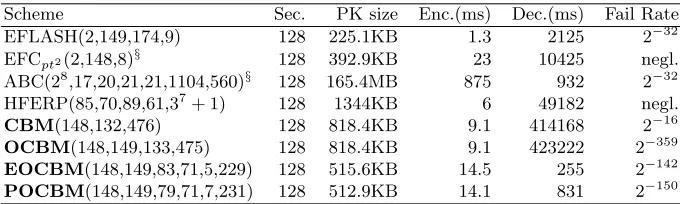
Table 5 provides a performance comparison of multivariate encryption schemes at the 128-bit security level. We note that the parameters for ABC and EFC are updated to achieve 128-bits of security, resisting the attacks of [9, 11] and [12, 13], respectively. We also point out in the specification of EFC, see [5], that the key sizes appear to be mistakenly written in KB when the values are accurate for Kb. Also, there is apparently a bad problem with the implementation which is far too inefficient, being several orders of magnitude slower than our non-optimized implementation.
Table 5.Performance characteristics of multivariate encryption schemes at the 128-bit security level.
Scheme Sec. PK size Enc.(ms) Dec.(ms) Fail Rate
EFLASH(2,149,174,9) 128 225.1KB 1.3 2125 2−32
EFCpt2(2,148,8)§ 128 392.9KB 23 10425 negl.
ABC(28,17,20,21,21,1104,560)§
128 165.4MB 875 932 2−32
HFERP(85,70,89,61,37+ 1) 128 1344KB 6 49182 negl.
CBM(148,132,476) 128 818.4KB 9.1 414168 2−16
OCBM(148,149,133,475) 128 818.4KB 9.1 423222 2−359
EOCBM(148,149,83,71,5,229) 128 515.6KB 14.5 255 2−142
POCBM(148,149,79,71,7,231) 128 512.9KB 14.1 831 2−150
B
Proof of Theorem 1
For clarity of notation, in the following, allow #Ato represent the size of the set A. A collision occurs when the size of the preimage of a valid ciphertext under P is greater than one. Thus, the probability of collision is given by
pfail=P r
#P−1(y)>1#P−1(y)>0
= P r
#P−1(y)>1 P r[#P−1(y)>0].
§
Clearly, since P=T◦(FkQ) andT is invertible, we have equivalently, pfail= P r
#(F−1(y
1)TQ−1(y2))>1 P r[#(F−1(y
1)TQ−1(y2))>0] = 1−P r
#(F−1(y1)TQ−1(y2)) = 1
−P r#(F−1(y1)TQ−1(y2)) = 0
1−P r[#(F−1(y
1)TQ−1(y2)) = 0]
,
wherey=y1ky2.
Considering the observation from Section 3 about the special status ofy1=0, we consider the two probabilities in the above numerator, splitting into the cases y1 = 0 and y1 6= 0. Since we know that F(C) = 0and |C| = qk, we model the random variable #F−1(y1) as a Binomial(qn−qk, q−k). Similarly, sinceqk values in F−1(0) are not random, we model #F−1(0) as qk+X where X ∼ Binomial(qn−qk, q−k). We will require the following Lemma related to binomial random variables. Lemma 1 n X k=0 k n k
(rp)k(1−p)n−k=npr(1 + (r−1)p)n−1.
Proof. Trivial.
First, we consider the probability of no intersection in the preimage ofF and Q.
P rh#(F−1(y1)
\
Q−1(y2)) = 0
i
=P rh#(F−1(y1)
\
Q−1(y2)) = 0
y1=0
i
P r[y1=0] +P rh#(F−1(y1)
\
Q−1(y2)) = 0
y16=0
i
P r[y16=0] We expand this expression by splitting the events into disjoint unions based on the value of #F−1(y
1). qn−qk
X
s=0
P rh#(F−1(y1)
\
Q−1(y2)) = 0∧#F−1(y1) =s+qk
y1=0
i
P r[y1=0]
+ qn−qk
X
s=0
P rh#(F−1(y1)
\
Q−1(y2)) = 0∧#F−1(y1) =s
y16=0
i
P r[y16=0]
LetQy1 represent the functionQrestricted toF −1(y
1). Then we may simplify the notation obtaining:
qn−qk
X
s=0
P r#Q−y11(y2) = 0∧#F −1(y
1) =s+qk
y1=0
P r[y1=0]
+ qn−qk
X
s=0 P r
#Q−y11(y2) = 0∧#F−1(y1) =s
Under the assumption that Q acts as a random oracle, independence is main-tained even with a restricted domain. Therefore, we obtain:
qn−qk
X
s=0
P r#Q−y11(y2) = 0
P r#F−1(y1) =s+qk
y1=0
P r[y1=0]
+ qn−qk
X
s=0 P r
#Q−y1
1(y2) = 0
P r
#F−1(y1) =s
y16=0
P r[y16=0]
Each of these probabilities is now readily computed. In the case that y1 =0, #F−1(y1)−qk is binomial; otherwise, #F−1(y1) is binomial. Since the proba-bility that a random input to Qproduces y2 is q−p, the probability that none oft outputs is equal to y2 is (1−q−p)t for eithert=sor t=s+qk. Thus we have:
qn−qk
X
s=0
(1−q−p)s+qk
qn−qk s
q−ks(1−q−k)qn−qk−sq−k
+ qn−qk
X
s=0
(1−q−p)s
qn−qk s
q−ks(1−q−k)qn−qk−s(1−q−k)
=1−q−k+q−k(1−q−p)qk 1−q−k−pq
n−qk
.
A similar process for P r[#(F−1(y1)TQ−1(y2)) = 1] produces expressions in the form of Lemma 1 withqn−qk in place ofn, 1−q−p in place ofrandq−k in place ofp. Simplifying the massive expression we obtain:
P rh#(F−1(y1)
\
Q−1(y2)) = 1
i
= (q−k−p∗(1−q−p)qk−1+q−p∗(1−q−k))∗(qn−k−1)∗(1−q−k−p)qn−qk−1 +q−p∗(1−q−p)qk−1∗(1−q−k−p)qn−qk.
With some tedious but trivial manipulation, we can show that the result-ing expression for lg(pf ail) is approximately equal to q2k−n−p−1. The proof is complete.
C
Statistical and ad hoc Attacks
As shown in [14, 15], statistical cryptanalysis techniques in multivariate cryp-tography can be quite varied and can possibly allow for hybridized statisti-cal/algebraic attacks. Security against all such attacks will be an ongoing re-search topic in this area, in general.
ciphertexts derived from codeword and non-codeword plaintexts, respectively. Second, we examine the difference in Hamming weight between ciphertexts and random vectors.
To compare the distributions P(C) and P(C) we chose to select a statis-tic sensitive to any change in distribution between two empirical distributions, the Kolmogorov-Smirnov statistic. We select subsets X1 and X2 of C and C, respectively, of the same size and compute
KSN = sup x∈Fmq
F1,N(x)−F2,N(x)
,
where Fi,N is the empirical distribution ofP(Xi) with respect to a fixed total order≺onFm
q and|Xi|=N. At significance levelα, the test detects a distinction in the distributions if
KSN >
r
−ln(α)
N .
For small parameters, we choseX1=Cand observed that the rejection rate approachesαas pincreases for fixednand k. Expecting more power for larger values of N, we increase parameter sizes and allow X1 to be a random sizeN subset ofC. In this case, we observe that the distributions seem to converge for sufficiently large data sets.
We further perform a goodness-of-fit test comparing the empirical distribu-tion ofP(X) forX⊆Fnq with|X|=N with the uniform distribution Unif(Fmq ). The test asserts that the distributions differ when
KSN0 = supx∈F m q
FN(x)−F(x) >
δα √
N,
where F(x) = 1 qm|{x
0 ∈
Fmq : x0 x}|and ϑ(12, 2i πδ
2
α) = 1−αwhere ϑ is the Jacobi theta function. We use the trick from [16] of replacing the parameterδα with δα+ 1
6√N + δα−1
N to maximize the accuracy of the tests for small sample sizes. In our case, we usedN= 2048 for all of the tests. Again, for fixednandk as pincreases we observe that the rejection rate approachesα. Some data from our experiments are presented in Table 6.
We also conduct experiments comparing the Hamming weight distribution H(P(Fnq)) to the distribution of the Hamming weight of random vectors inFmq , Binomial(m,0.5). The results of the experiments are presented in Table 7. Again, the data indicate that aspincreases the statistical differences become small.
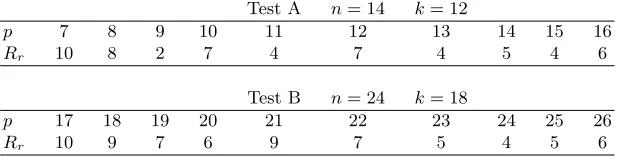
Table 6.Rejection rates (Rr) plotted versus the number,p, of plus polynomials for 100 trials of the Kolmogorov-Smirnov test for sample data values at theα= 0.05 level. Test A compares the distributions ofP(X1) andP(X2), while Test B comparesP(X)
with Unif(Fmq ). In all casesN= 2048.
Test A n= 14 k= 12
p 7 8 9 10 11 12 13 14 15 16
Rr 10 8 2 7 4 7 4 5 4 6
Test B n= 24 k= 18
p 17 18 19 20 21 22 23 24 25 26
Rr 10 9 7 6 9 7 5 4 5 6
Table 7. Rejection rate (Rr) plotted versus the number, p, of plus polynomials for 100 trials of the Kolmogorov-Smirnov goodness-of-fit test comparting the Hamming weight distribution onN = 2048 ciphertexts with parametersn= 14 andk= 12 with Binomial(m,0.5) at theα= 0.05 level.
Test A n= 14 k= 12
p 1 2 3 4 5 6 7 8 9 10