© 2016, IJCSMC All Rights Reserved 462 Available Online atwww.ijcsmc.com
International Journal of Computer Science and Mobile Computing
A Monthly Journal of Computer Science and Information Technology
ISSN 2320–088X
IMPACT FACTOR: 5.258
IJCSMC, Vol. 5, Issue. 7, July 2016, pg.462 – 466
A Study on Characterization and Issues of
WiMax Communication Network
Saloni Sehgal
Student, M.Tech, Ansal University, SET (School of Engineering and Technology)
Amit Kumar Yadav
Student, M.Tech, Ansal University, SET (School of Engineering and Technology)
Abstract— WiMAX is the high speed network defined for hybrid and open network communication. But as the communication requirement and the traffic increases, the network suffers from various issues and challenges. In this paper, a study work is provided to explore the WiMAX architecture, features, processing and the challenges. The paper also connected the communication to the 4G network as the new insight to the WiMAX communication. The paper has described the technological formulation with detail overview of the communication architecture. The critical handoff challenge in high speed network is also discussed in this paper.
Keywords: WiMAX, Challenges, Architecture, Functioning, Handoff
I. INTRODUCTION
WiMAX communication network is the improved communication method that provides high speed communication. The WiMAX communication provides the high speed video communication along with quality of service, lack of reproducibility and reliability over the transmission medium. This WiMAX communication has replaced the existing high speed communication technology with new technological formation. In private networks where high speed communication is required, WiMAX is able to provide such higher performance communication. This network can be adopted for telephone lines, video networks all can be connected through WiMAX networks[1][2][8][9][10][11].
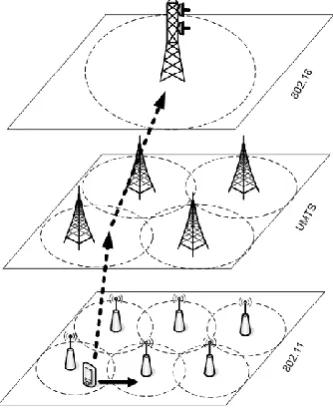
© 2016, IJCSMC All Rights Reserved 463 Figure 1 : WiMAX Communication Architecture
Here figure 1 is showing the WiMAX communication architecture with handoff mechanism. In HHO mobile stations maintains the communication with a single BS at any given time. So depending on the signal strength, MS breaks the communication with lower signal strength BS and establish the connection with the higher signal strength BS during its travel between different BS. A Hard handoff is also referred to as “Break-before-Make” handover. One of the advanced forms of 4G communication is provided by WIMAX network. These network models provide effective utilization of network resources and bandwidth. This network basically applied with authentication scenario so that the only valid license user can communicate to the network. Such kind of deployed wireless links are comparatively faster and less expensive. These links are significant to the radio communication and provides the Gbit/s communication rate. But these open space communication also suffers from some of environmental impurities. One of such impurity or the communication problem includes turbulence. In this work, the most critical communication model called handoff is resolved by reducing the communication loss and communication delay.
A) 4G WiMAX
4G network is a communication technology defined with high speed communication technology. This technology is adapted by WIMAX communication network to provide the high bandwidth based connection. This communication is performed in global network space, which provides the effective telecommunication in open wireless environment. 4G network is capable to provide high speed video and voice communication up to 2.5Gbps of communication rate. As the communication is performed in open medium through air, the wireless connectivity. This communication is performed with high wavelengths for high communication areas. The communication is performed without using the transmission media such as cable. The data transmitted in the air without any other source specification. The communication is comparatively fast and provides the radio relay adaptive communication over the network. This kind of communication is also affected by the atmospheric constraints and the channel adaptive constraints
II. RELATED WORK
© 2016, IJCSMC All Rights Reserved 464
in hybrid network. Author defined the centric algorithmic model for vertical handoff so that the node triggering will be achieved over the network. Zhiwei Yan [6] has provided a work on adaptive multi criteria analysis provided to improve the communication in vertical handoff network. Author provided the communication effectiveness for heterogeneous networks. Pravin Pawar [7] has provided a work on context driven analysis applied at architecture level to improve the vertical handoff. Author provided the study on mobile services with multi homed support. Author achieved the context aware analysis applied at architecture level to gain the nomadic mobile service based communication. Tae-sub Kim [8] has provided a vertical handoff mechanism for LTE and WLAN systems. Author provided the resource management based analysis applied on generic link layer. Author provided the architecture specific communication analysis applied on integrated environment. Author provided the resource driven communication management for heterogeneous networks.
Johann Márquez-Barja[9] has provided a work vertical handover under context matter analysis. The handoff mechanism is here applied with data rate analysis and provided the decision criteria based on this prior analysis. Zhiwei Yan [10] provided a work dual threshold based analysis provided to perform vertical handoff in hybrid network. The handoff condition is here applied with authentication support analysis so that more robust decision will be taken. Seyed Vahid Azhari [11] has provided a work on bandwidth deficit problem identification model for hybrid WLAN network. The handoff communication performed in the network with effective analysis for bandwidth. Author obtained the system performance considerations so that the problem mitigation will be obtained and the significant result will be derived from the work. R. Good [12] has provided a work on hybrid communication architecture to achieve the vertical handoff communication. Author applied the work for IEEE802.11 and UMTS networks. Author provided protocol driven analysis on the communication mobility, mobile IP and the session initiation based protocol. Author provided the vertical handoff process for multilayered network. Gracieth Valenzuela [13] has provided a work on heterogeneous communication network and provided the access point analysis. Author defined the network selection method based on the quality of experience. The communication quality analysis is provided over the network for WiFi and WiMax networks. Kuan-Lin-Chiu [14] has provided a fast handoff process for vehicular adhoc network. Author provided the analysis on the physical parameters and provided the delay reductive model for reliable and fast handoff. Author provided the analysis on the disconnected situation over the network to obtain the parameter based estimation so that the reliable communication map will be formed. Hugues Silva [15] has defined a fast handoff mechanism for hybrid Wifi and WiMAX networks. Author provided the mobility driven analysis provided to achieve the fast handoff with effective communication services. The cell network based analysis is provided with coverage range analysis and position space analysis.
III. WiMAX Issues and Characterization
The main vector that differentiates a WiMAX network with any other network type is the used communicating devices called high speed mobile devices. The mobility is the main feature of such networks. Due to the mobility, the special feature points considered here is the design solution of such kind of network. The issues associated and the characteristics difference between fixed networks and WIMAX Mobile networks is the mobile nature of the nodes. To control the mobility network and the communication over the network, there is no requirement of any such design issue associated with the network type [7][9][13][11][12]. The characteristics associated with the work are listed as under
A) NETWORK SIZE
The size of a network is defined in terms of network area as well as in the form of network nodes. To coordinate the network under distributed control mechanism, these two vectors are considered. A WiMAX network can perform a long distance communication up to LOS by using the multihop communication. Because of this the network is applicable for reuse areas such as forest etc.
B) CONNECTIVITY
The connectivity is defined in the form of link selection for the next node. To identify the neighbor of a node, the coverage range analysis is done over the nodes. The nodes that come under the coverage area are considered as the connectivity nodes. The bidirectional communication is performed with these networks. The local interference is the factor while considering the connection problem.
C) NETWORKS TOPOLOGY
© 2016, IJCSMC All Rights Reserved 465
connectivity type respective to the topology such as centralized connective system or random positioned network is basic types of such topological architecture.
D) BANDWIDTH CONSTRAINED LINKS
Wireless links are defined with lower capacity analysis under the hardwired connections. They are defined under the radio signal so that the long distance communication is possible. The channel bandwidth depends on the signal propagation. This connection can be defined under the bandwidth capacity. While performing the communication the factors included are the link quality analysis and the bit error rate.
E) ENERGY CONSTRAINED OPERATION
A WiMAX network requires some energy to start the communication. To provide this energy, the batteries are attached with mobile devices. The battery backup is the major factor to perform the communication when the mobile device is away from the energy source. As some operation is performed on this mobile device some amount of energy is lost. In the rescue systems, the energy vector is the critical so that more energy backup devices are taken to provide reliable communication.
F) SECURITY
In a WiMAX network, the nodes are shared and the information travels among multiple nodes before the final delivery. In such case, it is required for communication to maintain the security so that no intermediate node or any external node captures the communication information. Such kind of network also suffers from different kind of security threats such as DOS attack. As of the public network, WiMAX network suffer high security risks and having the problem of stolen information and heavy traffic that gives the insecure wireless link over the network.
G) AUTONOMOUS
Another property of the WiMAX networks is the communication without any centralized administration. The communication over such network is performed by the host and later on controlled by the routers. To perform the distance communication in hybrid networks, the switches and other cross link devices can be used.
H) DISTRIBUTED OPERATION
These kind of networks does not having any centralized control to perform the network operations. The network is distributed among the terminals. The nodes includes in the network collaborate so that each node can participate over the network and it is able to achieve the secure routing over the network.
I) MULTI-HOP ROUTING
To enable the infrastructure free communication as well as long distance communication, the multihop communication is provided by WiMAX network. The next hop selection is here done based on the best node election in neighboring nodes. It requires the destination selection while moving through the intermediate nodes so that effective communication will be performed while forwarding through the nodes.
IV. CONCLUSION
WiMAX is the advanced high speed network that provides the solution to all the requirements of different user types. But the mobility and the complex architectural specification, increases the scenario specific challenges. In this paper, the study to the WiMAX architecture, characterization and the various challenges to the WiMAX network are provided.
R
EFERENCES[1] Wonjun Lee, ”Movement-Aware Vertical Handoff of WLAN and Mobile WiMAX for Seamless Ubiquitous Access”, IEEE Transactions on Consumer Electronics, Vol 53, Issue 4, pp 1268 – 1275, 2007
© 2016, IJCSMC All Rights Reserved 466
[3] Jaeho Jo, ”A Cross-layer Vertical Handover between Mobile WiMAX and 3G Networks”, International Conference on Wireless Communications and Mobile Computing, pp 644 – 649, 2008
[4] Yu-Chang Chen, ”Advanced seamless vertical handoff architecture for WiMAX and WiFi heterogeneous networks with QoS guarantees”, International Symposium on Consumer Electronics, pp 188 – 191, 2011
[5] Z. Dai, ”Vertical handover criteria and algorithm in IEEE 802.11 and 802.16 hybrid networks”, International Conference on Communication, pp 2480 – 2484, 2008
[6] Zhiwei Yan, ”An Adaptive Multi-criteria Vertical Handover Framework for Heterogeneous Networks”, International Symposium on Applications and the Internet, pp 418 – 423, 2012
[7] Pravin Pawar, ”Context-Aware Middleware Architecture for Vertical HandoverSupport to Multi-homed Nomadic Mobile Services”, International Conference on Advanced Information Networking and Applications Workshops, pp 351 – 358, 2009
[8] Tae-sub Kim, ”Vertical Handover between LTE and Wireless LAN Systems based on Common Resource Management (CRRM) and Generic Link Layer (GLL)”, Proceedings of the 2nd International Conference on Interaction Sciences: Information Technology, pp 1160-1166, 2009
[9] Johann Márquez-Barja, ”Vertical Handover: When the Context Matters”, Proceedings of the 7th ACM workshop on Performance monitoring and measurement of heterogeneous wireless and wired networks, pp 21-28, 2012
[10] Zhiwei Yan, ”A Dual Threshold-based Fast Vertical Handover Scheme with Authentication Support”, Proceedings of the International Conference on Mobile Technology, Applications, and Systems, Artical No. 89, 2008
[11] Seyed Vahid Azhari, ”The Bandwidth Deficit Problem in Loosely Coupled WLAN-to-Cellular Vertical Handover”, International conference on Wireless communications and mobile computing, pp 623-628, 2007
[12] R. Good, ”A Multilayered Hybrid Architecture to Support Vertical Handover between IEEE802.11 and UMTS”, International conference on Wireless communications and mobile computing, pp 257-262¸2008
[13] Gracieth Valenzuela, ”Vertical Handover Decision Based on Quality of Experience in Heterogeneous Wireless Networks”, Euro-American Conference on Telematics and Information Systems, pp 1 – 6, 2012
[14] Kuan-Lin Chiu, "A Cross Layer Fast Handover Scheme in VANET", IEEE International Conference on Communications, pp 1 – 5, 2009