IJCSMC, Vol. 6, Issue. 7, July 2017, pg.249 – 254
Design and Implementation of
High Performance 4-bit Dadda
Multiplier using Compressor
Rathisha Shetty
1, Mr. Mahesh B.Neelagar
2¹Department of Studies in VLSI Design & Embedded System Engineering, VTU Belagavi, India
²Assistant Professor, Department of Studies in VLSI Design & Embedded System Engineering, VTU Belagavi, India 1
[email protected], 2 [email protected]
Abstract-Fast multiplication is an essential necessity of any high processing framework. Multiplier assumes a critical part in fast ASIC's and chip. Since Tree multiplier will prompts many-sided quality in its plan. The diminishment in incomplete item is done as late as conceivable in Dadda multiplier. For the most part Multipliers with less basic intricacy will enhance the speed and diminish the aggregate power dispersal. A regular Dadda multiplier utilizes 3:2 compressors or full adders and half adders in their fractional item decrease organize. In this work, faster column compression has been accomplished by utilizing higher request compressors. The proposed Dadda multiplier utilizes 4:2 compressors in their partial product reduction stages. The plan is actualized and implemented by CADENCE 180nm device.
Keywords: column compression, compressor, Dadda, PDP, Wallace,
I. INTRODUCTION
Fig No 1. Algorithm of Dadda multiplier Fig 2. Partial product generation
The general procedure can be separated into three stages. The initial step is to create the partial product matrix. A case of 4*4 partial product matrix is given in Figure 3. Every halfway item is produced with an AND gate. Thus, 16 AND gates are required in a 4 by 4 multiplier. As a rule for N by N multiplier we require N*N AND gates. The second step is otherwise called the "decrease" step is to lessen the N lines of partial product bits to 2 bits that have a proportionate esteem. This progression has the most of the delay in a multiplier and here we concentrated on enhancing this deferral. The third step is to utilize a carry skip adder (CSA) to include the 2 rows and acquire their aggregate which is the result of the two information operands.
The goal is to outline and execute the Dadda multiplier utilizing compressors to lessen the power dissipation and to expand the speed.
II. METHODOLOGY
CMOS logic implementation
Dissimilar to Wallace multipliers that lessen however much as could reasonably be expected on each layer, Dadda multipliers endeavor to limit the quantity of gates utilized, and in addition input/yield delay. Due to this reason, Dadda multipliers are having more affordable lessening of partial product stage, yet it will accomplish a more ideal final product. So the structure of the reduction procedure of Dadda multiplier is represented by marginally more complex rules than in Wallace multipliers.
The means utilized as a part of regular Dadda augmentations are as per the following. multiply (sensible AND operation) each piece of w1, by each piece of w2 yielding outcomes, grouped by weight in segments. At that point decrease the quantity of partial product items by phases of full and half adders until the point when we are left with at most two bits of each weight. At last include the last outcome with a traditional adder. The decreases steps which is utilized as a part of regular Dadda multiplier can be comprehended by the dot diagram. The plan of 4 by 4 Dadda multiplier is given beneath.
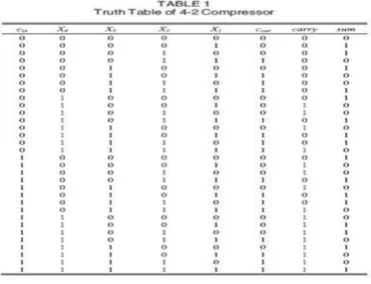
Fig no 4. Truth table and formulas of 4_2 compressor
We can do the execution of a 4-2 compressor is by utilizing two full-adder (FA) cells. Diverse plans
have been proposed in the writing for 4-2 compressor. The block diagram of 4-2 compressor is given in Figure
no 5 appears beneath. A 4-2 compressor can likewise be composed utilizing 3-2 compressors or full adder. It has
two 3-2 compressors (full adders) in arrangement and inactivity of the basic way of 4 XOR delays as appeared in
Figure no6. Another usage is given in a similar figure. This execution is better and has a basic way inertness of 3
XOR delay thus the basic way delay is diminished by 1XOR delay. The yield Cout is independent of the info Cin
which quickens the summation of the partial products.
Fig no 5. Block diagram of 4_2 compressor Fig no 6. 4_2 compressor design using full adders
A modified 4x4 Dadda multiplier utilizing compressors is composed. The components or the bits in the
partial product matrix of Dadda multiplier are reworked to apply higher order compressors. Reworking on
number of components is performed just in the sections that are beyond central column of the array of products.
In light of the quantity of components in the segments of the partial product matrix the order the compressors
have been picked. A 4x4 Dadda multiplier in light of higher order compressors will lessen the power utilization.
Power utilization is diminished in light of the fact that the quantity of computational component (adders) utilized
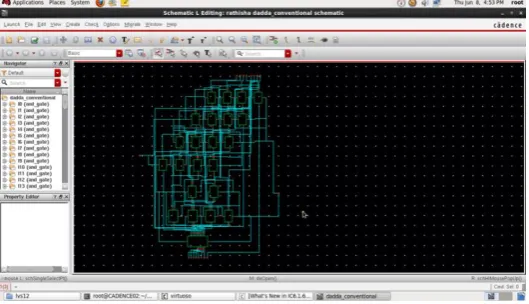
Fig no 7. Schematic of 4_2 compressor Fig no 8. Schematic of proposed multiplier
IV. EXPERIMENTAL RESULT
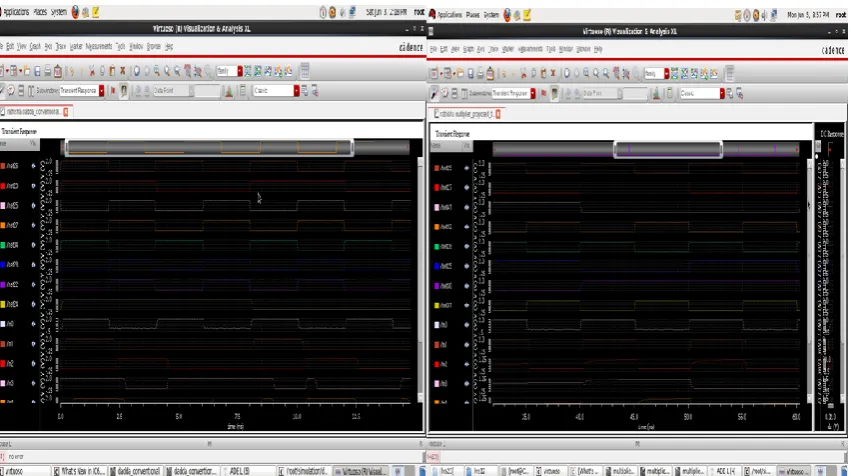
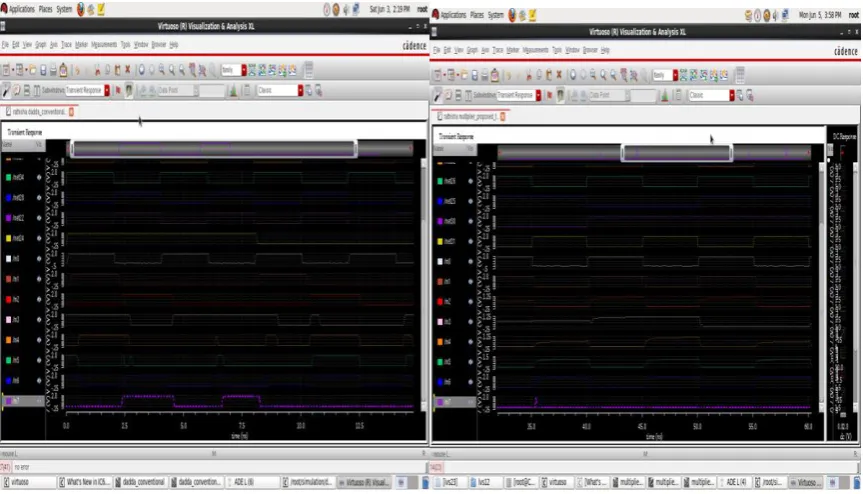
Fig no 9. Conventional multiplier output Fig no 10. Proposed multiplier output
Comparison of Performance Parameters for conventional and proposed multiplier
The traditional Dadda multiplier is having a power dissipation of 1.1mW. However, the multiplier which is outlined utilizing the proposed multiplier has a deferral of .66mW which implies a decrement of around .43. So the proposed multiplier lessens the power dissipation. Delay is an essential factor in the VLSI plan. The delay of customary Dadda multiplier is 359.3ps. Yet, the delay of proposed multiplier is 157.1. There is a decrease in 0.56. To plan traditional Dadda multiplier we utilized 376 transistor however in proposed multiplier there are just 244 transistor. So there is lessening in area in the proposed multiplier.The power delay product is a critical factor. The power delay product of proposed multiplier is less in the event that we contrast it and the regular multiplier power delay product. Every one of these parameters and its esteems are given in the beneath table.
PARAMETERS Conventional logic Proposed logic
1)Power(uW) 1172.9 662.2
2)delay(ps) 359.3 157.1
3) Chip area More Less
4)Number of transistors used 376 Transistors 244 Transistors
5) power delay product (pWsec)
0.421 0.104
V.CONCLUSION
The existing and proposed dadda multipliers are recreated utilizing cadence 180nm technology. The above table records the power and delay comes about for the regular and the proposed multipliers. It is observed that the change of 43.51% in control are accomplished for proposed structure when contrasted with existing 4x4 regular Dadda multipliers. A altered 4x4 Dadda tree multiplier in view of higher order compressors has been composed and implemented. The outcomes shows that proposed structure uses less power and area and transistor number. The PDP for proposed structure is minimum. Consequently the Dadda tree multiplier planned in using of higher order compressors is most appropriate for high performance multiplication.
REFERENCES
[1] Wallace C. (1964), „A suggestion for a fast multiplier‟, IEEE Transactions on Electronic Computers, Vol.
EC-13, pp. 14-17.
[2] Dadda L. (1965), „Some Schemes for Parallel Multipliers‟, Alta Frequenza, Vol. 34, No. 5, pp. 349-356.
[3] Xien Ye, Jianping Hu and Weijiong Tao (2005), „A Low-power complementary pass-transistor tree
multiplier based on adiabatic 4-2 compressors‟, 6th International Conference on ASIC,Vol.1, pp. 317-320.
[4] S.Karthick,S. Karthika and S.Valarmathy, „Design And Analysis Of Low Power Compressors‟ ,
International Journal of Advanced Research In Electrical, Electronics and Instrumentation Engineering,Vol.1,
Issue 6,December 2012.
[5] M. Jeevitha, R.Muthaiah and P.Swaminathan, “Review Article: Efficient Multiplier Architecture InVlsi