MASC: The Manually Annotated Sub-Corpus of American English
Nancy Ide*, Collin Baker**, Christiane Fellbaum†, Charles Fillmore**, Rebecca
Passonneau††
*Vassar College Poughkeepsie, New York USA **International Computer Science Institute
Berkeley, California USA †Princeton University Princeton, New Jersey USA
††Columbia University New York, New York USA
E-mail: [email protected], [email protected], [email protected], [email protected], [email protected]
Abstract
To answer the critical need for sharable, reusable annotated resources with rich linguistic annotations, we are developing a Manually Annotated Sub-Corpus (MASC) including texts from diverse genres and manual annotations or manually-validated annotations for multiple levels, including WordNet senses and FrameNet frames and frame elements, both of which have become significant resources in the international computational linguistics community. To derive maximal benefit from the semantic information provided by these resources, the MASC will also include manually-validated shallow parses and named entities, which will enable linking WordNet senses and FrameNet frames within the same sentences into more complex semantic structures and, because named entities will often be the role fillers of FrameNet frames, enrich the semantic and pragmatic information derivable from the sub-corpus. All MASC annotations will be published with detailed inter-annotator agreement measures. The MASC and its annotations will be freely downloadable from the ANC website, thus providing maximum accessibility for researchers from around the globe.
1.
Overview
To answer the critical need for sharable, reusable annotated resources with rich linguistic annotations, we are developing a Manually Annotated Sub-Corpus (MASC) including texts from diverse genres and manual annotations or manually-validated annotations for multiple levels, including WordNet senses and FrameNet frames and frame elements, both of which have become significant resources in the international computational linguistics community. To derive maximal benefit from the semantic information provided by these resources, the MASC will also include manually-validated shallow parses and named entities, which will enable linking WordNet senses and FrameNet frames within the same sentences into more complex semantic structures and, because named entities will often be the role fillers of FrameNet frames, enrich the semantic and pragmatic information derivable from the sub-corpus. All MASC annotations will be published with detailed inter-annotator agreement measures.
The MASC consists of unrestricted (public domain) texts drawn from the American National Corpus (ANC). The corpus and its annotations will be freely downloadable from the ANC website, thus providing maximum accessibility for researchers from around the globe. In addition to providing an invaluable resource for NLP research, the MASC project will contribute significantly to the development of best practices for corpus creation,
annotation, and harmonization of annotations from diverse sources on both linguistic and representational grounds.
Because the MASC is an open resource that the community can continually enhance with additional annotations and modifications, it will serve as a model for community-wide resource development. Past experience with corpora such as the Wall Street Journal shows that the community is eager to annotate available language data, and we can expect even greater interest in MASC, which includes language data covering a range of genres that no existing resource provides. Therefore, we expect that as MASC evolves, more and more annotations will be contributed, and we can move toward distributed development and a merging of independently developed resources to provide a massive, inter-linked linguistic infrastructure for the study and processing of American English in its many genres and varieties. In addition, by virtue of its WordNet and FrameNet annotations, MASC will be linked to parallel wordnets and framenets in languages other than English, thus creating a global resource for multi-lingual technologies, including machine translation.
2.
MASC composition
Materials in MASC are drawn primarily from the existing 15 million word Open ANC (OANC)3, which is
free of any licensing restrictions. The OANC includes traditional genres as well as newer genres such as blogs and email, and is annotated for sentence boundaries, part-of-speech (Penn, Biber, CLAWS5 and CLAWS7 tagsets), and noun and verb chunks. In addition to texts from the OANC, MASC will include portions of existing available corpora that have been manually produced or validated by other projects, such as the WSJ corpus annotated by the Penn Treebank II and Discourse Treebank, PropBank, NomBank, and TimeBank.
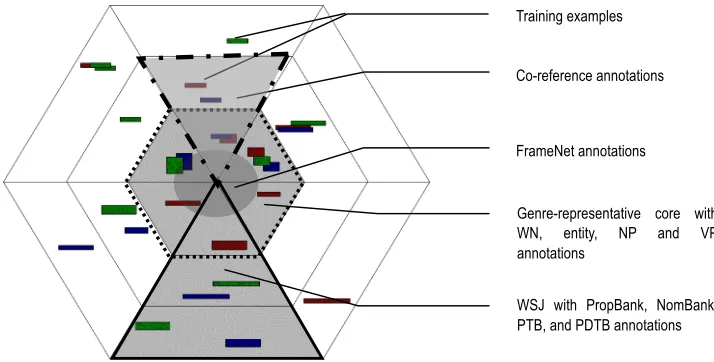
The outermost hexagon in Figure 1 represents the entire ANC, with each next interior hexagon representing a smaller subset of the data and each wedge representing a different genre. Given the issues outlined above, we
expect the contents of MASC, relative to the entire ANC, to follow the pattern of the shaded areas. FN annotations, which are time-intensive to produce, will be done for a genre-representative subset of the data manually validated for WN, entities, and shallow parse. Existing genre-specific data with manually produced annotations, such as the WSJ and Slate co-reference annotation, will be included in the core in proportions equal to other genres (the remainder of that data will also be made available as a part of the ANC itself). Since examples of phenomena not adequately represented in the core may be required for training, small amounts of data from other parts of the ANC will also be manually annotated to serve this purpose.
Figure 1. Configuration of MASC relative to the entire ANC
The MASC annotation process proceeds as follows: smaller portions of the sub-corpus are first manually annotated for specific phenomena, with an eye toward maintaining representativeness in these smaller portions as well as ensuring that a common component includes as many annotations of different types as possible. We then apply (semi)-automatic annotation techniques to determine the reliability of their results, and study interannotator agreement on manually-produced annotations in order to determine a benchmark of accuracy and fine-tune annotator guidelines. We also consider the degree to which accurate annotations for one phenomenon can improve the performance of automatic annotation systems for another—e.g., validated WN sense tags and noun chunks may improve automatic semantic role labeling. We then apply an iterative process of manual annotation followed by retraining of automatic annotation software to maximize the performance of the automatic taggers. The improved annotation software can later be applied to the entire ANC, thus providing more accurate automatically-produced annotation of this much larger body of data.
3.
Representation
The ANC project has implemented a scheme for representing the ANC and its annotations that answers one of the field’s urgent needs, that is, means for individual annotations to cohabit with one another and/or be layered over primary data, using a common format that allows them to be easily merged and manipulated (Ide and Suderman 2006, 2007). The perennial problem for language processing research is the fact that annotations produced at different sites are idiosyncratic and often demand considerable processing to render them usable with software for which they were not originally designed, or to combine annotations produced at different sites. For example, the Wall Street Journal corpus has been annotated by several groups for different phenomena: The Penn Treebank (PTB) II syntactic annotations are embedded in the data itself in a LISP-like format; PropBank and NomBank reference the data by sentence (tree) number and token number; and the Penn Discourse Treebank uses a complex addressing system to reference nodes in the PTB constituency trees. Using any one of these annotations demands that one’s software can process their addressing
Co-reference annotations
Genre-representative core with WN, entity, NP and VP annotations
WSJ with PropBank, NomBank, PTB, and PDTB annotations Training examples
Figure 2 shows part of the FrameNet annotation of one sentence from the ANC, from a travel guide to Dublin. The River Liffey flows from west to east through the center of the city to Dublin Bay. The three rows represent annotation in three different frames. Row 1 represents annotation in the frame Fluidic_motion; The work flows evokes the frame. The River Liffey is labeled as the FE Fluid, and the Source FE is expressed by from west, the Area FE, by through the center of the city, and the Goal FE by two separate phrases, to east and to Dublin Bay.; The FEs Source, Path, Area, and Goal occur in all the frames that inherit from the high-level frame Motion. Row 2 shows the annotation for the frame Part_inner_outer, evoked by the word center; center itself also denotes the FE Part, and the FE Whole is represented by the PP of the city. Row 3 gives two separate instances of
the frame Natural_feature, one evoked by River, and the other by Bay; in each case, the word itself denotes the FE Locale, and the FE Name follows in the one case and precedes in the other. (Note that expressions denoting natural features are idiosyncratic and have to be learned individually; River Liffey but Mississippi River, Dublin Bay, but Bay of Bengal, etc.) It should be clear that by correctly composing the information contained in these annotations (and others not shown for reasons of space), one should be able to make many valid inferences: that there is a river whose name is Liffey which flows through a place which is the inner part of a city, to a bay whose name is Dublin, etc. More elaborate types of inference should also be supported by FrameNet annotation, as discussed in Scheffczyk et al. (2006).
1
[
FLUIDThe River Liffey] FLOWS [
SOURCEfrom west] [
GOALto east] [
AREAthrough the center of the city] [
GOALto Dublin Bay].
2
The River Liffey flows from west to east through the [
PARTCENTER Target]
[
WHOLEof the city] to Dublin Bay.
3
The [
LOCALERIVER] [
NAMELiffey] flows from west to east through the center
of the city to [
NAMEDublin] [
LOCALEBAY].
Figure 2. Example of FrameNet annotation
The automatic labeling of frames is not as well-developed as the WSD algorithms for WN sense assignment, and the job of recognizing FEs adds another task of some complexity. The automatic semantic role labeling systems usually consist of two separate processes, each treated as a classification problem: (1) recognizing which words (or multi-word expressions) evoke which frames, and (2) labeling the arguments of such words with the correct FE (role) labels. Errors in the frame recognizer consist either of assigning a word (or MWE) to the wrong frame or to no frame where the correct frame exists. The frame element labeler (a.k.a. semantic role labeler) can produce a variety of errors, by failing to label FEs where they belong or by labeling the right text with the wrong FEs, or by misidentifying the boundaries of the FE.
Despite the difficulty, and thanks largely to the impetus of two separate competitions concerned with frame semantic annotation, at Senseval-3 (Litkowski et al. 2004) and Semeval-4 (Baker et al. 2006), there are currently three publicly available systems for automatically recognizing frames and assigning the semantic role (frame element) labels:
• Shalmaneser, developed by Sebastian Padó and Katrin Erk at University of Saarland (Erk,& Padó 2006, http://compling.utexas.edu/shalmanesar), • the ASSERT system, developed at University of
Colorado by Sameer Pradhan, (Pradhan et al. 2004, http://cemantix.org/assert) which has been used mainly for PropBank-style role labeling, but
has also been trained on the FrameNet data, and • the system developed by Richard Johansson and
Pierre Nugues at Lund University for the most recent Semeval (Johansson & Nugues 2007). As part of this work, the FrameNet team is also committed to improving the ASRL process, using an active learning system, whereby the ASRL system results are evaluated to determine where the most errors were occurring, and extra manual annotation is done to improve performance and reduce those errors. In some cases, the ASRL systems themselves can output a confidence measure; another approach is to use several systems and to concentrate on those cases in which the different systems disagree. 10 The
sentences to be manually annotated for this purpose could come from anywhere, but we plan to use the entire ANC (not just the MASC) for this purpose.11
The supplemental annotation is close to the usual FrameNet lexicographic annotation in terms of process, although it may involve more (or less) examples per LU than the usual 15-20 for FrameNet. Also, examples are chosen that are close to the boundary of other
10 Note that the three systems use different feature sets,
different machine learning algorithms, and even define labeling differently, some labeling nodes in a parse tree and others labeling spans of text.
11 It may be necessary to reach beyond the ANC to the
on Language Resources and Evaluation (LREC-2006), 527-332.
Fillmore, C. J. (1976). Frame semantics and the nature of language Annals of the New York Academy of Sciences: Conference on the Origin and Development of Language and Speech, Vol. 280, 20-32.
Fillmore, C. J.; Baker, C. F. & Sato, H. (2004). Framenet as a "Net" Proceedings of the Fourth International Conference on Language Resources and Evaluation (LREC), 1091-1094.
Ide, N. and Suderman, K. (2007). GrAF: A Graph-based Format for Linguistic Annotations. Proceedings of the Linguistic Annotation Workshop, Association for Computational Linguistics, 1-8. Johansson, R. & Nugues, P. (2007). LTH: Semantic
Structure Extraction using Nonprojective Dependency Trees Proceedings of the SemEval 2007 Workshop, Association for Computational Linguistics, 227-230.
Krippendorff, K. (1980.) Content Analysis: An Introduction to its Methodology. Sage Publications, Beverly Hills, CA.
Litkowski, K. Mihalcea, R. & Edmonds, P. (ed.) (2004). Senseval-3 task: Automatic labeling of semantic roles. Proceedings of SENSEVAL-3: Third International Workshop on the Evaluation of Systems for the Semantic Analysis of Text, Association for Computational Linguistics, 9-12. Lönneker-Rodman, B. & Baker, C. F. The FrameNet
Model and its Applications. (ms.)
Mihalcea, R. & Edmonds, P. (ed.) (2004). Proceedings of SENSEVAL-3: Third International Workshop on the Evaluation of Systems for the Semantic Analysis of Text. Association for Computational Linguistics.
Passonneau, R., Habash, N., Rambow, O. 2006. Inter-annotator agreement on a multilingual semantic annotation task. Proceedings of the Fifith International Conference on Language Resources and Evaluation (LREC). Genoa, Italy.
Passonneau, R., Nenkova, A., McKeown, K. and Sigelman, S. 2005. Applying the pyramid method in duc 2005. Proceedings of the 2005 Workshop of the Document Understanding Conference (DUC). Pradhan, S. S.; Ward, W. H.; Hacioglu, K.; Martin, J.
H. & Jurafsky, D. Susan Dumais, D. M. & Roukos, S. (ed.) (2004). Shallow Semantic Parsing using Support Vector Machines HLT-NAACL 2004: Main Proceedings, Association for Computational Linguistics, 233-240.
Scheffczyk, J.; Baker, C. F. & Narayanan, S. Oltramari, A. (ed.) (2006). Ontology-based Reasoning about Lexical Resources. Proceedings of ONTOLEX 2006, 1-8
Snyder, B. and Palmer, M. (2004). The English all-words task. In Mihalcea, R., Edmonds, P. (Eds.), Senseval-3: Third International Workshop on the Evaluation of Systems for the Semantic Analysis of
Text. Association for Computational Linguistics, 41-43.