Article
1
Using rare earth elements (REE) to study the origin of
2
ore-fluids associated with granite intrusions
3
Xue-Ming Yang
4
Manitoba Geological Survey, 360-1395 Ellice Avenue, Winnipeg, MB R3G 3P2, Canada; [email protected]
5
Received: May 2, 2019; Accepted: date; Published: date
6
Abstract: A practical method is presented to estimate rare earth elements (REE) concentrations in
7
magmatic vapour phase (MVP) in equilibrium with water-saturated granitic melts based on
8
empirical fluid-melt partition coefficients of REE (𝑘𝑃𝑅𝐸𝐸). The values of 𝑘𝑃𝑅𝐸𝐸can be calculated from a
9
set of new polynomial equations linking to the chlorine molality (𝑚𝐶𝑙𝑣) of the MVP associated with
10
granitic melts, which are established via a statistical analysis on the existing experimental dataset.
11
These equations may be applied to the entire pressure range (0.1 to 10.0 kb) within the continental
12
crust, suggesting that light REEs behave differently in magmatic fluids, i.e. either being fluid
13
compatible with higher 𝑚𝐶𝑙𝑣 or fluid incompatible with lower 𝑚𝐶𝑙𝑣 values. In contrast, heavy REEs
14
are exclusively fluid incompatible and partition favourably into granitic melts. Consequently,
15
magmatic fluids tend to be rich in LREE relative to HREE, leading to REE fractionation during the
16
evolution of magmatic hydrothermal systems. Maximum 𝑘𝑃𝑅𝐸𝐸value for each element is predicted
17
and presented in a REE distribution diagram constrained by the threshold of 𝑚𝐶𝑙𝑣. REE contents of
18
the granitic melt is approximated by whole-rock analysis, so that REE concentrations in the
19
associated MVP would be estimated from the value of 𝑘𝑃𝑅𝐸𝐸 given chemical equilibrium retains.
20
Two examples are provided respectively, to show the use of this method as a REE tracer to
21
fingerprint the source of ore-fluids responsible for the Lake George intrusion-related Au-Sb deposit
22
in New Brunswick (Canada), and for the Bakircay Cu-Au (-Mo) porphyry systems in northern
23
Turkey.
24
Keywords: REE distribution pattern; REE fluid-melt partition coefficient; granite; intrusion-related
25
gold system; porphyry copper (gold) system
26
27
1. Introduction
28
Using rare earth elements (REE) to study the origin of ore-fluids associated with granite (sensu
29
lato) intrusions has been made possible and attractive, thanks to the progress in a number of high P-T
30
experiments on REE partitioning between magmatic vapour phases and granitic melts [1-3]. This
31
technique has been proved reliable and cost-effective in probing the sources of ore-fluids associated
32
with granite intrusions [4-5].
33
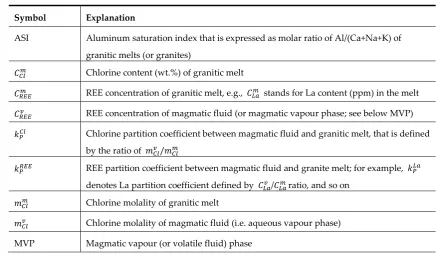
Experimental studies indicate that REE fluid-melt partition coefficient 𝑘𝑃𝑅𝐸𝐸(see Table 1 for the
34
explanations of symbols) is dominantly dependent upon fluid composition (i.e. chlorine molality
35
𝑚𝐶𝑙𝑣), and is also controlled to some extent by melt composition (e.g., ASI) and pressure (1.25 to 10.0
36
kb), but is not notably affected by temperature (750 to 950 °C) [3]. In a strongly peraluminous (ASI
37
>1.1) granitic melt system associated with a fluid phase with a large range of 𝑚𝐶𝑙𝑣 from 0.1 to 6.0 M,
38
the values of 𝑘𝑃𝐿𝑎 range from ca. 0.035 to 0.150. In contrast, in a moderately peraluminous (ASI = 1.0
39
to 1.1) to metaluminous (ASI <1.0) melt system associated with fluid phase with the same 𝑚𝐶𝑙𝑣 range,
40
𝑘𝑃𝐿𝑎 values range from ca. 0.005 to 1.5 [2-3]. These experimental observations suggest that 𝑘𝑃𝐿𝑎
41
values could be estimated over a range of X-P conditions.
42
It is well-known that granitic melts could lose a magmatic vapour phase (MVP; Table 1), shown
43
as trapped fluid inclusions in primary quartz phenocrysts [6-9] to surrounding country rocks during
44
cooling, resultingin hydrothermal alteration and sometimes mineralization (e.g., porphyry Cu-Au
45
(Mo), intrusion-related Au). As much as 5 wt% water containing various metals and/or ligands may
46
Table 1. Symbols used in this paper.
47
Symbol Explanation
ASI Aluminum saturation index that is expressed as molar ratio of Al/(Ca+Na+K) of
granitic melts (or granites)
𝐶𝐶𝑙𝑚 Chlorine content (wt.%) of granitic melt
𝐶𝑅𝐸𝐸𝑚 REE concentration of granitic melt, e.g., 𝐶𝐿𝑎𝑚 stands for La content (ppm) in the melt
𝐶𝑅𝐸𝐸𝑣 REE concentration of magmatic fluid (or magmatic vapour phase; see below MVP)
𝑘𝑃𝐶𝑙 Chlorine partition coefficient between magmatic fluid and granitic melt, that is defined
by the ratio of 𝑚𝐶𝑙𝑣/𝑚𝐶𝑙𝑚
𝑘𝑃𝑅𝐸𝐸 REE partition coefficient between magmatic fluid and granite melt; for example, 𝑘𝑃𝐿𝑎
denotes La partition coefficient defined by 𝐶𝐿𝑎𝑣 /𝐶𝐿𝑎 𝑚ratio, and so on
𝑚𝐶𝑙𝑚 Chlorine molality of granitic melt
𝑚𝐶𝑙𝑣 Chlorine molality of magmatic fluid (i.e. aqueous vapour phase)
MVP Magmatic vapour (or volatile fluid) phase
48
be lost to the surroundings upon cooling of granite magmas during their ascent and emplacement
49
[10]. This may be concentrated to form an ore deposit if the geological settings are favourable. The
50
composition of MVP (or magmatic fluids) can be modelled by studying ore-forming elements (e.g.,
51
Cu, Mo) partitioning between the MVP and granitic melts through high PT experimental and
52
empirical investigations [11-13]. Therefore, it is possible to determine what roles are played by the
53
magmatic fluids associated with granitic magmas in mineralization by comparing the geochemical
54
data (e.g., REE) of ore deposits and associated alteration with the composition of simulated
55
magmatic fluids based on the fluid-granitic melt partitioning data.
56
This paper presents the procedures of how to calculate REE concentrations of MVP based on a
57
set of new polynomial equations that can be used for estimation of REE fluid-granitic melt partition
58
coefficients over a wide range of P-T-X conditions. This technique is then used for tracking the
59
sources of ore-fluids responsible for the formation of two typical mineral deposits; 1) the Lake
60
George intrusion-related Sb-Au-W-Mo deposit (New Brunswick, Canada) characterized by low to
61
medium salinity ore-fluids; and 2) the Bakircay Cu-Au (-Mo) porphyry system in northern Turkey,
62
that may have been formed by ore-fluids with medium to high salinities.
63
2. Methodology
64
An element partition coefficient between MVP and granitic melt is defined by the ratio of its
65
concentration in the MVP to that in the melt [1, 14; Table 1]. For instance, the REE partition
66
coefficient 𝑘𝑃𝑅𝐸𝐸 between MVP and silicate melt can be expressed as the ratio of 𝐶𝑅𝐸𝐸𝑣 /𝐶𝑅𝐸𝐸𝑚 ; similarly,
67
chlorine partition coefficient 𝑘𝑃𝐶𝑙 is defined as the ratio of 𝑚𝐶𝑙𝑣 /𝑚𝐶𝑙𝑚 (Table 1). The partition
68
coefficient is dimensionless, and is controlled by various variables, such as pressure, temperature,
69
and composition of magmatic-hydrothermal systems [1-3, 5, 10-16]. It is also noted that the value of
70
𝑘𝑃𝐸𝑢 could be effected by oxygen fugacity (fO2) of the system in question, because Eu has two
71
valences (i.e. Eu3+, Eu2+) that depend upon fO2 [1, 3].
72
Estimates of REE concentration of magmatic fluid are made based on empirical values of 𝑘𝑃𝑅𝐸𝐸
73
obtained by the new equations presented in this study (see below); using the REE data of fresh
74
bulk-rock samples to approximate that of the granitic melt in equilibrium with the magmatic fluid,
75
and altered rock, which resulted from the interaction or reaction of the fresh rock with the magmatic
76
fluid. Thus, the signature of magmatic fluids may be recognized to some extent by following the
77
method presented in this study.
2.1. Relationship of REE fluid-granitic melt partition coefficient 𝑘𝑃𝑅𝐸𝐸to chlorine molality 𝑚𝐶𝑙𝑣
79
How to calculate REE partition coefficients 𝑘𝑃𝑅𝐸𝐸between magmatic aqueous fluid and granite
80
melt was presented by [5] according to the experimental results [1-2]. It could be described by a
81
linear function of cubic power of 𝑚𝐶𝑙𝑣, but the Eu fluid-granitic melt partition coefficient 𝑘𝑃𝐸𝑢 is
82
related to the fifth power of 𝑚𝐶𝑙𝑣 when the aqueous fluids have relatively low values of 𝑚𝐶𝑙𝑣. This
83
confirms the experimental observations by [1-2]. The mathematic relationships of 𝑘𝑃𝑅𝐸𝐸to the low
84
range of 𝑚𝐶𝑙𝑣 of aqueous fluids were provided on the basis of a least square regression analysis of
85
the experimental dataset. However, such a linear relationship cannot extend to higher values of 𝑚𝐶𝑙𝑣
86
(e.g., >3.5 M), which was also noticed by [3]. Therefore, it is necessary to re-assess the existing
87
experimental data presented in [1-3]. Here, these datasets (Supplementary Table 1) are plotted on
88
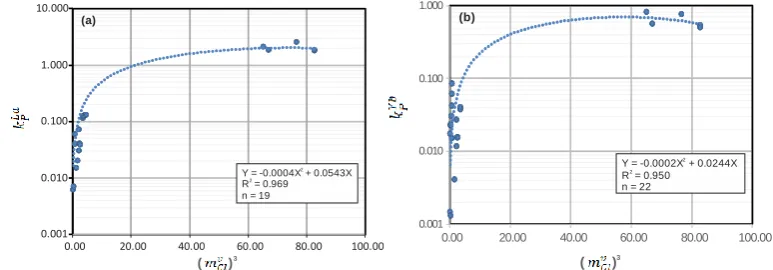
Figure 1, using La to represent LREE and Yb to represent HREE (note: the other REEs are not
89
shown). To best fit the dataset, a set of new polynomial equations linking 𝑘𝑃𝑅𝐸𝐸 with 𝑚𝐶𝑙𝑣 can be
90
obtained for each of REE as shown in Table 2, although more experimental data are required to fill
91
the data gap. Remarkably, these equations display relatively higher correlation coefficients (R2
92
ranging from 0.943 to 0.969; see Table 2) when compared with those (R2 ranging 0.90 to 0.95)
93
presented by [5]. Based on the equations presented in Table 2 respectively for La and Yb, 𝑘𝑃𝐿𝑎 can be
94
readily calculated, for example, for the magmatic fluid with 𝑚𝐶𝑙𝑣 value of 1.0 M , to be 0.054; and 𝑘𝑃𝑌𝑏
95
to be 0.024.
96
97
( )3
0.001 0.010 0.100 1.000 10.000
0.00 20.00 40.00 60.00 80.00 100.00
Y = -0.0004X + 0.0543X2
R = 0.9692
n = 19 (a)
( )3 0.001
0.010 0.100 1.000
0.00 20.00 40.00 60.00 80.00 100.00 (b)
Y = -0.0002X + 0.0244X 2
R = 0.9502
n = 22
98
Figure 1. Plot of REE fluid-granitic melt partition coefficient 𝑘𝑃𝑅𝐸𝐸versus chlorine molality 𝑚𝐶𝑙𝑣 of
99
magmatic vapour (fluid) phase: (a) 𝑘𝑃𝐿𝑎versus (𝑚𝐶𝑙𝑣 )3, and (b) 𝑘𝑃𝑌𝑏versus (𝑚𝐶𝑙𝑣 )3. Data used for this
100
plot from [1-3] (Supplementary Table 1). In each of the equation, Y denotes 𝑘𝑃𝑅𝐸𝐸; x represents (𝑚𝐶𝑙𝑣)3,
101
except for Eu where e is (𝑚𝐶𝑙𝑣 )5 (Table 2); R is correlation coefficient; and n is the number of
102
experimental dataset. It is worth noting that the uncertainties of such estimation for 𝑘𝑃𝑅𝐸𝐸using the
103
equations listed in Table 2 are not well constrained, although they must have been within the errors
104
of the original dataset [1-3], i.e. ±0.025 for LREE, and ±0.030 for HREE.
105
The REE fluid-granitic melt partition coefficients 𝑘𝑃𝑅𝐸𝐸 data used for the statistical analysis of
106
this study (Supplementary Table 1) were acquired under the experimental conditions of 4.0 kb,
107
800°C and quartz-fayalite-magnetite buffer by [1], at 2.0 kb and 800°C by [2], and experiments at 0.2
108
to 10 kb and 750 to 950°C by [3]. Numerical analysis of these dataset strongly suggest that 𝑘𝑃𝑅𝐸𝐸 is
109
dominantly controlled by chlorine molality 𝑚𝐶𝑙𝑣 of the fluids in equilibrium with the granitic melts,
110
consistent with the observations by [1-3]. The experiment work indicates that 𝑘𝑃𝑅𝐸𝐸 values are not
111
influenced by temperature, although the pressure effect appears to be notable (i.e. the values of 𝑘𝑃𝑅𝐸𝐸
112
for trivalent REEs would increase with decreasing pressure). Interestingly, Borchert et al. (2010) [3]
113
have pointed out that the pressure (ranging from 2.0 to 9.0 kb) effect on 𝑘𝑃𝐿𝑎 values is not discernible
114
for peraluminous granitic melts, although such an effect is slightly manifest for metaluminous melts.
115
For instance, the value of 𝑘𝑃𝐿𝑎 increases from 0.03 at 3.0 kb to 0.12 at 7.0 kb when a fluid with 𝑚𝐶𝑙𝑣 of
116
6.0 M associated with a metaluminous granitic melt [3]. Obviously, more high P-T experiments are
117
required to cover a range of pressures at least from lower to upper continental crust. Furthermore, it
118
has been well constrained that 𝑘𝑃𝐶𝑙 is only pressure dependent [10]. Consequently, the value of 𝑚𝐶𝑙𝑣
Table 2. Relationship of REE fluid-granite melt partition coefficients (𝑘𝑃𝑅𝐸𝐸) to chlorine molality (𝑚𝐶𝑙𝑣)
120
of magmatic fluids [note: x denotes (𝑚𝐶𝑙𝑣)3 in the equations except for Eu in which instead of x, a
121
different variable e is used that equals to (𝑚𝐶𝑙𝑣)5].
122
123
in magmatic fluids is only related to pressure (Table 1), which is the main controlling factor on
124
values of 𝑘𝑃𝑅𝐸𝐸 (Table 2). Therefore, these equations (Table 2) may be used to calculate 𝑘𝑃𝑅𝐸𝐸 values
125
for a wide range of pressure (0.1 to 10.0 kb) within the continental crust, and to estimate REE
126
concentrations of magmatic fluids, although the limitation of such a practical simulation should be
127
kept in mind.
128
A virtual examination of Figure 1 suggests that the value of 𝑘𝑃𝑅𝐸𝐸would approach its maximum
129
with increasing (𝑚𝐶𝑙𝑣)3 to a certain value, or a threshold. When (𝑚𝐶𝑙𝑣)3 is much smaller than this
130
threshold, 𝑘𝑃𝑅𝐸𝐸 is in linear relationship to the variable as described by [1-2, 5]. As long as 𝑚𝐶𝑙𝑣 of a
131
magmatic fluid reaches the threshold, the value of 𝑘𝑃𝑅𝐸𝐸 would reach the maximum and then appear
132
to remain constant regardless how much the concentration of chlorine in the fluid is increased. This
133
conclusion is also achieved by a numerical analysis (i.e. differentiation) of the equations listed in
134
Table 2. This practise is able to predict the (𝑚𝐶𝑙𝑣)3 threshold and maximum 𝑘𝑃𝑅𝐸𝐸value for each
135
individual element (Table 3). Obviously, the implication of such thresholds and (or) parameters
136
needs further discussed, and tested by more experimental work because the existing dataset used in
137
this paper (Supplementary Table 1) are limited. Albeit the data limitation, the functions presented in
138
Table 2 appear to be applicable to covering the entire pressure range within the continental crust
139
(e.g., 0.1 to 10.0 kb) owing to the fact that maximum 𝑘𝑃𝑅𝐸𝐸 values rely only upon the chlorine
140
molality thresholds (𝑚𝐶𝑙𝑣 )3 of magmatic fluids (Figure 2; Table 3) regardless pressures of the
141
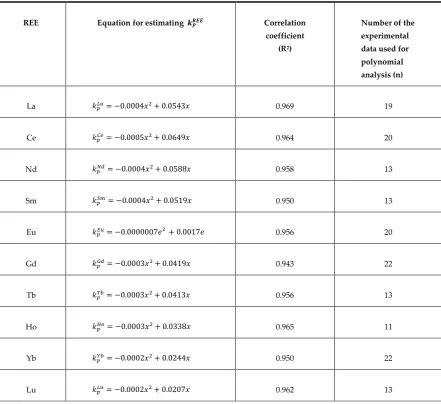
REE Equation for estimating 𝒌𝑷𝑹𝑬𝑬 Correlation coefficient
(R2)
Number of the experimental data used for polynomial analysis (n)
La 𝑘𝑝𝐿𝑎= −0.0004𝑥2+ 0.0543𝑥 0.969 19
Ce 𝑘𝑝𝐶𝑒= −0.0005𝑥2+ 0.0649𝑥 0.964 20
Nd 𝑘𝑝𝑁𝑑= −0.0004𝑥2+ 0.0588𝑥 0.958 13
Sm 𝑘𝑝𝑆𝑚= −0.0004𝑥2+ 0.0519𝑥 0.950 13
Eu 𝑘𝑝𝐸𝑢= −0.0000007𝑒2+ 0.0017𝑒 0.956 20
Gd 𝑘𝑝𝐺𝑑= −0.0003𝑥2+ 0.0419𝑥 0.943 22
Tb 𝑘𝑝𝑇𝑏= −0.0003𝑥2+ 0.0413𝑥 0.956 13
Ho 𝑘𝑝𝐻𝑜= −0.0003𝑥2+ 0.0338𝑥 0.965 11
Yb 𝑘𝑝𝑌𝑏= −0.0002𝑥2+ 0.0244𝑥 0.950 22
fluid-melt systems in question. Here, it is recommended that the maximum value of 𝑘𝑃𝑅𝐸𝐸 for each
142
REE be used to simulate REE contents of magmatic fluid once the chlorine molality of the fluid
143
reaches the threshold.
144
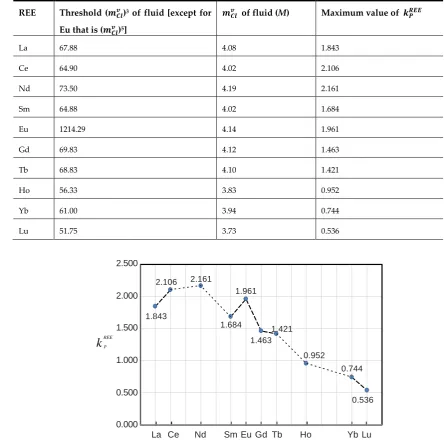
Table 3. Predicted chlorine molality thresholds (𝑚𝐶𝑙𝑣 )3 of magmatic fluids (note: for Eu, it should be
145
(𝑚𝐶𝑙𝑣)5 ) and maximum values of REE fluid-granite melt partition coefficients of 𝑘𝑃𝑅𝐸𝐸 from this study.
146
147
0.000 0.500 1.000 1.500 2.000 2.500
La Ce Nd Sm Eu Gd Tb Ho Yb Lu
REE p
k
1.843
2.106 2.161
1.684 1.961
1.463 1.421
0.952
0.744
0.536
148
Figure 2. Plot of the predicted maximum values of REE partition coefficients 𝑘𝑃𝑅𝐸𝐸between magmatic
149
fluids and granitic melts based on the equations in Table 2. Number marked on the graph is the
150
maximum value of predicted 𝑘𝑃𝑅𝐸𝐸for each element, e.g., La equals to 1.843.
151
Figure 2 indicates that REE partitioning between magmatic fluids and granite melts must have
152
resulted in LREE enrichment relative to HREE in the fluids, consistent with the observations of
153
alteration halos associated with the Cu-Au (-Mo) porphyry systems [4], intrusion-related Au
154
systems [5], and of natural fluid inclusions [6]. Also, it is likely that the fluids with relatively low 𝑚𝐶𝑙𝑣
155
values would display a negative Eu anomaly as indicated by the relationship of 𝑘𝑃𝑅𝐸𝐸 to 𝑚𝐶𝑙𝑣 (Table
156
2), unless their 𝑚𝐶𝑙𝑣 values are close to the threshold that would result in a positive Eu anomaly.
157
However, this effect could be influenced by the value of 𝑚𝐶𝑙𝑣 that is a function of pressure [10;
158
14-17]. Maximum partition coefficients for other REE (e.g., Pr, Dy, Er, Tm) may be obtained by
159
extrapolation from the data presented in Figure 2. Further stretching on this, nevertheless, is not
160
REE Threshold (𝒎𝑪𝒍𝒗)3 of fluid [except for
Eu that is (𝒎𝑪𝒍𝒗)5]
𝒎𝑪𝒍𝒗 of fluid (M) Maximum value of 𝒌 𝑷 𝑹𝑬𝑬
La 67.88 4.08 1.843
Ce 64.90 4.02 2.106
Nd 73.50 4.19 2.161
Sm 64.88 4.02 1.684
Eu 1214.29 4.14 1.961
Gd 69.83 4.12 1.463
Tb 68.83 4.10 1.421
Ho 56.33 3.83 0.952
Yb 61.00 3.94 0.744
encouraged, although such a practice would provide a basis for future experiment work to
161
determine their respective values experimentally.
162
Furthermore, the equations (Table 2) can also be used for evaluation of REE behaviour in a
163
fluid-granitic melt system. When the value of 𝑘𝑃𝑅𝐸𝐸is ≥1.0, REE is fluid compatible and prefers
164
partitioning into the magmatic fluid. Otherwise, REE is granitic melt compatible when 𝑘𝑃𝑅𝐸𝐸 is 1.0.
165
LREE (e.g., La) would not become fluid compatible until the value of (𝑚𝐶𝑙𝑣)3 is higher than 21.97 (i.e.
166
𝑚𝐶𝑙𝑣 ≥2.80 M, which is obtained by solving the equation when 𝑘𝑃𝐿𝑎 equals to 1.0; see Figures 1a and
167
3). In other words, La would be fluid incompatible and favours granite melt if the fluid has the 𝑚𝐶𝑙𝑣
168
value below 2.80 M. Therefore, LREE behaves differently in the fluid-granite melt system,
169
depending upon the value of 𝑚𝐶𝑙𝑣 of the magmatic fluid. Interestingly, Eu requires much higher 𝑚𝐶𝑙𝑣
170
value to become fluid compatible than the other LREE, indicating that it is melt compatible in
171
equilibrium with magmatic fluids with low 𝑚𝐶𝑙𝑣, and therefore, such fluids commonly have negative
172
Eu anomaly. If magmatic fluids reach thresholds (𝑚𝐶𝑙𝑣)3 (Table 3; Figure 2), they would display
173
positive Eu anomaly. HREE (e.g., Yb), however, is typically fluid incompatible and prefers
174
partitioning into granite melt (Figure 1b), and the maximum value of 𝑘𝑃𝑌𝑏 is 0.744 when (𝑚𝐶𝑙𝑣)3 is
175
equal to its threshold of 61.00 (or 𝑚𝐶𝑙𝑣 = 3.94 M) for the fluids associated with granite melts, leading
176
to REE fractionation that LREE are enriched relatively to HREE during evolution of magmatic
177
hydrothermal systems.
178
More recently, Song et al. (2016) [18] found that REEs prefer partitioning into carbonate melt
179
with fluid–melt partition coefficients <1.0 at 1–2 kb and 700–800 °C, leading to relative HREE
180
enrichment compared to LREE. Their experimental work suggests that REE fractionation in the
181
fluid-carbonatite melt system distinctly differs from that in the fluid-granite melt system as
182
discussed in this study.
183
184
0.00 0.50 1.00 1.50 2.00 2.50 3.00 3.50 4.00 4.50
La Ce Nd SmEu Gd Tb Ho Yb Lu
(0.952)
(0.744)
(0.536)
185
Figure 3. Diagram of 𝑚𝐶𝑙𝑣 values required for 𝑘
𝑃𝑅𝐸𝐸 ≥1.0 so that LREEs become fluid compatible,
186
whereas HREEs are exclusively fluid incompatible and prefer partitioning into granitic melts
187
because their 𝑘𝑃𝑅𝐸𝐸are always <1.0 and would reach maximum values (as shown by number; Table 3)
188
when (𝑚𝐶𝑙𝑣)3 values achieve their respective threshold.
189
2.2. Calculation of chlorine molality 𝑚𝐶𝑙𝑣
190
As pointed out by [17], it is not easy to obtain chlorine concentration in granite melt. To make it
191
simple, the chlorine molality 𝑚𝐶𝑙𝑚 (unit in M or moles/kg) of granitic melt can be calculated by
192
chlorine content of granite as indicated by the equation below.
193
194
𝑚𝐶𝑙𝑚= (𝐶𝐶𝑙𝑚÷ 35.5) × [(100 − 𝐶𝐶𝑙𝑚) ÷ 1000] (1)
195
196
where chlorine content 𝐶𝐶𝑙𝑚 in granitic melt is approximated by the analysis of whole-rock sample
197
and its unit is in wt%.
198
Such an exercise of using eq. 1 to calculate chlorine molality 𝑚𝐶𝑙𝑣 of a granite sample would
199
provide a minimum value of the corresponding granitic melt, because a large amount of chlorine
200
may have been lost from the melt during cooling [10, 16]. This is unavoidable because of high
chlorine partition coefficient between MVP and granitic melt at magmatic conditions [14-15, 17].
202
Table 4 shows the results of calculation by using two examples.
203
Table 4. Calculation of REE concentrations in magmatic fluid.
204
205
A more accurate chlorine molality 𝑚𝐶𝑙𝑚 of granite melt may be obtained by using the methods
206
proposed by Piccoli et al. [13], but their methods require chemical composition data of apatite, or
207
bulk composition of aplite associated with the main granite intrusion. Here, using the value of 𝑚𝐶𝑙𝑚
208
obtained by eq. 1 and chlorine partition coefficient 𝑘𝑃𝐶𝑙 [10, 14-15] one can readily estimate the value
209
of chlorine molality 𝑚𝐶𝑙𝑣 of the aqueous vapour phase in equilibrium with the granite melt at
210
Lake Geoge granodiorite [5] Bakircay granodiorite [4]
A B D E
La (ppm) 30.9 30.9 12.7 12.7
Ce 51.2 51.2 25.8 25.8
Nd 13.7 13.7 12.1 12.1
Sm 4.2 4.2 2.17 2.17
Eu 1.08 1.08 0.54 0.54
Gd 4.8 4.8 2.24 2.24
Tb 0.8 0.8
Dy 2.25 2.25
Er 1.16 1.16
Yb 2.2 2.2 1.1 1.1
Lu 0.3 0.3
Cl 1000
15 wt% NaCleqv . in fluid inclusion [7]
17 wt% NaCleqv . in primary inclusion
52% NaCleqv . in fluid inclusion,
18.52 M
>Threshold
Calculation of REE fluid-granitic melt partition coefficient Equation
0.028 1
1.23 3.02 3.50 >Threshold 2
43.5 at 2 kb [10]
0.099 1.189 1.593 1.843 from Table 2
0.118 1.405 1.863 2.106 from Table 2
0.107 1.313 1.786 2.161 from Table 2
0.094 1.123 1.490 1.684 from Table 2
0.005 0.381 0.700 1.961 from Table 2
0.076 0.924 1.245 1.463 from Table 2
0.075 0.908 1.219 1.421 from Table 2
0.061 0.702 0.898 0.952 from Table 2
0.044 0.519 0.678 0.744 from Table 2
0.038 0.418 0.520 0.536 from Table 2
Calculation of REE concentrations (ppm) in MVPs
3.05 36.74 20.23 23.41
6.04 71.92 48.08 54.33
1.47 17.98 21.61 26.15
0.40 4.72 3.23 3.65
0.01 0.41 0.38 1.06
0.39 4.73 1.43 3.28
0.06 0.73
0.10 1.14 0.75 2.14
magmatic P-T conditions. As mentioned above, 𝑘𝑃𝐶𝑙= 𝑚𝐶𝑙𝑣/𝑚𝐶𝑙𝑚, is a function of pressure and
211
independent of temperature within the continental crust [10-11]. Thus, 𝑚𝐶𝑙𝑣 can be obtained from
212
equation 2 below, if 𝑚𝐶𝑙𝑚 is given (column A in Table 4).
213
214
𝑚𝐶𝑙𝑣 = 𝑘𝑝𝐶𝑙× 𝑚𝐶𝑙𝑚 (2)
215
216
Chlorine partition coefficients 𝑘𝑃𝐶𝑙 between chloride-bearing fluids and granitic melts were
217
determined experimentally under pressure of 2 to 8 kb and near 700 and 750°C isotherms by Kilinc
218
and Burnham [14], indicating that the 𝑘𝑃𝐶𝑙 values are strongly dependent upon pressure. The values
219
increase from 43.5 at 2 kb to 83.3 at 6 kb, and then decrease sharply to 13.0 at 8 kb. Webster and
220
Holloway (1990) reported a similar result for the pressure range of 2 to 4 kb, although a fluorine-free
221
system has higher 𝑘𝑃𝐶𝑙values [15]. These experimental data suggest that chlorine prefers to
222
partitioning into aqueous fluids under magmatic conditions. However, experiments also showed
223
that chlorine is compatible to granite melt when it has high fluorine (>7 wt%) and low chlorine (0.12
224
wt%) contents at 2 kb and 1000°C [15].
225
Using the salinity data of fluid-inclusions to estimate the chlorine molality 𝑚𝐶𝑙𝑣 is a quick
226
solution regarding the potential problems (e.g., chlorine lost from cooled granitic melts), if the
227
inclusions trapped in minerals are primary magmatic fluids sourced from granite magmas
228
(intrusions). For example, the fluid inclusions trapped in apatite enclosed in a plagioclase crystal
229
from a granodiorite sample collected from the Lake George granodiorite stock represent typical
230
magmatic fluids with medium salinity of 15 wt% NaCleqv. that is suitable for calculating chlorine
231
molality 𝑚𝐶𝑙𝑣 of the fluids [5, 7] (column B in Table 4). This practice may avoid the complexity of
232
estimating 𝑚𝐶𝑙𝑚 [13, 17] and the use of eq. 2 which relies on the pressure dependant 𝑘𝑃𝐶𝑙 parameter
233
[14, 15-16].
234
Medium to high salinity fluids (e.g., 17 wt% NaCleqv., ~3.50 M Cl-; slightly lower salinity than
235
the threshold required for the maximum value of 𝑘𝑃𝑌𝑏, see Table 3) are commonly associated with
236
porphyry Cu-Au (-Mo) systems [19, 20]. These values may be input into the equations to calculate
237
𝑘𝑃𝑅𝐸𝐸 and then to calculate REE concentrations of the magmatic fluids that are presented in column
238
D in Table 4. High salinity fluids responsible for potassic alteration associated with porphyry Cu-Au
239
(-Mo) deposits (52 wt% NaCleqv., 18.52 M Cl-) [20] have much higher values of 𝑚𝐶𝑙𝑣 than the
240
thresholds (Table 3) required to reach the maximum values of 𝑘𝑃𝑅𝐸𝐸 for all REE (Table 3; Figure 2).
241
Thus, using the maximum 𝑘𝑃𝑅𝐸𝐸 values (Table 3) to calculate REE contents in magmatic fluids is
242
reasonable, that is presented in column E also in Table 4.
243
2.3. Calculation of REE concentration 𝐶𝑅𝐸𝐸𝑣 in MVP
244
The REE concentration 𝐶𝑅𝐸𝐸𝑣 in MVP (magmatic fluids) can be readily calculated in terms of the
245
𝑘𝑃𝑅𝐸𝐸 values as described above and bulk-rock (melt) REE content 𝐶𝑅𝐸𝐸𝑚 . Table 4 shows that, for
246
example, La content (3.05 ppm) in the MVP is computed by multiplying the value of 𝑘𝑃𝑅𝐸𝐸 (0.099)
247
and La content (30.9 ppm) in the melt that is approxiamted by the analysis of the granite sample
248
(column A in Table 4).
249
3. Application
250
Two examples are presented here to show how to calculate REE concentrations in magmatic
251
fluid associated with 1) the Lake George granodiorite stock, which is thought to genetically
252
responsible for the formation of the Sb-Au-W-Mo mineral deposit, New Brunswick (Canada); and 2)
253
the Bakircay Cu-Au (-Mo) porphyry system, Northern Turkey. The Lake George deposit was the
254
largest antimony producer in North America until mid-1990s. It is temporally and spatially
255
associated with the Early Devonian Lake George granodiorite stock [21-27]. The styles of Au
256
mineralization include Au-bearing quartz–carbonate veins, veinlets and stockworks are present
257
within the granodiorite stock, quartz-feldspar dyke, and proximal metamorphic aureole; they are
258
associated with earlier W–Mo mineralization. These characteristics suggest that the Lake George
granodiorite intrusion and related hydrothermal systems may have ultimately resulted in Au
260
mineralization [21-24, 26], resembling intrusion-related gold systems [7, 27-29].
261
Table 4 lists the analyses of the Lake George and Bakircay granodiorites, chlorine contents
262
either of bulk analysis or from fluid inclusion salinity data, calculated chlorine molality 𝑚𝐶𝑙𝑣 ,
263
calculated 𝑘𝑃𝑅𝐸𝐸and REE concentrations of magmatic fluids. Other data include the Lake George
264
mineralized quartz-feldspar porphyry [26], Bakircay potassic altered rock [4], and calculated REE
265
contents in magmatic fluids with different
𝑚
𝐶𝑙𝑣 are tabulated in Supplementary Table 2.266
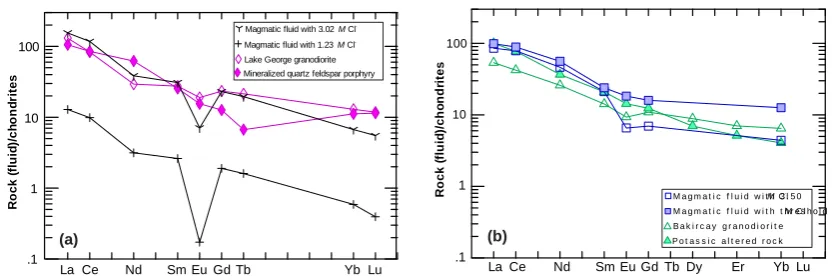
The Lake George granodiorite-normalized REE distribution patterns of magmatic fluids (see
267
Table 4 for the estimated value of 𝐶𝑅𝐸𝐸𝑣 for each element) at chlorine molality 𝑚𝐶𝑙𝑣 equals to 1.23 and
268
3.02 M, respectively are plotted in Figure 4a, indicating that REE concentrations in the magmatic
269
fluids are elevated remarkably with increasing the value of 𝑚𝐶𝑙𝑣 (Table 4). Also, the REE pattern of
270
the fluid displays a pronounced negative Eu anomaly at 𝑚𝐶𝑙𝑣 equal to 1.23 M, whereas the Eu
271
anomaly becomes much less pronounced when 𝑚𝐶𝑙𝑣 equals to 3.02 M. Figure 4b indicates the REE
272
patterns in the calculated magmatic fluid at 𝑚𝐶𝑙𝑣 = 3.50 M and with thresholds (Table 3), respectively
273
normalized by the Bakircay granodiorite. Although their LREEs are similar, the fluid with the
274
threshold Cl- molality displays relatively elevated HREE compared to the granodiorite.
275
276
.001 .01
M
a
g
m
a
ti
c
f
lu
id
s
/g
ra
n
o
d
io
ri
te
.1 1 10
La Ce Nd Sm Eu Gd Tb Yb Lu
= 1.23 M
= 3.02 M
(a)
.1
1 10
La Ce Nd Sm Eu Gd Tb Yb Lu
= 3 . 5 0 M w i t h C l- t h r e s h o l d s
( b )
M
a
g
m
a
ti
c
f
lu
id
s
/g
ra
n
o
d
io
ri
te
277
Figure 4. Lake George granodiorite-normalized REE distribution patterns of magmatic fluids with
278
chlorine molality of 𝑚𝐶𝑙𝑣 equals respectively to 1.23 to M and 3.02 M (a), and the Bakircay
279
granodiorite-normalized REE distribution patterns of magmatic fluids with 𝑚𝐶𝑙𝑣 values respective of
280
3.50 M and threshold (b). The normalization values in Table 4.
281
Figure 5a show chondrite-normalized REE patterns for the Lake George granodiorite,
282
mineralized (or altered) quartz-feldspar porphyry and the calculated magmatic fluids, suggesting
283
that these fluids are likely to decouple with the granodiorite although the altered porphyry lacks a
284
Eu anomaly. A higher 𝑚𝐶𝑙𝑣 fluid appears to be required to reduce Eu anomaly, which is evident in
285
fluid inclusion studies (i.e. halite-bearing inclusions) [7]. Such fluids with varied 𝑚𝐶𝑙𝑣 deriving from
286
progressively cooling magmas would interact the quartz-feldspar porphyry, resulting in reduction
287
to disappearance of Eu anomaly, and in some part (HREE) intersecting with the granodiorite. This
288
process may have produced hydrothermal alteration and simultaneously Au mineralization in the
289
vein stockwork systems [23, 26], consistent with evidence from lithogeochemistry, mineral
290
chemistry, fluid inclusions, and stable isotopes [7, 27-30]. Notably, increasing the values of 𝑚𝐶𝑙𝑣
291
could raise the 𝑘𝑃𝑅𝐸𝐸 values, thus raises the REE concentration of the ore-fluids, and further reduce
292
its Eu anomaly.
293
Figure 5b shows the calculated magmatic fluids with 𝑚𝐶𝑙𝑣 of 3.50 M and with threshold
294
associated with the Bakircay granodiorite melt, and are compared to potassic altered rock that hosts
295
Cu-Mo mineralization [4], indicating that the mineralization is most likely to related to the ore-fluids
296
that have medium to very high salinities. Interaction of such fluids with host rocks would have
297
ultimately resulted in potassic alteration and ore mineral (e.g., chalcopyrite) precipitation. Such
298
magmatic fluids with LREE enriched relatively to HREE, and released from cooling magmas, are
299
consistent with the mass-balance studies by [4] and numerical simulation also based on REE
300
fluid-granitic melt partitioning by [2].
R
o
c
k
(
fl
u
id
)/
c
h
o
n
d
ri
te
s
.1 1 10 100
La Ce Nd Sm Eu Gd Tb Yb Lu
Lake George granodiorite Mineralized quartz feldspar porphyry
Magmatic fluid with 3.02 M Cl -Magmatic fluid with 1.23 M Cl
-(a)
.1
1 10 100
La Ce Nd Sm Eu Gd Tb Dy Er Yb Lu
R
o
c
k
(
fl
u
id
)/
c
h
o
n
d
ri
te
s
B a k i r c a y g r a n o d i o r i t e P o t a s s i c a l t e r e d r o c k M a g m a t i c f l u i d w i t h 3 . 5 0 M C l -M a g m a t i c f l u i d w i t h t h r e s h o l d M C l
-(b)
303
Figure 5. (a) A comparison of chondrite-normalized REE patterns of calculated magmatic fluids, the
304
Lake George granodiorite and mineralized quartz-feldspar porphyry; (b) chondrite-normalized REE
305
patterns of the Bakircay granodiorite, potassic altered rock, and the calculated magmatic fluids. The
306
chondrite normalizing values are from [31].
307
4. Discussion
308
The experimental data used for this study has not considered chemical components (e.g., CO32- ,
309
HS-) effect on REE partition coefficients 𝑘
𝑃𝑅𝐸𝐸 except for chlorine concentrations of magmatic fluids
310
[1-3], although the recent experiments show that REEs prefer entering carbonate melt [18], that is a
311
different system. Despite the difficulty of determining chlorine molality (𝑚𝐶𝑙𝑣) of granite melt [17],
312
this study uses the bulk-rock analysis to estimate the minimum value of 𝑚𝐶𝑙𝑣 in the granitic magma
313
(melt), and also suggests that using salinity data of primary fluid inclusions may be a quick solution
314
to this problem (Table 4).
315
The method is presented here to estimate rare earth element concentrations in magmatic fluids
316
associated with water-saturated granites (magmas), which are then compared to those in
317
hydrothermal alteration zones related to intrusion-related Au and porphyry Cu-Au (-Mo) deposits,
318
providing clues as to the origin of their ore-fluids and metallogeny. The key is to estimating the
319
empirical values of 𝑘𝑃𝑅𝐸𝐸 that have been established and can be described by a set of new
320
polynomial equations (Table 2) based on a statistical analysis of the existing experimental dataset
321
(Supplementary Table 1). These equations (Figure 1 and Table 2) suggest that the values of
322
𝑘𝑃𝑅𝐸𝐸would achieve a maximum when the chlorine molality 𝑚𝐶𝑙𝑣 values are equal to the thresholds
323
(Table 3), which provide a theoretical constraint on REE solubility in magmatic fluids containing
324
chloride. When 𝑚𝐶𝑙𝑣> thresholds, REE chloride complexes (e.g., LaCl3, EuCl2-, EuCl3, YbCl3) would
325
become unstable at magmatic hydrothermal conditions, and thus some REE minerals (?) may have
326
precipitated. This prediction, however, needs to be tested by experimental work (e.g., using very
327
high salinity solution).
328
The values of 𝑘𝑃𝑅𝐸𝐸 in this study are only related to 𝑚𝐶𝑙𝑣 (Table 2) which is linked to 𝑘𝑃𝐶𝑙 that is
329
mainly pressure dependent [14]. Therefore, the equations proposed in this study may be applied to a
330
wide pressure range within the continental crust, given a proper value of 𝑘𝑃𝐶𝑙 at specific pressure
331
[14-16] is used to calculate the value of 𝑚𝐶𝑙𝑣. As pointed out above, this problem may be readily
332
resolved by using magmatic fluid inclusion data to estimate 𝑚𝐶𝑙𝑣 (Table 4). When the values of 𝑚𝐶𝑙𝑣
333
reach the thresholds (Table 3), 𝑘𝑃𝑅𝐸𝐸 would achieve the maximum and therefore must be
334
independent of pressure. Furthermore, LREE and HREE display distinct behaviour in magmatic
335
fluids associated with granitic magmas, leading to their fractionation in the magmatic-hydrothermal
336
systems. The examples given by this study confirm that the calculated magmatic fluids are enriched
337
in LREE relative to HREE (Figure 5), and europium appears to have deviated from the other REEs
338
with either having pronounced negative anomalies (in low to medium 𝑚𝐶𝑙𝑣 fluids) or without
339
notable Eu anomalies (in high 𝑚𝐶𝑙𝑣 fluids). Here, oxygen fugacity is not considered, although it is
340
known that the Lake George granodiorite exhibits characteristics of reduced I-type [27-29] whereas
341
the Bakircay granodiorite is a normal oxidized I-type based on its mineral assemblage [4]. This
342
suggests the behaviour of Eu in the magmatic hydrothermal systems may have been influenced by
redox conditions [1]. The Lake George granodiorite contains primary magmatic pyrrhotite, ilmenite
344
but lacks of magnetite, supporting the conclusion that it is a reduced I-type granite [28-30]. The
345
sulphide would be unstable when interacting with chlorine-bearing magmatic fluids, liberating ore
346
components (e.g., Au, S) and enhancing the ore-fluids [28, 32-35] that may have precipitated ore
347
minerals including Au in a suitable setting, e.g., shear zones, hydrofractures, to form
348
intrusion-related gold mineralization [7, 27-28, 36].
349
Although intrusion-related Au systems, such as the Lake George Sb-Au-W-Mo mineral deposit,
350
are commonly characterized by low to medium salinity, carbonic, and reduced ore-fluids [7, 35], the
351
presence of high salinity fluids appears required to balance the LREE, Eu anomaly and HREE as
352
observed in the mineralized porphyry [26] and by the modelling presented in this study. Such a high
353
salinity fluid is evident by the occurrence of halite-bearing fluid inclusions [7, 21-22]. On the other
354
hand, porphyry Cu-Au (-Mo) systems are characterized by oxidized, medium to high salinity (or
355
𝑚𝐶𝑙𝑣) ore-fluids [19-20] associated with the granite intrusions. Such conditions are favourable in
356
promoting Cu enrichment during magmatic-hydrothermal evolution [10-14].
357
5. Conclusions
358
LREEs behave differently in magmatic fluids associated with granitic magmas. They are either
359
fluid compatible in higher 𝑚𝐶𝑙𝑣 magmatic fluid or granitic melt compatible in low 𝑚𝐶𝑙𝑣 magmatic
360
fluid, whereas HREE are exclusively fluid incompatible. Consequently, magmatic fluids tend to be
361
rich in LREE relative to HREE, resulting in REE fractionation during the evolution of magmatic
362
hydrothermal systems.
363
When the value of (𝑚𝐶𝑙𝑣)3 reaches the threshold, REE fluid-granitic melt partition coefficients
364
𝑘𝑃𝑅𝐸𝐸would achieve their respective maximum value, suggesting that magmatic fluids associated
365
with granitic magmas could not dissolve any more REEs than the predicted maximum
366
concentrations.
367
Europium behaves differently from the other REEs, requiring much higher 𝑚𝐶𝑙𝑣 values to
368
become fluid compatible, and thus the magmatic fluids with low 𝑚𝐶𝑙𝑣 would have a negative Eu
369
anomaly.
370
REE concentrations in magmatic fluids associated with granitic melts (intrusions) may be
371
estimated in terms of the new polynomial equations (Table 2), which are then compared to those of
372
altered and (or) mineralized rocks to study the origin of ore-fluids. This technique is applied to the
373
Lake George Sb-Au-W-Mo mineral deposit, New Brunswick, Canada, and Bakircay Cu-Au (-Mo)
374
porphyry systems in northern Turkey, suggesting that ore-fluids may have been dominated by
375
magmatic fluids, albeit with different chlorine molarities (i.e., the former with low to medium values
376
of 𝑚𝐶𝑙𝑣, and the latter with medium to high values of 𝑚𝐶𝑙𝑣).
377
Supplementary Materials: The following are available online at www.mdpi.com/xxx/s1, S1: Supplementary
378
Table 1; S2: Supplementary Table 2.
379
Funding: This study did not receive any specific grant from funding agencies in the public, commercial, or
380
not-for-profit sectors.
381
Acknowledgments: Constructive review of an earlier draft of manuscript by Dr. Sean H. McClenaghan is
382
gratefully acknowledged, which greatly improved the manuscript. Discussion with Simon Gagne is
383
appreciated. I thank two anonymous journal reviewers for their constructive comments on the manuscript,
384
which significantly improved the presentation of this study. The Academic Editor of the journal is gratefully
385
acknowledged for handling the manuscript and for encouraging me to resubmit this paper.
386
Conflicts of Interest: The author declares no conflict of interest.
387
References
388
1. Flynn, R.; Burnham, C.W. An experimental determination of rare earth partition coefficients between a
389
chlorite containing vapour phase and silicate melts. Geochimica et Cosmochica Acta 1978, 42, 685-701.
390
2. Reed, M.J.; Candela, P.A.; Piccoli, P.M. The distribution of rare earth elements between monzogranitic
melt and the aqueous volatile phase in experimental investigations at 800°C and 200 MPa. Contributions to
392
Mineralogy and Petrology 2000, 140, 251-262.
393
3. Borchert, M.; Wilke, M.; Schmidt, C.; Cauzid, J.; Tucoulou, R. Partitioning of Ba, La, Yb and Y between
394
haplogranitic melts and aqueous solutions: An experimental study. Chemical Geology 2010, 276, 225-240.
395
4. Taylor, R.P.; Fryer, B.J. Multiple-stage hydrothermal alteration in porphyry copper systems in northern
396
Turkey: The temporal interplay of potassic, propylitic, and phyllic fluids. Canadian Journal of Earth Sciences
397
1980, 17, 901-926.
398
5. Yang, X.M. Calculation of rare earth element patterns in magmatic fluids: Evidence for origin of the Lake
399
George Sb-Au-W-Mo ore deposit, New Brunswick, Canada. The Open Geology Journal 2012, 6, 19-24.
400
6. Banks, D.A.; Yardley, B.W.D.; Campbell, A.R.; Jarvis, K.E. REE composition of an aqueous magmatic fluid:
401
A fluid inclusion study from the Capitan Pluton, New Mexico, USA. Chemical Geology 1994, 113, 259-272.
402
7. Yang, X.M.; Lentz, D.R.; Chi, G., Kyser, T.K. Fluid-mineral reaction in the Lake George granodiorite, New
403
Brunswick: implications for Au-W-Mo-Sb mineralization. Canadian Mineralogist 2004, 42, 1443–1464.
404
8. Harlov, D.E.; Austrheim, H. Metasomatism and the chemical transformation of rock: Rock-mineral-fluid
405
interaction in terrestrial and extraterrestrial environments, 1st ed.; Springer-Verlag: Berlin, Germany 2013; pp.
406
1-16.
407
9. Mathieu, L.; Racicot, D. Petrogenetic study of the multiphase Chibougamau Pluton: Archaean magmas
408
associated with Cu–Au magmato-hydrothermal systems. Minerals 2019, 9, 174; doi:10.3390/min9030174
409
10. Holland, H.D. Granites, solutions, and base metal deposits. Economic Geology 1972, 67, 281-301.
410
11. Candela, P.A. Theoretical constraints on the chemistry of the magmatic aqueous phase. In Ore-bearing
411
granite systems; petrogenesis and mineralizing processes; Stein, H.J., Hannah, J.L., Eds.; Geological Society of
412
America Special Paper 246, 1990; pp. 11-20.
413
12. Candela, P.A.; Piccoli, P.M. Magmatic contributions to hydrothermal ore deposits: an algorithm (MVPart)
414
for calculating the composition of the magmatic volatile phase. Reviews in Economic Geology 1998, 10,
415
97-108.
416
13. Piccoli, P.M.; Candela, P.A.; Williams, T.J. Estimation of aqueous HCl and Cl concentrations in felsic
417
systems. Lithos 1999, 46, 591-604.
418
14. Kilinc, I.A.; Burnham, C.W. Partitioning of chloride between silicate melt and coexisting aqueous phase
419
from 2 to 8 kilobars. Economic Geology 1972, 67, 231-235.
420
15. Webster, J.D.; Holloway, J.R. Partitioning of F and Cl between magmatic hydrothermal fluids and highly
421
evolved granitic magmas. In Ore-bearing granite systems; petrogenesis and mineralizing processes; Stein, H.J.,
422
Hannah, J.L., Eds.; Geological Society of America Special Paper 246, 1990; pp. 21-34.
423
16. Webster, J.D.; De Vivo, B. Experimental and modeled solubilities of chlorine in aluminosilicate melts,
424
consequences of magma evolution, and implications for exsolution of hydrous chloride melt at Mt.
425
Somma-Vesuvius. American Mineralogist 2002, 87, 104-1061.
426
17. London, D. Estimating abundances of volatile and other mobile components in evolved silicic melts
427
through mineral–melt equilibria. Journal of Petrology 1997, 38, 1691-1706.
428
18. Song, W.L.; Xu, C.; Veksler, I.V.; Kynicky, J. Experimental study of REE, Ba, Sr, Mo and W partitioning
429
between carbonatitic melt and aqueous fluid with implications for rare metal mineralization. Contributions
430
to Mineralogy and Petrology 2016, 171, 1. DOI 10.1007/s00410-015-1217-5
431
19. Bodnar, R.J. Fluid inclusion evidence for a magmatic source for metals in porphyry copper deposits.
432
Mineralogical Association of Canada 1995, Short Course Series 23, pp. 139–152.
433
20. Gregory, M.J. A fluid inclusion and stable isotope study of the Pebble porphyry copper-gold-molybdenum
434
deposit, Alaska. Ore Geology Reviews 2017, 80, 1279–1303.
435
21. Seal, R.R. II; Clark, A.H.; Morrissy, C.J. Stockwork tungsten (scheelite)-molybdenum mineralization, Lake
436
George, southwestern New Brunswick. Economic Geology 1987, 82, 1259-1282.
437
22. Seal, R.R. II; Clark, A.H.; Morrissy, C.J. Lake George, southwestern New Brunswick: a Silurian,
438
multi-stage, polymetallic (Sb-W-Mo-Au-base metal) hydrothermal centre. In Recent advances in the geology
439
of granite-related mineral deposits, Taylor, R.P., Strong, D.F., Eds; Canadian Institute of Mining and
440
Metallurgy 1988, Special Volume 39, pp. 252-264.
441
23. Lentz, D.R.; Thorne, K.G.; Yang, X.M. Preliminary analysis of the controls on the various episodes of gold
442
mineralization at the Lake George antimony deposit, New Brunswick. In Current Research, New Brunswick
443
Department of Natural Resources and Energy Division 2002, Mineral Resource Report 02-1, Carroll, B.M.W., Ed.;
444
pp. 55-79.
24. Yang, X.M.; Lentz, D.R.; Chi, G. Petrochemistry of Lake George granodiorite stock and related gold
446
mineralization, York County, New Brunswick. Geological Survey of Canada, Current Research 2002,
447
2002-D7, 1-10.
448
25. McLeod, M.J.; Johnson, S.C.; Krogh, T.E. Archived U-Pb (zircon) dates from southern New Brunswick.
449
Atlantic Geology 2003, 39, 209–225.
450
26. Leonard, P.R.R.; Lentz, D.R.; Poujol, M. Petrology, geochemistry, and U-Pb (zircon) age of the
451
quartz-feldspar porphyry dyke at the Lake George antimony mine, New Brunswick: implications for
452
origin, emplacement process, and mineralization. Atlantic Geology 2006, 42, 13–29.
453
27. Yang, X.M.; Lentz, D.R. Sulfur isotopic systematics of granitoids from southwestern New Brunswick,
454
Canada: Implications for magmatic-hydrothermal processes, redox conditions, and gold mineralization.
455
Mineralium Deposita 2010, 45, 795-816.
456
28. Yang, X.M.; Lentz, D.R.; Sylvester, P.J. Gold contents of sulphide minerals in granitoids from
457
southwestern New Brunswick, Canada. Mineralium Deposita 2006, 41, 369-386.
458
29. Yang, X.M.; Lentz, D.R.; Chi, G.; Thorne, K.G. Geochemical characteristics of gold-related granitoids in
459
southwestern New Brunswick, Canada. Lithos 2008, 104, 355-377.
460
30. Yang X.M.; Lentz, D.R. Chemical composition of rock-forming minerals in gold-related granitoid
461
intrusions, southwestern New Brunswick, Canada: Implications for crystallization conditions, volatile
462
exsolution and fluorine–chlorine activity. Contributions to Mineralogy and Petrology 2005, 150, 287-305.
463
31. Sun, S.-s.; McDonough, W.F. Chemical and isotopic systematics of oceanic basalts: implications for mantle
464
composition and processes; In Magmatism in the Ocean Basins, Saunders, A.D., Norry, M.J., Eds.; Geological
465
Society of London 1989, Special Publications 42, pp. 313–345.
466
32. Keith, J.D.; Whitney, J.A.; Hattori, K.; Ballantyne, G.H.; Christiansen, E.H.; Barr, D.L.; Cannan, T.M.; Hook,
467
C.J. The role of magmatic sulphides and mafic alkaline magmas in the Bingham and Tintic mining
468
districts, Utah. Journal of Petrology 1997, 38, 1679-1690.
469
33. Halter, W.E.; Heinrich, C.A.; Pettke, T. Magma evolution and formation of porphyry Cu–Au ore fluids:
470
Evidence from silicate and sulphide melt inclusions. Mineralium Deposita 2005, 39, 845-863.
471
34. Stavast, W.J.A.; Keith, J.D.; Christiansen, E.H.; Dorais, M.J.; Tingey, D.; Larocque, A.; Evans, N. The fate of
472
magmatic sulfides during intrusion or eruption, Bingham and Tintic Districts, Utah. Economic Geology
473
2006, 101, 329-345.
474
35. Fan, H.R.; Zhai, M.G.; Xie, Y.H.; Yang, J.H. Ore-forming fluids associated with granite-hosted gold
475
mineralization at the Sanshandao deposit, Jiaodong gold province, China. Mineralium Deposita 2003 38,
476
739–750.
477
36. Yang, X.M. Sulphur solubility in felsic magmas: implications for genesis of intrusion-related gold
478
mineralization. Geoscience Canada 2012, 39, 17-32.