Abstract
The main challenge in mobile adhoc network is guaranteed transfer of packet within coverage area and less coverage area. The hierarchical clustering is used to increase coverage area to reduce the packet loss in MANET.The coverage area, packet loss is analyzed and reliability of coverage area and less coverage area is increased by hierarchical clustering.The traffic can be reduced and packet loss will also be minimized and it achieves guaranteed transfer of packets. Every node is updated with the neighbored information in a timely manner to achieve guaranteed coverage and to increase the packet delivery ratio and reduce end to end delay.
Index Terms—MANET ,QOS, Neighboring Nodes, Clustering, Graph, Adhoc, Guarantee, Network .
I.Introduction
MANET is formed by a set of mobile wireless devices with no fixed topology. The nodes can move freely, leave and enter the network at anytime. Mobile ad hoc networks (MANET) consist of hundreds to thousands of small, low-cost, low-powered sensor nodes, where the nodes are densely deployed across certain geographical areas. Since these
sensor nodes have a severe limitation in their storage, radio communication, capabilities, bandwidth, and energy, the most important design consideration for MANET is to extend their operational lifetime by minimizing power
consumption. This is the reason why protocols with low energy consumption have been an important research orientation in this field.
1.2 Manet Routing Protocols
Dynamic Source Routing (DSR) ,Adhoc Ondemand DistanceVector(AODV), Zone Routing protocol(ZRP), Location Aided Routing(LAR), ProactiveRoutingPtocols(PRA) Temporally Ordered Routing (TOR).
2.Qos Factors
2.1 Throughput is the total number of packets received by the destination.
2.2 End to End Delay is the average end to end delay of data packets from senders to receivers.
2.3 Media Access Delay is the media transfer delay for multimedia and real time traffics’ data packets from senders to receivers.
2.4 Packet delivery ratio (PDR) is the ratio of the number of data packets received by the destination node to the number of data packets sent by the source node.
2.5 Routing load specifies the load over communications links for traffic flow.
3. Broadcasting Methods
3.1 Probability Based Method - Source node broadcasts the packet
to all its neighbors. Some neighbors nodes rebroadcast the packet. The selection is based on predetermined probability. When the probability is 100%, this scheme is same as simple flooding. This method is well suited for dense networks. For sparse networks, all the nodes might not receive the packets. Based on the understanding that in a dense network, nodal and network ¹S.Gomathi , 2K.Duraiswamy
¹ Professor / Department of MCA/ K.S.Rangasamy College of Technology / Tiruchengode -637215
2
Dean (Academic) /K.S.Rangasamy College of Technology / Tiruchengode -
637215
Performance Analysis Of Guaranteed Packet Transfer In Coverage Area And
resources can be save by having some nodes not rebroadcast the duplicate networks. A more refined probabilistic scheme is a counter-based approach in which upon receiving a broadcasted packet, the current node applies a Random Delay Time (RDT) before it determines whether or not to rebroadcast packet[11].
3.2 Area Based Method In the area based method, the packet is re-broadcasted only if the node covers a significant amount of area than the sender who sent the packet. Suppose a node receives a packet from a sender that is located very close to it. If the receiving node rebroadcasts, the additional area covered by the retransmission is low. If the receiving node is located at the boundary of the sender node’s transmission distance, then a rebroadcast would reach significant additional area. intermediate nodes will evaluate additional coverage area based on all received duplicate packet. We can image that in a dense network there may be multiple nodes which are located very close to each other. In such situations, the majority of the coverage areas of these nodes overlap each other. Based on estimated distance or location information, an intermediate node will determine whether or not to rebroadcast the received packet[11].
3.3 Distance-Based Method A node using the Distance-Based Scheme compares the distance between itself and each neighbor node that has previously rebroadcast a given packet. Upon reception of a previously unseen packet, a RAD (Random Assessment Delay) is initiated and redundant packets are cached. When the RAD expires, source node location is examined to see if any node is closer than a threshold distance value. If true, the node doesn’t rebroadcast. [12]
3.4 Broadcasting methods Broadcasting methods have been categorized into four families utilizing the IEEE 802.11 MAC specifications. Note that for the comparisons of these categories the reader is referred to[12]
3.5.Simple flooding Can be used as a simple
hoc networks with low node densities and/or high mobility .[12]
3.6 Neighborhood knowledge based methods A node will determine whether or not to rebroadcast based on its neighbor list. Upon receiving a broadcasted packet, a node will check the previous node’s neighbor list which is included in the packet header. If it turns out that it would not reach any additional nodes, it will decide not to rebroadcast the packet.[5]
4 .Clustering
Connecting two or more interconnected computers together in such a way that they behave like a single computer. Clustering is used for, and higher availability, higher scalability or both[4].
5.Proposed Method
The basic principle behind hierarchical clustering is the following: If there are m input points (or data items), we start with n clusters where each cluster has a single point. From there on, the “closest” two clusters are identified. The
Distance between two clusters can be defined in many ways.
The two closest clusters are merged, resulting in a reduction in the number of clusters (by one). This process of merging is continued until the number of remaining clusters is q (where q is the target number of clusters and could be a part of the input).
There are many ways in which the distance between clusters can be defined [12]. The metric that is commonly employed is the single link metric. Here, the distance between two clusters is defined to be the minimum weight of any edge connecting a point in one cluster with a point in the other. In this paper, a single link metric is employed as well.
7.Motivation And Related Work
The popular Techniques are the lowest ID and the Maximum –Connectivity.
In the Former case, if a Low-ID node ever gets highly mobile ,this could result in unacceptably large number of cluster head changes.
In the Maximum connectivity as well as lowest distance value cluster, the clustering changes from one mobile node to another depending on the activity coverage area. The cluster based on mobile nodes observed over a long period of time.
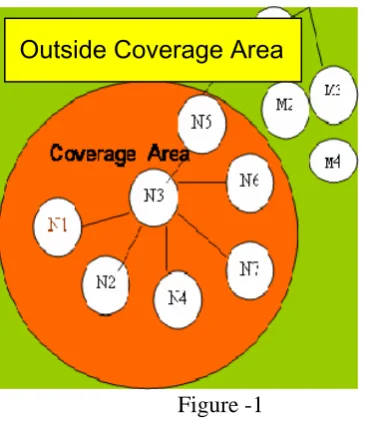
In the Proposed algorithm, a path is defined as the most reliable within the graph, through which delivery is guaranteed .In the ideal first identified the coverage area range .
The transferring packet with in the coverage area and calculate the time taken for transferring a packet. Next compute less coverage area and transfer the packet .
First step to identify the packet transferred time and packet loss within coverage area and less coverage area. The packet loss reduce the less coverage area.
Figure -1
Coverage area and less Coverage area
XII.Simulation Results
Network Model Sample Data
Routing AODV,DSR
Protocol
Coverage area 670 m x 670 m Packet Size 512
No. of Nodes 10,20,30 Algorithm Random casting
Inside the coverage area
44.8921 42.7631
40.2331
12 14
16
0 10 20 30 40 50
10 20 30
No. of nodes
Packet delivery ratio
Time taken to transfer the packets
Figure-2 Inside the coverage area packet delivery ratio and time taken to transfer the packets
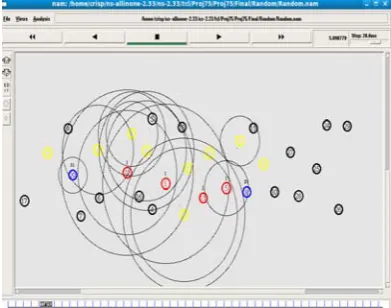
Figure3. Node Creation
Figure 4: Node cover for coverage area
Outside the coverage area
47.8324 48.7621 48.2381
16 18
20
0 10 20 30 40 50
10 20 30
No. of nodes
Packet delivery ratio
Time taken to transfer the packets
Figure-5 Outside the coverage area packet delivery ratio and time taken to transfer the packets.
Figure 6 :Node cover for outside the coverage area
Figure 7: Node cover for coverage area and less coverage area
Figure 9 : Node spilt to coverage area and less coverage area
Figure 10 : Reduce the packet loss in less coverage area.
Figure11:Energy consumption for coverage area and less coverage area
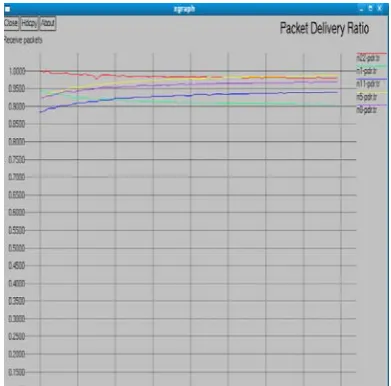
Figure 11 : Packet delivery ratio for coverage area and less coverage area
ACKNOWLEDGMENT
The researcher would like to thank Lion. Dr.K.S.Rangasamy MJF ,Chairman of KSR Educational Institutions , Dr .K.Thiyagarajah Principal K.S.R College of Technology and Dr K.Duraiswamy Dean (Academic ) K.S.R College of Technology for their motivation and continuous encouragement .
REFERENCE
[1] Banerjee and S.Khuller ,” A Clustering Scheme for hierarchical routing in wireless networks” , Technical Report CS-TR-4103,UMD, College patrk2001.
[2] C.Perkins ,E Beld ig-Royer and S.Das “ Ad hoc on Demand Distance Vector (AODV) Routing “ Request for Comments 3561 July 2003.
[3] Y.Ko and N.Vaidya “ Location Aided Routing (LAR) in mobile Ad hoc Networks . Proceeding of the ACM /EEE International conference on Mobile Computing and Networking(MOBIKON),66-75,1998.
[4] 1N.Karthikeyan, 2Dr.V.Palanisamy, and
3Dr.K.Duraiswamy “Performance Comparison of Broadcasting methods in
[5] Heinzelman, W.R., Chandrakasan A, Balakrishanan H, “Energy-efficient communication protocol for wireless microsensor networks[J]” System Sciences,2000, In: Proceedings of the 33rd Annual Hawaii International Conference on 4-7 Jan 2000 Page:10 pp.vol.2.
[6] Heinzelman W, Chandrakasan A,
Balakrishanan H, “An Application-specific protocol architecture for wireless microsensor networks[J]”, In: IEEE Transaction on Wireless Communications, 2002, (10):660-670.
[7] Jie Wu and Fei Dai “Mobility Management and Its Applications in Efficient Broadcasting in Mobile Ad Hoc Networks[J] “ 0-7803-8356-7/04 IEEE INFOCOM 2004
[8] S.V.M.G.Bavithiraja “Location Aided Broadcasting in Mobile Ad Hoc Networks[J]” International Journal of Recent Trends in Engineering, Vol. 1, No. 1, May 2009 pp 619. [9] Mahboobeh Abdoos, Karim Faez, and
Masoud Sabaei ”Position Based Routing Protocol with MoreReliability in Mobile Ad Hoc Network[J]” World Academy of Science, Engineering and Technology 49 2009
[10]Hossein Ashtiani, Shahpour Alirezaee, seyed
mohsen mir hosseini, HamidKhosravi“PNR:
New Position based Routing Algorithm for Mobile Ad Hoc Networks[J]” Proceedings of the World Congress on Engineering 2009 Vol I WCE 2009, July 1 - 3, 2009, London, U.K. [11]N. Karthikeyan, V. Palanisamy and
Duraiswamy “Reducing Broadcast Overhead Using clustering Based Broadcast Mechanism in Mobile Ad Hoc Network[J]” Journal of Computer Science 5 (8): 548-556, 2009 ISSN 1549-3636 © 2009 Science Publications
[12] Md. Anisur Rahman, Md. Shohidul Islam, Alex Talevski “Performance Measurement of Various Routing Protocols in Ad-hoc Network[J]”Proceedings of the International MultiConference of Engineers and Computer Scientists 2009 Vol I IMECS 2009, March 18 - 20, 2009, Hong Kong ISBN: 97
[13]Wei Lou, Member, Jie Wu, Senior
Member”Toward Broadcast Reliability in Mobile Ad Hoc Networks with Double Coverage[J]” IEEE Transcations on Mobile Computing, vol. 6, NO. 2, Feb 2007
AUTHORS
Gomathi. S received the B.Sc and MCA Degrees from Madras University and M.Phil (C.S) ,Mother Teresa Woman’s University Kodaikanal. She is working as a Professor in Department of MCA at K.S.R College of Technology,Tiruchengode. Her area of interest Computer Networks, Network Protocols, Mobile Ad hoc Networks, Unix and Network Programming. She is a member of ISTE.
Dr.K.Duraiswamy received the B.E,M.E and Ph.D (Communication Engineering ) in 1972,1974 and 1987 respectively. After working as a Lecturer in the Department of Electrical Engineering in Government College of