Is hexagonal flow
v
6just a superposition of elliptic
v
2and
trian-gular
v
3flows?
E. Zabrodin1,2,a, L. Bravina1, B.H. Brusheim Johansson1,3, G.Kh. Eyyubova2,4, V.L. Korotkikh2, I.P. Lokhtin2, L.V. Malinina2,5, S.V. Petrushanko2, and A.M. Snigirev2
1Department of Physics, University of Oslo, PB 1048 Blindern, Oslo, Norway
2Skobeltsyn Institute of Nuclear Physics, Moscow State University, RU-119991 Moscow, Russia 3Oslo and Akershus University College of Applied Sciences (HIOA), Oslo, Norway
4Czech Technical University in Prague, FNSPE, Prague, Czech Republic 5Joint Institute for Nuclear Researches, Dubna, Russia
Abstract. HYDJET++model, which combines parametrized hydrodynamics with jets, is employed to study the dependence of the hexagonal flow,v6, on the elliptic,v2, and
tri-angular,v3, flows. Calculations are performed for lead-lead collisions at
√
s=2.76 ATeV with centrality 10%≤σ/σgeo ≤50%. Hexagonal flow in the model emerges only due
to the presence ofv2andv3. Position of its event plane,Ψ6, is found to be closer toΨ3
for semi-central events, whereas in peripheral reactions it is closer toΨ2, in line with the
experimental analysis of the plane correlations. The amplitude of “induced" hexagonal flow is also comparable with that obtained in experiments. It means, in particular, that many features of thev6can be explained by interplay of elliptic and triangular flows.
1 Introduction
The collective flow of hadrons as a signal of early stage of hot and dense matter, produced in rela-tivistic heavy-ion collisions, was proposed about 40 years ago [1]. At the beginning, the flow was decomposed into the in-plane bounce-offflow and the squeeze-out flow, elongated perpendicular to the reaction plane. The new method, proposed for the flow analysis in [2, 3], relies on the Fourier decomposition of hadron distribution in the azimuthal plane
Ed
3N
d3p =
1 2π
d2N
pTd pTdy
⎧⎪⎪⎨ ⎪⎪⎩1+2
∞
n=1
vncosn(φ−Ψn)⎫⎪⎪⎬⎪⎪⎭ . (1)
Here pT is the transverse momentum of a particle,yis the rapidity,φdenotes the azimuthal angle
between the pT, and the participant event plane, whilevn andΨnrepresent the n-th flow harmonic
coefficient and the azimuth of its plane, respectively. The flow harmonics are
vn=cos(n(φ−Ψn), (2)
ae-mail: [email protected]
DOI: 10.1051/
C
Owned by the authors, published by EDP Sciences, 2014
/2 01
where averaging is taken over all events and all particles in each event. The first three harmonics, called directedv1, ellipticv2, and triangularv3flow, are belonging to lower harmonics, whereas others,
such as quadrangularv4, pentagonalv5, hexagonalv6etc. flow, are regarded as higher harmonics.
The studies of heavy-ion collisions within the 2+1 or 3+1 hydrodynamic models are focused particularly on the response of partonic matter to initial density fluctuations. The present status of the investigation of connection between the final flow harmonicsvnand the initial eccentricitiesεnis as
follows. Elliptic and triangular flows depend linearly [4] on ellipticity and triangularity, respectively, whereas for higher harmonics this dependence is nonlinear [5].
The aim of our work is to study the partial contributions of lower harmonics to the higher ones. Since the study is performed in the midrapidity range, where the directed flow is very weak compared to the elliptic and triangular flows [6], we will dropv1from our consideration and concentrate mainly
on thev2,v3, and their interplay. The possible connection between lower and higher harmonics was
discussed first in [7]. It was shown that in ideal hydrodynamics the quadrangular flow should depend on the elliptic one asv4=0.5v22in the limit of large transverse momenta and unique reaction planeΨ.
Later on everyn-th harmonic was found to possess its own reaction planeΨn. However, even in the
Ψ2plane the measured signalv4/v22 well exceeds the value 0.5, mainly because of its determination
not on event-by-event basis [8]. Jets and decays of resonances also increase the ratio [9, 10].
But quadrangular flow gets the major contribution just from one lower harmonic,v2. Hexagonal
flow is of special interest for us, because it receives the independent contributions from the elliptic and the triangular flows, and has no term proportional to their product,v2v3. In case of the unique
reaction plane and at high transverse momenta the expression forv6reads [11]:
v6
1 6v
3 2+
1 2v
2
3. (3)
Therefore, it would be interesting to study hexagonal flow, emerging as a result of the interplay ofv2
andv3, in case of absence of genuine hexagonal eccentricityε6, and compare the obtained results with
the available experimental data. Jets and decays of resonances can also modify the final distributions. -For instance, the violation of the number-of-constituent-quark (NCQ) scaling at LHC can be explained by the influence of jets, whereas resonances are trying to restore the scaling [9, 10]. - The present study is performed within the HYDJET++model, which couples parametrized ideal hydrodynamics with jets traversing hot and dense medium. Basic features of the model are given in Sec. 2.
2 Elliptic and triangular flows in the HYDJET++ model
The description of the event generator HYDJET++(HYDrodynamics with JETs) can be found else-where [12–14]. Recall briefly, that parametrized hydrodynamics is employed [13] to generate soft part of particle spectra, including hadron yields, femtoscopy correlations and differential elliptic flow. In the hard sector the model accounts for radiative and collisional losses [14] for partons traversing hot and dense nuclear matter. Cold nuclear matter effects, such as gluon shadowing [15], are also implemented. Recently [16] the HYDJET++was modified to generate also the triangular flow,v3.
Compared to the former transverse radius of the fireball, which reproduces the elliptic deformation
Rell(b, φ)=Rfo(b)
1−2(b)
1+(b) cos 2φ , (4)
the altered radius of the freeze-out hypersurface in azimuthal plane takes into account triangular de-formations as well
R(b, φ)=Rell(b, φ){1+3(b) cos
3(φ
−Ψ3)
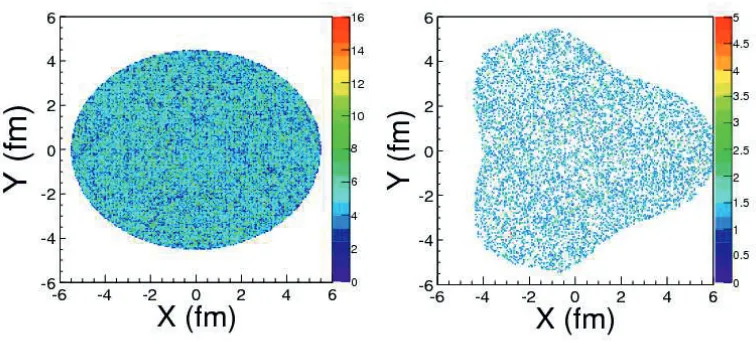
Figure 1.A snapshot of the particle density in the azimuthal plane illustrating the generation of second (left plot) and second plus third (right plot) flow harmonics in semiperipheral Pb+Pb collisions generated in HYDJET++ at√s=2.76 ATeV.
Herebis the impact parameter andRfo(0) is the model parameter which determines the scale of the
fireball transverse size at freeze-out. Parameters(b) and3(b) are responsible for the elliptic and
triangular spatial anisotropies, respectively. The event plane of the triangular flow,Ψ3, is randomly
oriented with respect to the planeΨ2. This means that the generated elliptic and triangular flows are
not correlated, in accordance with the experimental observations. The free parameters of the model were tuned to reproduce differential distributionsv2(pT) andv3(pT) in Pb+Pb collisions at LHC within
the centrality range 5%≤σ/σgeo≤50%. The flow fluctuations in the HYDJET++arise due to
parti-cle momentum distributions and fluctuations of partiparti-cle multiplicity, which are significantly amplified by the decays of resonances and production of minijets. Figure 1 illustrates generation of the second and the third flow harmonics in HYDJET++by representing particle densities in the transverse plane. Note that the triangular deformation shown here is very strong. The actual deformations needed to describe triangular flow at LHC energies are typically order of magnitude weaker.
Higher flow harmonics are not explicitly generated in the model, therefore, these harmonics are absent if bothv2andv3is zero. If just the elliptic flow is present, then only even higher harmonics are
excited as overtones of thev2. Thus, the HYDJET++provides us a tool to study the pure contributions
of both lower harmonics to the higher ones.
3 Results for hexagonal flow
Results presented in the Section are based on our two recent studies [11, 16]. About 2·106
Figure 2. Elliptic flowv2(pT) of charged hadrons at
pseudo-rapidity|η|<0.8 in Pb+Pb collisions at √s = 2.76 ATeV with centrality 20-25%. Solid circles and solid squares arev2{2} and v2{LYZ}from CMS [17],
open cirles and histogram arev2{EP}andv2(Ψ2) for
HY-DJET++events, respectively.
Figure 3.The same as Fig.2 but for the triangular flow v3(pT). Solid circles and solid squares arev3{2} and
v3{EP}from CMS [18], open cirles and histogram are
v3{EP}andv2(Ψ3) for HYDJET++events, respectively.
10−20%, 20−30%, 30−40%, and 40−50%. Comparison of the model results with the CMS data at 20%≤σ/σgeo ≤25% is given in Figs. 2 and 3 for the elliptic and triangular flows,
respec-tively. The agreement is good. A detailed comparison of the generated flow harmonics from second to sixth with ATLAS and CMS results at different centralities can be found in [16]. Then, the ratio v1/n
n /v12/2is often used to find the possible scaling trends in the behavior of different flow harmonics.
Figure 4 presents the ratiov16/6(pT)/v21/2(pT) in theΨ2plane for charged hadrons produced (a) only in
the hydrodynamic part of the calculations and (b) in both soft and hard processes. Recall that hexag-onal flow is determined here with respect to theΨ2plane. The horisontal lines show the ideal limit
v1/6
6 /v
1/2
2 =(1/6)1
/6≈0.74. It is worth mentioning that this limit is attained in pure hydro branch of
the calculations already atpT ≈1 GeV/c. All four curves are on top of each other. Jets [see Fig. 4(b)]
modify this picture by (i) increasing the ratio a bit less than 10% and (ii) causing the rise of its high-pT tail atpT ≥ 3 GeV/c. Still, there is a hair-width difference between the curves representing the
selected centralities.
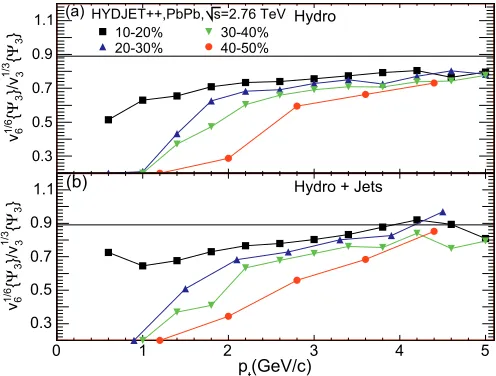
Similar ratio but for the triangular flow,v16/6(pT)/v31/3(pT), in theΨ3 plane is displayed in Fig. 5.
Here one can see the hierarchy of centralities, i.e., the ratio is larger for more central events. All curves are below the ideal limitv16/6/v31/3 = (1/2)1/3 ≈0.89, although they seem to approach it with rising pT. Jets increase the ratio and make its rise steeper, but no distinct rise of high-pT tail is observed.
Definitely, the partial contributions of elliptic and triangular flows to the hexagonal one should change with centrality.
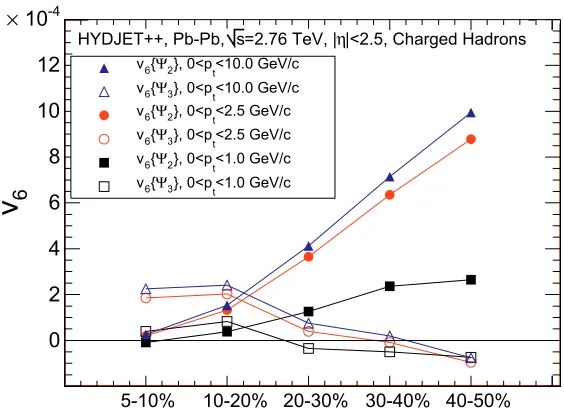
To verify this hypothesis we plot in Fig. 6v2{Ψ2}andv3{Ψ3}integrated over transverse momentum
within the centrality intervals. The difference between the distributions is obvious. For semicentral collisionsv6{Ψ2}is weak because the elliptic flow is weak also. Hexagonal flow inΨ2plane becomes
stronger with increasing peripherality of collisions. And vise versa,v6{Ψ3}is the strongest in
}2 Ψ { 1/2 2 /v}2 Ψ { 1/6 6 v 0.6 0.7 0.8
0.9 HYDJET++,PbPb, s=2.76 TeV
10-20% 20-30% 30-40% 40-50% (a) Hydro (GeV/c) t p
0 1 2 3 4 5
}2 Ψ { 1/2 2 /v}2 Ψ { 1/6 6 v 0.6 0.7 0.8 0.9 1.0
1.1 (b) Hydro + Jets
Figure 4. Ratiov16/6/v21/2 as a function of pT in theΨ2 event plane for charged particles, originated from (a)
soft processes only and (b) both soft and hard processes, in HYDJET++simulations of Pb+Pb collisions at √
s=2.76 ATeV. See text for details.
}3 Ψ { 1/3 3 /v}3 Ψ { 1/6 6 v 0.3 0.5 0.7 0.9
1.1 HYDJET++,PbPb, s=2.76 TeV
10-20% 20-30% 30-40% 40-50% (a) Hydro (GeV/c) t p
0 1 2 3 4 5
}3 Ψ { 1/3 3 /v}3 Ψ { 1/6 6 v 0.3 0.5 0.7 0.9
1.1 (b) Hydro + Jets
6
v
<10.0 GeV/c t , 0<p } 2 Ψ { 6 v <10.0 GeV/c t , 0<p } 3 Ψ { 6 v <2.5 GeV/c t , 0<p } 2 Ψ { 6 v <2.5 GeV/c t , 0<p } 3 Ψ { 6 v <1.0 GeV/c t , 0<p } 2 Ψ { 6 v <1.0 GeV/c t , 0<p } 3 Ψ { 6 v|<2.5, Charged Hadrons
η
=2.76 TeV, | s HYDJET++, Pb-Pb, 0 2 4 6 8 10 12 -4 10 ×
5-10% 10-20% 20-30% 30-40% 40-50%
Figure 6.Integrated flowv6{Ψ2}andv6{Ψ3}of charged particles vs. centrality in generated Pb+Pb collisions at
√
s=2.76 ATeV.
If so, the same tendency should be revealed in the behavior of the correlators between the event planes. Here the event flow vector−→Qnand the event plane angleΨnshould be determined for the flow
harmonic ofn-th order [3]
−→
Qn=(Qn,x,Qn,y)= ⎛ ⎜⎜⎜⎜⎜
⎝
i
wicos (nφi),
i
wisin (nφi)
⎞ ⎟⎟⎟⎟⎟
⎠ , (6)
tan (nΨn)=
Qn,y
Qn,x
, (7)
wherewiandφiare the weight and the azimuthal angle ofi-th particle in the lab-system, respectively.
The correlators between arbitrarylevent planes of orderklhave the form [20–22]cos (
klmax
k=klmin
kckΨk)
with the constraint
klmax
k=klmin
kck=0. For the correlations betweenΨ6andΨ2(orΨ3) the corresponding
correlators are simplycos 6(Ψ2−Ψ6)andcos 6(Ψ3−Ψ6). To see the correlations more distinctly
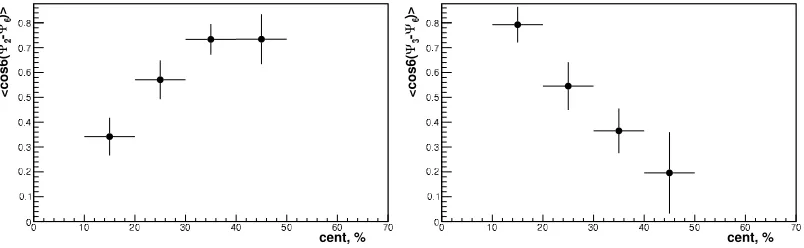
we artificially increased the triangular deformation of the freeze-out hypersurface. Both correlators are obtained from the generated events by the method proposed for the analysis of experimental data in [21]. Figure 7 demonstrates that the correlatorcos 6(Ψ2−Ψ6)increases for more peripheral
colli-sions. In contrast, the correlatorcos 6(Ψ3−Ψ6)drops with rise of the impact parameter, as shown in
Figure 7. Two-plane correlator cos6(Ψ2−Ψ6)for
charged hadrons in generated Pb+Pb collisions at √s= 2.76 ATeV.
Figure 8.The same as Fig. 7 but for two-plane correla-tor cos6(Ψ3−Ψ6).
theΨ3plane. With the increase of peripherality the elliptic flow becomes significantly stronger, while
the triangular flow just slightly increases. Thus, the hexagonal flow is mainly determined by thev2for
the peripheral collisions. Becausev3is randomly oriented with respect tov2, the correlations between
theΨ6plane and theΨ3plane become weaker.
4 Conclusions
Our aim was to study the influence of the elliptic and triangular flows on higher harmonics in ultra-relativistic heavy-ion collisions at LHC energies. Hexagonal flow was chosen because it is getting independent contributions from the both lower harmonics,v6∼v32+v23. For the ratiov
1/6 6 (pT)/v
1/2 2 (pT)
in theΨ2 plane scaling was found for centralities 10%≤σ/σgeo ≤ 50%. Jets cause the rise of this
ratio atpT ≥3 GeV/c. Similar effect for Pb+Pb collisions at LHC was observed earlier for the ratio
v4(pT)/v22(pT).
The analysis of the strength ofv6as a function of centrality inΨ2 andΨ3planes, accomplished
by the analysis of the plane correlatorscos 6(Ψ2−Ψ6)andcos 6(Ψ3−Ψ6), shows that hexagonal
flow is strongly correlated withv3 in semicentral events, whereas in semiperipheral cnd peripheral
ollisions prevail correlations withv2. These findings agree well with the experimental data. Thus, the
nonlinear response of the hexagonal flow to the corresponding eccentricity, found in hydrodynamic models, can be explained by the strong influence of the elliptic and the triangular flows and their nonlinear interplay. Further investigations are needed to shed light on this very exciting problem.
Acknowledgements
References
[1] W. Scheid, H. Müller, and W. Greiner, Phys. Rev. Lett.32, 741 (1974) [2] S. A. Voloshin and Y. Zhang, Z. Phys. C70, 665 (1996)
[3] A. M. Poskanzer and S. A. Voloshin, Phys. Rev. C58, 1671 (1998)
[4] G.-Y. Qin, H. Petersen, S. A. Bass, and B. Müller, Phys. Rev. C82, 064903 (2010) [5] U. Heinz and R. Snellings, Annu. Rev. Nucl. Part. Sci.64, 123 (2013)
[6] B. Abelevet al.(ALICE Collab.), Phys. Rev. Lett.111, 232302 (2013) [7] N. Borghini and J.-Y. Ollitrault, Phys. Lett. B642, 227 (2006)
[8] C. Gombeaud and J.-Y. Ollitrault, Phys. Rev. C81, 014901 (2010)
[9] L. Bravina, B. H. Brusheim Johansson, G. Eyyubova, and E. Zabrodin, Phys. Rev. C87, 034901 (2013)
[10] E. Zabrodin, G. Eyyubova, L. Malinina, and L. Bravina, Acta Phys. Polon. B5, 349 (2012) [11] L. V. Bravinaet al., arXiv:1311.0747 [hep-ph] (Phys. Rev. C, in press)
[12] I. P. Lokhtinet al., Comput. Phys. Commun.180, 779 (2009) [13] N. S. Amelinet al., Phys. Rev. C74, 064901 (2006);
N. S. Amelinet al., Phys. Rev. C77, 014903 (2008)
[14] I. P. Lokhtin and A. M. Snigirev, Eur. Phys. J. C46, 211 (2006)
[15] K. Tywoniuk, I. C. Arsene, L. Bravina, A. B. Kaidalov, and E. Zabrodin, Phys. Lett.B657, 170 (2007)
[16] L. V. Bravinaet al., arXiv:1311.7054 [nucl-th]
[17] S. Chatrchyanet al.(CMS Collab.), Phys. Rev. C87, 014902 (2013) [18] S. Chatrchyanet al.(CMS Collab.), arXiv:1310.8651 [nucl-ex] [19] B. Abelevet al.(ALICE Collab.), Phys. Lett. B719, 18 (2013)
[20] R. S. Bhalerao, M. Luzum, and J.-Y. Ollitrault, Phys. Rev. C84, 034910 (2011) [21] J. Jiaet al.(ATLAS Collab.), Nucl. Phys. A910-911, 276 (2013)
![Figure 2.{EP} from CMS [18], open cirles and histogram arev33({EPp} and The same as Fig.2 but for the triangular flowT)](https://thumb-us.123doks.com/thumbv2/123dok_us/8201701.1369980/4.482.53.410.84.248/figure-cms-open-cirles-histogram-arev-triangular-owt.webp)