J. Mol. Biol. (1995) 249, 398-408
J M B
Crystallization of RNA-Protein Complexes I. Methods
for the Large-scale Preparation of RNA Suitable for
Crystallographic Studies
Stephen R. Price, Nobutoshi Ito, Chris Oubridge, Johanna M. Avis
and Kiyoshi Nagai*
MRC Laboratory of Molecular Biology, Hills Road
CambrMge CB2 2QH, UK
*Correspomting author
In vitro transcription using bacteriophage RNA polymerases and linearised plasmid or oligodeoxynucleotide templates has been used extensively to produce RNA for biochemical studies. This method is, however, not ideal for generating RNA for crystallisation because efficient synthesis requires the RNA to have a purine rich sequence at the 5' terminus, also the subsequent RNA is heterogenous in length. We have developed two methods for the large scale production of homogeneous RNA of virtually any sequence for crystallization. In the first method RNA is transcribed together with two flanking intramolecularly-, (cis-), acting ribozymes which excise the desired RNA sequence from the primary transcript, eliminating the promoter sequence and heterogeneous 3' end generated by run-off transcription. We use a combination of two hammerhead ribozymes or a hammerhead and a hairpin ribozyme. The R N A - e n z y m e activity generates few sequence restrictions at the 3' terminus and none at the 5' terminus, a considerable improvement on current methodologies. In the second method the BsmAI restriction endonuclease is used to linearize plasmid template DNA thereby allowing the generation of RNA with any 3' end. In combination with a 5' cis-acting hammerhead ribozyme any sequence of RNA may be generated by in vitro transcription. This has proven to be extremely useful for the synthesis of short RNAs.
Keywords: in vitro transcription; ribozymes; RNA-protein interactions; X-ray crystallography; oligoribonucleotide.
Introduction
The growing number of DNA-protein complex structures has provided considerable insight into the structural basis of sequence-specific interactions between protein domains and double-helical DNA (for a comprehensive review of the field see Harrison & Sauer, 1994). In contrast, protein-RNA interactions are so far poorly understood. Our lack of understanding of how proteins interact with their cognate RNA is due to the existence of only five published structures of a specialised type, the aspartyl-, glutaminyl- and the seryl-tRNA syn- thetases with their cognate tRNAs (Rould et al., 1989; Ruff et al., 1991; Biou et al., 1994) and the bacteriophage MS2 coat protein complexed to a small RNA hairpin (Valegdrd et al., 1994) and the U1A
Present address: N. lto, Department of Biochemistry and Molecular Biology, University of Leeds. Leeds, LS2 9JT, U.K.
protein complexed with its cognate RNA hairpin (Oubridge et al., 1994). RNA is capable of folding into complex structures through base-pairing of comp- lementary stretches, base stacking and base-triplet formation (see Varani & Tinoco, 1991 for a com- prehensive review of RNA secondary structure). These interactions create hairpin, bulge and internal loop structures within double-stranded regions, which are often binding sites for RNA binding proteins (Nagai, 1992). Structures of these RNAs with their binding proteins will reveal how unique nucleic acid structures and proteins interact. The lack of structural information on protein-RNA inter- actions is due in part to the difficulty of synthesising and purifying RNA of a defined length and sequence in large quantities, sufficient for structural work.
The chemical synthesis of RNA (Beaucage & Caruthers, 1981; Usman et al., 1987) is less efficient than that of DNA due largely to the chemical protecting groups at the 2' oxygen of the ribose sugar. This inefficiency, at present, renders the synthesis of
Synthesis of RNA for Crystallographic Studies 399
oligoribonucleotides of greater than about 30 nucleotides in length impractical at the preparative scale. RNA synthesis by in vitro transcription using bacteriophage RNA polymerases, which have been over-expressed and purified, is an alternative method (for a review see Francklyn & Schimmel, 1990). Linearised plasmid DNA or chemically synthesised oligodeoxynucleotides (Milligan et al.,
1987) are used as a template for run-off transcription, and allow the generation of milligram quantities of RNA. This method has proved to be powerful for preparing RNA for biochemical studies but has serious drawbacks as a method of RNA preparation for crystallisation. Firstly, the efficiency of transcrip- tion depends on the sequence of the initiation site as well as the promoter sequence. The yield of RNA is poor unless the 5' end of the transcribed RNA is purine-rich, thus there is significant restriction on the sequences that can be made efficiently. Secondly, the RNA polymerase often adds one or more extra nucleotides at the 3' end of the transcript in a template-independent manner (Milligan et al., 1987). In most DNA-protein complex crystals the packing of repeating units is mediated by end-to-end interactions of the DNA. RNA-protein complexes are likely to pack within crystals using similar interactions between the RNA components. There- fore, the homogeneity of oligonucleotide prep- arations and unrestricted choice of sequence, particularly at either end of the sequence, are likely to prove essential factors for success in RNA-protein co-crystallisation. In this paper we describe two methods of large scale RNA synthesis by in vitro
transcription that overcome these difficulties. All methods use ribozymes in order to generate precise termini of RNA.
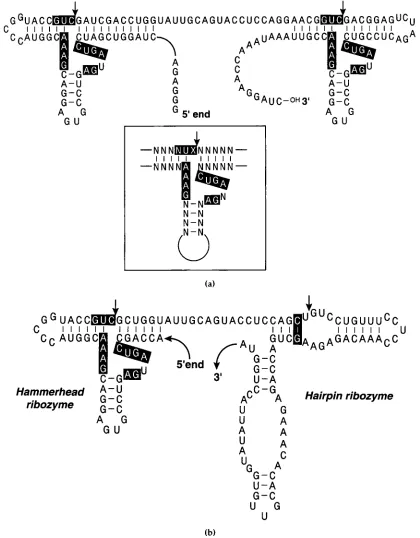
The hammerhead ribozyme (see inset of Figure la) was identified as a sequence sufficient for self-cleav- age in satellite RNAs of certain plant viruses (Prody
et al., 1986; Hutchins et al., 1986; Buzayan et al.,
1986a,c), and catalyses a transesterification reaction generating a cyclic 2',3'-phosphodiester and a free 5'-hydroxyl terminus of the product RNAs (Hutchins
et al., 1986; Buzayan et al., 1986b; Epstein & Gall, 1987). Mutagenesis studies of the core of the hammerhead domain revealed that sequence re- quirements for cleavage immediately upstream of the cleavage site may be approximated to a NUX (N = rA, rC, rG or rU, X = rA, rC or rU) trinucleotide, although CAC, CGC and AAC trinucleotides at this site also appear to cleave efficiently when placed in the context of the domain shown in the inset of Figure la (Sheldon & Symons, 1989; Perriman et al., 1992; Koizumi et al., 1989). What is clear, however, is that the base-pairing potential of the stem immediately upstream of the cleavage site must be conserved with the nucleotide at the cleavage site unpaired (Koizumi
et al., 1988a,b; Sheldon & Symons, 1989). Divalent cations are believed to participate in the cleavage reaction with Mg 2÷ and Mn ~ being preferred (Uhlenbeck, 1987; Dahm & Uhlenbeck, 1991). Structural studies on the hammerhead ribozyme by NMR spectroscopy confirmed the domain structure
(Heus & Pardi, 1991), this being further refined through the three-dimensional structure by X-ray crystallography (Pley et al., 1994).
Taira et al. (1991) have shown that a truncated RNA sequence can be generated when sequences at both 5' and 3' ends of RNA fold into hammerhead ribozyme structures. This method was originally designed to deliver hammerhead ribozymes into cells infected with HIV and to cleave the viral genomic RNA, but its possible use as a method for the large scale synthesis of RNA for crystallisation has not been investigated until now. We have further refined and optimised this method for large scale RNA preparation. The only sequence restriction of this method is the requirement for a UX (X#G) (Sheldon & Symons, 1989; Perriman et al., 1992; Koizumi et al., 1989) di-nucleotide at the 3' end of the sequence. However, we are able to overcome this sequence restriction by the use of a hairpin ribozyme to generate the 3' terminus. The hairpin ribozyme was, like the hammerhead, identified as a self-cleav- age domain from certain satellite RNAs of plant viruses (Feldstein et al., 1989; Haseloff & Gerlach, 1989; Hampel & Tritz, 1989). The hairpin ribozyme requires a G, C or U nucleotide at the -2 position for efficient cleavage (Berzal-Herranz et al., 1992) thus allowing the generation of any RNA terminating in the sequence (G/C/U)N. For instance, the gener- ation of RNA terminating with a CCA trinucleotide, for example transfer-RNA, would be possible using a hairpin ribozyme to generate the 3' terminus.
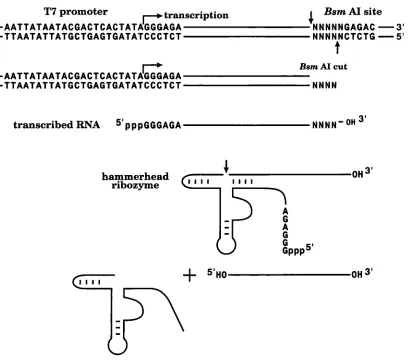
The third method described here overcomes this restriction and involves transcription of a plasmid template in which the gene encoding the desired RNA sequence is preceded by a hammerhead ribozyme gene and followed by a restriction site for BsmAI, an enzyme which cleaves outside its recognition sequence so that the plasmid template can be linearised for run-off transcription regardless of the nucleotide sequence at the 3' end. This third method complements, rather than supersedes, the others. Collectively these methods allow the large scale preparation of virtually any sequence of RNA overcoming most of the current problems associated with in vitro transcription of RNA for crystallisation. RNA synthesised by this method has been used successfully for crystallisation of the UIA protein with its cognate RNA (see accompanying paper).
Results
The use of double
cis-acting
hammerhead ribozymes, 5' and 3' to the desired sequence yields large amounts of a homogeneous RNA product400
Synthesis of RNA for Crystallographic StudiesRNA. This double-stranded fragment was produced by assembling four oligodeoxynucleotides and cloned into the EcoRI-BamHI site of pUC18. The plasmid DNA was linearised with BamHI and used for in vitro transcription. The RNA transcript was
designed to fold into a secondary structure shown in Figure la. If both ends of the transcript fold into the hammerhead ribozyme structure, the transcript should be cleaved at two sites following the GUC sequences, shown by the arrow, to liberate the
G GuAcCI~GAUCGACCUGGUAUUGCAGUACCUCCAGGAACGI~GACGGAGUC U
C
cc u cl cu°° uc-
I I I I I I I I I I I I I I I I I I I I I I I I I I I I IIC-G ~'~IU
G
C
C_ G~I u
A-U
A
A
A-U
G-C
G
AGGAuc_oH3 '
G-C
G-C
G
G-C
A
G
G 5' end
A
G
GU
GU
~NNNIII~NNNNN~
I I I I I I I I I I
~NNNN~
~ N - -
.m_NmN
N-N N-N©
(a)
C I I I I I I I I I I I I I IIII I I I I I I U
C - G ~ U
nd
-C
3'
U-A
Hammerhead A - U
G-C
A CC-G
A H a i r p i n r i b o z y m er i b o z y m e G - C U G
A G U A
GU
A
A
U
A
A
C
A
UGG_ C
U-A
G-C
U
G
U
(b)
Synthesis of RNA for Crystallographic Studies 401
1 mM each NTP a b c d e f g h
8 0 N
2-~ ;.
6 0
i.
4 4 . , .~
37W
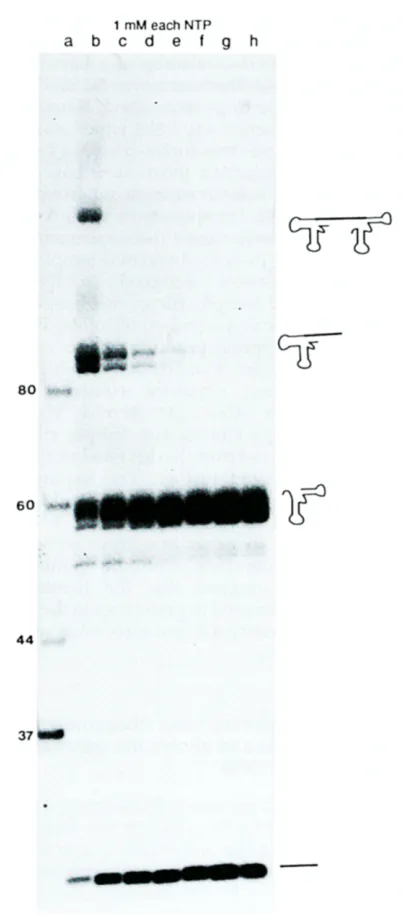
Figure 2. The effect of Mg 2. concentration on the efficiency of cleavage of the double hammerhead ribozyme construct with the sequence shown ill Figure la. Lane a, single-stranded DNA markers, lanes b to h are titration points at 6, 10, 14, 20, 24, 28 and 32 mM added MgCI2. All transcriptions include each nucleotide triphosphate at a concentration of I mM, and were continued for three hours at 37°C.
required fragment, the NUX (X#G) trinucleotide preceding both cleavage sites is essential for high efficiency cleavage, this restricts the RNA that can be made by this method to that which terminates in the sequence UX. Linearised plasmid template was transcribed in the presence of [¢(-32P]UTP with varying concentrations of Mg 2÷, in order to demonstrate the dependence on Mg 2. of cleavage of the ribozymes (see Figure 2). Several bands were produced at low concentrations of Mg 2. but above 24 mM Mg 2. only two major bands were seen. The
highest band from low Mg 2. conditions corresponds to the uncleaved, full length RNA and the second highest band is a product of a single cleavage at either the 5' or 3' cleavage site, the third highest band is a mixture of the 5' and 3' hammerhead fragments, which co-migrate in this gel system, and the lowest band is the 27 nucleotide U2 snRNA fragment. The nucleotide sequence at the transcription initiation site incorporated into this plasmid is the GGGAG sequence observed in the natural ~10 transcript and, therefore, the template is transcribed to high efficiency. Since the 27 nucleotide product migrates on a preparative polyacrylamide/urea gel away from any other bands, a large amount of transcription- cleavage product can be applied to the gel; this results in fewer gels being run in order to purify the RNA and a concomitant decrease in the risk of contaminating nucleases hence reducing the risk of degrading the product before it can be used. In contrast, a simple run-off transcription reaction produces additional RNA fragments one or two nucleotides longer than the correct product, hence only a small amount of the transcription product can be applied to a preparative gel. Other ribozyme constructs have been tested which generate frag- ments ranging from 36 nucleotides to 140 nucleo- tides in length. All constructs show a similar Mg 2. dependence in their transcription and result in homogeneous RNA preparations. All further charac- terisation of the RNA produced by this method was carried out on the 36mer produced by a construct, the sequence of which is shown in Figure la.
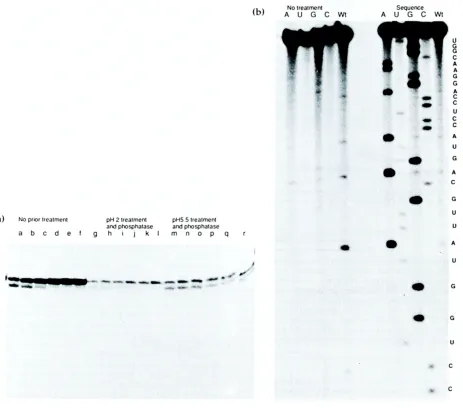
In order to characterise RNA made by this method, unlabelled purified RNA was phosphorylated in the presence of [y-~2p]ATP using T4 polynucleotide kinase and analysed on a thin polyacrylamide/urea gel. The product of conventional in vitro transcription has a 5' triphosphate terminus and cannot be radio-labelled efficiently with ~aP by T4 polynucle- otide kinase without prior treatment with calf intestinal alkaline phosphatase. In contrast, RNA produced by this method should have 5' hydroxyl and 2', 3' cyclic phosphodiester termini and should, therefore be phosphorylated by T4 polynucleotide kinase. As shown in Figure 3a, the phosphorylation reaction produces two closely running bands. It appears that one product is one nucleotide shorter than the other. However, this explanation may be discounted by the disappearance of the faster running product generating more of the slower running product during the time-course of the incubation with T4 polynucleotide kinase. In Figure 2, only one band is observed when product RNA is labelled using [~-32P]UTP during the transcription reaction, and the analysis of this product on a polyacrylamide gel after elution under identical conditions produced a single band (data not shown). This indicates that the appearance of the double band is due to an additional activity present in the kinase reaction, and not impurity of the RNA itself.
402 Synthesis of RNA for Crystallographic Studies
polynucleotide kinase and [7-32P]ATP generates only one product visible by autoradiography (data not shown). Therefore, it is most likely that the additional product is due to modification by the kinase, of the 2', 3' cyclic phosphodiester terminus (present due to the 3' ribozyme activity). Calf intestinal alkaline phosphatase has no phosphodiesterase activity and treatment of the RNA produced by ribozyme cleavages prior to phosphorylation with T4 polynu- cleotide kinase, had no effect on the time-course of the phosphorylation reaction (data not shown). Upon treatment of the non-phosphorylated RNA to decyclise the 2', 3' cyclic phosphate with maleic acid at pH 2 and subsequent incubation with calf intestinal alkaline phosphatase, to remove the mono-phosphate group, the lower band is substan- tially decreased (see Figure 3a, lanes g to 1). Treatment of the RNA with maleic acid at pH 5.5, however, appears to leave the RNA unaffected, as assayed by the subsequent phosphorylation time- course (Figure 3a, lanes m to r). This observation is consistent with the existence of a 2', 3' cyclic phosphate terminus; treatment at pH 2 being sufficient for its decyclisation, in contrast to the treatment at pH 5.5 (Buzayan et al., 1986b). The activity in the T4 polynucleotide kinase preparation that we have observed has been postulated to comprise part of a cyclic phosphodiesterase activity intrinsic to the enzyme itself (an unpublished result O. C. Uhlenbeck quoted Snyder, 1983). T4 phage polynucleotide kinase has an intrinsic 3' phosphatase activity, which is located independently to the kinase activity (Cameron & Uhlenbeck, 1977; Soltis & Uhlenbeck, 1982). The existence of this activity may be used to explain the time-course of reaction of T4 polynucleotide kinase with RNA generated by our ribozyme method, the upper band being the cis-diol terminated RNA, the lower being a phosphate mono-ester terminated RNA.
RNA produced by this method was also sequenced using the phosphorothioate footprinting method as described by Schatz et al. (1991). An analysis of the iodine cleavage products on a 20% thin polyacrylamide/urea gel demonstrated that the correct RNA sequence was produced, although the sequence of the first six nucleotides and the last was not verified (see Figure 3b). We have shown that the product is pure and strictly template-encoded and, therefore, suitable for structural investigation of RNA and RNA-protein complexes by NMR and crystallography. The only sequence requirement of this method is the NUX trinucleotide at the 3' end of the sequence which is essential for cleavage utilising the 3' cis-acting hammerhead ribozyme.
The use of a hairpin ribozyme to generate the 3' end of the desired RNA
The hairpin ribozyme has sequence requirements at the 5' side of the cleavage site that are less stringent than those of the hammerhead ribozyme, with sequence restrictions to the 3' side of the cleavage site
being more stringent (Haseloff & Gerlach, 1989; Hampel et al., 1990; Berzal-Herranz et al., 1992, 1993; Anderson et al., 1994). By utilising a hammerhead ribozyme to generate the 5' terminus of the RNA and a hairpin ribozyme to generate the 3' terminus, we will be able to generate any RNA which starts with any sequence and terminates in the sequence ( G / C / U ) N (the construct must allow base-pairing of the G / C / U prior to the ultimate nucleotide, with the ribozyme itself, Hampel et al., 1990; Anderson et al., 1994). Figure lb shows the sequence of RNA transcribed using linearised plasmid template with 5' and 3' sequences designed to fold into hammerhead and hairpin ribozymes, respectively, and liberate a 24mer oligoribonucleotide. Figure 4 shows the transcription products of this construct compared to similar transcription products of a double-hammerhead ribozyme construct which releases a 27mer RNA. At 2 0 m M MgC12 an alternative cleavage site for the hairpin ribozyme appears to be selected over the designed site; this has not been investigated further. The required site, however, is chosen over all others at 30 mM MgC12. The products of the cleavages using a hairpin ribozyme appear to generate a more complicated pattern of products than with the hammerhead ribozyme. This suggests that the hammerhead ribozyme should be used in preference to the hairpin ribozyme in generating a 3' terminus when sequence requirements allow.
A 5'
cis-acting
hammerhead ribozyme and a 3'BsmAI
restriction site allows the generation of any sequence of RNASynthesis of RNA for Crystallographic Studies 4 0 3
The R N A b i n d i n g d o m a i n of the U I A ribonucle- oprotein w i t h a 21mer R N A h a i r p i n p r o d u c e d b y this m e t h o d yields crystals identical to those p r o d u c e d using chemically s y n t h e s i z e d R N A (see a c c o m p a n y - ing paper, O u b r i d g e et al., 1995).
D i s c u s s i o n
The h a m m e r h e a d r i b o z y m e is one of the m o s t - s t u d i e d examples of a self-cleaving RNA. A l t h o u g h nucleotides at certain positions within this
folded d o m a i n are required for cleavage the identity of only t w o nucleotides (UX, X # G ) preceding the cleavage site is largely conserved. We have described three different m e t h o d s for large scale R N A p r e p a r a t i o n b y in vitro transcription all of which use r i b o z y m e s to generate one or both termini of the RNA. The double cis-acting r i b o z y m e m e t h o d originally described b y Taira et al. (1989) was m o d i f i e d a n d conditions o p t i m i s e d for large scale preparation. The p r o d u c t to b e isolated migrates on a p r e p a r a t i v e p o l y a c r y l a m i d e gel away f r o m the
( a ) No prior treatment pH 2 treatment pHS.5 treatment and phosphatase and phosphatase a b c d e f g h i j k I m n o p q r
J
No treatment Sequence
( b ) A U G C Wt A U G C Wt
J
~ i 1 ~ ~ _~=~. ~ ~ J ~- , l ~ Q ~ t m n ~ b m D ~ 'dll~ llWl~
~Q
Q
G G
C
- 41D ~: c ~ • c A U
O
D -~ .- A
~ C
e
°
... U
.° U
O G
U
le C
~Im C
404
Synthesis of RNA for Crystallographic Studiesa b c ~ . dg
wlB
- 8 0
J
,~
- 4 4 374P18
Figure 4. Comparison of transcription products from the double hammerhead ribozyme construct and tile 5' hammerhead, 3' hairpin ribozyme construct. Lane a, transcription identical to lane g in Figure 2. Lane b and c, transcription of the 5' hammerhead, 3' hairpin ribozyme construct at 30 mM and 20 mM added MgCI2, respectively Lane d is a phosphorylated chemically synthesised sequence identical to that produced by the 5' hammerhead, 3' hairpin ribozyme construct. Lane e, DNA markers.
ribozyme fragments and, therefore, a large a m o u n t of p u r e RNA can be obtained readily, resulting in fewer gels being required for the purification and thus a reduced risk of ribonuclease contamination. For large RNA sequences it is quite difficult to separate the desired p r o d u c t from N + 1 and N + 2 products and the double cis-acting r i b o z y m e m e t h o d is essential in preparing RNA that is h o m o g e n e o u s in length. Although RNA made by this m e t h o d requires a UX sequence at the 3' end, this restriction may not be critical for crystallisation of large RNAs and is certainly a great i m p r o v e m e n t on current technologies. A possible r e m e d y for the sequence restrictions i m p o s e d by the h a m m e r h e a d r i b o z y m e at the 3' cleavage site is the use of other self-cleaving
sequences, such as the hairpin r i b o z y m e at this position, the hairpin r i b o z y m e has fewer sequence restrictions immediately 5' to the cleavage site and we show that it allows the synthesis of almost a n y sequence of RNA h o m o g e n e o u s in length. In addition, ribozymes with novel cleavage site specificities have b e e n r e p o r t e d (Nakamaye & Eckstein, 1994), which may p r o v e to be useful in the synthesis of RNAs terminating in different sequences.
For shorter RNAs the choice of sequence may be critical and therefore the third m e t h o d using a 5'
cis-acting r i b o z y m e and 3' B s m A I site is preferable. A drawback of this m e t h o d is that the p r o d u c t RNA is heterogeneous in length, although for small (<30 nucleotides in length) RNAs generation of h o m o g e n - eity should be facile by gel electrophoresis. For crystallisation of the U I A RNA-binding d o m a i n with its cognate RNA this m e t h o d has b e e n used successfully (see accompanying paper).
The m e t h o d s described in this p a p e r overcome most of the problems associated with in vitro
transcription of RNA. Large a m o u n t s of chemically p u r e RNA may be p r o d u c e d economically and we believe this m e t h o d m a y be widely applicable to structural studies of RNA and R N A - p r o t e i n complexes.
Materials and Methods
Construction of plasmid templates for in vitro transcription
Oligodeoxynucleotides were synthesised on an Applied Biosystems 380B DNA Synthesizer using standard phosphoramidite methods and purified using denaturing polyacrylamide gel electrophoresis. Tlle oligonucleotides were visualised by ultraviolet shadowing and eluted from the gel into water. The constructs were generated from several oligodeoxynucle- otides by annealing and ligating the individual oligomers together which had been previously phosphorylated using T4 polynucleotide kinase. These genes were cloned into the pUC18 vector between the EcoRI and Hindlll sites in the polylinker following standard protocols (Sambrook et al., 1989). Correct DNA sequences were verified by double-stranded DNA sequencing using the Sequenase TM protocol provided by United States Biochemi- cal Corp. In order to produce enough template for large scale RNA transcriptions plasmid from eight litres of a saturated culture of Escherichia coli TG1 strain was prepared by tile alkaline lysis method (Sambrook et al.,
1989) and purified by caesium chloride density gradient centrifugation. We include RNase A treatment in the preparation of tile plasmid template, even though this may appear to be foolhardy as tile plasmid will eventually come into contact with RNA. This plasmid DNA was linearised with a restriction endonuclease, phenol extracted three times and ethanol precipitated.
RNA synthesis by in vitro transcription
Synthesis of RNA for Crystallographic Studies 405
and uridine-triphosphate were obtained from Sigma. All NTPs were acquired as the s o d i u m salt with the exception of lithium guanosine triphosphate. Each nucleotide- triphosphate was stored as a 50 mM stock solution at p H 8.0 at -20°C with no loss of competence noted over a period of one year. T7 RNA polymerase was purified as described by G r o d b e r g & Dunn (1988) with slight modifications (S.R.P., C.O. & K.N., unpublished). Transcription con- ditions use 40 mM Tris-HCl (pH 8), 30 mM MgCI_, 200 ~lg linearized plasmid DNA, 4 mM ATE 4 mM UTP, 4 mM GTP, 4 mM CTP, 20 ~lg T7 phage RNA polymerase, 2 mM s p e r m i d i n e in a 2 ml reaction. The enzyme reaction is continued for three hours at 37°C, the magnesium pyrophosphate precipitate is pelleted by centrifflgation at 10,000 g for ten minutes and the supernatant removed. We have not used pyrophosphatase or ribonuclease inhibitors in our transcription reactions. Further, we have not experimented with the use of GMP to initiate transcription (see Sampson & Uhlenbeck, 1988). However, the amounts of polymerase a d d e d and the concentration of nucleotide triphosphates and template should be optimised in a case-by-case manner. Hence assaying the quality of the T7 RNA polymerase was not undertaken.
Gel purification of RNA
3 ml of in vitro transcription reaction mixture were
mixed directly with 1.5 ml of formamide which had
been deionised by a 16 hour incubation with Amberlite MB-3 resin (BDH biochemicals) and applied to a 20 cm x 40 cm x 0.1 cm, 15% ( w / v ) polyacrylamide gel containing 8 M urea, 1 x Tris-borate EDTA buffer (TBE, Sambrook et al., 1989). Bands containing the correct RNA product were visualised by ultraviolet shadowing and excised. RNA was removed from the gel slices by electroelution into 1 x TBE using a Schleicher & Schuell (Dassel, Germany) Biotrap. The RNA solution was dialysed extensively against water and concentrated using rotary evaporation under reduced pressure. Using these methods as much as 10 mg of pure RNA may be purified on as few as five gels. This amount represents one or two NMR samples and enough for several hundred crystallisa- tion trials.
5' radioactive labelling of RNA
A phosphorylation reaction contains RNA (1 ~lM), 12raM dithiothreitol, 12BM [y-32p]ATP ( 3 C i / m m o l e , Amersham), 12 units per ILl of RNasin (Promega), 1 unit per pl of T4 phage polynucleotide kinase and T4 polynucleotide kinase buffer supplied with the enzyme (New England Biolabs, NEB). A normal reaction is continued for 30 minutes at 37°C. The reaction is terminated by the addition of one half volume of formamide dye, and applied to a 15% polyacrylamide gel (400 m m x 200 m m x 0.5 ram) in 1 x TBE and 8 M urea.
T7 promoter
[--~transcription
5 ' - - A A T T A T A A T A C G A C T C A C T A T A ' G G G A G A 3 ' - - T T A A T A T T A T G C T G A G T G A T A T C C C T C T
5' AATTATAATACGACTCACTATAGF~GGAGA 3 ' - - T T A A T A T T A T G C T G A G T G A T A T C C C T C T
B s m A I
site
NNNNNGAGAC NNNNNCTCTG
t
Bsm AI
cut
NNNN
3 I 5'
transcribed RNA
5'pppGGGAGA NNNN - OH 3'hRmmerhead
ribozyme
~ , , i
I I IG
Gppp 5
+
5'HOFigure 5(a) (caption opposite)
OH 3'
406 Synthesis of RNA for Crystallographic Studies
Number of ribozymes
One Two
p
by standard methods (Sambrook et al., 1989). After
centrifugation at 100,000 g, washing and drying, the RNA pellet is re-dissolved in diethyl pyrocarbonate (DEPC) treated water to a final concentration of 100 nM.
De-cyclisation of 2', 3' cyclic phosphate by sodium maleiate treatment
RNA m a d e by the double h a m m e r h e a d ribozyme method was treated with s o d i u m maleiate at pH 2 in order to decyclise the 2', 3' cyclic phosphate which results from the cleavage at the 3' ribozyme. RNA at a concentration of 1 {iM was incubated with 0.8 M maleic acid/0.4 M NaOH (pH 2) for 80 minutes at 25°C after which the pH was increased to 5.5 by the addition of NaOH. A control incubation contained RNA at a concentration of 1 BM in 0.8 M maleic acid/0.8 M NaOH (pH 5.5) for 80 minutes at 25°C. Tris buffer was added to a final concentration of 0.15 M and HCI was a d d e d to a final concentration of 10 mM, this brings tile final pH to around 8.0 at which calf intestinal alkaline phosphatase may work. One unit of calf intestinal alkaline phosphatase was added and the mixture incubated at 55°C for 60 minutes. After phenol extraction and ethanol precipitation, the RNA was then phosphorylated by T4 phage polynucleotide kinase and [y-~-~P]ATP and a time-course of reaction performed (see Figure 3a).
I
|
(b)
Figure
5. a, A strategy for producing RNA of anysequence by run-off transcription. A 5' cis-acting
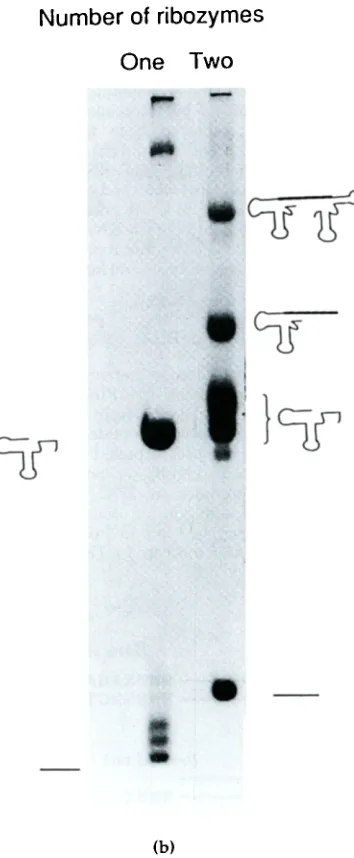
hammerhead ribozyme generates the 5' end of tile RNA, and the restriction enzyme BsmAI is used to linearise tlle plasmid template to generate the run-off transcription template, b, Transcription of two templates yielding different length RNAs. The left-hand lane shows production of a 24mer RNA by run-off transcription utilizing a 5' hammerhead ribozyme and 3' terminus generated by run-off transcription of a plasmid which had
been linearized using tile BsmAI restriction enzyme. The
right-hand lane shows transcription of a construct which yields a 27mer RNA through the action of 5' and 3'
cis-acting hammerhead ribozymes. Note tile homogeneity of the right-hand lane product compared to that produced by run-off transcription.
After electrophoresis and visualisation by autoradiography desired bands were excised by cutting the gel with a razor blade for further characterisation. Gel slices were cut into small pieces (around 1 m m cubes) and shaken in sterile water at 37°C in a sterile plastic tube, for four hours. The RNA solution is decanted and ethanol precipitated
Sequencing of RNA by iodine mediated phosphorothioate oxidation
RNA sequences are determined as described by Schatz et al. (1991). Sulphurs are incorporated at nucleotide
specific positions by in vitro transcription reactions
where one of the four ribose nucleotide solutions in tile transcription is supplemented by its ribose nucleotide phosphorothioate analogue (Amersham) at 1/20 concen- tration. The concentration of iodine used in the sequencing reaction is 1 mM. Tile reactions are terminated by the addition of a dithiothreitol solution to a final concentration of 2 mM and loaded onto a 20% denaturing polyacrylamide gel after tile addition of one-half volume of formamide dye. The construct which is shown in Figure l a was transcribed in four separate reactions, each reaction incorporating a different nucleoside phosphorothioate analogue. The 36 nucleotide cleavage product of each reaction was purified by gel electrophor- esis and phosphorylated at the 5' terminus in tile presence of [y-3-~PIATP and T4 polynucleotide kinase and the u p p e r band of the product was gel purified for further characterisation. A small proportion of the RNA has a phosphorothioate analogue incorporated at each position. Iodine treatment of each of the four reactions
produces nucleotide-specific partial cleavage (Schatz et al.,
1991).
A c k n o w l e d g e m e n t s
Synthesis of RNA for Crystallographic Studies 407
J.M.A. by an MRC training fellowship. This project was supported by the MRC and H u m a n Frontier Science Programme.
References
Anderson, P., Monforte, J., Tritz, R., Nesbitt, S., Hearst, J. & Hampel, A (1994). Mutagenesis of the hairpin ribozyme. Nucl. AcMs Res. 22, 1096-1100.
Beaucage, S. L. & Caruthers, M. H. (1981). Deoxynucle- otide phosphoramidites- a new class of key intermediates for deoxypolynucleotide synthesis. Tetrahedron Letters, 22, 1859-1862.
Berzal-Herranz, A., Joseph, S. & Burke, J. M. (1992). In vitro selection of active hairpin ribozymes by sequential RNA-catalysed cleavage and ligation reactions. Genes Dev. 6, 129-134.
Berzal-Herranz, A., Joseph, S., Chowrira, B. M., Butcher, S. E. & Burke, J. M. (1993). Essential nucleotide sequences and secondary structure elements of the haipin ribozyme. EMBO ]. 12, 2567-2574.
Biou, V., Yaremchuk, A., Tukalo, M. & Cusack, S. (1994). 2.9 Angstrom crystal structure seryl-tRNA synthetase complexed with t-RNA s~*. Science, 263, 1404-1410.
Buzayan, J. M., Gerlach, W. L. & Bruening, G. (1986a). Non-enzymatic cleavage and ligation of RNAs complementary to a plant-virus satellite RNA. Nature, 323, 349-353.
Buzayan, J. M., Gerlach, W. L., Bruening, G., Keese, P. & Gould, A. R. (1986b). Nucleotide sequence of satellite tobacco ringspot virus RNA and its relationship to multimeric forms. Virology, 151,
186-199.
Buzayan, J. M., Hampel, A. & Bruening, G. (1986c). Nucleotide-sequence and newly formed phospho- diester bond of spontaneously ligated satellite tobacco ringspot virus-RNA. Nucl. AcMs Res. 14, 9729- 9743.
Cameron, V. & Uhlenbeck, O. C. (1977). 3' Phosphatase activity in T4 polynucleotide kinase. Biochemistry, 16, 5120-5126.
Dahm, S. C. & Uhlenbeck, O. C. (1991). Role of divalent metal-ions in the hammerhead RNA cleavage reaction. Biochemistry, 30, 9464-9469.
Grodberg, J. & Dunn, J. J. (1988). O m p T encodes the Escherichia coli outer-membrane protease that cleaves T7-RNA polymerase during purification. J. Bacteriol. 170, 1245-1253.
Epstein, L. M. & Gall, J. G. (1987). Self-cleaving transcripts of satellite DNA from the newt. Cell, 48, 535-543. Feldstein, P. A., Buzayan, J. W. & Bruening, G. (1989). Two
sequences participating in the autolytic processing of satellite tobacco ringspot virus complementary RNA. Gene, 82, 53-61.
Francklyn, C. S. & Schimmel, E (1990). Synthetic RNA molecules as substrates for enzymes that act on transfer-RNAs and transfer-RNA-like molecules. Chem. Rev. 90, 1327-1342.
Hampel, A. & Tritz, R. (1989). RNA catalytic properties of the m i n i m u m ( - ) sTRSV sequence. Biochemistry, 28, 4929-4933.
Hampel, H., Tritz, R. Hicks, M. & Cruz, P (1990). Hairpin catalytic RNA model---evidence for helices and sequence requirement for substrate RNA. Nucl. Acids Res. 18, 299-304.
Harrison, S. C. & Sauer, R. T. (eds). (1994). Protein-nucleic acid interactions. Curt. Opin. Struc. Biol. 4, 1-66.
Haseloff, J. & Gerlach, W. L. (1988). Simple RNA enzymes with new and highly specific endoribonuclease activities. Nature, 334, 585-591.
Haseloff, J. & Gerlach, W. L. (1989). Sequences required for self-catalysed cleavage of the satellite RNA of tobacco ringspot virus. Gene, 82, 43-52.
Heus, H. A. & Pardi, A. (1991). Nuclear magnetic resonance studies of the hammerhead ribozyme domain, secondary structure formation and mag- nesium ion dependence. J. Mol. Biol. 217, 113-124. Hutchins, C. J., Rathjen, P. D., Forster, A. C. & Symons,
R. H. (1986). Self-cleavage of plus and minus RNA transcripts of avocado sunblotch viroid. Nucl. Acids Res. 14, 3627-3640.
Koizumi, M., Iwai, S. & Ohtsuka, E. (1988a). Construction of a series of several self-cleaving RNA duplexes using synthetic 21-mers. FEBS Letters, 228, 228-230. Koizumi, M., Iwai, S. & Ohtsuka, E. (1988b). Cleavage of
specific sites of RNA by designed ribozymes. FEBS Letters, 239, 285-288.
Koizumi, M. Hayase, Y., lwai, S., Kamiya, H., lnoue, H. & Ohtsuka, E. (1989). Design of RNA enzymes distinguishing a single base mutation in RNA. Nucl. Acids Res. 17, 7059-7071.
Milligan, J. F., Groebe, D. R., Witherell, G. W. & Uhlenbeck, O. C. (1987). Oligoribonucleotide synthesis using T7 RNA-polymerase and synthetic DNA templates. Nucl. Acids Res. 15, 8783-8798.
Nagai, K. (1992). RNA-protein interactions. Curr. Opin. Struct. Biol. 2, 131-137.
Nakamaye, K. L. & Eckstein, F. (1994). AUA cleaving hammerhead ribozymes--attempted selection for improved cleavage. Biochemistry, 33, 1271-1277. Oubridge, C., Ito, N., Teo, C.-H., Fearnley, I. and Nagai, K.
(1995). Crystallisation of RNA-protein complexes II. Crystallisation of the complex of U I A small nuclear ribonucleoprotein with its cognate RNA hairpin . ]. Mol. Biol. 249, 398-412.
Oubridge, C., Ito, N., Evans, P. R., Teo, C.-H. & Nagai, K. (1994). Crystal structure at 1.92 A resolution of the RNA-binding domain of the U1A spliceosomal protein complexed with an RNA hairpin. Nature, 372, 432-438.
Perriman, R., Delves, A. & Gerlach, W. L. (1992). Extended target site specificity for a hammerhead ribozyme. Gene, 113, 157-163.
Pley, H. W., Flaherty, K. M. & McKa)4 D. B. (1994). Three-dimensional structure of a hammerhead ribozyme. Nature, 372, 68-74.
Prod~ G. A. Bakos, J. T., Buzayan, J. M., Schneider, 1. R. & Bruening, G. (1986). Autolytic processing of dimeric plant satellite RNA. Science, 231, 1577-1580.
Rould, M. A., Perona, J. J., Soll, D. & Steitz, T. A. (1989). Structure of Escherichia coli glutaminyl t- RNA synthetase complexed with transfer-RNA c~" and ATP at 2.8 A resolution. Scieuce, 246, 1135-1142. Ruff, M., Krishnaswamy, S., Boeglin, M., Poterszman, A.,
Mitschler, A., Podjam)4 A., Rees, B., Thierr~ J. C. & Moras, D. (1991). Class II aminoacyl t-RNA synthetases- crystal structure of yeast aspartyl transfer RNA synthetase complexed with tRNA A~r. Science, 252, 1682-1689.
Sambrook, J., Fritsch, E. F. & Maniatis, T. (1989). Molecular cloning--A Laboratory Mamml, 2nd edit. Cold Spring Harbor Laboratory Press, Cold Spring Harbor, NY. Sampson, J. R. & Uhlenbeck, O. C. (1988). Biochemical and
408 Synthesis of RNA for Crystallographic Studies
Schatz, D., Leberman, R. & Eckstein, F. (1991). Interaction of Escherichia coli tRNA s~'' with its cognate aminoacyl- tRNA synthetase as determined by footprinting with phosphorothioate-containing tRNA transcripts. Proc. Natl Acad. Sci. USA, 88, 6132-6136.
Sheldon, C. C. & Symons, R. H. (1989). Mutagenesis analysis of a self-cleaving RNA. Nucl. Acids Res. 17, 5679-5685.
Snyder, L. (1983). In Bacteriophage T4 (Mathews, C. K., Kutter, E. M., Mosig, G. & Berget, P. B., eds) pp. 351-355. American Society for Microbiology, Washington, DC.
Soltis, D. A. & Uhlenbeck, O. C. (1982). Independent locations of kinase and 3'-phosphatase activities on T4 polynucleotide kinase. ]. Biol. Chem. 257, 11340-11345.
Taira, K., Nakagawa, K., Nishikawa, S. & Furukawa, K. (1991). Constructing a novel RNA-transcript- trim- ruing plasmid which can be used both in vitro in place
of run-off and (G). free transcription and in vivo as multi-sequence transcription vectors. Nucl. Acids Res.
19, 5125-5130.
Uhlenbeck, O. C. (1987). A small catalytic oligoribonucle- otide. Nature, 328, 596-600.
Usman, N., Ogilvie, K. K., Tiang, M.-Y. & Cedergren, R. G. (1987), Automated chemical synthesis of long oligoribonucleotides using 2'-O-silylated ribonu- cleoside 3'-O-phosphoramidites on a controlled glass support: synthesis of a 43 nucleotide sequence similar to the 3'-half molecule of an Escherichia coli
formylrnethionyl tRNA. J. Am. Chem. Soc. 109, 7845-7854.
Valegdrd, K., Murray, J. B., Stockley, P. G., Stonehouse, N. J. & Liljas, L. (1994). Crystal structure of an RNA bacteriophage coat protein-operator complex. Nature,
371, 623-626.
Varani, G. & Tinoco, I. Jr (1991). RNA structure and NMR spectroscopy. Quart. Rev. Biophys. 24, 479-532.
Edited by D. Draper